Ohio Attorney General Dave Yost has agreed to settle the largest bribery and money laundering scandal in state history with the massive utility that funded it.
At just $20 million, the settlement amounts only to less than a third of the bribes Akron-based FirstEnergy paid and it is dwarfed by the benefits Ohio utilities have received from ratepayers as a consequence of the corrupt legislation those bribes paid for.
In response to questions, his office said Yost had “voluntarily walled himself off from the case months ago to avoid any suggestion that the case was politically driven or any outcome was influenced by politics or political decision making.” But it didn’t explain how.
The statement comes after more than a year of questions about the attorney general’s own involvement in the fight to pass and protect the $1.3 billion ratepayer bailout that mostly went to FirstEnergy.
Yost’s office added that the company was cooperating in state prosecutions of two former executives, and that the company had reformed in the years since the scandal.
“The non-prosecution agreement signed between FirstEnergy, the Ohio Attorney General’s Office and the Office of the Summit County Prosecuting Attorney requires FirstEnergy to provide evidence, access to witnesses and testimony in the ongoing criminal cases against (former CEO) Chuck Jones and (former Vice President) Michael Dowling, as well as in civil proceeding relating to the passage of” the corrupt bailout bill, spokesman Steve Irwin said in an email.
By agreeing to the pact, FirstEnergy won’t be charged criminally. The company paid the federal government $230 million in 2021 to get criminal charges dropped in that instance.
In dropping the charges, the state and federal governments allowed FirstEnergy to dodge a big financial hit. Consultants told the company it could face nearly $4 billion in fines if indicted, the Cleveland Plain Dealer reported Tuesday.
According to weeks of testimony in federal court in Cincinnati last year, FirstEnergy executives began wooing Larry Householder and other state leaders in late 2016. The executives had bet heavily on coal and nuclear generation that was losing money because they failed to anticipate that the fracking boom would make gas-fired electricity generation cheaper.
So the executives — CEO Jones and Vice President Dowling — undertook a frantic search for a bailout.
They flooded $61 million in corporate money into 501(c)(4) dark money groups. From there, the money went to elect friendly Republicans who would vote to make Householder speaker of the Ohio House at the start of 2019.
From that perch, Householder shepherded the corrupt bailout, House Bill 6.
Sam Randazzo, Gov. Mike DeWine’s pick to chair the Public Utilities Commission, helped write and lobby for the bailout even though he was supposed to be a neutral regulator. FirstEnergy later said it paid a $4.3 million bribe to Randazzo, who died by suicide in April.
DeWine, whose administration had several senior officials connected to FirstEnergy, signed the bill the same day that it passed. But it ran into instant opposition in the form of a fierce campaign to repeal the bailout.
Yost gave HB 6 supporters a big assist in the heat of the repeal fight.
Before a repeal could go on the ballot, supporters had to gather 1,000 valid signatures from registered voters and submit a ballot summary to the attorney general. Yost had to approve that before repeal advocates could start gathering the necessary 265,000 additional voter signatures. And they had just 90 days after DeWine signed the corrupt bailout on July 23, 2019 to do it.
The summary and 1,000 signatures were submitted within 10 days. But then Yost rejected the ballot language on the first go-round. By the time they had submitted different language and more signatures — and Yost approved it — their time to gather more than a quarter-million signatures had been cut by 40% and the repeal failed.
While Yost — a hopeful to become governor in 2026 — hasn’t commented on his conduct during this period, some of the conspirators did.
During last year’s trial, federal prosecutors presented messages between former Ohio GOP Chairman Matt Borges, who is serving a five-year prison sentence for his involvement, to Juan Cespedes, who has pleaded guilty to his.
In one, Borges said the attorney general told him that he thought the bailout was a bad law, but he wasn’t speaking publicly as a favor to Borges and FirstEnergy. Yost “‘would be out front (in opposition) if not for (FirstEnergy) support and your involvement,’” Borges quoted Yost as supposedly saying.
Irwin, Yost’s spokesman, justified the settlement by saying FirstEnergy had reformed.
“FirstEnergy today is not the company it was five years ago – the corporation has undertaken, and continues to undergo, reforms to strengthen its internal ethics programs, to increase transparency, and promote reporting of questionable conduct by its employees and leadership,” Irwin said. “It has also restructured its board and leadership to remove the individuals responsible for the conduct that gave rise to the House Bill 6 scandal. This is an important step in bringing the disgraced corporate leaders who used their positions of power to betray FirstEnergy’s ratepayers and employees and the people of Ohio to account for their crimes.”
Indeed, the company is battling furiously not to turn over an internal investigation it commissioned in the wake of the scandal. After being denied an attempt to appeal an order to turn it over, the company filed a risky petition for a writ of mandamus on July 30.
Meanwhile, ratepayers are still paying big money as a consequence of HB 6. Its provisions solely benefitting FirstEnergy were repealed after the scandal broke. But the state’s leadership has refused to repeal the rest of the bill.
It includes a measure that has so far paid $343,000,000 to subsidize two aging coal plants owned by a group of Ohio utilities. One’s not even in Ohio.
Marty Schladen
Marty Schladen has been a reporter for decades, working in Indiana, Texas and other places before returning to his native Ohio to work at The Columbus Dispatch in 2017. He’s won state and national journalism awards for investigations into utility regulation, public corruption, the environment, prescription drug spending and other matters.
Ohio Capital Journal is part of States Newsroom, the nation’s largest state-focused nonprofit news organization.
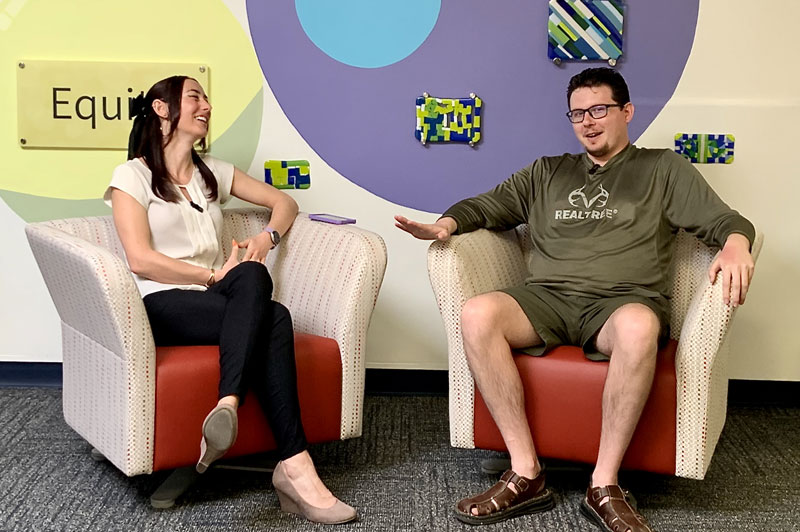
“Livelsburger is not only advocating for those with Autism within the community, but he is also using his experiences as a learning tool to help those that are encountering their own obstacles due to their disability! Tim sat down with BCBDD PR Coordinator Cassie Mattia to talk about his disability and how he has overcome so many obstacles along the way. Tim is thriving and wants nothing more than to use his voice to help others with developmental disabilities achieve their goals!”
Stay tuned to see the full-length interview coming soon!
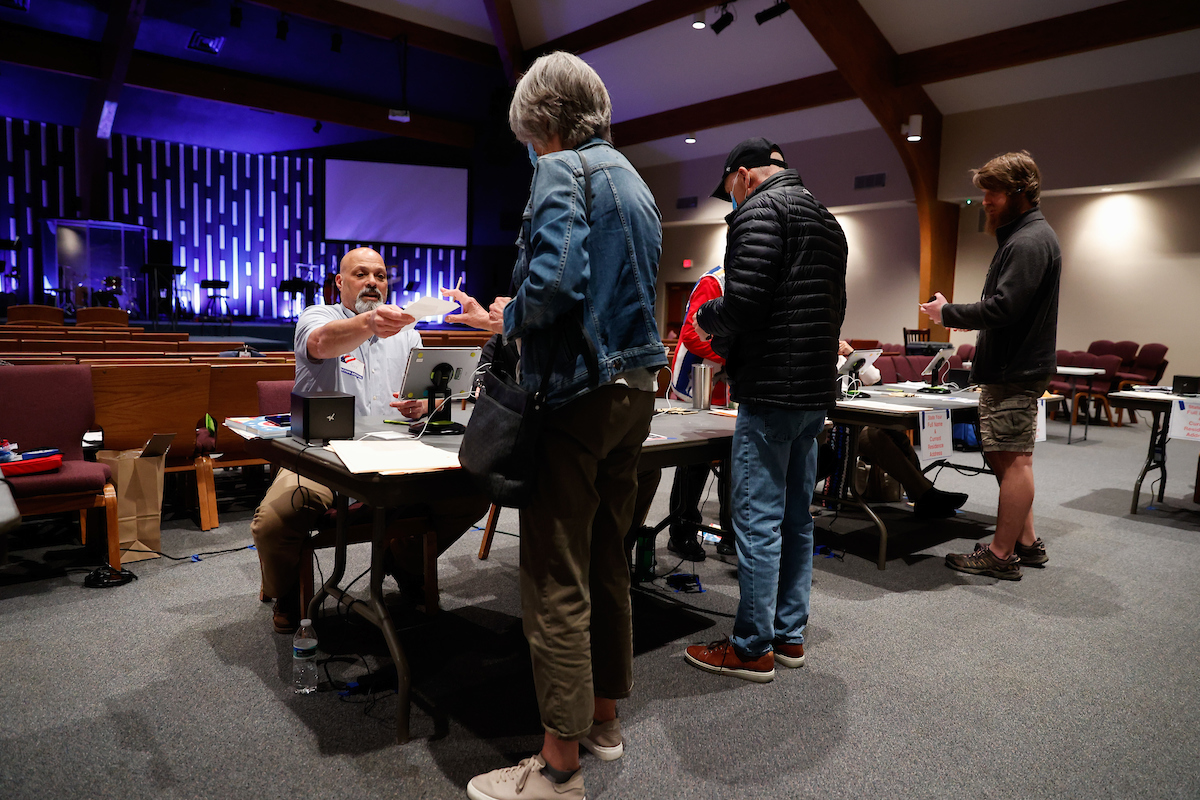
NEW ALBANY, OH — MAY 03: Roster judge Jeff Greenberg checks a voter during the Ohio primary election, May 3, 2022, at the Grace Life Nazarene Church voting location, New Albany, Ohio. (Photo by Graham Stokes. Republish photo only with original story.)
An Ohio House committee took up two measures Wednesday aimed at re-establishing an August special election. Lawmakers eliminated nearly all such contests in the waning days of the last session, just a few short months ago.
But with an abortion amendment looking likely to appear on the November ballot, Republicans are pulling out all the stops in a bid to raise the threshold for constitutional amendments first.
That threshold resolution has already passed the Senate. If Republicans in the House can cobble together enough votes, voters will soon decide whether it should take a 60% supermajority to amend the state constitution. The two elections measures in the House would settle the question of when.
Non-sequiturs and counting noses
At the outset of Wednesday’s hearing, committee chair Rep. Bob Peterson, R-Washington Court House, admonished members and witnesses to stick to the substance of the August election bills. Throughout the hearing he tried — valiantly — to maintain that separation, but it proved a losing effort.
In the end, the move to reinstate August elections has only arisen as an counterpart of the feverish bid to raise the constitutional threshold.
That became clear in the testimony offered by the bill’s sponsors and supporters. Instead of presenting a case for an August election’s necessity, they often offered non-sequiturs.
“Our hopes were to get SJR 2 or HJR 1 to the ballot in May, but things didn’t work out in time,” Sen. Theresa Gavarone, R-Bowling Green, argued.
Later, in a back and forth with Rep. Dani Isaacsohn, D-Cincinnati, Sen. Rob McColley, R-Napoleon, added that a May election would’ve been preferable “because it was already scheduled.”
“Did you know that we have an election scheduled already for November?” Isaachson asked.
Separately, McColley acknowledged the reasoning behind Republicans’ effort to bring back the August election date. Again, their logic boils down to a political calculation inextricable from raising the constitutional threshold.
“In order to get 60 votes for this, there are other considerations that needed to be made for enough members to get us over the 60-vote threshold I had to be on in August,” McColley explained.
Some members, notably former chair of the House constitutional resolutions committee, Scott Wiggam, R-Wayne County, flatly rejected allowing the constitutional threshold question on the same ballot as an abortion rights measure. In a letter for House Speaker Jason Stephens, after his ouster from the committee, Wiggam elaborated.
“If that initiative and HJR 1 were both to pass we could see the very real scenario of abortion on demand placed in Ohio’s constitution with a 50% plus 1 vote and then it be protected with the 60% threshold because of HJR 1’s passing,” he wrote. “It is well known that this scenario is not acceptable to the Republican Caucus.”
Low turnout
Democrats repeatedly hammered the sponsors about timing because August elections typically involve far lower voter turnout. In the most recent August election, turnout averaged just 8% statewide.
Rep. Susan Manchester, R-Waynesfield, however, argued back that low turnout isn’t “a forgone conclusion.”
She pointed to her own election in 2022.
“I’m proud to say that my district had the highest voter turnout in the entire state, and it was equal if not similar to what the turnout is during a November or May election.” Manchester argued. “So let’s not underestimate the voice of our citizenry and wanting to participate in this process.”
At best, however, Manchester’s boast is a bit of an exaggeration. The 18.23% turnout in Auglaize County in 2022’s August election was the most in the state, but it was not quite in line with prior elections. It was four percentage points behind the 2020 primary, marred by COVID-19 and more than eight percentage points behind the 2018 primary.
When it comes to general elections, the August 2022 turnout is a pittance. The 2022 general election saw 58.47% turnout — more than three times the turnout in August. In 2020, Auglaize turnout was nearly 80% and in 2018 it cleared 60%.
The problem, as critics of August elections — many of them Republicans — have consistently noted, is that the contests are an inconsistent grab bag of local issues like school or construction levies. They aren’t the sort of issues the average voter spends an enormous amount of time thinking about, and they come up at a time most voters aren’t thinking about heading to the polls.
To that end, Rep. Richard Brown, D-Canal Winchester, asked Manchester if she’d voted in any recent August elections. Manchester admitted she couldn’t recall. But aside from the 2022 primary, Auglaize County hasn’t had an August election in at least ten years.
Still, for all her optimism about turnout, even Manchester isn’t immune from sitting out a sleepy election or two. According to the Auglaize County board of elections, her even-year voting record is basically flawless, save missing a primary in 2014. But when it comes to odd-year elections where posts like city council, mayor and school board get decided, she’s only shown up once since casting her first ballot in 2006.
Nick Evans has spent the past seven years reporting for NPR member stations in Florida and Ohio. He got his start in Tallahassee, covering issues like redistricting, same sex marriage and medical marijuana. Since arriving in Columbus in 2018, he has covered everything from city council to football. His work on Ohio politics and local policing have been featured numerous times on NPR.
OHSAA adjusts high school season if football is approved by Governor
by Cassie Mattia
COLUMBUS, Ohio – The Governor’s recommendation to shorten Ohio’s High School Football seasons has been approved! The Ohio High School Athletic Association (OHSAA) announced Friday that due to concerns COVID-19 may spike in the early winter, all Ohio HS football teams will enter into the playoffs on October 9th. The HS State Championship games would be played no later than November 21st. This is only in the event that the Governor’s Office approves Ohio HS Football being played this year.
The proposal for a shorter football regular season was approved by the OHSAA Board of Directors with a 9-0 vote. OHSAA released a press release after the vote saying that they considered the proposal a win-win situation for all schools because it would then not matter how many games each team played leading up to the playoffs.
So how will it be determined which HS football teams qualify for the playoffs you may be asking yourself? Well, instead of using the traditional computer ratings system, coaches in each region will conduct a tournament seed meeting the week of September 28th in order to form the regional brackets. This is very similar to how several other team sports within the OHSAA determine which teams qualify for playoffs.
Loveland High School is apart of the Eastern Cincinnati Conference.
The shortened football season guidelines state that schools may keep their first six previously scheduled games, but all regular-season football contracts will be now voidable by either school. This is especially important in the event that conferences redo their league schedules so that games will fit into the first six weeks. The OHSAA will also determine new playoff regions in September. Teams that are eliminated from the playoffs may continue to schedule regular-season games up until November 14.
MAC Announces Postponement of Fall Sports
The Mid-American Conference (MAC) has announced the postponement of all scheduled fall contests, as well as MAC championships, due to continuing concerns related to the COVID-19 global pandemic. Read on…
The Big 10 is expected to announce the cancelation of the Fall football season on Tuesday.
Those schools that have paused sports due to COVID-19 are still able to begin their season in September or early October as well as compete in the playoffs. If a school finds that they would rather play regular-season games up until November 14th and not compete in playoffs they are able to do so.
“To both ensure we can offer students the opportunity to participate in education-based athletics but do so with their best interests in mind, we believe this modified plan offers a positive solution by addressing many of the concerns of our member schools,” President of the OHSAA Board of Directors and Athletic Administrator at Mentor High School, Jeff Cassella said, “Those that are able to start their seasons on time will be able to do so. Those that are starting later can still have a season. Add in the option of all schools entering the playoffs and the possibility of schools still being able to play 10 regular-season contests, and this plan is helpful to virtually all of our schools.”
Here are the most important details in regards to the OHSAA’s modified Ohio HS Football season and changes to the Playoffs process:
Regular-season games will begin the week of August 24 (same regular-season starting date).
All teams are eligible to enter the OHSAA playoffs. New regions will be determined in September.
The number of playoff rounds is dependent upon the number of schools entering the playoffs in each division. Coaches in each region will seed all playoff teams in the region to form a bracket, similar to other OHSAA sports.
Schools eliminated from the OHSAA playoffs or those schools that choose not to enter the OHSAA playoffs have the option to schedule additional regular-season contests through Saturday, November 14 (maximum of 10 regular season contests permitted).
Playoff seeding will be determined via a vote of the coaches the week of September 28 (Harbin Ratings is suspended for the 2020 season).
All playoff contests through the regional semifinals (and possibly the regional finals) will be hosted by the higher-seeded team.
Schools must commit to participating in the playoffs by 11:59 PM on Thursday, September 17.
Playoff regions will be drawn on Friday, September 18.
Schools may withdraw from the playoffs without a penalty until Thursday, September 24.
Below is what the new modified Ohio HS Football season will look like:
Regular season Week 1: Week of August 24
Regular season Week 2: Week of August 31
Regular season Week 3: Week of September 7
Regular season Week 4: Week of September 14
Regular season Week 5: Week of September 21
Regular season Week 6: Week of September 28
Playoffs begin Friday, October 9
State Finals end no later than Saturday, Nov. 21
Still, have questions on OHSAA’s modified football season and the new Playoffs process? Click HERE for all of the Q&A’s!
Thus far the decision on whether or not spectators will be allowed to be present at contact sports this year has not been made yet. The OHSAA stated that “At a minimum, parents should be permitted to attend.”
Luckily four of the OHSAA’s Fall sports, golf, tennis, volleyball, and cross country, have been determined to be low-contact by the Governor’s Office which means these particular sports will be permitted to have contests with other schools. The remaining Fall sports, field hockey, soccer, and football, have been determined to be high-contact, so the OHSAA, the Governor’s Office and the Ohio Department of Health are working together to create a safe game plan so that these three sports may participate in contests with other schools as well.
To get the latest 411 on which of Ohio’s High School sports will be competing this year and the most up to date COVID-19 sports safety protocols stay tuned to the Sports 411 With me, Cassie Mattia!
Blue Ash, Ohio – Matthew 25 Ministries is partnering with P&G and City of Blue Ash to provide free back-to-school PPE supplies to students and teachers in the Greater Cincinnati community.
Teachers and families can simply drive through the Matthew 25 parking lot to receive a free kit of supplies. With the start of the school year rapidly approaching, we hope to help both students and teachers stay safe and healthy during this unprecedented time.
WHERE: Matthew 25: Ministries, 11060 Kenwood Rd, Cincinnati, OH 45242
WHEN: Monday through Friday, August 3 – 7, from Noon – 4 PM daily
IMPORTANT INFO:
Kits will only be distributed to students and/or teachers who are present in the vehicle.
Student kits will include masks, sanitizer, coloring book and crayons.
Teacher kits will include a face shield, masks, sanitizer and pens.
Teachers will be required to show their ID/credentials.
In an effort to best protect public health and maintain social distancing, recipients must remain in their vehicles while picking up supplies.
To sign up and receive a free book every month mailed to your child, visit the Clermont County Public Library’s website, www.Clermontlibrary.org.
Clermont County, Ohio – A program connected to County-singing superstar Dolly Parton launches today in Clermont County with a goal of providing free books to more than 2,000 local preschoolers.
The Clermont County Ohio Governor’s Imagination Library will soon mail age-appropriate books to 2,400 children age 0-5 before the 2020-2021 school year begins.
To sign up and receive a free book mailed to your child, visit the Clermont County Public Library’s website, www.Clermontlibrary.org.
United Way of Greater Cincinnati and the Clermont County Public Library formed the partnership to bring the program to Clermont County.
It is an extension of the Dolly Parton’s Imagination Library, a program started in 1995 to mail free, high-quality books to preschool children. The first books were distributed in Sevier County, TN, where Parton grew up, but word spread, the program went national, and by 2003, had distributed more than 1 million books. It is now a world-wide program.
United Way’s Eastern Area Center brought together the Dollywood Foundation, Clermont County Public Library, the Ohio Governor’s Office and others to initiate the program to Clermont County.
“This program aligns well with our focus on quality education and our Success by Six initiatives of promoting early literacy and kindergarten readiness as well as encouraging parent-child interaction,” said Moira Weir, president and CEO of United Way of Greater Cincinnati. “We know early reading is a foundation for a lifetime of academic success and we’re happy to bring this program to Clermont County. United is the way to quality education.”
Parents who sign their children up will receive a free book delivered to their home every month. If the program hits its goal of 2,400, it will serve about 12 percent of the eligible population in Clermont County.
“That would be a great start to reaching all children in Clermont County by the end of 2021,” said Erika Yingling, director of United Way’s Eastern Area Center. “We hope others will join together to support this expansion and ensure children start off with the reading material they need to super-charge their imagination.”
Making the public library the focal point of the program will spur increased reading engagement, Yingling said. She added that the program was supported by more than $8,500 in funds, including grants from Duke Energy Foundation and Connect Clermont.
About United Way
For more than 100 years, United Way of Greater Cincinnati has developed, supported and strengthened social systems that improve lives in Greater Cincinnati communities. UWGC provides relief for families in crisis, supports families as they establish stronger foundations, and revitalizes systems of support for long-term economic resiliency. United Way is uniquely positioned to bring together and harness the collective power of social service agencies, governments, businesses, donors and more to tackle ingrained, persistent, community-wide problems in a coordinated, comprehensive way that maximizes donor dollars. The generosity of our community, combined with our more than 100 years of experience bringing people together, enables us to support families in a 10-county area across Ohio, Kentucky and Indiana. Additional information about our community impact is available at UWGC.org #LiveUnited
Cincinnati and Hamilton County, Ohio – “The health and safety of customers and staff is our first priority,” said Paula Brehm-Heeger in an announcement issued July 2 by the Public Library of Cincinnati and Hamilton County. Paula Brehm-Heeger is the Director of the system of libraries.
Paula Brehm-Heeger is the Director of the Public Library of Cincinnati and Hamilton County
Her statement was issued after Thursday’s announcement by Governor DeWine and his team of health professionals unveiled a new monitoring and reporting system for COVID 19 infections in each county.
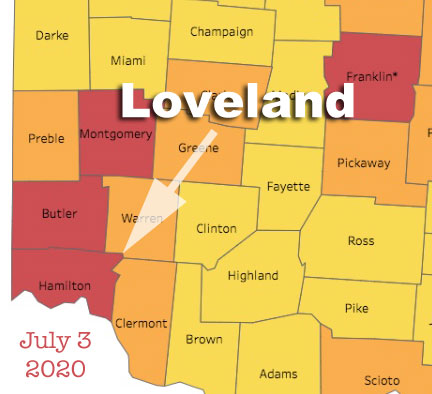
The “Ohio Public Health Advisory System” is based upon a set of criteria and categorizes all Ohio counties in one of four levels. Counties are rated as: 1) yellow, 2) orange, 3) red or 4) purple — with purple being the highest cautionary rating.
Seven counties in Ohio are rated “red” including Hamilton County. The description and guidelines for level three include:
Very high exposure and spread
Limit activities as much as possible
Follow all current health orders
“Based upon this new information, we have made the difficult decision to pause in-person services in our buildings beginning Monday, July 6,” said Brehm-Heeger. All of the 28 open locations will continue to provide curbside or drive-thru service, and they will continue to open nine more locations to provide these services throughout July.
This temporary change is a proactive decision to help limit the spread of the virus, according to Brehm-Heeger. “We will monitor news and information from health officials daily so we can bring back in-person service as soon as the situation improves and the key alert indicators start trending downward. We have repeatedly been reminded that the pandemic is fast moving and requires our quick response and ability to adjust plans accordingly.” Thank you for your continued patience and understanding as we adjust to the pandemic and find new ways to serve you.”
Between now and the middle of July, the Library is phasing services back in, with new locations being added each week. The goal is to be providing services at all locations by mid-July. The exception is Price Hill, as that location is currently closed through the end of 2020 for a major renovation and expansion project. “We’ll use this space to keep you up to date on what is going on. We are excited to see you again,” said Kathy Taylor, Regional Manager in a statement issued on July 3.
The Loveland Branch currently has Curbside Service only and no Drive-Thru Service is planned.
Brehm-Heeger said, “Thank you for your continued patience and understanding as we adjust to the pandemic and find new ways to serve you.”
Hours of Service
Beginning June 15, all open locations will be operating from 10 a.m. to 6 p.m., Monday through Saturday.
Book Drops
All locations are accepting returns through their book drops, except Price Hill. Materials are being quarantined for 3 days before being checked-in, so it will be a few days before you see any changes reflected on your account.
Curbside Service
Curbside: Avondale, Blue Ash, Clifton, College Hill, Delhi, Forest Park, Green Township, Hyde Park, Loveland, Madisonville, Mariemont, Monfort Heights, North Central, Oakley, Pleasant Ridge, St. Bernard, Sharonville, Symmes, Walnut Hills, Westwood, West End and Wyoming
Beginning July 6th these branches will open curbside service: Madeira, Mt. Washington
Beginning July 13 these branches will open for curbside service: Bond Hill, Cheviot, Corryville, Deer Park, Green Hills, Miami Township, Northside, Norwood
Scheduled appointments are not required for curbside service, but calling ahead will make the process more efficient for you, especially if you need to do something other than pick up a hold.
When you arrive at your location for curbside pick-up, look for the curbside service sign, park, and call the branch at the number on the sign.
Drive-Thru Service
Drive-thrus are at these locations: Anderson, Covedale, Groesbeck, Harrison, Reading, and the Downtown Main Library
Scheduled appointments are not required drive-thru service, but calling ahead will make the process more efficient for you, especially for curbside service, or if you need to do something other than pick up a hold. Find phone numbers for all branches on this web page.
Holds/Borrowing Items
If you would like to borrow an item from the library, search our catalog, find the item you want, place a hold on it, and choose which location you’d like to pick up the item from. Or you can call us, and we’ll place the hold for you.
When the item is ready, you will receive an email notice. You can pick it up anytime between 10 a.m. and 6 p.m., Monday through Saturday. If you’d like, you can call the location and schedule a time for pick-up.
In-Person Services
Due to the wide community spread of the virus in Hamilton County right now, the Library made the decision to temporarily suspend in-person services. Read more in this blog post from the director.
We’re Here for You Online and on the Phone
Our eBranch is always open, and we are continuing to provide events like storytimes online on a regular basis. Check our calendar for more information.
Call, email or chat with us seven days a week for help with job searching, finding trusted health information, getting assistance with a library resource, and more.
For the latest Library service updates and resources, please visit our COVID-19 resource page.
This article provided to Loveland Magazine was edited by David Miller and is by by Eye on Ohio, the nonprofit, nonpartisan Ohio Center for Journalism. Please join their free mailing list as this helps us provide more public service reporting.
In early March, just as Ohioans were learning about the first cases of novel coronavirus in the state, Anna Bondar’s grandfather fell at his Cleveland home.
Luckily, the 92-year old, who lives with dementia, wasn’t injured badly.
The tight-knit family started to discuss the possibility of a nursing home, though they had serious reservations.
Their tough choice was made even more difficult by mounting fears about the coronavirus. In nearly four months, COVID-19 has infected more than 31,191 people statewide and has proven particularly deadly for residents of long-term care facilities in Ohio.
Seventy percent of the reported deaths in Ohio due to COVID-19 complications have been in long-term care facilities, which is among the highest in the country.
Nationally the portion of COVID-19-related deaths in long-term care facilities has hovered just over 40%, though the amount of testing done in nursing homes varies significantly by state.
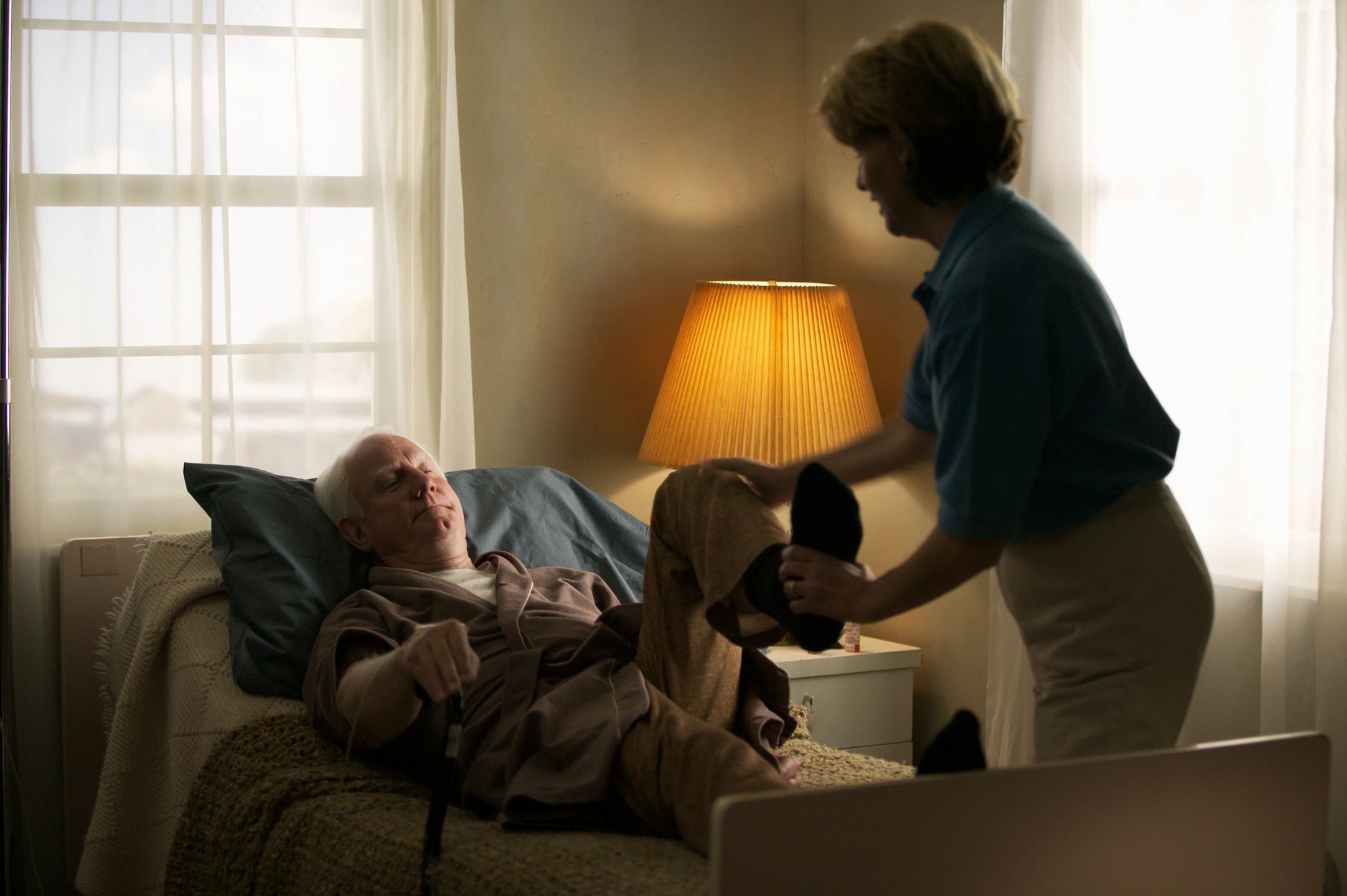
Every day, families like Bondar’s are making what can feel like an impossible choice – whether to send a loved one to a nursing home where they will receive around-the-clock specialized care but face a greater risk of contracting COVID-19, or to care for that person at home where risk of transmission is lower but providing care can be more challenging.
Even before the pandemic, sorting through the myriad of quality ratings and measures was daunting enough. Then, COVID-19 deaths started to soar.
Now, families and seniors agonize over what could be life or death choice using confusing numbers on infection “hotspots” and without the ability to visit nursing homes to observe how the staff cares for residents – which is the number one recommendation of most advocates.
Dr. Amy Acton, director of the Department of Health
State officials, including Dr. Amy Acton, the former director of the Department of Health, have emphasized that “congregate” settings like nursing homes are at highest risk of infection. Staff, who often travel between facilities, need to be in close contact with residents to provide care. And residents, who are primarily older and have multiple medical conditions, are more susceptible to COVID-19-related complications.
“All of this makes it high risk. At the same time, it’s really necessary for many patients to be there,” said Dr. Steven Schwartz, a geriatric physician at the Cleveland Clinic who travels to nursing homes as part of the Clinic’s Center for Connected Care.
Ohio National Guardmembers will begin testing all staff members and any residents who likely were exposed to COVID-19 in the state’s nursing homes, Gov. Mike DeWine announced May 27. What are being called Congregate Care Unified Response Teams will focus on facilities where confirmed or assumed positive cases are reported in hopes of reducing the number of COVID-19 cases and deaths in Ohio’s nursing homes, which as of May 27 was 5,324 resident cases and more than 1,442 deaths.
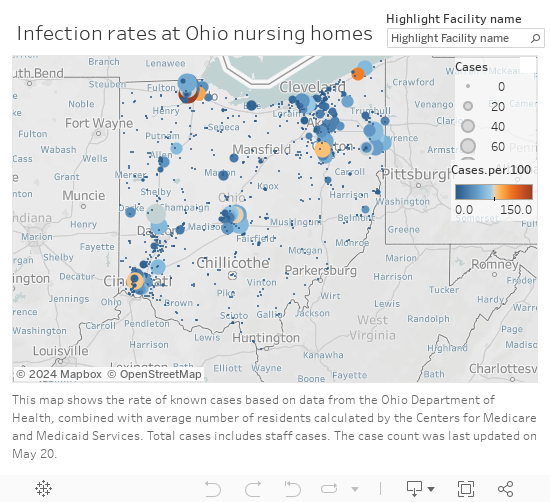
Infection rates in Ohio Nursing Homes
Making an educated decision
Last month, state officials began to release the numbers of reported infections and deaths in long-term care facilities, which include nursing homes, rehabilitation centers, and assisted living centers.
But it’s unclear how much the numbers – which are reported weekly and are also tracked cumulatively – matter for families currently trying to choose a facility.
The state, on its coronavirus website, says the infection and death numbers shouldn’t replace a thoughtful conversation with a nursing facility about infection control practices and that “residents and family members should understand that the presence of COVID-19 at a facility is [in] no way an indicator of a facility that isn’t following proper procedures.”
Yet many in the health care industry say infection information should be considered, along with other factors, when deciding which site to choose.
“If you see a nursing home with a large outbreak, that’s something to worry about. If you see a nursing home with a small outbreak, I’m not sure it means anything but bad luck.”
“If you see a nursing home with a large outbreak, that’s something to worry about. If you see a nursing home with a small outbreak, I’m not sure it means anything but bad luck,” said Dr. James Campbell, department chair of geriatric medicine at MetroHealth.
The infection information provided by the state can be useful, for instance, if a family is choosing between two similar facilities, said Nate Cyrill, a Long Term Care Ombudsman for Cuyahoga, Geauga, Lake, Lorain and Medina counties.
Since information on the virus changes rapidly, most families still rely on the quality measures that were available before COVID-19, including existing state and federal online guides Cyril said.
One of the commonly-used ranking systems, maintained by the Centers for Medicare and Medicaid Services, assigns ratings – from 1 to 5 “stars” – to facilities based on performance on quality measures, staffing and inspections.
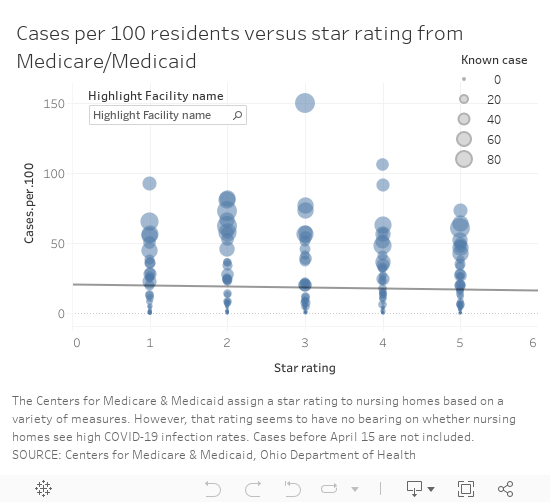
The number of “stars” Ohio’s nursing homes received, however, does not appear to have a correlation to the number of infections reported to the state, based on a comparison of the publicly available information. The analysis did not include assisted living facilities.
Cases vs. Star rating
“You want to look for a nursing home that’s four of five stars preferably but even that doesn’t tell you the whole story,” Steven Schwartz said.
There are numerous 1-star rated facilities that have reported few infections, like Whetstone Gardens and Care Center in Columbus, which has reported 9 cases or 8 per 100 residents.
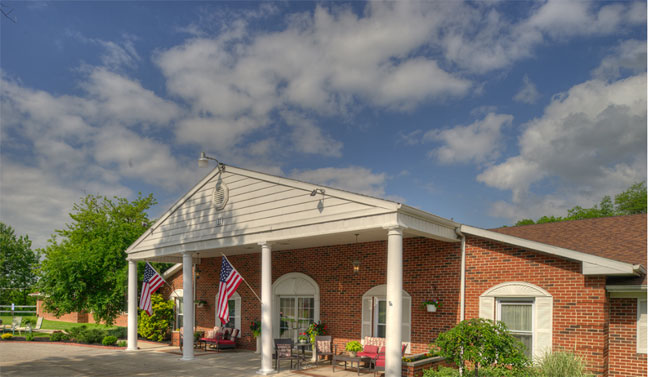
Salem North Healthcare Center
Salem North Healthcare Center in northern Columbiana County had 51 patients test positive for the virus as of May 20, as well as five staff, according to the state. It is rated a 5-star facility, the highest rating from CMS.
It’s one of four 5-star facilities with an infection rate over 50 casesper 100 residents, based on Medicare’s calculation of each facility’s average number of residents. (The rate does not include infections among staff because the number of staff in each facility was not available.)
Since April, the focus on high numbers of reported infections, often referred to as clusters, in long-term care facilities has intensified. In some cases, those numbers are a reflection of the level of testing, said Fred Stratmann, general counsel and chief compliance officer for CommuniCare Health Services. It doesn’t mean all of the residents with a positive test had symptoms of COVID-19. The state infection numbers also don’t show the residents who have recovered from the virus, he said.
CommuniCare, which operates close to 90 health care facilities in seven states has been proactive about testing, Stratmann said. When COVID-19 cases started to appear at the North Salem facility, the company enlisted the state’s “strike team” to proactively test all of the residents. It has since re-tested all of the residents who were initially negative and purchased 3,000 testing kits to supplement what the state could provide.
“We wanted to be certain of the extent of COVID in this center in order to be able to properly treat it and to fight back against it,” Stratmann said. The facility does that by isolating any COVID-19-postive patients in a separate unit with its own dedicated staff and by admitting new residents to an observation unit for 14 days to make sure they have no symptoms of infection, he said.
Restrictions on visits make choices harder
The most effective way to scout out a facility typically is to visit it, preferably unannounced, said Dr. James Campbell, department chair of geriatric medicine at MetroHealth. However, because visitors aren’t permitted in nursing homes right now, the next best thing is to ask detailed questions about care, any COVID-19 cases and infection control measures, he said.
Campbell also suggested turning to hospital staff, who work with nursing homes regularly, for advice. Social workers can place five people in a week, while most individuals face that decision, at most, only a few times in their lives, he said.
Cyrill said his agency can also provide information that can’t be found online for families trying to choose between facilities.
Cyrill said his agency can also provide information that can’t be found online for families trying to choose between facilities.
The agency, along with other similar independent agencies across the state, investigates complaints in long-term care, skilled nursing, group homes and rehabilitation facilities and can share what are called “verified complaints” that aren’t otherwise available publicly.
Most of the complaints investigated in relation to COVID-19, Cyrill said, have been related to visitation or the ability of families to get information on a loved one’s condition.
It’s been harder, though, for Cyrill and his colleagues to investigate complaints with COVID-19 restrictions in place.
It’s been harder, though, for Cyrill and his colleagues to investigate complaints with COVID-19 restrictions in place.
Under normal circumstances, an ombudsperson would go to the facility and talk to patients and could do so without announcing the visit in advance. Since visits are restricted for infection control reasons, they have to work through staff to speak to residents or to ask questions, which isn’t optimal. And they aren’t able to make direct observations.
“It makes our job much more challenging,” Cyrill said.
At the North Salem facility, which has had about a dozen new residents admitted or transfered from other facilities, the staff has given “virtual tours” over the phone to family members or prospective residents who were in the hospital, Stratmann said. The company also invested in technology that won’t replace face-to-face visits but enables more family contact and the ability and for staff to help keep residents’ spirits up by making videos of activities, like dancing and singing, to keep them connected with the local community.
In addition, Stratmann said they walk families through the infection control procedures and share techniques they have implemented to improve health outcomes for patients with COVID-19 including, when appropriate:
Treating residents with anticoagulant medications to reduce the risk of blood clots and strokes, which has been a factor in some COVID-19-related fatalities.
Practicing “proning” or positioning residents, while awake, flat on their belly and chest to reduce the buildup of fluid in lung tissue and reduce the risk of Acute Respiratory Distress Syndrome, which has been associated with many COVID-19 fatalities.
The idea of putting their beloved grandfather in a nursing home was gut-wrenching
Choosing home
For Bondar’s family, the idea of putting their beloved grandfather in a nursing home was gut-wrenching, especially as visitation was curtailed to limit the virus’ spread. He speaks Russian, his native language, and would not have been able to communicate well with the staff caring for him.
“It felt like admitting him [to a facility] would be like saying goodbye,” Bondar said. “Like leaving him to die.”
Bondar’s family ultimately decided to care for her grandfather at home, in his Mayfield Heights senior highrise, where they could limit his exposure to the virus.
Before his fall, an aide visited for about eight hours a week. After the Ohio’s “stay at home” order was put in place March 23, Bondar and her mother were able to work from home and pitch in with care.
The advice of the Clinic’s Steven Schwartz led them to a hospice program, which helped the family find additional aides, including one who speaks Russian, as well as a hospital bed for safer sleeping and a wheelchair.
The home care route isn’t the easiest but Bondar said the family feels like they have more contact and control over the quality of care.
The home care route isn’t the easiest but Bondar said the family feels like they have more contact and control over the quality of care.
“We’ll do this as long as we can manage it,” Bondar said.
Anecdotally, it is a choice more families are making: the decision to use home care or even pull family members out of nursing homes out of fear or because they miss them and can’t visit, Steven Schwartz said.
“Sometimes it’s appropriate. But sometimes, even given everything, it may be safer to have your family member there to get stronger and get the necessary care,” said Steven Schwartz. “I would really try to balance the benefit of going to a nursing home versus the risk.”
Patients with dementia or Alzehimer’s may be unsafe going back home.
Patients with dementia or Alzehimer’s may be unsafe going back home, he said, and families may need to decide if a nursing home really is the safer place.
One of the first orders Ohio put in place to prevent the spread of COVID-19 was to halt in-person visitation in more than 900 nursing and long-term care facilities. The state is not yet ready to lift those restrictions and resume visits in those settings, Gov. Mike DeWine said, but on June 8 will start allowing outdoor visits at assisted living facilities care centers for individuals with disabilities.
“We are not to nursing homes yet and I know that causes anguish for a lot of people who are watching this but we’re trying to do this so that we don’t increase the COVID inside the nursing homes or the assisted living or the immediate care facilities,” DeWine said during a May 28 briefing.
Decisions made harder
Figuring out what kind of care might be best for a patient has become more challenging, too.
Previously, nurses and social workers would visit clients in their homes to assess how they functioned – whether they could independently bathe, cook and grocery shop, said Theresa Foster, a nurse and licensed social worker at Western Reserve Area Office on Aging.
They relied on conversations with clients and family and also observations of the environment in the home and possible risks, said Foster, who runs the agency’s resource center.
Those assessments were used to determine whether a person could safely remain at home with community support or whether they needed facility-level care and what resources, whether subsidized or private, existed to pay for the services.
Now, those assessments are done by phone and can be done successfully, but it is more difficult, Foster said.
At UH’s hospitals, medical staff use a scoring system to determine the best place for a patient being discharged, said Dr. Sean Cannone, UH’s medical director for population health.
Patients are assessed on their ability to perform daily tasks and on their cognitive abilities.
“We’re trying as much as we can to get patients home if at all possible,” he said. The goal is to provide patients with resources so they can receive care in whichever setting they prefer.
The goal is to provide patients with resources so they can receive care in whichever setting they prefer.
“We want to respond to what people really want for their own care,” Cannone said.
The shift started before COVID-19 cases surfaced but has accelerated as more families worry about potential exposure to the virus in congregate living situations.
As technology has advanced, the capabilities of what can be done in a patient’s home has also increased. In March, UH introduced a new patient management system, Massimo SafetyNet, for remote monitoring.
When patients are released from the emergency room or from a COVID-19 floor, providers now put a bluetooth sensor on their wrist — it looks like an Apple Watch — that streams data about a patient’s vitals to a central monitoring center, said Jonathan Sague, UH’s vice president of clinical operations. That way, providers can make sure a patient is safe at home.
Douglas Beach is the chief executive officer at Western Reserve Area Office on Aging
Douglas Beach, chief executive officer at Western Reserve Area Office on Aging, has had firsthand experience weighing care decisions amid COVID-19 worries. His mother is rehabilitating in a nursing home after a six-week hospital stay related to a heart condition.
Not being able to visit her in the hospital or the facility has been hard, Beach said. He and his brother, who is a doctor, had to make all of the arrangements by phone, including figuring the best way to transport her that would have the lowest risk of exposure to the virus.
“Home and community-based services is what I do,” Beach said. Part of his mission is to advocate for the setting that allows for any person, whether they are older adults or live with a disability, to be as independent as possible .
But for his mother, a nursing facility was the right choice because she needed 24-hour care that her family could not provide at home.
Beach said nursing homes have had to deal with an unprecedented set of circumstances: a new virus, initial unknowns about transmission and populations at extremely high risk for complications.
Nursing homes will continue to play a vital role and will remain the best option for people who need more care than can be safely provided at home, Beach said.
For the more than 9,500 clients his agency serves in Cuyahoga, Geauga, Lake, Lorain and Medina counties, delivering care at home, with health aides, nurses and community and family supports, has proven a low risk. As of mid-May only 35 clients had tested positive for the virus, he said. That is roughly 0.3% of clients, though not all clients are tested.
Managing COVID-19
Cuyahoga County nursing homes have been paired with one of the area’s three largest hospital systems during the pandemic, Campbell said. The hospitals help the facilities both prepare for and respond to COVID-19 cases.
“The goal is when you have one patient in a nursing home with COVID is to make sure you don’t end up with 30 patients with COVID,” Campbell said.
UH developed what is being called a playbook for local nursing homes. The playbook gives facilities a plan for how to respond if there’s a COVID-19 outbreak on-site, said Sague, who works as a firefighter and medic on the weekends.
“It can be pretty startling and pretty alarming if they’re not ready for it,” Sague said.
The playbook gives guidelines on screening, triaging, determining exposure, testing and isolating those who test positive, as well as how to get personal protective equipment, increase staffing and to eventually reopen safely, Sague said.
Once a case is identified at a facility, what is known as an intercept team is dispatched — either virtually or in person — to help a nursing home handle it, he said.
Patrick Schwartz, director of strategic communications for LeadingAge Ohio, a long-term care trade association, said access to testing and safety equipment has been a consistent problem for Ohio’s nursing homes.
But in the past month or so, the state has made “a definite shift” and started prioritizing testing at nursing homes, which is helping, he said.
Patrick Schwartz said he hoped the expanded testing would enable facilities to test their entire population— of residents and staff — so they can better limit the spread of the virus.
Throughout Ohio, populations that have received mass testing — health care workers, first responders, those incarcerated and those in nursing homes — have had higher numbers of positive cases. Many people with COVID-19 are asymptomatic, so it is unknown if they have the virus until they are tested.
“Since this pandemic first reared its head, it was clear to long-term care providers that the front lines would be in long-term care,” Patrick Schwartz said. The populations at those congregate living facilities, many of whom are older and have multiple medical conditions, are among the most vulnerable for complications from COVID-19, he said.
In Cuyahoga County, and elsewhere, local health departments have deployed limited testing resources to nursing homes quickly in hopes of limiting spread in and between facilities and given guidance to homes about how to isolate patients and trace exposures between facilities to limit the spread of infection.
Cuyahoga County Health Commissioner Terry Allan said nursing homes try to guard against outbreaks but have varying degrees of resources. The assistance from the National Guard will allow more residents and staff at facilities in Northeast Ohio to be tested, he said.
Support for this project was provided by the Center for Community Solutions.
Questions to ask:
How can family members stay in touch with residents while visiting is restricted?
Does staff facilitate video visits? Is window visiting allowed?
How often will the facility provide updates on a resident’s condition?
How much COVID-19 testing is being done? Is the facility proactively testing patients or only those with symptoms?
Are private rooms available?
Do staffing ratios allow for residents to be taken outside?
Are residents currently restricted to rooms?
Are separate units and staffs used for COVID-19-positive patients and COVID-19-negative patients?
How does the facility work to limit COVID-19 complications?
Willie Lutz is a former Loveland resident, a graduate of Loveland High School, and former sportswriter for Loveland Magazine
by Willie Lutz
Those who endured the 12-minute run from the Bengals, who looked lifeless in Miami, down 23 points on a day many at home hoped to be the final loss on one of the worst seasons of the last decade in Cincinnati, despite eight losses being within one possession.
After a 35-38 overtime loss at Hard Rock Stadium in Miami, the Cincinnati Bengals secured the first overall pick in the 2020 draft, a pick that should bring a new franchise centerpiece, Joe Burrow. LSU’s Heisman-winning quarterback won the nation’s collective hearts with a dazzling senior season, finishing with 4,715 passing yards, 48 touchdowns, completed 77.9% of passes, and averaged 10.7 yards per attempt. With only 6 interceptions and without a loss on his Tigers’ resume, he represents the nation’s top seed in the College Football Playoff as the nation’s best player.
If the jungle kittens don’t win next Sunday…
If the jungle kittens don’t win next Sunday against Cleveland, they’ll have the worst record of any Bengals team ever, though a win would tie the team with the Jon Kitna-led 2002 team who finished 2-14. That finish put Cincinnati in place to draft Heisman winner Carson Palmer with the top pick in the 2003 NFL Draft.
Certainly, a narrative exists in which the Andy Dalton-led Cincinnati Bengals crush the messy Cleveland Browns in a fitting end to the 2019 season. It’ll likely be Dalton’s last game in a striped helmet and the Browns are about to wrap up one of the most embarrassing seasons of NFL football in recent memory. As we learned on Sunday against the Dolphins, Dalton is here to win; he passed for 396 yards, 4 touchdowns, 0 interceptions, and completed 33-of-56 passes, nearly leading the team to the biggest comeback victory in team history.
It’ll likely be Dalton’s last game in a striped helmet and the Browns are about to wrap up one of the most embarrassing seasons of NFL football in recent memory.
Dalton will want to impress the potentially red-hot quarterback market, as many teams seem ready to move a different direction with their passers. Teams like the Chicago Bears, Carolina Panthers, Jacksonville Jaguars, New England Patriots, and Tampa Bay Buccaneers are among teams that may make a change at QB in the coming months. Potentially, Dalton could head to one of those teams in a favorable trade for the Bengals, as a move could net the team a second or third-round pick if Andy continues to impress against the Browns.
For Cincinnati, loss to Miami made a few things pretty clear; Joe Burrow is obviously the pick at the top of the draft and that this team needs to add more good players to the roster this offseason.
There is obviously bound to be plenty of pressure from a central Ohio-minded fanbase to go with Burrow’s teammate and practice opponent at Ohio State in DE Chase Young. There probably won’t be as much pressure to draft QB Tua Tagovailoa from Alabama, as the 21-year-old quarterback will enter the league with a cumbersome injury resume.
It’s amazing to hear so many college-aged people rave not about the player, but about the human being.
Having graduated from Ohio State in 2019 and thus meeting a handful of people who are friends or former classmates with Burrow, it’s amazing to hear so many college-aged people rave not about the player, but about the human being. What some knew before but many learned during his incredibly touching Heisman speech, Joe Burrow has the heart of a leader and the poise of a title fighter, essentially the intangibles you’d dream of in a franchise quarterback.
Before the season, I think like many people, I thought Dwyane Haskins had a higher upside and was probably a better player than Joe Burrow; it’s impossible for me to feel that way after everything I’ve seen from the senior passer’s closing season at LSU.
Burrow does everything you’d hope from a young quarterback all before NFL refinement.
Navigating the pocket like a pro and keeping his eyes on a level plane while reading the defense, Burrow does everything you’d hope from a young quarterback all before NFL refinement. In Cincinnati, he’ll have the chance to work with Zac Taylor and Brian Callahan, two coaches with backgrounds as quarterback coaches from their earlier days in the NFL (of course both are under 40, so those earlier days aren’t exactly ancient).
“New Dey” promise
When Cincinnati comes to the blatant conclusion that they’ll take Burrow at the top of the draft and set this franchise on a brand-new trajectory, it’ll finally deliver on the “New Dey” promise that became apart of the team’s marketing pitch following Zac Taylor’s hire. As many know by now, Burrow is an Ohio kid and a willing leader; he’s more personable than Palmer ever was and doesn’t bring any baggage to a lockerroom currently loaded with likable personalities.
If this team drifts from Joe Burrow, they’re making a mistake that the 6’3” passer will certainly find a way to make them regret in years down the road.
If this team drifts from Joe Burrow, they’re making a mistake that the 6’3” passer will certainly find a way to make them regret in years down the road. Sure, Ohio State when got lucky when Justin Fields decided to join the Buckeyes via transfer, filling the gap left by the Burrow departure in 2018, but even they might feel the brunt of that move if they advance to the National Championship game. In the NFL, Burrow will have the chance to make the Bengals pay once every four years, at the most minimal rate.
The pick seems obvious to this sports-watcher, draft Joe Burrow and call it a day; it’ll give your team one of the best chances in its history to construct a contending roster. However, like many others, I think this is all just preaching to a Bengals-based choir, one including Duke Tobin, Troy, and Katie Blackburn.
Enjoy books, songs, activities, and more while learning early literacy skills. For preschoolers and their caregivers. Ages 3-6. No registration required.
Enjoy books, songs, activities, and more while learning early literacy skills. For preschoolers and their caregivers. Ages 3-6. No registration required.
Join us every 3rd Tuesday of the month to discuss and share Genealogy tips and techniques for general Genealogy research. Everyone is welcome from beginners to experts. No registration is required.
Families, help us welcome the winter season by listening to stories, participating in activities and creating a gingerbread house. Registration is required.
Teens! Join us for exciting book discussions, crafts, and activities! Happens on the third Wednesday of every month. For ages 12-15. Registration required.
This is not your typical yoga class and does not incorporate traditional yoga moves. Laughter is nature’s most powerful stress buster and can have a profound effect on our health and well being. It oxygenates our bodies, strengthens the immune system, reduces blood pressure, and helps create peace in ourselves and our world. Wear loose, comfortable clothing and come prepared to move and laugh with Judi Winall, M.Div., CIH, CLYT.







 MAC Announces Postponement of Fall Sports
 The Big 10 is expected to announce the cancelation of the Fall football season on Tuesday.




 Seven counties in Ohio are rated “red” including Hamilton County. The description and guidelines for level three include:
 “Based upon this new information, we have made the difficult decision to pause in-person services in our buildings beginning Monday, July 6,” said Brehm-Heeger. All of the 28 open locations will continue to provide curbside or drive-thru service, and they will continue to open nine more locations to provide these services throughout July.
 Those assessments were used to determine whether a person could safely remain at home with community support or whether they needed facility-level care and what resources, whether subsidized or private, existed to pay for the services.