Tag: vaccinated

  • Health Director Urges Parents to Ensure Children Are Vaccinated Against Measles as ODH Confirms Outbreak in Ohio

    Health Director Urges Parents to Ensure Children Are Vaccinated Against Measles as ODH Confirms Outbreak in Ohio

    If people are not protected against the disease, nine out of 10 people who are exposed will become ill

    Ohio Department of Health (ODH) Director Bruce Vanderhoff, MD, MBA, announced today a measles outbreak in Ashtabula County and one confirmed case of a visitor in Knox County who exposed others to measles in Knox and nearby counties.

    Dr. Vanderhoff said ODH and Ashtabula County have identified 10 measles cases. Nine are linked to an adult male reported last week as the state’s first measles case of 2025. None of the individuals were vaccinated.

    “Given the measles activity in Texas, New Mexico, and other states around the country, we’re disappointed but not surprised we now have several cases here in Ohio and known exposure in some counties,” said Dr. Vanderhoff. “This disease can be very serious, even deadly, but it is almost entirely avoidable by being properly vaccinated. Measles is especially dangerous for young children, so I strongly urge all parents across Ohio to make sure your children are vaccinated. It is a crucial layer of protection that can save lives.”

    ODH is working with health departments in Ashtabula and Knox counties to follow up on potential exposures and to promote opportunities for vaccination. For more information, visit ashtabulacountyhealth.com and knoxhealth.com.

    The Centers for Disease Control and Prevention (CDC) defines a measles outbreak as three or more related cases. Measles can spread quickly, and each case can lead to an additional 12 to 18 cases if people aren’t protected against the disease. The CDC reported 378 cases nationwide as of March 20.

    Ohio had 90 cases of measles in 2022, when an outbreak in central Ohio totaled 85 cases. The state had one measles case in 2023 and seven in 2024.

    Measles is extremely contagious and can spread to others through coughing and sneezing. It can be brought into Ohio by individuals who travel to places where measles is spreading. If people are not protected against the disease, nine out of 10 people who are exposed will become ill.

    The measles vaccine (called MMR as it protects against measles, mumps and rubella) is safe and effective at preventing measles. Two doses of MMR is 97% effective against measles. If you are up to date on measles vaccine, the risk of getting sick is extremely low.

    The CDC recommends all children get two doses of MMR vaccine, starting with the first dose at 12 through 15 months of age, and the second dose at 4 through 6 years of age.

    In most instances, adults who were vaccinated against measles as children do not need any additional doses as adults. However, adults who did not receive the MMR vaccine as children or those who are unsure about their vaccination status are encouraged to talk to their healthcare provider for more information.

    Those born prior to 1957 are likely protected by previous infection.

    The measles virus can live for up to two hours in air where an infected person coughed or sneezed. If other people breathe the contaminated air or touch an infected surface and then touch their eyes, noses, or mouths, they can become infected. People infected with measles can spread it to others from four days before, through four days after a rash appears.

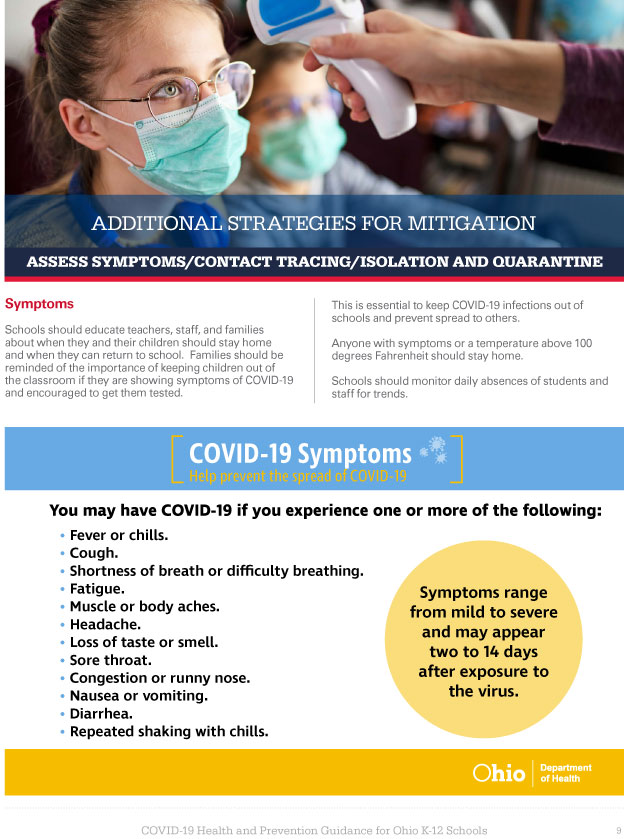
    Measles symptoms include a rash, high fever, runny nose, cough, loss of appetite and red, watery eyes. The rash usually lasts five to six days and begins at the hairline, moves to the face and upper neck, and proceeds down the body. Diarrhea and ear infections are common complications of measles. More severe complications may also occur.

    Complications from measles are more common among children younger than 5 years of age, adults older than 20 years of age, pregnant women, and people with compromised immune systems. As many as one out of every 20 children with measles gets pneumonia, the most common cause of death from measles in young children.

    Dr. Vanderhoff held a news conference on March 18 to discuss Ohio’s childhood immunization rates and to urge parents to get their children up to date on all recommended vaccines, including the MMR vaccine. You can find the video of that news conference on the ODH YouTube channel.

    More information about measles is available on the CDC website, including general information and the recommended immunization schedule. ODH also has a measles FAQ page.
  • Need a replacement COVID-19 vaccination card?

    Need a replacement COVID-19 vaccination card?

    Lost your Covid-19 vaccine card?

    If you were vaccinated in the state of Ohio, Hamilton County Public Health will replace your card for free.

    Follow this LINK and fill out the form.

  • Governor provides update on COVID-19 hospitalizations and Ohio National Guard deployment

    Governor provides update on COVID-19 hospitalizations and Ohio National Guard deployment

    Ohio Governor Mike DeWine announced today that he has ordered the mobilization of an additional 1,250 members of the Ohio National Guard to support hospitals with the most critical needs across the state. The mobilization comes on the same day the state set an all-time high for the total number of COVID-19 hospitalizations during the pandemic.

    The Ohio Hospital Association reported today that 5,356 people are currently hospitalized with COVID-19. One in four patients are COVID-19 positive. This surpasses the previous hospitalizations record of 5,308 on Dec. 15, 2020. Of today’s hospitalizations, 1,228 patients are in the ICU, which is approaching the record high of 1,318 ICU patients reported on Dec. 15, 2020.

    While Southwest Ohio is not seeing the same volume of patients as northern parts of the state, Richard P. Lofgren, MD, President and Chief Executive Officer, UC Health, expressed concerns about the surge in cases making its way across the entire state during the coming weeks.

    Ohio National Guard Deployment
    As hospitals struggle with staffing to support the surge in COVID-19 patients, Governor DeWine announced during a press conference today, that he has asked Major General John C. Harris, Jr., Adjutant General, Ohio National Guard, to mobilize an additional 1,250 members of the Ohio National Guard, bringing the total deployment of National Guard members working with Ohio’s healthcare systems to 2,300 members.

    “This is not something we take lightly… We are asking them to leave their families, their jobs and homes. This is a huge sacrifice,” Governor DeWine said.

    Governor DeWine previously authorized the deployment of 1,050 Ohio National Guard members on Friday, Dec. 17. Major General Harris said the Ohio National Guard’s goal is to augment hospitals’ medical staff and wraparound services. Teams including nurses and medics will provide clinical care and non-medical teams will offer support services such as food service, patient transportation within facilities, and administrative support.

    Approximately 460 Guard members are deployed in the Cleveland area; more than 160 in the Toledo area; about 100 in Columbus area. Smaller numbers of the Guard will be deployed in the coming days in Mansfield, Dayton, and Lima to support hospitals. Guard personnel are also supporting testing sites in Cleveland and Akron.

    “The National Guard has been indispensable,” said Robert Wyllie, MD, Chief Medical Operations Officer, Cleveland Clinic.

    The Ohio Department of Health and the Ohio Hospital Association are working daily with Ohio hospitals to assess staffing needs to determine the most appropriate support from the Ohio National Guard.

    “Everybody agreed when the decision was made to send in the National Guard to our hospitals … All the way through this, we are going to be guided by where they are needed most today. It should give people confidence that everybody is on the same page here. Let’s deploy them where they are needed the most,” Governor DeWine said.

    Hospitals
    Hospitals have been taking extraordinary measures to manage this COVID-19 surge, including postponing elective surgeries, while battling staffing shortages as a result of COVID-19 infection or exposure, and burnout.  

    The northern parts of Ohio have been particularly hard hit, especially the greater Cleveland area, where one in three patients are COVID-19 positive, including ICU patients, according to OHA data.

    “The hospital systems are under significant stress in Northern Ohio,” Dr. Wyllie said. “We are running 2,000 tests a day. Let me tell you about those tests: 36% of the people going into the Walker Center for testing are testing positive for COVID.”

    Statewide, the COVID-19 positivity rate is 25%, according to Ohio Department of Health data.

    The state’s strategic hospital zone and region structure has allowed hospitals to work together with neighboring hospitals to balance the load of patients. This structure continues to be vital as cases and hospitalizations dramatically rise statewide and staffing remains a significant concern.

    While Southwest Ohio is not seeing the same volume of patients as northern parts of the state, Richard P. Lofgren, MD, President and Chief Executive Officer, UC Health, expressed concerns about the surge in cases making its way across the entire state during the coming weeks.

    “Unfortunately, the pandemic is not over … we are seeing more cases now than we have ever seen along the way,” he said. “Now, the spread of Omicron is adding fuel to this raging fire. One of the things that I want to make sure that people understand, is that this not only affects the care of people with COVID, but also affects people who don’t have COVID. It squeezes out our ability to take care of patients with other life-serious or life-threatening problems, such as heart attacks and strokes.”

    Governor DeWine also spoke with Jennifer Hollis, a critical care nurse at OhioHealth Riverside Methodist Hospital in Columbus, about her experience in the hospital.

    “I just want everybody to be able to walk a mile in my shoes and kind of understand as a critical care nurse, what I am seeing when I am coming into work. It is beyond difficult,” Hollis said. “Our beds are full. There is nowhere else to go, and we are just as short-staffed as everyone else is seeing as well … We are tired, we are frustrated, and we want the best for all of our patients.”

    Hollis urged Ohioans to get vaccinated to protect themselves, their loved ones, and their communities. “I’ll continue to fight for you, when you won’t fight for yourself. Please get vaccinated. Quarantine if you are symptomatic. Get tested,” she said.

    Vaccination, prevention
    Governor DeWine emphasized that the COVID-19 vaccines remain a powerful tool to keep people out of the hospital. Since June 1, 2021, there have been 35,962 admissions, and 92.5% of those have been among people who are not fully vaccinated.

    Now more than ever, it’s critical to follow prevention strategies including getting vaccinated, getting a booster shot if eligible, wearing face masks, washing your hands frequently, getting tested, and staying home if sick, even if symptoms are mild.

    “We are looking now at an impact of COVID-19 that is unlike anything we’ve seen before in this pandemic,” said Bruce Vanderhoff, MD, MBA, Director, Ohio Department of Health. “We have access to a powerful tool that can really shield us from the worst outcomes of COVID-19, and that is vaccination.”

    As of today, more than 6.9 million Ohioans have received at least their first dose of a COVID-19 vaccine. That’s 63% of those Ohioans eligible (ages 5 and older). More than 2.6 million have received an additional dose, or a booster dose.

    Masking in Schools
    Today, the Ohio Hospital Association also distributed a letter from the Ohio Hospital Association and Ohio Children’s Hospital Association to Ohio school superintendents, administrators and school board members encouraging them to implement a masking requirement when students return from the holiday break. A masking requirement in schools will help limit community spread of COVID-19 and keep students in school, the letter said. 

    Holidays
    Dr. Vanderhoff encouraged Ohioans to celebrate safely this holiday weekend so we can all have a healthy start to 2022. “As we get ready to ring in a new year, please, think about the steps you can take to prevent COVID-19 spread before you gather. Keeping vaccinations up to date, appropriate testing, staying home if you feel the least bit sick, masking especially in crowded indoor environments, proper ventilation, and regular handwashing can all help prevent the spread of COVID-19, flu, and other illnesses this season,” he said.

  • Hamilton County Public Health responds to request for back to school info

    Hamilton County Public Health responds to request for back to school info

    “It is strongly recommended that schools implement masking.”

    Loveland, Ohio – When asked, this morning to provide Loveland Magazine with the current Board of Health guidance for covid 19 protocol for K-12 schools “Mike Samet, the Public Information Officer for Hamilton County Public Health responded, “We are following the Ohio Dept. of Health guidelines (attached) until we develop our own, if necessary.”

    The current Loveland school protocol reads in part, “…the Board will follow any mandates set forth by the Ohio Governor, Ohio State Health Department, Hamilton County Health Department, and Ohio Department of Education, (“Directing Entities”) as it relates to protecting the health of students, staff and visitors.”

    There will be no remote learning opportunities (Remote Academy) for Loveland teachers or students as all school buildings will return to full capacity in-person classes in August.

    Samet referred Loveland Magazine to the Ohio Dept. of Health (ODH) guidelines which are currently Hamilton County Health Department’s as well.

    The ODH guidelines begin with this opening introduction:

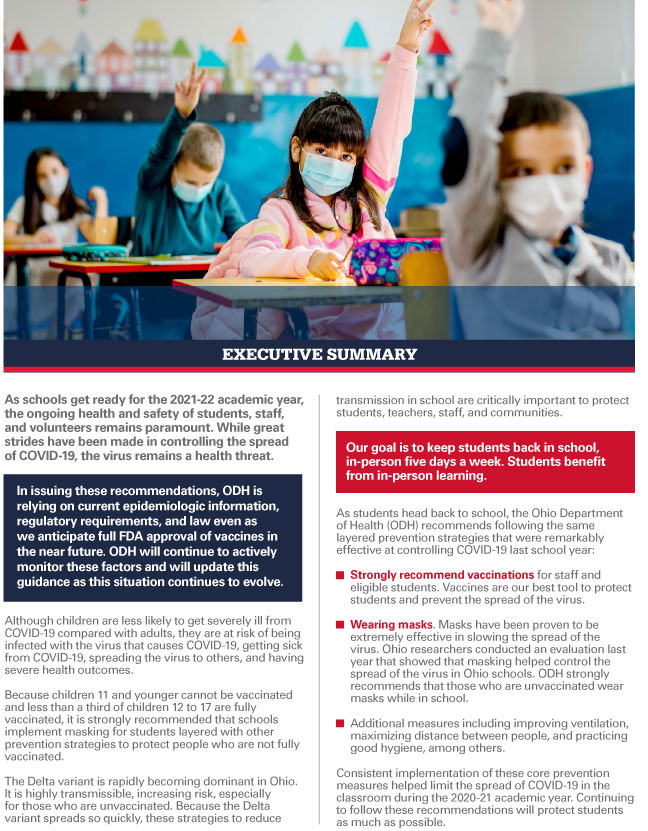
    As schools get ready for the 2021-22 academic year, the ongoing health and safety of students, staff, and volunteers remains paramount. While great strides have been made in controlling the spread of COVID-19, the virus remains a health threat. 

    Although children are less likely to get severely ill from COVID-19 compared with adults, they are at risk of being infected with the virus that causes COVID-19, getting sick from COVID-19, spreading the virus to others, and having severe health outcomes. 

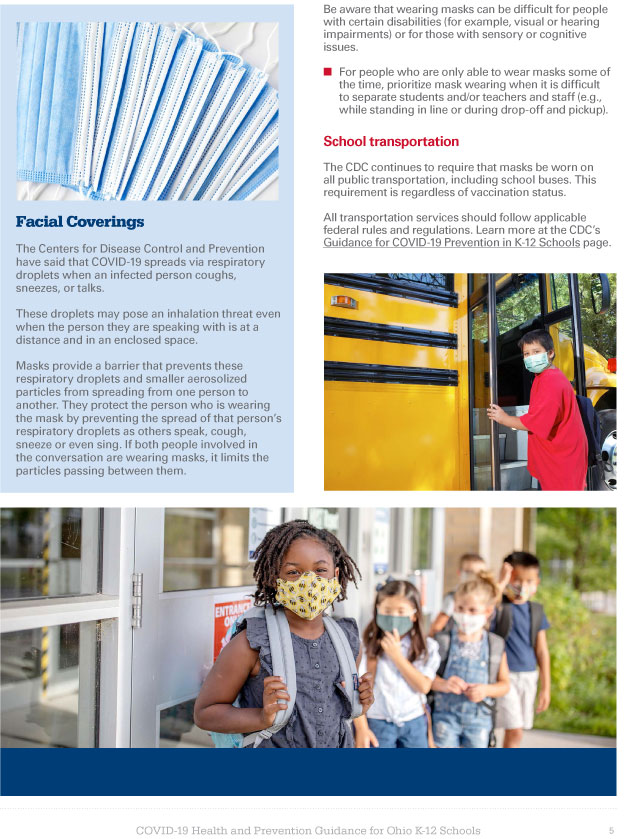
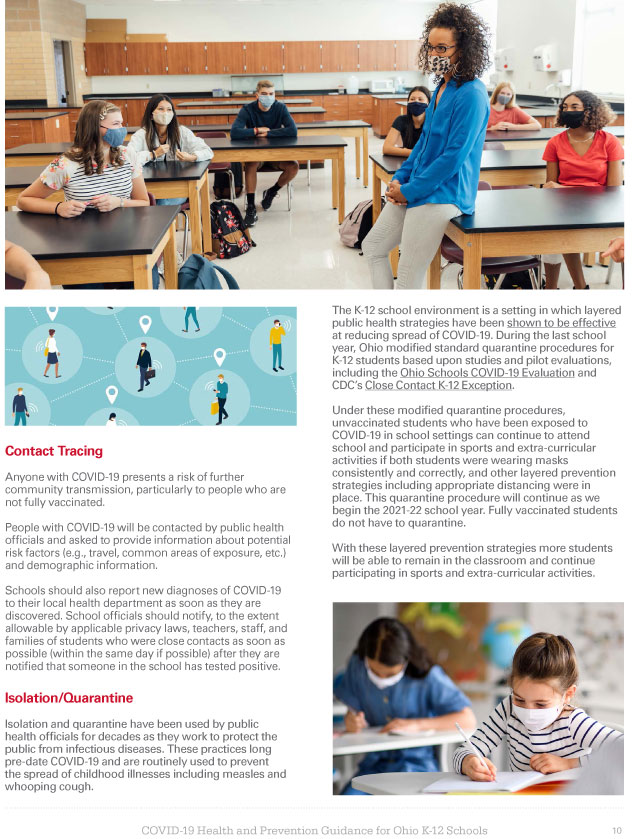
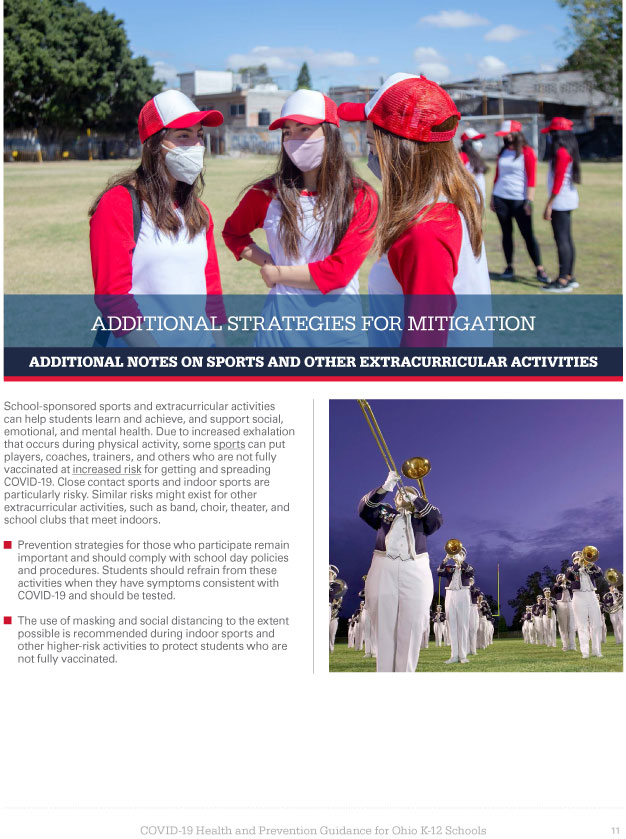
    Because children 11 and younger cannot be vaccinated and less than a third of children 12 to 17 are fully vaccinated, it is strongly recommended that schools implement masking for students layered with other prevention strategies to protect people who are not fully vaccinated. 

    The Delta variant is rapidly becoming dominant in Ohio. It is highly transmissible, increasing risk, especially for those who are unvaccinated. Because the Delta variant spreads so quickly, these strategies to reduce transmission in school are critically important to protect students, teachers, staff, and communities.

    As students head back to school, the Ohio Department of Health (ODH) recommends following the same layered prevention strategies that were remarkably effective at controlling COVID-19 last school year: 

    Strongly recommend vaccinations for staff and eligible students. Vaccines are our best tool to protect students and prevent the spread of the virus. 

    Wearing masks. Masks have been proven to be extremely effective in slowing the spread of the virus. Ohio researchers conducted an evaluation last year that showed that masking helped control the spread of the virus in Ohio schools. ODH strongly recommends that those who are unvaccinated wear masks while in school. 

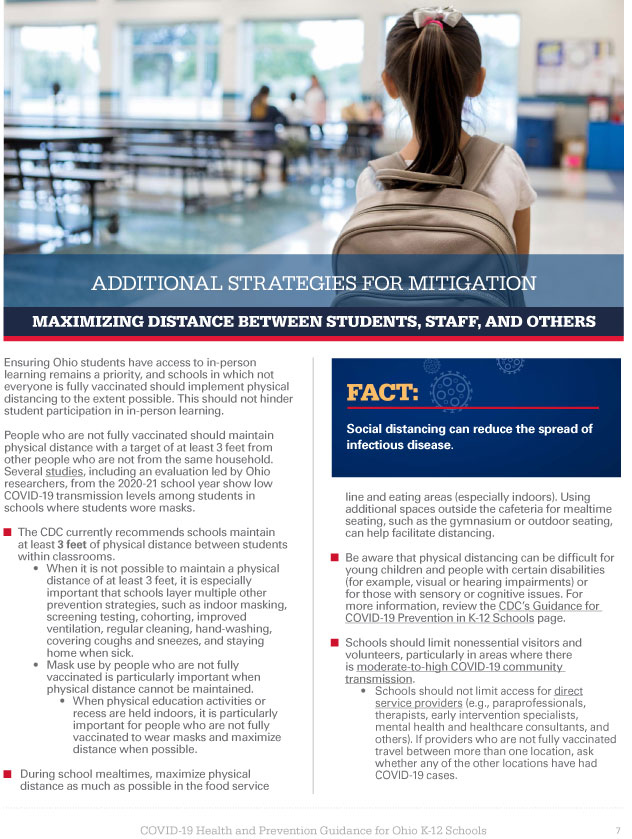
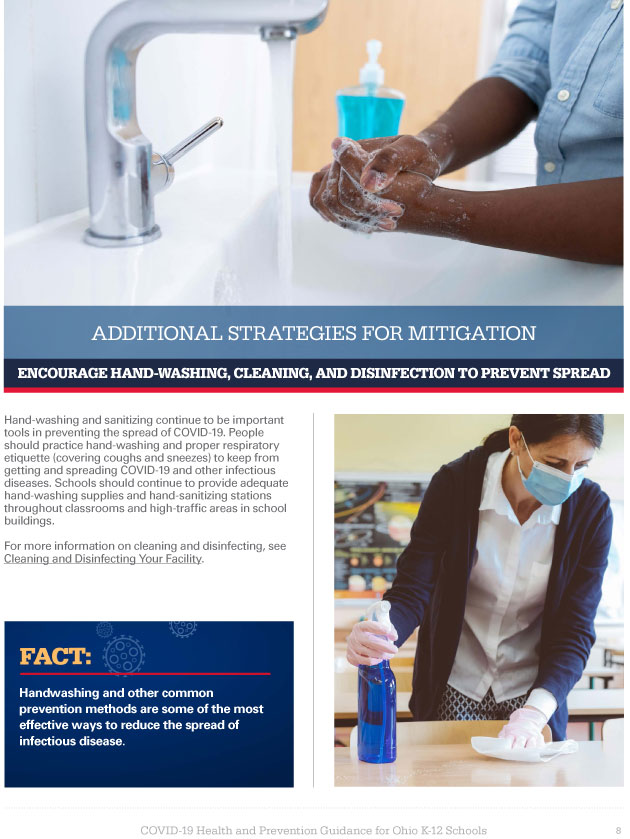
    Additional measures including improving ventilation, maximizing distance between people, and practicing good hygiene, among others. 

    Consistent implementation of these core prevention measures helped limit the spread of COVID-19 in the classroom during the 2020-21 academic year. Continuing to follow these recommendations will protect students as much as possible. 

    Below is the full ODH document:

  • Latest Ohio Vax-a-Million winners

    Latest Ohio Vax-a-Million winners

    Uo-date for final week:

    For the final Ohio Vax-a-Million drawing, 3,469,542 vaccinated adults entered for a chance to win $1 million, and 154,889 vaccinated youth entered for a chance to win a college scholarship. This is an increase of 41,028 adult entries and 4,702 youth entries over last week. 

    Ohio Vax-A-Million’s newest winners joined Governor DeWine Thursday morning to discuss why they chose to be vaccinated and their excitement of being selected during this week’s drawing. 

    Esperanza Diaz from Cincinnati won the final week’s $1 million prize, and Sydney Daum from Brecksville in Cuyahoga County won the college scholarship prize. 

    “I got the Pfizer vaccine, and I didn’t have any side effects, I was completely OK,” said Diaz. I would recommend it to everyone. I think it can save a lot of lives.” 

    “We were always planning to get her vaccinated, but we were going to wait later in the summer to have her fully vaccinated by the time school started,” said Jennifer Daum, Sydney’s mother. “When (Governor DeWine) announced Vax-a-Million we thought this would be a good time to do it now, and we did, and we can’t believe it paid off.”

    For week four of Ohio Vax-a-Million drawing, 3,428,514 vaccinated adults entered for a chance to win $1 million, and 150,187 vaccinated youth entered for a chance to win a college scholarship. This is an increase in 66,311 adult entries and 6,583 youth entries over the previous week. 

    Ohio Vax-A-Million’s newest winners joined Governor DeWine Thursday morning to discuss why they chose to be vaccinated and their excitement of being selected during this week’s drawing. 

    Suzanne Ward from Findlay in Hancock County won this week’s $1 million prize, and Sean Horning from Cincinnati won this week’s college scholarship prize. 

    “I did not have any hesitation when my age group came up to get vaccinated,” said Ward. “I would encourage anybody to get vaccinated. I think it’s the smart thing to do from a health perspective.” 

    “I always knew it was the best for everyone,” said Lina Horning, who is Sean’s mother and experienced having COVID-19. “I encouraged my son to do it for the safety of our community and everyone.”

    Week 1:

    Abbigail Bugenske, 22, of Silverton.

    Joseph Costello, 14, of Englewood, won the college scholarship.

    Week 2:

    Jonathan Carlyle, of Toledo

    Zoie Vincent, of Mayfield Village won the college scholarship.

    Week 3:

    Mark Cline, of Richwood.

    Sheffield Lake 13-year-old Sara Afaneh from Sheffield Lake won the college scholarship.

    Week 4:

    Suzanne Ward, of Findlay

    Sean Horning, of Cincinnati won the college scholarship.

    There is one more Ohio Vax-a-Million drawing left and Governor DeWine encouraged all eligible Ohioans to get vaccinated and enter to win. For more information and to enter, visit ohiovaxamillion.com. Ohioans 18 and older who have received at least one dose of the COVID-19 vaccine can enter to win a $1 million prize. Ohioans ages 12-17 who have received at least one dose of the COVID-19 vaccine can enter to win a four-year college scholarship to any Ohio state college or university.

  • Ohio’s COVID-19 vaccination slows ‘dramatically’

    Ohio’s COVID-19 vaccination slows ‘dramatically’

    Photo from the U.S. Department of Defense.

    By Jake Zuckerman and Ohio Capital Journal– May 4, 2021

    One month ago, nearly 475,000 Ohioans over seven days marched into small pharmacies and mass clinics alike around the state to get vaccinated against COVID-19.

    Each week since, the number of newly “vaccine-started” Ohioans has tumbled. Just 152,000 Ohioans were vaccinated during the week ending April 25, according to data from the Ohio Department of Health.

    As the vaccine rollout pace slows, only about 4.7 million of Ohio’s 11.7 million residents have begun the vaccination process.

    “We clearly have a lot more vaccine than we have demand,” Gov. Mike DeWine said to reporters Monday.

    The week ending April 25, the most recent with complete data, shows vaccine uptake at its lowest rate since mid-February, when a nasty winter storm swept the country and temporarily closed vaccination sites.

    https://datawrapper.dwcdn.net/1jYQd/2/

    Vaccines protect individuals against COVID-19 but, at a certain threshold, can protect those in a population who haven’t yet or cannot receive the vaccine. Experts have estimated this threshold, known as herd immunity, to be somewhere between 70% and 90%.

    While the first four months of the vaccine rollout were defined by scarcity, uptake rates began to plunge nationally in April.

    DeWine, noting the uptake has declined “dramatically,” said herd immunity is more of a gradient than a black-and-white concept. The formula, he said, is simple.

    “The more people that get vaccinated, the harder it is for this virus to spread,” he said. “The more people that get vaccinated, the fewer people that are going to die.”

    All told, more than 19,200 Ohioans have died from COVID-19, and nearly 57,000 have been hospitalized. The Ohio Department of Health reports more than 1 million residents have been infected, though the true count is likely much higher.

    Ohio is in the middle of the pack in terms of states and percentage of the population who have received at least one dose.

    On the low end: Mississippi (31%), Louisiana (32%), Alabama (33%), Wyoming (34%) and Idaho (34%) according to New York Times Vaccine Tracker data.

    On the upper end: New Hampshire (61%), Massachusetts (58%), Vermont (57%), Connecticut (56%) and Maine (55%).

    The U.S. Census Bureau has been surveying Americans’ attitudes about the COVID-19 vaccine. As of March 29, nearly 20% of Ohioans expressed hesitancy toward the vaccine, compared to about 15.6% nationally. The bureau is slated to release fresh data later this week that will give a sense of whether the trend is improving or worsening.

    Similarly, polling data from Kaiser Family Foundation estimates 13% of Americans will “definitely not” get the vaccine and another 7% only will if they’re required to. Other data from Gallup estimates that 26% of Americans are unwilling to take the vaccine, down from about 35% when they were authorized for use in December.