Tag: vaccines

  • Nurse’s Notes: Preventative Healthcare

    Nurse’s Notes: Preventative Healthcare

    Every month, the staff nurses at the Butler County Board of Developmental Disabilities share important health updates. This month, their nurses are talking about preventative healthcare!

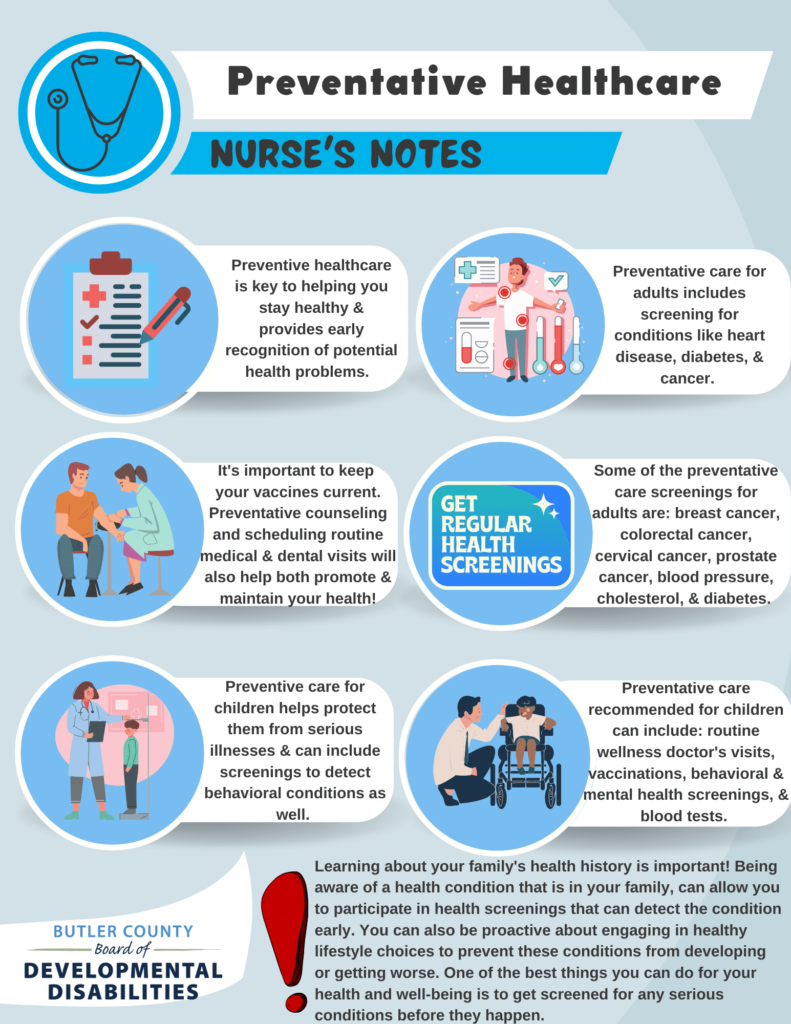
    Preventive healthcare is key to helping you stay healthy and provides early recognition of potential health problems. Seeking preventative healthcare can help you live a longer, healthier life!

    Preventative care for adults typically includes screening for conditions like heart disease, diabetes, and cancer. This also includes counseling and receiving appropriate patient teaching on healthy eating and life habits.

    What are some of the screenings recommended for adults? (Please note that these screenings are recommended based on age and family history).

    • Screenings for breast cancer, colorectal cancer, cervical cancer, and prostate cancer: These types of cancers are affecting men and women the most and early detection can stop or slow the spread and allow early treatment.
    • Screenings for blood pressure, cholesterol, and diabetes: These screenings can detect common conditions that can be treated with basic lifestyle changes and or medications. If left untreated or diagnosed, they can lead to serious diseases and early death.
    • Immunizations: Not only children need vaccines, but adults should also stay on top of their vaccines as well.  Annual flu shots, COVID-19 vaccines and any necessary boosters can help you prevent illness and diseases. Visit the CDC for guidelines on vaccines.
    • Preventative Counseling: Preventative counseling and patient teaching is useful to help us make ongoing positive health related changes to promote a healthy lifestyle.
    • Scheduling routine medical and dental visits:  Annual physicals and routine dental care is valuable to maintain general health and ensure necessary recommended screenings are performed.

    Preventive care for children helps protect them from serious illnesses and can include screenings to detect behavioral conditions as well. Preventive healthcare can help children stay healthy when they’re young and promote healthy decision making as they grow older.

    What preventative care is recommended for children?

    • Well-child visits: Routine visits every few months when your child is an infant, and yearly after that.  Routine immunizations and screenings are also conducted during these visits.
    • Vaccinations: Vaccinations for children protect them from serious diseases now and in the future.
    • Behavioral and mental health screenings: Pediatricians routinely screen children for conditions like autism, depression, and developmental delays.
    • Blood tests: Various blood test screenings can be conducted throughout childhood to detect various diseases.

    Why is knowing your family history important?

    Learning that you have a family history of a serious health condition can be discouraging and stressful, but knowledge is power. When you are aware of a health condition that is in your family, you can participate in health screenings that can detect the condition early, so that treatment is more effective and can be started early on. You can also be proactive about engaging in healthy lifestyle choices to prevent these conditions from developing or getting worse.

    One of the best things you can do for your health and well-being is to get screened for any serious conditions before they happen. That’s what preventive health is about, and why medical experts recommend that all adults and children participate in routine tests, screenings, and immunizations.
    If you have any questions about preventive care and what screenings you or your children should get, be sure to talk with your doctor or healthcare professional. Check to see if you are up to date on your preventative care! 
    The Butler County Board of Developmental Disabilities supports over 3,700 people to live, work, and learn successfully in their community. Supports and services are available life-long through contracts with partner agencies or directly provided by our Board.
    Please visit the website of the Butler County Board of Developmental Disabilities often for more great information about the services that they provide, many of which go beyond the walls of their facilities and take place in the greater community.

    Look for, and subscribe to their newsletters!
  • COVID-19 “High” in Butler and Clermont Counties

    COVID-19 “High” in Butler and Clermont Counties

    According to the CDC:

    In Clermont County, Ohio, the community level is High.

    In Butler County, Ohio, the community level is High.

    In Hamilton County, Ohio, the community level is Medium.

    In Warren County, Ohio, the community level is Medium.

    At all COVID-19 Community Levels (LOW, MEDIUM, AND HIGH):

    Green, yellow, and orange squares representing all COVID-19 Community Levels

    MEDIUM AND HIGH

    When the COVID-19 Community Level is Medium or High:

    • If you are at high risk of getting very sick, wear a high-quality mask or respirator (e.g., N95) when indoors in public
    • If you have household or social contact with someone at high risk for getting very sick, consider self-testing to detect infection before contact, and consider wearing a high-quality mask when indoors with them
    Yellow- and orange-colored rectangles indicating medium and high COVID-19 Community Levels

    HIGH

    When the COVID-19 Community Level is High:

    • Wear a high-quality mask or respirator.
    • If you are at high risk of getting very sick, consider avoiding non-essential indoor activities in public where you could be exposed.
    Orange-colored rectangles indicating high COVID-19 Community Level

    Community-Level Prevention Strategies

    LOW, MEDIUM, AND HIGH

    At all COVID-19 Community Levels:

    • Promote equitable access to vaccination, testing, masks and respirators, treatment and prevention medications, community outreach, and support services.
    • Ensure access to testing, including through point-of-care and at-home tests for all people.
    • Maintain ventilation improvements.
    • Provide communications and messaging to encourage isolation among people who test positive.

    WHAT TO DO IF YOU HAVE COVID-19

    WHAT TO DO IF YOU WERE EXPOSED TO COVID-19


    Clermont County Public Health offers childhood COVID-19 vaccine clinics

    COVID-19 Testing Locations | Clermont County Public Health (ccphohio.org)

    COVID-19 Vaccine Info in Clermont County

    Vaccine and Testing Information for HamiltonCounty

    Vaccine information for Warren County

  • Latest increase in cases, hospitalizations has Ohio health officials pushing vaccines

    Latest increase in cases, hospitalizations has Ohio health officials pushing vaccines

    BY: TYLER BUCHANAN and Ohio Capital Journal

    On Tuesday, the state reported 744 new positive cases within the previous 24 hours, a daily total that hadn’t been seen since May.

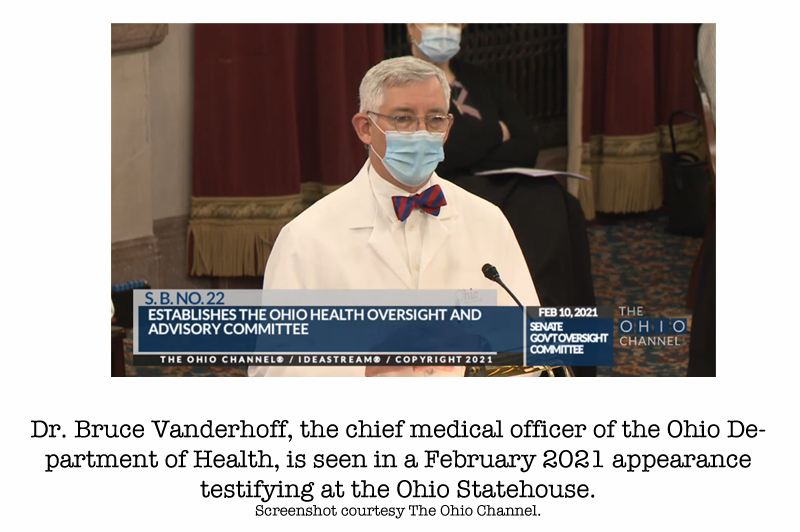
    Dr. Bruce Vanderhoff acknowledges that as the public face of the Ohio Department of Health he is repeating himself a lot these days.

    Dr. Bruce Vanderhoff

    But the message is important enough to continue repeating in simple terms, ODH’s chief medical officer said Wednesday.

    “It really comes down to, are you vaccinated and safe or are you unvaccinated and vulnerable?”

    Ohio once again finds itself at a crossroads. After months of declining rates of new cases, hospitalizations and deaths, Ohio is now seeing increases thanks mostly to a new “Delta variant” that officials say is even more contagious.


    I think it is absolutely the case that we are now looking at a pandemic of the unvaccinated.

    – Dr. Bruce Vanderhoff, Ohio Department of Health


    Vaccination rates here have all but stalled, concerning those like Vanderhoff who fear the state will slip back into a public health crisis as schools look to return to class next month.

    “I think it is absolutely the case that we are now looking at a pandemic of the unvaccinated,” he told reporters .

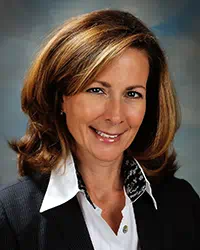
    Vanderhoff was joined by two pediatricians, including Dr. Patty Manning-Courtney, the chief of staff at Cincinnati Children’s Hospital. The recent rise in cases has them worried not just of the Delta variant, but what else could be on the horizon.

    Patricia Manning-Courtney, MD

    Manning-Courtney said her hope is Ohioans will get vaccinated before the state experiences an even worse variant that could significantly impact the youth population. She fears a scenario of Ohio learning “the hard way” that vaccines are necessary for public health.

    The latest surge

    The state’s COVID-19 numbers declined throughout the spring, leading Gov. Mike DeWine and ODH to rescind the swath of public health mandates.

    There was reason for optimism:  The two-week average was down to just 17.6 cases per 100,000 residents as of July 7.

    But since then, that average has more than doubled to 37.8.

    On Tuesday, the state reported 744 new positive cases within the previous 24 hours, a daily total that hadn’t been seen since May. The state is recording a greater proportion of cases and hospitalizations among younger people, according to ODH data.

    “It appears that this surge is being driven by yet another variant, the Delta variant,” Vanderhoff said, “which is, as I’ve shared before, even more contagious than the (alpha) variant that preceded it.”

    The Delta variant is now present in more than one-third of all new cases in Ohio and is on its way to being the dominant variant of COVID-19, Vanderhoff said.

    ‘Captains of the ship of their own health’

     President Biden recently said COVID-19 vaccine misinformation is costing Americans lives. (Photo by Alex Wong/Getty Images)

    Unlike a year ago, when mitigation tactics like distancing and face masks were seen as the most effective ways to protect oneself from the virus, a proven vaccine is now available for Ohioans.

    But it remains difficult to convince a majority of residents here to get vaccinated.

    A vast number of Ohioans received shots when they were first made available, with a boost in vaccinations this spring with the widening of eligibility and the announcement of a Vax-A-Million sweepstakes. (Franklin County is among the places still experimenting with vaccine incentives; those who get their first dose at Columbus-area clinics receive a $100 Visa gift card.)

    On the whole, the statewide vaccination rate has stagnated. More than 5.3 million Ohioans have completed their vaccination doses, but that still reflects just 45.5% of the total population. 

    DeWine had said his lottery idea was meant to target those who were not anti-vaccine, but needed some kind of boost to schedule their appointment.

    Now, after months of availability, Vanderhoff and others believe there is still a large segment of the population who can be convinced. These are well-intentioned people with understandable concerns that can eventually be swayed to change their minds, the officials hope.

    Misinformation spread online and in public spaces isn’t helping matters. Vanderhoff agreed with a recent statement by President Joe Biden that vaccine misinformation shared around on social media platforms is contributing to ongoing hesitancy and COVID-19 deaths.

    “I think there have been people who are sharing information in a very authoritative way that is not scientifically accurate,” Vanderhoff said. “As a physician, that’s very distressing, because we want people to make their own decisions of course. We want people to be the captains of the ship of their own health, but we want them to make their decisions on the basis of good, well-founded, scientific information.

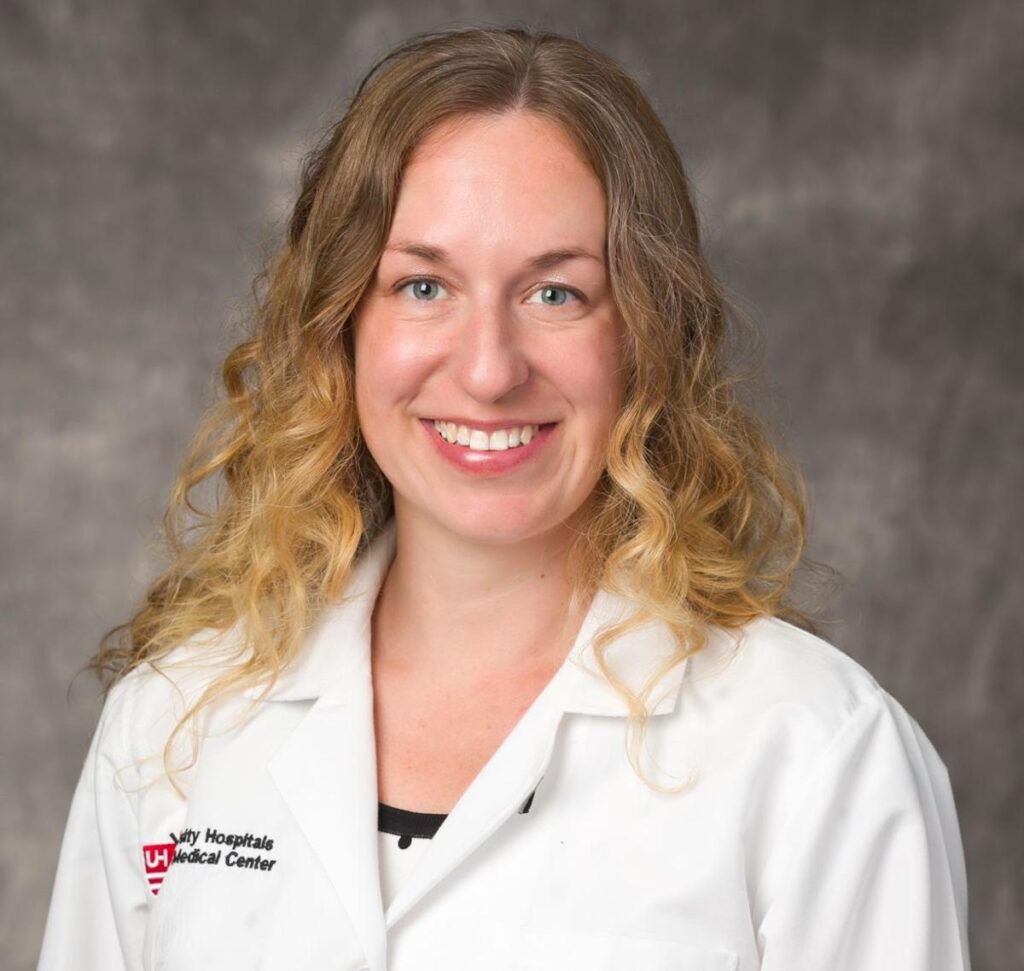
    Dr. Amy Edwards

    “Frankly, it’s heartbreaking when we see people who are cascading information that is not scientifically based,” he added.

    Dr. Amy Edwards, the associate medical director of pediatric infection control at UH Rainbow Babies & Children’s Hospital, said vaccine misinformation has been around long before the coronavirus. She noted an example of seeing a child die of the whooping cough.

    “That’s unacceptable to me,” she said. “It should just never happen.”

    Vanderhoff and the pediatricians tried to dispel fears about the vaccine harming children. They noted rare cases of myocarditis, an inflammation of the heart muscle that has been reported in a small number of children this year.

    But Edwards called this a “rare side effect” that impacts as few as one in every 100,000 or more that receive the vaccine.

    “The risk is much higher from the virus itself,” she said.

    While there continue to be some examples of vaccinated people getting COVID-19, most are protected against serious outcomes like hospitalizations and deaths. 

    All of the 130 people in Maryland who died of the virus in June were unvaccinated. Other states have reported similar statistics, including Alabama, where 96% of the COVID-19 deaths between April and mid-July were unvaccinated. 

    “The issue of breakthrough with this kind of a vaccine against this kind of virus,” Vanderhoff said, “is really the issue of: Are you seeing people get severely ill? Are they ending up in the hospital? Are they dying? We’re just not seeing that in appreciable numbers with this vaccine.”

    Asked about future health orders with school returning in the fall, Vanderhoff said he could not disclose ongoing policy discussions within the state health department. He said ODH will be providing guidance and recommendations “in the near future.”

  • Loveland City School District included in COVID-19 Vaccine Distribution Week 2

    Loveland City School District included in COVID-19 Vaccine Distribution Week 2

    * Story up-dated at 6:10 PM on 1-30-2021

    by David Miller

    David Miller

    Loveland, Ohio – Ohio K-12 schools, including public, private, and career-tech entities, yesterday learned when their teachers and staff necessary for in-person learning are able to begin receiving vaccines.

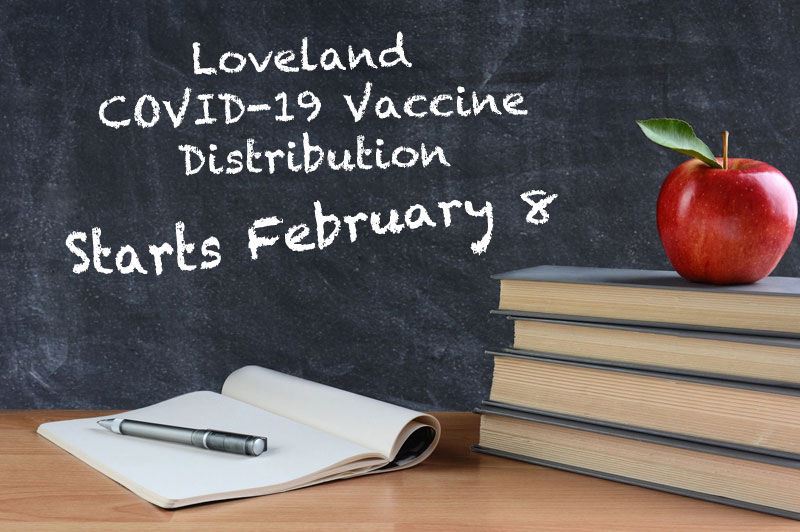
    Loveland City School District is included in COVID-19 Vaccine Distribution Week 2 of first doses, starting February 8 as well as Indian Hill, Moeller, St. Xavier, Cincinnati Hills Christian Academy, Forest Hills (Anderson), Great Oaks Career Campuses, and Sycamore.

    Included in Distribution Week 3 are, Kings, Lebanon, Little Miami, Mason, and St Margaret Of York.

    Included in Distribution Week 4 are, Children’s Meeting House, Goshen, Milford, Ohio Valley Voices, and St. Columban.

    Cincinnati Public Schools were able to jump the line and began their vacinations yesterday.

    Loveland’s schools remain in hybird-learning at all buildings, a combination of some students and staff attending in-person five-days per week and some students and staff teaching or learning in Loveland’s Remote Academy five-days a week.*

    Ohio Governor Mike DeWine has said that he is making it clear his “goal of Ohio returning to in-person learning either full-time or in a hybrid model by March 1st.” In order to do this, the governor identified teachers and school personnel necessary for in-person learning as Phase 1B recipients as part of the Ohio COVID-19 Vaccination program.

    “Vaccine is incredibly scarce, and we simply don’t have enough to vaccinate everyone at the same time. Therefore, this will be a rolling process, just like it has been during other vaccination phases, with a goal of administering all first doses by March 1st,” said Governor DeWine. “This rollout schedule is a heavy logistical lift that aims to ensure the maximum number of people can be vaccinated in the shortest amount of time.”

    In a news release, Dewine said, “The plan also makes the process as simple as possible for staff to be vaccinated and is organized to allow most K-12 staff in a county to be vaccinated within seven days of their assigned vaccination start date. For the limited number of counties where vaccinations will take place over multiple weeks, local leaders will make the logistical and scheduling decisions.”

    Eligible school employees will learn more about the locations and times of the vaccination sites from their administrators. The following documents list the entities by county in the week when teachers and personnel are able to begin vaccinations.

    Week One (Beginning February 1st)

    Week Two (Beginning February 8th)

    Week Three (Beginning February 15th)

    Week Four (Beginning February 22nd)

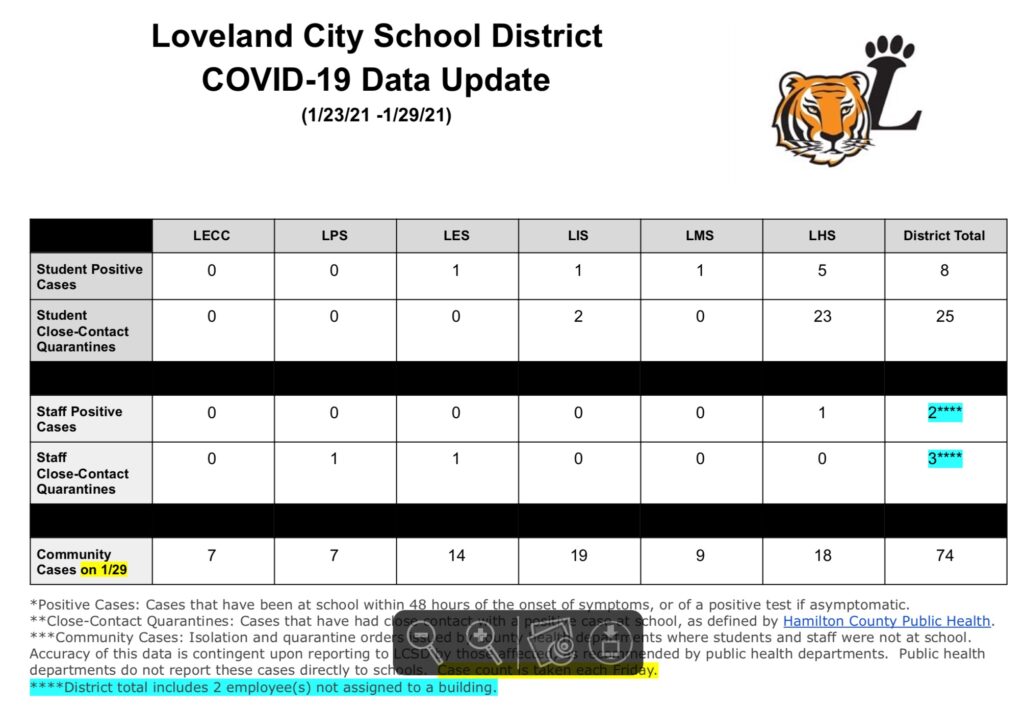
    Here is the Loveland District’s latest Covid 19 Dashboard also released on Friday:

    Below are the recent daily reports issued by the District:

    The district has been notified of the following positive case of COVID-19:

    • On 1/28/21, a student at Loveland Elementary School, last at school on 1/25/21.
    • On 1/26/21, a student at Loveland Intermediate School, last at school on 1/22/21.
    • On 1/23/21, a teaching staff member at Loveland High School, last at school on 1/20/21;
    • On 1/24/21, a student at Loveland High School, last at school on 1/20/21; 
    • On 1/25/21, a non-teaching, non-school-based staff member, last at work on 1/21/21;
    • On 1/25/21, a student at Loveland High School, last at school on 1/20/21; and
    • On 1/25/21, a student at Loveland High School, last at school on 1/22/21.
    • On 1/22/21, a student at Loveland High School, last at school on 1/20/21.
  • ‘Trust issues’ prompt nursing home workers to decline COVID-19 vaccine, union says

    ‘Trust issues’ prompt nursing home workers to decline COVID-19 vaccine, union says

    By Jake Zuckerman and Ohio Capital Journal

    Nursing home workers are passing on their chance at early access to the COVID-19 vaccine, officials say, blowing a crosswind against a scarce supply of doses and a pandemic in a tailspin.

    Gov. Mike DeWine first drew attention to the issue Wednesday, claiming during a televised press briefing that roughly 60% of staffers who were offered the vaccine declined it.

    “I think in this case, [DeWine] is on target,” said Pete Van Runkle, executive director of an industry association representing Ohio’s long term care facilities.

    “I talk to a lot of members on a regular basis. They are reporting a pretty low uptake among staff.”

    Patrick Schwartz

    Patrick Schwartz, a spokesman for Leading Age Ohio, an elder advocacy group, said he’s hearing mixed reports of some providers finding that 90% of staff chose to take the vaccine while others are “well below 50%.”

    He attributed the shortfalls to misinformation and fear surrounding the potential for an adverse reaction to the vaccine.

    “Many staff are simply ‘not yet ready,’ which will hopefully change as they see more and more colleagues vaccinated without side effects and confidence continues to build,” he said.

    “By contrast, an overwhelming majority of residents seem willing to accept the vaccine, with many coming from the generation that saw polio and other deadly diseases wiped out by life-saving vaccines.”

    The local Service Employees International Union surveyed its members on the issue, it said in a statement Monday.

    The responses, according to SEIU 1199 President Becky Williams, indicate a trust problem between an exhausted, underpaid, underappreciated, and in many cases already-infected staff and health authorities.

    She said this is a “substantial issue” that’s bigger than just the union and requires outreach and education from the state.

    “Workers commented that the vaccine appeared rushed and unproven without enough data to show that it would be effective,” she said.

    “Some workers are also concerned that the vaccine could cause fertility issues among women who may want to have a child. There are trust issues among frontline health care workers — some of which preceded the pandemic. These trust issues continue after so many nursing home workers have been on the frontlines of the pandemic without hazard pay and support such as needed personal protective equipment.”

    Several news outlets have debunked this notion of ‘fertility issues’ related to the vaccine. A quick scroll through the right Facebook group can deluge visitors with this and similar pieces of misinformation relating to the vaccine.

    The Ohio Capital Journal called 13 state long-term care facilities Monday, who have each reported at least 100 COVID-19 cases among their residents, to discuss vaccination among their staffs. No administrators agreed to an interview.

    Two vaccines (one from Moderna and one jointly from Pfizer and BioNTech) are currently approved for emergency use against COVID-19. They are both two-dose vaccines, taken several weeks apart.

    Company data reviewed by the Food and Drug Administration shows both vaccines are about 95% effective preventing symptoms of COVID-19. While side effects (sometimes more intense than a standard flu vaccine) have been reported with both products, none of the vaccine trials have reported any serious safety concerns, according to information from Johns Hopkins University.

    Before coming to market, both vaccines underwent large scale clinical trials over the course of months. They are now under review via continuous monitoring for problems and side effects from the FDA and the CDC.

    The vaccine hesitancy comes as COVID-19 has infected 727,000 Ohioans, put about 39,000 in the hospital, and killed at least 9,143 since March.

    At least 4,856 of those deaths occurred among residents of Ohio’s long-term care facilities.

    Nationally, more than 353,000 Americans have died of COVID-19 and nearly 21 million have been infected.

    Tory Harper Hogan, PhD

    There are several theories as to why nursing home workers would rebuff a vaccine dose, according to Tory Hogan, an Ohio State University professor who researches nursing homes and infection control.

    She said some probably just don’t trust health authority; some have “been in the trenches” of the pandemic for a year now, prompting them to shrug off the unknown risk of vaccine for the better-known risk of infection; some probably just don’t want to be the guinea pigs.

    “There has been so much misinformation about everything in this process,” she said.

    Wood County Health Commissioner Ben Robison said he’s detected some vaccine hesitancy and refusal across all industries. However, some who deny at first are likely to come around.

    “Anecdotally, we’ve heard among some of the populations we’re reaching with our vaccine, some have initially said no and then later said yes,” he said.

    Some employers, especially in the health care industry, mandate the flu vaccine and other immunization. However, Van Runkle said the industry is already dealing with a widespread staffing shortage, only worsened by the pandemic.

    He said most of Ohio’s nursing homes do not even mandate the flu vaccine. Mandating a COVID-19 vaccine would worsen staffing problems.

    “We don’t need another reason for people not to work in our facilities,” he said.

    A vaccine mandate would backfire

    Hogan agreed that a vaccine mandate would backfire, and Williams, from SEIU, said education and outreach should drive universal vaccination.

    The Ohio Department of Health has shipped 341,100 Moderna first-doses, as well as 9,750 Pfizer first-doses plus another 9,750 Pfizer second-doses, according to ODH spokeswoman Melanie Amato. Only about 162,942 Ohioans have started the vaccination process, which is prioritizing health care workers, first responders and nursing home staff and residents.

    ODH said it is not actively tracking vaccine declination rates. CVS Health, a company administering the doses in state long term care facilities, isn’t either.

    “We do not have visibility to how many staff members at a facility decline to be vaccinated,” said CVS Health Spokesman Charlie Rice-Minoso.

    “While we aren’t provided with full staff rosters, based on feedback from our teams in the field we’re seeing more vaccine hesitancy among staff when compared with residents.”

    Walgreens, another company administering the vaccines, did not respond to inquiries.

    Looking at the bigger picture, Hogan said governments from the federal to local level need to do a better job understanding why some are declining vaccination. Similarly, she said they need to emphasize, as they did during the polio years, that vaccination is the patriotic thing for Americans to do.

    “It takes consistently pushing the right message, the correct and accurate information,” she said. “That takes money, a federal response, all levels. We’re struggling with that a lot.”

  • DeWine: 60% of Ohio nursing home workers are refusing vaccine

    DeWine: 60% of Ohio nursing home workers are refusing vaccine

    By Marty Schladen and Ohio Capital Journal

    As the coronavirus vaccine dribbles out far more slowly than promised, many of the people who can get it are refusing to do so.

    Gov. Mike DeWine on Wednesday said that a whopping 60% of nursing home workers who have been offered the vaccine have refused it. 

    The news comes amid disappointing vaccination numbers across Ohio, which was told by the Trump administration that it would receive more than 530,000 doses of the vaccines by the end of December. Just 94,000 so far have been administered.

    “I am not satisfied with where we are in Ohio,” DeWine said during a coronavirus press conference. “We’re not moving fast enough, but we’re going to get there.”

    He said he had a Wednesday morning conference call with CEOs of Ohio hospital systems and set a goal of getting the covid vaccine into people’s arms within 24 hours of when hospitals receive it. DeWine said the job of distributing the vaccine is more complex than many appreciate, but it’s vital to do it quickly.

    “There’s a moral imperative to get this out just as quickly as we can,” he said.

    But the numbers emerging from nursing homes might portend something just as bad.

    “Our bigger concern is the amount of staff who are not taking it,” DeWine said. “I don’t have data in front of me, but anecdotally, it looks like somewhere around 40% of staff at nursing homes are taking the vaccines and 60% are not taking it.”

    Those figures are disturbing not only because of what they might say about attitudes toward the vaccines among the larger population. They also mean that most staffers will be unprotected as they move between the outside world and nursing homes filled with vulnerable people — some of whom will not be able to take the vaccine for medical reasons.

    Even so, DeWine said he isn’t going to make anybody take it.

    “I’m not going to compel anybody to do it, but I’m urging people to take that vaccine,” he said. “It’s very important,” 

    It’s not clear why the governor isn’t imposing such a requirement. 

    All 50 states have laws requiring — with exemptions — that children be vaccinated before going to school. Also, many healthcare facilities require employees to be vaccinated.

    A DeWine spokesman didn’t immediately respond when asked why DeWine wouldn’t order Ohio nursing homes to follow suit.

    Ohio’s problems distributing the coronavirus vaccine come amid national problems producing and distributing the two vaccines that so far have received approval. With hospital beds filling, the country is falling far short of the Trump administration’s promises.

    The administration said that 20 million Americans would be vaccinated by the end of December, but so far, only 11.4 million doses have been sent to states and just 2.1 million people have received a first dose, the Washington Post reported Tuesday.

    At the current pace, it will take 10 years to vaccinate enough Americans to achieve herd immunity, NBC reported.

    Among those promising 20 million vaccinated Americans by the end of 2020 was U.S. Surgeon General Jerome Adams. He made the statement just 11 days ago in a press conference with DeWine.

    Adams dismissed reports that vaccine doses were coming to states at substantially lower levels than promised as blips that are to be expected in such a complex project. He also scoffed at the need to invoke the Defense Production Act to scale up production of approved vaccines, saying the manufacturers were operating at full capacity.

    Three days later, the New York Times reported that Pfizer, manufacturer of one of the vaccines, was close to a deal with the administration to use the Defense Production Act to obtain more of the materials to make it. Pfizer had been asking for such help since September, the story said.