Tag: veto

  • Ohio families with transgender children relieved DeWine vetoed HB 68, worry about potential override

    Ohio families with transgender children relieved DeWine vetoed HB 68, worry about potential override

    A transgender Pride flag is covered with the words “Hands Off Trans Youth.” (Photo by Greg LaRose/Louisiana Illuminator/States Newsroom)

    The Ohio House will be in session next Wednesday and the Senate’s next scheduled session is Jan. 24.

    BY:  Ohio Capital Journal

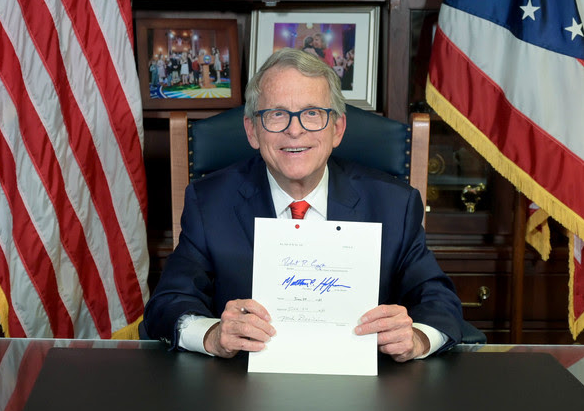
    The Burkle family huddled together to watch last week’s press conference where Ohio Gov. Mike DeWine vetoed a controversial bill that would have banned gender-affirming care for transgender youth.

    “It was a brief sigh of relief,” mom Alicia Burkle said. “We were crying and hugging.”

    Their 10-year-old daughter Astrid has socially transitioned, but has not yet started puberty blockers.

    Ohio House Bill 68 would prevent transgender athletes from playing women’s sports and would ban transgender youth from accessing gender-affirming care, including puberty blockers and hormone therapy. DeWine said during last week’s press conference his focus was on the health care component of the bill.

    The Burkles figured they had a couple of weeks before the lawmakers returned from winter break, but the Ohio House announced they will have session next Wednesday, Jan. 10. The Ohio Senate’s next schedule session is Jan. 24.

    “It’s just so hurtful and it’s exhausting,” Burkle said.

    The Ohio Capital Journal talked to three families with transgender children who were relieved DeWine vetoed HB 68, but are now concerned the legislature could override his veto.

    “We do know that this was a math problem also and that the veto was not necessarily the end,” said Nick Zingarelli, the father of a transgender teenager.

    A three-fifths vote of the members of the House and Senate is necessary to override the governor’s veto — meaning 60 representatives and 20 senators.

    HB 68 passed in December with 24 votes in the Senate and 62 votes in the House. State Sen. Nathan Manning was the lone Republican senator to vote against the bill in December. Republican state Reps. Jamie Callender and Brett Hillyer voted against the bill when it originally passed the House with 64 votes in June.

    Ohio House Speaker Jason Stephens, R-Kitts Hill, said last week he was disappointed in DeWine’s veto.

    “We will certainly discuss as a caucus and take the appropriate next steps,” Stephens said in a statement.

    Burkle family

    When the Ohio House and Senate passed HB 68 on Dec. 13, the Burkles launched into action mode by asking their doctor what next steps they can take as well as emailing and calling DeWine. Astrid even sent DeWine some handwritten letters.

    “We really didn’t get to truly enjoy the holiday because we were just so anxious about what was going to happen,” Alicia Burkle said.

    Astrid is not currently on puberty blockers and wouldn’t be covered under the grandfather clause that would allow doctors who already started treatment on patients to continue.

    “We don’t know that she would be (on puberty blockers) before the bill were to take effect, if it were to pass,” Alicia Burkle said.

    DeWine said he would pursue administrative rules banning gender-affirming surgery on minors, collecting data, and combating clinics that might pop up to try to perform ideologically-driven care. No Ohio children’s hospital currently performs gender-affirming surgery on those under 18.

    “Those are all really reasonable concessions,” Burkle said.

    The Cleveland-area family doesn’t want to move out-of-state, and hopes it doesn’t get to that point.

    “It’s certainly one of the options that we’re keeping open if that’s what we’re forced to do,” Burkle said.

    The Scagliones

    While Kat Scaglione was impressed with DeWine’s veto, she said it feels like sitting in limbo waiting to see what happens next.

    “What if this override happens?” she asked. “It feels like we’ve almost backpedaled and we’re back to where we started.”

    She has a 14-year-old transgender daughter, a 13-year-old cisgender son, and a 10-year-old transgender daughter.

    Amity, 14, is past the point of being able to get puberty blockers and is waiting on hormone treatment.

    “I am supposed to be worrying about the next test I have to study for,” Amity said. “Not whether my rights are going to disappear. …  It’s very scary to have that thought looming over your head, like all the time.”

    Kat said waiting on the governor’s decision overshadowed the holiday season.

    “My kids were sitting there writing Christmas lists and writing letters to send to the governor and to the representatives,” she said. “It didn’t feel like much of a holiday this year.”

    Zingarelli family

    The Zingarelli family celebrated DeWine’s veto.

    “It was we’re going to take the next few days just to savor this victory, because it was a huge victory,” father Nick Zingarelli said.

    His 14-year-old daughter is treated by Cincinnati Children’s Hospital Medical Center, so she would be able to continue receiving care under the grandfather clause but he wants to make sure all Ohio kids would have access to this kind of care.

    He hopes DeWine’s veto will give other Republican lawmakers pause.

    “I would hope that they would listen to the elected leader from their own party, and then consider that and say, ‘Am I on the wrong side of this issue?’ … We’re not gonna roll over on this battle. If they win in the legislature, we will see them in court,” he said.

    Follow OCJ Reporter Megan Henry on X.

    ___________

    Megan Henry
    MEGAN HENRY

    Megan Henry is a reporter for the Ohio Capital Journal and has spent the past five years reporting in Ohio on various topics including education, healthcare, business and crime. She previously worked at The Columbus Dispatch, part of the USA Today Network.

    MORE FROM AUTHOR

  • Ohio Gov. Mike DeWine vetoes bill that would’ve banned gender-affirming care for trans youth

    Ohio Gov. Mike DeWine vetoes bill that would’ve banned gender-affirming care for trans youth

    JANUARY 31: Ohio Governor Mike DeWine gives the State of the State Address, January 31, 2023, in the House Chamber at the Statehouse in Columbus, Ohio. (Photo by Graham Stokes for Ohio Capital Journal. Republish photo only with original story.)

    BY:  Ohio Capital Journal

    Republican Ohio Gov. Mike DeWine has vetoed legislation that would have prohibited transgender youth from accessing gender-affirming care. His veto shoots down the controversial bill, which would also stop middle and high school trans students from participating in athletics with cisgender peers.

    He announced the decision in a press conference Friday morning, the last day that he was allowed to veto it.

    DeWine said he listened to the bill’s sponsor and also listened to physicians at the five children’s hospitals in Ohio. He said he listened to families of youth, some who had negative experiences and detransitioned, as well as those who said gender-affirming treatment saved their child’s life.

    “They told me their child is alive only because they received care,” he said, adding that he thinks people on both sides truly believe they are trying to protect youth.

    While the law would impact only a very small number of children, the consequences of the bill would be profound, DeWine said.

    “Ultimately, I believe this is about protecting human life,” he said. Both parents of trans kids and adults who received care told him that the care saved their lives.

    “These are gut-wrenching decisions that should be made my parents and should be informed by teams of doctors who are advising them. These are parents who have watched their children suffer for years, and have real concerns their children would not survive without it… Families are basing their decisions on the best medical advice they can get.”

    While he vetoed the bill, DeWine said he would pursue administrative rules to help address several concerns, including the banning of gender-affirming surgery on minors (which currently is not practiced in Ohio). He also is looking at administrative rules to collect data, and to combat clinics that might pop up to try to perform ideologically-driven care, which he said was a concern from both sides of the issue.

    What happens now?

    Trans youth, LGBTQ+ rights advocates and doctors are rejoicing at the decision.

    However, the lawmakers against the bill have another option to take away rights for trans children: The House and the Senate can override the governor on his veto. There may be an effort to do this, but it is possible it doesn’t have enough votes, according to one Republican lawmaker who originally voted in favor of the bill.

    A three-fifths vote of the members of the House and Senate is necessary to override the governor’s veto — meaning 60 representatives and 20 senators. The bill passed forward with 64 representatives originally (62 after amendments) and 24 senators. Only three Republicans have publicly been against the bill. When it was passing the House, Republican state Reps. Jamie Callender and Brett Hillyer voted against it. In the Senate, state Sen. Nathan Manning voted against it. All the GOP no votes came from Northeast Ohio lawmakers.

    In a one-on-one interview with Statehouse reporter Morgan Trau just a week before his decision, DeWine explained the research he was doing into H.B. 68.

    Morgan Trau: “Are you going to sign [H.B. 68]?”

    Governor DeWine: “Well, this is something that I’m really thinking a lot about… So I went to children’s hospital here in Columbus; I went to the children’s hospital in Akron and children’s hospital in Cincinnati — just to see how they do it, what kind of care they give to these young people. But I’ve also talked to opponents who don’t think that kind of care is appropriate… I’ve also talked to families who have told me that care is just vitally important and save their child’s life. So I’m trying to weigh all this and trying to get as much information together.”

    Morgan Trau: “You’ve always been somebody to care about children, but also parental rights. How would you reckon with signing this?”

    Governor DeWine: “I really don’t want to get too deeply into this… We’ve got to get this — I have to get this right… There’s a lot of testimony in the Statehouse that you covered and I want to look at that testimony — both pro and con.”


    Morgan Trau
    MORGAN TRAU

    Morgan Trau is a political reporter and multimedia journalist based out of the WEWS Columbus Bureau. A graduate of Syracuse University’s S.I. Newhouse School of Public Communications, Trau has previously worked as an investigative, political and fact-checking reporter in Grand Rapids, Mich. at WZZM-TV; a reporter and MMJ in Spokane, Wash. at KREM-TV and has interned at 60 Minutes and worked for CBS Interactive and PBS NewsHour.

    MORE FROM AUTHOR

  • DeWine signs 23 bills into law, vetoes one

    DeWine signs 23 bills into law, vetoes one

    File photo: Gov. Mike DeWine signing a bill. Source: The governor’s office.

    BY: NICK EVANS – Ohio Capital Journal

    While Ohio House and Senate lawmakers organize committees and prepare for the coming session, Gov. Mike DeWine is putting the finishing touches on the last one. So far this week, the governor has signed 23 bills into law and vetoed one.

    The veto

    DeWine rejected HB 286, sponsored by Rep. Bill Seitz, R-Cincinnati. The bill would have allowed legal challenges for certain agency orders to occur in the county where a business or a person resides.

    The changes applied to agencies handling liquor control, workers compensation, medicine, chiropractors, nursing, and the casino control commission. Existing law sends those challenges the Franklin County Court of Common Pleas, which Seitz criticized in his sponsor testimony.

    “While it is true that the current law represents a great convenience for the State’s bureaucrats and lawyers who need only to defend their decisions on their “home turf”,” Seitz argued, “these considerations are counterbalanced by the inconvenience to the Ohio citizens and businesses who must always play “an away game.”

    DeWine’s veto message was notably terse. “(HB 286) is very similar to provisions that I vetoed previously,” he wrote. “The language as drafted in HB 286 is simply too broad.”

    Those previously vetoed provisions are actually in state law. They come from SB 22 — a measure limiting the governor’s emergency powers and passed by lawmakers despite DeWine’s veto in 2021. Among other changes, it allows people challenging a rule “adopted in response to a state of emergency” to file their case in their home county.

    And a change of venue can make an enormous difference in a case. Columbus’ ongoing bid to institute local firearm regulations offers an illustrative example. After a Franklin County judge ruled against a state law blocking local gun provisions, Columbus passed a large capacity magazine ban and a safe storage ordinance. Attorney General Yost went to neighboring Fairfield County — “where roughly 11,000 Columbus residents live” his press release points out — to challenge those laws.

    Columbus City Attorney Zach Klein accused Yost of “judge shopping,” but the AG’s move secured a temporary restraining order.

    What’s left?

    The final batch of bills arrived on the governor’s desk Dec. 30. Because DeWine has ten days not including holidays and Sundays in which to act, he has until Jan. 12 to make a decision on those proposals, according to his office.

    Among the measures still outstanding are bills that institute photo ID requirements for voting and a prohibition on local tobacco ordinances. DeWine has hinted at vetoing the latter. In a separate OCJ story today, the governor’s office said the elections and voter ID bill was received Dec. 29, so they calculate the deadline for action on that to be Jan. 11.

    The governor also hasn’t taken action yet on a last minute bill which appropriates $6 billion in federal money. Because it includes spending, DeWine could issue line-item vetoes rather than scrapping the bill as a whole.

    The signatures

    Meanwhile, DeWine approved the following bills:

    SB 16: Increased penalties for assault or menacing when the victim is a first responder. The measure also gave local governments explicit authorities when dealing with a riot or mob and prohibited any limitations on firearm rights due to a state of emergency.

    SB 33: Changed Community Reinvestment Area policy to allow greater deduction to 529 education savings plans.

    SB 63: Allowed county probation offices to accept credit card payments. A House amendment added on a new liquor permit for auto-sports facilities.

    SB 131: Required the issuance of certain occupational licenses if a person has experience in that field in a different state. It also specifies individuals can’t register as a credit services organization or a fireworks manufacturer.

    SB 164: Altered animal cruelty laws and prohibited shelters from using gas chambers to put down pets. It also gives Cuyahoga County the greenlight to convert its tobacco tax to a wholesale tax and institute a new wholesale tax on vapor products.

    SB 202: Prohibited restricting parental rights due to the parent’s disability. House amendments gave lawyers credit toward judicial eligibility for out of state practice time and created a bail study task force.

    SB 288: Instituted new texting while driving provisions including making it a primary offense. Also made numerous changes to the criminal code.

    SB 302: Made changes to the state unemployment compensation system.

    HB 23: Required EMS and police officers undergo dementia-related training and raised the maximum age for new highway patrol troopers.

    HB 35: Permitted Ohio mayors to solemnize marriages.

    HB 66: Made numerous tweaks to local taxing authority and reporting as well as $30 million for minor league sports teams.

    HB 107: Revised Ohio’s elevator laws.

    HB 150: Established a rural practice incentive program to pay student loans for attorneys working in public offices or underserved communities.

    HB 178: Known as Makenna’s Law, this measure placed limits on water pressure at pools and other water parks.

    HB 254: Established domestic violence fatality review boards.

    HB 279: Shortened timeline for filing certain wrongful death claims.

    HB 353: Known as Ohio’s “Testing Your Faith Act,” this bill directed higher ed institutions to develop accommodations for students who need to be absent for religious reasons.

    HB 364: Changed application process for sewer and water infrastructure surcharges.

    HB 392: Authorized transport of police dogs injured in the line of duty. An amendment made provisions for riding in a fifth wheel trailer and mounting safety devices on a windshield.

    HB 405: Clarified rules of county hospital boards, gave coroners access to a law enforcement database and allowed treasurers to send bills electronically.

    HB 423: Designated the American Soap Box Derby Ohio’s official gravity racing program.

    HB 462: Prohibited “swatting.”

    HB 487: Altered bidding process for Ohio ballot printing contracts to allow out of state vendors/printers to participate.

    Follow OCJ Reporter Nick Evans on Twitter.