Tag: violent crime

  • New report looks at underlying causes of Ohio’s violent crimes

    New report looks at underlying causes of Ohio’s violent crimes

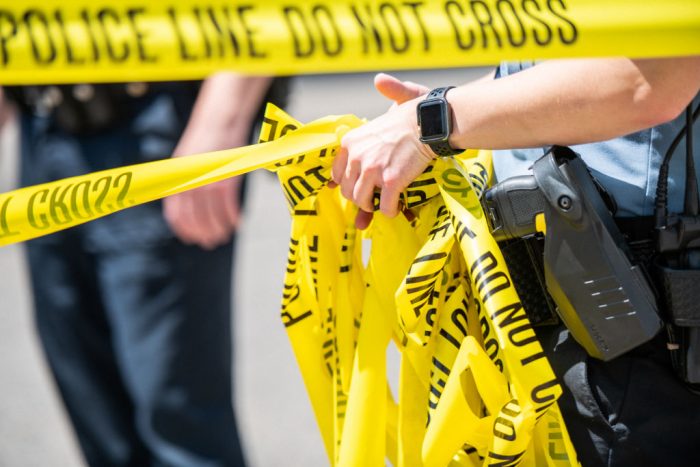
    Photo by Brandon Bell/Getty Images

    More than 30,000 violent crimes — including homicide, rape, robbery and aggravated assault — were reported in Ohio in 2023.

    BY:  Ohio Capital Journal

    Many societal structures and systems can be drivers of violent crimes, according to a new report by the Health Policy Institute of Ohio.

    More than 30,000 violent crimes — including homicide, rape, robbery and aggravated assault — were reported in Ohio in 2023.

    “Even with laws and penalties such as arrest and incarceration in place, violent crime persists and causes significant harm to victims and communities,” the report states. “Community conditions and societal structures can support or prevent violent crime. Since the research evidence is clear that arrests and incarceration are detrimental to the health of individuals, families and communities, it is important to take an upstream approach for violence prevention.”

    There’s lots of opportunities as a state to mitigate violence, said Tonni Oberly, one of the authors of the report, titled Criminal Justice and Health: Social Drivers of Violent Crime.

    “We can then also be preventative and treat it as a public health issue by addressing those underlying root causes of violence,” she said.

    Violent crimes in Ohio

    Ohio ranks 34th in the nation in homicides and 80% were gun-related in 2022, according to the report.

    Homicides peaked in Ohio during the COVID-19 pandemic, but have not returned to pre-pandemic rates, according to the report. Two of Columbus’ deadliest years on records were 2021 with 204 homicides and 2020 with 175 homicides. Cleveland had 192 homicides in 2020 and 165 in 2021.

    Columbus and Dayton both recently had mass shootings in the same weekend.

    There were 18,742 incoming domestic violence cases in Ohio in 2014 — a number that has increased almost every year since with the exception of 2020 — and there were 24,534 cases in 2023.

    Societal Structures and Systems

    Racism, income inequality, zoning and neighborhood planning, gender-related social norms, education, employment, healthcare, housing and criminal justice are all structures and systems that can contribute to violent crime, according to the report.

    “All of these structures and systems are also interconnected and interrelated, whether we have typical and current ongoing racist policies that have shaped the way communities are structured and the resources that people have access to,” Oberly said. “All of that aligns with income inequality, with how neighborhoods are shaped, and funding that goes into them, and that, of course, ties into the systems that drives violent crime as well.”

    Redlining and the building the Interstate Highway System through communities of color in the 1950s are two examples of historical policies and practices.

    “These … resulted in poor community stability, lower home valuations, increased foreclosures and limited economic mobility in majority-Black, Hispanic and Asian neighborhoods,” the report said. “As a result, many of these communities experienced concentrated disadvantage, which includes limited educational and employment opportunities and higher rates of poverty, unemployment and food insecurity that continue today.”

    Ohio ranks 30th when it comes to income inequality, which puts people at risk for a shortened life span, poor health and increased neighborhood and interpersonal violence.

    The report illustrates that increases in income supports — such as increased minimum wage, Earned Income Tax Credits and the Supplemental Nutrition Assistance Program — have been shown to lower violence and result in less firearm homicides.

    Zoning and neighborhood planning can also play a role in the amount of violence in a particular area.

    The report explained the relationship between alcohol outlet density and violent crime in a neighborhood. Off-premise outlets such as liquor and convenience stores are associated with higher rates of violent crime compared to on-premise outlets such as bars and restaurants.

    “Alcohol outlet density is a prime example of how zoning impacts violence,” according to the report. “Due to inequitable zoning codes and weakened political power, communities of color and low-income neighborhoods are more likely to have a high density of alcohol outlets.”

    Ohio’s liquor sales have increased 98% in the past two decades while the state’s adult population has gone up 8%. Ohio ranks 34th in the nation for excessive drinking.

    Legislative actions

    There have been legislative attempts to curb violent crimes.

    The DeWine administration gave $20 million in grants to support more than three dozen community-based intervention programs to reduce violence and help victims of crime as part of the Community Violence Prevention Grant Program, according to the report.

    An Ohio law will go into effect in August that bans all forms of spousal rape.

    DeWine recently signed a bill into law that will go into effect in September that aims to help formerly incarcerated people find stable housing.

    House Bill 420 would create the Office of Firearm Violence Prevention within the Ohio Department of Children and Youth which would administer grant programs to reduce firearm violence. Reps. Darnell T. Brewer, D-Cleveland, and Munira Abdullahi, D-Columbus introduced the bill earlier this year, which is in the House Finance Committee.

    The report recommends implementing evidence-based firearm safety policies that includes child access prevention laws and firearm licensing laws.

    Ohio is not one of the 30 states with child-access prevention laws nor is Ohio one of the 14 states that require checks at the point of transfer for all firearms.

    The report also recommends increasing housing affordability, alcohol policies, including density zoning and pricing; and education, employment and criminal justice reform.

    Follow OCJ Reporter Megan Henry on Twitter.


    Megan Henry
    MEGAN HENRY

    Megan Henry is a reporter for the Ohio Capital Journal and has spent the past five years reporting in Ohio on various topics including education, healthcare, business and crime. She previously worked at The Columbus Dispatch, part of the USA Today Network.

    Ohio Capital Journal is part of States Newsroom, the nation’s largest state-focused nonprofit news organization.

    MORE FROM AUTHOR

  • Prohibition on gun insurance requirements getting first Ohio House hearing

    Prohibition on gun insurance requirements getting first Ohio House hearing

    Loveland, Ohio
    State Sen. Terry Johnson – Photo by Graham Stokes for Ohio Capital Journal.

    BY:  – Ohio Capital Journal

    A consequential firearms measure cruised through the Ohio Senate and is currently waiting on a hearing in the House Insurance committee. The proposal, like numerous previous measures, preempts local action, this time by prohibiting fees or liability insurance for gun owners.

    Cities around Ohio are wrestling with increases in violent crime since the pandemic, but many local leaders argue they’re hamstrung by state laws barring most local firearm restrictions.

    Columbus, for instance, is currently locked in a court battle with the state to impose three local firearm ordinances. Those laws aren’t particularly draconian — they prohibit high-capacity magazines, criminalize straw sales, and require safe storage. Nevertheless, state officials insist they violate state law preempting local restrictions.

    The insurance proposal would extend those preemptions further.

     Sen. Theresa Gavarone, R-Huron. Photo from OhioSenate.gov 

    Liability insurance

    Sens. Terry Johnson, R-McDermott, and Theresa Gavarone, R-Bowling Green, insist an insurance requirement for gun owners would infringe on their constitutional rights. They filed a similar bill in the previous general assembly.

    “The right of the American citizens to keep and bear arms is as clear as day,” Johnson said on the Senate floor. “And attempts to make it so it’s difficult for law abiding citizens to exercise this right, that’s guaranteed, blazoned into the Constitution, that’s wrong.”

    The sponsors aren’t particularly concerned about the fact that they can’t identify a single Ohio municipality that has proposed an insurance requirement. Instead, they point to legislation elsewhere.

    “There is a trend of extreme anti-gun measures that directly contradict the Constitution,” Gavarone argued. “In places like California, Illinois, and New Jersey. So we can never discount the fact that it could and probably will be attempted in Ohio.”

    “Senator Johnson and I wanted to slam the door shut on present and future attempts on infringement on this particular constitutional right,” Gavarone added.

    The sum total of gun owner liability requirements in the U.S. are a state law in New Jersey and a local ordinance in San Jose, California. Both laws are the subject of federal litigation. Illinois lawmakers have proposed insurance requirements in the past, but those measures haven’t made it through the legislature.

     COLUMBUS, OH — FEBRUARY 15: Senate Minority Leader Nickie J. Antonio, D-Lakewood. (Photo by Graham Stokes for Ohio Capital Journal. Republish photo only with original story.) 

    Pushback

    In committee, Powell resident Michelle Lee Heym questioned the logic driving the legislation.

    “Why would you make access to a lethal weapon easier by prohibiting payment of insurance for normal people?” she asked. “Normal people get insurance when they buy a car, for protecting themselves against sickness or injury. It is almost comical to think one would not buy liability insurance when purchasing a firearm.”

    Sen. Hearcel Craig, D-Columbus, criticized the bill as “a performative action that undermines the home rule of Ohio cities and townships.”

    Craig argued the prohibition removes a tool for incentivizing safer conduct — like locking up firearms or reporting them as stolen.

    More fundamentally, Senate minority leader Nickie Antonio argued the sponsors have their priorities backward. She cited a string of recent victims shot for banal misunderstandings.

    “We’re preemptively protecting something that might happen down the road,” she said, “instead of addressing the things that have already happened, and providing some kind of solutions — common sense solutions to address gun violence.”

    The measure passed the Senate on a party line vote. The House has referred the bill to the Insurance Committee. The current schedule has it slated for its first hearing May 10.

    Follow OCJ Reporter Nick Evans on Twitter.

    ____________________________

    Nick Evans
    NICK EVANS

    Nick Evans has spent the past seven years reporting for NPR member stations in Florida and Ohio. He got his start in Tallahassee, covering issues like redistricting, same sex marriage and medical marijuana. Since arriving in Columbus in 2018, he has covered everything from city council to football. His work on Ohio politics and local policing have been featured numerous times on NPR.

    MORE FROM AUTHOR

  • Ohio Republicans’ attempted erasure of a 10-year-old rape victim is incredibly sick and disturbed

    Ohio Republicans’ attempted erasure of a 10-year-old rape victim is incredibly sick and disturbed

     Left to right: Republican Ohio Gov. Mike DeWine, Republican Ohio Attorney General Dave Yost, and Republican U.S. Congressman Jim Jordan. Official photos.
    Ohio Capital Journal Editor-in-Chief David DeWitt

    A Guest Column by David Dewitt

    The first and most important thing to recognize right now is that a heinous, violent crime was committed on a 10-year-old Ohio child, and thankfully justice has now found the alleged perpetrator.

    Columbus man was indicted Wednesday in a case that made national and international headlines about 10-year-old girl who had to travel to Indiana for an abortion after Ohio’s abortion ban went into effect following the U.S. Supreme Court overturning Roe v. Wade.

    The story is horrifying and tragic. She has experienced enormous trauma. My heart breaks for her, and I’m very grateful to all the hard-working professionals out there providing her and her family assistance in what must be a truly awful time.

    Republican Ohio Gov. Mike DeWine and his spokesman responded to the story by ignoring questions about whether children should be forced to have their rapists’ babies. Then DeWine allies contacted members of the press, asking how sure they were that the case of the pregnant 10-year-old even happened.

    The Washington Post, the conservative Daily Caller and other media outlets published stories saying that the case was unverified. The Wall Street Journal Editorial page suggested the story was a “fanciful tale.” The National Review’s Michael Brendan Dougherty referred to the case as “a fictive abortion and a fictive rape.”

    Republican Ohio Attorney General Dave Yost went on Fox News Monday to raise further doubts. He said he works closely with law enforcement authorities and he’d gotten “not a whisper” about the case.

    Hamilton County Republican Party Chair Alex Triantafilou on Twitter called the case, “A garbage lie that a simple google search confirms is debunked.”

    State Rep. Brian Stewart tweeted the Washington Post story saying he “wouldn’t trust an abortionist to tell me whether the sky is blue.”

    Ohio U.S. Rep. Jim Jordan tweeted, “Another lie. Anyone surprised?

    None of them had the patience to verify for themselves with certainty the truth of the matter before going public on a massive, self-serving scale.

    The propaganda erasing this 10-year-old’s existence was so swift it spread out over right-wing social media like a blanket. Those advocating the truth of her story — privately already confirmed for some of us, and crushing to hear about — were subjected to wild-eyed mockery and ridicule.

    It’s incredibly disturbing that the default position of so many sick and twisted people — including Ohio’s most prominent Republican elected officials — is to very vocally and very publicly question whether the rape and impregnation of a 10-year-old child ever happened.

    DeWine, Yost, and other Ohio Republicans hurt a traumatized child once by forcing her to flee the state in order to receive health care; then they hurt her again by peddling propaganda erasing her; now they’re hurting her a third time by refusing to acknowledge and apologize for their actions.

    This case was never implausible. In 2020, the most recent year for which statistics are available, 52 girls aged 14 and younger had abortions in Ohio, according to the state department of health. A review of just the city of Columbus’ police log since March 15 uncovered 59 reports of sexual assaults of girls 15 and younger that, based on the information available, could have resulted in pregnancy.

    Nevertheless, the wheels and integrity of local journalism spun and uncovered the truth, with the Columbus Dispatch breaking the news of confirmation of the case.

    But after the confirmation broke Wednesday, DeWine’s spokesman, Dan Tierney, again refused to comment on whether child rape victims should be forced to carry their pregnancies to term.

    Ten-year-olds who become pregnant are by definition rape victims. But Ohio’s abortion law signed by DeWine doesn’t make exceptions for rape and incest.

    Yost’s office didn’t respond Wednesday when asked whether he believes child rape victims should be forced to carry pregnancies, nor whether it was important to believe stories about sexual violence. Instead he put out a statement applauding the arrest.

    Yost offered no correction, no apology, and showed no contrition for going on national television to try to erase the lived experience of a child rape victim.

    They behave on a base level so repugnant and removed from the general good-heartedness of most Ohioans it’s almost unfathomable.

    “Apologize for what? Questioning a newspaper story?” Yost, Ohio’s top law enforcement officer, said about a case in his own county.

    DeWine, Yost, and other Ohio Republicans hurt a traumatized child once by forcing her to flee the state in order to receive health care; then they hurt her again by peddling propaganda erasing her; now they’re hurting her a third time by refusing to acknowledge and apologize for their actions.

    These powerful Ohio Republican politicians have thoroughly and completely shed themselves of any sense of shame or conscience.

    They’re disgusting and disgraceful; callous, careless and cruel.

    This is a matter of basic human decency, good faith and sensitivity on the most fundamental level of society.

    If they are willing to try to erase the traumatic story of a 10-year-old rape victim, whose pain and suffering will they not try to ignore and erase?

    They behave on a base level so repugnant and removed from the general good-heartedness of most Ohioans it’s almost unfathomable.

    I honestly don’t know how they sleep at night, or look at themselves in the mirror in the morning.