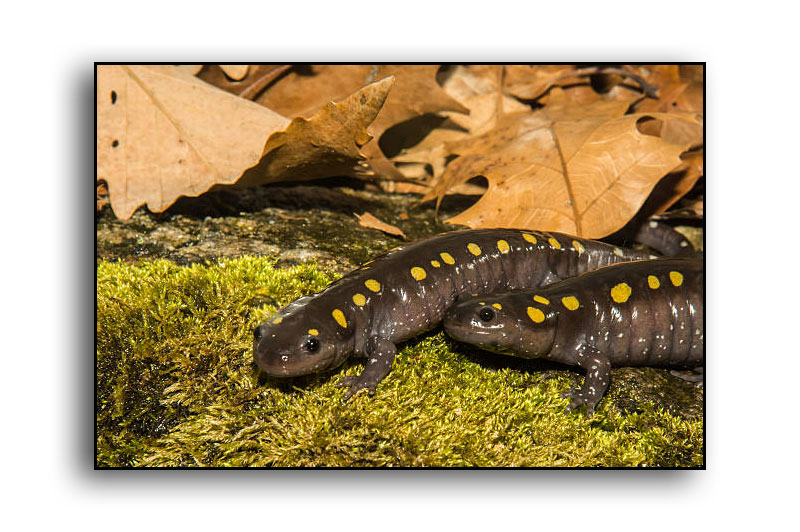
Breeding salamanders lack vocal chords, although some species can make clicking or popping sounds with their jaws. There are approximately two dozen species of salamanders that call the Buckeye state home.
 by Julie Watson
Spring is here! The school year is winding up, the days are getting warmer, and rain is falling. Spring rain is essential. It waters all the new plant growth, pulls pollen out of the air, and boosts water table and wetland levels.
All wetlands are important. They help control flooding and provide habitat for a wide variety of plants, animals, and invertebrates. In fact, wetlands often have more biodiversity than most other types of habitats.
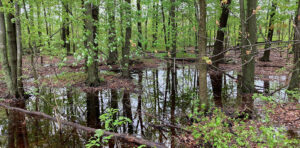
One very special type of wetland that occurs commonly in Ohio is the vernal pool. The word ‘vernal’ refers to anything relating to spring. These shallow pools are filled by melting snow and spring rains. Having no permanent inlet or outlet, they tend to dry out during the summer months. But vernal pools are more than just large puddles. They are crucial habitats hosting a wide variety of species.
However brief their stay, vernal pools are vital for the survival of many amphibian species. Many frogs, toads, and salamanders use vernal pools as breeding grounds. Some return to lay their eggs in the same vernal pools that they hatched from. Since vernal pools are temporary wetlands, they are free of fish which would prey on their eggs and young.
The mating calls of many of these frogs and toads often betray the location of vernal pools. Spring peepers and wood frogs are the earliest to start. They can usually be heard before the snow stops flying.
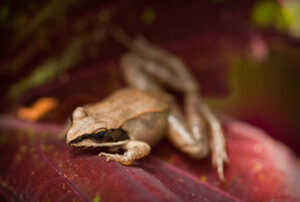
The tiny wood frog is the toughest amphibian, ranging as far as northern Canada. Unlike other cold-blooded species, they don’t bury themselves during winter months. Instead, they hibernate under leaf litter found on the forest floor. This leaves them vulnerable to freezing. Wood frogs are the only species able to manufacture natural ‘antifreeze’ which keeps their cells from freezing while allowing the area between their cells to turn to solid ice. As much as 45% of a wood frog’s body freezes during the winter. But when winter loses its grip, these cool frogs thaw out and make their way to vernal pools to find a mate.
In addition to noisy frogs and toads, Ohio’s vernal pools also play host to breeding salamanders. These amphibians lack vocal chords, although some species can make clicking or popping sounds with their jaws. There are approximately two dozen species of salamanders that call the Buckeye state home. However, several species are endangered due to habitat loss. Like their noisier cousins, salamanders are carnivorous predators consuming mostly worms, insects, and other invertebrates.
Due to the timing of vernal pool appearances, they are often important rest stops for migrating birds and mammals emerging from winter sleeps. They provide fresh, still water and protein rich snacks.
Listen to Spring peepers…
Vernal pools are also helpful to us humans. Like all wetlands, they help control flooding by holding onto excess water. In turn, they filter the water making it safer when it is slowly released into the water table. They also absorb large amounts of carbon dioxide from the air, helping to slow climate change.
In other words, vernal pools are wonderous places that deserve our respect and protection. Although they are still common throughout the Buckeye state, they are only around for a limited time, spring. If you’d like to check out a vernal pool near you, ask your local park system where to find one. If you are lucky enough to find one, please observe from a distance so you don’t disturb the delicate ecosystem.