

Tag: wire fraud

  • FirstEnergy paid $4.3 mil to top energy regulator and reaped the benefits, court docs state

    FirstEnergy paid $4.3 mil to top energy regulator and reaped the benefits, court docs state

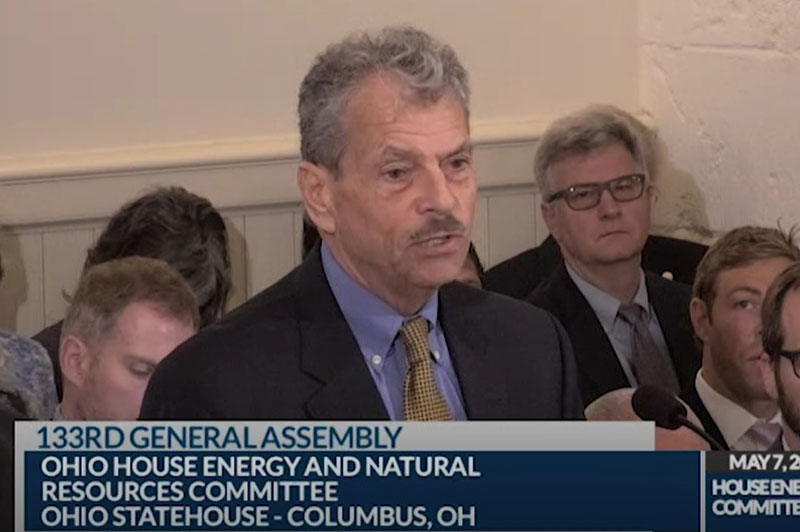
    Then-PUCO Chair Sam Randazzo testifies as an interested party regarding House Bill 6 on May 7, 2019.

    Source: Ohio Channel.

    “HB 6 F(***) ANYBODY WHO AINT US,” the executive wrote.

    BY: JAKE ZUCKERMAN and Ohio Capital Journal

    An energy lobbyist who Gov. Mike DeWine appointed as the state’s top regulator of public utilities received $22 million from FirstEnergy Corp. in the decade before his appointment — including $4.3 million paid just before assuming the post and specifically to execute official duties to benefit the Akron-based utility — court documents revealed Thursday.

    Sam Randazzo, who resigned as chairman of the Public Utilities Commission of Ohio after federal agents raided his Columbus home, used his PUCO chairmanship to scuttle a requirement that FirstEnergy undergo a rate review set for 2024, which company executives believed would hurt its bottom line, the documents state.

    FirstEnergy entered into a deferred prosecution agreement — in which the U.S. Department of Justice could drop the charge if the company meets certain conditions including a $230 million criminal penalty — on one count of wire fraud.

    It also agreed to a stipulation of facts detailing its nearly $61 million in payments to an account the former speaker of the Ohio House allegedly controlled and spent to pass House Bill 6, legislation worth an estimated $1.3 billion to the company.

    Thursday’s filing, however, is flush with new details about FirstEnergy’s long relationship with Randazzo, dating back to a contract in 2010 and a consulting deal inked in 2013.

    The agreement states one FirstEnergy executive texted another on Nov. 15, 2019 that Randazzo is “going to make the requirement [for a rate review] to file go away, but I do not know specifically how he plans to do it.” The document doesn’t directly identify the executives.

    On Nov. 21, 2019, PUCO issued an order finding it is “no longer necessary or appropriate” that three utilities owned by FirstEnergy file a new case when its current rate structure expires in 2024.

    Executive 1 thanked Randazzo via text the next day, according to prosecutors, attaching an image showing the company’s stock price increasing.

    An email for Randazzo on file with the Supreme Court is no longer in operation. In a statement obtained by the Cincinnati Enquirer, he said he executed his duties as chairman lawfully and denied performing any action to advance FirstEnergy’s interests. He said all payments to him were made under his consulting agreement with the utility.

    “In the fall of 2020, it became clear that issues surrounding House Bill 6 and a public attack on my background and character had escalated to a point that made it impossible for me to effectively perform my duties at the PUCO,” he said, explaining his choice to step down.

    According to prosecutors, Executive 1 and Executive 2 met Randazzo at his condo in late December 2018 to discuss remaining $4.3 million on his consulting agreement and a job posting for a PUCO seat. FirstEnergy had no legal requirement to make the payment but did so anyways.

    When a related court filing divulged Randazzo’s company accepted payments from FirstEnergy, executives worried the disclosure would torpedo the appointment. However, it only “grazed the temple,” they said, and forced “State Official 1” and “State Official 2” to perform “battlefield triage.”

    The governor nominates PUCO commissioners off a shortlist from a nomination council. A DeWine spokesman did not answer specific inquiries, including whether the governor is one of the unmentioned state officials.

    “As I have consistently said, we understood that Sam Randazzo had worked for manufacturing companies, energy companies, and consumers, and that he had done work for First Energy. Sam Randazzo was a well-known subject-matter expert in energy issues,” the governor said in a statement. “If, as stated in the court documents, Sam Randazzo committed acts to improperly benefit First Energy, his motives were not known by me or my staff.”

    Haley Carducci, a spokeswoman for Lt. Gov. Jon Husted, didn’t specifically answer whether Husted is one of the two state officials.

    “The Lt. Governor has not been contacted by any federal law enforcement officials regarding this case, so we have no reason to believe that he is mentioned in this document,” said Husted spokeswoman Haley Carducci.

    Along with Randazzo’s help on the regulatory side, the agreement states that he helped craft and review language of House Bill 6 including a “decoupling” provision, which created a ratepayer backed guarantee of FirstEnergy’s revenues at 2018 levels, a good year for the company. The bill also bailed out two nuclear plants owned by a former FirstEnergy subsidiary; bailed out two coal plants owned by a spread of different utility companies; and gutted the state’s renewable energy and efficiency standards.

    Randazzo has deep ties to the fossil fuel energy industry. He worked as a lobbyist and lawyer for the Industrial Energy users Ohio, which represents interests of energy-intensive manufacturing and commercial business before the PUCO.

    Lobbying records show he represented Greenwich Neighbors United, which fought off a potential wind farm development in Huron County; the Ohio Gas Company; and Vectren Corp., a natural gas company.

    As a donor, he contributed more than $282,000 to state candidates over 23 years, according to an analysis from the National Institute on Money and Politics. More than $194,000 went to Republicans, $36,000 to Democrats, and $48,000 to candidates of unspecified parties.

    When his name appeared on a short list of potential candidates for DeWine to choose, a spread of environmental groups wrote a letter outlining “serious concern” for Randazzo’s “extreme bias” against clean energy.

    “Mr. Sam Randazzo has worked earnestly to dismantle Ohio’s energy efficiency resource standard and renewable portfolio standard (RPS) since 2012 via multiple pieces of legislation,” they wrote. “He was supportive of the legislation that froze Ohio’s standards for two years, worked behind the scenes with the study committee that issued a faulty report allegedly assessing the costs and benefits of the RPS and EERS, and even continued to push the repeal and weakening of these standards after Governor Kasich’s veto of a bill that would have essentially eliminated the standards.”

    The Ohio Consumers Counsel, a state agency that represents residential ratepayers before PUCO, issued a statement after news broke of the filing.

    “The public got some justice today regarding the Ohio House Bill 6 scandal and FirstEnergy,” said agency director Bruce Weston. “But justice is also a longer road that requires state reforms to curb the utilities’ political influence that is costing Ohioans money on their utility bills.”

    Rep. David Leland, D-Columbus, said the information about Randazzo places the scandal right on DeWine’s doorstep.

    “This, combined with the significant money FirstEnergy gave to his campaign makes it clear that Governor DeWine needs to come clean to the people of Ohio about his role in this historic scandal,” he said.

    Catherine Turcer, director of Common Cause Ohio, which frequently advocates for anti-corruption and campaign finance reform legislation, said the entire episode highlights that current law allows some political entities to spend enormous sums of money without ever disclosing the source.

    “Clearly, Ohio legislators also need to create greater transparency so that voters can ‘follow the money’ and determine who is funding political spending by all entities including nonprofits. It’s not yet too late for us to pass new laws that will shine a light on ‘dark money,’” she said. “However, our state legislative leaders need to act with urgency and make transparency and accountability a top priority — or Ohioans will undoubtedly face yet another embarrassing scandal.”

    Shortly after HB 6 passed, a FirstEnergy executive texted Randazzo, according to prosecutors. Attached was an edited image of Randazzo’s face atop Mount Rushmore, with FirstEnergy executives and lobbyists alongside him on the iconic monument.

    “HB 6 F(***) ANYBODY WHO AINT US,” the executive wrote.

  • Doug Evans and Evans Landscaping conviction to defraud minorities up-held by United States District Court

    Doug Evans and Evans Landscaping conviction to defraud minorities up-held by United States District Court

    Doug Evans exercised, “complete control over Ergon’s operations to ensure that the fruits of the fraud benefitted Evans Landscaping.”

    Evans faces twenty-one months in jail

    Loveland, Ohio – Defendant Doug Evans, a White male, and Evans Landscaping Inc. were tried and convicted of two counts of conspiracy to commit wire fraud and three counts of wire fraud arising out of their scheme to secure government contracts through a shell company.

    Evans Landscaping based in Newtown has a satellite location on East Kemper Road just outside of Loveland in Symmes Township.

    In a decision issued yesterday, the United States Sixth Circuit Court of Appeals denied Evans’ motion to suppress, various evidentiary rulings made at trial, and a jury instruction given by the district court.

    “We find no merit in the first two issues. Regarding the jury instruction, we conclude that
    the district court erred by instructing the jury that it could find that a defendant knowingly and
    voluntarily joined the conspiracy through deliberate ignorance. However, defendants did not preserve this issue for review below and cannot satisfy the demanding plain-error standard on appeal. Accordingly, we affirm the judgment of the district court.”

    Defendant Evans Landscaping Incorporated is an Ohio corporation engaged in transportation, demolition, and excavation services. The company is controlled by its president, defendant Doug Evans. It is also wholly owned by a trust to which Doug Evans is the sole beneficiary.

    Around 2006, Evans Landscaping began bidding on contracts for demolition work that
    were offered by government entities including the State of Ohio and the City of Cincinnati. The
    company found success in this niche and was awarded several contracts. However, the government entities began to include goals for “minority participation” as one criterion for evaluating bids for public works, and those goals later became mandatory bid components. In state contracts, minority inclusion was generally expressed as a percentage of the work that would be performed by a certified “EDGE” subcontractor that met Ohio’s definition of a Minority Business Entity (MBE).

    The City of Cincinnati similarly considered whether a bid was made by a business designated
    as a Small Business Enterprise (SBE) when administering municipal contracts. Evans Landscaping could not qualify for EDGE or SBE status. Therefore, to skirt local
    and state inclusion requirements, Evans Landscaping employees sought a “go-to” minority
    contractor to work with on public contracts. To that end, Doug Evans, Evans Landscaping’s Chief Financial Officer Maurice Patterson, and other Evans Landscaping managers held a meeting to discuss setting up a new company, which they called Ergon Site Construction.

    At that meeting, Doug Evans told Patterson to “go ahead and set [Ergon] up” because “Evans Landscaping needed whatever help [it] could get in securing contracts.” Accordingly, Patterson, in coordination with Evans Landscaping’s in-house counsel, filed the necessary paperwork to bring Ergon Site Construction into being in 2008.

    Ergon’s organizing documents established that it was ostensibly owned by an African
    American IT consultant named Korey Jordan who had done work for Evans Landscaping. But
    Jordan had no experience running a construction company and invested no funds of his own into Ergon’s operations. Jordan understood that Ergon “was set up between [him]self and Evans to go after government contracts” and that his role was to “handle all the paperwork” for Ergon. In exchange for his work, Jordan received $1,000 a month (later increased to $2,000), and Evans Landscaping “received basically the profits from the contracts that were secured with the participation of Ergon.”

    Evans Landscaping and Jordan spent the next two years building up Ergon’s resume with
    a few small jobs that were completed using Evans Landscaping resources. But in 2010, Jordan
    was informed that “for Ergon to exist,” he had to secure EDGE certification from the State and
    SBE certification from the City of Cincinnati. He applied first for SBE status from the City and
    falsely represented that he wholly owned Ergon and personally handled the company’s finances.

    The City approved Ergon’s application in 2011, and it began bidding as an SBE for contracts
    offered by the City at Evans Landscaping’s direction. By 2014, the City had awarded
    approximately 170 contracts to Ergon with a value of around $2,000,000. Ergon also applied for and received EDGE certification from the State of Ohio. Thereafter, Evans Landscaping began including Ergon as an EDGE subcontractor on its bids, but Ergon rarely, if ever, performed the work Evans Landscaping represented it to be doing.

    The respective schemes began breaking down between 2013 and 2014 when local officials
    grew suspicious of the relationship between Evans Landscaping and Ergon. The Appeal Court said in its ruling, “In truth, it did not require Holmesian sleuthing to deduce the relationship between the companies.” For instance, Ergon sometimes used heavy machinery that bore the Evans Landscaping logo. Ergon also stored and dispatched its two work trucks from an Evans Landscaping facility—even after Patterson suggested to Doug Evans that doing so was inconsistent with making Ergon an “independent” operation. The ruling continues, “Thus, it was only a matter of time before public officials became suspicious of the cozy
    relationship between the companies, and they acted on their suspicion by auditing Ergon several times.”

    The increased scrutiny, in turn, drew the attention of the FBI, which opened its own
    investigation in 2013. As part of that investigation, FBI Special Agent Matthew DeBlauw
    executed search warrants for several Evans Landscaping properties including the Symmes township location and additional search warrants for email accounts associated with Doug Evans and Korey Jordan.

    In 2017, the FBI’s investigation bore fruit when a grand jury returned an indictment
    charging Evans Landscaping Inc., Doug Evans, and Jim Bailey (the Vice President of Evans
    Landscaping) with two counts of conspiracy to commit wire fraud in violation of 18 U.S.C. § 1349 (one each for the Cincinnati SBE and State of Ohio EDGE schemes), and three counts of wire fraud in violation of 18 U.S.C. § 1343. The government also obtained pre-indictment plea
    agreements from Jordan, Patterson, and two other Evans Landscaping executives for their role in the Ergon scheme.

    After four weeks of trial, the jury returned a guilty verdict on all counts. The court
    sentenced Doug Evans to twenty-one months’ imprisonment and imposed $500,000 in fines upon Evans Landscaping, among other criminal penalties.

    In the ruling the court found, “Thus, the evidence shows that Doug Evans—as someone without any documented ownership or managerial interest in Ergon—was personally involved in all aspects of the company’s operations. He was everywhere: approving Ergon’s logos and business cards, authorizing minor expense requests submitted by Ergon’s supposed owner, and directing where Ergon’s trucks be kept.”

    The judges added, “Beyond the day-to-day, Doug Evans also made the big decisions. It was his word that put the scheme into action, and his direction that kept Ergon in business as time went on and the government contracts rolled in. In short, Doug Evans entered the conspiracy at its founding and furthered the purpose of the conspiratorial agreement in two respects: (1) by maintaining and bolstering Ergon’s façade to deceive government officials about the relationship between it and Evans Landscaping; and (2) by exercising complete control over Ergon’s operations to ensure that the fruits of the fraud benefitted Evans Landscaping.”