Tag: Women’s Health

  • Loveland Magazine seeking Issue 1 proponents for video interview

    Loveland Magazine seeking Issue 1 proponents for video interview

    Loveland, Ohio – Loveland Magazine seeking Issue 1 proponents for a sit-down video interview in our LOVELAND MAGAZINE TV studio. Must be a Loveland Area resident and preferably actively working in the community to get Issue 1 passed.

    Ohio Issue 1, is a ballot measure regarding the process for proposing and approving amendments to the Ohio state constitution. It will be before voters in a special election on August 8.

    Reply with an email.

    Background


  • Despite reports of harm, DeWine refuses comment on abortion ban law

    Despite reports of harm, DeWine refuses comment on abortion ban law

    BY: MARTY SCHLADEN – Ohio Capital Journal

    With Gov. Mike DeWine’s blessing, Ohio is in court, fighting to reimpose strict abortion regulations under a law he signed in 2019. But he’s refusing to publicly comment on the numerous stories of suffering it caused during the 11 weeks it was enforced.

    The law DeWine signed, Senate Bill 23, bans abortion after fetal cardiac activity can be detected. That’s about five or six weeks into a pregnancy — a point so early that many women and girls don’t yet know they’re pregnant.

    The law makes no exceptions for rape and incest. It includes some protections for the life and health of the mother, but doctors — who can be charged with felonies under the law — say they’re too vague to be workable.

    SB 23 was unenforceable until June 24 because it violated the 1973 U.S.  Supreme Court decision in Roe v Wade. But then the U.S. Supreme Court conservative majority handed down its decision in Dobbs v Jackson Women’s Health, overturning Roe and its protections of the right to an abortion.

    Almost immediately, SB 23 went into effect and just a week later, the Indianapolis Star reported that the law had forced a 10-year-old rape victim from Columbus to travel there for an abortion. The incident made for international news, but DeWine refused to comment on it, other than to say child rape is “gut wrenching.”

    After that, more horror stories came in the form of sworn affidavits filed by doctors and other workers in Ohio abortion clinics. 

    They included two more minors who had been impregnated by rapists and cancer patients who couldn’t get abortions needed for treatment because their doctors were afraid of being charged with crimes and losing their medical licenses. 

    Other women were diagnosed with fetal abnormalities so severe that their pregnancies couldn’t be successful. Under SB 23 they had to leave Ohio for abortions if they didn’t want to carry those fetuses for months.

    On Sept. 14, enforcement of SB 23 was paused when a Cincinnati judge granted a temporary restraining order against it and then later issued a preliminary injunction. The case is expected to make its way to the Ohio Supreme Court, on which DeWine’s son, Pat, sits as a justice.

    In the face of news of medical and emotional problems caused by SB 23, Gov. DeWine has been steadfastly silent. 

    “Our office has no new comments on the issue or the ongoing litigation at this time,” Press Secretary Dan Tierney said in an email Monday. He said something similar 10 days earlier.

    Also, some of the governor’s recent conduct might be seen partly as an attempt to avoid questions about the impact the abortion law he signed is having on some women and girls. 

    He has refused to debate his Democratic challenger in the Nov. 8 election, Nan Whaley. Also in recent weeks, DeWine has made few appearances in central Ohio, where he’d be likely to face the Capitol press corps.

    At the same time, he may be quietly signaling his support for even more sweeping abortion measures.

    After the Dobbs decision, state Rep. Jean Schmidt, R-Cincinnati, introduced a bill that would ban abortions at any point in a pregnancy with only narrow exceptions to protect the life and health of the mother. She said she had the governor’s support.

    DeWine apparently hasn’t spoken publicly about the measure, House Bill 598. But a spokesman didn’t dispute Schmidt’s claims.

    Follow Marty Schladen on Twitter.

  • Jewish congregations mount legal challenges to state abortion bans

    Jewish congregations mount legal challenges to state abortion bans

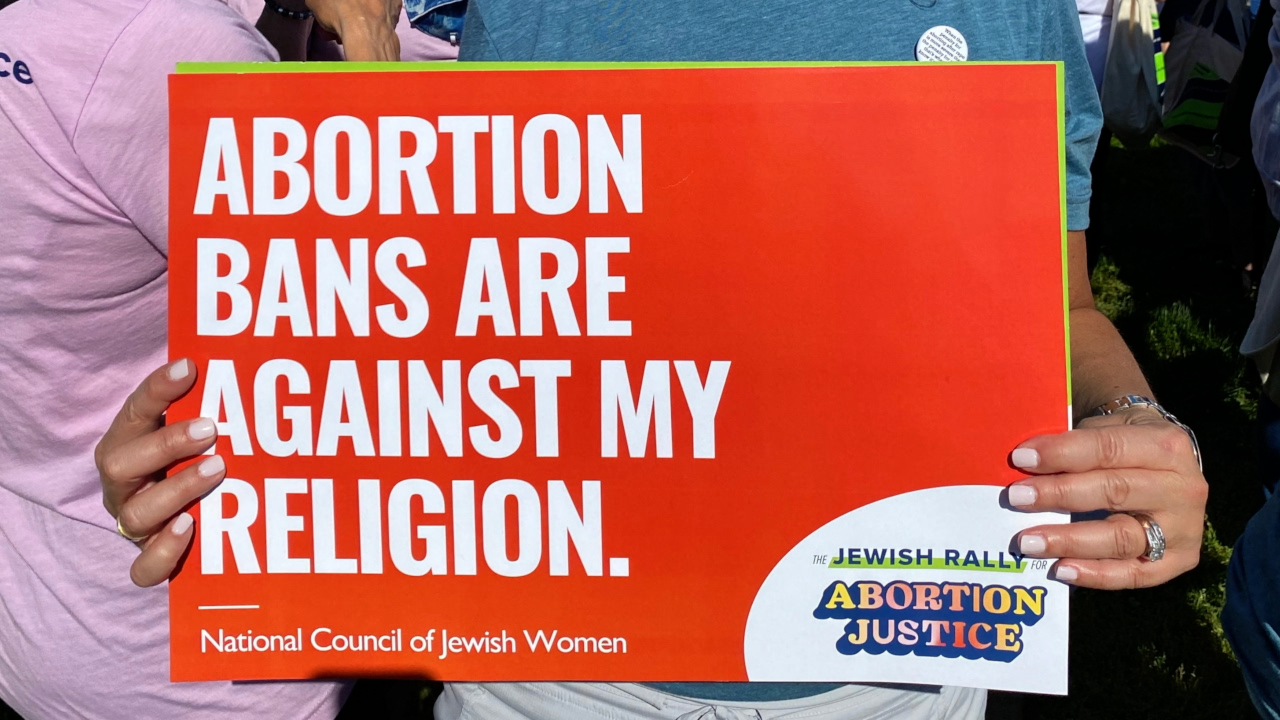
    Members of the Jewish community have spoken out against abortion bans in Ohio, saying it infringes on their religious freedom. Photo by Morgan Trau, WEWS.

    BY: ARIANA FIGUEROA – Ohio Capital Journal

    WASHINGTON — Thousands of years of Jewish scripture make it clear that access to abortion care is a requirement of Jewish law and practice, according to Rabbi Karen Bogard.

    “We preserve life at all costs,” she said in an interview with States Newsroom. “But there is a difference between that which is living, and that which is not yet living.”

    Bogard is a rabbi at Central Reform Congregation in St. Louis, which is in the  progressive tradition of Reform Judaism. She said that whether it’s the Torah — the first five books of the Old Testament in the Hebrew Bible — or the Talmud — the central text of Rabbinic Judaism and the primary source of Jewish religious law and theology — those pieces of Jewish literature “really draw the difference between life and potential life.”

    But with the fall of Roe v. Wade in late June, some members of the Jewish faith as well as other religious groups find their beliefs in deep conflict with state laws that ban or greatly restrict abortion — especially if a pregnant patient’s life is in danger.

    Since the Supreme Court’s Dobbs v. Jackson Women’s Health Organization decision, states now are permitted to craft their own laws regarding abortion, and in Bogard’s home state of Missouri, the procedure is banned.

    “Our congregants are heartbroken,” she said. “It’s really violating to be told what you can and can’t do with your own self.”

    Legal challenges are resulting. The enactment of state laws that ban or restrict access to abortion has already sparked a lawsuit in Florida from a liberal Jewish congregation in the Sunshine State. In Ohio, another liberal Jewish congregation is joining the American Civil Liberties Union in a lawsuit against the state’s six-week abortion ban.

    A coalition of three dozen rabbis also filed a brief on a separate lawsuit in the Buckeye State, where physicians are challenging the new abortion law in the Supreme Court of Ohio.

    Similar lawsuits are anticipated, not only from liberal Jewish congregations, but other religious groups as well.

    There’s currently a lawsuit in the U.S. District Court for the Southern District of Texas Houston Division filed by the Satanic Temple — not to be confused with the Church of Satan — on behalf of a member who argues the state’s abortion ban violates that temple member’s religious beliefs allowing access to an abortion ritual.

    The ritual involves members repeating verses in a mirror to affirm body autonomy and repel any guilt, shame or discomfort that can surface when undergoing an abortion.

    “There’s going to be a wave of religious freedom lawsuits,” Rabbi Daniel Bogard, who’s married to Rabbi Karen Bogard, said. “We’re going to find out if this country really believes in religious freedom, or whether this country believes in the freedom of a small minority to impose its will on the rest of us.”

    But it’s unclear if these religious-based lawsuits challenging state abortion laws can win in court.

    “We’re very much in the wild, wild west of abortion law and religious law,” said Candace Bond-Theriault, the director of racial justice policy and strategy at Columbia Law School’s Center for Gender and Sexuality Law.

    Jewish law

    According to Jewish law, a fetus is not considered a full human being and the biblical foundation for this is found in Exodus 21:22 of the Torah, Rabbi Daniel Bogard said.

    The translation reads: “When men fight, and one of them pushes a pregnant woman and a miscarriage results, but no other damage ensues, the one responsible shall be fined according as the woman’s husband may exact from him, the payment to be based on reckoning. But if other damage ensues, the penalty shall be life for life, eye for eye, tooth for tooth, hand for hand, foot for foot, burn for burn, wound for wound, bruise for bruise.…”

    Rabbi Daniel Bogard said that the Jewish legal interpretation of these passages states that a fetus is not a person, because the miscarriage results in only monetary compensation, rather than the “life for life” punishment.

    There are several other passages in Jewish literature that make the distinction that the life of the person who is pregnant is prioritized.

    “If we’re going to live in a religiously free society, we are each allowed to interpret these verses on our own for our own traditions and a minority in this country can’t impose their conservative white Christian religiosity on the rest of us,” Rabbi Daniel Bogard said.

    The lawsuits challenging abortion laws are predominately filed by congregations that practice Reform Judaism, but Conservative Judaism also supports access to abortion.

    The question of access to abortion gets more restrictive when it comes to Orthodox Judaism, but access to the medical procedure isn’t barred, says Yedida Eisenstat, a fellow at the Center for the Study of Law and Religion at Emory University in Atlanta.

    “Abortion in Judaism absolutely does have a place, and within Jewish law, there absolutely is a place for abortion,” she said. “Judaism is not anti-abortion, like Christianity is, so it absolutely does make sense for Jewish congregations to be saying, ‘Hey, this is a violation of our religious rights.’”

    Eisenstat specializes in Jewish biblical interpretation and also works as an editorial associate at the Posen Library of Jewish Culture and Civilization.

    “Judaism doesn’t have one voice or one opinion or one ruling about everything,” she said, adding that every situation is different and “there’s all this other gray area,” when it comes to theoretical cases in Jewish law pertaining to abortion.

    And interpretations on abortion in Jewish law, or Halacha, vary across American Jewish denominations.

    “We use the theoretical cases to illuminate other cases — just like in American law — so there isn’t one blanket answer for every situation, every situation has its own nuances,” she said. “And again, that’s why this is a decision, a very personal decision, not one that the government should be making.”

    The Rabbinical Assembly, a major institution of Conservative Judaism, condemned the Supreme Court’s ruling in Dobbs.

    “Denying individuals access to the complete spectrum of reproductive healthcare, including contraception, abortion-inducing devices and medications, and abortions, among others, on religious grounds, deprives those who need medical care of their Constitutional right to religious freedom,” the organization said in a statement.

    Orthodox Judaism is typically more aligned with Christian conservative views on religious liberty issues, Eisenstat said, but differs on the belief that life begins at conception.

    Following the Dobbs decision, the Rabbinical Council of America and Agudath Israel, large organizations that represent Orthodox Jewish communities, urged states to consider exceptions to expand abortion access.

    “As the debate over abortion rights enters this new phase, we encourage states to craft policies that will simultaneously express the great value we place on life as well as protecting the rights to abortion when warranted by Jewish law,” the Rabbinical Council of America said in a statement.

    Florida lawsuits

    Rabbi Barry Silver is a self-proclaimed “rabbi-rouser.”

    He’s an attorney, a social activist, a former Democratic legislator in the Florida House of Representative and the leader of the Congregation L’Dor va-Dor, a synagogue practicing progressive Judaism in Palm Beach, Florida.

    Silver, along with three rabbis, a United Church of Christ reverend, a Unitarian Universalist minister, an Episcopal Church priest and a Buddhist lama, each have filed separate lawsuits challenging the state’s 15-week abortion ban that went into effect July 1. Those suits argue that the new abortion law violates Florida’s state constitution, as well as U.S. constitutional protections for freedom of speech and religion.

    The suits also claim the law creates “substantial” burdens on individuals’ ability to practice their faith, and creates a “potential” burden on religious leaders to advise their members. Because of the vagueness of the law, Silver said, rabbis or other religious leaders who counsel their clergy members on abortion could face criminal charges.

    “It criminalizes the practice of Judaism as well as all the other religions that are not aligned with fundamentalist Christianity, which is pretty much everybody,” Silver said of Florida’s new abortion law.

    Silver’s Congregation L’Dor Va-Dor also filed a separate suit in June in state court that argues the 15-week abortion ban violates the right to privacy guaranteed by the Florida state constitution.

    “For Jews, all life is precious and thus the decision to bring new life into the world is not taken lightly or determined by state fiat,” according to the lawsuit. “As such, the act prohibits Jewish women from practicing their faith free of government intrusion and this violates their privacy rights and religious freedom.”

    Silver said he still plans to counsel his congregants who need or are considering abortion care, despite Florida’s new law.

    “We do the right thing and if they want to come after us, they can make our day, we’re not going to stop saying what we need to say. We’re not gonna stop practicing Jewish law,” he said.

    A spokesperson with GOP Gov. Ron DeSantis’ office did not answer questions from States Newsroom about whether the newly passed abortion law prevents Jewish people from practicing their faith.

    “Governor DeSantis is pro-life, and we believe HB 5 will ultimately withstand all legal challenges,” a spokesperson with DeSantis’ office wrote in an email to States Newsroom, referring to the abortion law. “The struggle for life is not over.”

    Congregation L’Dor Va-Dor’s suit claiming Florida’s constitution has an explicit right to privacy is “fairly straightforward, and would generally be unremarkable,” said Caroline Mala Corbin, a law professor at the University of Miami School of Law.

    “Under the existing law, it’s a no-brainer challenge,” Corbin said.

    She added that the Florida Supreme Court has interpreted that language to cover abortion.

    “Except that, like the U.S. Supreme Court, the Florida Supreme Court has taken a sharp turn to the right, so just as you have the U.S. Supreme Court completely remake abortion law, it’s a possibility the Florida Supreme Court will as well,” she said.

    Corbin said the court could rule several ways in the congregation’s case.

    “They might argue, ‘We question your sincerity,’ which would be shocking given how deferential they are to other claims of religious liberty,” she said.

    The court could also rule that the congregation did not prove Florida’s abortion law created a substantial burden, or that even if the law prevents someone from practicing their religion, “the state has a compelling reason for its law, and therefore, the state must prevail,” she said.

    “So the state might respond, even if this does affect your ability to live your religious truth, the state has a compelling interest in saving lives and therefore the state still prevails,” Corbin said.

    Future cases

    Micah Schwartzman, the director of the University of Virginia School of Law’s Karsh Center for Law and Democracy, and the Hardy Cross Dillard professor of law, said lawsuits brought on behalf of a group of people, like the one from Silver’s congregation in Florida, rather than a particular individual, will have more procedural hurdles to prove the group has standing to sue under state and federal law.

    “I’m not terribly confident about these early lawsuits,” Schwartzman said.

    He pointed to the case in Texas, the one by the Satanic Temple, which the religious organization filed in federal court on behalf of one of its members, and said he expects to see similar cases.

    “I think in the future, we’re going to see cases that are brought on behalf of particular individuals who are burdened by abortion restrictions or prohibitions,” he said. “And those types (of cases) will have a stronger chance of surviving the preliminary stages of litigation.”

    Schwartzman said there’s also the question of religious exemptions, particularly in states that have enacted trigger law bans or near total bans on abortion, and whether those laws impose a burden on people trying to practice their religion.

    State abortion laws are going to have some exemptions for abortion, he said, such as in cases of rape and incest and to protect the life and health of the mother.

    “And in those circumstances, courts are going to face the question if these laws have certain secular exceptions, why shouldn’t they also grant exceptions on religious grounds?” he said. “And I think that will be the structure of many challenges that we will see in the future.”

    Elizabeth Sepper, a religious liberty, health law and equality scholar at the University of Texas School of Law, said that over the last couple of decades the Supreme Court has “reduced the establishment clause to rubble,” which under the First Amendment prohibits the government from establishing a religion.

    When Roe v. Wade was initially issued, Congress passed the Hyde Amendment, which prohibits the use of federal funds to cover the cost of abortions, with some limited exceptions.

    Sepper said Congress’ decision to pass a restriction related to abortion in the case of the Hyde Amendment, is an example of “an establishment of religion because when legislators pass abortion bans that say ‘Well, human beings come into life at the moment of conception,’ that’s a doctrine — is a theological stance — that’s rooted in a particular religious faith, and we all know religious faith that is.”

    “I think some large segment of the population on both sides of the abortion issue understands (that) to be the truth, which is that many abortion bans require religious reasoning,” Sepper said.


  • U.S. Senate to try again on abortion rights after bombshell disclosure of draft opinion

    U.S. Senate to try again on abortion rights after bombshell disclosure of draft opinion

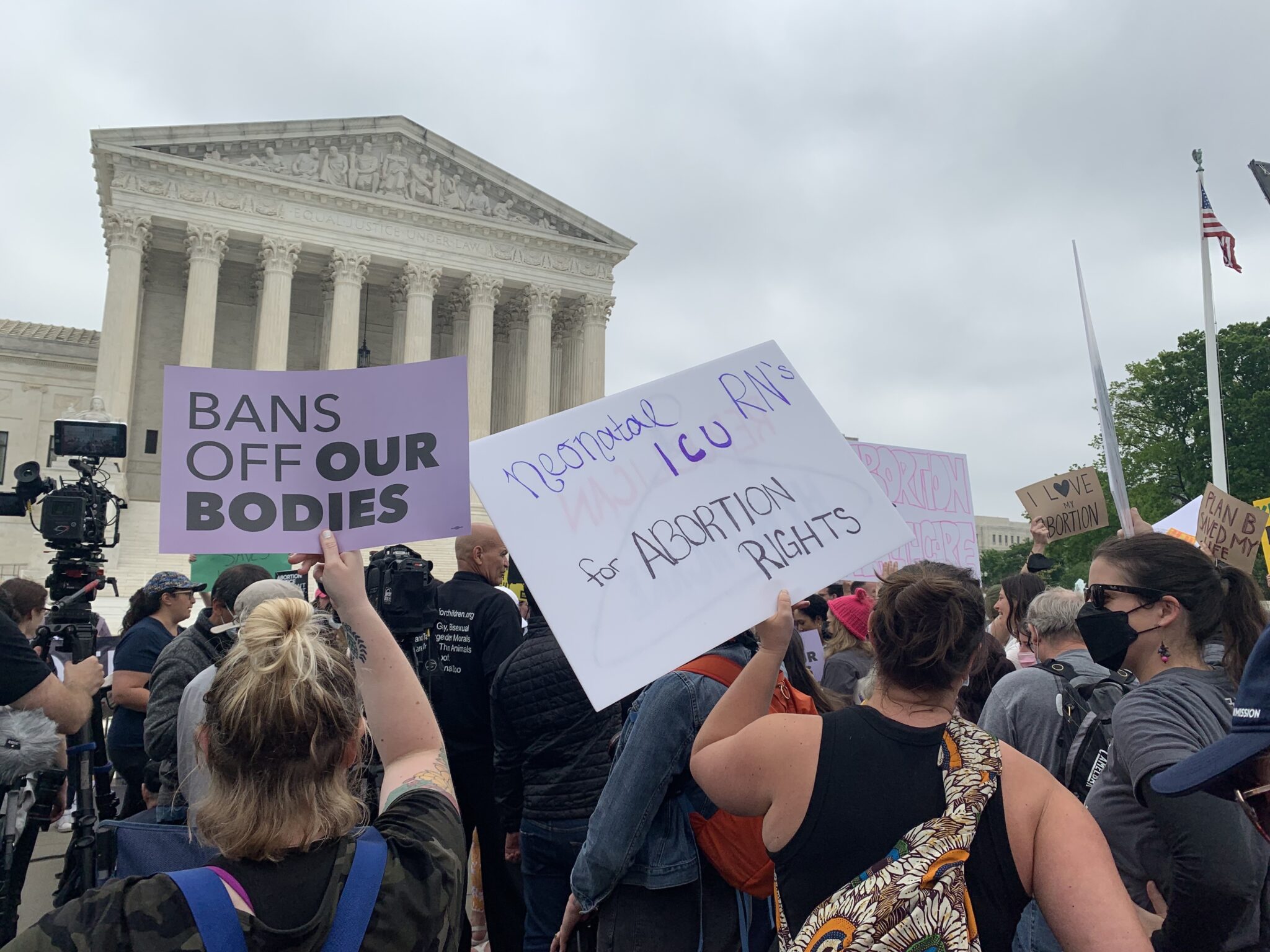
    Abortion rights activists protest outside the U.S. Supreme Court Tuesday. Photo by Jane Norman, States Newsroom.

    BY: JENNIFER SHUTT – Ohio Capital Journal

    WASHINGTON — U.S. Senate Democrats on Tuesday pledged a new vote codifying the right to an abortion after publication of a draft court ruling that showed the Supreme Court on track to overturn the landmark Roe v. Wade abortion decision.

    Democrats, who likely won’t have the votes to advance that bill, also predicted that abortion will emerge as a major issue in the upcoming midterm elections for members of Congress.

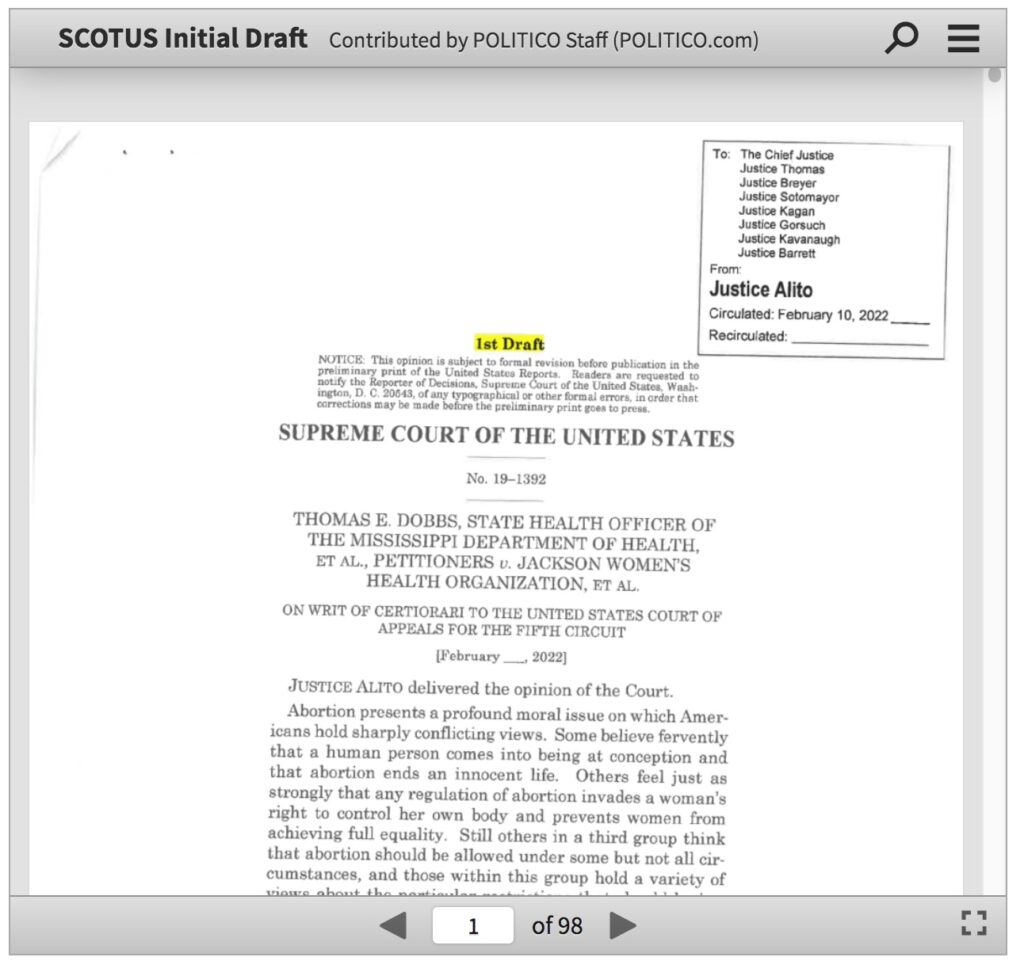
    Their comments came as abortion rights supporters across the United States reeled in reaction to the disclosure of the initial draft U.S. Supreme Court opinion, led by Justice Samuel Alito and leaked to Politico. While the court ruling is not final until published, the draft states that earlier abortion decisions “must be overruled.”

    Senate Majority Leader Chuck Schumer, a New York Democrat, said Tuesday he plans to release a new bill this week that senators will vote on next week to codify Roe v. Wade.

    But in the evenly divided Senate, it will run into problems getting past a legislative filibuster that requires 60 votes for legislation to advance.

    Were Roe v. Wade to be struck down by the court, which is dominated 6-3 by conservatives, the question would be left up to states, and more than two dozen Republican-led states have been racing to enact abortion bans and restrictions.

    Supreme Court Chief Justice John Roberts said the draft, published on Monday night, was authentic, though he cautioned it wasn’t the final opinion, and said he’d directed the Marshal of the Court to investigate the leak.

    Republicans called for the Justice Department to also investigate how the draft made its way to two journalists, saying the leak was a violation of the court’s judicial process.

    Roberts said the leak of the document was wrong.

    “Court employees have an exemplary and important tradition of respecting the confidentiality of the judicial process and upholding the trust of the Court,” Roberts said in the statement. “This was a singular and egregious breach of that trust that is an affront to the Court and the community of public servants who work here.”

    The court is expected to release its official ruling in the case, Dobbs v. Jackson Women’s Health Organization, within the next two months, though many organizations have long expected the six conservative justices to at least pare back the constitutional right to an abortion.

    Democratic senators on Tuesday said a final decision undoing the constitutional right to an abortion the Supreme Court established five decades ago would be unacceptable and harmful to women.

    Montana Democratic Sen. Jon Tester said letting each state, once again, set its own abortion laws would be a “step in the wrong direction.”

    “I think that a woman’s right to choose, a woman’s right to make their own health care decisions is really fundamental to who we are as a nation,” Tester said.

    Washington Democratic Sen. Patty Murray criticized the conservative justices for moving to undo nationwide protections for people seeking to terminate a pregnancy.

    “We do not want this to become a country where women are forced to remain pregnant no matter their personal circumstances and yes, we are talking about situations like rape and incest,” Murray said.

    “A country where extreme politicians will control patients’ most private decisions. A country where for the very first time ever the next generation of women will have fewer rights than their mothers.”

    Michigan Sen. Gary Peters, chair of the Democratic Senatorial Campaign Committee, said abortion rights will become a “major issue” in November’s midterms elections.

    “We’ve seen legislation being passed in state legislatures across the country to limit reproductive freedom for women. But there was always the belief that Roe versus Wade was there,” Peters said. “If Roe versus Wade is overturned, it’s a completely different ballgame.”

    60 votes needed

    In the Senate, Democrats would need 60 senators to vote to get past the legislative filibuster and actually pass legislation codifying abortion access throughout the country. Those votes would be required to end debate and move on to final passage, which is a simple majority vote.

    Peters, asked if Democrats could somehow get to a 60-seat majority in the midterm elections, said “it would be pretty difficult to get there.”

    While the entire U.S. House — an increasing number of whom represent gerrymandered districts — will be up for reelection in November, just one-third of the U.S. Senate will face voters.

    This year that will be 35 seats, with 14 occupied by Democrats and 21 filled by Republicans.

    The Cook Political Report with Amy Walter rates five of those races — Arizona, Georgia, Nevada, Pennsylvania and Wisconsin – as “toss up.” Florida, North Carolina and Ohio are classified as “lean Republican.”

    Senators’ positions 

    Georgia Sen. Raphael Warnock said he’s going to “do everything” he can to “support reproductive rights.”

    He’s one of many Senate Democrats who support eliminating the filibuster.

    “No Senate procedure should get in the way of basic civil rights — voting rights, reproductive rights,” Warnock said.

    Arizona Democratic Sen. Mark Kelly isn’t as convinced that the Senate should change its procedures, but didn’t rule out backing a change to how bills are processed.

    “If there is a proposal to change the rules, I will make a decision on what is in the best interest of the country and the folks I represent in Arizona,” Kelly said.

    Fellow Arizona Democratic Sen. Kyrsten Sinema doesn’t back such a change and neither does West Virginia Democratic Sen. Joe Manchin III.

    That means Senate Democrats don’t have the votes during this Congress to codify abortion rights or change the rules to make it easier to pass abortion rights legislation.

    If Democrats lose control of the Senate following the midterm elections, Republicans are expected to keep the filibuster in place.

    Minority Leader Mitch McConnell, a Kentucky Republican, said Tuesday he would “absolutely” commit to keeping it intact.

    “We don’t want to break the Senate and that’s breaking the Senate,” he said.

    McConnell declined to answer questions on how a final Supreme Court decision overturning Roe v. Wade would affect women throughout the country or whether he’d bring legislation to the floor to address federal abortion laws.

    “All of this puts the cart before the horse,” he said.

    National Republican Senatorial Committee Chairman Rick Scott, a Florida Republican senator, declined to say if the Supreme Court overturning abortion as a fundamental right would affect the election.

    “I think this is an important issue to many people, but so is inflation, so is crime, so is the border,” Scott said. “So, these are important to people and people are gonna be passionate about this. And we ought to be passionate about what we believe in.”

    Scott — who infuriated many fellow GOP senators earlier this year when he released an 11-point plan without leadership approval — declined to say if the GOP would try to pass a bill banning abortion nationwide if they gain control of the Senate in the midterms.

    “We’ll worry about that next year,” Scott said.

    ‘Inconsistent’ justices

    While many Senate Republicans oppose abortion rights and would support the Supreme Court overturning Roe v. Wade, two expressed frustration with the possibility.

    Maine Republican Sen. Susan Collins — who voted to confirm Neil Gorsuch and Brett Kavanaugh, but not Amy Coney Barrett— said in a statement that “If this leaked draft opinion is the final decision and this reporting is accurate, it would be completely inconsistent with what Justice Gorsuch and Justice Kavanaugh said in their hearings and in our meetings in my office.”

    Collins declined to answer reporters’ questions throughout the morning, simply saying she’d released a statement.

    Alaska GOP Sen. Lisa Murkowski — who supported Gorsuch and Barrett, but not Kavanaugh — told reporters that certain justices voting to overturn precedent would erode her confidence in the court.

    “If in fact this draft is where the Court ends up being, it has rocked my confidence in the court. That is because I think there were some representations made with regards to precedent and settled,” said Murkowski. “Comments were made to me and to others about Roe being settled and being precedent.”

    When the Senate took a procedural vote in February on a House-passed bill that would codify the right to an abortion, Collins, Murkowski and Manchin all voted against moving to final passage.

    Schumer said he expects a new vote could be different from the one taken just over two months ago.

    “It’s a different world now, the tectonic plates of our politics on women’s choice and on rights in general are changing,” Schumer said.

    “Every senator, now under the real glare of Roe v. Wade being repealed by the courts, is going to have to show which side they’re on. And we will find the best way to go forward after that. But don’t think that what happened two (months) ago will be exactly the same.”