Tag: Youngstown State University

  • Opponents of new Ohio higher education law don’t have enough signatures to get a referendum

    Opponents of new Ohio higher education law don’t have enough signatures to get a referendum

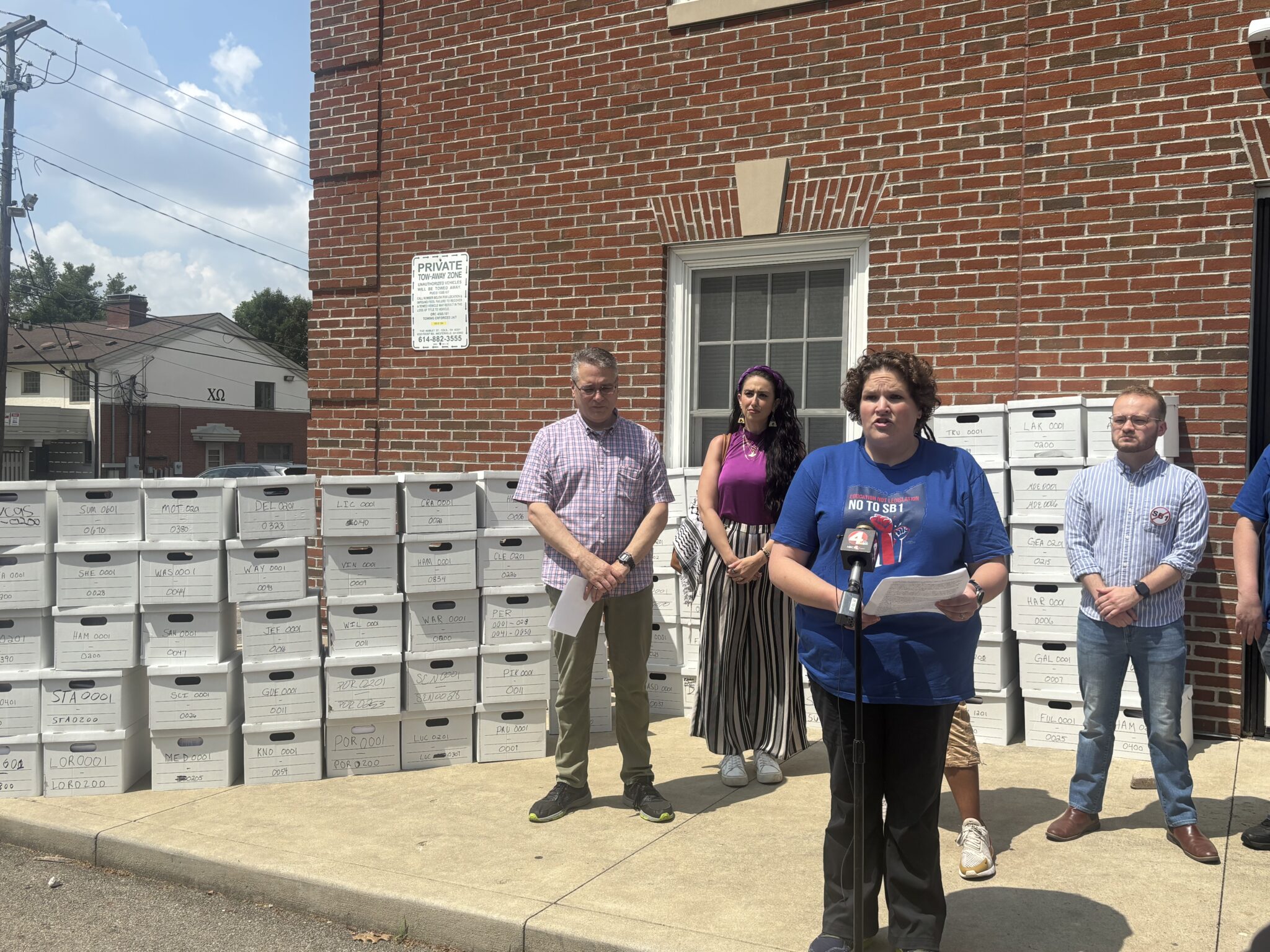
    Amanda Fehlbaum, one of three Youngstown State University faculty members who tried to get referendum on the Nov. 4 ballot to stop Senate Bill 1, spoke at a press conference on June 26. (Photo by Megan Henry, Ohio Capital Journal).

    By:  Ohio Capital Journal

    Opponents of Ohio Republican lawmakers’ higher education overhaul that bans diversity efforts and faculty strikes, and sets rules around classroom discussion, have failed to collect enough signatures to put a referendum on the ballot this year to block it.

    Members of the Youngstown State University’s chapter of the Ohio Education Association tried to get a referendum on the Nov. 4 ballot to stop Ohio Senate Bill 1, but said they ultimately ran out of time.

    GET THE MORNING HEADLINES.


    “Over the course of the last few days, we were collecting over 4,000 signatures a day, and that momentum was only increasing,” said Youngstown State’s Ohio Education Association President Mark Vopat. “It was only because we ran out of time that we weren’t able to get the required signatures. … I believe that if we’d had just a little bit more time, we could have gotten those numbers.”

    They needed to collect about 248,092 signatures from at least 44 of Ohio’s 88 counties — 6% of the total vote cast for governor during the last gubernatorial election.

    Instead, they collected nearly 195,000 signatures and met the signature requirements in at least 33 counties, said Amanda Fehlbaum, a Youngstown State faculty member who helped champion efforts to get a referendum.

    The plan was to submit the collected signatures to Ohio Secretary of State Frank LaRose on Thursday for him to verify the signatures. This was the deadline to submit signatures since the law goes into effect Friday.

    The new law creates post-tenure reviews, puts diversity scholarships at risk, sets rules around classroom discussion, and creates a retrenchment provision that blocks unions from negotiating on tenure, among other things. The law affects Ohio’s public universities and community colleges.

    “One thing is clear in all of this, the people do not want politicians making decisions about higher education,” Fehlbaum said. “The people do not like this legislation.”

    S.B. 1 quickly passed through the legislature earlier this year and Ohio Gov. Mike DeWine signed the bill into law on March 28.

    Fehlbaum said she thought another group “with infrastructure and funding” would come forward to challenge S.B. 1 after DeWine signed it into law, but that never happened so they decided to go the referendum route.

    Vopat and Fehlbaum along with fellow Youngstown State faculty member Cryshanna Jackson Leftwich started the referendum process in mid-April and Ohio Attorney General Dave Yost and the Ohio Secretary of State’s office gave them approval to start collecting signatures May 5.

    “I do think we could have pulled this off had we not wasted two weeks waiting on another group or groups to come forward,” Fehlbaum said.

    Vopat agrees they would have been able to get enough signatures if they had started the referendum process immediately after DeWine signed the bill into law.

    “That might have also given us the extra time we needed,” he said.

    The three Youngstown State faculty members said they are figuring out next steps and considering efforts to potentially try to get on the ballot in 2026.

    “This is not the end for us,” Jackson Leftwich said. “I want people to know that we’re going to use this momentum.”

    More than 1,700 people volunteered to collect signatures across the state. They ended up raising more than $43,000 in small dollar donations with $1,000 being their largest donation, Fehlbaum said.

    “I cannot underscore how much we did not have money,” she said. “We did not have paid consultants. We did not have paid petitioners. None of us are getting paid. …  There’s no dark money here.”

    But they said it ultimately came down to a lack of time, not a shortage of money.

    “I would love to take these boxes of petitions and put them on Jerry Cirino’s front door as a visible symbol of how detested this legislation is by the people,” Fehlbaum said. “We’re instead going to spend some of our remaining campaign funds on a shredding service so that information voters shared with us will not be mishandled.”

    Cirino is the Republican Ohio state senator who introduced S.B. 1.

    Some of Ohio’s public universities have started making decisions because of the new law. Ohio University announced it will close the Pride Center, the Women’s Center, and the Multicultural Center.

    The University of Toledo is suspending nine undergraduate programs. Kent State University is closing its LGBTQ+ Center, Women’s Center, and Student Multicultural Center.

    Referendums are rare and the last one that passed in Ohio was when voters overturned an anti-collective bargaining law in 2011.

    Follow Capital Journal Reporter Megan Henry on Bluesky.c


    Megan Henry
    Megan Henry

    Megan Henry is a reporter for the Ohio Capital Journal and has spent the past five years reporting in Ohio on various topics including education, healthcare, business and crime. She previously worked at The Columbus Dispatch, part of the USA Today Network.

    Ohio Capital Journal is part of States Newsroom, the nation’s largest state-focused nonprofit news organization.

    MORE FROM AUTHOR

  • Former Ohio State football coach Jim Tressel confirmed as Ohio lieutenant governor

    Former Ohio State football coach Jim Tressel confirmed as Ohio lieutenant governor

    By:  Ohio Capital Journal

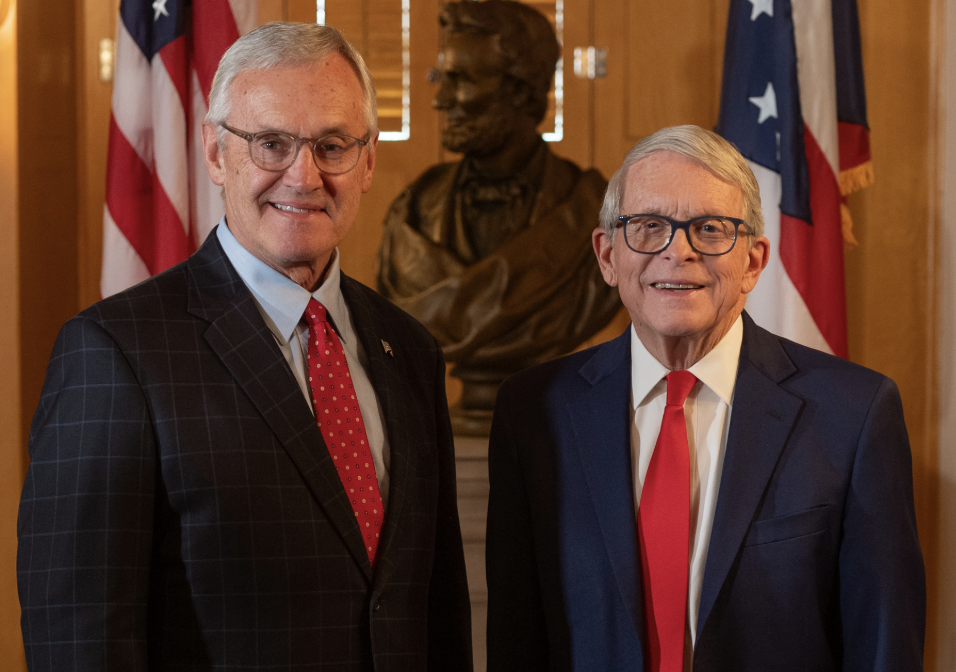
    Former Ohio State football coach Jim Tressel has been officially confirmed by the General Assembly as Ohio Gov. Mike DeWine’s lieutenant governor.

    DeWine announced Tressel, 72, as his pick for lieutenant governor on Monday and needed the House and the Senate to confirm the pick. Tressel has never held a political position before.

    The Senate voted 31-1 and the House voted 68-27 during Wednesday’s sessions to make Tressel’s appointment official.

    State Sen. Beth Liston, D-Dublin, voted against the appointment. All 27 opposed votes in the House were from Democrats, but a handful of Democrats voted in support of Tressel’s appointment.

    Tressel replaces former Lt. Gov. Jon Husted, whom DeWine appointed to the U.S. Senate last month to fill Vice President J.D. Vance’s Senate vacancy.

    GET THE MORNING HEADLINES.


    DeWine celebrated Tressel’s confirmation in a post on X, formerly known as Twitter.

    “Congratulations to Jim Tressel on being confirmed by the Ohio General Assembly to become the next lieutenant governor! He brings a wealth of knowledge to the position and will serve Ohio with distinction,” DeWine said in his post.

    Tressel is best known for his time as the head football coach of the Ohio State Buckeyes from 2001-2010, including winning the 2002 national championship. He then went on to serve as the president of Youngstown State University from 2014-2023. Before his time at Ohio State, he was the head football coach at Youngstown State for 15 years.

    Tressel is from Mentor and graduated with a degree in education from Baldwin Wallace University, where he played quarterback on the football team.

    “He’s widely known, obviously, for his activities on the gridiron, being one of the most successful college football coaches of the last 20 years or so,” said Senate President Rob McColley, R-Napoleon. “He’s also widely known, even more importantly, for the mentorship that he provided to countless young men and young women who were part of the Ohio State football program during that time period.”

    McColley went on to call Tressel one of the “greatest leaders we’ve had in our state.”

    State Sen. Al Cutrona, R-Canfield, said he has seen firsthand how Tressel has transformed the part of the state he represents.

    “He brings about passion for workforce development and higher education,” Cutrona said. “(Tressel) brings out the very best in every person that he meets, and, I believe, he will bring out the very best in Ohio as our next lieutenant governor.”

    Senate Minority Leader Nickie J. Antonio, D-Lakewood, had a chance to talk with Tressel before the Senate vote.

    “My caucus is very hopeful that Jim Tressel will provide through his expertise and experiences in higher ed that they’re hopeful that he will bring some balance and some inside experience and expertise on higher ed to the administration,” she said.

    Over in the House, state Rep. Phil Plummer, R-Dayton, spoke in favor of Tressel’s confirmation.

    “I, along with many of our colleagues, instantly agreed that that was the right pick because Jim Tressel is a winner, he’s a leader and he’s a champion for the people of Ohio,” he said.

    State Rep. Juanita O. Brent, D-Cleveland, voted against Tressel’s confirmation due to his involvement in helping pass a 2015 law that allows the state to take control over school districts with low standardized test scores.

    “The Academic Distress Commission has kept schools like in my district — East Cleveland, Lorain, Youngstown — under the control of the state, is taking away parental choice … is taking away the voice of our school board members,” Brent said. “And the person behind all of this is the person who’s now trying to be appointed to our lieutenant governor.”

    Follow Capital Journal Reporter Megan Henry on Bluesky.


    Megan Henry
    Megan Henry

    Megan Henry is a reporter for the Ohio Capital Journal and has spent the past five years reporting in Ohio on various topics including education, healthcare, business and crime. She previously worked at The Columbus Dispatch, part of the USA Today Network.

    Ohio Capital Journal is part of States Newsroom, the nation’s largest state-focused nonprofit news organization.

    MORE FROM AUTHOR

  • 12 race-based scholarships worth $46,000 weren’t awarded to Ohio University journalism students

    12 race-based scholarships worth $46,000 weren’t awarded to Ohio University journalism students

    That’s only a fraction of $450,000 worth of scholarship money at OU that’s under review after advice from Ohio Attorney General Dave Yost.

    BY:  Ohio Capital Journal

    Twelve race-based scholarships totaling $46,000 weren’t given out at Ohio University’s E.W. Scripps School of Journalism’s awards banquet this week, said Journalism School Director Eddith Dashiell.

    And that’s only a fraction of the 130 gift agreements that represent $450,000 worth of scholarship money under review by the university after comments Ohio Attorney General Dave Yost made about race-based scholarships after the U.S. Supreme Court ruled against race-conscious admissions.

    “I’m disappointed that the university chose this route,” Dashiell said to the Ohio Capital Journal. “It would have been a clear, very easy way to demonstrate their true commitment to diversity and by cowardly cowering to one person’s opinion about how to interpret the U.S. Supreme Court’s decision has resulted in at least 12 of our students not getting scholarships they need.”

    Ohio University’s scholarship review is ongoing, university spokesperson Dan Pittman said in an email.

    “It would be premature for us to speculate on any potential outcomes, including the scope of impacted scholarships and/or gift agreements,” Pittman said.

    Dashiell said it’s misleading for a university to say the scholarships are still under review at the tail end of spring semester.

    “To me, when the university says their official position is the scholarships are still under review, that is code for they haven’t been given out,” she said. “Scholarship season is over. … The decision has already been made.”

    The Capital Journal reported in March that at least seven Ohio public universities — including OU — are reviewing scholarships. The other universities include Cleveland State University, Kent State University, the University of Akron, the University of Toledo, Youngstown State University and Ohio State University. Bowling Green State University is also reviewing race-based scholarships.

    Cleveland State University said the scholarships in questions remain under review and Bowling Green said it “continues to evaluate next steps.” The rest of the universities did not respond by the Capital Journal’s deadline.

    Dave Yost’s remarks

     Ohio Attorney General Dave Yost. (Photo by Morgan Trau, WEWS.) 

    The day after the Supreme Court decision, Yost sent a letter to Ohio colleges and universities saying his office won’t legally protect someone at a college or university who uses race as a factor.

    Race-based scholarships came up on a January call Yost had with universities — even though scholarships were not mentioned in the Supreme Court decision.

    “What was said in response to a question was after the recent Supreme Court decision, scholarships will need to be looked at to ensure compliance with the law,” Yost’s spokesperson Bethany McCorkle said in a Febuary email. “… Race-based scholarships discriminate on the basis of race in awarding benefits. Therefore, it would follow that such programs are unconstitutional.”

    Not long after that phone call, university faculty and staff across the state got wind that diversity scholarships were under review.

    “A public institution of higher education is … supposed to follow the law,” Dashiell said. “(OU is) following one man’s opinion of what the law is.”

    12 missing scholarships

    Dashiell compared this year’s list of journalism scholarships to last year’s list and noticed 12 scholarships were missing.

    “They aren’t there,” she said. “That’s more than under review. They made a decision. They deleted them.”

    OU’s journalism school is made up of 84% white students, Dashiell said.

    “The diversity scholarships weren’t created to keep white students from getting any money,” she said. “They were designed to help encourage African American students to come to a little bitty town called Athens, Ohio. … To say that these 12 scholarships somehow according to the Ohio Attorney General’s Office, somehow that these scholarships discriminate against whites, is so blatantly racist, I don’t even know how to explain that.”

    Dashiell apologized to the donors whose scholarships weren’t awarded in her speech during Tuesday’s awards banquet.

    “On behalf of the E. W. Scripps School of Journalism: To our donors, please accept our deepest apology for our inability to share your generosity with our students for next academic year,” she said.

    Some of the donors whose scholarships weren’t awarded include Pulitzer Prize winning journalist and columnist Clarence Page and former Washington Post ombudsman Andrew Alexander.

    Dashiell is worried how else the Supreme Court decision is going to be interpreted.

    “If it’s diversity scholarships this year, what are they going to pause next year?” she asked. How are they going to stretch the U.S. Supreme Court decision again?”

    Follow OCJ Reporter Megan Henry on X.


    Megan Henry
    MEGAN HENRY

    Megan Henry is a reporter for the Ohio Capital Journal and has spent the past five years reporting in Ohio on various topics including education, healthcare, business and crime. She previously worked at The Columbus Dispatch, part of the USA Today Network.

    Ohio Capital Journal is part of States Newsroom, the nation’s largest state-focused nonprofit news organization.

    MORE FROM AUTHOR

  • At least seven Ohio universities are reviewing race-based scholarships after Supreme Court ruling

    At least seven Ohio universities are reviewing race-based scholarships after Supreme Court ruling

    College students walk on campus. (Klaus Vedfelt/Getty Images)

    The University of Akron, the University of Toledo, Cleveland State University, Kent State University, Ohio University, Ohio State University and Youngstown State University all said they are in the process of reviewing their scholarships.

    BY:  – Ohio Capital Journal

    At least seven Ohio public universities are reviewing scholarships in the wake of comments Ohio Attorney General Dave Yost made about race-based scholarships after the U.S. Supreme Court ruled against race-conscious admissions.

    Cleveland State University, Kent State University, the University of Akron, the University of Toledo and Youngstown State University all said they are in the process of reviewing their scholarships. This is in addition to Ohio University and Ohio State University, as previously reported by the Capital Journal.

    “The University of Toledo has paused the distribution of scholarships that consider race as a part of their award criteria following the U.S. Supreme Court ruling on the use of affirmative action in higher education admissions,” university spokesperson Tyrel Linkhorn said in email.

    This affects 6% of Toledo’s nearly 1,200 donor-supported scholarships, which is worth $500,000, he said in an email.

    “The University and The University of Toledo Foundation are actively working with donors to explore potential revisions to scholarship agreements so we can continue to support our donors’ goals in a way that fully complies with the Supreme Court decision,” Linkhorn said in an email.

    Kent State and Youngstown State mentioned the Supreme Court case and “guidance from the state of Ohio” as reasons for their review. Cleveland State just mentioned the Supreme Court case and Akron didn’t give a specific reason.

    The Capital Journal previously reported that Ohio University is “temporarily pausing” awarding race-based diversity scholarships and that Ohio State University is in the “process of updating scholarship criteria to ensure compliance with the law,” according to the university’s website.

    Ohio University has 130 gift agreements that are currently under review that represent $450,000 in potential scholarship awards, university spokesperson Dan Pittman said in an email.

    “The review is to ensure language in the gift agreements remains lawful,” Pittman said. “If deemed necessary, the University will work with donors to make revisions to language in the agreements.”

    Ohio State University expects to give away approximately $448 million dollars in financial aid this fiscal year, university spokesperson Ben Johnson said in an email.

    Bowling Green State University, Miami University, Northeast Ohio Medical Center, Shawnee State University, the University of Cincinnati and Wright State University did not answer questions about the status of their race-based scholarships.

    A university spokesperson for Central State University, Ohio’s only public historically Black university, said in email they don’t have race based scholarships.

    Supreme Court decision

    The U.S. Supreme Court. (Al Drago/Getty Images)
     The U.S. Supreme Court. (Al Drago/Getty Images) 

    Last summer, the U.S. Supreme Court ruled Harvard and the University of North Carolina violated the equal protections clause of the 14th Amendment by using race as a factor in applications.

    The next day, Yost sent a letter to Ohio colleges and universities saying “employees must immediately cease considering race when making admissions decisions,” according to the letter. It also said his office won’t legally protect someone at a college or university who uses race as a factor.

    The topic of race-based scholarships came up on a Jan. 26 call with universities, said Yost’s spokesperson Bethany McCorkle.

    “What was said in response to a question was after the recent Supreme Court decision, scholarships will need to be looked at to ensure compliance with the law,” McCorkle said in an email. “Although the Court did not expressly prohibit race-based scholarships, it indicated that ‘eliminating racial discrimination means eliminating all of it.’ Race-based scholarships discriminate on the basis of race in awarding benefits. Therefore, it would follow that such programs are unconstitutional.”

    The Harvard Supreme Court decision is being “weaponized to intimidate and create fear,” said Sara Kilpatrick, executive director of the Ohio Conference of the American Association of University Professors.

    “We obviously disagree with the Harvard decision, and we also disagree with how the Attorney General is trying to extrapolate it to apply to virtually anything that touches race,” she said. “We hope that institutions are not being pushed into a direction that ultimately will harm students.”

    If race-based scholarships are removed from universities, Kilpatrick said it could prevent Ohio students from earning degrees.

    “This is a dangerous slippery slope, and they should be cautious about how far they’re trying to push this,” she said. “This will undoubtedly dry up desperately needed revenue streams for institutions.”

    Follow OCJ Reporter Megan Henry on X.


    Megan Henry
    MEGAN HENRY

    Megan Henry is a reporter for the Ohio Capital Journal and has spent the past five years reporting in Ohio on various topics including education, healthcare, business and crime. She previously worked at The Columbus Dispatch, part of the USA Today Network.

    MORE FROM AUTHOR