Year: 2024

  • Before leaving Washington, Ohio Sen. Sherrod Brown restores retirement benefits for public workers

    Before leaving Washington, Ohio Sen. Sherrod Brown restores retirement benefits for public workers

    By:  Ohio Capital Journal

    On his way out of town, Ohio Democratic U.S. Sen. Sherrod Brown was able to notch one final long-sought legislative victory that will benefit public sector workers in Ohio and around the country. The Social Security Fairness Act ensures former government workers like police, firefighters and teachers can collect their full retirement benefits by repealing two provisions that reduce social security payouts.

    Many public sector workers aren’t covered by Social Security because their employer runs a pension program for their retirement. But eventually, a lot of those workers move on to other jobs that do pay into the Social Security system. Even though many of them end up working the requisite 40 quarters to be fully eligible for Social Security benefits, the program reduces their payouts because they’re also collecting retirement benefits from their other pension program.

    GET THE MORNING HEADLINES.


    William Johnson, who heads up the National Association of Police Organizations explained, “Most police officers must retire after specific time served, usually in their early to mid-fifties, (but) many look for new opportunities to serve their community.”

    Those workers are penalized by what’s known as the Windfall Elimination Provision, he explained.

    “Instead of receiving full support from their rightfully earned Social Security retirement benefit, their pension heavily offsets it, thus vastly reducing the amount they receive,” Johnson said.

    Surviving spouses can come off even worse though. The Government Pension Offset requires reductions in Social Security dependent benefits if one spouse receives benefits from a public pension. Johnson argued that offset often results in “eliminating most or all of the payment.”

    Those provision were approved by lawmakers in the 1970s and 80s in a bid to keep the program solvent.

    In all, Brown’s office said, the reductions affect 3 million Americans including almost a quarter million Ohioans.

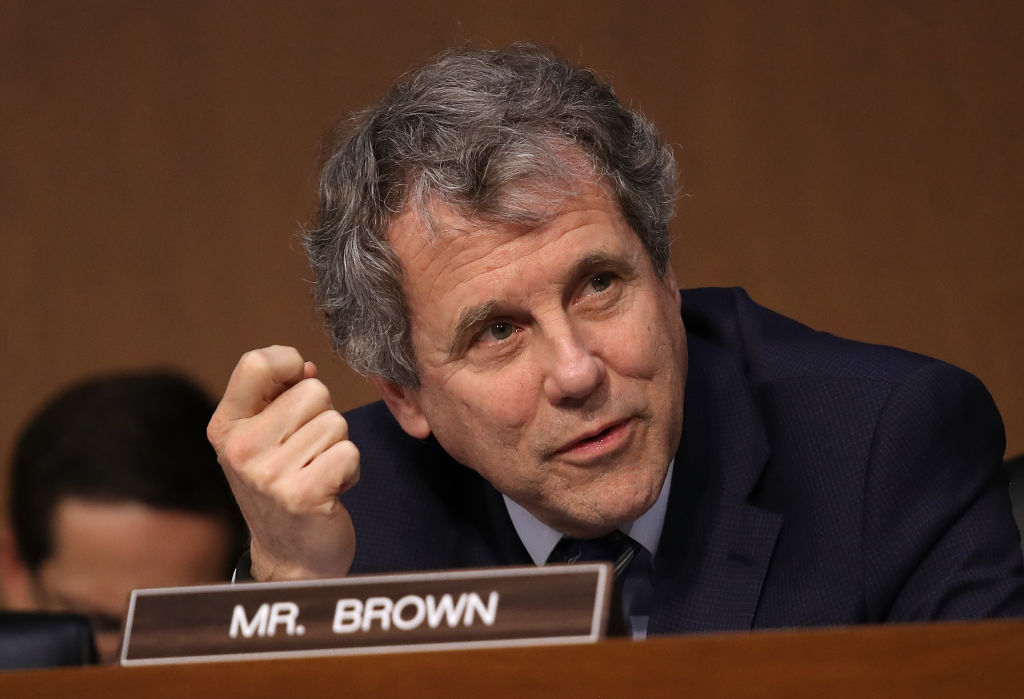
     U.S. Sen. Sherrod Brown, D-OH, leading a panel discussion on public workers’ Social Security benefits. (Photo by Nick Evans for Ohio Capital Journal.) 

    How we got here

    Following an election in which Republicans criticized Brown’s long service in Washington, passage of the Social Security Fairness Act offers one data point in favor of experience. Brown held a field hearing in Columbus discussing the proposal earlier this year and he’s been working to pass it since serving in the U.S. House of Representatives.

    He last served in that chamber 17 years ago.

    In a press release following the vote Brown described working for years to eventually cobble together more than 60 cosponsors.

    “We have spent decades working to pass this legislation and tonight is a victory for all the public servants who will finally get the Social Security they have earned,” he said. “Tonight, Congress ensured that police officers, firefighters, teachers, and public servants across Ohio will be able to retire with the Social Security they spent their lives paying into.”

    Brown’s effort has also been the beneficiary of shifting attitudes in the Republican Party. For many, many years, a core tenet of Republican politics was searching for a way to get Social Security spending under control. Former House Speaker Paul Ryan’s chief legislative goal was privatizing the program. More recently U.S. Sen. Rick Scott, R-FL, proposed a Rescue America Plan in 2023 that would sunset Social Security and Medicare.

    But since the emergence of Donald Trump as the leader of the Republican Party, efforts to overhaul the retirement program have largely taken a back seat. Within weeks of introducing his plan, for instance, Scott backtracked on sunsetting Social Security and Medicare. Last week, he even voted in favor of the Social Security Fairness Act.

    It’s not hard to see why. With Trump leading the party there’s no longer a top-down rhetorical push for cutting spending on a popular program. At the same time, traditionally Republican-leaning constituencies like police have a strong case that it’s unfair to limit Social Security benefits they earned simply because they earned other benefits from a different career.

    All the same, the measure does nothing to improve the long-term balance sheet for Social Security. The most recent report on the Social Security Trust Fund puts its depletion date at 2033. Meanwhile, although Trump has not proposed cutting retirement benefits he has proposed cutting the taxes that pay for that trust fund—potentially burning through its reserves more quickly.

    Reactions

    In the moment however, passage of the bill was met with praise from organizations representing public sector workers. National Fraternal Order of Police President Patrick Yoes argued the WEP and GPO are “inherently unfair provisions that unjustly penalize our nation’s public employees.”

    “No one, even those who did not vote for our bill today, argued that the provisions treated workers fairly,” he went on. “If this scheme were being run by a pension board or private money management group, instead of the social security administration, they would not call it an elimination of a windfall or an offset — it would be considered embezzlement.”

    International Association of Fire Fighters General President Edward Kelly chimed in that “for over 40 years,” firefighters and other public workers have had retirement benefits “stolen” by Congress.

    “But today,” he said, “the United States Senate, in a rarely seen bipartisan effort, stood up to say, ‘No more,’ voting to ensure retirees finally get the benefits they paid into and earned.”

    Ohio Education Association President Scott DiMauro said, “for too long, the federal government has failed to provide the full Social Security benefits many public school educators earned.”

    “For too long,” he added, “potentially great educators have chosen not to enter this profession because they would lose much of the Social Security benefits they had previously earned if they entered a life of public service. That changes now.”

    Follow OCJ Reporter Nick Evans on Twitter.

    YOU MAKE OUR WORK POSSIBLE.

    ______________
    Nick Evans
    Nick Evans

    Nick Evans has spent the past seven years reporting for NPR member stations in Florida and Ohio. He got his start in Tallahassee, covering issues like redistricting, same sex marriage and medical marijuana. Since arriving in Columbus in 2018, he has covered everything from city council to football. His work on Ohio politics and local policing have been featured numerous times on NPR.

    Ohio Capital Journal is part of States Newsroom, the nation’s largest state-focused nonprofit news organization.

    MORE FROM AUTHOR

  • Habitat for Humanity: Honoring the life of service of President Jimmy Carter

    Habitat for Humanity: Honoring the life of service of President Jimmy Carter


    Habitat for Humanity joins the world in mourning the death of former U.S. President Jimmy Carter. A champion for affordable and decent housing, he and Rosalynn Carter donated their time and leadership each year to build and improve homes with Habitat around the world. President Carter died peacefully Sunday, Dec. 29, at his home in Plains, Georgia, surrounded by his family.

    “We are deeply saddened by President Carter’s passing, and our prayers are with the Carter family,” said Jonathan Reckford, CEO of Habitat for Humanity International. “President and Mrs. Carter began volunteering with Habitat for Humanity near their home in southwest Georgia more than 40 years ago, and soon brought worldwide attention to the need for decent and affordable housing. We are grateful for the incredible impact the Carters have had on Habitat and on the families who have benefited from their shining example. The Carters put Habitat for Humanity on the map, and their legacy lives on in every family we serve around the world.”

    After leaving the White House, the Carters sought out meaningful ways to continue their commitment to social justice and basic human rights. They first volunteered with Habitat for Humanity in Americus, Georgia, near their home of Plains, in March 1984. Later that same year, the Carters joined Habitat volunteers in New York City’s Lower East Side to renovate an abandoned building in partnership with families in need of affordable housing. That trip marked Habitat for Humanity’s first Jimmy Carter Work Project (later renamed the Jimmy & Rosalynn Carter Work Project). Each year since then until 2019, the Carters volunteered with Habitat to build or improve houses alongside homeowners in communities across the United States and around the world. President Carter also served as a member of the organization’s board of directors from 1984-1987.

    “I think every human being has within himself or herself a desire to reach out to others and to share some of our blessings with those who are in need,” President Carter has said. “What’s opened up that avenue for me and my wife and hundreds and thousands of others is Habitat for Humanity. It makes it easy for us to reach out and work side by side with the homeowner who’s never had a decent house, perhaps. I haven’t been on a Habitat project that I wasn’t thrilled and inspired and wept.”

    Over the last three decades, the Carter Work Project has touched lives around the world by inspiring more than 108,000 volunteers across the U.S. and in 14 countries to build, renovate and repair 4,447 Habitat homes. Since its founding in 1976, Habitat has served more than 62 million people around the world.

    In 2016, Habitat named President and Mrs. Carter as the inaugural Habitat Humanitarians for their extraordinary dedication to service in alignment with Habitat’s vision of a world where everyone has a decent place to live.

    Habitat for Humanity will be celebrating President Carter’s life of service with local observances. To learn more or to share a tribute, visit habitat.org.

    For photos and videos of President and Mrs. Carter volunteering with Habitat for Humanity, visit habitat.ngo/cwpphotos.

    ____________________

    Carter Work Projects through the years

    In September of 1984, former U.S. President Jimmy Carter and former first lady Rosalynn Carter led a group of Habitat for Humanity volunteers to New York, building alongside 19 families in need of safe, affordable housing. That was the inaugural Carter Work Project, which is now a weeklong event somewhere around the world each year.

    Since 1984, President and Mrs. Carter have been building and advocating for affordable housing alongside Habitat for Humanity for over 30 years. Journey through the incredible legacy of Carter Work Projects!

    Learn more

    Rosalynn Carter’s impact on Habitat

    For more than three decades Rosalynn Carter and her husband former U.S. President Jimmy Carter donated their time and voices to help Habitat build alongside families across the globe. Together, the Carters traveled 167,279 miles worldwide, building with future homeowners and fellow Carter Work Project volunteers and raising awareness for Habitat’s mission.

    Look back on Mrs. Carter’s extraordinary legacy and hands-on commitment to Habitat’s mission.

    Read stories

    Honoring a legacy

    Your donation will help Habitat honor President Carter’s legacy by continuing to work towards our shared vision of a world where everyone has a decent place to live.

    Donate

    Stories of service

    Hear from homeowners and volunteers who worked alongside President Carter and learn more about all he helped Habitat accomplish.

    Learn more

    Habitat Humanitarians: The Carters

    Since 1984, President and Mrs. Carter have been champions and groudbreaking voices for affordable, decent housing for all, donating their time and leadership each year to build and improve homes through Habitat’s Carter Work Project.

    Read more


  • Former U.S. President Jimmy Carter Passes Away at 100

    Former U.S. President Jimmy Carter Passes Away at 100

    ATLANTA (Dec. 29, 2024) — Jimmy Carter, 39th president of the United States and winner of the 2002 Nobel Peace Prize, died peacefully Sunday, Dec. 29, at his home in Plains, Georgia, surrounded by his family. He was 100, the longest-lived president in U.S. history.

    President Carter is survived by his children — Jack, Chip, Jeff, and Amy; 11 grandchildren; and 14 great-grandchildren. He was preceded in death by his beloved wife, Rosalynn, and one grandchild.

    “My father was a hero, not only to me but to everyone who believes in peace, human rights, and unselfish love,” said Chip Carter, the former president’s son. “My brothers, sister, and I shared him with the rest of the world through these common beliefs. The world is our family because of the way he brought people together, and we thank you for honoring his memory by continuing to live these shared beliefs.”

    There will be public observances in Atlanta and Washington, D.C., followed by a private interment in Plains, Georgia. The final arrangements for President Carter’s state funeral, including all public events and motorcade routes, are still pending. The schedule will be released by the Joint Task Force-National Capital Region at https://jtfncr.mdw.army.mil/statefunerals/.

    Members of the public are encouraged to visit the official tribute website to the life of President Carter at www.jimmycartertribute.org. This site includes the official online condolence book as well as print and visual biographical materials commemorating his life.

    The Carter family has asked that in lieu of flowers, donations be made to The Carter Center, 453 John Lewis Freedom Parkway N.E., Atlanta, GA 30307.

    ________________

    The Carter Center

    Waging Peace. Fighting Disease. Building Hope.

    A not-for-profit, nongovernmental organization, The Carter Center has helped to improve life for people in over 80 countries by resolving conflicts; advancing democracy, human rights, and economic opportunity; preventing diseases; and improving mental health care. The Carter Center was founded in 1982 by former U.S. President Jimmy Carter and former First Lady Rosalynn Carter, in partnership with Emory University, to advance peace and health worldwide.

    Jimmy Carter Presidential Library and Museum

    [pdf-embedder url=”https://lovelandmagazine.com/wp-content/uploads/2024/12/jimmy-carter-biography.pdf”]

  • Council votes pay raise for future members

    Council votes pay raise for future members

    Loveland, Ohio – On November 26, City Council heard a second reading of Ordinance 2024-92 and voted unanimously to approve a pay raise for future, next elected council members.

    Background

    Salaries raise possible for next elected council


  • Ohio law aims to reduce license suspensions

    Ohio law aims to reduce license suspensions

    By:  Ohio Capital Journal

    The Ohio Poverty Law Center is praising a bill passed in the lame-duck session of the Ohio General Assembly that is intended to reduce the huge number of Ohioans whose driver’s licenses are suspended because of unpaid debts or drug offenses. The bill awaits Gov. Mike DeWine’s signature.

    In a state so poor that a fourth of Ohioans are on Medicaid, 1 million have suspended licenses because of debts from things such as a lack of insurance, unpaid fines and court costs, according to a 2022 analysis by the Legal Aid Society of Cleveland.

    “Debt-related suspensions trap drivers with limited resources in a vicious cycle,” the report said. “Fines and fees related to seemingly minor traffic stops can easily spiral into thousands of dollars owed to the state. Drivers unable to pay these debts cannot get their licenses back, which for most Ohioans means they cannot drive to work to earn the money needed to pay down the debt, without risking even more driving restrictions, fines, fees, or even jail.”

    The suspensions are concentrated most heavily in impoverished urban communities of color, the analysis found. Not only is that bad news for poor people needing to get to work and businesses in need of employees, it risks disenfranchising thousands under Ohio’s strict voter ID law.

    But new legislation, House Bill 29, prevents many debt and drug-related license suspensions. The bill, sponsored by Reps. Latyna Humphrey, D-Columbus, and Darnell T. Brewer, D-Cleveland, mandates several measures aimed at reducing license suspensions:

    • It eliminates suspensions for failure to pay court fines or fees both retroactively and automatically, without reinstatement fees.
    • It ends suspensions for drug-abuse offenses, unless they involve manufacture or trafficking with the offender using a vehicle in the commission of the offense.
    • It reduces the lookback period for driving without insurance offenses. Where previously drivers could be charged as repeat offenders if caught driving without insurance twice in five years, they would have to be caught twice in 12 months to be charged as repeat offender under the bill just passed.
    • It eliminates school truancy as a reason to deny licenses or to suspend them.
    • It allows people whose licenses are suspended for failure to pay child support to ask a judge to allow limited driving privileges in all circumstances, not just when the motion is made during contempt proceedings.

    In a statement, the Ohio Poverty Law Center said provisions from a separate Senate bill were amended into H.B. 29, making it much stronger.

    “In Ohio, 1 million drivers currently have suspended driver’s licenses. Approximately 60% of these suspensions are the result of debt-related and issues other than dangerous driving,” it said. “With the inclusion of the provisions from Senate Bill 37, House Bill 29 goes a long way toward ensuring that a person’s ability to pay a fine or fee should not determine whether they are free to drive. In fact, the bill will help hundreds of thousands of Ohioans get their licenses back immediately and dramatically reduce the number of suspensions in the future.”

    The statement added, “We thank Senate Bill 37’s co-sponsors, Sen. Louis Blessing III (R-Colerain Township) and Senator Catherine Ingram (D-Cincinnati) for their dedication to eliminating debt-related driver’s license suspensions. We also thank Senate Judiciary Committee Chairman Nathan Manning (R-North Ridgeville) for his efforts to advance the legislation through the amendment process. They all have continually demonstrated their understanding that eliminating debt-related suspensions will put Ohioans back on track to a more productive future.”

    GET THE MORNING HEADLINES.

    YOU MAKE OUR WORK POSSIBLE.

    _____________
    Marty Schladen
    Marty Schladen

    Marty Schladen has been a reporter for decades, working in Indiana, Texas and other places before returning to his native Ohio to work at The Columbus Dispatch in 2017. He’s won state and national journalism awards for investigations into utility regulation, public corruption, the environment, prescription drug spending and other matters.

    Ohio Capital Journal is part of States Newsroom, the nation’s largest state-focused nonprofit news organization.

    MORE FROM AUTHOR

  • Hot to recycle your Christmas Tree in Deerfield Township

    Hot to recycle your Christmas Tree in Deerfield Township

    Deerfield Township, Ohio – The Township is offering its annual Christmas Tree Drop-Off Program to help residents responsibly dispose of their natural Christmas trees after the holiday season.

    From January 6 through January 31, residents can drop off their trees at Cottell, Fleckenstein, and Landen Deerfield Parks.

    Trees must be free of decorations, tinsel, and plastic bags to ensure they can be recycled into mulch. The mulch is then used on trails and landscaping in Deerfield parks.

  • Ohio Minimum Wage Set to Increase in 2025

    Ohio Minimum Wage Set to Increase in 2025

    Columbus, Ohio – Ohio’s minimum wage is scheduled to increase Jan. 1, 2025, to $10.70 per hour for non-tipped employees and $5.35 per hour for tipped employees. The minimum wage will apply to employees of businesses with annual gross receipts of more than $394,000 per year.

    The current 2024 minimum wage is $10.45 per hour for non-tipped employees and $5.25 per hour for tipped employees. The 2024 Ohio minimum wage applies to employees of businesses with annual gross receipts of more than $385,000.

    The Constitutional Amendment (II-34a) passed by Ohio voters in November 2006 states Ohio’s minimum wage shall increase on January 1 each year by the rate of inflation. The state minimum wage is tied to the Consumer Price Index (CPI-W) for urban wage earners and clerical workers over the 12-month period prior to September. The CPI-W index increased by 2.4 % over the 12-month period from Sept. 1, 2023, to Aug. 31, 2024.

    For employees at smaller companies with annual gross receipts of $394,000 or less per year after Jan. 1, 2025, and for 14- and 15-year-olds, the state’s minimum wage is $7.25 per hour. For these employees, the state wage is tied to the federal minimum wage of $7.25 per hour, which requires an act of Congress and the President’s signature to change.

    Employers can access the 2025 Minimum Wage poster for display in their places of business by visiting the Ohio Department of Commerce’s Division of Industrial Compliance’s Bureau of Wage and Hour website.

    The Division of Industrial Compliance is part of the Ohio Department of Commerce. The department is Ohio’s chief regulatory agency, focused on promoting prosperity and protecting what matters most to Ohioans. We ensure businesses follow the laws that help them create jobs and keep Ohioans safe. To learn more about what we do, visit our website at com.ohio.gov.

  • New Episode: The Queen City Sports Podcast by Chris Ball & Mark Raines

    New Episode: The Queen City Sports Podcast by Chris Ball & Mark Raines

    by Chris Ball

    Loveland, Ohio – Chris and Mark are back at it again! This time the duo talks about the Bengals’ much-needed win over the Browns. Just how much faith can we have in this Cincinnati defense? It has played much better as of late, but has done so against much lesser quarterbacks than the one it will face this week in Denver’s Bo Nix. Joe Burrow was once again Superman against Cleveland, and Chris and Mark discuss just how much of a boost Chase Brown has been this year. Having a running back of his quality on the roster only spells good things for this team. Next, Mark clues us into the state of Bearcats basketball and just how special this team might end up being. Their next run of very tough conference games will tell us quite a lot about just how good they are. They will face off against some of the best college teams in the country in the coming weeks, including Kansas, Arizona, and Baylor. Finally, the guys take a look at the upcoming slate of College Football Playoff games and discuss which ones may be close, and which could get ugly.

    Have a listen and don’t forget to leave your comments and feedback!

    _______________________

    Hey readers… have an opinion about sports? How about a topic you’d like to see written about in Loveland Magazine or a thought about one of our articles?

    Just need to vent and get out your frustration about the Reds, Bengals, or any other sports issues?

    Feel free to share with an email to lovelandmagazinesports@gmail.com!

    We would love to hear from our readers, and we thank you for your support and engagement.

    Also, don’t forget to follow us at The Loveland Sports Desk at the below links:

    For Facebook, click here.

    For X, click here.

    For Instagram, click here


    Christopher Ball is a longtime Loveland resident and an attorney. He graduated from Loveland High School in 2003 and was a member of the football team before going on to become a coach’s assistant at DePauw University in Greencastle, Indiana. He has been following and rooting for the Reds and Bengals since the early 1990s and has been through the many ups and downs that fandom has wrought over the years.

  • Justice Department sues CVS over opioid practices, including some in Ohio

    Justice Department sues CVS over opioid practices, including some in Ohio

    A CVS store. (Photo by Lynne Terry, Oregon Capital Chronicle, States Newsroom.)

    By:  Ohio Capital Journal

    The U.S. Justice Department is suing pharmacy giant CVS, accusing it of putting profits over patient safety and thus fueling the opioid crisis. The accusations bear similarities to violations for which the Ohio Board of Pharmacy last year fined the company, and the DOJ complaint cites some of board’s findings in its suit.

    The complaint was unsealed last week in Providence, R.I.

    In essence, it accuses CVS of understaffing its pharmacies to such an extent that pharmacists and technicians could not ensure they were filling opioid prescriptions properly. Additionally, it accuses CVS of even graver conduct.

    “CVS also allegedly filled large quantities of prescriptions for controlled substances written by prescribers it knew to be engaged in ‘pill mill practices’ — that is, prescribers who issue large numbers of controlled substance prescriptions without any medical purpose,” a statement announcing the lawsuit said. “According to the complaint, CVS ignored substantial evidence from multiple sources, including its own pharmacists and internal data, indicating that its stores were dispensing unlawful prescriptions.”

    Particularly notorious pill mills were located in and around Portsmouth, Ohio, in a region that was particularly hard hit by the opioid epidemic.

    In a statement, CVS said it has already worked law enforcement on opioids.

    “We have cooperated with the DOJ’s investigation for more than four years, and we strongly disagree with the allegations and false narrative within this complaint,” it said. “We will defend ourselves vigorously against this misguided federal lawsuit, which follows on the heels of years of litigation over these issues by state and local governments—claims that already have been largely resolved by a global agreement with the participating state Attorneys General.”

    CVS added that it has taken extensive action to stop overprescription of opioids.

    “CVS Health has been an industry leader in developing innovative programs to fight opioid misuse,” the statement said. “As one example, 12 years ago CVS Pharmacy pioneered a first-of-its-kind program to block controlled-substance prescriptions written by doctors of potential concern. To date, we have blocked more than 1,250 practitioners, including nearly 600 prescribers who the government continues to license. This program is not required by any statute or regulation, and CVS Health repeatedly has defended lawsuits from those alleging we go too far in blocking opioid prescribers. “

    However, the Justice Department is accusing CVS of not wanting to spend enough money to staff its pharmacies adequately to operate safely. The Ohio Board of Pharmacy concluded the same thing in February, when it fined the company $250,000, placed a CVS store in Canton on indefinite probation and imposed sweeping new rules in an attempt to ensure adequate staffing. CVS later paid $1.25 million in fines to settle violations the Board of Pharmacy said it found at 22 Ohio CVS stores.

    Inspection reports from those stores described waits as long as a month to fill prescriptions, expired and adulterated drugs on shelves and a lack of controls as hundreds of doses of opioids such as oxycodone and hydromorphone went missing. Current and former CVS employees told the Capital Journal that upper management didn’t listen when pharmacy workers pleaded for extra help. They added that the problems weren’t limited to CVS’s Ohio stores.

    The Justice Department suit cited the Ohio findings and leveled similar charges.

    “The complaint alleges that CVS’ violations resulted from corporate-mandated performance metrics, incentive compensation, and staffing policies that prioritized corporate profits over patient safety,” it said in the statement announcing the suit. “CVS set staffing levels far too low for pharmacists to both meet their performance metrics and comply with their legal obligations. CVS also allegedly deprived its pharmacists of crucial information (including, for example, by preventing pharmacists from warning one another about certain prescribers) that could have reduced the number of unlawful prescriptions filled. The complaint alleges that CVS’ actions helped to fuel the opioid crisis and that, in some particularly tragic instances, patients died after overdosing on opioids shortly after filling unlawful prescriptions at CVS.”

    The suit was brought as a result of a whistleblower complaint by a former employee. Under federal law, whistleblowers are entitled to a share of the money recovered in such suits.

    Among its demands, the Justice Department suit asks for triple damages, other financial penalties and a permanent injunction requiring it to dispense opioids in accordance with its legal obligations.


    Marty Schladen
    Marty Schladen

    Marty Schladen has been a reporter for decades, working in Indiana, Texas and other places before returning to his native Ohio to work at The Columbus Dispatch in 2017. He’s won state and national journalism awards for investigations into utility regulation, public corruption, the environment, prescription drug spending and other matters.

    Ohio Capital Journal is part of States Newsroom, the nation’s largest state-focused nonprofit news organization.

    MORE FROM AUTHOR