Loveland, Ohio– A pine, standing almost 60 feet tall next to the Loveland Bike Trail is being decorated with approximately 2,500 lights and 250 ornaments for the annual Christmas Tree Lighting Festival in Historic Downtown Loveland.
This is a FREE, family friendly event with holiday activities for all ages.
A holiday themed drone show by Rozzi’s Fireworks will cap off the evening. You and your children and your sweetheart can enjoy 100 drones synced to music.
Saturday, December 7 between 4 and 8 PM
Activities
Entertainment around town featuring a full lineup of stage performers (see below) and the Loveland High School Jazz Band at City Hall
Interact for Health partnered with Crossroads Church, FOX 19, and The Joe Burrow Foundation for BREAKING THE SILENCE: Teens Fighting Suicide. Teens were tasked with creating a 30-second public service announcement that answered the question: What do you wish adults knew about teen mental health and/or teen suicide prevention?
Three finalists have been selected, and voting is now live to choose the winning video, which will be broadcast during Superbowl LIX.
BREAKING THE SILENCE: TEENS FIGHTING SUICIDE, is designed to raise awareness, encourage education, and foster hope about the importance of the mental health of someone that you love.
If you or someone you know is struggling – there is help out there. Call 988 to reach a crisis resource professional who’s there to listen.
Please be patient when loading page, videos will take a second to populate.
A wide variety of assistance programs are available for eligible Ohioans to help pay their utility bills. Such programs can provide one-time payments, adjust monthly costs or reduce energy use. Many of these programs are administered by the Ohio Department of Development and local energy assistance providers; you can check your eligibility and get started at energyhelp.ohio.gov.
You’ve probably heard this one before: “Guns don’t kill people, people kill people.” Maybe you’ve even heard it from loved ones at your own holiday table.
Myths about guns, gun violence, and gun safety laws in America are, unfortunately, widespread. And arguing with family and loved ones about these misconceptions may feel especially difficult. That’s why we developed Fork Over the Facts—a resource to help you debunk misinformation this holiday season.
Knowing how to respond to these myths in the moment can be challenging, but having these difficult conversations is an important first step toward creating safer communities.
Every day, 125 Americans are killed with guns and more than 200 are shot and wounded.There are a lot of widespread myths and conflicting information about guns, gun violence, and gun safety laws in America. To set the record straight, we’ve developed a series of graphics to help you “fork over the facts” and dispel some of the most prominent myths about gun violence.
Loveland, Ohio – for those that are late to the party, Jonathan India’s time in a Reds uniform has come to a close. The fan favorite was traded this past week to the Kansas City Royals along with outfielder Joey Wiemer. It was a trade that no doubt came with a wide array of emotions for fans.
After winning the Rookie of the Year award in 2021 there was a lot of belief that India could take the next step and be a potential all star in the following seasons. However, he never was able to match his award winning output and most of his numbers declined with each successive year. Despite those struggles no one in Cincinnati questioned India’s dedication to this city and the team as he consistently played through injuries and gave everything he could.
Despite his popularity there were significant calls to trade him in the offseason. Given the Reds’ surplus of infielders it was an understandable reaction. But the devastating early season injury to Matt McLain changed that very quickly and thrust India back into the starting lineup.
While it wasn’t a perfect 2024 campaign for him, India was extremely solid. He hit .248 and his on base percentage, OPS+ and BWAR were the highest since his rookie season. It was a much better season than most expected and certainly meant that his potential trade value was the highest it might realistically have been.
Thank you, @JonathanIndia, for giving Reds Country 110% on and off the field. You've been our ROTY, Captain America and a phenomenal representative of the Reds organization. We wish you, Daniella and Adalina nothing but the best in Kansas City. pic.twitter.com/OM9ftOQFcl
While we all love and will miss Jonathan India, it’s clear that it is now the Matt McLain era at second base is here to stay. It’s time to remember all of the great memories that Jonathan India gave this team, but also recognize that the Reds got a solid pitcher in return.
Here is a video of newest Red, Brady Singer, paying off his parents debt on Christmas a couple years back.
Brady Singer might not have dominant numbers, but he brings a lot of what the Reds need on their pitching staff. As MLB.com points out, “In 32 starts and 179 2/3 innings for Kansas City last season, Singer was 9-13 with a 3.71 ERA and 3.1 bWAR. He had more starts and innings than anybody on Cincinnati’s pitching staff in 2024.” This league is all about pitching and establishing depth. Singer provides that for a team that saw a flurry of injuries to its starters all year. He is primarily a ground ball pitcher, something that will be a significant benefit at the hitter-friendly Great American Ballpark.
Charlie Goldsmith also notes that over the last three years, Singer ranks 24th among big league pitchers in total WAR. There was a real chance that Jonathan India was going to spend a good chunk of the 2025 season on the Reds bench. Now, because of this trade Cincinnati added another decent arm for its pitching staff, something they clearly needed based on what happened in 2024. Time will tell if this trade was a “win” for the team, but at first blush, when you take out the emotion of trading away a fan favorite (struggles or no) and look at the objective reality of it, the move makes good baseball sense.
"It's an old-fashioned baseball trade. I like that a lot for the Royals, I like that a lot for the Reds."@ctrent breaks down the trade that sent Jonathan India and Joey Wiemer to the Royals in exchange for Brady Singer. pic.twitter.com/Ixxe9GqeBs
Hey readers… have an opinion about sports? How about a topic you’d like to see written about in Loveland Magazine or a thought about one of our articles?
Just need to vent and get out your frustration about the Reds, Bengals, or any other sports issues?
Christopher Ball is a longtime Loveland resident and an attorney. He graduated from Loveland High School in 2003 and was a member of the football team before going on to become a coach’s assistant at DePauw University in Greencastle, Indiana. He has been following and rooting for the Reds and Bengals since the early 1990s and has been through the many ups and downs that fandom has wrought over the years.
Partnership announced between OHSAA and Ohio Expo Center and State Fairgrounds
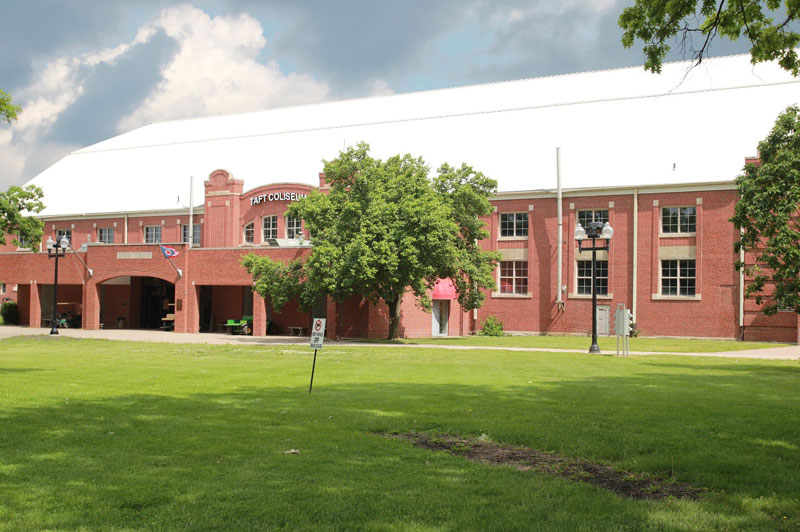
Columbus, Ohio – After a 10-year hiatus, postseason high school basketball will return to the Taft Coliseum at the Ohio Expo Center and State Fairgrounds next February and March. The announcement was made Monday by Doug Ute, Ohio High School Athletic Association Executive Director, and Adam Heffron, Ohio Expo Center Executive Director.
The historic multipurpose arena on the state fairgrounds campus was one of several hosts of the OHSAA basketball state tournament from 1923 until the state tournament moved to St. John Arena in 1958. The fairgrounds coliseum then hosted district and regional tournament contests from 1959 through 2014.
“We have been working with the Expo Center on this for quite a while and are so excited to make this announcement,” Ute said. “We are also excited to announce that girls basketball will now play tournament games at the Coliseum in addition to boys, which wasn’t done before. Reaching the Fairgrounds Coliseum was the goal for so many schools in Central Ohio for decades, and we are thrilled that the Coliseum will be that destination once again.”
The Taft Coliseum is a 5,000 seat arena that has hosted countless basketball and ice hockey contests, along with hundreds of other events.
“We are thankful for this great partnership with OHSAA,” Heffron said. “The Taft Coliseum is the perfect historic location to host post-season games, and we cannot wait to welcome players, coaches, families, and fans back to the fairgrounds for years to come.”
Beginning the week of February 17, the OHSAA will place selected girls and boys district and regional tournament games at the Taft Coliseum, which could also host state semifinal games. More information will be released in January.
2025 OHSAA Basketball Tournament Schedule
Girls Basketball
Tournament Draw – February 2
Sectional Tournaments – February 10-15
District Tournaments – February 17-22
Regional Tournaments – February 24-March 2
State Semifinals – March 3-9
State Finals – March 14-15 at University of Dayton Arena
Boys Basketball
Tournament Draw – February 9
Sectional Tournaments – February 17-22
District Tournaments – February 24-March 2
Regional Tournaments – March 3-9
State Semifinals – March 10-16
State Finals – March 21-22 at University of Dayton Arena
WASHINGTON, D.C. — With Congress failing to pass any meaningful immigration reforms, state legislatures are increasingly taking up the issue. But some police officials and immigrant-rights advocates say the harshest of those laws will further overstretch police and drive many immigrants further into the shadows.
Speaking last week at the National Immigration Forum’s annual Leading the Way conference, the leaders said that while it might sound like common sense to task local law enforcement with determining who might be here without authorization, the reality is a lot more complicated.
According to the Immigrant Legal Resource Center, Florida, Georgia, Iowa, Texas and West Virginia already have laws on the books forcing local law enforcement to participate in deporting noncitizens. It adds that legislators in many others are seeking to join them. The federal courts have sharply limited enforcement of those laws after Texas last year passed Senate Bill 4, which challenges a 2012 U.S. Supreme Court ruling that overturned much of an Arizona law that sought to put immigration enforcement into the hands of state authorities.
Limited personnel, resources
In April, Iowa Gov. Kim Reynolds, a Republican, signed Senate File 2340, which would make unauthorized immigration a crime under state law, give local law enforcement the power to enforce it, and allow state judges to order deportation or incarceration of the undocumented. As with Texas’s SB 4, that law has been stayed by the federal courts.
Speaking at the National Immigration Forum conference, Marshalltown, Iowa, Police Chief Michael Tupper cited a number of reasons why the law is bad for local police and their communities. One is a simple lack of resources.
GET THE MORNING HEADLINES.
“Every police department and sheriff’s office in the United States right now is hiring,” he said. “For the last five years it’s been a constant battle to try to maintain staffing.”
Tupper said he needs 50 officers, the city of 27,000 budgeted for 42, and he can’t even keep those filled as the department scrambles to respond to more than 750 service calls each week.
SF 2340 “would put local law enforcement on the front lines enforcing immigration law in Iowa and we’re a long ways from the border if you looked at a map lately,” Tupper said. “We just don’t have the time to do that and we don’t have the resources to do that. We all have concerns about just what this legislation will do and the unfunded mandates it will place on local governments.”
Alexandria, Va., Sheriff Sean Casey agreed that law enforcement agencies across the country are understaffed, and he said it wasn’t helpful when Gov. Glenn Youngkin, a Republican, vetoed bills that would have allowed police chiefs and sheriffs the authority to hire noncitizens such as lawful permanent residents and those in the Deferred Action for Childhood Arrivals — or DACA — program.
“Why wouldn’t you trust your local chiefs and sheriffs to make their own hiring decisions?” Casey asked. “I thought we did a really good job crafting some pretty good legislation, but unfortunately, politics got in the way. I heard, ‘How can a noncitizen tell a citizen what to do?’ I really found that to be unproductive, and I don’t think it’s in the best interest of public safety, to be honest.”
Living in the shadows
Perhaps even more harmful to public safety than stretching scarce law enforcement resources would be to scare large swaths of the community from interacting with cops for fear of deportation, the officials said.
Iowa might sound to outsiders like a lily-white state, but Tupper said his city was officially 25% Hispanic — and he thought the group made up closer to 40% of the city’s population. On top of that, refugees from Southeast Asia are making up growing share of the populace, and the chief added that 50 languages are spoken in Marshalltown’s public schools.
To have any part of that community afraid to approach the police makes the entire public less safe, Tupper said.
Criminals are exploiting those fears, for example with domestic abusers telling their victims, “‘You can’t call the police because if you do, they’re going to deport you,’” Tupper said. “We cannot put local law enforcement in the shoes of federal immigration enforcement if we expect to keep our communities safe, because it actually does the opposite.”
Reyna Montoya is herself a DACA recipient, with her family fleeing from Tijuana, Mexico to Arizona after Mexican police kidnapped her father in 2003. She founded and runs Aliento, which supports and advocates for the undocumented and mixed-status families.
She said that when former Maricopa County Sheriff Joe Arpaio was racially profiling residents in an improper attempt to enforce immigration law, immigrants would text each other reports of where police were so people could avoid them.
“It meant for me and my mother deciding not to go to the grocery store,” Montoya said. “If it was on a Sunday, it meant not going to church. We weren’t going to risk getting a deportation proceeding. Typically, that’s what would happen in our first face-to-face interaction with law enforcement.”
She said she knew many who didn’t report crimes against them for fear that police would initiate deportation proceedings.
“The reality is that the trust has been completely broken,” Montoya said. “There’s been so many undocumented immigrants that didn’t report crimes that they were impacted by because of the fear that they would get deported.”
Legal quandary
Tupper and Casey, the law enforcement officials, said they feared that if required to enforce immigration law, they didn’t know how to keep their officers or deputies from engaging in noxious practices like racial profiling.
“We do not know and we have not received any direction from the state of Iowa about how this law should be enforced,” Tupper said.
Then there’s the prospect of a patchwork of inconsistent immigration laws across the states.
“I also worry that we could end up having 50 different ways of dealing with immigration in the United States. Every state will do it a little bit differently,” Tupper said. “Do I, as the police chief of Marshalltown, Iowa, have to establish relationships with governments in Mexico and Central America because — if we’re forced to take people into custody — are we also going to be forced to get them back to their country of origin? Are local taxpayers going to be responsible for all of that?”
SF 2030, might not be in effect, but its passage has already done serious damage, the chief said. It’s scared immigrants into the shadows, and it’s created the impression among much of the public that Iowa cops are now de facto Border Patrol agents, Tupper said.
“Even if the federal courts strike down the Iowa law, people in my community already think it exists and those kinds of conversations are going to continue,” he said. “I’m not a politician. I was not involved in the writing of this law, but my belief is that the Iowa legislature and Gov. Kim Reynolds never expected that this law would actually take effect. I think it was presidential campaign-year politics and it was designed to rile up the base.”
YOU MAKE OUR WORK POSSIBLE.
___________
Marty Schladen
Marty Schladen has been a reporter for decades, working in Indiana, Texas and other places before returning to his native Ohio to work at The Columbus Dispatch in 2017. He’s won state and national journalism awards for investigations into utility regulation, public corruption, the environment, prescription drug spending and other matters.
Ohio Capital Journal is part of States Newsroom, the nation’s largest state-focused nonprofit news organization.
A Republican bill to provide more accountability for Ohio private schools had several provisions removed in a substitute version passed by committee, including the elimination of funding transparency and standardized testing requirements.
State Reps. Gayle Manning, R-North Ridgeville, and Bill Seitz, R-Cincinnati, introduced House Bill 407 earlier this year and Rep. Sarah Fowler Arthur, R-Ashtabula, introduced a substitute bill with the changes that was adopted during last week’s Ohio House Primary and Secondary Education Committee Meeting.
Eliminated from the bill was a provision that would have required private schools to submit an annual report to the Ohio Department of Education and Workforce showing how state funds received from voucher scholarship programs are being used. The bill would also have required DEW to post the reports on its website.
The substitute bill also removed a provision that would have required private schools to annually report the family income of each EdChoice voucher scholarship student who also got tuition help from scholarship granting organizations to DEW.
The changes nixed a requirement that voucher scholarship students take the same standardized tests public school students take, which would leave the law unchanged. Private schools are required to test voucher students through either the standardized test or the alternative assessments.
GET THE MORNING HEADLINES.
The substitute bill kept a provision that requires DEW to issue state report cards for private schools that enroll scholarship students.
Ohio spent nearly a billion dollars on private school scholarship programs for the 2024 fiscal year, the first full year with near-universal school vouchers. During this time, nonpublic school enrollment increased 2% and public school enrollment declined slightly.
“The danger of taking public dollars is that over time there’s going to be more and more demands from the public, from the schools that are accepting those dollars,” said state Rep. Sean Patrick Brennan, D-Parma. “They’re demanding accountability for those dollars, and rightfully so.”
Manning said she introduced the bill because her and Seitz are “fiscal conservatives,” saying no organization asked them to introduce the bill.
“If we have a superintendent that is being paid $500,000 in Upper Arlington schools, everybody knows about it, and we should,” Manning said. “If we have one that’s being paid $500,000 in a school that’s receiving vouchers, they have every right to do, but if we don’t know about that, and parents don’t have that knowledge, to me, that’s what this is all about. We need the knowledge of where the money is going.”
She said the purpose of the bill is answer questions about where the money goes — whether it’s going to students, classrooms, or people on the school board.
Most parents had already decided where they were going to send their child to school by the time the state budget passed last summer that allowed the near-universal vouchers, Vice President for Ohio Policy at the Fordham Institute Chad Aldis said when asked if the students who are receiving vouchers were already attending private schools.
“I think this year, seeing the number of new students who enter, will be a better indication of who is entering (private schools),” he said.
After reviewing the bill’s changes, Executive Director of the Ohio Christian Education Network Troy McIntosh went from opposing the bill to being an interested party.
“We firmly believe that EdChoice serves students best when the state does not over-regulate providers,”he said. “In particular, the bill’s requirement that DEW create a report card for EdChoice providers is concerning, without knowing what the form of that would look like.”
Despite the changes to the bill, Executive Director for the Ohio Alliance of Independent Schools Dan Dodd, said it would still cause an administrative burden to schools.
“We would like to focus more of our attention and resources on educating children and less time on paperwork that gets submitted to DEW,” he said. “We don’t think that the education that you receive at a public school district is the same that you receive at a private school. We would reject the idea that apples to apples comparisons on a state website, using test data or some other type of metric is not the best way to determine whether or not a certain type of school or a certain type of education is best for your child.”
About half of the Ohio Alliance of Independent Schools’ 46 member schools participate in the state’s school voucher program — up from about a third a couple years ago, Dodd said.
Tuition for member schools of Ohio Alliance of Independent Schools range from between $12,000-$17,000 for elementary school to upwards of $20,000 for high schools he said.
“Our schools largely don’t make (EdChoice) mandatory, that I’m aware of, for every family to sign up, and those families at the higher income levels that receive less money through the voucher are probably more inclined to not participate,” Dodd said.
Megan Henry is a reporter for the Ohio Capital Journal and has spent the past five years reporting in Ohio on various topics including education, healthcare, business and crime. She previously worked at The Columbus Dispatch, part of the USA Today Network.
Ohio Capital Journal is part of States Newsroom, the nation’s largest state-focused nonprofit news organization.
Loveland, Ohio – The Works Pizza Company is collaborating with Loveland Interfaith Effort LIFE Giving Shop for a Winter Blanket Drive.
Now through December 8th, you can drop off your gently used or new warm blankets at The Works Pizza Co. in Historic Downtown Loveland. Help us keep Loveland families warm this holiday season!
Drop-off Location:
The Works Pizza Co. 20 Grear Militzer Place in Downtown Loveland.