Month: May 2025

  • Ohio private college presidents ask to get rid of proposed changes to Governor’s Merit Scholarship

    Ohio private college presidents ask to get rid of proposed changes to Governor’s Merit Scholarship

    Getty Images

    By:  Ohio Capital Journel

    Ohio private college presidents slammed proposed requirements for participating in the Governor’s Merit Scholarship that were added to the House’s version of the two-year operating budget during testimony in the Senate Higher Education Committee.

    The committee had four hearings on the budget, which Senate lawmakers are currently working on. The Ohio House passed the budget last month and Ohio Gov. Mike DeWine must sign the budget by June 30.

    GET THE MORNING HEADLINES.


    Todd Jones, president and general counsel of the Association of Independent Colleges and Universities of Ohio (AICUO), spoke out against provisions the Ohio House added to the budget regarding new requirements for private colleges if they want to continue to participate in the Governor’s Merit Scholarship, which gives the top 5% of each high school graduating class a $5,000 scholarship each year to go to an Ohio college or university.

    Under the new changes made in the House, private colleges would also have to accept the top 10% of Ohio’s graduating class and comply with parts of Senate Bill 1 — Ohio’s new higher education law that bans diversity and inclusion efforts and regulates classroom discussion, among other things.

    “I want to be clear that our concerns are not about DEI and SB 1,” Jones said. “Our concerns are about the very nature of our institutions and what it means to be a private, nonprofit institution. … When the state dictates our missions, board structures, curriculum, hiring practices, workloads, and public engagement, the autonomy that defines nonprofit institutions disappears.”

    Tiffin University President Lillian Schumacher said the S.B. 1 mandates would increase operational costs without improving educational outcomes.

    “For many institutions, these new burdens could lead to closures, reduced financial aid, higher tuition, and a reduction in critical educational services for students,” she said in her testimony.

    Forcing private colleges and universities to accept the top 10% of Ohio’s graduating class would create challenges for those institutions, Chancellor of the Ohio Department of Higher Education Mike Duffey said.

    “Public universities have the infrastructure with branch campuses, large-scale facilities, and state funding to absorb enrollment increases,” Jones said. “Independent institutions operate on much smaller scales.”

    Eight AICUO institutions function out of a single academic building, he said.

    “Imposing this mandate without providing financial or logistical support places an impractical burden on private colleges,” Jones said.

    Being able to welcome an additional influx of students depends on various factors including the students’ major, housing and financial needs, University of Findlay President Kathy Fell said.

    “I know we all agree that students will not benefit from this opportunity if approbate supports and resources for success are not available,” she said in her testimony.

    Aultman College President Jean Paddock said the 10% acceptance mandate would not be possible in healthcare programs that are limited to a capped number of seats.

    “With a nursing shortage well documented, sending our best and brightest who want to enter the healthcare field to other states is the opposite of what we want,” Paddock said in her testimony.

    The Governor’s Merit Scholarship was enacted through the last state budget two years ago and 76% of the state’s 6,250 eligible students from the class of 2024 accepted the scholarship. The acceptance rate was 100% in Hocking, Holmes, Putnam, Adams, Monroe, Noble, and Vinton counties, Duffey said.

    In the second year of the scholarship, 87% of Ohio students accepted the scholarship and 11 rural counties had a 100% acceptance rate, Duffey said.

    Ohio Sen. Jane Timken, R-Jackson Township, said she has received several inquiries from private colleges and universities with concerns about the Governor’s Merit Scholarship requirements being linked to compliance with parts of S.B. 1.

    “Clearly we would lose some students if they weren’t able to access those funds,” Duffey said.

    The budget currently allocates $47 million for fiscal year 2026 and $70 million for fiscal year 2027 for the Governor’s Merit Scholarship.

    Follow Capital Journal Reporter Megan Henry on Bluesky.

    EDITOR’S NOTE:

    These Loveland High School seniors earned a Governor’s Merit Scholarship. Only the top 5% of Ohio high school students are eligible for this scholarship, worth up to $5,000 toward tuition at an Ohio college or university.

    • Olivia Bast
    • McKenzie Dunlap
    • Chloe Finkler
    • Luis Garcia Saucedo
    • Daniel Gomez Carrillo
    • Jacob Hentz
    • Alyse Knapschaefer
    • Mackenzie Liu
    • Carter Lucas
    • CJ Margraf
    • Isaiah Marx
    • Jonas Moore
    • Tyler Roberts
    • Benjamin Tibbs
    • Sophia Yurovski

    Megan Henry
    Megan Henry

    Megan Henry is a reporter for the Ohio Capital Journal and has spent the past five years reporting in Ohio on various topics including education, healthcare, business and crime. She previously worked at The Columbus Dispatch, part of the USA Today Network.

    Ohio Capital Journal is part of States Newsroom, the nation’s largest state-focused nonprofit news organization.

    MORE FROM AUTHOR

  • Do it For Jack raffling off a one-week stay at a stunning vacation home

    Do it For Jack raffling off a one-week stay at a stunning vacation home

    Loveland, OhioFor the second year in a row, The Jack Quehl Foundation is raffling off a one-week stay at a stunning vacation home in Seagrove Beach along Florida’s scenic 30A. The beachfront property sleeps up to 18 guests and offers the perfect getaway for families or groups of friends.

    Raffle tickets are $100 each and limited to just 250 entries. Proceeds directly support the Foundation’s mission to educate communities about the dangers of fentanyl and prevent future tragedies.

    “We’re incredibly grateful to our supporters for making this fundraiser such a success last year,” said Stephanie Quehl from the Foundation. “It’s not just a chance to win a dream vacation, it’s an opportunity to help save lives.”

    Tickets are selling fast. For more information or to purchase a ticket, visit https://donorbox.org/events/762041/steps/choose_tickets

    __________

    We educate

    We’re empowering our community to face the threat of fentanyl.

  • Ohio property tax repeal campaign preparing to collect signatures

    Ohio property tax repeal campaign preparing to collect signatures

    Ballot petition signature collection. Photo by WEWS.

    By:  Ohio Capital Journal

    In a short meeting, the Ohio Ballot Board signed off on a proposed constitutional amendment abolishing property taxes in the state. The only question before the board was whether the proposal contains one or multiple amendments.

    Supporters contend lawmakers have been unwilling or unable to make significant enough changes as property taxes climb. But critics warn eliminating that revenue stream could cripple important services like schools and first responders.

    Campaign reaction

    GET THE MORNING HEADLINES.


    The day after the ballot board meeting, Beth Blackmarr described her mood as ‘busy.’

    “Busy, busy, busy,” she said, “I mean, here we go — we’ve got to hit the ground running.”

    Blackmarr is part of the organization Citizens for Property Tax Reform which is leading the repeal campaign. With the ballot board’s decision, the group is now able to start gathering signatures to appear on the ballot.

    To go before voters, they’ll need 10% of the electoral turnout from the last governor’s race (just shy of 415,000). Additionally, in 44 of Ohio’s counties, they’ll need signatures from at least 5% of the governor’s race turnout. In practice, campaigns turn in hundreds of thousands more signatures than necessary to make up for any rejections.

    Blackmarr said they want to start collecting “as soon as humanly possible,” and work could begin as early as next week. Asked whether they’d work with paid circulators, she just laughed.

    “Many of us are youthful at heart, but senior citizens that are just really working out of our pockets,” she said. “There’s no big money backing this at all. It’s all volunteer.”

    The merits

    Blackmarr argued Ohio’s current property tax system is broken. She points to other states like New Jersey and Texas that have far more generous initiatives to keep seniors, vets and the disabled in their homes.

    “You can’t have senior citizens who have paid for their homes — fully paid for — having to move out because they can’t afford property tax,” she insisted.

    Blackmarr contends those kinds of protections are low-hanging fruit. Lawmakers have had continual warnings and “ample opportunity” to act. Instead, she argued, they’ve dithered with changes at the margins.

    “I suspect it’s because they built a wobbly tower of property tax law over these decades,” she said, “and they’re afraid to pull one of the blocks out, because they’re afraid the whole thing’s gonna come tumbling down.”

    That ‘tumbling down’ is exactly the concern many critics voice about the plan. The most recent annual report from the Ohio Department of Taxation puts 2023 property tax collections at about $18.5 billion. That’s an enormous amount of funding to just disappear. It’s roughly double the amount reported for state income taxes, and a billion more than Ohio’s sales and use tax.

    Spread evenly, it would cost every single Ohioan more than $1,500 to make up that gap in funding.

    Blackmarr argued repeal will just force lawmakers “to come up with an alternative.” But that’s a big ask — particularly for Republicans allergic to tax increases.

    Still she’s right about dramatic increases in property taxes. The same Department of Taxation report shows assessed values climbing almost 40% in five years while tax collections have risen more than 21%.

    Legislature’s role

    In a statement following the ballot board decision, House minority leader Allison Russo said the proposal “clearly demonstrates frustration by Ohioans on this issue” and blamed lawmakers for failing to act.

    “However, this particular initiative concerns me because while it eliminates the property tax, it doesn’t explain how we’ll replace the funds that support police, fire departments, public education, and other critical services,” she said.

    Russo argued Democrats have signed on to bipartisan legislation providing direct relief but Republican leaders haven’t prioritized those bills.

    Blackmarr acknowledged that as their campaign gains steam, pressure will grow on lawmakers to pass legislation or propose their own ballot measure to undercut their efforts.

    “At the end of the day it goes to the voters,” she said.  “They have to make the decision for themselves.”

    And if lawmakers’ intervention means voters have to choose between competing visions, that’s just fine with Blackmarr.

    “Wouldn’t that be nice, you know?” she said.

    Follow Ohio Capital Journal Reporter Nick Evans on X or on Bluesky.


    Nick Evans
    Nick Evans

    Nick Evans has spent the past seven years reporting for NPR member stations in Florida and Ohio. He got his start in Tallahassee, covering issues like redistricting, same sex marriage and medical marijuana. Since arriving in Columbus in 2018, he has covered everything from city council to football. His work on Ohio politics and local policing have been featured numerous times on NPR.

    Ohio Capital Journal is part of States Newsroom, the nation’s largest state-focused nonprofit news organization.

    MORE FROM AUTHOR

  • Calling all kayakers: DVD Brew is supporting Kayak Team USA

    Calling all kayakers: DVD Brew is supporting Kayak Team USA

    Loveland, OhioDVD Brew is calling all kayakers to come in on May 20th for a special event.

    FaceBook Photo

    Be part of sending Eric Bartl to the world championship in Germany this summer. Team USA members must raise much of their own money and most of the expenses for representing Team USA at the World Championships will come directly out of Eric’s own pocket.

    Thanks to the generosity of Whitewater Warehouse, attendees will receive 20% off paddling accessories discount.

  • Military Appreciation Days at KINGS ISLAND

    Military Appreciation Days at KINGS ISLAND

    May 23 – 26, 2025

    All active and retired members, including National Guard, reserves, and veterans, will receive free admission at select Six Flags parks*, valid from May 23 through May 26, 2025**.

    Plus, they can purchase up to six discounted tickets for family and friends.

    How to enter the park on Memorial Day Weekend

    Present a valid U.S. Military ID at the front gate any one-day, from May 23 through May 26**. Additional tickets for family and friends must be purchased online in advance. Verification is required.

    *Free admission for U.S. military members and veterans is available at all Six Flags parks, excluding Knott’s Berry Farm, Knott’s Soak City, and Cedar Point Shores.

    Discounted admission will be available during Memorial Day weekend at these locations.

    **Validity applies to regular park operating days and hours. Check your park’s calendar.

    Simply pick your park to get started.

  • Little Miami alumnus Thomas Sweeney to compete on Jeopardy

    Little Miami alumnus Thomas Sweeney to compete on Jeopardy

    Morrow, Ohio – On Wednesday, May 28 at 7:30 EST on FOX 19, Little Miami alumnus and current Academic Team assistant coach Thomas Sweeney, will be appearing on an upcoming episode of Jeopardy.

    The 2019 graduate of Little Miami High School and former Academic Team standout, Sweeney is making history as the first LM grad to ever compete on Jeopardy.
    “This is an incredible honor and a moment of Panther pride we won’t forget.” said the District on FaceBook.
  • Ohio lawmakers introduce bipartisan bill that would help college students combat food insecurity

    Ohio lawmakers introduce bipartisan bill that would help college students combat food insecurity

    Stock image of a food pantry courtesy Hurlburt Field.

    Ohio House Reps. Sean Patrick Brennan, D-Parma, and Jim Hoops, R-Napoleon, introduced Enact the Hunger Free Campus Act earlier this year.

    By: Ohio Capital Journal

    A proposed bipartisan bill would help Ohio college students struggling with food insecurity.

    Ohio House Reps. Sean Patrick Brennan, D-Parma, and Jim Hoops, R-Napoleon, introduced Enact the Hunger Free Campus Act earlier this year and it had sponsor testimony Tuesday in the Ohio House Workforce and Higher Education Committee meeting.

    Ohio House Bill 157 would require the Chancellor of Higher Education to create the Hunger-Free Campus Grant Program and award hunger-free campus grants which could, for example, create an on-campus food pantry or a partnership with a local bank, provide students information about SNAP, have an emergency assistance grant available to students, or have a student meal plan credit donation program.

    GET THE MORNING HEADLINES.


    “A Hunger Free Campus program addresses these challenges directly by providing accessible resources and support systems tailored to meet students’ nutritional needs free from stigma,” Brennan said. “Such initiatives ensure that no student has to choose between paying the electric bill or buying textbooks or groceries, allowing them to concentrate fully on their education.”

    H.B. 157 would appropriate $625,000 for fiscal year 2026 and 2027 for the program.

    Some universities across the state have a food pantry on campus for students, but how they operate varies, Brennan said.

    “There is not consistency on where the pantries live, the size, what is offered, what department they are under, and what you have to prove in order to utilize them,” he said. “Sometimes it’s a single staff member going to the local grocer on their day off to buy things for the pantry.”

    Food insecurity is often an overlooked issue that affects many college students, Brennan said.

    “Rising costs are making it tougher for students to find sustainable and affordable food options, especially for the growing number of non-traditional students with children,” he said.

    Food insecurity is an issue that goes beyond hunger, Brennan said.

    About 23% of college students experienced food insecurity in 2020 and 59% of food-insecure students potentially eligible for SNAP did not report receiving benefits, according to a report released last summer by the U.S. Government Accountability Office.

    A survey conducted last year at Ohio State University showed that nearly one out of every three Ohio State students is food insecure, according to the student newspaper The Lantern.

    Food insecurity means a household has limited or uncertain access to enough food to meet their needs, according to the U.S. Department of Agriculture.

    “It affects students’ academic performance, mental health, and overall well-being,” Brennan said. “When students are unsure where their next meal will come from, they struggle to focus in class, perform poorly on exams, and are more likely to drop out.”

    Similar legislation has passed in California, Washington, Oklahoma, Illinois, Louisiana, Minnesota, Pennsylvania, Maryland, and Massachusetts.

    “This bill will place Ohio at the forefront of tackling food insecurity in America and serve once again as a beacon by which more states will soon emulate,” Hoops said.

    Brennan introduced a similar bill in the previous general assembly, but it only had sponsor testimony.

    Members of the committee had positive things to say about H.B. 157.

    “I remember working in college full-time, but still it was difficult to afford food alongside my medicine, and so this is, no doubt, hopefully passes and will support a lot of students,” said state Rep. Munira Abdullahi, D-Columbus.

    State Rep. Beryl Brown Piccolantonio, D-Gahanna, asked Brennan and Hoops about the importance of students being nourished in order to learn.

    “If you don’t have a full belly, the last thing you’re thinking about is loading the three branches of government,” Brennan said. “The same would be true for anyone, for that matter, whether you’re an elementary school kid, a middle school, a high school, or in our higher ed classrooms.”

    State Rep. Kevin Ritter, R-Marietta, asked where the line is?

    “Just because we can do it, should we do it?” he asked.

    Brennan responded by saying he views this bill as an investment in young people.

    “When we invest in people that are hard-working and want to move ahead and climb that socioeconomic ladder, it’s going to save us in the long run,” he said.

    Follow Capital Journal Reporter Megan Henry on Bluesky.


    Megan Henry
    Megan Henry

    Megan Henry is a reporter for the Ohio Capital Journal and has spent the past five years reporting in Ohio on various topics including education, healthcare, business and crime. She previously worked at The Columbus Dispatch, part of the USA Today Network.

    Ohio Capital Journal is part of States Newsroom, the nation’s largest state-focused nonprofit news organization.

    MORE FROM AUTHOR

  • FDA and RFK Jr. aim to remove ingestible fluoride products used to protect kids’ teeth

    FDA and RFK Jr. aim to remove ingestible fluoride products used to protect kids’ teeth

    By  MATTHEW PERRONE

    WASHINGTON (AP) The Associated Press has reported today that the Food and Drug Administration and Robert F. Kennedy Jr. aim to remove ingestible fluoride products used to protect kids’ teeth.

    WASHINGTON (AP) — U.S. health regulators announced plans Tuesday to phase out ingestible fluoride supplements sometimes used to strengthen children’s teeth, opening a new front in Health Secretary Robert F. Kennedy Jr.’s effort against a mainstay of dental care.

    The Food and Drug Administration said it will conduct a scientific review of the children’s products by late October with the aim of removing them from the market. It was not immediately clear whether the agency planned to formally ban the supplements or simply request that companies withdraw them.

    Read on at the Associated Press

  • All Loveland schools now have “Project Adam” certification

    All Loveland schools now have “Project Adam” certification

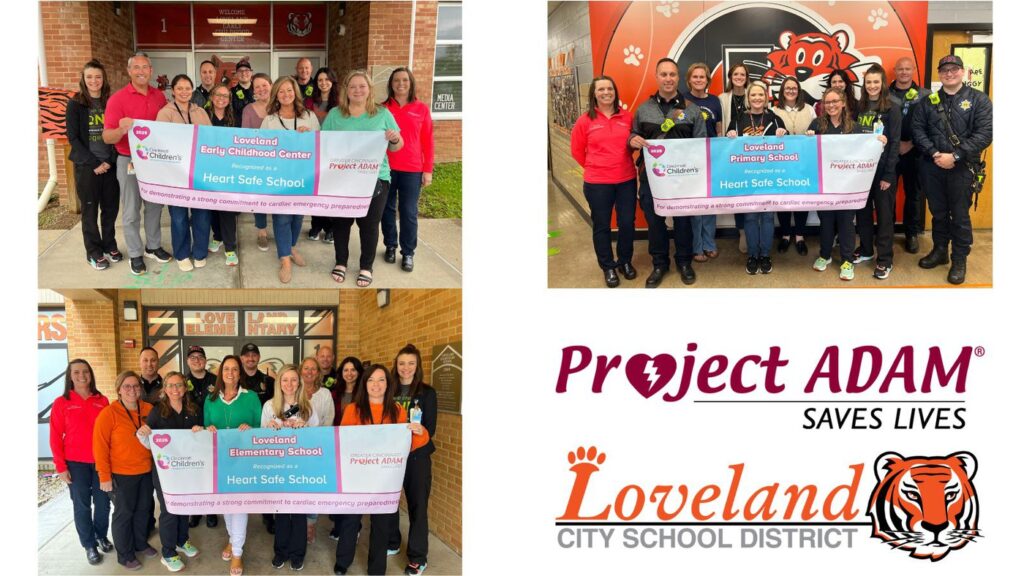
    Loveland, Ohio – “Project Adam” Heart Safe Schools have now been established at Loveland Early Childhood Center, Loveland Primary School, and Loveland Elementary School. This certification indicates that the campuses have the procedures, tools, and training necessary to guarantee a prompt reaction in the event of an unexpected cardiac attack.

    The whole Loveland City School District now holds the classification, joining previously certified Loveland Intermediate School, Loveland Middle School, and Loveland High School.

    According to the district, Loveland is just the second district in the region to get district-wide Project Adam certification. Loveland said it was made possible by the building leadership and nursing staff. They also said they are lucky to have a great relationship with the Loveland-Symmes Fire Department and Cincinnati Children’s Hospital Medical Center.

    In July of 2024, Ohio Governor Mike DeWine signed House Bill 47. The law required automated external defibrillators (AEDs) to be placed in every public and chartered nonpublic school in Ohio, as well as all municipally owned or operated sports and recreation locations.

    It also required schools to adopt emergency action plans for the use of automated external defibrillator devices (AEDs) and practice these plans quarterly, among other provisions.

    At the time Dewine signed the bill, Loveland High School Athletic Director Jayson Bruce told Loveland Magazine, “We have been extremely blessed to have been way ahead of this for many years here in Loveland. As a matter of fact, Loveland High, Middle and Intermediate schools are all certified as Heart Safe schools through Project ADAM. And as part of this certification, we had to create and execute plans to respond to heart emergencies. A huge part of these plans are the AED’s. Our High School and Middle/Intermediate school campuses are extremely well equipped with AED’s for not only the school day, but all of our athletic teams. The number one priority is and always will be safety. We are blessed to be able to provide access to AED’s to all of our sports teams.”

    Bruce said that on the High School campus their trainers have an AED with them at all times. There is also an AED mounted on the outside of the team room at Loveland High School Stadium. At Loveland High School, they have AED’s mounted outside of the gyms and the workout facility. Bruce added, “We also have backpack units that go along with our teams that train or participate off campus, like cross country, etc.”

    The Loveland Middle and Intermediate school campus is very similar to the High School. “We have AED’s mounted directly outside of each gym. The trainer, who is at football practices and games, always has an AED with them. Since we have teams that practice off campus as well, we send them with AED’s,” Bruce said.

    The automated external defibrillator (AED) at the Loveland Town Clock (Loveland Magazine  2024 File Photo)

    Loveland City Manager Dave Kennedy told Loveland Magazine at the time that there is an AED at the Loveland Bike Trail next to the town clock at West Loveland Avenue and Railroad Avenue, Phillips Park, and McCoy Park. “We have cameras protecting the AED’s and if the alarms go off when accessed, the communication center will see them first hand.”

    Photos by Loveland Schools

    Project ADAM began in 1999 after the death of Adam Lemel, a 17-year-old Whitefish Bay, WI, high school student who collapsed and died while playing basketball. Adam suffered a Sudden Cardiac Arrest (SCA), in which ventricular fibrillation occurred, a condition in which the ventricles cannot pump blood into the body. Defibrillation, or an AED, could have saved his life. Adam’s parents, Patty Lemel and Joe Lemel, collaborated with Children’s Hospital of Wisconsin to create this program in Adam’s memory.

    In this video, learn a father’s perspective on the journey and importance of Project ADAM and the program mission to save lives.
    Project ADAM began in 1999 after the death of Adam Lemel, a 17-year-old Whitefish Bay, WI, high school student who collapsed and died while playing basketball after he suffered a sudden cardiac arrest (SCA). Project ADAM (Automated Defibrillators in Adam’s Memory) aims to prevent sudden cardiac death through helping schools and communities implement life-saving programs to maintain a practiced CPR/AED program and people confident to take action.

    Implementing a Heart Safe School Program

  • Backers urge Ohio lawmakers to pass AI restrictions

    Backers urge Ohio lawmakers to pass AI restrictions

    State Sen. Louis Blessing, III, R-Colerain Township (Photo by Graham Stokes for Ohio Capital Journal. Republish photo only with original article.)

    The measure focuses on prohibiting deepfake child pornography but also require watermarks and punishes AI identity fraud

    By:  Ohio Capital Journal

    Ohio senators heard from supporters Wednesday of a proposal establishing guardrails around media produced with artificial intelligence. The proposal would prohibit the use of AI to create deepfake porn — particularly involving minors. But with provisions requiring watermarks and punishing identity fraud, the bill’s impact could extend far beyond the creation of pornography.

    Senate bill 163

    The bill’s sponsors, state Sens. Louis Blessing, R-Colerain Twp., and Terry Johnson, R-McDermott, argue the restrictions will “prevent potentially harmful uses” of an emerging technology while protecting Ohioans “safety and privacy.”

    GET THE MORNING HEADLINES.


    The bill goes after AI-generated child porn by expanding the definition of obscenity to include an “artificially generated depiction.” Blessing explained “current laws against child sexual abuse material require an actual real photo of a child to be able to prosecute someone.”

    “With AI not being a real photo,” he added, “this leads to issues of prosecuting someone generating these photos. Senate bill 163 will give attorneys the ability to prosecute these people.”

    The sponsors argue AI can also be used to engage in fraud for financial, political and reputational purposes. So, the proposal extends identity fraud statutes to include a “replica” of an individual’s voice or likeness. It prohibits the use of a replica persona to defraud, damage a person’s reputation, or depict a person in a state of nudity or engaged in a sexual act.

    Beyond its prohibitions, the bill aims to get ahead of deceptive uses by requiring any media created with artificial intelligence to include a watermark identifying it as such. Removal of a watermark is subject to a civil lawsuit for damages, and anyone who removes a watermark faces the presumption that they caused the alleged harm.

    Proponents’ testimony

    Ohio Attorney General Dave Yost praised the measure’s “three-pronged approach.” He argued the watermark requirement “would provide a minimum level of transparency and notice” when an individual encounters AI-generated content.

    Speaking about the bill’s identity fraud provisions, Yost brought up a case from his time as state auditor. A scammer successfully mimicked a school district’s email system and then sent a fake funds transfer request to the accounts payable department posing as the district’s financial controller. Best practice, Yost said, would be to call the sender for confirmation.

    “But now, in the era of deepfakes with audio,” Yost explained, “you can send that fake email, call up (accounts payable) using the controller’s voice and say, ‘Hey, I just sent you an email asking you to do a wire transfer. This is really important. We need to move it. I wanted to follow up with phone calls so you didn’t have any questions.’”

    As for the restrictions on child sexual abuse material, Yost urged lawmakers ensure “these powerful tools are not used for evil,” and added that “these are the kinds of things that keep me up at night.”

    Sen. Kent Smith, D-Euclid, pressed Yost on how useful state legislation can be when it comes to addressing a “borderless” crime.

    Yost acknowledged he’d prefer to see federals laws and even international treaties governing the use of AI-generated images. But “possession or use within Ohio can still be proscribed by this body and it ought to be.” He added that one way to push Congress to act is for states to pass an array of legislation.

    Lou Tobin, speaking on behalf of the Ohio Prosecuting Attorneys Association, noted many states have passed bills to prohibit AI-generated child sexual abuse material or CSAM.

    “As of last month,” he said, “Thirty-eight states, including every state surrounding Ohio, have enacted laws that criminalize the creation, possession and distribution of artificially generated CSAM.”

    But while many states have taken action, it’s not clear those laws will hold up in court.

    “I think a federal district court has found one of these statutes to be in violation of the Ashcroft decision,” Tobin told lawmakers. “The Ashcroft decision was a U.S. Supreme Court decision from the early 2000s that said you could not criminalize artificially generated images of child pornography because there wasn’t a real victim.”

    In February, a federal judge in Wisconsin threw out one charge related to possession of “virtual child pornography,” but allowed three others to go forward. Prosecutors in that case have appealed the decision to dismiss the charge.

    Tobin explained his office and the AG’s worked with state lawmakers to narrowly tailor S.B. 163 bill to avoid problems with the First Amendment. Regardless of how the case in Wisconsin or others play out, Tobin agued, “We think that’s a fight worth having.”

    Follow Ohio Capital Journal Reporter Nick Evans on X or on Bluesky.


    Nick Evans
    Nick Evans

    Nick Evans has spent the past seven years reporting for NPR member stations in Florida and Ohio. He got his start in Tallahassee, covering issues like redistricting, same sex marriage and medical marijuana. Since arriving in Columbus in 2018, he has covered everything from city council to football. His work on Ohio politics and local policing have been featured numerous times on NPR.

    Ohio Capital Journal is part of States Newsroom, the nation’s largest state-focused nonprofit news organization.

    MORE FROM AUTHOR