Author: David Miller

  • Loveland grad Reed Stewart among two Miami University Nursing students credited with helping save life of faculty member

    Loveland grad Reed Stewart among two Miami University Nursing students credited with helping save life of faculty member

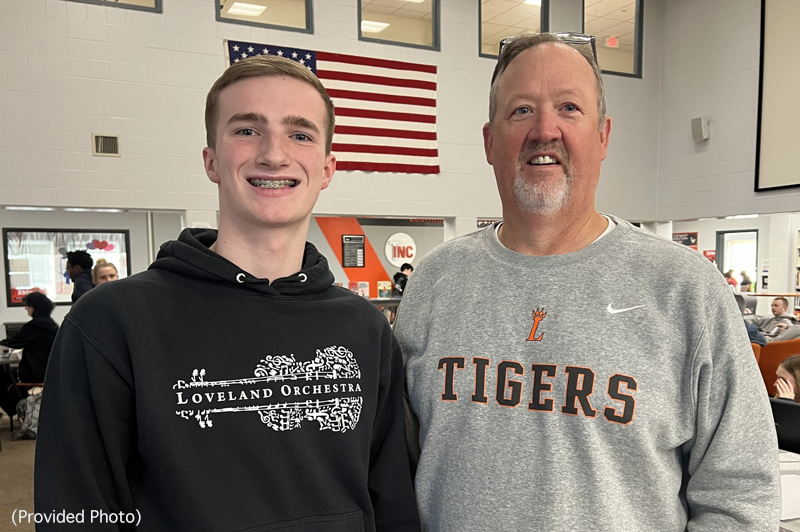
    Brayden Osborne, left, and Reed Stewart (’22) stand in Miami University Regionals Nursing Lab on the Hamilton campus. The students didn’t know each other before they performed CPR to help save the life of an adjunct faculty member (photos by Alyssa Maul).

    Their instincts and training took over as they performed CPR on the unconscious man

    by Margo Rutledge Kissell and Miami University News

    Junior Reed Stewart and sophomore Brayden Osborne — who didn’t know each other before the medical emergency — took turns performing cardiopulmonary resuscitation (CPR) on the instructor of Mathematical and Physical Science outside Mosler Hall on the Hamilton campus. It happened on Dec. 11 during finals week before students left for winter break.

    After the man collapsed, Osborne felt compelled to help as he watched Stewart perform CPR, so he offered assistance with the chest compressions before paramedics arrived. Read the full story…

    Stewart: ‘This all happened so fast’

    Both students said they conducted chest compressions silently to the rhythm of “Stayin’ Alive” by the Bee Gees, which has become a recommended timing strategy.

    “Reed immediately popped up out of his chair and said he could help,” recalled Webb, who phoned security and her supervisor to alert them of the situation.

    Stewart said he went outside and found several students standing over the man. They were screaming for help and asking if anyone knew CPR. Stewart ran over and quickly assessed the situation: He wasn’t breathing and had no pulse.

    Read the full story…

  • Loveland High School to Start 30 Minutes Later Next Year

    Loveland High School to Start 30 Minutes Later Next Year

    Decision Based on Community Feedback and Mental Health Research

    Loveland, Ohio – Loveland High School will implement a 30-minute later start time for the upcoming school year. This change follows recommendations from community engagement sessions conducted by the District’s Community Advisory team.

    Superintendent Mike Broadwater emphasized the importance of adequate sleep for adolescents, citing research on mental health. “The goal is that our students come to school ready to go,” Broadwater stated.

  • City of Loveland’s Annual Report for 2024

    City of Loveland’s Annual Report for 2024

    Loveland, Ohio – The Charter of the City of Loveland mandates that an annual report be prepared and made available to the public. It provides an overview of city finances, personnel, police, fire, public works, and economic development. In addition, the 2024 report highlights capital projects.

    [pdf-embedder url=”https://lovelandmagazine.com/wp-content/uploads/2025/02/Loveland-Ohio-2024-Annual-Report.pdf” title=”Loveland, Ohio 2024 Annual Report”]

  • A “Jazz Night” at Loveland High School

    A “Jazz Night” at Loveland High School

    Loveland, Ohio – Thursday night Geoffrey Miller and Christopher Huening will lead Loveland High School musicians through a casual night of jazz. All money raised in a raffle, silent auction, split the pot, and at the dessert/drink table supports the student musicians.

    Admission is $5 at the door. Cash and credit cards will be accepted.

    The concert is at the Loveland Intermediate School cafeteria where there will be themed baskets, gift cards, and a silent auction. The night of jazz starts at 7 PM and features three school jazz bands. Doors open at 6:30 PM.

  • Medicare 101: ‘Welcome to Medicare’ event at the Miami Township Public Library

    Medicare 101: ‘Welcome to Medicare’ event at the Miami Township Public Library

    The Ohio Department of Insurance provides Medicare beneficiaries with free, objective, health insurance information and one-on-one counseling through the Ohio Senior Health Insurance Information Program (OSHIIP). OSHIIP’s hotline experts, speaker’s bureau, and trained volunteers educate consumers about Medicare, Medicare prescription drug coverage (Part D), Medicare Advantage options, Medicare supplement insurance, long-term care insurance, and other health insurance matters.

    _____________

    Medicare 101 FREE at the Miami Township Public Library

    Join us for our in-person “Welcome to Medicare” event at the Miami Township Public Library.

    If you will be eligible for Medicare soon and have questions, are helping a friend or family member navigate their Medicare benefits, or are currently on Medicare yourself and have questions or concerns, join us for this informative, helpful, in-person event!

    Monday, February 10, 2025
    6 PM
    Clermont County Public Library – Miami Township Branch
    5920 Buckwheat Rd, Milford, OH, 45150

    See the full events list HERE.

    _____________

    Can’t make it to an event? Join us for one of the VIRTUAL (online) Medicare webinars or sign up for a one-on-one counseling session with one of our Medicare experts.

    Can’t make it to an event? Join us for one of our VIRTUAL (online) Medicare webinars or sign up for a one-on-one counseling session with one of our Medicare experts!

    You probably know someone covered by Medicare. Many people call OSHIIP to get information for their parents, grandparents, or other family members and friends who are covered by Medicare. If someone close to you is on Medicare, one way you can help is by taking the time to understand Medicare yourself. People covered by Medicare can get help from OSHIIP in various ways by:

    • Calling the OSHIIP hotline at 800-686-1578.
    • Talking with volunteers and contacting information sites near you.
    • Requesting a (virtual or in-person) speaker from our speakers’ bureau.
    • Reading our free literature.

    [pdf-embedder url=”https://lovelandmagazine.com/wp-content/uploads/2025/02/Ohio-Senior-Health-Insurance-Information-Program.pdf” title=”Ohio Senior Health Insurance Information Program”]_____________

    Contact the Ohio Senior Health Insurance Information Program (OSHIIP)

    50 W Town St
    Third Floor – Suite 300
    Columbus OH 43215

    Monday – Friday 7:30 AM – 5 PM

  • Southbound I-471 to Reopen Sunday evening

    Southbound I-471 to Reopen Sunday evening

    Cincinnati, Ohio – Ohio Department of Transportation (ODOT) Director Pamela Boratyn has announced that the southbound lanes of Interstate 471 approaching the Daniel Carter Beard Bridge will reopen on Sunday evening, exactly 100 days after the roadway was severely damaged by fire.

    Through Sunday evening, crews will put finishing touches on the bridge, including grinding and grooving the deck, final welding below the expansion joint seal, and pavement striping.

    ODOT will announce an exact reopening time on social media about an hour before the final barricades are removed.

  • Loveland High School Junior Connor Burns selected for first-ever Ohio Suicide Prevention Foundation Youth Advisory Council

    Loveland High School Junior Connor Burns selected for first-ever Ohio Suicide Prevention Foundation Youth Advisory Council

    Connor Burns and Superintendent Mike Broadwater

    Loveland, Ohio – Loveland High School Junior Connor Burns, has been selected for the first-ever Ohio Suicide Prevention Foundation Youth Advisory Council. He’ll meet with leaders from around the state to shape suicide prevention efforts in Ohio.

    Ohio Suicide Prevention Foundation

    The Ohio Suicide Prevention Foundation is a non-profit organization that works tirelessly to prevent one of our most preventable causes of death: suicide. Our work includes reducing the stigma of suicide, promoting evidence-based prevention strategies, and raising awareness about suicide’s relationship to mental illness and substance use disorders, and other factors that contribute to suicide.

    Our community-based programs and best-practice resources are specifically designed to improve mental health across the state. Thanks to a combination of education, training, and support, we’re helping all of Ohio’s communities reduce the risk of suicide and lessen its effects on family, friends, and neighbors.

    Theteam is available to connect you to programs, services, and resources. For more information, call 614-429-1528 or email support@ohiospf.org. Learn more…

  • Loveland man,  Bryan Hambley Announces Campaign for Ohio Secretary of State

    Loveland man, Bryan Hambley Announces Campaign for Ohio Secretary of State

    Bryan Hambley (Provided Photo)

    Loveland, Ohio – Bryan Hambley, a cancer doctor who cares for leukemia patients, has announced his campaign for Ohio Secretary of State. Hambley and his wife Jana, a trauma surgeon, live in Loveland with their five and seven-year-old children. While practicing medicine, Bryan has also organized communities, “To fight against pharmaceutical companies that use their money to buy influence in hospitals, bring critical healthcare to underserved communities, and stand up for the right to vote and be heard.”

    Having been raised on a small family-owned farm, Hambley told Loveland Magazine that he believes in the power of communities banding together to advocate for their needs.

    His first foray into organizing happened when he was a small child, and the state tried to shut down his town’s small public school. The town of 800 people got into their trucks, drove to the capitol, and made their voices heard to save the school.

    Hambley said that Democracy works best when communities can exercise their right to be heard. “Here in Ohio, we have seen our Secretary of State abuse our democracy, making it harder to vote, purging voters from the voter rolls, and drawing unfair maps that disenfranchise millions of Ohio citizens. I am running because I care about Ohio, and I have seen my patients and our communities suffer from a broken and gerrymandered democracy.”

    Kelly Sakalas, Chair of the Warren County Democratic Party, said, “Bryan is the first in the door and last to leave. He spent countless hours volunteering and knocking on doors supporting reproductive rights, fighting against gerrymandering, and supporting Senator Sherrod Brown. We are lucky to have him here in Warren County, and Ohio will be lucky to have him as their Secretary of State!”

    As Hambley gears up for this election, he said that he will travel to “all corners of the state” to meet folks and hear their vision for Ohio. He welcomes any outreach from the press or any Ohioan interested in discussing the future of our State.

    Bryan can be reached at team@hambleyforohio.com.

    __________________

    HAMBLEY FOR OHIO CAMPAIGN RAISES OVER $360,000 IN 30 DAYS

    In just the month of January, Bryan Hambley’s campaign for Ohio Secretary of State raised an impressive 6-figure haul

    LOVELAND, Ohio – Bryan Hambley, candidate for Ohio Secretary of State, announced having raised over $362,081 in just 31 days.

    “We know there is a long way to go, but we are extremely proud of the first 31 days of the campaign. In just four weeks, we have been to Cleveland, Columbus, Cincinnati, Toledo, Lebanon, West Chester, and Dayton.  I’m looking forward to visiting every county in Ohio to meet with voters this year” Hambley said. “Ohio is a big state and it takes strong fundraising to reach voters across the state. The support we’ve received in January demonstrates our commitment to running a strong, viable campaign across our state.”

  • ACLU provides FAQ For Educators on Immigrant Students in Public Schools

    ACLU provides FAQ For Educators on Immigrant Students in Public Schools

    Can U.S. Immigration and Customs Enforcement (ICE) and U.S. Customs and Border Protection (CBP) arrest immigrants while at school?

    __________________

    In recent months, the ACLU has received numerous inquiries, questions, and concerns about the vulnerabilities and rights of immigrant and perceived immigrant students in our public education system. Educators and school districts have been among those seeking guidance on how best to serve their immigrant students and meet their legal obligations. Below are answers to some common questions we have received. Download a PDF version

    This information is not intended as legal advice and is for informational purposes only.

    What does federal law say about immigrant students?

    Federal laws prohibit discrimination in public education, including discrimination on the basis of race, color, or national origin. Federal law specifically prohibits schools from “utiliz[ing] criteria or methods of administration which have the effect of subjecting individuals to discrimination because of their race, color, or national origin, or have the effect of defeating or substantially impairing accomplishment of the objectives of the program as respects individuals of a particular race, color, or national origin.”

    The Supreme Court, in the case Plyler v. Doe, also held that discrimination on the basis of immigration status in access to basic public education (i.e. elementary and secondary school) violates the Constitution.

    What does the Plyler v. Doe decision mean for me as an educator?

    Requiring students or students’ parents to provide schools with information regarding their immigration status, or taking other actions that significantly interfere with the right to a basic public education, violates the constitutional principles set out in Plyler.

    Can my school district require students to provide a social security number?

    No. Schools cannot require students to provide a social security number and, consistent with Plyler, should identify a range of documents (e.g., birth certificate, family bible, parent affidavit) that may be used to establish a child’s age. Federal law prohibits denial of a benefit for refusal to supply a social security number, and a school district collecting social security numbers must inform individuals that the disclosure is voluntary, and must explain both the statutory or other basis for seeking the numbers, and how the district intends to use the numbers.

    What other rules apply to collecting information from students?

    Schools cannot delay enrollment of homeless children, even if they are unable to produce these records. The Federal Educational Rights and Privacy Act (FERPA) prevents schools from releasing students’ education records, including information about immigration status, except in exceptional circumstances. A school may only disclose information to ICE officials with the consent of a parent or student (if 18 or older) or if necessary to comply with a judicial order or a subpoena signed by a judge. If a school receives an administrative subpoena, school officials can still seek review by legal counsel and could potentially challenge the reasonableness of the subpoena.

    What is the best way for schools to go about collecting educational information from students?

    School administrators should limit the information collected from students, provide a variety of means for establishing necessary information for enrollment (including alternatives for students who lack traditional proof of residence), and review district policies and practices regarding the management and use of student data.

    Schools should not ask students for information such as place of birth that may indicate a student’s immigration status. To further remove barriers to enrollment, schools can limit the information required to enroll to proof of residency, proof of age, and immunization records, and request any other information after enrollment.

    How can a school protect the information that it collects from students?

    To properly protect students’ rights, educators must also ensure that contractors, consultants, and other agency partners who come into contact with students or who access student records respect students’ rights. In particular, school police should commit through a signed agreement or official policy not to inquire about immigration status or to detain or report students and family members for purposes of immigration enforcement.

    Further, the district should review its policing practices to focus attention on protecting the school community from outside threats and limit law enforcement engagement with students to immediate threats to physical safety.

    Can U.S. Immigration and Customs Enforcement (ICE) and U.S. Customs and Border Protection (CBP) arrest immigrants while at school?

    ICE and CBP maintain a policy which provides that they will not engage in immigration enforcement in sensitive locations like schools absent prior approval by a supervisor or exigent circumstances. This policy has recently been reaffirmed by the Department of Homeland Security. This means that ICE and CBP generally will not arrest, interview, search, or surveil a person for immigration enforcement purposes while at a school, a known school bus stop, or an educational activity.

    What should school officials do if they or others witness ICE or CBP enforcement actions within my school?

    Schools can reassure their students that enforcement actions within schools are very unlikely. Although there have been distressing reports about arrests near schools, we are not aware of any recent immigration arrests within schools. Both Immigration and Customs Enforcement (ICE) and Customs and Border Protection (CBP) continue to adhere to their policy, described above, of avoiding enforcement actions within schools. If such an incident occurs, school staff should:

    • Direct ICE/CBP agents to the Superintendent.
    • The Superintendent should request to see written legal authorization and verify the identity of the agent(s).

    If agents do not supply a judicial warrant, signed by a judge, request legal review before permitting agents further into the school. Only a judicial warrant, not an administrative warrant, will allow ICE agents to enter locations in which there is a reasonable expectation of privacy.

    • The Superintendent should advise agents of the school district’s Plyler obligations, refer agents to the ICE/CBP sensitive locations memos, and request that officers not conduct the enforcement action at school/school activities.
    • Consistent with the school district’s Plyler obligations, school officials must not affirmatively aid in removing a student from school based upon her immigration status.
    • If agents detain a student, the school district should promptly notify the student’s parent or guardian.
    • As soon as possible, notify your local ACLU affiliate. You can also lodge a complaint with ICE or CBP through their websites.

    What other steps can school officials take to safeguard education for immigrant students (and all students)?

    • Communicating with district families that all students are welcome in district schools, including through the adoption of a resolution, can go a long way in assuaging community fears and strengthening the school community.
    • Educators can also adopt a number of practices to instill a positive school climate.

    Where can school officials and educators get more information on these issues?

    There are many organizations that publish resources for educators, including the National Immigration Law Center (NILC). The NILC webpage about education is https://www.nilc.org/issues/education/. In particular, they provide a detailed guide for educators and school support staff available at https://www.nilc.org/wp-content/uploads/2016/06/ICE-Raids-Educators-Guide-2016-06.pdf.

  • Meet Anne Jellema, 350.org’s new Executive Director: “The time to address climate change is now!”

    Meet Anne Jellema, 350.org’s new Executive Director: “The time to address climate change is now!”

    Meet Anne Jellema, 350.org’s new Executive Director.

    ABOUT 35.org

    We’re building a movement that fights for a fairer future for all. We believe in the collective power of ordinary people taking action: we campaign and organize locally and globally to create a world powered by just and accessible renewable energy that will move us away from fossil fuels, for good. And we are doing this with the urgency the climate crisis demands of us. Are you ready to join us?

    Take action!

    We’re shaping a future where:

    People are empowered, ordinary people have the tools and training to build a better future and know the pathways they can take to make that happen.

    Communities are resilient, renewable energy is produced, consumed and owned within a community, creating jobs and local economic benefits.

    Governments and institutions prioritize climate action, implementing policies that reduce emissions and support a transition to renewable energy.

    Renewable energy becomes the dominant source of power, lessening the environmental impacts, providing more access to communities and reducing the overall cost to people.

    Fossil fuels are kept in the ground to protect both people and the planet.

    We are calling for a transformative energy transition that prioritizes people over corporate profit. This means creating local jobs and revenue for communities, lessening environmental impacts and offering more energy access to people in cities and rural areas.

    Here’s how we get there:

    Our strategy is twofold: resisting fossil fuel projects and its enablers, and advocating for a world powered by the sun, wind and people.

    Stop fossil fuels

    Learn More

    Climate finance

    Learn More

    Solutions for climate change

    Learn More

    Our Impact

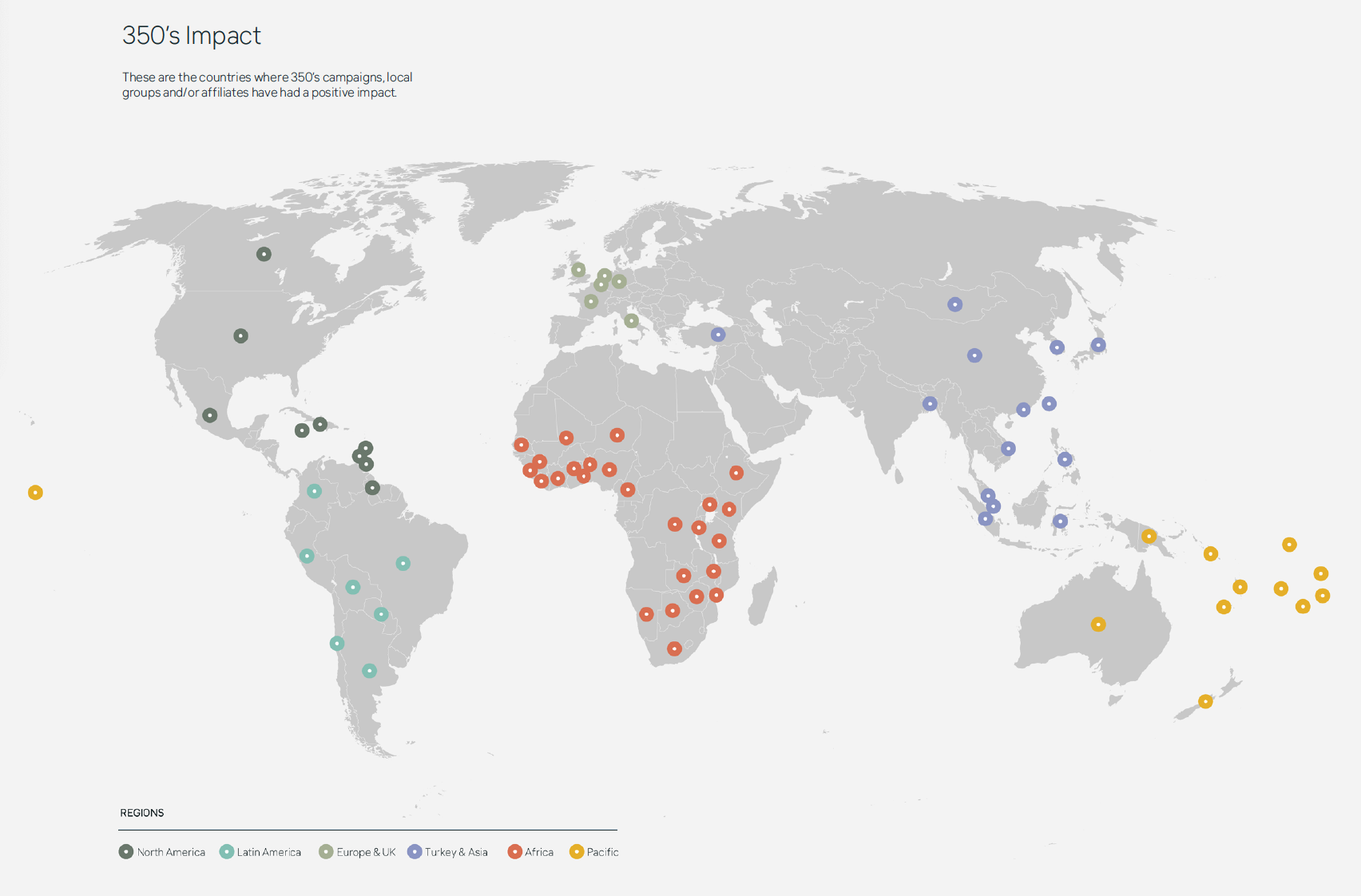
    We campaign to keep fossil fuels in the ground and accelerate the renewable energy transition in an effort to tackle the climate crisis. We train and empower ordinary people to create local campaigns to ignite a renewable energy revolution. Get involved here!

    Our biggest strength is our global network, connecting local and national campaigns across the world to confront injustice, challenge our fossil-fueled economic systems and showcase a groundswell of support for renewable energy. See our network of local groups.

    Together, we have achieved extraordinary things: training thousands of people to become climate leaders in their own communities, moving trillions of dollars away from the fossil fuel industry, stopping dirty coal, oil and gas projects – and much more! Learn more about our history and wins so far.

    330+

    campaigns and events led or supported worldwide last year

    490+

    active local groups all around the world

    10,000+

    activists provided with tools and trainings every year

    Our Latest Annual Report

    What’s in a name?

    Ours, 350, is a number. And a very important one. It is a reference to 350 parts per million (ppm) – the concentration of carbon dioxide (CO2) in the atmosphere considered the safe limit to avoid the worst impacts of climate change. We are currently at 423 ppm. Our name, 350.org, is a reminder that our fight to stop this number increasing further is more important than ever.

    Our People

    We are a team of smart, strategic and driven people spread all around the world. We believe that a diverse, equitable, inclusive, and collaborative team brings a variety of approaches to the work we do.

    Our Team Work with us

    Our Values

    We work across languages and continents to form a powerful worldwide network, having justice, collaboration and respect at the forefront of all we do. Our work is grounded in the change we want to see.