Author: Loveland Magazine

  • Current local COVID 19 data: How does Hamilton County avoid Level 4 Alert

    Current local COVID 19 data: How does Hamilton County avoid Level 4 Alert

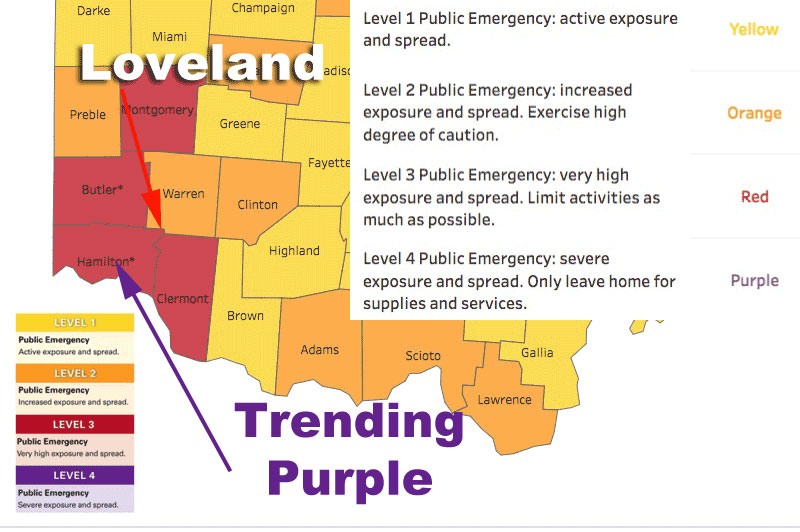
    Loveland, Ohio – Mike Samet the Public Information Officer for Hamilton County Public Health told Loveland Magazine on Friday, “As a ‘red’ county, most of our “indicators” are trending upward, hence the potential designation as ‘purple.”

    The message to county residents is a simple one said Samet in response to the question of how does Hamilton County avert escalating to Level 4. “The one we’ve been talking about since February. Until we have a vaccine and/or treatment for COVID-19, the only way to slow down transmission is: physical distance (6 ft. plus); wear a mask when out; stay home if you are ill; wash hands often and thoroughly; cover coughs/sneezes.”

    Samet added, “Wearing a mask is not a political statement. The mask shows care and respect for others in that we’re trying to reduce their risk of infection, as well as ours. It’s summer, it’s hot, no one likes wearing a mask, but it’s what we have to do to protect each other.”

    Samet said that from an enforcement perspective, as a county agency, the Health Department is not able to issue citations. “Nobody wants to be the mask police. This is education over enforcement, he said.  Samet added that he wants people to understand why masks are important now, not punish them for non-compliance. “In any event, our enforcement system is complaint-driven. People may register complaints with us at www.hcph.org. We follow-up on each complaint received,” said Samet. Read how to file a complaint in Clermont County below.

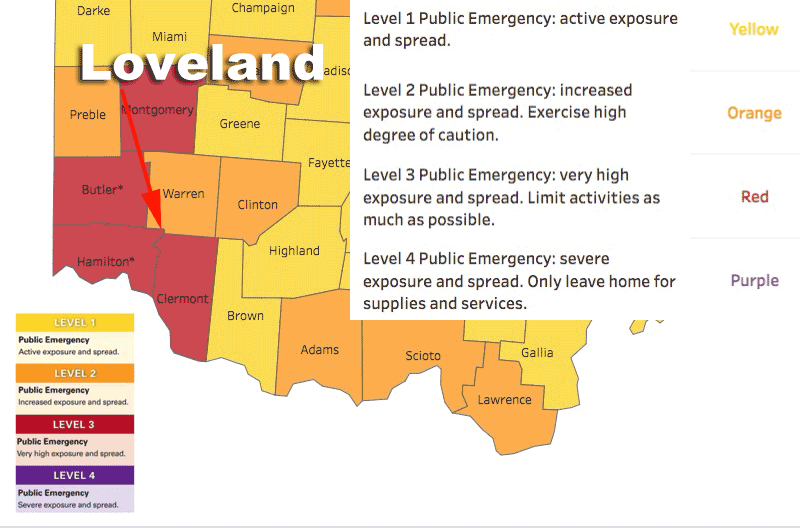
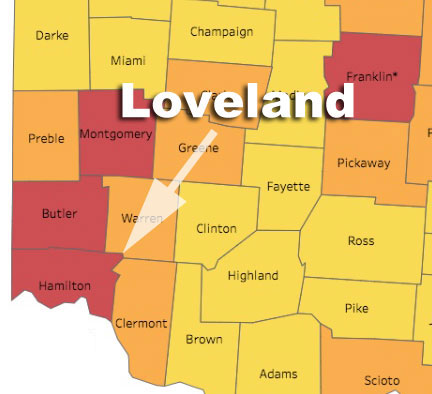
    Both Hamilton and Clermont counties are currently under the State RED Alert for COVID 19 spread. Clermont County was elevated from ORANGE to RED last Thursday. Warren County remains in the ORANGE Alert designation.

    What does it mean if Hamilton County goes to the highest Alert level?

    Hamilton County is on the State Watch list to possibly be elevated from the current RED Level Alert to the highest, PURPLE Level Alert. That destination would mean that the county is experiencing “Severe exposure and spread.” The order from the state would be, “Only leave home for supplies and services and Stay at home/necessary travel only.”

    Why was Hamilton County put under a RED Alert?

    As of July 7, Hamilton County during the 3 weeks prior had COVID 19 cases increase along with several other healthcare indicators.

    Between June 24 and June 30, Hamilton County had 1,124 cases, the largest number of COVID 19 cases in any week since the beginning of the pandemic.

    From June 16 until June 30, the average new cases per day doubled from 82 to 161. Due to clinical and reporting lags, these numbers may continue to grow for this reporting period.

    The community continued to experience early signs that more people are seeking medical care for COVID 19 symptoms.

    From June 16 to June 30, visits for COVID 19 to the emergency department doubled from an average of 11 per day to 22. More people are also visiting their doctors and being diagnosed with COVID 19.

    Between June 16 and July 2, the average outpatient visits more than tripled from 52 to 172 visits per day.

    In recent weeks, more than 86% of the cases are not in congregate settings, signaling significant transmission in the broader community.

    Hamilton County also hit a new threshold for the overall utilization rate for regional intensive care unit beds, which exceeded 80% during 5 of those past 7 days.
    Why was Clermont County put under a RED Alert?

    As of July 7, Clermont County during the 3 weeks prior had COVID 19 cases increase along with several other healthcare indicators.

    From June 16 until June 30, the average new cases per day doubled from 4 to 9. Due to clinical and reporting lags, these numbers may continue to grow for this reporting period.

    The community continued to experience early signs that more people are seeking medical care for COVID 19 symptoms.

    More people are also visiting their doctors and being diagnosed with COVID 19.

    Between June 16 and July 2, the average outpatient visits nearly tripled from 9 to 25 visits per day.

    In recent weeks, more than 94% of the cases are not in congregate settings, signaling significant transmission in the broader community.

    Clermont County also hit a new threshold for the overall utilization rate for regional intensive care unit beds, which exceeded 80% during 5 of those past 7 days.

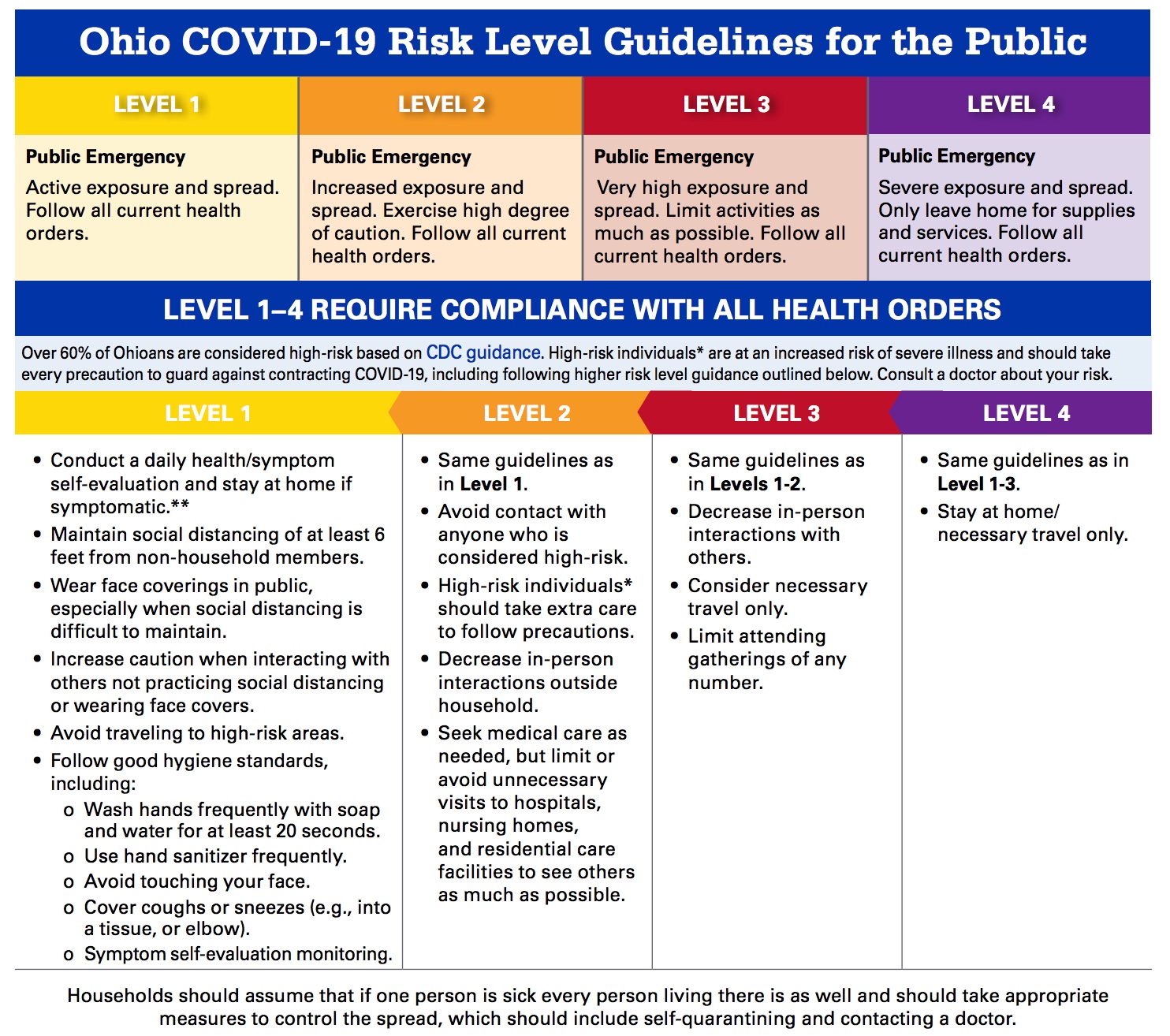
    LEVEL 1   0–1 Indicators Triggered

    Active exposure and spread. Follow all current health orders.

    LEVEL 2   2–3 Indicators Triggered

    Increased exposure and spread. Exercise high degree of caution. Follow all current health orders.

    LEVEL 3   4–5 Indicators Triggered

    Very high exposure and spread. Limit activities as much as possible. Follow all current health orders.

    LEVEL 4   6–7 Indicators Triggered

    Severe exposure and spread. Only leave home for supplies and services. Follow all current health orders.

    Summary of Alert Indicators


    As of today, Monday, July 13:

    The number of hospitalizations in Ohio is 8,842. Total Deaths in Ohio is 3,058.

    There are 462 hospitalizations and 131 deaths in Hamilton County. There have been 3,657 cases and 1,154 recoveries.

    There have been 497 confirmed and probable cases of COVID 19 in Clermont County and 7 confirmed and probable death. There are currently 60 hospitalizations. 341 people are being reported as recovered.

    In Warren County there have been 945 positive and probable cases and 25 positive and probable deaths. Warren County is reporting 120 new positive cases, 5 new hospitalizations, and 3 new deaths in the last 14 days.


    Clermont County Public Health has issued these 5 Protocols for All Businesses and these Frequently Asked Questions and Answers

    1. Require face coverings for employers and recommend them for clients/customers at all times.

    2. Conduct daily health assessments by employers and employees (self-evaluation) to determine if “fit-for-duty”.

    3. Maintain good hygiene at all times -hand washing, sanitizing, and social distancing.

    4. Clean and sanitize workplaces throughout the workday and at the close of business or between shifts.

    5. Limit capacity to meet social distancing guidelines.

    •Establish maximum capacity at 50% of the fire code.
    • And, use appointment setting where possible to limit congestion.

    Q. Will I have to wear a mask or face covering while I am at work?
    A. Yes. Face coverings are required for employees except if any of the following apply:

    1. Facial coverings in the work setting are prohibited by law or regulation;

    2. Facial coverings are in violation of documented industry standards;

    3. Facial coverings are not advisable for health reasons;

    4. Facial coverings are in violation of the business’ documented safety policies;

    5. Facial coverings are not required when the employee works alone in an assigned work area; or There is a functional (practical) reason for an employee not to wear a facial covering in the workplace.

    Q. Will I have to wear a mask or face covering if I am a customer at a business?
    A. Yes. Under the level 3 Public Health Emergency issued on July 10, customers must wear masks while inside businesses or other buildings.

    Q. Will I need to take my temperature before coming to work?
    A. Yes. Employees must take their temperature and watch for other symptoms such as coughing or difficulty breathing. Sick employees should stay at home.

    Q. What safety precautions should my employer be taking?
    A. All businesses should follow these protocols

    1. Require face coverings for employers and customers.

    2. Conduct daily health assessments by employers and employees (self-evaluation) to determine if “fit-for-duty”.

    3. Maintain good hygiene at all times -hand washing, sanitizing, and social distancing.

    4. Clean and sanitize workplaces throughout the workday and at the close of business or between shifts.

    5. Limit capacity to meet social distancing guidelines.

    •Establish maximum capacity at 50% of the fire code.
    • And, use appointment setting where possible to limit congestion.

    Q. What should I do if my co-workers aren’t wearing facial coverings at work?
    A. If an employee of a business is not wearing a facial covering, ask the employer/business for written justification on why the employee isn’t wearing a face covering.

    Q. What should I do if my employer is not following proper safety precautions?
    A. If an employer is not following the above safety protocols, you can file an online complaint here.

    To File a complaint about a business you think is in violation of the Stay Safe Ohio Order, click here.

    To check the status of a complaint click here. (Choose “Code Case” in the search drop-down box).

    Full Ohio Department of Health Stay Safe Ohio Order 

    More information from the Ohio Department of Health on the Responsible RestartOhio page
  • Cleanings, empty desks, and a 4th case suggest COVID-19 outbreak at the Statehouse

    Cleanings, empty desks, and a 4th case suggest COVID-19 outbreak at the Statehouse

    Ohio House Photo

    No one said why the cleaners were needed, but they showed up in N95 masks, face shields, gloves, an outer gown type covering and shoe covers, Vance said.

    July 10, 2020


    Columbus, Ohio – A state Senator said Thursday that another staffer at the Ohio Statehouse has tested positive for COVID-19, the fourth known case to hit the building in two weeks.

    Managers for the House office buildings have been called in seven times in the last two weeks for special disinfection of “multiple offices and common spaces.”

    Managers for the House office buildings have been called in seven times in the last two weeks for special disinfection of “multiple offices and common spaces.”

    Staffers at just eight of 45 House Republican offices answered their phones Thursday at two floors where large spreads of employees have purportedly been quarantined.

    In other words, the new coronavirus seems to have penetrated the seat of Ohio’s government, after the members of the controlling GOP majority have spent months downplaying or outright denying the gravity of a pandemic that has killed more than 3,000 Ohioans.

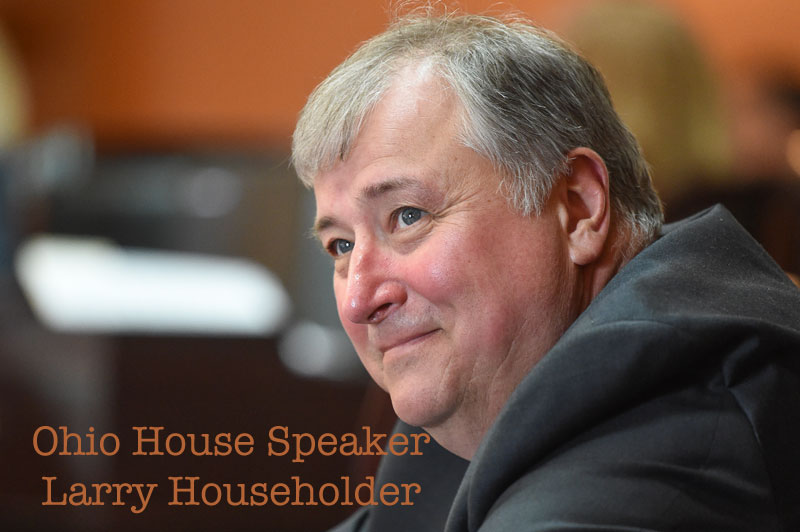
    Ohio House Speaker Larry Householder issued a directive late Thursday afternoon ordering all staffers to work from home, effective Friday morning.

    Ohio House Speaker Larry Householder, R-Glenford, who has not responded to multiple requests through spokesmen for comment, issued a directive late Thursday afternoon ordering all staffers to work from home, effective Friday morning. This is after he ended a prior work-from-home policy June 1.

    Householder and other members of his leadership team voted down a requirement in late May that members and staff wear masks, which research published in The Lancet suggests could substantially reduce viral transmission.

    House staff have refused to state how many at the Capitol have been quarantined or infected by the coronavirus.

    There’s an imperfect proxy: The Division of Administrative Services cleans the Riffe Center on a regular basis with special measures advised by the World Health Organization.

    On seven occasion over the last two weeks, DAS spokeswoman Melissa Vance said workers have been called in for “specialized cleaning/disinfection regimen.”  This includes electrostatic fogging, which discharges a disinfecting mist on all surfaces, along with manual cleaning of lateral surfaces and touchpoints like desks, phones and doorknobs.

    No one said why the cleaners were needed, but they showed up in N95 masks, face shields, gloves, an outer gown type covering and shoe covers, Vance said.

    The Ohio Capital Journal reported Thursday morning the presence of three known COVID-19 cases (one House lawmaker, one House staffer, and one Senate staffer), and an unusual arrangement in which House administrative staff is seemingly handling contact tracing in lieu of the health department.

    “The Speaker’s staff has taken it upon itself to do contact tracing and send people home,” said Rep. Allison Russo, D-Upper Arlington.

    Russo said she spoke to a governmental affairs liaison from Columbus Public Health on Thursday morning, who told her the department only learned of the House aide who tested positive for the disease through a media report. She said CPH was working to figure out where he or she had been tested.

    A CPH spokeswoman did not responded to multiple inquiries.

    Voicemails were left at 37 of 45 Republican lawmakers’ offices on the 11th and 13thfloor, which Russo alleged were home to some of the most notable vacancies. Of the eight staffers who answered, only one (who requested anonymity) agreed to an interview.

    “On the eleventh floor, there is a significant amount of people not here today,” the GOP staffer said.

    Across the building, another Senate staffer allegedly contracted the coronavirus.

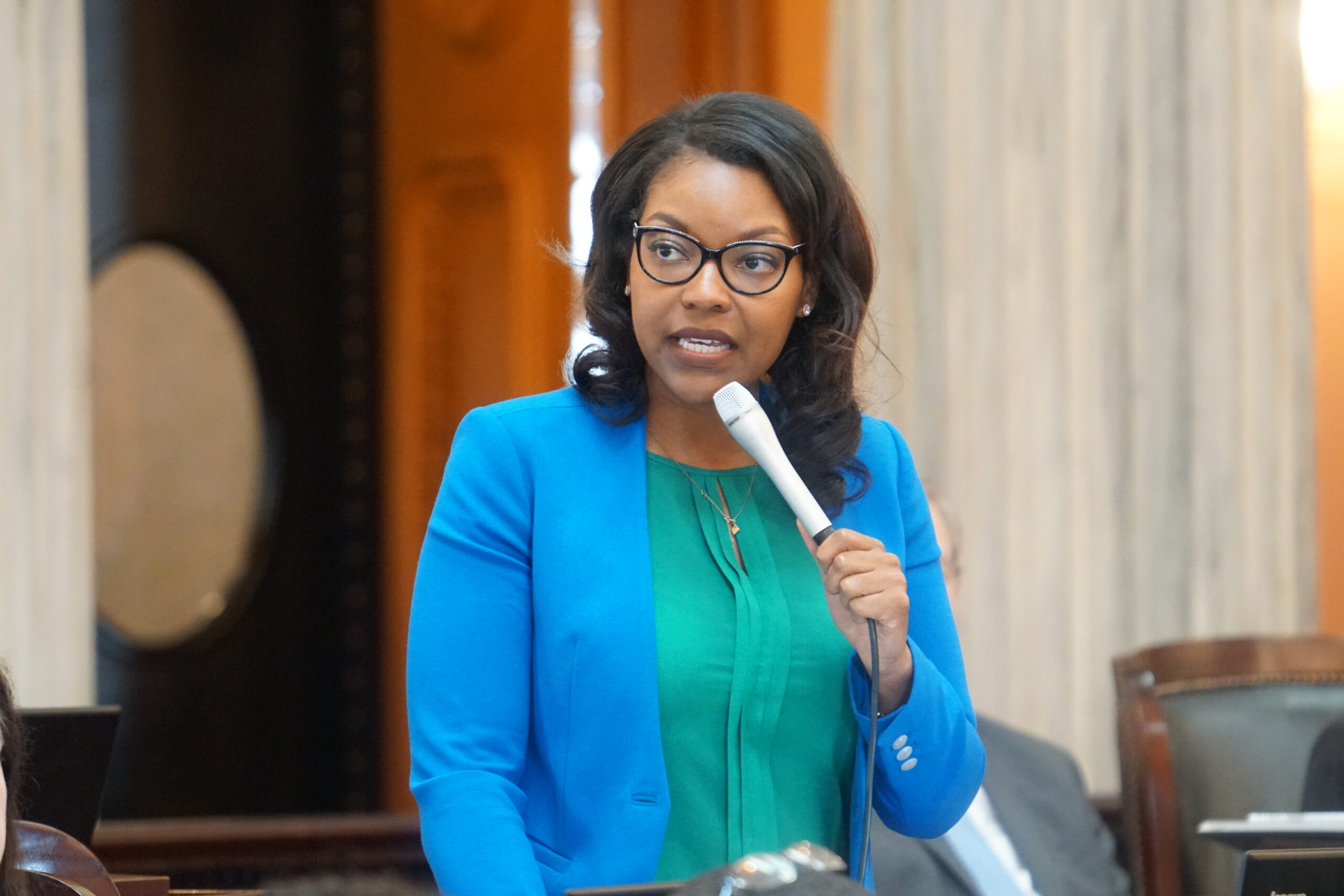
    The Senate Democrats chief of staff notified Sen. Teresa Fedor on Thursday that a Senate staffer tested positive for COVID-19, Fedor said in an interview.

    “I think that there is a definite wave of the virus coming through our work environment at the statehouse,” said Sen. Teresa Fedor.

    Sen. Teresa Fedor Senate Photo

    She closed her Senate office indefinitely in late June after an aide contracted the virus. She said she’d only re-open it after an agreement could be reached between the Senate Democrats and Republicans regarding how to respond to future outbreaks or individual cases.

    “I think that there is a definite wave of the virus coming through our work environment at the statehouse,” she said. “If the politics were out of this, we wouldn’t be going through this. It’s a health crisis, and it’s preventable.”

    A spokesman for Senate President Larry Obhof, R-Medina, could not be reached for comment.

    For weeks now, Democrats have complained about working conditions at the Capitol. They say Republicans refuse to wear masks and a lack of social distancing has made for an unsafe workplace.

    In a news release Thursday evening, House Minority Leader Emilia Sykes, D-Akron, blasted Householder for withholding information about potential cases and “spreading lies” about what’s happening.

    House Minority Leader Emilia Sykes Senate Photo

    In a news release Thursday evening, House Minority Leader Emilia Sykes, D-Akron, blasted Householder for withholding information about potential cases and “spreading lies” about what’s happening.

    “The Speaker of the House has an obligation during this pandemic to provide accurate information to members and staff,” she said. “People deserve to know what risks are associated with reporting to work each day and contact tracing should never be a partisan process. Our constituents need us to be healthy in order to work for them.”

    Franklin County, which encompasses the state Capitol, carries the heaviest case load (about 11,000) and death toll (439) of the pandemic by county in Ohio, according to state data.


    The Ohio Capital Journal is a hard-hitting, independent, nonprofit news organization dedicated to connecting Ohioans to their state government and its impact on their lives. The Capital Journal combines Ohio state government coverage with relentless investigative journalism, deep dives into the consequences of policy, political insight and principled commentary.

  • Ohio’s K-12 public schools got cuts. Private, charter schools got cash

    Ohio’s K-12 public schools got cuts. Private, charter schools got cash

    The amount of the state revenue reduction for the Loveland City School District was $1,010,855

    An up-date on 7/12/2020:

    Loveland Treasurer Kevin Hawley reports to the Board in the agenda for their June 23 business meeting:

    Loveland City Schools received approximately $350,000 from the CARES Act. These funds were provided to the state of Ohio and they determined the breakdown for each district. Ohio determined the allocation based on Title I federal funding rates. Title I is a federal grant primarily provided to “schools with high numbers or high percentages of children from low-income families to help ensure that all children meet challenging state academic standards.” This was the way the state determined equity in payments. As a reminder, the state decreased our overall state funding by $1,010,855. These funds are provided specifically for any increased expenses due to COVID-19. Therefore, this will help with any additional expenses incurred due to the pandemic and with the resumption of school in the fall of 2020.

    By Susan Tebben| Tyler Buchanan at the Ohio Capital Journal


    Local Private Schools Receiving Paycheck Protection Program Funds

    Cincinnati Country Day School 2-5m

    Cincinnati Hills Christian Academy 2-5m

    St. Xavier High School 2-5m

    Elder High School 1-2m

    Mount Notre Dame 1-2m

    McNicholas High School 350k-1m

    La Salle High School 350k-1m

    Roger Bacon High School 350k-1m

    Seton High School 350k 1m

    Lebanon Christian School 150k-350k

    Liberty Bible Academy (Mason) 150k-350k

    Ohio educators were at home celebrating “Teacher Appreciation Week” in May when they learned cuts would be made at every public school district in the state.

    These cuts came just as hundreds of private and charter schools in Ohio were approved to receive millions of dollars from the federal government to keep their workers on payroll. Some of these already receive public school funding as part of the EdChoice private school voucher program.

    The federal funding was offered through the Paycheck Protection Program (PPP). It is a program administered by the Small Business Administration which gives low-interest loans to businesses and nonprofits. The loans are forgiven if used primarily to help with payroll costs.

    After the federal government released a list of PPP recipients on Monday, the Ohio Capital Journal reviewed data on the nearly 23,000 recipients in this state to track funding that went to schools.  

    The list does not give an exact dollar figure received by each place, but rather provides a range: $150,000 to $350,000; $350,000 to $1 million; $1-2 million; $2-5 million; and $5-10 million.

    In total, the Capital Journal identified 220 schools in Ohio that received PPP funding. The possible range of the combined funding is between $95 million and $232 million.

    This money went to a variety of schools. Many are religious institutions, such as Chaminade Julienne Catholic High School in Dayton, which received between $1-2 million. The list includes many charter schools, such as the chain of Horizon Science Academy locations in more than a half-dozen cities which took in millions of dollars.

    There are private gifted schools, college preparatory schools and those which operate as nonprofits independent of the traditional public school system. Some are specialized schools for certain areas of study, such as the Global Ambassadors Language Academy in Cleveland, which allows children to learn in language immersion programs for Spanish and Mandarin. The academy took in between $150,000 and $350,000.

    Together, the 220 schools were able to retain many thousands of jobs thanks to the PPP funding. 

    There were additional loans given to Montessori schools, day care centers, pre-schools, after-school programs, summer camps and other entities which serve children. These were not included in the Capital Journal review. 

    PPP money has been limited to businesses and nonprofit entities, thus making public school districts ineligible for funding.

    The Ohio Capital Journal previously reported about a similar disparity within higher education. Dozens of private colleges and universities took in tens of millions of dollars in forgivable PPP loans, while some of Ohio’s public institutions have suffered from severe budget shortfalls in 2020. 

    Public schools hope for future funding

    Public schools are still searching for funding relief after $300 million was cut by Gov. Mike DeWine’s administration in early May as the coronavirus pandemic began to impact state revenues. The amount of the state revenue reduction for the Loveland City School District was $1,010,855.

    Columbus City Schools Superintendent and CEO Talisa L. Dixon told a legislative committee discussing the future of K-12 education as the cuts took place that uncertainty is the greatest factor facing Ohio schools.

    “Uncertainty for the educational programs our families may need and want during this crisis, uncertainty of what our revenues may be as the state discusses further reductions, uncertainty of what our expenses may be in order to bring students back safely,” Dixon said.

    The state education system has seen declining growth not just related to coronavirus cuts, but year over year, according to historic data. On top of decreasing budgets, public schools have had to absorb the expenses of sending some students in low-ranked public schools to private schools through the EdChoice program.

    The Cleveland Heights-University Heights City School District, for example, saw more than one-third of its state aid deducted for EdChoice scholarships in fiscal year 2019, according to a report done by the district.

    According to the PPP awards, a number of Cleveland private schools received funding — examples include the Lutheran High School Association as well as the St. Joseph Academy, each taking in forgivable loans of between $1-2 million.

    Hamilton County’s Indian Hill Exempted Village School District had around one-fourth of its state aid diverted to EdChoice private school vouchers, and Sycamore Community City School District lost about one-fifth.

    In 2020 PPP awards, nearby schools received loans such as Cincinnati Hills Christian Academy (between $2-$5 million) and St. Ursula Academy (between $1-$2 million).

    The leader of a teacher’s union representing 20,000 Ohio educators is taking issue with PPP funding and public school monies going toward private schools. In a recent conference call regarding falling budgets and the need for federal aid, Ohio Federation of Teachers Executive Director Melissa Cropper said the diversion of government funding to private schools has only added to the struggles that impact most students in the state.

    “Ninety percent of our students are educated in public schools, so when we have this money diverted to private schools, we’re impacting 90% of the students that the money is being taken away from,” Cropper said. “So this just continues to create disparities within our education system.”

    Education advocates see other potential solutions to public schools’ budget woes — namely, funding from the federal CARES Act, a COVID-19 relief bill signed into law back in March. A separate HEROES Act includes more funding for public education, including $3.2 billion earmarked for Ohio schools, but the bill has languished in the U.S. Senate after passing in the U.S. House of Representatives. 

    The Ohio Capital Journal is a hard-hitting, independent, nonprofit news organization dedicated to connecting Ohioans to their state government and its impact on their lives. The Capital Journal combines Ohio state government coverage with relentless investigative journalism, deep dives into the consequences of policy, political insight and principled commentary.

  • Clermont County elevated to RED COVID 19 Alert

    Clermont County elevated to RED COVID 19 Alert

    The Public Health Advisory Alert System is a color-coded system designed to supplement existing statewide orders through a data-driven framework to assess the degree of the virus’ spread and to engage and empower individuals, businesses, communities, local governments, and others in their response and actions.

    The system consists of four levels that provide Ohioans with guidance as to the severity of the problem in the counties in which they live.  The levels are determined by seven data indicators that identify the risk level for each county and a corresponding color code to represent that risk level.

    Loveland, Ohio – Governor DeWine announced today that new public health data has led the Ohio Department of Health to designate that Clermont County is now among 12 counties as being in a Red Alert Level 3 Public Emergency as defined by the Ohio Public Health Advisory System.

    Clermont County had been in Level 2 until the announcement today.

    Hamilton County remains RED Alert Level 3 however it is on Ohio’s “Watch List” as they are approaching Purple Alert Level 4.

    Mandates for people to begin wearing masks in public in Clermont County will begin at 6 PM on Friday, July 10.

    Governor DeWine announced the creation of the Ohio Public Health Advisory System last week to provide local health departments, community leaders, and the public with data and information on the severity of the COVID-19 spread in the counties in which they live. The system consists of four levels with specific risk-level guidelines. Each level is calculated with data gathered on seven public health indicators.

    Read the Health Order

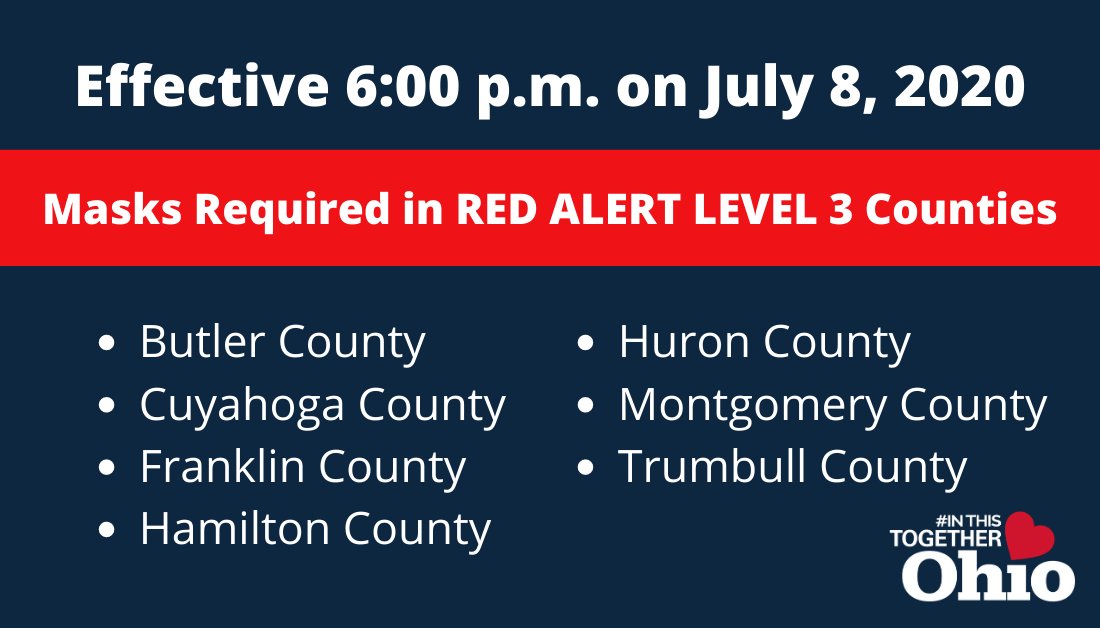
    Director’s Order for Facial Coverings in Butler, Cuyahoga, Franklin, Hamilton, Huron, Montgomery, and Trumbull Counties in Level 3 Public Health Advisory

    Those in counties designated as Red Alert Level 3 or Purple Alert Level 4 are required to wear a face covering:

      • In any indoor location that is not a residence;
      • When outdoors and unable to consistently maintain a distance of six feet or more from individuals who are not members of their household; or
      • While waiting for, riding, driving, or operating public transportation, a taxi, a private car service, or a ride-sharing vehicle.

    The order does not apply to children under the age of 10 or any other minor who cannot safely wear a face covering. The order also reflects the mask guidance in place for employees and businesses which does not require a person to wear a mask if their physician advises against it, if wearing a mask is prohibited by federal regulation, if communicating with the hearing impaired, when alone in an office or personal workspace, and other similar measures.

    Schools that offer Kindergarten through Grade 12 instruction should follow the guidelines set forth last week by the Ohio Department of Education and the Ohio Department of Health.

    The Ohio Department of Health will update county rankings every Thursday. Any county that increases to Red Alert Level 3 will automatically be included in the face-covering mandate. Any county that decreases from Red Alert Level 3 to Orange Alert Level 2 will automatically be released from the face-covering requirement.

  • Health Order for Hamilton County requiring face masks released

    Health Order for Hamilton County requiring face masks released

    Loveland, Ohio – Today beginning at 6 PM all of Hamilton County is under an order of the Ohio Department of Health that mandates the wearing of face coverings in public.

    Read the Health Order

    Director’s Order for Facial Coverings in Butler, Cuyahoga, Franklin, Hamilton, Huron, Montgomery, and Trumbull Counties in Level 3 Public Health Advisory

    Read Background

    Hamilton County, including part of Loveland under Mandatory Mask order at…

  • [POLL] Do you feel safe sending your child back to school in light of the “Red” Alert?

    [POLL] Do you feel safe sending your child back to school in light of the “Red” Alert?

    “The Public Health Advisory Alert System is a color-coded system designed to supplement existing statewide orders through a data-driven framework to assess the degree of the virus’ spread and to engage and empower individuals, businesses, communities, local governments, and others in their response and actions.”

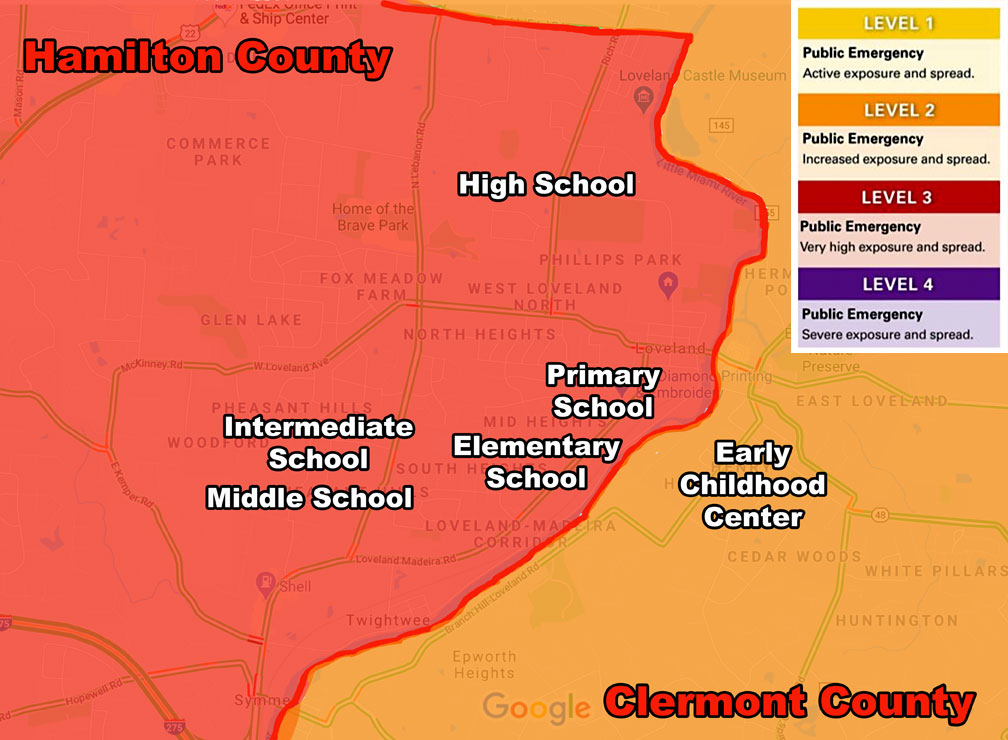
    Loveland, Ohio – Today beginning at 6 PM all of Hamilton County which includes parts of the Loveland School District is under an order of the Ohio Department of Health that mandates the wearing of face coverings in public.

    Loveland High School, the Intermediate and Middle School Campus, and the Primary and Elementary Campus are all within the RED alert area. There are approximately 4,000 students that attend these schools.

    The Early Childhood Center is in Clermont County which is in the Orange Alert area.

    Loveland Schools are currently scheduled to resume classes on August 26, 48 days from now.

    Loveland is in three counties. The Little Miami River is the East/West dividing line between Hamilton County and Clermont County, A smaller part of Loveland is in Warren county. Hamilton County is in the RED in Ohio’s Public Health Emergency Alert system. Clermont and Warren are both currently ORANGE.

    Also, Governor Dewine tweeted on July 7, “As the #COVID19 pandemic has progressed more younger Ohioans are being diagnosed with #COVID19. We are seeing young people who are getting very sick. There is also the concern that they are passing it on to those who are at risk.” He released this graphic to emphasize that point.


    [poll id=”5″]


    Read the Health Order

    Director’s Order for Facial Coverings in Butler, Cuyahoga, Franklin, Hamilton, Huron, Montgomery, and Trumbull Counties in Level 3 Public Health Advisory

  • Ohio cannabis industry virtual food drive provides nearly 15 thousand meals

    Ohio cannabis industry virtual food drive provides nearly 15 thousand meals

    Cincinnati/Cleveland/Columbus, Ohio – When the cannabis industry was deemed essential business by the State of Ohio, civic organization Cannabis Can! immediately felt a responsibility to help fellow Ohioans. Its mission that Cannabis Can! Strengthen Communities! and Fight Hunger! called organizers into action in March as COVID-19 shutdowns began to increase food insecurity nationwide.

    Cannabis Can! worked with Freestore Foodbank, Greater Cleveland Food Bank, and Mid-Ohio Foodbank for its 2019 Holiday Canned Food Drive, which collected half a ton of nonperishable goods. In conjunction with its food bank partners in Cincinnati, Cleveland, and Columbus, they established branded landing pages for the 2020 Virtual Food Drive. Through these web pages, a text-to-give campaign and Facebook, Cannabis Can! supporters have been making secure, tax-deductible gifts directly to food banks for immediate use.

    Forty-one mainstream and cannabis industry businesses, nonprofits, organizations, and influencers became Partners in the Cannabis Can! campaign to raise funds for Ohio food banks. Partners promote the Virtual Food Drive and offer incentives to donors; in turn, they receive promotion benefits from Cannabis Can!. A diverse group of Partners formed that includes businesses and organizations not directly related to the cannabis industry.

    The Drive itself started on April 20 and the call went out to “Celebrate 4/20 by showing that the cannabis community cares about fighting hunger.” Organizers set a fundraising goal of $3,000.00, equivalent to 12,000 meals or $27,000 worth of groceries, by June 30.

    They not only met that goal, they surpassed it. Cannabis Can! Director, Lorien Hill-Purcell, announced $3,745.55 has been given directly to the Columbus area Mid-Ohio Foodbank, Greater Cleveland Food Bank, and Freestore Foodbank in Cincinnati collectively. Sixty donations, ranging from $5 to $525, make up the total. “Our Partners and Supporters include individuals and organizations who invested time, energy, and resources to reduce the stigma around cannabis by fighting hunger and strengthening Ohio communities,” says Hill-Purcell.

    The $3,745.55 raised will help Ohio food banks acquire and distribute up to $33,709.95 worth of groceries, equivalent to 14,982 meals for our neighbors in need. However, the Drive does not stop because the goal was achieved. Donation pages will be active throughout the remainder of 2020 and links to them are available on the Cannabis Can! website, cannabiscanohio.org. Organizers’ new Virtual Food Drive target is $5,000 by January 1, 2021.

    DONATE NOW

    Cannabis Can! 2020 Virtual Food Drive Partners include:
    AdvoCare Clinic
    Canna.ED
    Cannabis Safety First
    Cincinnati Botanical Depot
    Cincinnati Medical Marijuana Meetup
    Cincy Mom Buds
    Cleveland School of Cannabis
    Columbus Botanical Depot
    Compassionate Alternatives
    Cresco Labs
    Ediybles
    Galenas
    Green Harvest Health
    Green Ideas and Wellness
    Have A Heart Cincy
    Health and Wellness Online, LLC
    Hunger-fighting Masks
    Key to Life Garden
    KT Scooter Rentals
    Leaf Medic
    Luminous Life Wellness Center, LLC
    Medical Marijuana Patient Care, LLC
    MedicateOH
    Midwest CannaWomen
    Murray Road Strong
    My Drops of Sanity
    Ohio CBD Guy
    Ohio Medical Marijuana Physicians Association
    Ohio Rights Group
    OhioCannabis.com
    ORG Education Fund
    Rise Dispensaries of Ohio
    Terrasana Cannabis Co.
    Tha Presidential Suite
    The Nature Factory
    The Ohio Cannabis and Hemp Chamber of Commerce
    The Relaxation Place Inc.
    Traxler Printing
    Tulip Tree CBD
    Vireo Health, LLC

  • Hamilton County, including part of Loveland under Mandatory Mask order at 6 PM tomorrow

    Hamilton County, including part of Loveland under Mandatory Mask order at 6 PM tomorrow

    The Public Health Advisory Alert System is a color-coded system designed to supplement existing statewide orders through a data-driven framework to assess the degree of the virus’ spread and to engage and empower individuals, businesses, communities, local governments, and others in their response and actions.

    The system consists of four levels that provide Ohioans with guidance as to the severity of the problem in the counties in which they live.  The levels are determined by seven data indicators that identify the risk level for each county and a corresponding color code to represent that risk level.

    The Order has not been released as of press time but here is what we can report

    UPDATE:

    Read the Health Order

    Director’s Order for Facial Coverings in Butler, Cuyahoga, Franklin, Hamilton, Huron, Montgomery, and Trumbull Counties in Level 3 Public Health Advisory

    Loveland, Ohio – Beginning tomorrow at 6 PM all of Hamilton County which includes parts of Loveland will be under an order of the Ohio Department of Health that mandates the wearing of face coverings in public.

    Loveland is in three counties. The Little Miami River is the dividing line between Hamilton County and Clermont County, A smaller part of Loveland is in Warren county. Hamilton County is in the RED in Ohio’s Public Health Emergency Alert system. Clermont and Warren are currently ORANGE.

    Currently, there are 37 persons diagnosed with COVOD 19 in the 45140 ZIP Code area of Hamilton County.

    Governor Mike DeWine made the announcement today that covers all counties that are designated Red Level 3 Ohio’s Public Health Emergency Alert.

    Currently, Ohio has seven counties that have triggered a Red Level 3 Public Health Emergency Alert: Butler, Cuyahoga, Franklin, Hamilton, Huron, Montgomery, and Trumbull.

    Those in counties designated as Red Alert Level 3 or Purple Alert Level 4 are required to wear a face covering:

    • In any indoor location that is not a residence;
    • When outdoors and unable to consistently maintain a distance of six feet or more from individuals who are not members of their household; or
    • While waiting for, riding, driving, or operating public transportation, a taxi, a private car service, or a ride-sharing vehicle.

    The order does not apply to children under the age of 10 or any other minor who cannot safely wear a face covering. The order also reflects the mask guidance in place for employees and businesses which does not require a person to wear a mask if their physician advises against it, if wearing a mask is prohibited by federal regulation, if communicating with the hearing impaired, when alone in an office or personal workspace, and other similar measures.

    Schools that offer Kindergarten through Grade 12 instruction should follow the guidelines set forth last week by the Ohio Department of Education and the Ohio Department of Health.

    The Ohio Department of Health will update county rankings every Thursday. Any county that increases to Red Alert Level 3 will automatically be included in the face-covering mandate. Any county that decreases from Red Alert Level 3 to Orange Alert Level 2 will automatically be released from the face-covering requirement.


    Also, Dewine tweeted today, “As the #COVID19 pandemic has progressed more younger Ohioans are being diagnosed with #COVID19. We are seeing young people who are getting very sick. There is also the concern that they are passing it on to those who are at risk.” He released this graphic to emphasize that point.

    More than 6,100 new Ohio COVID-19 cases in July so far

    By

    Jake Zuckerman at The Ohio Capital Journal

    July is off to a poor start in Ohio, as measured by the more than 6,100 Ohioans diagnosed with COVID-19 since the month began.

    State data released Monday shows 805 new coronavirus cases in Ohio with varying illness onset dates, which marks the end of a 20-day streak in which the average new reported caseload has increased.

    All told, nearly 58,000 Ohioans have contracted COVID-19, at least 2,927 of whom have died. At least 8,249 Ohioans have been hospitalized.

    Graph: Jake Zuckerman, data from the Ohio Department of Health

    Ohio’s increased caseload reflects a trend of contagion growth occurring in 39 U.S. states, according to a New York Times tracker.

    However, Ohio’s epidemic curve depicts slower growth than case explosions seen in Arizona, Texas, Louisiana, Mississippi, Georgia, Tennessee, Nevada, California, South Carolina, and Florida.

    The new caseload in Ohio is trending more heavily toward young people. In May, people under 40 comprised about 41% of the new caseload, per an analysis of state data. In June, that figure hit 54%, though more June cases are likely to be reported through the month.

    On Thursday, Gov. Mike DeWine announced a new county-by-county measurement system based on seven metrics like hospitalizations and cases per capita. Under the new criteria, seven counties in Ohio are at alert level three, the second-highest category.

    They include Cuyahoga, Hamilton, Montgomery, Butler, Trumbull and Huron counties. He said he plans to update the risk level estimations weekly.

    DeWine indicated Franklin County is on special watch and could escalate to top tier risk precautions, though he didn’t specify what that would entail in terms of social distancing regulations.

  • COOL: Episode 3 of Ricky Mulvey’s documentary podcast about Ezzard Charles, Total Fighter, is up RIGHT NOW

    COOL: Episode 3 of Ricky Mulvey’s documentary podcast about Ezzard Charles, Total Fighter, is up RIGHT NOW

    Ricky Mulvey’s Podcast: “Total Fighter” about Cincinnati’s Ezzard Charles

    This podcast shines a new light on the underrated Cincinnati Cobra; the greatest light-heavyweight of all time.

    Ricky Mulvey is a former sportswriter and talking head at Loveland Magazine

    Part 3 of Ricky Mulvey’s 5 part podcast series on Ezzard Charles, “Total Fighter” is up now.

    In the third episode, Ezzard Charles tries to move on from his tragic meeting with Sam Baroudi and the mafia tightens its grip over his boxing career. A match against Joe Louis becomes more possible after the biggest fight in Cincinnati’s history.

    The Man in Front of Me (Part 3)


    Total Fighter features interviews with Buddy LaRosa, founder of LaRosa’s Pizza, William Dettloff, author of “Ezzard Charles: A Boxing Life,” and Ezzard Charles II.

    Episode 2: “Cobra Strike” covers Ezzard’s tragic and career-defining boxing match, his experience in World War II, and his manager who was “allegedly” connected to the New York Mafia.

    Play Episode 2

    Featuring interviews with P Man Jones, Ezzard Charles II, William Dettloff, author of “Ezzard Charles: A Boxing Life,” and Buddy LaRosa, founder of LaRosa’s Pizza.

    “Total Fighter,” is a narrative, nonfiction podcast about Ezzard Charles, Cincinnati’s heavyweight champion, and hosted by Loveland native Ricky Mulvey.
    By Source, Fair use, https://en.wikipedia.org/w/index.php?curid=42512075

    This podcast shines a new light on the underrated Cincinnati Cobra; the greatest light-heavyweight of all time.

    The series will ultimately follow Charles to his match against Joe Louis, and the characters who followed him– his family and the mafia.

    The premier episode, “More Than a Gym Fighter” is a deep-dive into a very different Cincinnati. Go to a bustling Findlay Market in the 1940s, in between the pool tables and cigar smoke at the American Legion Hall in Newport, Kentucky for Charles’ first boxing match, and a Battle Royale in Lawrenceville, Georgia.

    Play Episode 1

    “Total Fighter” features interviews and stories from Buddy LaRosa, founder of LaRosa’s Pizza, William Dettloff, author of “Ezzard Charles: a Boxing Life,” Frank Wettencamp, one of Ezz’s high school classmates, and more. 

    This show explores his complex character; why the name “Ezzard Charles” became an insult by Frank Sinatra and an inspiration to the composer George Russell.

    You can first hear new episodes and updates right here on Loveland Magazine or by following Ricky Mulvey on Facebook, @rickymulvey on Instagram, and @rickssoslick on Twitter.
    You can find the show on Apple Podcasts, Spotify, or most other platforms.
  • DORA open carry extended into September in Historic Downtown Loveland

    DORA open carry extended into September in Historic Downtown Loveland

    Loveland City Manager Dave Kennedy was given the authority to extend the DORA for 60-days.

    Loveland, Ohio – The City of Loveland’s Designated Outdoor Refreshment Area (DORA), which previously allowed for the consumption of alcohol within specific boundaries in Historic Downtown only during specified events was modified in May from being in effect only during specified events to being in effect seven days a week from noon to 11 PM.

    The modification that went into effect in May was set to expire today.

    The DORA allows for the consumption of alcohol within specific boundaries in Historic Downtown.

    As provided within the legislation previously adopted by City Council, the City Manager was given the authority to extend the DORA for an additional 60-days.

    Under that authorization, City Manager Dave Kennedy announced yesterday that he has extended the seven-day DORA until September 5.


    Q: What is a DORA?

    A: A Designated Outdoor Refreshment Area (DORA) is a specially designated area that allows patrons of an establishment serving alcohol to take an open container of alcohol out of the business and walk around the public streets. Drinks must be in special cups designated as DORA cups. These cups can be obtained at all participating alcohol establishments inside the DORA.

    Q: May a person bring their own alcohol into a DORA?

    A: No. Ohio open container law prohibits a person from having an opened container of alcohol on a permit premises that was not purchased from that permit holder even if the permit premises are within a DORA purchased elsewhere.

    Q: Do I have to use special DORA Cups?

    A: Yes. Any open alcohol which leaves an establishment must be in designated DORA cups. And, DORA cups must be empty to enter an establishment. Cups can be obtained at any participating establishment.

    Q: What types of alcoholic beverage can I have in my DORA cup?

    A: Beer, wine and liquor are allowable beverages to be consumed in designated DORA cups.

    Q: Can I walk anywhere with my DORA cup?

    A: Patrons can enjoy their beverage within the designated DORA Boundaries which are marked by signage.

    Businesses serving DORA beverages will have the below sticker decal displayed:
    DORA Sticker


    Check out these savings from All American Gutter Protection. All American Gutter Protection offers the best micro mesh gutter guards and gutters at highly competitive pricing.