Valentine’s Day is right around the corner, and you can send a smile to a child spending the holiday with Cincinnati Children’s by sending an e-Card. There’s no cost to you, but all the feels will be priceless: https://give.cincinnatichildrens.org/…/ValentinesDay.html!
f you decide to make a donation, friends at Kolar will match your gift dollar-for-dollar, up to $20,000—helping us give the world the joy of happy, healthy kids living their best lives.
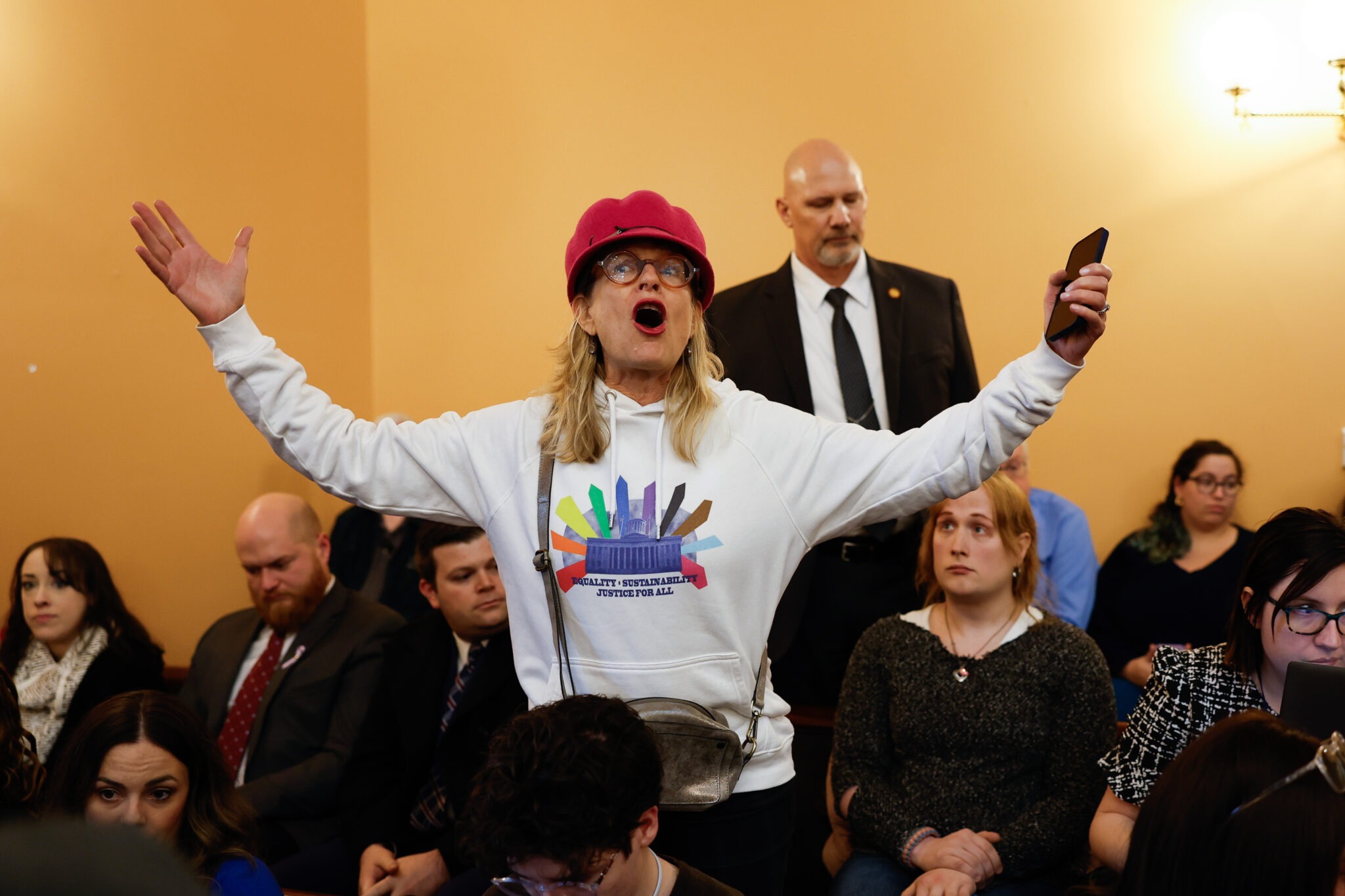
COLUMBUS, OH — JANUARY 24: A protester asks senators to not override Gov. Mike DeWine’s veto of House Bill 68 that would limit medical care for transgender minors and block transgender girls from sports during the Ohio Senate session, January 24, 2024, at the Statehouse in Columbus, Ohio. (Photo by Graham Stokes for Ohio Capital Journal)
Both laws — banning gender-affirming care and local flavored tobacco regulations — are now set to take effect at the end of April.
The Ohio Senate voted to override two of Gov. Mike DeWine’s vetoes Wednesday — one on a bill blocking gender-affirming care for trans youth and the other blocking cities from banning flavored tobacco sales. Both laws are now set to take effect at the end of April.
The Senate voted 24-8 to override DeWine’s veto of House Bill 68, which blocks gender-affirming care for trans youth and prevents transgender athletes from playing women’s sports. The bill prohibits transgender youth from starting hormone therapy and puberty blockers.
“I think parents should make those decisions and not the government,” DeWine said before the vote Wednesday.
The Senate also voted 24-8 to override DeWine’s veto of a provision that would prevent cities from banning flavored tobacco sales. A flavored tobacco ban took effect in Columbus earlier this month after Columbus City Council voted to stop the sale of flavored tobacco products in December 2022.
“It will be a win for big tobacco and it will be a loss for Ohio,” DeWine said before the vote Wednesday.
A three-fifths majority vote from the members of the House and Senate is necessary to override the governor’s veto. The Ohio House voted to override HB 68 earlier this month and voted to override the flavored tobacco ban in December. State Sen. Nathan Manning of North Ridgeville was the only Republican to vote against overriding the Republican governor on the gender-affirming care ban, and state Sen. Louis Blessing of Colerain Township was the sole Republican to vote against overriding DeWine on the tobacco law.
The laws are set to go into effect 90 days after they are delivered to the Secretary of State’s office, meaning it would likely take effect April 23.
House Bill 68
COLUMBUS, OH — JANUARY 24: A protester asking senators to not override Gov. Mike DeWine’s veto of House Bill 68 that would limit medical care for transgender minors and block transgender girls from sports is removed from the gallery during the Ohio Senate session, January 24, 2024, at the Statehouse in Columbus, Ohio. (Photo by Graham Stokes for Ohio Capital Journal)
Ohio Senators discussed House Bill 68 for about an hour before taking a vote. Democrats said they celebrated DeWine’s veto while Republicans expressed their disappointment in last month’s veto.
“There are men and there are women and there are boys and there are girls and they are different,” said State Sen. Kristina Roegner, R-Hudson.
“Gender is not fluid. There is no such thing as a gender spectrum,” she claimed.
State Sen. Bill DeMora, D-Columbus, said this bill becoming law will lead to loss of life.
“Politicians have no business banning evidence-based, life-saving medical care – especially when it is endorsed by every major medical and mental health association,”said Ohio Senate Democratic Leader Nickie J. Antonio, D-Lakewood.
“We should listen to parents, providers and patients, not willfully and purposely pass harmful legislation that will add to the mass exodus of individuals from the state of Ohio,” Antonio said.
A protester was removed from the Senate chamber after she interrupted Roegner.
“Jesus loves the little children, all the children of the world, LGBTQIA,” she screamed. “Jesus would be here on their side today. We need to support them.”
HB 68 has a grandfather clause that would allow doctors who already started treatment on patients to continue.
Gender-affirming care is supported by every major medical organization in the United States. Children’s hospitals across Ohio, the Ohio Children’s Hospital Association, and the Ohio Academy of Family Physicians all oppose HB 68. No Ohio children’s hospital performs gender-affirming surgery on patients under 18 currently.
DeWine said his veto of HB 68 was “about protecting human life.”
“These are gut-wrenching decisions that should be made by parents and should be informed by teams of doctors who are advising them,” he said during a press conference on Dec. 29.
It’s likely this new law will end up in court.
Twenty-two other states have passed a law that bans gender affirming care for transgender youth, but most have faced legal challenges, according to the Human Rights Campaign.
Before the Senate voted to override his veto, DeWine said he does not plan to pursue legal against HB 68.
“The legislature has the constitutional right to override anything, any bill that I sign, or any or any bill that I veto,” DeWine said. “That’s part of our system. And I respect our system. It doesn’t mean I like the vote, but I respect our system.”
Senate President Matt Huffman, R-Lima, told reporters Wednesday he believes HB 68 will hold up in court.
“I do think that it’ll pass constitutional scrutiny,” he said.
State Rep. Gary Click
The bill’s author state Rep. Gary Click, R-Vickery, has denied that HB 68 has any religious backing, but Click can be heard saying in a recorded sermon from 2018 that trans people break from God’s plan for the family.
COLUMBUS, Ohio — JANUARY 10: State Rep. Gary Click, R-Vickery, celebrates the vote to override Gov. Mike DeWine’s veto of HB 68 during the Ohio House session, January 10, 2024, at the Statehouse in Columbus, Ohio. (Photo by Graham Stokes for Ohio Capital Journal. Republish photo only with original article.)
“You’re not born that way,” Click says about trans people during the sermon. “God’s not going to curse you in the wrong body. He’s not going to curse you with desires that cannot be adequately and appropriately and biologically fulfilled correctly.”
Click is a pastor at Fremont Baptist Church and celebrated Wednesday’s Senate vote.
“The SAFE Act and Save Women’s Sports Act are the civil rights issues of our day, ensuring that children have the right to grow up intact and that women are no longer subject to men invading their spaces,” he said in a statement.
Gender-affirming care
Gender-affirming care can “include any single or combination of a number of social, psychological, behavioral or medical interventions designed to support and affirm an individual’s gender identity,” according to the World Health Organization.
Puberty blockers use hormones to pause puberty development and are reversible.
Hormone therapy helps align a person’s body with their gender identity by giving testosterone hormones to those who were assigned female at birth and giving estrogen hormones to those who were assigned male at birth. This is partially reversible.
A 2022 study published in JAMA Network Open found access to hormones and puberty blockers for young people ages 13-20 was associated with a 60% lower odds of moderate to severe depression and a 73% lower odds of self-harm or suicidal thoughts compared to youths who didn’t get these medications.
Transgender athletes
House Bill 6, which prevents trans athletes from playing Ohio women’s sports, was rolled into HB 68 during the summer.
“It’s too bad that House Bill 68 and House Bill 6 were combined into one piece of legislation because the only commonality these two pieces of legislation have is they both target the same small portion of transgender kids,” said State Senator Kent Smith, D-Euclid.
Twenty-three states have passed similar laws in regards to transgender athletes since 2020, according to ESPN.
Currently, if a trans girl wants to play on a team with cis girls in Ohio, she must go through hormone treatments for at least one year or show no physical or physiological advantages, according to the Ohio High School Athletic Association.
“They think that they can erase transgender people with this legislation and the other legislation they’re passing, but our kids will still be trans and trans people will still be trans no matter what they do,” Zelch said. “And we’re here to fight and continue fighting.”
Human Rights Campaign President Kelley Robinson said the override of HB 68 will harm innocent children.
“Despite the fact that they have no medical training, these politicians believe they know better than parents and transgender youth seeking health care. It’s shameful,” Robinson said in a statement.
Dara Adkison, board secretary of TransOhio, said trans youth deserve better.
“Our community is strong and resilient in ways that hateful legislators can not comprehend, and trans Ohioans across the state cannot and will not be legislated away,” Adkison said.
Carson Hartlage, an Ohio medical student, said this is a dark day for the Ohio trans community.
“I was a trans kid who became a trans adult in Ohio, and it feels so dehumanizing to see my home state spend years trying to stop healthcare from my community,” Harlage said.
Tobacco
Back in January 2023, DeWine vetoed a bill that would have prevented any city or municipality from regulating smoking, vaping and other e-cigarette usage and sales. Before the Senate voted to override the tobacco veto, DeWine said a veto override would be horrible for Ohio children.
“I just don’t know how anybody thinks it was a great idea,” DeWine said. “To have more children in the state of Ohio become addicted (to nicotine).”
One out of every five children in Ohio vape, DeWine said.
“It’s the Tutti Frutti and all the other kinds of crazy flavors that masked all nicotine and it gets them addicted,” he said.
The American Cancer Society Cancer Action Network said lawmakers have turned their backs on Ohio kids with the veto override.
“Instead of offering solutions to address the health of Ohioans, lawmakers have now rolled back existing local laws regulating the sale of tobacco products and limited what local governments can do to prevent people from starting to use tobacco and help people quit,” ACS CAN said in a statement.
Municipal home rule gives cities and villages in Ohio the constitutional right to certain powers, including establishing laws in accordance with the self-government clause. Cities have the right to make their own policies, as long as it doesn’t get in the way of laws in the Ohio Revised Code.
Ohio Capital Journal reporter Zurie Pope contributed to this report.
Megan Henry is a reporter for the Ohio Capital Journal and has spent the past five years reporting in Ohio on various topics including education, healthcare, business and crime. She previously worked at The Columbus Dispatch, part of the USA Today Network.
Loveland, Ohio – The Austin Peay State University Govs open the season at the Grand Sands Tournament in Loveland, Ohio, where they face Tusculum and Morehead State on February 23rd and Liberty and Atlantic Sun Conference opponent Eastern Kentucky on February 24th. Read on at Clarksville Online…
Terry Cole of Colemine Records and Plaid Room Records Photo by Mitch LaGrow
“It’s a massive discovery tool for our artists. I wish the pay was more for sure,” Cole says. “But 2023 was the first year where our digital revenue was higher than our physical revenue. And that’s saying something because we sell a shitload of records. We sold 154,000 records last year, LPs, CDs and 45s. And we still generated more revenue digitally.”
Terry Cole of Colemine and Plaid Room Records, located in Historic Loveland, is featured in CityBeat’s January 24 print edition. Here is the story by City Beat’s Katie Griffith their arts and culture reporter.
Katie Griffith is CityBeat’s arts and culture reporter. She proudly hails from the West Side of Cincinnati and studied journalism at the University of Cincinnati. After freelancing for CityBeat for many years, she is happy to continue sharing arts and culture news and stories in novel ways as a staff writer.
NEW YORK (AP) — Amazon-owned Ring will stop allowing police departments to request doorbell camera footage from users, marking an end to a feature that has drawn criticism from privacy advocates. Read on at the Associated Press
Ohio Gov. Mike DeWine during the State of the State Address, Jan. 31, 2023, in the House Chamber at the Statehouse in Columbus, Ohio. (Photo by Graham Stokes for Ohio Capital Journal. Republish photo only with original story.)
Responding to a media request to obtain the amount taxpayers paid for the governor’s security detail at 2022’s Super Bowl, the Ohio Supreme Court ruled in a 4-3 decision that the information is not for public review.
The Cincinnati Enquirer requested the information through a public records request in February 2022, but were rebuffed by the Ohio Department of Public Safety and the governor’s office, which said releasing the information would compromise future security for Gov. Mike DeWine.
The request asked for “travel and expenses for troopers and/or staff attending the 2022 Super Bowl in Los Angeles, CA, with Gov. DeWine” and expenses for overtime pay, air travel, hotel and vehicle rental costs.
The denial led to a lawsuit, thus ending up in the hands of the Ohio Supreme Court.
To the state’s highest court, the Enquirer’s attorneys argued expenses from the Super Bowl trip don’t contain “information directly used for protecting or maintaining the security of a public office against attack, interference or sabotage,” contradicting arguments by the state attorneys, who said the documents were “security records.”
Ohio’s Attorney General’s Office, who represents the governor in lawsuits, said records related to DeWine’s security detail “necessarily contain information (the Ohio State Highway Patrol) directly uses for protecting and maintaining the governor’s security against attack, interference or sabotage.”
That, according to the AG’s office, includes not only the number of officers, the timeline of their travel, and the security detail’s “patterns and protocols,” but also choice of hotel and rental car vendors.
Even though the information is from a trip that had already occurred, lawyers for the governor said the information “may inform how the governor travels on future out-of-state trips, and because this information exposes security protocols OSHP and the Governor’s (Executive Protection Unit) follow on a regular basis, it is precisely the sort of information a potential aggressor would necessarily exploit in launching an attack on the governor at a vulnerable moment.”
“DPS properly withheld the records because they are security records … and thus not ‘public records’ – to ensure the safety of Governor DeWine and that of the state employees who protect them,” state attorneys said in court documents.
The state’s highest court agreed with state attorneys in a 4-3 decision, ruling on Tuesday that the records are “exempt from disclosure when public office presents evidence showing that information in requested records is directly used for protecting and maintaining public office’s safety.”
The high court majority pointed to statements from a state Highway Patrol captain, a patrol staff lieutenant and a former Secret Service and Indiana State Police officer, all of whom said details like those requested by the Enquirer “can be used to plan an attack” and are considered “law enforcement sensitive.”
“And the evidence also reflects that the (Ohio Department of Public Safety) will rely on information contained in the security detail records for the Super Bowl trip in formulating future security plans for the governor’s office,” the majority wrote. “Accordingly, we hold that the department met its burden to show that the requested records are exempt from public disclosure as security records under (Ohio Revised Code).”
Justice Michael Donnelly disagreed with the majority opinion, spelling out the meaning of “security record” in Ohio law, and saying “the records sought in this case do not fit clearly and squarely into any those categories, as they must in order to be exempt from disclosure.”
“In this case, there is no evidence – or reason to believe – that the department uses its expense records for anything related to protecting or maintaining security; there is evidence only that such records could be misused by someone else,” Donnelly wrote in a dissent joined by Justice Melody Stewart and Justice Jennifer Brunner.
Justice Pat DeWine, the governor’s son, recused himself from the case, but did not give a reason as to why in a letter filed with the court. The OCJ reached out to the justice’s office asking for a reason, but had not received a response as of Tuesday afternoon.
It was reported that the governor and First Lady Fran DeWine took multiple unspecified family members to the Super Bowl with them, at their own expense.
SUSAN TEBBEN
Susan Tebben is an award-winning journalist with a decade of experience covering Ohio news, including courts and crime, Appalachian social issues, government, education, diversity and culture. She has worked for The Newark Advocate, The Glasgow (KY) Daily Times, The Athens Messenger, and WOUB Public Media. She has also had work featured on National Public Radio.
Miami Township, Ohio – If you or your business are looking for a meeting space, call our office to check the availability of our beautiful conference rooms and book your meeting/class today!
Loveland, Ohio– Ohio Secretary of State Frank LaRose has announced that 18 candidates have been certified to appear on Ohio’s March 19 primary ballot.
Secretary LaRose also provided all county boards of elections with Directive 2024-2(opens in a new window) which includes the list of qualifying statewide candidates and the forms of the official ballots to be used in the primary election.
“The statewide ballot is officially certified for the March 19th primary election, and this now sets in motion the work that our county boards of elections need to do to prepare for the first ballots to go out to military and overseas voters in a little more than three weeks,” said LaRose. “We’re anticipating that 2024 will be another year of record turnout and broad public engagement in Ohio’s elections, and we’ll be ready to defend our reputation as the gold standard of elections nationwide.”
The validated candidate list includes:
Presidential
Chris Christie (R)
Ron DeSantis (R)
Nikki R. Haley (R)
Vivek Ramaswamy (R)
Donald J. Trump (R)
Joseph R. Biden (D)
Dean Phillips (D)
US Senate
Matt Dolan (R)
Frank LaRose (R)
Bernie Moreno (R)
Sherrod Brown (D)
Supreme Court (Full term commencing 1/1/2025)
Megan E. Shanahan (R)
Michael P. Donnelly (D)
(Full term commencing 1/2/2025)
Joseph T. Deters (R)
Melody J. Stewart (D)
(Unexpired term ending 12/31/2026)
Daniel R. Hawkins (R)
Lisa Forbes (D)
Terri Jamison (D)
The deadline to register to vote in the March primary is February 20, 2024. For more information on elections and how to register, go to VoteOhio.gov
The three Ohio Republican candidates competing for their party’s U.S. Senate nomination met Monday in the race’s first televised statewide debate.
State Sen. Matt Dolan, R-Chagrin Falls, Ohio Sec. of State Frank LaRose, and Cleveland-area businessman Bernie Moreno tussled over issues like immigration, abortion and the economy. Each insists they should be the state’s Republican standard bearer, while their competitors would fall flat against Ohio Democratic U.S. Sen. Sherrod Brown.
The debate sets the stage for what could be a consequential and highly competitive race. While presidential campaigns have largely moved away from Ohio to focus on other battlegrounds, the state could help determine who controls the closely divided Senate.
Ohio’s primary election is March 19.
Ohio’s first televised statewide U.S. Senate debate for 2024. (Photo courtesy of WCMH-TV.)
Immigration
The debate kicked off with a discussion of immigration and the U.S.-Mexico border. It’s been a perennial issue for Republicans and one that all three candidates have made a centerpiece of their campaigns. But the rhetoric has grown sharper since Ohio’s last U.S. Senate campaign in 2022.
During the last cycle, now-U.S. Sen. J.D. Vance, R-OH, argued cartels should be designated terrorist organizations. Now, all three Republican candidates embrace the idea.
Does LaRose agree the U.S. should use drone strikes against them? “100%,” he said, adding, “we must define these cartels as foreign terrorist organizations and use the full force of the U.S. military and the U.S. federal government to kill them so that they can’t kill our fellow Americans.”
LaRose has also proposed deploying three military divisions to the border.
Moreno criticized that rhetoric as “irresponsible.”
“We have to work with Mexico to give Mexico the option,” he argued, “They can be our largest legal trading partner or our largest illegal trading partner — they can’t be both.”
Similarly, Dolan argued the administration should threaten to withhold aid and trade with Mexico to compel its participation in fighting cartels.
But all three candidates readily staked out an even more radical position — ending birthright citizenship. “Birthright citizenship is a bad idea,” LaRose argued, adding people who came to the country illegally should not be able to “take advantage of that.”
Sec. of State Frank LaRose, left, and Bernie Moreno. (Photo courtesy of WCMH-TV.)
Abortion
The candidates also made their case for a national abortion ban — even if they quibbled with the terminology.
“You’re using that word, I’m not,” Moreno argued before pitching “a 15-week floor where there’s common sense restrictions after 15 weeks.”
Dolan signed on to 15 weeks, with “the three exceptions,” presumably rape, incest, and health of the mother.
LaRose argued “it’s not enough to be pro-birth” and insisted “we need to make sure there are supports available” for prospective mothers.
Still, like the others, LaRose argued, “the states can set their own standards, but there should be a bare minimum that we look at at the federal level.”
But after the U.S. Supreme Court’s decision overturning Roe v. Wade sent abortion policy back to the states, the moderators pressed the candidates on why they believe federal lawmakers should be involved at all.
“I don’t want it to be a federal issue,” Dolan insisted, “but I don’t want late term abortions to be the norm in the United States of America because that is out of touch.”
A few minutes later, however, the moderators asked Dolan whether federal lawmakers should pursue anti-trans legislation and he offered a different argument.
“No,” he said, “the Tenth Amendment makes it clear. The issues that are not expressly stated in the Constitution are left to the states and in Ohio.”
OH Sec. of State Frank LaRose, speaking, and Bernie Moreno. (Photo courtesy of WCMH-TV.)
The economy and federal spending
When it comes to backing stopgap continuing resolutions to keep the federal government funded, LaRose and Moreno both readily embraced shutting down the federal government as a negotiation tactic.
“You would never run a business that way,” Moreno said, dismissing the approach as kicking the can down the road. “Republicans need to go into a negotiation with nothing off the table,” he added.
LaRose insisted “if the Democrats are unwilling to join us on border security, if they’re unwilling to get the out-of-control spending under control, you bet I’m willing to shut down the government.”
He added it’s not something to “relish” but “absolutely a tool we have to be willing to use.”
Dolan stands out for his experience actually drafting budgets as the Ohio Senate’s Finance committee chair. And while he said he wouldn’t use continuing resolutions, he emphasized his ability to get agreement.
“You have to be willing to make difficult choices and I have a career where I have made difficult choices,” Dolan argued, “They always haven’t been the best political choice for me, but they’ve always been the best for Ohio.”
Bernie Moreno, left, and state Sen. Matt Dolan, R-Chagrin Falls. (Photo courtesy of WCMH-TV.)
The Trump factor
Moreno got the former president’s endorsement late last month — a boon for the candidate after Trump’s backing helped propel Vance’s primary victory in 2022.
LaRose had sought Trump’s endorsement as well, and after falling short, argued what matters is who will have the president’s back in the Senate. But Moreno pushed back.
“The reality is he did endorse me,” Moreno insisted. “He knows who Frank LaRose is and doesn’t think that Frank will have his back and understands that dynamic.”
In this campaign, and his unsuccessful run in 2022, Dolan has made a point of not seeking Trump’s approval. He insists “I’m about enacting Trump policies,” but that his chief focus is on Ohio voters.
“They know that I will fight for Ohio,” Dolan argued, “and they also know the only thing you can trust about my two opponents is that when the political winds change, they will change with it.”
It’s one of the few areas in which the candidates diverge, even if it’s more a matter of style than substance.
A much more significant divergence is evident when it comes to funding for Ukraine. All three have vocally supported aid for Israel — LaRose quoting the Bible in doing so. But when it comes to Ukraine, LaRose contends “not another penny will go to Ukraine until we’ve secured the southern border.”
“The world’s most exceptional nation can do things to make sure that our world is safer and more importantly, that America is more secure,” LaRose argued, “and that means that we need to create the circumstances where the fight in Ukraine can end very rapidly.”
Moreno wants nothing to do with additional aid to Ukraine, arguing instead “what we need to do is drive towards peace and end the killing in Ukraine.”
But Dolan, noting he represents a substantial Ukrainian population, said he views the issue differently. “This isn’t a balance sheet war for them,” he said, “this is real.”
“If the United States does not continue to provide ammunition, weaponry, and aid to Ukraine, then Ohio boys and girls will be fighting Russia, in Poland, Western Europe or the Baltics,” Dolan argued.
“That is a result of their policies,” he said of LaRose and Moreno.
Democratic prebuttal
Meanwhile, Democrats in Ohio are feeling a bit optimistic after recent victories for marijuana and abortion rights ballot measures. After voters approved Issue 1, enshrining abortion access in the state constitution, the Ohio Democratic Party began arguing abortion would be on the ballot again in 2024. All three Republican candidates, party chair Liz Walters argued, support a national abortion ban.
Even as Republicans have tried to steer the race onto more favorable territory, former President Donald Trump has dragged it back — calling the repeal of Roe v. Wade during his administration “a miracle.”
In a call with reporters before Monday’s debate, the party aimed to keep the issue front and center. Dr. Catherine Romanos, a family doctor in Columbus, said her patients “breathed a sigh of relief” after the passage of Issue 1 last November.
“They asked me less often if what they’re doing is breaking the law and they seem confident to come and get the care that they need,” she said.
Echoing the warning that Republican candidates would support national abortion restrictions, Romanos argued “They think they know better than Ohioans. They’re wrong.”
Nick Evans has spent the past seven years reporting for NPR member stations in Florida and Ohio. He got his start in Tallahassee, covering issues like redistricting, same sex marriage and medical marijuana. Since arriving in Columbus in 2018, he has covered everything from city council to football. His work on Ohio politics and local policing have been featured numerous times on NPR.