Author: Loveland Magazine

  • More signs that criminal investigation into Ohio utility bailout continues

    More signs that criminal investigation into Ohio utility bailout continues

    Davis-Besse Nuclear Power Station with electricity pylons, Ohio. Getty Images.

    BY:  Ohio Capital Journal

    Five have been charged and four have been convicted in a massive bribery and money-laundering scandal, but there were more signs this week that the federal criminal investigation is continuing.

    In court documents filed in a separate case on Monday, a special master said that a major player in the conspiracy — Akron-based FirstEnergy — continues to cooperate with federal prosecutors. The same documents order the major beneficiary of the conspiracy, a former FirstEnergy subsidiary, to do more to cooperate in a federal class-action suit.

    Former House Speaker Larry Householder, R-Glenford, and former GOP Chairman Matt Borges in June were respectively sentenced to 20 and five years in federal prison for their roles in the conspiracy. Two others have pleaded guilty and await sentencing, while a third who was charged died by suicide.

    In the conspiracy, FirstEnergy and its then-subsidiary paid more than $60 million from 2017 to 2019 to make Householder speaker so he could pass and protect a $1.3 billion bailout. Of that sum, the vast majority was intended to prop up two nuclear plants owned by the subsidiary, then called FirstEnergy Solutions.

    Over the course of a six-week trial in Cincinnati early this year, prosecutors put on evidence that FirstEnergy found itself in a precarious state because its heavy investments in coal and nuclear-powered generation were being undercut by cheap natural gas. Top executives with the company — including then-CEO Chuck Jones and Vice President Michael Dowling — desperately sought a ratepayer bailout to prop up the nuclear plants so they could spin them off and get most of the liability associated with closing and cleaning them up off their books.

    In 2019, as Householder was shepherding the bailout through the legislature, FirstEnergy Solutions was in bankruptcy and emerged in February 2020. It had a new name, Energy Harbor, and it was no longer a subsidiary of FirstEnergy.

    Five months later, the FBI arrested Householder and the others. Then large pension and investment funds sued FirstEnergy, saying the reckless, undisclosed conduct of its top executives caused investors to lose billions when that conduct hit the public fan.

    FirstEnergy signed a deferred prosecution agreement admitting wrongdoing and agreeing to pay a $230 million penalty to the government. But that didn’t get it off the hook in the multiple civil suits it’s faced, including the class action filed in the Southern District of Ohio by large investors.

    As part of the suit, those investors have been battling FirstEnergy for communications and other information that might implicate officials other than Jones and Dowling, who were fired.

    They’re also battling Sam Randazzo. He isn’t named in the suit, but FirstEnergy said he took a $4.3 million bribe from Jones and Dowling just as Gov. Mike DeWine nominated Randazzo to chair the Public Utilities Commission of Ohio at the beginning of 2019. The class-action plaintiffs say Randazzo might be sitting on text messages and other communications relevant to the conspiracy.

    Jones, Dowling and Randazzo deny criminal wrongdoing in the scandal, but U.S. Attorney Kenneth L. Parker in June said that the investigation was continuing. On Monday, Special Master Shawn Judge also said in a court filing that the investigation continues — and that FirstEnergy is cooperating.

    “During this jury trial, the government highlighted Jones’s and Dowling’s purported relationships with Householder and involvement in the conspiracy,” Judge wrote, referring to the criminal trial earlier this year. “And multiple representations before the Court suggest that FirstEnergy’s cooperation with government investigations is ongoing.”

    Judge is helping to referee the numerous discovery disputes in the class-action case. In this instance, he ordered Energy Harbor to provide almost everything the FirstEnergy investors wanted.

    As a now-independent company, Energy Harbor said it’s not a defendant in the civil case, so it shouldn’t be put to the trouble and expense to provide the information the pension and investment funds are demanding.

    But Judge noted that while it was still a FirstEnergy subsidiary, the company “​​contributed $43 million of the $60 million paid to Householder and his affiliates in exchange for the official action of passing (the bailout law) and defending it from a repeal referendum.”

    In addition, Judge wrote, the subsidiary’s lobbyist, Juan Cespedes, helped direct some of those funds and pleaded guilty to his role in the racketeering conspiracy.

    Judge then ordered Energy Harbor to provide the plaintiffs with the information they requested, but reduced the time period the required documents span by several months.


    Marty Schladen
    MARTY SCHLADEN

    Marty Schladen has been a reporter for decades, working in Indiana, Texas and other places before returning to his native Ohio to work at The Columbus Dispatch in 2017. He’s won state and national journalism awards for investigations into utility regulation, public corruption, the environment, prescription drug spending and other matters.

    MORE FROM AUTHOR

  • DeWine Announces Additional Funding to Support Child Care Centers

    DeWine Announces Additional Funding to Support Child Care Centers

    Ohio Governor Mike DeWine announced that applications are now being accepted for a fourth round of child care stabilization grants and that steps were being taken to increase the base rates for publicly funded child care beginning February 4, 2024.

    “We have been focused on increasing the safe, stable, quality child care programs to ensure Ohio’s youngest students have the best possible foundation for their future learning,” said Governor DeWine. “We are now focusing on supporting early childhood professionals in order to increase the availability of child care spaces for working parents and caregivers.”

    “Child care employers are balancing employee shortages and increasing costs,” said Ohio Department of Children and Youth Director Kara Wente. “Increasing the base rate reimbursement for publicly funded child care will help more than 5,000 programs across the state. This sustained increase in reimbursements and another round of one-time grant money will help struggling providers support children and their families.”

    The application for a fourth round of child care stabilization grants is now open on the Ohio Child Care Resource and Referral Association website at Http://occrra.org. The $200 million childcare discretionary funding grants from the federal American Rescue Plan Act (ARPA) can be used for operating costs, workforce recruitment and retention, expanding access, or mental health and wellbeing of students and employees.

    The base reimbursement rate for publicly funded child care will increase to the 35th percentile of the 2022 market rate survey as part of an effort for reimbursement rates to increase to the 50th percentile by December 2024.

  • Ohioans hit food banks in record numbers as SNAP requirements hinder assistance programs

    Ohioans hit food banks in record numbers as SNAP requirements hinder assistance programs

     Feeding America and Akron-Canton Regional Food Bank host Hungry to Help Lesson Plan for students at an Ohio elementary school in Fairlawn, Ohio. (Photo by Duane Prokop/Getty Images for Feeding America)

    BY:  Ohio Capital Journal

    As Ohio food banks see record-breaking amounts of need, the state is also at risk of losing federal funding that could help residents get essential needs and boosts in employment.

    After the most recent state budget passed with a plan to redesign the education and training piece of the state’s Supplemental Nutrition Assistance Program (SNAP), food and employment advocates across the state watched as the program became a “compliance machine,” rather than a way to bring Ohioans out of poverty.

    “The bottom line is that our current program that we’ve been running for many, many years in Ohio does not … meet the needs of employers, it does not increase employment, it does not increase wages,” Rachel Cahill, a visiting fellow with the Center for Community Solutions, said during a recent webinar by the Ohio Workforce Coalition.

    The federally-funded SNAP program’s future in Ohio could also be at risk after negative evaluations from the US Department of Agriculture and federal agencies meant to “assess how well our staff employment training program is working or not working,” according to Hope Lane-Gavin, director of nutrition policy and programs with the Ohio Association of Food Banks.

    “Ohio has continued to produce bad management evaluations … that determine we are not screening participants for exemptions adequately and we are not providing supportive services,” said Lane-Gavin, who also participated in the OWC webinar on SNAP benefits and local implementation.

    Cahill said she is in a work group aimed at redesigning the state SNAP program. She mentioned a “written warning letter” that was sent to the state from the USDA saying federal funding for the next fiscal year may be in jeopardy if the state doesn’t bring their program into compliance.

    “If we don’t get this right, if we don’t redesign this well, we are going to lose that federal funding, and we won’t be able to support the type of programs … that we have now,” Cahill said.

    The Ohio Department of Job and Family Services’ SNAP Employment & Training Plan states a new policy was implemented by the state effective July 1, 2023, “to help ensure all requirements are being met prior to sanctioning an individual who is non-compliant with SNAP E&T.”

    The document states the change was made as a result of notification from the USDA’s Food and Nutrition Service, which said “until Ohio is in full compliance with regulations affecting program access, the state must take steps immediately to ensure that SNAP E&T participants are not improperly sanctioned.”

     Stock image of a food pantry courtesy Hurlburt Field. 

    The current Ohio program expands on work requirements that are already in place through the federal SNAP program’s regulations by including the state option of mandatory employment requirements for “able-bodied adults without dependents” or ABAWDS.

    Under the federal program, while there are work requirements, there is also a three-month grace period allowing individuals to attempt to gain employment before they’re removed from the SNAP program.

    With Ohio’s mandatory employment and training, that three-month grace period does not exist for ABAWDS, unless they’ve been a victim of domestic violence, according to Lane-Gavin.

    “So, the federal time limit recognizes that individuals need access to food first before any meaningful attempts are made at identifying adequate and sustainable employment,” Lane-Gavin said.

    Job training and barriers

    For those programs who provide job training to SNAP-eligible Ohioans, the idea that someone is forced to participate doesn’t necessarily improve the chances of success.

    At the Center for Employment Opportunities, an Ohio-based program working to help formerly incarcerated individuals re-enter the workforce, program leaders would rather work with those who commit voluntarily. That way, CEO knows those that come to their program are ready to improve their lives, rather than merely check a state-mandated box.

    “Individuals are coming to CEO really motivated to work, but are facing barriers in connecting to the right opportunities,” Bacon said.

    Bacon said studies of their program participants show about 80% of them are eligible for SNAP, and access to basic necessities as the formerly incarcerated come back out is needed as they navigate their new situation.

    “We know that there’s a need, we know that people need both training and food security, and we’re seeing that play out in our program,” Bacon said.

    While advocates are hoping for state reform, the opportunity for federal reform outside of the long-awaited farm bill, at least for one “unintended consequence” of the work requirements included in SNAP, could be on the horizon.

    Federal legislation called the Training & Nutrition Stability Act, co-sponsored by Ohio Republican U.S. Rep. Max Miller, was touted by Bacon as a fix for a clause in SNAP eligibility that counts wages earned in job training toward benefit levels. Counting those wages could potentially reduce benefits or make a household ineligible, Bacon said.

    The TNSA would exclude that income with regard to eligibility.

    Locally, Lane-Gavin said the state needs to jump in to help county Job and Family Services agencies deal with the heavy implementation load that comes from the mandatory education and training requirements.

    “Our county agencies are stretched thin … and SNAP employment and training is a compliance issue,” Lane-Gavin said. “It is just a paperwork machine.”

    Part of the changes needed as part of the SNAP program in Ohio is a “paradigm shift” for county JFS offices that will not only allow them to stem the flow of paperwork, but also gain back the trust of program participants, who may have “animosity” because of the “punitive” nature of the current program, according to Cahill.

    “If we really want to do meaningful recruitment and outreach for an employment and training program … we are going to have to do some rebuilding of trust with the community and that’s not going to happen overnight,” Cahill said.


    Susan Tebben
    SUSAN TEBBEN

    Susan Tebben is an award-winning journalist with a decade of experience covering Ohio news, including courts and crime, Appalachian social issues, government, education, diversity and culture. She has worked for The Newark Advocate, The Glasgow (KY) Daily Times, The Athens Messenger, and WOUB Public Media. She has also had work featured on National Public Radio.

    MORE FROM AUTHOR

  • Signature collection can begin anew after Ohio redistricting amendment passes next step

    Signature collection can begin anew after Ohio redistricting amendment passes next step

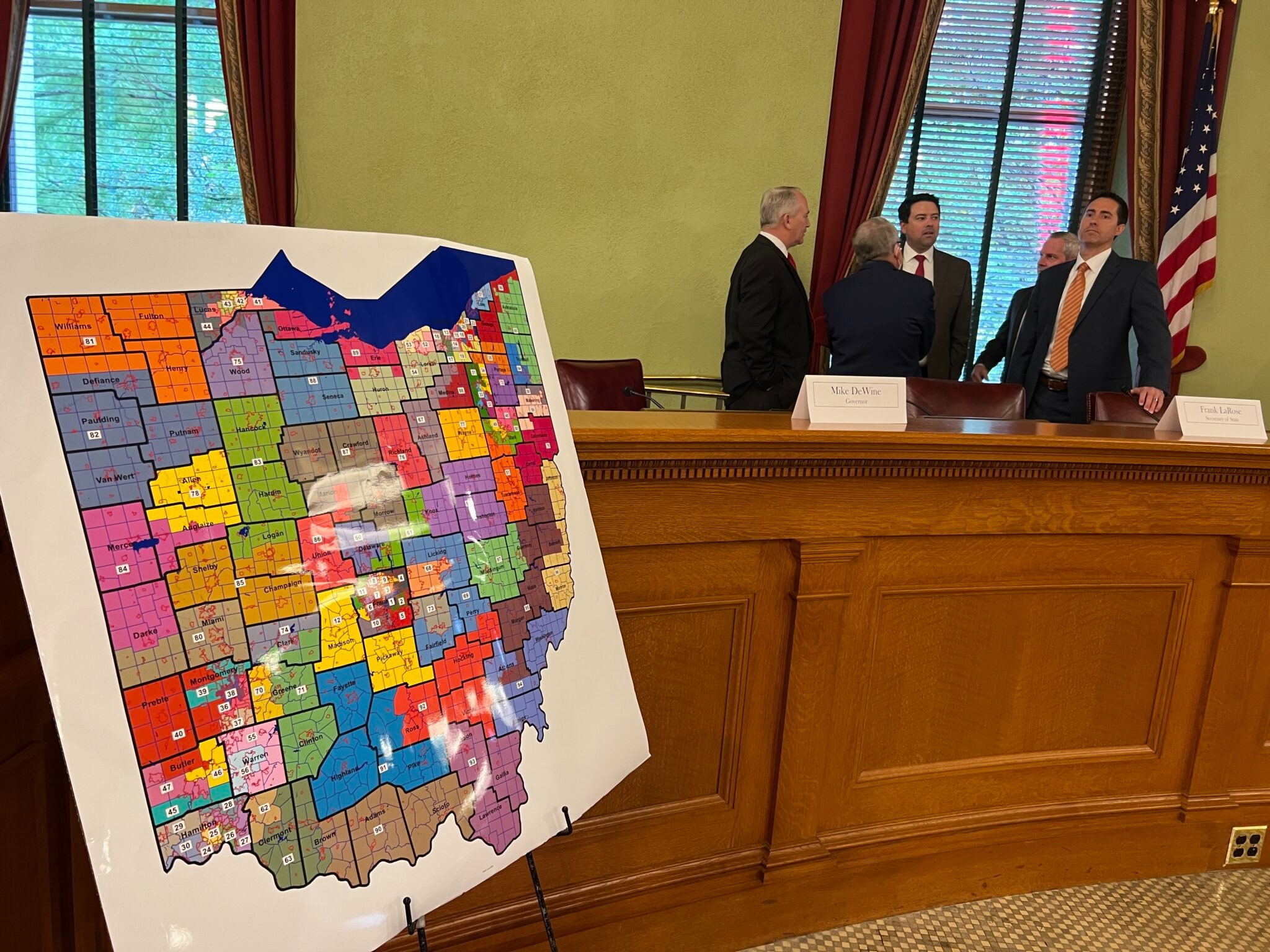
    The Republican members of the Ohio Redistricting Commission talk before a 2023 public hearing on statehouse district maps. (Photo: Susan Tebben, OCJ)

    BY:  – Ohio Capital Journal

    The newest measure to change the Ohio Constitution and reform the redistricting process in Ohio has cleared its most recent hurdle: a typo.

    The Ohio Ballot Board met Monday, quickly certifying a proposed constitutional amendment that would “replace the current politician-run redistricting process.” The board’s only role is to determine if an amendment follows the legal requirements that the measure only contain one amendment to the state’s constitution.

    The certification came as no surprise, since the board had previously certified the amendment in October. This time around, the re-certification was needed after the creator of the proposed amendment, anti-gerrymandering group Citizens Not Politicians, noticed a typo in one of the deadlines mentioned in the amendment.

    Attorney Don McTigue was present at Monday’s ballot board meeting, and said that nothing about the intent of the amendment changes with the correction of the error.

    The amendment also went through multiple rounds of revisions, after Ohio Attorney General Dave Yost rejected the measure twice, saying amendment reviewers identified “omissions and misstatements” that the AG said would “mislead a potential signer as to the actual scope and effect of the proposed amendment.”

    The amendment would replace the current redistricting process, also created through a constitutional amendment, and would eliminate the Ohio Redistricting Commission as it stands now, a seven-member panel made up of all elected officials, five from the GOP majority and two Democrats.

    The commission would be replaced with a “citizen-led commission,” chosen by a bipartisan panel. If approved by the voters, the amendment would create the Ohio Citizens Redistricting Commission, which would have 15 members, five matching the political party of the governor at the time, five from the party of the gubernatorial candidate who received the second-most votes in the most recent election, and five unaffiliated members.

    The amendment also specifically lays out anti-gerrymandering mechanisms that have been a sticking point throughout the last two years, as the Ohio Redistricting Commission tumbled through the process of six different statehouse district maps and two congressional maps, all but one of which (the most recent statehouse districts) has been rejected as unconstitutional by the Ohio Supreme Court.

    The statehouse districts adopted in September by the current commission are being challenged in a case before the state’s highest court, but no decision has been made.

    The ORC has been rife with chaos and uncertainty as well, as the last two years contained multiple line-up changes, arguments over deadlines and lack of action, and even a stumbled start to the most recent adoption process.

    In the new amendment proposal, the citizen-led commission would have to create a redistricting plan with political party proportions that “correspond closely to statewide partisan preferences of the voters of Ohio,” and the commission has to state how the districts’ partisan divide was determined.

    The group who wrote the measure defines “correspond closely” as no more than a 3-percentage-point difference between the redistricting plans and the statewide voter preferences, “unless arithmetically impossible.”

    The Ohio Supreme Court holds the jurisdiction for all court challenges of redistricting plans in the amendment, just as it does in the current system. That system was criticized, however, for not creating enough of an enforcement mechanism. The state supreme court rejected seven different district maps, but did not hold commission members in contempt for missing deadlines.

    The commission also did not receive any consequences for eschewing a proposal from court-ordered mapmakers, brought in on the taxpayers’ dime, and passing a map that was nearly identical to a previous, unconstitutional statehouse map.

    In the new process, if approved by voters, “special masters” would be chosen to “review the record before the commission and hold a public hearing” if a court challenged is filed against a redistricting plan. Then, a report must be issued “as to whether the commission abused its discretion in its determination that the adopted plan complies with the partisan fairness criteria required by the amendment for a redistricting plan.”

    Once the report from the special masters is released, objections to the report can be filed with the Ohio Supreme Court, who will ultimately rule on the maps.

    The commission would have an appropriation from the Ohio General Assembly of $7 million for 2025 redistricting under the new measure, plus more for the bipartisan panel who chooses the commission.

    The cost of the special masters would come from the Ohio Supreme Court’s budget, according to the amendment language.

    Signature collection for the initiative can begin again, now that the state ballot board has re-approved the measure. According to Citizens Not Politicians, the group must collect 413,487 valid Ohio voter signatures by July 3, 2024, to qualify for the general election next year.


    Susan Tebben
    SUSAN TEBBEN

    Susan Tebben is an award-winning journalist with a decade of experience covering Ohio news, including courts and crime, Appalachian social issues, government, education, diversity and culture. She has worked for The Newark Advocate, The Glasgow (KY) Daily Times, The Athens Messenger, and WOUB Public Media. She has also had work featured on National Public Radio.

    MORE FROM AUTHOR

  • OH AG forces Dollar General to pay up — by supporting food banks

    OH AG forces Dollar General to pay up — by supporting food banks

    The Dollar General store in Loveland, Ohio

    BY:  – Ohio Capital Journal

    Ohio Attorney General Dave Yost on Thursday announced that Dollar General would pay $750,000 to Ohio’s food banks.

    It was part of $1 million the chain — which typically locates itself in underserved neighborhoods — is paying to settle allegations that it ripped off customers by posting one price on store shelves and then charging more at the cash register.

    Auditors in Butler County found that one store there was engaged in the practice 88% of the time, and county auditors elsewhere in Ohio also found such activity, but less frequently.

    “Most people don’t shop at Dollar General because they have a lot of extra money to spend,” a statement from Yost’s office quoted him as telling a gathering of county auditors in Westerville Thursday. “So when a bottle of shampoo that should cost $1 costs $2 at the checkout, that’s a real thing. And you all brought it to light.”

    In signing the settlement, Goodlettsville, Tennessee-based Dollar General stipulated that it wasn’t admitting wrongdoing. But critics of the company, which has 980 stores in Ohio, say it does plenty of harm to poor communities — both out in the country and in big cities.

    In a June event hosted by the Institute for Self Reliance, panelists said that consolidation in the grocery sector — including by Dollar General — is driving independent stores out of poor neighborhoods and they’re taking healthy foods like fresh produce with them.

    One member of the panel, Rev. Dr. Donald Perryman of the Center of Hope Community Baptist Church in Toledo, said that police there compiled statistics indicating that the presence of such dollar stores increased crime. A September report by CBS News found similar problems nationwide.

    Workers at the stores aren’t just vulnerable to crime. Retail Dive this summer reported that Dollar General had racked up $21 million in fines from the U.S. Occupational Safety and Health Administration since 2017 and had paid just $4 million so far.

    A February report by The Institute for Self Reliance also told of what it called predatory, anticompetitive practices dollar stores use to drive traditional grocers away. It described how a small grocer called Dave’s Market was left struggling to survive in the Collinwood neighborhood of Cleveland.

    Seven Dollar General and Family Dollar stores popped up within a two-mile radius selling the packaged, processed foods that Dave’s also depended on for much of its profit. But the dollar stores didn’t sell the fresh produce and meat that Dave’s offered. The store closed and took those offerings with it last year.

    Then there’s the attorney general’s lawsuit, filed last November, claiming that some Dollar General stores were ripping off customers by pricing items one way on the shelves and then charging more when it came time to pay. Yost on Thursday told the county auditors that each of Ohio’s 88 counties has a Dollar General and food banks in each would get $1,000 for that first store. The remainder of the $750,000 would be divided up based on the number of stores a county has, he said.


    Marty Schladen
    MARTY SCHLADEN

    Marty Schladen has been a reporter for decades, working in Indiana, Texas and other places before returning to his native Ohio to work at The Columbus Dispatch in 2017. He’s won state and national journalism awards for investigations into utility regulation, public corruption, the environment, prescription drug spending and other matters.

    MORE FROM AUTHOR

  • Christmas in Historic Downtown

    Christmas in Historic Downtown

    Promoted Post

    Loveland, Ohio – Join us for the annual tradition of Christmas in Historic Downtown presented by the Little Miami River Chamber Alliance.

    -Carriage Rides
    -Live Nativity
    -Vendors
    -Holiday specials and treats at area businesses
    -Choirs and Dance Performances
    -Christmas Train
    – Santa!
    – and much more!

  • Bengals sign former Loveland High School standout QB Drew Plitt to practice squad

    Bengals sign former Loveland High School standout QB Drew Plitt to practice squad

    Loveland Magazine file photo of Drew Plitt visiting Loveland High School in 2018

    Loveland, Ohio – The Cincinnati Bengals signed former Loveland High School standout, QB Drew Plitt to their practice squad today. Plitt (6-2, 217), a first-year player out of Ball State University, originally was a college free agent signee of the Bengals in 2022. He played in two preseason games for Cincinnati in 2022 before being waived, and was not with an NFL team during the ’22 regular season and ’23 offseason. Plitt played in five games for the Arlington Renegades of the XFL during the 2023 season.

    The Bengals play the Pittsburgh Steelers at 1 PM in Paycor Stadium this Sunday.

    Drew Plitt QB’d the Loveland Tigers when they won the State Championship in 2013
  • Shop Small in Loveland on Saturday

    Shop Small in Loveland on Saturday

    Promoted Post

    Loveland, Ohio – Be sure to support our local businesses as you begin your holiday shopping. Remember to shop small all season long, kicking off with Small Business Saturday on November 25.

    Right Click to download a Passport.

    [pdf-embedder url=”https://lovelandmagazine.com/wp-content/uploads/2023/11/2023-Shoppers-Passport.pdf” title=”2023 Shopper’s Passport”]

  • Pharmacy middleman grants huge bonuses for winning business meant to help the poor

    Pharmacy middleman grants huge bonuses for winning business meant to help the poor

    BY:  Ohio Capital Journal

    Medicaid might be a taxpayer-funded health program for the poor, but that doesn’t mean others aren’t getting rich off of it — including employees of a company the state is suing on antitrust grounds.

    Several employees of drug middleman Express Scripts last year raked in bonuses of $750,000 each for getting the business of a managed-care company that depends on Medicaid for the bulk of its business.

    In other words, in addition to their already-high pay, they received bonuses that were 18 times the average American’s annual pay just for landing a contract.  And that contract is with a company that has already paid out $88.3 million to settle claims that it had defrauded the Ohio Medicaid program.

    It might be striking to the average taxpayer that people with huge corporations are profiting so lavishly off of programs for the poor. But one of the Express Scripts employees — who also helped prepare the company for a federal antitrust investigation — said the bonuses were “well earned.”

    Ohio Attorney General Dave Yost in March sued Express Scripts and several other healthcare companies under the Valentine Act — Ohio’s antitrust law — claiming that the companies participate in  “a complex ‘pay to play’ rebate system that, perversely, pushes manufacturers to increase drug prices in order to be placed on, or receive, preferred placement on PBM formularies.”

    As a pharmacy benefit manager, or PBM, St. Louis-based Express Scripts represents health insurers — including parent company Cigna — in drug transactions. It decides which drugs are covered and uses that leverage to extract rebates from drug manufacturers who want to get their products on its “formularies,” or lists of covered drugs.

    Express Scripts also creates networks of pharmacies and it decides how much to reimburse them for the drugs they dispense. And because it keeps much of the data about rebates and reimbursements secret, it’s hard to know how much they’re passing along to insurers and pharmacies and how much they’re pocketing.

    It’s sure to be a lot. Two thirds of Cigna’s $110 billion in revenue last year came from its Express Scripts subsidiary, the PBM’s former president said in a sworn statement in June.

    The executive, Amy Bricker, resigned her post earlier in January to take another with another vast healthcare player, CVS.

    That company owns another huge PBM, CVS Caremark, and between it, Express Scripts and OptumRx (part of UnitedHealth) they control the prescription coverage of more than 70% of the insured people in the United States.

    As part of her sworn statement, Bricker stuck to the company line.

    “As a PBM, Express Scripts’ goal is to reduce the cost of prescription medication for its clients—the Payor Entities,” she said. “As President of Express Scripts, I was responsible for Express Scripts’ relationships with its (client insurance companies) as well as the tools/levers utilized to lower the cost of prescription medications.”

    However, Yost and many others maintain that the big PBMs actually force drugmakers to raise list prices in order to provide ever-growing rebates to PBMs and there’s been some research to support that. And there’s the fact that an investigation found that in 2017, CVS Caremark and OptumRx billed Ohio Medicaid $223 million more for prescription drugs than they paid the pharmacies that had purchased and dispensed them.

    Those claims and others last year prompted the Federal Trade Commission to open a major, ongoing investigation into the big PBMs.

    Bricker said that while she was still president of Express Scripts, one of her duties was to help the company respond to the FTC investigation. But the whole reason she was making the statement centered around another major enterprise she led — acquiring the business of Centene.

    That company, also based in St. Louis, is the largest Medicaid managed-care company in the United States. It acts as health insurer on behalf of states as they administer the federal-state health program for the poor.

    When it acts as insurer, Centene hires PBMs to handle drug transactions. And in that capacity, the company has had its problems in Ohio and elsewhere. Yost sued Centene in early 2021 on claims that it used two of its own PBMs to bilk Ohio Medicaid out of tens of millions.

    Within months, the company agreed to pay Ohio $88.3 million to settle the suit — and it announced that it was setting aside more than $1 billion to settle similar claims with more than 20 other states that hadn’t even sued it. Centene later announced that it would exit the PBM business.

    Centene had used CVS Caremark as its PBM until last November, when it announced that it was moving $35 billion in prescription business on behalf of 20 million clients to Express Scripts.

    Centene manages care in health sectors other than Medicaid, such as Medicare and for prisons. But last year it derived almost two-thirds of its revenue — or $94 billion — from its Medicaid business, according to the company’s financial statements.  So roughly $23 billion of the new revenue Express Scripts is getting from the contract is coming from tax-funded health programs for the poor.

    As president of Express Scripts, Bricker led the effort to snatch that business away from CVS. But early this year after Express Scripts parent company Cigna didn’t make her part of its top executive team, Bricker announced that she was leaving and going to work for… CVS.

    Cigna and Express Scripts sued, citing a non-compete clause and expressing fears that Bricker might use insider knowledge to help win Centene’s business back for CVS. At least for now, a federal judge in Missouri has stopped Bricker from going to work for her erstwhile employer.

    The back-and-forth court filings shed some light on how prescription drugs and taxpayer-funded health programs for the poor are used to pad the paychecks of the very rich.

    In suing, Cigna cited the “high six-figure spot bonus” it gave Bricker after she got the Centene contract and it cited other big awards she received since 2019. The company is demanding that she repay $1.5 million in restricted stock and stock options that she received.

    For her part, Bricker didn’t betray any sense of irony in her response as she defended the huge “spot bonus” she got for winning a big book of mostly Medicaid business.

    “The Amended Complaint specifically references Express Scripts recent successful bid for the Centene contract, and that I earned a significant, one-time bonus for my integral role in achieving that business success,” she wrote in her sworn statement. “The bonus was $750,000. The context Cigna omits from its Amended Complaint is that the contract is worth billions of dollars to Cigna over its five-year term. Several members of the Express Scripts team received this one-time bonus which was appropriate given the magnitude of the contract and well earned.”

    Cigna didn’t respond when asked how many such bonuses it awarded or what Bricker’s total compensation was. Nor did it respond when asked how it justified them, given that most of the new business ultimately is from taxpayer dollars intended to provide healthcare for poor people.

    There’s a reason why Bricker might think a $750,000 spot bonus should be routine for a job well done. It pales in comparison to what the top bosses in her industry get.

    Cigna CEO David Cordani and CVS CEO Karen Lynch each were paid more than $20 million last year, while Centene CEO Sarah London was paid more than $13 million. For perspective — and assuming a 70-hour workweek — the lowest-paid of those executives gets in a day about as much as the median worker in the United States earns all year.


    Marty Schladen
    MARTY SCHLADEN

    Marty Schladen has been a reporter for decades, working in Indiana, Texas and other places before returning to his native Ohio to work at The Columbus Dispatch in 2017. He’s won state and national journalism awards for investigations into utility regulation, public corruption, the environment, prescription drug spending and other matters.

    MORE FROM AUTHOR

  • Coal company got big payback from HB 6

    Coal company got big payback from HB 6

    FirstEnergy’s headquarters in Akron. Source: Google Maps.

    BY: Ohio Capital Journal

    A coal company got roughly $12.6 million above market prices to supply one of the 1950s-era plants subsidized by Ohio House Bill 6. That’s roughly 50 times the amount the company gave to the dark money group at the center of that coal and nuclear bailout law, according to a new analysis from the Checks and Balances Project.

    In other developments:

    • An evidentiary hearing about the reasonableness and prudence of the subsidized coal plants’ costs wrapped up last week. But it’s unclear when regulators might issue rulings.
    • In a separate FirstEnergy case, opponents want regulators to deny or limit more customer charges, saying the rider items should be considered in the company’s full rate case to be filed next May. The evidentiary hearing is expected to continue until Nov. 21.
    • Former Ohio House Speaker Larry Householder and lobbyist Matt Borges have appealed their criminal convictions but still haven’t filed their briefs. The Department of Justice has not yet filed additional criminal charges related to HB 6, either.

    Coal company overpayments

    A new report highlights how much Resource Fuels has collected for coal supplied to one of the two 1950s-era coal plants subsidized by HB 6 and run by the Ohio Valley Electric Company, or OVEC.

    OVEC paid roughly $12.6 million to Resource Fuels in above-market charges for coal, said Ray Locker, executive director of the Checks and Balances Project, which produced the report. And as a result of HB 6’s coal subsidies, Ohio ratepayers have been paying utilities for their share of OVEC’s costs that exceed their revenue.

    In 2018, Resources Fuels also sent $250,000 to Generation Now, the main dark money group in the HB 6 corruption scandal. The Energy and Policy Institute reported that wire transfer earlier this year and connected Resource Fuels to the Boich Companies, which the Columbus Dispatch had earlier identified as “Company C” in the 2020 criminal complaint against Householder and others.

    So, Resource Fuels “donated $250,000 to Generation Now to facilitate everything for Larry Householder. And the excess money they’ve been paid on this coal contract is 50 times more,” Locker said.

    To back up his calculations, Locker reviewed testimony statements filed with the Public Utilities Commission of Ohio by Elizabeth Stanton, an expert witness for the Office of the Ohio Consumers’ Counsel, and from John Seryak, an expert witness for the Ohio Manufacturers’ Association Energy Group. The case file also includes redacted audit reports from London Economics International.

    Stanton’s testimony showed that Clifty Creek, one of the two HB 6-subsidized coal plants, paid about one-fifth more per million BTUs (units of heat value) for coal bought from Resource Fuels, compared to another supplier of coal from the same mine. The price per million BTUs paid to Resource Fuels was also more than that paid to companies providing coal with a higher average heat value.

    The PUCO had let some utilities collect OVEC costs from ratepayers even before HB 6 passed. Seryak’s testimony said London Economics “repeatedly found that the cost under the Resource Fuels coal contracts is unusually high.” OVEC had a long-term deal with Resource Fuels, but it was neither prudent nor reasonable, he added. In his view, Ohio utilities have used the HB 6 coal subsidy riders “to recoup losses resulting from an unreasonable decision.”

    Seryak’s testimony also connected Resource Fuels to the Boich Companies and discussed the HB 6 corruption scandal.

    American Electric Power and Duke Energy both want the PUCO to strike parts of the testimony, arguing against Seryak’s point that the PUCO should not authorize recovery of the coal subsidies while the HB 6 investigations continue. They also want to keep out evidence about cost reviews of pre-HB 6 OVEC riders, which supports points made by Seryak and others.

    The PUCO’s hearing examiners struck those parts of Seryak’s testimony on Nov. 6 without a written opinion. The Ohio Manufacturers’ Association Energy Group appealed that decision to the full PUCO on Nov. 13.

    “That’s a total smokescreen to divert people from the details of these contracts,” Locker said. “The information is out there. And now they’re trying to stick the genie back in the bottle and say it doesn’t matter.”

    Representatives of the Boich Companies did not provide comments in response to Energy News Network’s questions.

    Read more: 

    Waiting

    The PUCO wrapped up its evidentiary hearing on the 2020 OVEC charges about which Seryak and Stanton provided testimony on Nov. 6. The hearing started on Halloween and took less than one week. Besides the above-market payments to Resource Fuels, challengers contended that other spending by the OVEC coal plants was not reasonable and prudent, including costs related to times when it was uneconomic to run them.

    Briefs and reply briefs are due Jan. 8 and Jan. 29, said Matt Schilling, spokesperson for the PUCO. After that, parties will wait for regulators to decide whether to disallow any costs that have already been passed through to ratepayers. Adjustments would presumably be reflected in future charges for the OVEC plants, which run through 2030.

    That wait could take a while. Regulators still have not ruled on challengers’ objections to pre-HB 6 OVEC plant costs. Nor have lawmakers advanced bills to repeal the subsidies.

    Costs for the coal subsidies continue to mount. The Office of the Ohio Consumers’ Counsel estimates those subsidies have cost ratepayers nearly $221 million since 2020 began.

    Read more:

    FirstEnergy riders

    The PUCO began another evidentiary hearing on Nov. 7 in a FirstEnergy rider case with roughly $1.4 billion at stake. The PUCO currently expects that hearing to continue through Nov. 21, Schilling said.

    Among other things, FirstEnergy wants to extend a “delivery capital recovery” charge. That DCR rider is involved in one of four cases the PUCO has put on hold since August 2022 while the Department of Justice considers more criminal charges related to HB 6. The new case also presents questions about possible side deals that may affect settlements. That issue was raised in another of the stayed cases.

    Despite the parallels, regulators declared on Oct. 18 that the rider case and two grid modernization cases “are completely unrelated” and refused to lift the stay. The PUCO also refused to put the rider case on hold, because it also deals with charges for customers who don’t choose a competitive electricity supplier. The current tariff for that is due to expire, and Ohio law requires a plan for those customers to be in place, the order said.

    The case “introduces various mechanisms aimed at ensuring the ongoing investment and maintenance of the distribution system,” FirstEnergy spokesperson Lauren Siburkis said, talking about the case’s charges for all customers. Those include the DCR rider and an advanced metering infrastructure rider, plus charges for vegetation management and storm mitigation.

    The increase for a residential customer using about 750 kilowatt-hours per month of electricity would initially be $3.11 per month. But witnesses for multiple challengers want regulators to deny various riders.

    For example, Justin Bieber, an expert for Kroger, said in a filed testimony statement that the DCR rider is improper “single-issue ratemaking.” Instead, he said, it should properly be considered in a full ratemaking case, which would look at all of a utilities’ revenues and expenses. He had a similar view about the vegetation management rider. FirstEnergy is due to file a full ratemaking case next May.

    Greg Meyer, an expert for the Office of the Ohio Consumers’ Counsel, similarly challenged the DCR rider, along with the advanced metering rider and storm recovery rider. Aside from the single-issue ratemaking problem, he noted that a process already exists for utilities to recoup major storm costs if they show the costs would impact their total operations.

    Colleen Shutrump, another expert for the Ohio Consumers’ Counsel, objected to a proposed energy efficiency rider, saying customers could get efficiency services in a competitive market.

    If approved, the riders would last eight years, with some possible adjustments in next year’s ratemaking case. A hearing on charges in a separate grid modernization case is set for January.

    Read more:

    Convictions on appeal

    Former Ohio House Speaker Larry Householder and lobbyist Matt Borges appealed their criminal convictions related to HB 6 this summer. Yet their lawyers have sought multiple extensions to file legal briefs on the trial court’s alleged errors.

    The filings are currently due next month, with the government’s responses due in January. For now, both remain in federal prisons.

    Meanwhile, Borges and Householder are still defendants in the state of Ohio’s HB 6 civil case, along with former PUCO Chair Sam Randazzo, FirstEnergy, Energy Harbor (formerly FirstEnergy Solutions), two former FirstEnergy executives and others.

    Borges’ amended answer filed on Oct. 25 denies liability for the state’s claims under the Ohio Corrupt Practices Act. The filing also says he wouldn’t be liable anyway because of the legal doctrines of in pari delicto or unclean hands. Those doctrines basically say plaintiffs can’t recover on a civil claim if they themselves engaged in wrongdoing.

    Borges’ lawyers did not respond to the Energy News Network’s request for comments about which state actors and what conduct they say supports those defenses.

    More charges?

    The Department of Justice has not yet filed charges against anyone other than Householder, Borges and others named in their July 2020 criminal complaint and indictment. (Three of the other defendants named have settled, and one has died.) As noted above, four FirstEnergy regulatory cases remain stayed, although various civil cases against the company continue to move ahead.

    A Nov. 6 order in one of the shareholder cases calls for Ebony Yeboah-Amankweh, a former lawyer and ethics officer for FirstEnergy, to answer plaintiffs’ lawyers’ questions under oath in a pretrial process called a deposition. The company ended her employment a few months after the 2020 complaint came out.

    A separate Nov. 6 order requires Randazzo to turn over documents and information which plaintiffs in that case have sought for months. Randazzo will also have to pay costs arising from the documents dispute.

    People from regulatory agencies or utilities “should not get to have their lawyers pick and choose what discovery and subpoena requests they will respond to, and what documents they will turn over,” said Dave Anderson, policy and communications manager for the Energy and Policy Institute.

    Read more:

    This article first appeared on Energy News Network and is republished here under a Creative Commons license.


    Kathiann M. Kowalski, Energy News Network
    KATHIANN M. KOWALSKI, ENERGY NEWS NETWORK

    Kathi is the author of 25 books and more than 600 articles, and writes often on science and policy issues. In addition to her journalism career, Kathi is an alumna of Harvard Law School and has spent 15 years practicing law. She is a member of the Society of Environmental Journalists and the National Association of Science Writers. Kathi covers the state of Ohio.

    MORE FROM AUTHOR