An Editorial

Two WDBJ7 employees killed in attack at Bridgewater Plaza
Reporter Alison Parker and photographer Adam Ward were attacked during a live broadcast
This happened during a live broadcast around 6:45 a.m.

From left to right: Sarah, Max, Audrey and Brad Downs, Gaye and Mark Salisbury, Don Goldschmidt, Doug Parsely , Tracy and Colin Snow and Amy Van Strien

by Amy Van Strien
Loveland Sustainability Council is excited to announce that houses on 800-842 Quailwoods Drive in Loveland have been selected as the Green Street of the Month for August. This section of Quailwoods had almost 100% of their recycling bins at the curb for pick up. By participating in curbside recycling these residents saved hundreds of pounds of items from the landfill. The residents were awarded with a certificate and a prize package from area business.
Loveland Sustainability Council is comprised of members of the community, school, business district and city hall with a shared vision to is encourage recycling, reduce waste, and promote sustainability for the future of Loveland. One of the ways that they promoting recycling is through a campaign called “Sustainable Street of the Month”.
Loveland area residents can nominate their street for this recognition if they engage in one or more of the following: curbside recycling, composting, having a rain barrel, etc. (anything “sustainable” makes them eligible). Streets that earn this distinction will be recognized on LSC’s social media (Facebook, twitter, etc.).
Here is how they people can nominate a street:
Loveland area residents, including Symmes & Miami Township, that engage in one or more of the following: curbside recycling, composting, having a rain barrel, etc. can nominate their street for Green Street of the Month. Streets earning this distinction will be recognized on LSC’s social media and receive a prize package from area businesses (including Pizazz, Loveland Sweets, Title boxing, etc.). Just fill out the entry below and send it to: lovelandsustainabilitycouncil@gmail.com

The Loveland Initiative distributed 187 backpacks filled with school supplies and calculators to help 95 local families

by Terri Rogers,
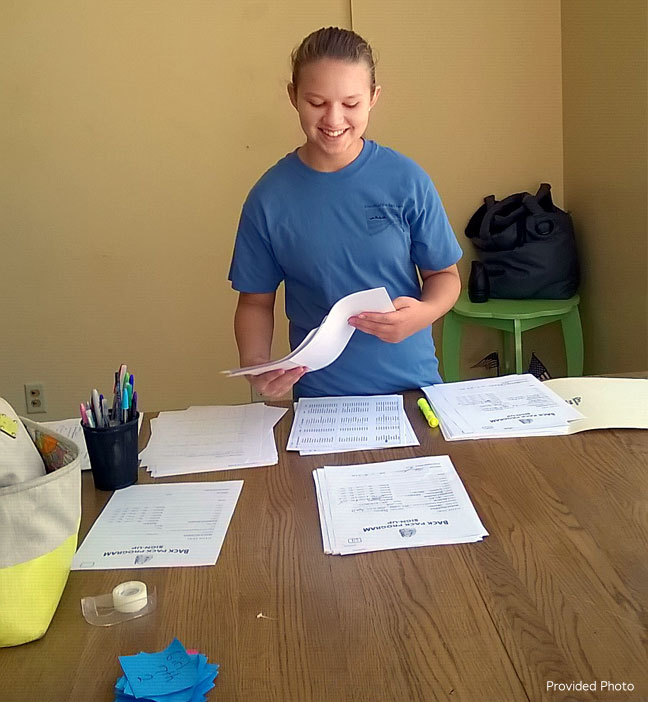
On August 14, The Loveland Initiative, held the 17th Annual Back Pack Program for the 2015/2016 school year. Over the years we have been very successful providing backpacks filled with school supplies to lower-income students in our community. After being without a location for three-years, we were so excited to be able to operate this program from our new home thanks to our supporters.
This service is important because (1) we have made a positive impact on the lives of children and families in our community, (2) we relieve the financial burden of back-to school-time on families and (3) students are focusing on learning and not on hand-me-down bags. It is about generating excitement and joy at the prospect of students returning to school. We have succeeded in reaching our goal.
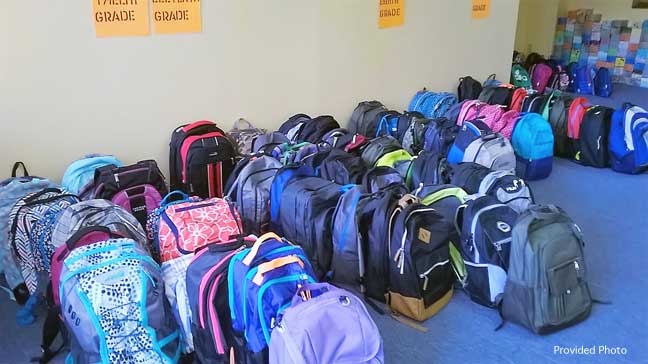
The Loveland Initiative distributed 187 backpacks filled with school supplies and calculators to students in (Pre-K through grade 12) from 95 families in the Loveland City School District. After the program, we also distributed to 8 more Loveland families that didn’t sign up. In addition to the supplies, the families were able to learn more about services offered through The Loveland Initiative’s Resource Center and Cool School Tutoring. It was a successful collaboration between The Loveland Initiative and our sponsors.
Many thanks to our sponsors — ImpactGFC, Mosaic Cincinnati, Saint Columbian Church, Tina Pickle, Zumba Gold, Prince of Peace, Epiphany United Methodist Church, Miami Trails Neighborhood Network, Northeast Community Church, Sycamore Presbyterian, Loveland Presbyterian, Loveland Tiger student-athletes and many others.
We also thank all of the hard working volunteers who participated in the event. All of this would not have been possible without the generosity and overwhelming assistance of so many volunteers, businesses, agencies, organizations, places of worship and our larger community.
Thank you for your support!
Contact: Terri Rogers
Phone: 513.677.1057
Email: trogers7@fuse.net

[dropcap type=”2″]E[/dropcap]very year, the Trustees of the Social Security and Medicare trust funds release reports to Congress on the current financial condition and projected financial outlook of these programs. The 2015 reports, released on July 22, show that, despite some encouraging signs, both programs continue to face financial challenges that should be addressed as soon as possible, with the Disability Insurance Trust Fund needing the most urgent attention.
What are the Social Security trust funds?
The Social Security program consists of two parts. Retired workers, their families, and survivors of workers receive monthly benefits under the Old-Age and Survivors Insurance (OASI) program; disabled workers and their families receive monthly benefits under the Disability Insurance (DI) program. The combined programs are referred to as OASDI. Each program has a financial account (a trust fund) that holds the Social Security payroll taxes that are collected to pay Social Security benefits. Other income (reimbursements from the General Fund of the Treasury and income tax revenue from benefit taxation) is also deposited in these accounts. Money that is not needed in the current year to pay benefits and administrative costs is invested (by law) in special Treasury bonds that are guaranteed by the U.S. government and earn interest. As a result, the Social Security trust funds have built up reserves that can be used to cover benefit obligations if payroll tax income is insufficient to pay full benefits.
(Note that the Trustees provide certain projections based on the combined OASI and DI (OASDI) trust funds. However, these projections are theoretical, because the trusts are separate, and one program’s taxes and reserves cannot be used to fund the other program.)
Trustees report highlights: Social Security
• The combined trust fund reserves (OASDI) are still increasing and will continue to do so through 2019 (asset reserves increased by $25 billion in 2014, with year-end reserves totaling $2.8 trillion). Not until 2020, when annual program costs are projected to exceed total income, will the U.S. Treasury need to start withdrawing from reserves to help pay benefits. Absent congressional action, the combined trust fund reserves will be depleted in 2034, one year later than projected in last year’s report.
• Once the combined trust fund reserves are depleted, payroll tax revenue alone should still be sufficient to pay about 79% of scheduled benefits in 2034, with the percentage falling gradually to 73% by 2089. This means that 20 years from now, if no changes are made, beneficiaries could receive a benefit that is about 21% less than expected.
• The OASI Trust Fund, when considered separately, is projected to be depleted in 2035 (one year later than projected in last year’s report). At that time, payroll tax revenue alone would be sufficient to pay 77% of scheduled OASI benefits.
• The DI Trust Fund is in worse shape and will be depleted in late 2016 (the same as projected last year). The Trustees noted that the DI Trust Fund “now faces an urgent threat of reserve depletion, requiring prompt corrective action by lawmakers if sudden reductions or interruptions in benefit payments are to be avoided.” Once the DI Trust Fund is depleted, payroll tax revenue alone would be sufficient to pay just 81% of scheduled benefits.
• Based on the “intermediate” assumptions in this year’s Trustees report, the Social Security Administration is projecting that there will be no cost-of-living adjustment (COLA) for calendar year 2016.
What are the Medicare trust funds?
There are two Medicare trust funds. The Hospital Insurance (HI) Trust Fund pays for inpatient and hospital care (Medicare Part A costs). The Supplementary Medical Insurance (SMI) Trust Fund comprises two separate accounts, one covering Medicare Part B (which helps pay for physician and outpatient costs) and one covering Medicare Part D (which helps cover the prescription drug benefit).
Trustees report highlights: Medicare
• Annual costs for the Medicare program have exceeded tax income annually since 2008, and will continue to do so this year and next, before turning positive for four years (2017-2020) and then turning negative again in 2021.
• The HI Trust Fund is projected to be depleted in 2030 (unchanged from last year, but with an improved long-term outlook from last year’s report). Once the HI Trust Fund is depleted, tax and premium income would still cover 86% of program costs under current law. The Centers for Medicare & Medicaid Services (CMS) has noted that, under this year’s projection, the HI Trust Fund will remain solvent 13 years longer than the Trustees predicted in 2009, before passage of the Affordable Care Act.
• Due to increasing costs, a Part B premium increase is likely in 2016. However, about 70% of Medicare beneficiaries will escape the increase because of a so-called “hold harmless” provision in the law that prohibits a premium increase for certain beneficiaries if there is no corresponding cost-of-living increase in Social Security benefits. If there is no COLA for 2016, the increased costs may be passed along only to the remaining 30% not eligible for this hold-harmless provision–generally, new enrollees, wealthier beneficiaries, and those who choose not to have their premiums deducted from their Social Security benefit. If so, these individuals could see the base premium rise to $159.30 in 2016, up sharply from $104.90 in 2015.
Why are Social Security and Medicare facing financial challenges?
Social Security and Medicare accounted for 42% of federal program expenditures in fiscal year 2014. These programs are funded primarily through the collection of payroll taxes. Partly because of demographics and partly because of economic factors, fewer workers are paying into Social Security and Medicare than in the past, resulting in decreasing income from the payroll tax. The strain on the trust funds is also worsening as large numbers of baby boomers reach retirement age, Americans live longer, and health-care costs rise.
What is being done to address these challenges?
Both reports urge Congress to address the financial challenges facing these programs in the near future, so that solutions will be less drastic and may be implemented gradually, lessening the impact on the public. As the Social Security Board of Trustees report states, “Social Security’s and Medicare’s projected long-range costs are not sustainable with currently scheduled financing and will require legislative action to avoid disruptive consequences for beneficiaries and taxpayers.”
Some long-term Social Security reform proposals on the table are:
• Raising the current Social Security payroll tax rate (according to this year’s report, an immediate and permanent payroll tax increase of 2.62 percentage points would be necessary to address the revenue shortfall)
• Raising the ceiling on wages currently subject to Social Security payroll taxes ($118,500 in 2015)
• Raising the full retirement age beyond the currently scheduled age of 67 (for anyone born in 1960 or later)
• Reducing future benefits, especially for wealthier beneficiaries
• Changing the benefit formula that is used to calculate benefits
• Changing how the annual cost-of-living adjustment for benefits is calculated
Regardless of the long-term solutions, Congress needs to act quickly to address the DI program’s imminent reserve depletion. According to this year’s report, in the short term, lawmakers may reallocate the payroll tax rate between OASI and DI (as they did in 1994). However, this may only serve to delay DI and OASI reforms.
You can view a combined summary of the 2015 Social Security and Medicare Trustees reports at www.socialsecurity.gov/OACT/TRSUM/. You can also access a full copy of the Social Security report from that page. You can find the full Medicare report at www.cms.gov.



Dear Loveland Magazine Readers,
by Megan Graff
For years, the Loveland Community has supported the Loveland Initiative via donating supplies and backpacks for low-income kids going back to school, toys and gift cards during the holidays and snacks for the Cool-School tutoring program.
But, I learned recently that The Loveland Initiative was unable to secure enough grant funding to stay at their location on Loveland-Madiera Road and have started a GoFundMe site. In addition to the great things that many of us are aware of, this organization needs the resource center for several reasons:
Please consider a donation to the Loveland Initiative by following the link below and by spreading the word via e-mails and Facebook.
http://www.gofundme.com/lovelandinitiative
Sincerely,
Megan Graff

Dear Loveland Magazine Readers,
First and foremost, I want to be clear that neither I nor Loveland City Council have had any discussions or taken any actions that would force Loveland Kayak and Canoe [sic] to leave Loveland. In fact if you look at the history of their business and the land designated for the parking lot, the City helped facilitate Mr. Bersani’s purchase of his business by purchasing and leasing back to him land adjacent to what they required for their operation. With the City’s purchase of the McCoy property and the award of a matching grant recently, City Manager Dave Kennedy and City engineers have been communicating with Mr. Bersani to work out terms that will allow Loveland Kayak and Canoe [sic] to operate safely and effectively, both now and in the future. For example, as you can see on the attached parking lot layout (printed below), spaces that could have been used for cars has been designated for eight trailer parking spaces to accommodate the canoe livery’s trailers. Furthermore, those spaces will allow Mr. Bersani’s vans to access his property so their customers can safely load and unload. The City’s design engineer also revised the parking lot layout to ensure the turning radius is sufficient so that Mr. Bersani’s vehicles can safely navigate both his property and the parking lot. Just last week Mr. Kennedy worked with Mr. Bersani to seek the Board of Zoning Appeals’ approval to relocate his buildings from their current site onto his property. This is necessary so that construction can begin before asphalt plants close for the winter in late November or early December, rather than waiting for construction to begin in the spring.
As the above facts indicate, the City values Loveland Kayak and Canoe [sic]. Mr. Kennedy has and continues to work with Mr. Bersani to work out an agreement that is beneficial to his business, all Downtown businesses, and the City so that all have additional parking as soon as possible. We are confident we will find an equitable solution soon.
Linda Cox, Mayor
City of Loveland
(BACKGROUND: VIDEO: Will Loveland Canoe and Kayak survive the progress in Historic Downtown Loveland?)


Dear Loveland Magazine Readers,
Recently there has been a lot of media coverage regarding the City of Loveland and Loveland Kayak and Canoe [sic] (VIDEO: Will Loveland Canoe and Kayak survive the progress in Historic Downtown Loveland?). As the Mayor of Loveland I feel it is very important to clarify the facts surrounding this issue.
Here is a brief outline of the facts:
The City of Loveland has a long history of partnering with all of its businesses – large ones like CMC properties (developers of the new Downtown Loveland retail and residential development), and small and start-up companies such as Loveland Kayak and Canoe [sic] and The Works Restaurant. For example, in the early 2000’s, the city leased the old public works building to The Works Restaurant for $1/year to help them get started; subsequently they purchased the building from the city for fair market value and today operate a successful restaurant that draws people into Loveland. Another example of the City’s successful partnerships with businesses is the restoration of the Bronner Building, located along the Little Miami Bike Trail. The city sold this property to a developer who renovated the building; it was subsequently sold to the Little Miami Inc. to be used as a nature and information center. Because of the city’s involvement, this once dilapidated building is now a beautifully restored building along the Little Miami Bike Trail.
As Loveland continues to grow and prosper we are taking steps to plan for and accommodate its growth and development. A vital component of this plan is parking. The city acquired a matching grant to build over 100 new parking spaces on the city-owned property next to the Loveland Kayak and Canoe [sic].
All of our businesses, both existing and new, are vital to our quality of life and tax base. We work hard to balance the needs of our long time existing businesses with our future business growth.
Linda Cox, Mayor
City of Loveland
MORE BACKGROUND:
Mayor Cox responds to concerns of Loveland Canoe and Kayak
How the squeeze began for Loveland Canoe and Kayak
Comments pour in to save Loveland Canoe and Kayak
VIDEO: Will Loveland Canoe and Kayak survive the progress in Historic Downtown Loveland?

[vc_row][vc_column][vc_column_text]Loveland, Ohio – To contact City Council, call the Clerk of Council, Misty Cheshire at (513) 683-0150 or select “Email” below the Council member’s name.
Council meetings are generally the 2nd and 4th Tuesday of each month at 7 PM at City Hall – 120 West Loveland Avenue.
City Council Meeting Packets (Agendas) are available online prior to each Council Meeting: click here to view. Information on action taken at Council Meetings can be obtained from the City Manager’s Office by calling or emailing the office the day following the meeting.
Mayor Linda Cox – lcox@LovelandOH.com

Vice Mayor Mark Fitzgerald – mfitzgerald@LovelandOH.com

Pam Gross – pgross@LovelandOH.com

Paulette Leeper – pleeper@LovelandOH.com

Ted Phelps – tphelps@LovelandOH.com

Angie Settell – asettell@LovelandOH.com

Robert Weisgerber – rweisgerber@LovelandOH.com

City Manager Dave Kennedy – dkennedy@lovelandoh.com
[/vc_column_text][vc_gmaps title=”Loveland City Hall” link=”#E-8_JTNDaWZyYW1lJTIwc3JjJTNEJTIyaHR0cHMlM0ElMkYlMkZ3d3cuZ29vZ2xlLmNvbSUyRm1hcHMlMkZlbWJlZCUzRnBiJTNEJTIxMW0xOCUyMTFtMTIlMjExbTMlMjExZDMwODguODg2NzgxMDM3MDQwNyUyMTJkLTg0LjI1NzU1MzclMjEzZDM5LjI2ODEzNTQwMDAwMDAwNiUyMTJtMyUyMTFmMCUyMTJmMCUyMTNmMCUyMTNtMiUyMTFpMTAyNCUyMTJpNzY4JTIxNGYxMy4xJTIxM20zJTIxMW0yJTIxMXMweDg4NDA1NjA0ZDVmZWZhMjMlMjUzQTB4ODlmMjg1ZDZhYzFlNjc0YiUyMTJzMTIwJTJCVyUyQkxvdmVsYW5kJTJCQXZlJTI1MkMlMkJMb3ZlbGFuZCUyNTJDJTJCT0glMkI0NTE0MCUyMTVlMCUyMTNtMiUyMTFzZW4lMjEyc3VzJTIxNHYxNDQwMjY4MDAyMTE4JTIyJTIwd2lkdGglM0QlMjI0MDAlMjIlMjBoZWlnaHQlM0QlMjIzMDAlMjIlMjBmcmFtZWJvcmRlciUzRCUyMjAlMjIlMjBzdHlsZSUzRCUyMmJvcmRlciUzQTAlMjIlMjBhbGxvd2Z1bGxzY3JlZW4lM0UlM0MlMkZpZnJhbWUlM0U=”][/vc_column][/vc_row]

[vc_row][vc_column][vc_column_text]
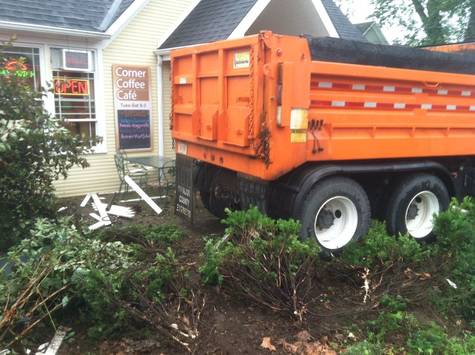
Remington, Ohio – On July 8, a 15-ton dump truck owned by Hamilton County was traveling northeast on Loveland Madeira Road (9440 Main Avenue) and ended up on the patio of Corner Coffee Café. It stopped within feet of the front entrance containing a full lunch crowd of 30-40 people.

The truck is owned by the Hamilton County Engineer’s office
This is the second time their business has been damaged by reckless vehicles, and owners Joni and Rick Lawson want something done to protect their business and customers. Their suggestion is to lower the speed limit and they would like to see guardrails installed at the busy curve. They have started a petition and they would like for you to sign it.
[/vc_column_text][vc_gmaps link=”#E-8_JTNDaWZyYW1lJTIwc3JjJTNEJTIyaHR0cHMlM0ElMkYlMkZ3d3cuZ29vZ2xlLmNvbSUyRm1hcHMlMkZlbWJlZCUzRnBiJTNEJTIxMW0xOCUyMTFtMTIlMjExbTMlMjExZDI0NzI3Ljc2OTU0OTY4MzkxJTIxMmQtODQuMzI1ODg5MTQ5OTk5OTIlMjEzZDM5LjIyMDgxOTk0OTk5OTk5JTIxMm0zJTIxMWYwJTIxMmYwJTIxM2YwJTIxM20yJTIxMWkxMDI0JTIxMmk3NjglMjE0ZjEzLjElMjEzbTMlMjExbTIlMjExczB4ODg0MDU0NTk5NTI1ODg0NSUyNTNBMHhiNTEyNDZjM2IwZTAzODExJTIxMnM5NDQwJTJCTWFpbiUyQlN0JTI1MkMlMkJDaW5jaW5uYXRpJTI1MkMlMkJPSCUyQjQ1MjQyJTIxNWUwJTIxM20yJTIxMXNlbiUyMTJzdXMlMjE0djE0MzgwNDMwODE1NzAlMjIlMjB3aWR0aCUzRCUyMjQwMCUyMiUyMGhlaWdodCUzRCUyMjMwMCUyMiUyMGZyYW1lYm9yZGVyJTNEJTIyMCUyMiUyMHN0eWxlJTNEJTIyYm9yZGVyJTNBMCUyMiUyMGFsbG93ZnVsbHNjcmVlbiUzRSUzQyUyRmlmcmFtZSUzRQ==”][/vc_column][/vc_row]

Loveland, Ohio – Here is the time-lapse video Bob Kessler shot for LOVELAND MAGAZINE TV when city hall demolished the McCoy deli and carry out on March 15, 2013.
The remaining empty lot is part of a bigger parcel where city hall plans to build the parking lot needed because of the construction of Loveland Station Apartments. The parking lot construction threatens to sink the Loveland Canoe and Kayak business which is adjacent to where this video was taken.
Read more: