Photo taken at the Cardinal Land Conservancy HQ in Loveland
CORRECTION AND UPDATE:
The Cardinal Land Conservancy has changed the date of this event to March 5th.
March 5th
6 PM until 8 PM
Loveland, Ohio – You can join an evening hike at the Cardinal Land Conservancy HQ in Loveland. You will be on the lookout for Woodcocks displaying courtship behavior which begins after dusk for these nocturnal birds. They are known for dramatic aerial displays and like to display in grassy fields near shrub and woodland edges. Cardinal says that this should be an exciting event.
This is at the former Grail property.
Participants should bring their own binoculars and dress for the weather. RSVP by February 25th to Lauren here.
Loveland, Ohio – Congratulations to Loveland High School Senior, Andrew Sichak for being selected as Finalist in the 2025 Visual Arts category of the Overture Awards Competition. Finalists are awarded $1,000. Andrew will now compete for one of six $3,000 awards. Andrew is a Loveland Magazine Intern.
Andrew Sichak
The Overture Awards Competition is Greater Cincinnati’s largest solo arts competition and encourages art education as an integral part of the student’s academic experience. Andrew is one of only 4 finalists in the visual arts category.
The Award Ceremony will be held at the Aronoff Center in the Jarson-Kaplan Theater, Saturday, March 15th at 1 PM. For more information or tickets to the event visit the The Overture Awards Site Here.
Loveland, Ohio – Team CoUREage 6.0 is a group of Loveland students dedicated to raising money for The Leukemia & Lymphoma Society. If you’d like to support them in their quest , here are some opportunities:
• Online Auction ends March 2nd, check out the great items
• Friday, 2/28, Cappy’s giveback night
• Saturday, 3/1 Fly Bungee Fitness class
• More info on all activities can be found on their website
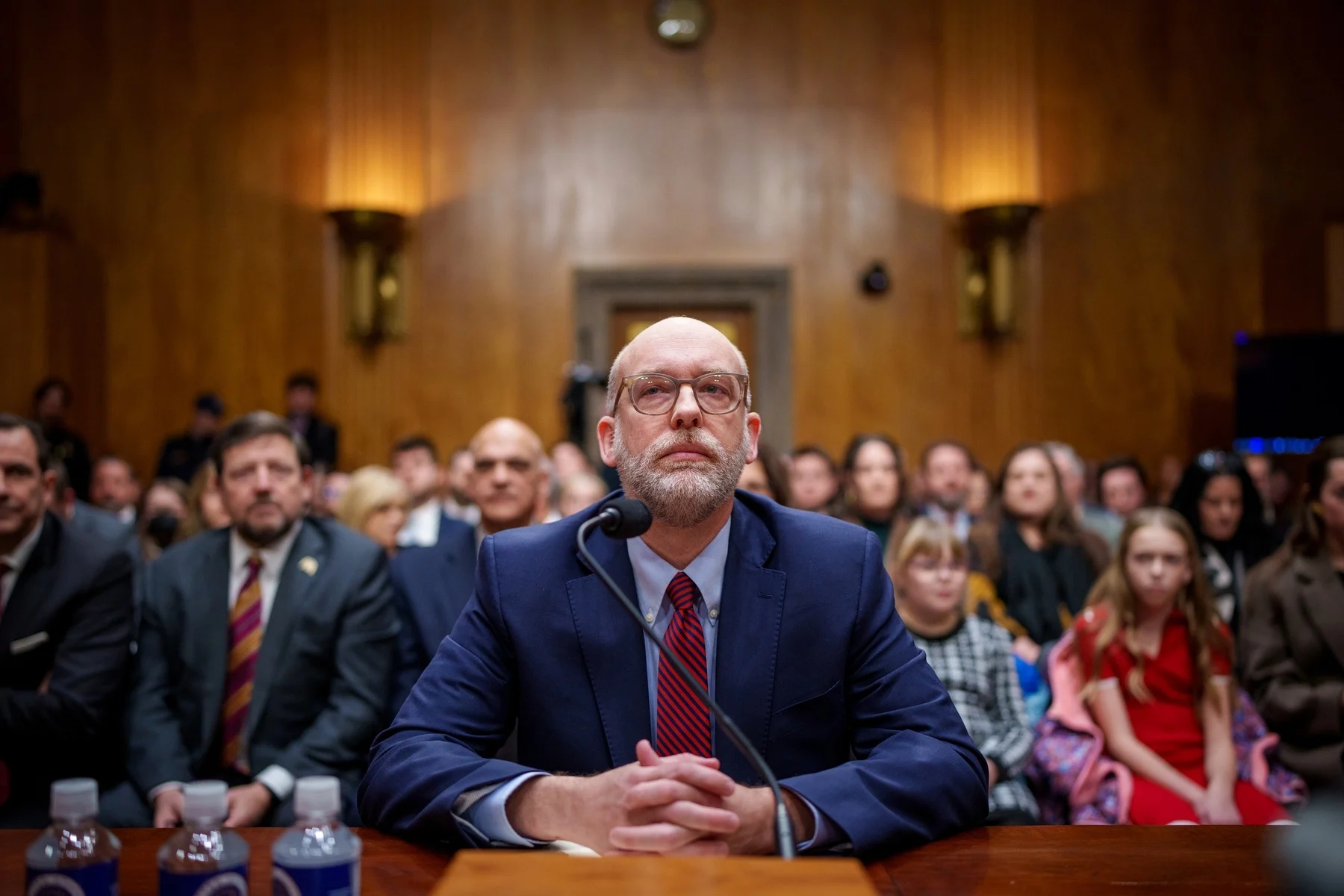
Russell Vought sees the Office of Management and Budget as a “nerve center” that can be used to curtail DEI programs and purge the federal workforce of Trump’s perceived enemies.
Read Amanda Becker’s Loveland connection in her Bio below.
The U.S. Senate on Thursday approved Project 2025 architect Russell Vought to lead the Office of Management and Budget (OMB) on a party-line vote after Democrats held the floor overnight in an attempt to delay the confirmation since they did not have the numbers to block it.
Vought was confirmed by a vote of 53-47.
For 30 hours, starting on Wednesday afternoon and into Thursday evening, Democrats took turns on the Senate floor to protest Republican President Donald Trump’s nomination of Vought, who also led OMB at the tail end of Trump’s first administration.
During his first stint at OMB, an under-the-radar entity that wields immense influence over the federal government by crafting the president’s budget, Vought helped Trump come up with a plan to jettison job protections for thousands of federal workers and assisted with a legally ambiguous effort to redirect congressionally appropriated foreign aid for Ukraine. In the years since, Vought founded two pro-Trump groups whose work has focused on discrediting structural racism and curtailing diversity, equity and inclusion (DEI) programs. The chapter that Vought wrote for Project 2025 detailed how the budget agency could be used to withhold money appropriated by Congress and eliminate dissent within agencies by purging them of employees.
Trump said repeatedly during his campaign that he had not read Project 2025 and did not know its authors, though at least 60 percent of its more than 350 contributors were linked to the president. These include appointees and nominees from his first administration, members of his prior transition team and unofficial advisers.
Project 2025 is a 920-page roadmap from the conservative Heritage Foundation about how Trump’s second administration could use the federal government to enact a far-right Christian agenda. If implemented — and some of the Trump administration’s earliest moves track the blueprint’s objectives — it has the potential to redefine rights long held by all Americans, with disproportionate impacts for women, LGBTQ+ people, people of color and vulnerable populations like the elderly and disabled.
“What was in Project 2025 that made it so widely hated across the political spectrum? A few things: firing civil servants, weaponizing the Department of Justice and the Federal Bureau of Investigation, unleashing force onto protestors, and targeting political opponents, restricting abortion nationwide, ripping retirement and health care benefits from seniors, dismantling public education,” Sen. Elizabeth Warren said Wednesday evening on the Senate floor in a speech opposing Vought’s nomination.
Warren noted that Vought has called on Congress to outlaw medication abortion and encouraged discrimination against transgender people in the workplace. She continued: “Now, Donald Trump has named the lead architect of Project 2025, Russ Vought, to oversee the federal government’s entire budget office … to carry out the Republican blueprint to make our government force people to live in the image that Russ Vought and other extremist Republicans approve of.”
Last week an OMB letter sent by acting director Matthew Vaeth instructing federal agencies to pause “all activities related to obligation or disbursement of all Federal financial assistance” sent shock waves across Washington. The White House moved to quell the backlash. A federal judge earlier this week issued a temporary restraining order, extending a pause on implementing the directive.
Vought, in an interview with conservative activist Tucker Carlson shortly after Trump’s reelection, discussed how the incoming administration could force federal agencies to “come to heel and do what the president has been telling them to do.” He likened OMB to the “nerve center” through which Trump could ensure his policy directives trickle down through the federal agencies that employ more than 2 million Americans.
Many of these federal workers received an email last week from the Office of Personnel Management (OPM), which acts as the federal government’s human resources department, with the subject line “Fork in the Road.” The email offered them a chance to opt into a “deferred resignation” program intended to trim the federal workforce and set an acceptance deadline of February 6. Already, federal employees identified as working on DEI programs had received letters notifying them that they were placed on leave and could be fired. Some have sued the administration.
Labor unions representing federal employees also sued over the resignation offer and deadline, and a federal judge on Thursday blocked OPM from enforcing it. White House press secretary Karoline Leavitt said that about 40,000 workers had already accepted the offer and the White House expected that number to grow. Leavitt said she was not part of discussions about next steps or whether layoffs would follow if enough employees did not resign.
“Americans need to know that OMB is extremely powerful, with oversight over the president’s budget and functionally all federal agency actions, including regulatory decisions,” Democratic Sen. Mazie Hirono of Hawaii said Thursday.
“With such responsibility, the person leading this office needs to be level-headed and impartial. They need to put loyalty to the Constitution above loyalty to the President,” she added. “Mr. Vought, however, is the ultimate yes-man.”
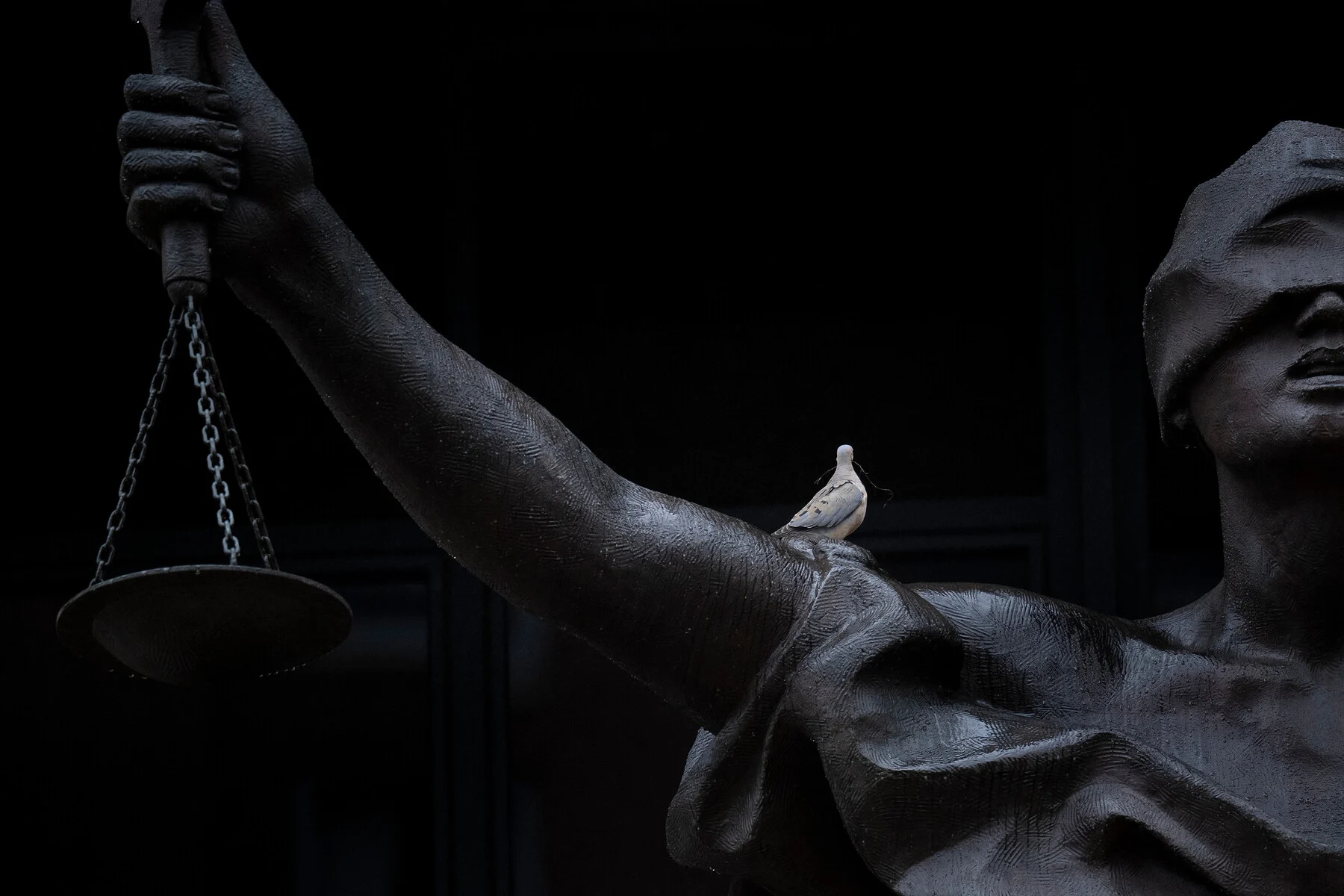
A bird rests on a statue of Justice at the US District Court for the Eastern District of Virginia April 7, 2022, in Alexandria, Virginia.(Brendan Smialowski/AFP/Getty Images)
The Department of Justice Office on Violence Against Women (OVW) has removed from its website all information on current funding opportunities and directs visitors not to finalize any applications. This adds to the fear of nonprofits that work to help victims of gender-based violence that a major funding source may dry up.
It is unclear whether this pause is temporary. OVW did not return a request for comment on Friday afternoon.
Users looking for information about funding from OVW are directed to the homepage, which on Friday showed a message to grantees saying that a funding freeze announced January 27 by the Office of Management and Budget (OMB) was not in effect due to a judge’s restraining order. OMB had directed agencies to pause funds pending a review of their compatibility with executive orders related to immigration, “illegal DEI” and “woke gender ideology.”
The notice of the court order says “agencies may exercise their own authority to pause awards or obligations, provided agencies do so purely based on their own discretion” and in accordance with agreements and not solely due to the rescinded OMB memo or the executive orders.
An archived version of the OVW funding opportunities webpage from January 24, and viewable on the Internet Archive, shows 10 grants open for applications, with deadlines varying from January to May 2025. The update about withdrawing grant opportunities is dated February 6. Grants previously listed included ones aimed at ending abuse later in life, providing housing for victims of domestic violence and helping local law enforcement stop cybercrimes.
OVW is one of largest funders of programs for survivors of gender-based and domestic violence.
Many nonprofits that work with victims of domestic or intimate partner violence edited their websites in the wake of the funding freeze, providing static pages with just phone numbers or removing resources for LGBTQ+ people.
A hearse carrying the casket of Rosa Parks and a 1950s era bus sit in front of the Metropolitan AME Church where a memorial service for the civil rights icon was being held on Oct. 31, 2005, in Washington, D.C. A judge has ordered the naming rights of the extremist group the Proud Boys be given to the church.
Mark Wilson/Getty Images
“For the first time in our nation’s history, a Black institution owns property of a white supremacist group.”
Washington, D.C. – A historic Black church in Washington, D.C., that has been awarded control of the name of an extremist group that vandalized its property is calling for people to take a stand against hate.
On Monday, D.C. Superior Court Judge Tanya Jones Bosier ordered that all interests in Proud Boys International’s trademarked name, “Proud Boys,” be given to Metropolitan African Methodist Episcopal Church. And no one can sell, transfer, license or dispose of the Proud Boys’ trademarked name without permission from the church or the court, according to the judgment.
The order is a victory for the church, after it asked the court to enforce a default judgment of $2.8 million in damages and said it was “entitled to all of PBI’s interests in the Proud Boys Trademark and a lien on the Trademark.”
In December 2020, the Proud Boys desecrated and vandalized Metropolitan African Methodist Episcopal Church (and by extension, everyone who stands against hate) when the Proud Boys “leaped over Metropolitan AME Church’s fence, entered the church’s property, and went directly to the Black Lives Matter sign. They then broke the zip ties that held the sign in place, tore down the sign, threw it to the ground, and stomped on it while loudly celebrating. Many others then jumped over the fence onto the church’s property and joined in the celebration of the sign’s destruction.” Read the order from Judge Neal E. Kravitz.
Metropolitan AME Church did not back down. The church stands drawing strength from the legacies of Elizabeth Freeman and Ida B. Wells-Barnett, against the Proud Boys, a white supremacist group, and vowed to fight because following Jesus in these times and circumstances demands nothing less. As a result of these efforts, Metropolitan was able to secure $2.8 million in damages based on the hateful conduct of the Proud Boys burning our Black Lives Matter banner.
However, this resounding victory was incomplete as just a judgment on paper with no actual exchange of monies to compensate Metropolitan. As a result, Metropolitan went to court to enforce the judgment and Judge Tanya M. Jones Bosier ruled in the church’s favor. For the first time in our nation’s history, a Black institution owns property of a white supremacist group. Metropolitan African Methodist Episcopal Church now owns the exclusive rights to the Proud Boys trademark, stripping them of the very name they rallied under. This also means that any money the Proud Boys makes from using the trademark must be paid to Metropolitan to help satisfy the multi-million-dollar default judgment.
Metropolitan African Methodist Episcopal Church was founded in 1838. From its founding, Metropolitan AME Church, has and continues to do what other churches will not. We are known locally, nationally, and internationally, to be deeply spiritual and deeply engaged in the world. From anti-slavery leadership in the mid-19th century, in the harboring of runaway slaves, to organizing power, people and money toward the flourishing of all people in the District of Columbia today. Metropolitan has been not just a significant center of worship, but also an institution in the forefront of the civic, cultural, and intellectual life among African Americans and others. Today, Metropolitan is focused on theologically sound teaching and preaching in worship; combatting food insecurity through our Food Bank; addressing ecological devastation by addressing heat islands in metropolitan cities with Smart Surfaces Coalition; equipping parents and families with culturally responsive and biblically grounded teaching through the Sankofa project; and building Black Equity and Wealth through Homeownership, prioritizing community safety and holding political leaders accountable with Washington Interfaith Network.
We appreciate you taking the time to visit us and we hope you can stand with us by investing in the Community Justice Fund. In these unprecedented times, we are called to continue doing the work of Jesus in the church, the community, and the world. Every contribution will make a difference as we counter the radical ideology and rhetoric that is flowing from the leaders of our Nation while eroding and eliminating civil rights and societal strides that have been made by the sacrifices of our elders and ancestors.
Fairfax, Ohio – The Ohio Bureau of Criminal Investigation and the Fairfax Police Department are seeking the public’s assistance in identifying a suspect who broke into a 64-year-old woman’s home and killed her.
The crime is believed to have taken place between midnight and 6 a.m. on Sunday, February 2nd.
Sheila “Denise” Tenpenny, who lived alone, was found dead later Sunday morning inside the home, at 3919 Germania Street. Fairfax is a village in southeastern Hamilton County.
The Fairfax Police Department requested BCI’s assistance to investigate the suspicious death, which investigators have concluded was a murder.
The perpetrator, a male, was likely physically injured while committing the crime, investigators say, and may have visible cuts or bruises on his hands, wrists and/or forearms. He may also have facial injuries.
Anyone with information about the crime or who has surveillance cameras near the crime scene is urged to contact BCI at 855-BCI-OHIO (855-224-6446). Tips may also be submitted on the Attorney General’s website.
President Donald Trump reportedly plans to fulfill a campaign promise aimed at sweeping changes for public schools: closing the Department of Education.
An executive order from the White House outlining this goal is expected imminently, sources close to the matter told news organizations including NBC News, The Washington Post and The Wall Street Journal this week. The placement of multiple Department of Education employees on administrative leave and a probe of the agency by the Elon Musk-led Department of Government Efficiency have lent credibility to the claims. So has Trump.
Asked by a reporter Tuesday why he was nominating Linda McMahon education secretary if he plans to scrap the department, the president said, “I told Linda — ‘Linda, I hope you do a great job and put yourself out of a job.’ I want her to put herself out of a job [in the] Education Department.”
In a 2023 campaign video, Trump shared his vision for education, expressing his intention for local school boards and parents to control their children’s education, incorporate prayer into schools and expand school choice — or options for families to choose the public, private or religious school they prefer.
“One other thing I’ll be doing very early in the administration is closing up the Department of Education in Washington, D.C., and sending all education and education work and needs back to the states,” he said, disregarding that states and school districts already run public schools.
The prospect of the agency closing has sparked outcry from education leaders, elected officials and families with vulnerable children. Eliminating the Department of Education, they say, could have a ripple effect across the country — with particular consequences for children with disabilities, youth from low-income households and student loan borrowers, most of whom are women.
“Students across the country benefit from programs run by the Department of Education, especially lower-income students in rural, suburban and urban communities, students who qualify for federal grants or loans to receive career training or attend 2- and 4-year colleges, and students with disabilities,” Becky Pringle, president of the National Education Association (NEA), said in a statement Monday. The nation’s largest labor union, the NEA represents over 3 million educators and other school stakeholders.
Shuttering the Department of Education would adversely affect nearly all of the nation’s students, Pringle said, as 90 percent of students overall and 95 percent of students with disabilities are educated in public schools. “Trump’s power grab would steal resources for our most vulnerable students, explode class sizes, cut job training programs, make higher education more expensive and out of reach for middle class families, take away special education services for students with disabilities, and gut student civil rights protections.”
As alarm grows over the Department of Education’s possible elimination, questions are also mounting — namely if an executive order is all it takes to axe the federal agency.
Can a president shut down the Department of Education?
The president cannot close a federal agency with an executive order lawfully.
“But what I think is important to remember here is that you don’t have to dismantle the Department of Education to really, really limit its reach and its effectiveness,” said Jasmine Bolton, who served as senior counsel in the Department of Education’s Office for Civil Rights from 2021 to 2023. “Although it is less likely that they are able to fully dismantle the Department of Education, they could very easily limit its ability to do a lot of things. They could also really take a look at its grant making, its funding — who it’s funding, what it’s funding and really strike at the heart of some of those provisions.”
Bolton said that it’s not inconceivable that the Trump administration would dial back some of the large funding grants that school districts in blue and red states rely on to serve their students.
“We have to be vigilant and aware of all possibilities,” she said.
The Department of Education dates back to former President Jimmy Carter’s administration. In 1979, Congress passed legislation to create the agency. To dismantle the Department of Education, Congress would have to approve its abolishment. Rep. Thomas Massie of Kentucky on January 31 reintroduced legislation to dissolve the agency, a goal shared by the Republican Party and conservative think tank the Heritage Foundation, which wrote Project 2025, its blueprint for Trump’s return to the White House. But the chance of such a bill surviving is a long shot, experts say, especially in the Senate.
“I think it’d be very challenging to do because you’d have to overcome the filibuster in the Senate,” said Wil Del Pilar, senior vice president of the Education Trust, a nonprofit advocating for equity in education. “They don’t have 60 votes in the Senate unless they disband the filibuster. So, it’s possible, but I think it’s highly unlikely.”
Most of Congress, including 60 House Republicans, opposed legislation to eliminate the department last session. Del Pilar said that abolishing the agency would prevent Republicans from pursuing some of their objectives.
“Given all the things that they want to do in terms of what I would call a deregulatory agenda, what I expect them to come in and want to do is undo all of the Biden-era regulations that were put in place through negotiated rule making,” he said.
Pedro Noguera, dean of the Rossier School of Education at the University of Southern California, said the Trump administration needs the Department of Education to carry out goals like withholding funding from education institutions that practice DEI (diversity, equity and inclusion) or teach critical race theory.
“I don’t know how he does that without using the powers of the Department of Education,” Noguera said. “On the other hand, if he wants to redistribute the duties that are present in the Department of Education into other departments, that’s kind of a rebranding. I could see them doing that.”
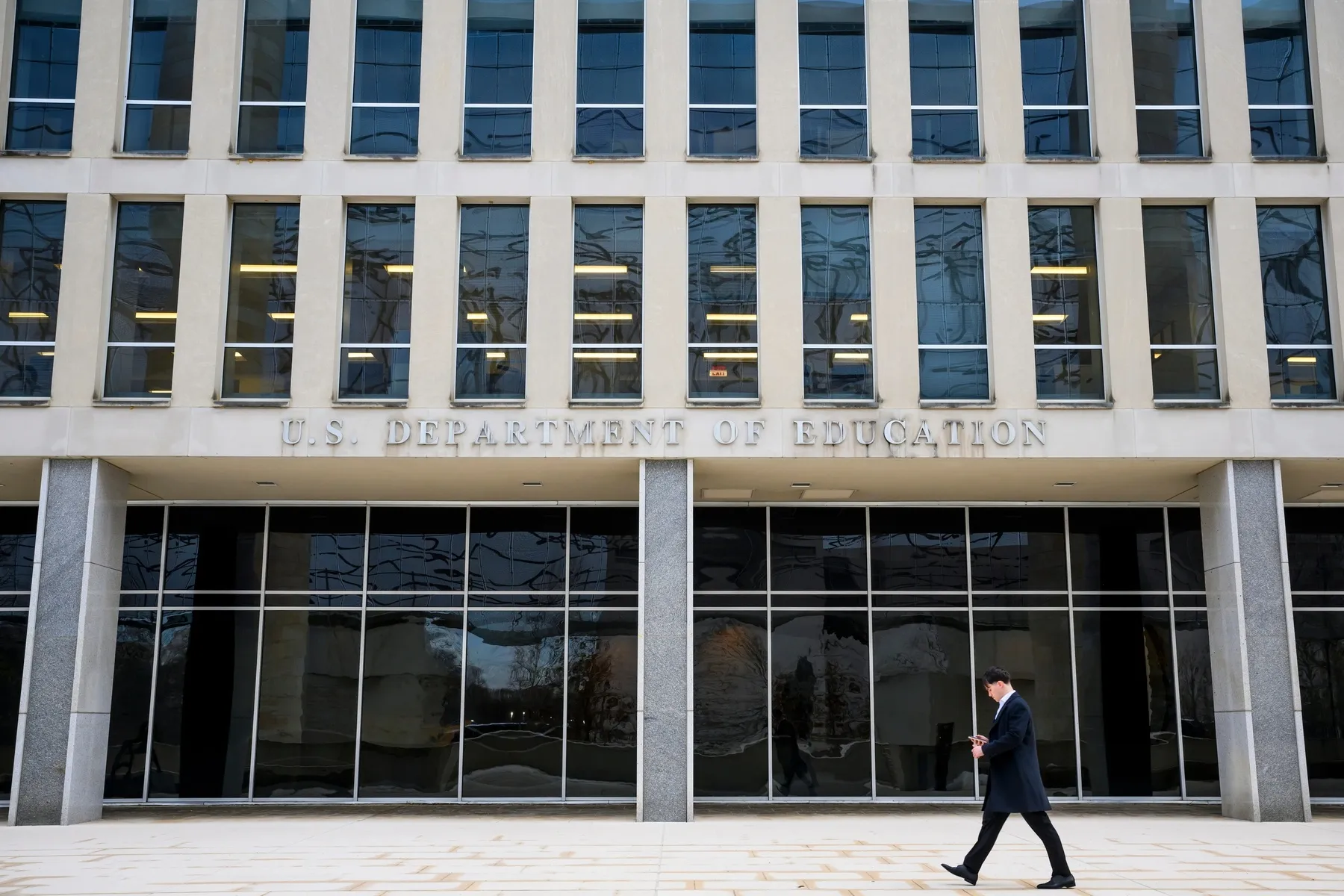
A pedestrian walks by The Lyndon Baines Johnson Department of Education Building on February 3, 2025 in Washington, DC.
(Pete Kiehart/The Washington Post/Getty Images
What does the Department of Education do?
Ensuring that all students have equal access to education is the agency’s overarching responsibility. It includes a civil rights division that investigates allegations of discrimination related to factors such as sex, race and disability.
Trump can’t close the Department of Education with the sweep of a pen, but he can drive out its senior personnel or issue an executive order instructing the agency to severely reorganize, both of which would render it largely ineffectual. Placing dozens of the department’s employees on unexplained leave on Friday has already prompted a letter from a lawyer representing some of the staffers; it accuses the agency of retaliating against them for attending a DEI training. Should it be dismantled, the Department of Education’s key functions are expected to go to other federal agencies. Congressional approval, though, would be needed to transfer many of those duties.
While states, by far, provide most of the money public schools need to operate, the Department of Education, which has a $79 billion annual budget, disperses billions of dollars in federal funding. This includes to the Title I program, which gives supplemental funding to schools that primarily serve economically disadvantaged students. The agency also directs funding toward students with disabilities in line with the Individuals with Disabilities Education Act (IDEA), federal legislation that guarantees this population an education appropriate for their needs. Both IDEA and Title I, created in 1975 and 1965, respectively, predate the Department of Education and can be dissolved only by an act of Congress.
“I’m not sure what it accomplishes if they try to go after programs like Title I,” Noguera said. “They’re going to get a lot of opposition, not just from blue areas, but from red areas as well, and from Congress, because people tend to support the public schools.”
Like Title I and IDEA, the National Assessment of Educational Progress (NAEP) also predates the agency, which administers the test today. Known as the “Nation’s Report Card,” the results of the assessment provide the department with a baseline of how well students are doing in reading, math and other areas.
Upon last week’s release of NAEP scores showing that students’ reading scores had worsened and math scores had stalled, the Department of Education issued a statement unveiling the Trump administration’s plans to upend public schools and give states more control, a deceptive remark since states and school districts already have authority over what students learn. The federal government does not shape local curriculum.
But the Department of Education does track the academic progress of K-12 and college students. At the higher education level, the agency monitors how well institutions serve students by compiling data about admissions numbers and graduation rates. It also oversees funding for the federal student loan program and the Free Application for Federal Student Aid (FAFSA), which students complete to receive financial assistance for college. This aid includes the Pell Grants that supplement higher education costs for students from low-income households.
Braxton Brewington, a spokesperson for the Debt Collective, which works to abolish debt and transform how public goods and services are distributed, said that he’s concerned about how marginalized students will fare under an Education Department run by the Trump administration, though the Debt Collective also criticized Biden officials for not overhauling the student loan system.
“We are expecting the Trump administration to carry out a deeply catastrophic agenda,” Brewington said. “So that will look like privatizing education — K-12 to higher education — incentivizing private loans to pay for college, rolling back repayment plans like Public Service Loan Forgiveness and other types of safety nets. These plans are not ideal, but to the extent that they’ve helped borrowers, we’re expecting a Trump administration to roll those back.”
Does the public support closing the department?
Surveys of the public have found different attitudes about the Department of Education. A new poll released Tuesday by Data for Progress, a progressive think tank and polling firm, found that likely voters oppose eliminating the federal agency by about a two-to-one margin. Data for Progress conducted the poll of 1,294 likely voters from January 31 to February 2 on behalf of the Student Borrower Protection Center, which works to improve the student loan system, and Groundwork Collaborative, which advocates for an equitable economy.
Fifty-two percent of likely voters under age 45 strongly oppose closing the agency compared with 13 percent of this demographic who strongly support such a move. Forty-six percent of likely voters over 45 strongly oppose elimination, while 19 percent strongly support it. College-educated likely voters object to slashing the agency the most, with 55 percent strongly opposing this effort and 14 percent strongly supporting it.
A 2024 survey of Americans by the Pew Research Center found that partisanship shaped opinions about the federal agency, with 64 percent of Republican and Republican-leaning respondents holding an unfavorable view of the department. Just 26 percent of Democrats and Democratic-leaning voters felt the same. Overall, 44 percent of respondents had a favorable opinion of the agency and 45 percent had the opposite view.
Beyond partisanship, attitudes about the Department of Education may depend on whether people feel the agency plays a key role in their lives. Advocates for students with disabilities and student loan borrowers are among the loudest raising concerns about its potential dismantling or diminishment.
“The last time Trump was in office, he significantly understaffed the Office for Civil Rights,” Del Pilar said. “So I do think we should be concerned about what this potentially means for students with disabilities, for English language learners, for immigrant students, because if they don’t staff up and investigate, then we’re not going to see institutions, schools and districts’ feet held to the fire around the inequities that are being placed on our students.”
Why do Republicans want to kill this federal agency?
Republicans have wanted to eliminate the federal agency since its launch.
“Some of it was the old Republican focus on smaller government,” Noguera said. “They’re just shrinking the size of government and seeing the department as largely regulatory, but what they don’t understand is that many of the functions that are now within the U.S. Department of Education, such as funding Pell Grants, are essential to higher ed and access to higher ed for all kinds of Americans across the country. You can’t just get rid of that without a lot of resistance.”
Without congressional support, Noguera continued, the Trump administration will find it difficult to achieve its goals for the nation’s schools. Many of them, such as implementing school prayer, expanding voucher programs and limiting what students can learn and read in class, directly clash with the public education system.
On January 29, the White House issued an executive order asking the Department of Education to spend the next two months developing guidance to help states apply federal funding to school choice initiatives, mirroring a trend that’s been unfolding at the state level. For years, billionaires have collaborated with conservative lawmakers to route funding away from public schools and send it to private schools through voucher programs, according to a 2024 report by the Senate Committee on Health, Education, Labor and Pensions (HELP). Billionaires have funneled their financial resources into the School Freedom Fund, a political action committee that attempts to remove state lawmakers who oppose private school vouchers from office.
Billionaires have a vested interest in privatized education because they can cash in on it through voucher tax credits and federal business expense deductions, the HELP report posits. For example, over 20 states provide voucher tax credits to companies that make contributions to pay students’ private school tuition. Moreover, vouchers overwhelmingly benefit students from high-income families since they typically cover just part of tuition costs. Lower-income families can’t afford to make up the difference. The effort to defund the nation’s public schools, the study contends, is ultimately one to make the elite class even wealthier.
Vouchers harm communities that are already vulnerable due to systemic underfunding and disinvestment, Bolton said.
“By pulling out this money and constantly pulling the rug out under schools, folks who support vouchers, particularly in this administration, are really intentionally undermining the schools that will continue to serve the majority of our students,” said Bolton, who is now policy director at the Partnership for the Future of Learning, a network of organizations fighting for high-quality public schools. “It’s incredibly frustrating that this administration seems to want to pour into a federal voucher program that doesn’t serve us and isn’t really responsive to what people are telling our leadership.”
For the third year, a handful of Black staffers at The 19th have come together to reflect on what Black History Month means to us.
For too many reasons to count, this year’s celebration of our history and culture feels even more pressing, present and vital to many of us.
These feelings are represented in words and phrases that dot these powerful essays: unapologetically Black, rebellion, uplifting others, collective excellence, hope, motivation, nurturing and holding our ground.
‘Every month felt like Black History Month’
Growing up, every month felt like Black History Month. Within our four walls, the Bunting household was unapologetically Black.
It was required that my siblings and I understood our history — not just the highlights, but the depths. As Parliament-Funkadelic blasted through the house, my parents passionately explained why funk and soul were more than music — they were lifelines of culture, identity and rebellion. And, through their work and service, they showed us the power of showing up for our people and our community.
(Courtesy of LaSharah S. Bunting)
Yet it was the quiet, powerful way my mother and father carried themselves, with unwavering strength and dignity, that made the most impact. They instilled a deep level of pride and resilience that still lives with me every day.
Today, at a time when our very existence as Black people feels like an act of defiance, I hold tight to those values and my parents’ belief in the beauty of who we are. Those lessons are my armor. My parents’ love is my legacy. And their hope is the fire that keeps me going. — LaSharah S. Bunting, vice president
‘Creating paths where none existed’
Leadership has always been a lens through which I view the world, shaped by the extraordinary examples of my parents. As the child of two veterans, leadership wasn’t something pushed onto me but rather modeled with quiet consistency and purpose. My parents taught us to give our best in everything we did, to show up for others and to do so with integrity. I didn’t fully grasp the depth of these daily lessons until I watched my dad, 25 years older than my mom, set aside his passions and routines to support her career overseas.
(Courtesy of Clarice Bajkowski)
Recently, as I’ve reflected on his life and sifted through his personal effects, I’ve come to understand the profound depth of his leadership during his service in the U.S. Navy during World War II. He served with distinction, bravery and valor aboard ships like the U.S.S. Polana, U.S.S. General E.T. Collins and the USS Franklin, where he earned a Purple Heart for his courageous service on the most heavily damaged U.S. Navy vessel to survive the war. But his contributions extended far beyond his bravery in battle. He laid the groundwork for equity, advocating for wage and rank corrections for Black sailors, and worked to ensure that Black men and women could be seen and valued beyond the roles they were historically confined to, creating opportunities for those who came after him.
Though he never sought leadership, it always found him. He lived it by standing up for others and creating paths where none existed. That same spirit carried into how he raised our family, showing up with resilience, purpose and quiet strength. His legacy, combined with my mother’s determination, shaped my understanding of leadership as service, advocacy and a commitment to uplifting others. My brother and I are the realization of their wildest dreams — a testament to their vision, sacrifice, and unwavering belief in our collective excellence. — Clarice Bajkowski, chief creative officer
‘They were determined to know freedom’
I’m an Alabamian and my folks are from Montgomery and Lowndes counties, epicenters for the Civil Rights and Black Power Movements. I grew up listening to stories of my relatives, their childhood friends and neighbors committing acts of resistance in the Jim Crow South.
Whether it was hosting civil rights leaders in their homes as they passed through town or integrating high school or sneaking out to march for justice or simply living full, beautiful lives in spite of such ugliness, they were determined to know freedom.
Through direct action or through small acts of defiance, they resisted oppression at great personal risk and rebelled against laws that didn’t respect their dignity. They resisted the temptation to be completely consumed by fear and despair.
I am shaped by their determination to find a way to live abundant lives in spite of the dangerous forces trying to derail their destiny. I carry that same courageous and resilient spirit. — Amethyst Holmes, product fellow
‘Continue to nurture our country for the better’
I was not sure if I could write a Black History Month reflection this year. I didn’t think I would have anything interesting or inspiring to say less than two weeks after watching a U.S. president be inaugurated on Martin Luther King Jr. Day, and then hours later issue an executive order calling diversity, equity and inclusion work “illegal discrimination.”
But, the same week as the inauguration, a trend started on TikTok with a group of (mostly Black women) professors and professionals teaching online courses about their areas of expertise. It began inadvertently when Dr. Leah Barlow at North Carolina Agricultural and Technical State University posted a now-viral video that was originally meant for students in her Intro to African American Studies class.
(Afro American Newspapers/Gado/Getty Images)
Now, other professors are offering courses on racial disparities in health care, managing implicit biases, the history of U.S. education, constitutional law and more. I am personally “enrolled” in a course analyzing the works of Octavia Butler taught by Dr. Briana Whiteside.
During such a politically tumultuous time, it gives me hope and motivation to see the ways that Black women in particular continue to nurture our country for the better. — Candice Norwood, general assignment reporter
‘What happens when people aren’t curious about what they don’t know’
No offense, Dorothy Hamill, but you weren’t my first choice.
I was the only Black kid in advanced English in sixth grade. We were assigned to choose a famous person to profile, and I picked Billie Holiday. My father and uncle were musicians, and my grandfather had jazz on heavy rotation.
I’ll never forget the blank look and dismissive shake of the head from my teacher in response. “Billie Holiday? I don’t know who that is.”
So I slunk back to my desk, eventually picking the very White, very acceptable (to her) Hamill instead.
(Heritage Art/Heritage Images/Getty Images)
This is what happens when people aren’t curious about what they don’t know. My teacher assumed that because she hadn’t heard of someone being mentioned by a little Black girl, the person wasn’t worthwhile.
That memory has surfaced for me this Black History Month as we face the erasure of our stories and the weaponization of our identities. As people who think only their heroes matter amass power to make decisions for all of us.
I gave in on Hamill, but I’ve held my ground ever since. And this month I’m putting Holiday back on heavy rotation. — Karen Hawkins, story editor
Columbus, Ohio – Today, Ohio Treasurer of State Robert C. Sprague declared his candidacy for Ohio Secretary of State in the 2026 Primary Election.
In announcing his candidacy, Treasurer Sprague released the following statement:
“Governments are judged by how it treats two things—your dollar and your vote. For the past six years, the people of Ohio have entrusted me to be a responsible steward of their tax dollars, and today I am asking them to put their trust in me to protect their sacred vote. I look forward to continuing to serve Ohio in an office so fundamental to good government and our democratic process.
“In Ohio, we are fortunate to have an election process that is secure, accurate, and accessible, but that is the direct result of the vigilance and leadership of Secretary LaRose and a Republican legislature that takes election security seriously. As Secretary, I will continue to ensure that our elections are fair, the results are trusted, and our right to vote is protected. I look forward to working with President Trump, the Administration, and the Ohio General Assembly to these ends.”
Since January of 2019, Robert Sprague has served as Ohio’s 49th Treasurer of State. The office manages the state’s $39 billion investment and $11 billion debt portfolios, collects and deposits all state revenues, and oversees custodial assets. Prior to his work as Treasurer, Sprague served from 2011 through 2018 as State Representative and began his public service as City Treasurer and Auditor of his hometown of Findlay.











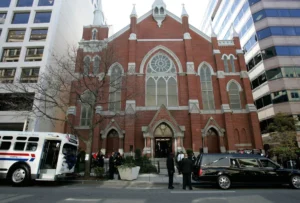 A hearse carrying the casket of Rosa Parks and a 1950s era bus sit in front of the Metropolitan AME Church where a memorial service for the civil rights icon was being held on Oct. 31, 2005, in Washington, D.C. A judge has ordered the naming rights of the extremist group the Proud Boys be given to the church.
 We Stand Up For Justice and Stand Against Hate