Author: Mihaela Manova

  • Teaching the Truth About Climate Change Is Up to Us, Because Textbooks Lie

    Teaching the Truth About Climate Change Is Up to Us, Because Textbooks Lie

    Loveland Magazine is one of the 400 news outlets worldwide, with a combined audience of over 2 billion people “Covering Climate Now”, a global journalism initiative committed to bringing more and better coverage to the defining story of our time.
    The initiative, was co-founded by The Nation and Columbia Journalism Review

    Mihaela Manova is “Covering Climate Now” in Loveland, Ohio as an editor for Loveland Magazine
    In today’s (reposted) article from Covering Climate Now/Rethinking Schools, Bill Bigelow writes about the scarcity of climate change education in current textbooks.

    In 2016, the school board in Portland, Oregon, approved a comprehensive climate justice resolution, one part of which mandated that Portland Public Schools “will abandon the use of any adopted text material that is found to express doubt about the severity of the climate crisis or its root in human activities.”

    I was a member of the committee of parents, teachers, students, and activists that pushed for the resolution. In drafting it, we knew that there were a couple of especially egregious texts in Portland classrooms, but until we sat down to formally evaluate 13 middle and high school science and social studies textbooks, we had no idea that every single one of the texts adopted in famously green and liberal Portland misleads young people about the climate crisis.

    Few teachers put their faith in multinational behemoths like Pearson and Houghton Mifflin Harcourt. But our Climate Justice Committee needed more than hunches about how these corporations’ profit-first orientation would distort their coverage of climate change — we needed evidence.

    Before our committee collected district-adopted textbooks to evaluate, we developed a rubric to evaluate their adequacy, inspired by the work of K. C. Busch at Stanford’s Center for Assessment, Learning, and Equity. Here’s what we came up with:

    • The text provides stories and examples that help students grasp the immediacy, systemic nature, and gravity of the climate crisis.
    • The text includes actions that people are taking to address the climate crisis, locally and worldwide.
    • The text emphasizes that all people are being affected by the climate crisis, but also highlights the inequitable effects of the crisis on certain groups (e.g., Indigenous peoples, people in poverty, Pacific Islanders, people in sub-Saharan Africa, people dependent on glaciers for drinking water and irrigation, etc.)
    • The text does not use conditional language that expresses doubt about the climate crisis (e.g., “Some scientists believe . . .” or “Human activities may change climate . . .”)
    • There are discussion and/or writing questions that provoke critical thinking.

    Given our climate emergency, meeting these criteria seemed to us to be a reasonable cut score.

    Thirteen retired teachers and members of our Portland Public Schools Climate Justice Committee gathered to evaluate the school district’s texts. The first thing we noticed is how difficult it was to find anything about climate change in many of the books. A typical social studies text, History Alive! Pursuing American Ideals, includes no mention of climate change, but offers breathless paeans to fossil fuels: “Oklahoma’s oil reserves are among the largest in the nation. Fossil fuels helped the United States become an industrial giant.” As one committee reviewer wrote, in this and other texts, “there is an opportunity to look at early U.S. history as prologue to the climate crisis, but this book is utterly silent.”

    Contemporary Economics: not a word. The iconic Magruder’s American Government: 844 pages with no reference to global warming, climate change, greenhouse gases. One committee reviewer wrote: “How can a book about the U.S. government say nothing about the climate crisis — or environmental policy more broadly? This is egregious, unacceptable.” Despite a focus on industrialization, neither volume of the Advanced Placement text Sources of the Western Tradition includes anything about climate change — as if we can cleave fossil fuel-powered industrialization from its contemporary climate consequences.

    Other texts acknowledge the existence, or at least the possibility, of climate change, but the texts’ language is drenched in doubt. Issues and Life Sciences describes global climate change in just one sentence, as a “potential threat to Earth’s biomes.” However, other “threats” to the Earth’s biomes — eight of them — are listed as actual, and climate change a mere potential threat.

    The books are littered with conditional language. The high school text Biology: As greenhouse gas concentrations increase, global temperatures “may be affected,” and there might be “potential” for serious environmental problems. And: “Explain how burning of fossil fuels might lead to climate change.” AP World History informs students that the global rise in temperatures “might have serious consequences.”

    A key component of Portland’s climate justice resolution is its insistence on student agency: “All Portland Public Schools students should develop confidence and passion when it comes to making a positive difference in society, and come to see themselves as activists and leaders for social and environmental justice — especially through seeing the diversity of people around the world who are fighting the root causes of climate change.” But not a single text our committee reviewed suggests that students or ordinary people can play a role in addressing this growing crisis — or that “frontline communities” are themselves responding to climate destabilization. In its one sentence on climate change, Pursuing American Ideals says that “environmentalists fear” problems like global warming. Similarly, Modern World History acknowledges that “environmentalists are especially concerned . . .” and that “Scientists also are worried about global warming . . .” These are both true, of course, but the resolution’s intent is to emphasize our students’ own role in making the world a better place, rather than assigning concern and action only to scientists and environmentalists.

    All 13 of the books earned an F. Our committee is in the midst of sending letters to each publisher informing them that their book is out of compliance with Portland school district policy on climate education. We are also sending letters to teachers who may be using these books, alerting them to our findings and urging them to use alternatives, and to engage students in critical reading activities to dissect the problems with these texts’ ho-hum approach to climate change.

    Do we expect to influence these corporations’ treatment of the climate crisis in their textbooks? No. The corporate giants that publish school textbooks have no interest in raising critical questions about the frenzied system of extraction and consumption at the root of climate change — a system from which they benefit. Our aim is to build an argument that we cannot look to conventional sources of curriculum to educate our students about the causes of climate change and the kind of fundamental social transformation needed to address the crisis.

    For this, we need a grassroots approach to curriculum development — a partnership among educators, parents, environmental organizations, frontline communities, and our students. We need to demand time for teachers to collaborate, to write new curriculum, to share stories — to learn from one another and from the communities being hit by climate change first and the hardest. The climate crisis threatens life on Earth. Our students have a right to learn about this and to know that they can make a difference.

    Bill Bigelow (bill@rethinkingschools.org) is the curriculum editor of Rethinking Schools and co-director of the Zinn Education Project.ÊHe co-edited A People’s Curriculum for the Earth: Teaching Climate Change and the Environmental Crisis.

    This story is part of Covering Climate Now, a global collaboration of more than 250 news outlets to strengthen coverage of the climate story.

    Link to this article: https://rethinkingschools.org/articles/teaching-the-truth-about-climate-change-is-up-to-us-because-textbooks-lie/

  • The Fall of Trump Propels the Climate Story into a Decisive New Era/Covering Climate Now

    The Fall of Trump Propels the Climate Story into a Decisive New Era/Covering Climate Now

    Loveland Magazine is one of the 400 news outlets worldwide, with a combined audience of over 2 billion people “Covering Climate Now”, a global journalism initiative committed to bringing more and better coverage to the defining story of our time.

    The initiative, was co-founded by The Nation and Columbia Journalism Review

    Mihaela Manova is “Covering Climate Now” in Loveland, Ohio as an editor for Loveland Magazine

    In today’s Covering Climate Now newsletter, the source explains what the future could hold after Trump’s presidency and how the United States will return to battle climate change.

    Donald Trump’s defeat in the US presidential election is the biggest development in the climate story in years, if only because it means that the story might not have a hellish ending after all. News columns and Zoom meetings are already abuzz with to-do lists and speculation about what the administration of president-elect Joe Biden will or will not be able to accomplish on climate change. But that is another story for another day.

    Like the fall of the Berlin Wall or the Apollo 11 Moon landing, Trump’s impending departure from the most powerful office on earth is an event of epochal importance whose ramifications cannot be fully fathomed at this point, much less confidently forecast. Instead of trying to predict what will come next, this is a time to pause and reflect. Let’s recognize the magnitude of what America’s voters just did and ponder what lessons it holds for the challenges ahead.

    Penn State University scientist Michael Mann spoke for many climate experts when he warned before the election that “a second term for Trump would be ‘game over’ for climate.” That was not partisan hyperbole but unsentimental physics and math. To avoid an apocalyptic future—one shaped by intensifying heat waves, droughts, wildfires, and storms—humanity must slash greenhouse gas emissions in half by 2030, scientists with the United Nations Intergovernmental Panel on Climate Change declared in a landmark 2018 report. That remains an immensely difficult challenge, requiring shifts in economic behavior at a scale and speed the scientists called “unprecedented” in human history. But the task would have become outright impossible, Mann explained, if the world’s biggest economy spent a second four years galloping in the wrong direction under a re-elected president Trump, with his pro-fossil fuels policies and rejection of the Paris Agreement.

    That is the suicidal scenario humanity just avoided.

    But make no mistake: Many more mountains remain to be climbed in order to preserve a livable climate. For example, three of the world’s four biggest economies—the European Union, Japan, and China—have recently pledged to reach net zero carbon emissions by 2050 or, in China’s case, 2060; citizens, public officials, and business leaders will have to push those countries’ governments to make that scientifically correct target a political reality. The US must match these net-zero efforts, starting during the Biden administration and despite all-but-certain opposition from Republicans and other fossil fuel loyalists in Congress, and sustain that progress for decades. Meanwhile, business and financial interests the world over must shift investment and loans away from the climate de-stabilizing status quo and towards clean energy, regenerative agriculture, and other foundations of a post-carbon economy. And all this and more must be accomplished even as the diminished yet still-formidable wealth and power of the fossil-fuel industry continues obstructing progress.

    Removing Trump, then, is a necessary first step—but it is only a first step, a prerequisite to the difficult journey ahead. Where to turn next?

    Good journalism is vital to answering that question, because the overall US election results, including congressional races, yield decidedly mixed signals about how committed America’s voters are to climate action.

    Young activists—with their moral fervor; massive street protests; insistence on the intersectionality of racial, class, gender, and environmental justice; and pathbreaking policy reforms such as the Green New Deal—have upended climate politics in recent years. In the US, the Sunrise Movement and other groups mounted extensive campaigns to register and mobilize voters, especially other young people, to oppose Trump and vote champions of climate action into office. Post-election, activists have claimed considerable credit for the outcome. Observing that the candidate “with the strongest climate plan in history just won the White House with the most votes ever,” Varshini Prakash, the executive director of Sunrise, said that “a big part of the story is an unprecedented level of youth voter turnout, especially among young people of color.”

    On the other hand, more than 71 million Americans, very nearly half of the electorate, voted to re-elect a president whose climate policies promised certain death for the world they know and love. They did so even though pre-election polling consistently found that sizable, bipartisan majorities of the American public supported clean energy and other forms of climate action. And while Rep. Alexandria Ocasio-Cortez is correct that Rep. Michael Levin, a fellow co-sponsor of the Green New Deal, kept his seat, quite a few other Green New Deal backers—including Sunrise-backed candidates Mike Siegel in Texas, Beth Doglio in Washington, and Marquita Bradshaw in Tennessee—were handily defeated.

    Identifying the ways in which the climate crisis shaped political engagement this election cycle should be a top priority for newsrooms in the weeks ahead. There is no substitute for shoe-leather reporting that talks in-depth with as many voters as possible to understand how and why they voted as they did. Probing, open-minded interviews can drill down into individual races, comparing what political parties, candidates, activist groups and others claim they accomplished with what actual voters say as well as the final election tallies. Don’t put much stock in exit polls, which have increasingly been recognized as methodologically suspect. Better insights come from Pew Research Center analyses that match post-election voter surveys with official voting records. It takes months to produce such analyses, however; in the meantime, newsrooms should be cautious about drawing conclusions about what role climate change did or did not play in the 2020 US elections.

    What’s clear is that the fall of Trump propels the climate story into a decisive new era. The world is about to see whether the US government will help humanity grasp a final opportunity to turn down the heat. For journalists on the climate beat, it’s an exciting, important time. There are indeed mountains still to climb in humanity’s quest for a livable climate future. Strong and steadfast journalism is essential to lighting the way.

    Now, here’s your weekly sampling of the latest in climate news, from across the CCNow collaboration:

    • The Guardian examines the climate implications of Republicans possibly maintaining control of the Senate. Under the Biden administration “there will probably still be large-scale spending on green infrastructure, like renewable power, electric vehicles and transit. But any hopes for climate requirements for businesses, like a clean energy standard, would feel much farther off.”
    • Though a Republican Senate might prove intransigent on climate action, Biden could  still use the “bully pulpit” of his office to advance his climate agenda, 350.org co-founder Jamie Henn argues in The Nation. A large majority of Americans favor climate action already, and Biden can use the presidential bully pulpit, Henn says, to keep climate in the spotlight and make opposition politically costly for Republicans.
    • The U.S. exited the Paris Climate Accord last week. InsideClimate News looks at what Biden, as president, will need to do to rejoin the international agreement. The task  is trickier than it might seem—but critical. “If it’s backed up with ambitious domestic climate policies, a green recovery from the pandemic, support from Congress and a renewed push for international collaboration on various climate initiatives, the U.S. reentry could help reinvigorate worldwide efforts to transition to a net-zero carbon economy by 2050,” InsideClimate News explains.
    • From Bloomberg Greena review of corporate campaign contributions reveals that a great majority of cash—even from companies that publicly tout their  ambitious climate agendas—goes to lawmakers who vote against climate action. Of $68 million given to House and Senate members since 2018, nearly half went to candidates with a lifetime score of 10% or lower from the League of Conservation Voters (meaning the member has voted for environment-friendly legislation 10% or less of the time).
    • The YEARS Project has a series of strong, explainer-style videos with Rewiring America’s Saul Griffith, suggesting that Americans need not sacrifice their lifestyles to tackle the climate crisis. Powering the U.S. with renewable electricity could actually save families thousands of dollars every year, jump start a post-Covid economy, and create tens of millions of jobs. The key is to provide up-front financing that underwrites a shift of energy production from fossil fuels to electricity generated by solar, wind and other non-carbon sources, Griffith says. Videos herehere, and here.
  • What happened to Wuhan?

    What happened to Wuhan?

    By: Mihaela Manova

    Wuhan, the Chinese city that became widely known as a being one of the first hot spots for COVID-19. As the entire world observed this city for its increasing numbers of infected persons, they were also hoping for an immediate cure.

    As COVID-19 spread to the rest of the world and soon came even to the Midwest, some seemed to forget about the city that got hit first. Here is what Wuhan has been doing since the outbreak in January.

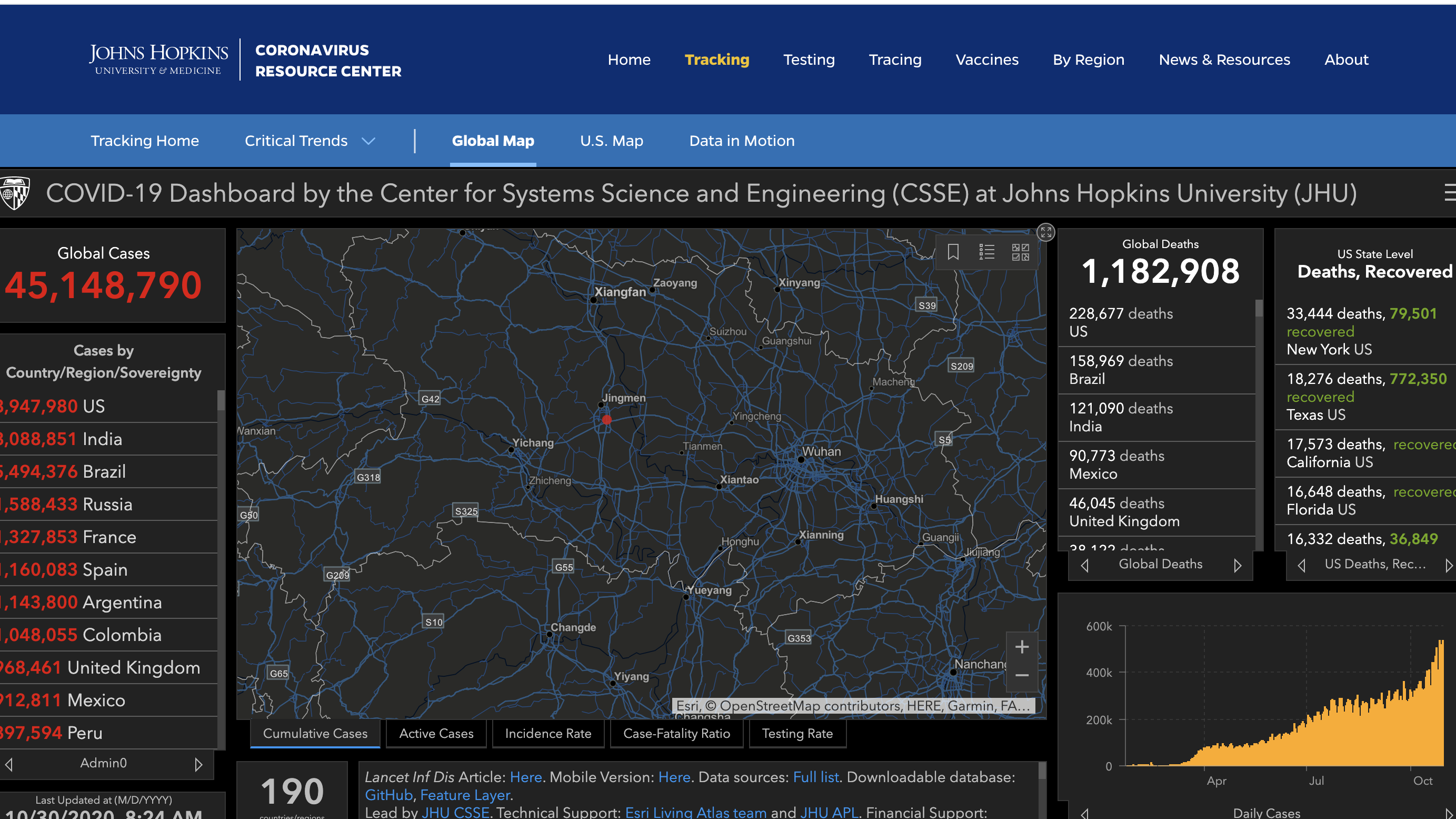
    As of today, according to Johns Hopkins Coronavirus Resource Center, the map shows no red dots indicating a hot spot for COVID-19. The nearest one is in Hubei, China with 68,139 cases and 4,512 deaths.

    A screenshot of the hot spot in Hubei, right next to a spotless Wuhan /Source: Johns Hopkins Coronavirus Resource Center

    During the month of October, a reporter from CGTN by the name of Zhou Minxi returned to Wuhan, their home city for the holidays. In an article for the news source, Minxi recounted the events that started in January when the city was sealed off from the rest of China.

    Going back to Wuhan on a train, Minxi saw that traveling precautions were only intended for foreign travelers, as there was “a loudspeaker asking foreign nationals to produce their nucleic acid test results upon arrival,” recounted Minxi.

    “From that moment, it is clear that for the people in Wuhan, the only risks now come from outside China.” Minxi explained the ways Wuhan came to revitalize themselves, by testing 10 million people in two weeks and “bringing back peace of mind” to the citizens there. 

    Now, Wuhan is living in ways that most people miss, enjoying freedom and even throwing parties. BBC News reported in August that the Wuhan Maya Beach Water Park had gone viral, as many partygoers were seen packed in pools or on bright orange floaties.

    The packed pools in Wuhan’s Maya Beach Water Park /Source: Getty Images

    “It’s not a very 2020 image,” writes the BBC, as during those times, Europe and North America were experiencing troubling times with cases sky-rocketing. 

    An article from Bloomberg mentions the current party scene in Wuhan. Several signs warn that people should be wearing masks and staying distant, but now no one follows those rules. 

    The source explained, “No one sees the need. Wuhan has had just four confirmed cases of the novel coronavirus since May, when the city tested its entire population in the space of two weeks.”

    Bloomberg explains that Wuhan sets an example for a “New China,” as the city now symbolizes “relative economic freedom but intense controls on speech” as President Xi Jinping wants to control the narrative and redefine the city. Bloomberg also mentions that people are scared of losing their jobs speaking against this control.

    In February, Wuhan built two hospitals in two weeks to isolate coronavirus patients, an impressive feat that set an example to the world. These were called “instant hospitals,” as around 40+ makeshift hospitals were built in Wuhan to treat the patients.

    As of March 2020, the curve of infected persons in Wuhan slowed and as most patients were treated, the hospitals were “sealed off and retired” as reported by NPR. The remaining patients were sent to the general hospitals to be treated.

    The construction of these hospitals has said to be cost-effective and that “no one besides China has the resources or cost-effective labor to follow suit” said Raymond Pan, a design principal at HMC Architects who was interviewed by NPR.

    As of today, the U.S election will decide on the next president, yet COVID-19 is still continuing to spread at record-breaking rates

    With Wuhan setting an example for disrupting the spread of the coronavirus, the U.S public is currently awaiting a vaccine in the future.       

  • A beginner’s guide to WitchTok

    A beginner’s guide to WitchTok

    By Mihaela Manova

    Season’s greetings to the new aesthetic of the October season: everything pumpkin, scary and  (unsurprisingly) deeply orange. To contribute to the feel of fall, I felt like I should join the many people celebrating this season despite my longing to have a summer do-over.

    Over the summer, The Cut wrote a story about amateur witches hexing the moon, an article that not only spiked the interest of many people, but introduced another side of the entertainment app TikTok.

    “WitchTok,” a separate section of the app, is an expanding cohort of experienced and baby witches, another name for the beginners who practice the craft.

    The rumor of the moon being hexed stemmed from a Twitter thread of more than 30 tweets from the user @heyyadoraa. More than 40,000 people retweeted the thread with the rumor gaining momentum and warning that the Sun could be next too.

    Having a developing interest in WitchTok, I dove into learning about the subject. In this age, a simple Google search can lead to becoming anyone you want, and I felt like going “undercover” in this witchy community.

    The first thing I’ve discovered is that one should know the difference between Voodoo and witchcraft. The Merriam-Webster Dictionary states that Voodoo is derived from Africa and is  chiefly practiced in Haiti.

    On the contrary to someone associating the religion with Voodoo dolls, according to the HuffPost this religion is not a cult and does not practice devil worship or black magic.

    Instead, members of WitchTok advise others not to mess with ancient Voodoo spirits due to possible endangerment.

    Witchcraft, on the other hand, has many different pathways that one can explore. The top two terms that often stem from the term witchcraft are Paganism and Wicca.

    Paganism is an umbrella term for a spiritual belief outside of mainstream organized religions (Christianity, Islam, Buddhism, etc.) which mainly focuses on nature.

    According to Britannica, Wicca was created by Gerald Brosseau Gardner, who “founded a new movement based on a reverence of nature, the practice of magic, and the worship of a female deity (the Goddess) and numerous associated deities (such as the Horned God).”

    Not every practicing witch agrees with the information from WitchTok. There are many YouTube videos disproving advice with the most common being the terms deity, hexing and the Fae.

    A deity is a supernatural being, like a god or goddess, who is worshipped by followers of a certain religion or belief. Being “hexed” often refers to a spell that is cast on someone to give them misfortune.

    The Fae, otherwise known as the mythical creatures faeries, resemble an orb of light according to Amino, a discussion app. Comments on WitchTok have different answers to describing the fae, as one user under the name @rhearogue says, “ [They are] Celtic folklore forest creatures. They want to eat you, not befriend you.”

    After getting to know the common vocabulary of this community, I began to research the type of content that is made on WitchTok.

    My search began after clicking the hashtag #WitchTok on the app. Dozens of videos popped up, explaining and showcasing the powers these users have. These videos do not reside solely on TikTok, as users on YouTube create compilations of the best WitchToks.

    As many viewers are beginners to the craft, critics from the community often warn others about misrepresentation, bad usage of the craft and ignorance on certain topics. Comments under the most popular WitchTok compilation warn other beginner witches about the topics presented.

    One YouTube user, named “Lavender moon magick,” commented under the compilation, “Just to put this out there but be careful getting information about witchcraft from TikTok, some of these have misinformation in them.”

    As a certain video was part of the compilation, user “unknown boi,” said, “Don’t listen to the one telling you to use crystal and herbs instead of therapy!! If you are going to therapy continue, if you need therapy please go!!!”

    The most common videos showcase witches sharing spells and tips on how to execute them. To practice a spell, you apparently need to focus and clear your head, set an intention and then perform the spell that you desire.

    Stumbling upon other similar content, I learned pendulum readings are one of the more popular types of videos. During a pendulum reading, a crystal strung on a cord hangs over a circular disk with the sides marked yes, no, maybe and rephrase.

    Similar to getting answers from a Magic 8-Ball, pendulum readings can tell a person’s future or confirm something in the present. The crystal begins swinging fast toward the answer that it has chosen for you.

    After every video I watched, the comments underneath usually prompted various responses. One of which was the increasing amount of Christians advising the witches to repent their practice.

    Many of these witches are trying to fight against the stigma that the community faces, arguing that there are different sides to their magic, who they communicate with and the kind of spells they practice.

    Observing this witchy community from an outsider perspective, I learned there’s more to WitchTok than what meets the (newt’s) eye.

    manovamd@miamioh.edu

    (This post was originally published to The Miami Student)

  • Versace Spring 2021: Diversity, CGI and Starfish

    Versace Spring 2021: Diversity, CGI and Starfish

    By Mihaela Manova

    In a time of empty seats and face masks, a schedule of runway livestreams awaited the fashion fan as well as the front row regular.

    As in-person fashion shows were excluded from New York and London Fashion Week, Milan presented something new, residing in Versace’s new collection.

    Livestreamed with an audience of only staff members, Donatella Versace presented her new ready-to-wear collection with a nostalgic and electric underwater theme. “Versacepolis,” as introduced by Donatella on Youtube, focuses on the banishment of Medusa by Athena and in turn creates a new world for the Gorgon.

    “I wanted to create something disruptive, something that could be in tune with what has changed inside all of us,” said Versace in the description of her show. “To me that meant dreaming of a new world in which we can all coexist peacefully.”

    A writer for Women’s Wear Daily wrote that Versace’s inspiration was “out of yearning for nature, escape, and fantasy.”

    This collection featured a modern twist on one of their previous collections from the 90s, the Tresor De la Mer collection, with bursts of green, orange and blue neons alongside muted shades of pale pink.

    This show also saw Versace reveal a major change in casting diversity, with a group of models with a broad range of ethnic backgrounds, as well as three “plus-size” models. Viewers were pleasantly surprised to see models of color be represented, not just sporadically placed.

    Ellie Krug, president of Miami University’s Fashion & Design club (MUF&D), weighed in on the subject.

    “I think the fashion industry is making great strides when it comes to the diversification of their models and the people they represent on the runway and in print,” she said. “I think we have a long way to go, but I believe the industry is definitely heading in the right direction.”

    Donning the Versace pieces, curvy models Alva Claire, Precious Lee and Jill Kortleve were praised by many for leading the way in diverse sizing.

    “I think it is important for designers and companies to represent everybody in their advertising and in their runway shows,” Krug said. “I would love to see a more diverse variation of height, size, skin color, hair color and ethnicity on the runway, and I have faith that we will be seeing all of those things in the near future.”

    This ready-to-wear collection was presented on a runway lightly dusted with sand, while Greek columns and statues made up the background of a sunken Versacepolis.

    Heavily influenced by marine aesthetics, a variety of sea creatures appeared throughout the collection. Either printed on clothing or featured by brooches, starfish took the lead and tiny sea turtle accents could also be found on necklaces.

    The bedazzled clamshell bustiers were the focus of the night, appearing in various blues, neon multicolor — even a sunset-like gradient.

    Pinstripe suits also made an appearance. The opening look worn by Mica Arganaraz featured an oversized blazer, while Sacha Quenby’s look incorporated pinstripe bottoms with a subtle hip cutout.

    The “star” look of the show featured an embellished starfish gown, worn by supermodel Irina Shayk.

    Both the female and male models looked as if they had just emerged from the ocean, with drenched hair clinging to glistening faces. The women’s makeup varied from glowy and neutral, to bold and eccentric, varying in shades of electric pink, orange and red on the lips.

    Alongside the fashion, a new member of the Versace family was introduced. Video content featuring a computer generated image (CGI) of an octopus named Churro appeared on the Twitter feeds of fashion fans, “sliding” across the roads and rushing to enter the show.

    Many viewers were wondering why the octopus was introduced at the end of the runway show, when Churro popped up from the sand and glided across the runway, closing Versace’s collection.

    As CGI was newly introduced into the fashion industry, most designers have not taken the leap to include it in a show. In 2018, CGI influencer Noonoouri starred in a Dior Beauty Campaign, prompting the brand’s followers to call the collaboration “absurd.”

    On the contrary, Krug thinks the Versace octopus is an innovative idea.

    “I think this CGI octopus is the coolest thing ever, and I have never seen anything like it,” she says. “I love that technology like this is being introduced to the industry, and I think it will open a lot of doors for future innovation and interaction.”

    Similarly, members of Twitter’s high fashion community expressed mixed reactions. User @DECOUTURIZE tweets, “can’t stop thinking about the Versace octopus,” while @modavitalita writes, “I feel personally attacked by the Versace octopus.”

    In the end, as the last livestreams of fashion month approach, viewers wonder what surprises the next season will bring. Besides awaiting new pieces to be unveiled by their favorite designers, viewers will also be awaiting more diversity and representation on the runway.

    With that said, as this fashion month comes to a close, a new age of inclusion and innovation begins.

    manovamd@miamioh.edu

    (This story was originally published to The Miami Student

  • Amy Coney Barrett refuses to tell Kamala Harris if she thinks climate change is happening/ Covering Climate Now

    Amy Coney Barrett refuses to tell Kamala Harris if she thinks climate change is happening/ Covering Climate Now

    Loveland Magazine is one of the 400 news outlets worldwide, with a combined audience of over 2 billion people “Covering Climate Now”, a global journalism initiative committed to bringing more and better coverage to the defining story of our time.
    The initiative, was co-founded by The Nation and Columbia Journalism Review

    Mihaela Manova is “Covering Climate Now” in Loveland, Ohio as an editor for Loveland Magazine

    In today’s Covering Climate Now article, Supreme court nominee Amy Coney Barrett chose not to answer questions about the topic of climate change. Article is written by Guardian staff and agency for The Guardian.

    Supreme court nominee accuses Democratic senator of soliciting an opinion ‘on a very contentious matter of public debate’

    Supreme court nominee Amy Coney Barrett refused to say whether she accepts the science of climate change, under questioning from Kamala Harris, saying she lacked the expertise to know for sure and calling it a topic too controversial to get into.

    On Wednesday, Barrett framed acknowledgment of a manmade climate crisis as a matter of policy, not science, when she was pressed at her confirmation hearing by Democratic senator from California.

    Barrett said Harris, the Democrats’ vice-presidential nominee as well as a member of the Senate judiciary committee, was trying to get her to state an opinion “on a very contentious matter of public debate, and I will not do that”.

    The federal appeals court judge responded that she did think coronavirus was infectious and smoking caused cancer. She rebuffed Harris on the climate change question, however, for seeking to “solicit an opinion” on a “matter of public policy, especially one that is politically controversial”.

    The exchange occurred during the committee’s hearing on Barrett’s nomination to replace the late Justice Ruth Bader Ginsburg on the supreme court.

    Scientists say climate change is a matter of established fact and that the damage is mostly caused by people burning oil, gas and coal. Climate experts, including federal scientists in the Trump administration, say increasingly fierce wildfires, hurricanes and other natural disasters point to the urgency of global warming.

    When Harris asked Barrett “is climate change happening?” Barrett responded: “I will not answer that because it is contentious.”

    Harris later tweeted: “Amy Coney Barrett will admit that Covid-19 is infectious. She’ll admit that smoking causes cancer. But whether climate change is real? Apparently that’s up for debate.”

    Donald Trump, an ardent booster of the coal, oil and and gas industries, routinely questions and mocks the science of climate change, while Democratic rival Joe Biden is proposing a $2tn plan to wean Americans off fossil fuels to tackle the climate crisis.

    The Trump administration has rolled back major Obama-era efforts to reduce fossil fuel emissions from cars and trucks and power plants. Many of the administration’s environmental and public health rollbacks are likely to wind up before the supreme court.

    On Tuesday, Senator John Kennedy, a Louisiana Republican and another member of the committee considering Barrett’s confirmation, also asked Barrett what she thought about a series of issues, including climate change.

    “I’ve read about climate change,” Barrett answered.

    “And you have some opinions on climate change that you’ve thought about?” Kennedy asked.

    “I’m certainly not a scientist,” Barrett replied, using a frequent refrain of more conservative Republicans on the matter. “I would not say that I have firm views on it.”

  • EPA Grants Oklahoma Control Over Tribal Lands / Covering Climate Now

    EPA Grants Oklahoma Control Over Tribal Lands / Covering Climate Now

    Loveland Magazine is one of the 400 news outlets worldwide, with a combined audience of over 2 billion people “Covering Climate Now”, a global journalism initiative committed to bringing more and better coverage to the defining story of our time.
    The initiative, was co-founded by The Nation and Columbia Journalism Review

    Mihaela Manova is “Covering Climate Now” in Loveland, Ohio as an editor for Loveland Magazine

    In today’s Covering Climate Now post, the Environmental Protection Agency has given Oklahoma authority over tribal lands on the basis of environmental issues. The article was written by Ti-Hua Chang for TYT.

    Agency Decision Reverses Tribal Sovereignty That Was Recognized in Landmark Supreme Court Ruling

    The Environmental Protection Agency (EPA) has granted the state of Oklahoma regulatory control over environmental issues on nearly all tribal lands there, TYT has learned. This strips from 38 tribes in Oklahoma their sovereignty over environmental issues. It also establishes a legal and administrative pathway to potential environmental abuses on tribal land, including dumping hazardous chemicals like carcinogenic PCBs and petroleum spills, with no legal recourse by the tribes, according to a former high-level official of the EPA.

    This also includes hazardous chemicals that are byproducts of petroleum procurement and refining. In 2019, Oklahoma had the fourth largest petroleum industry in the US.

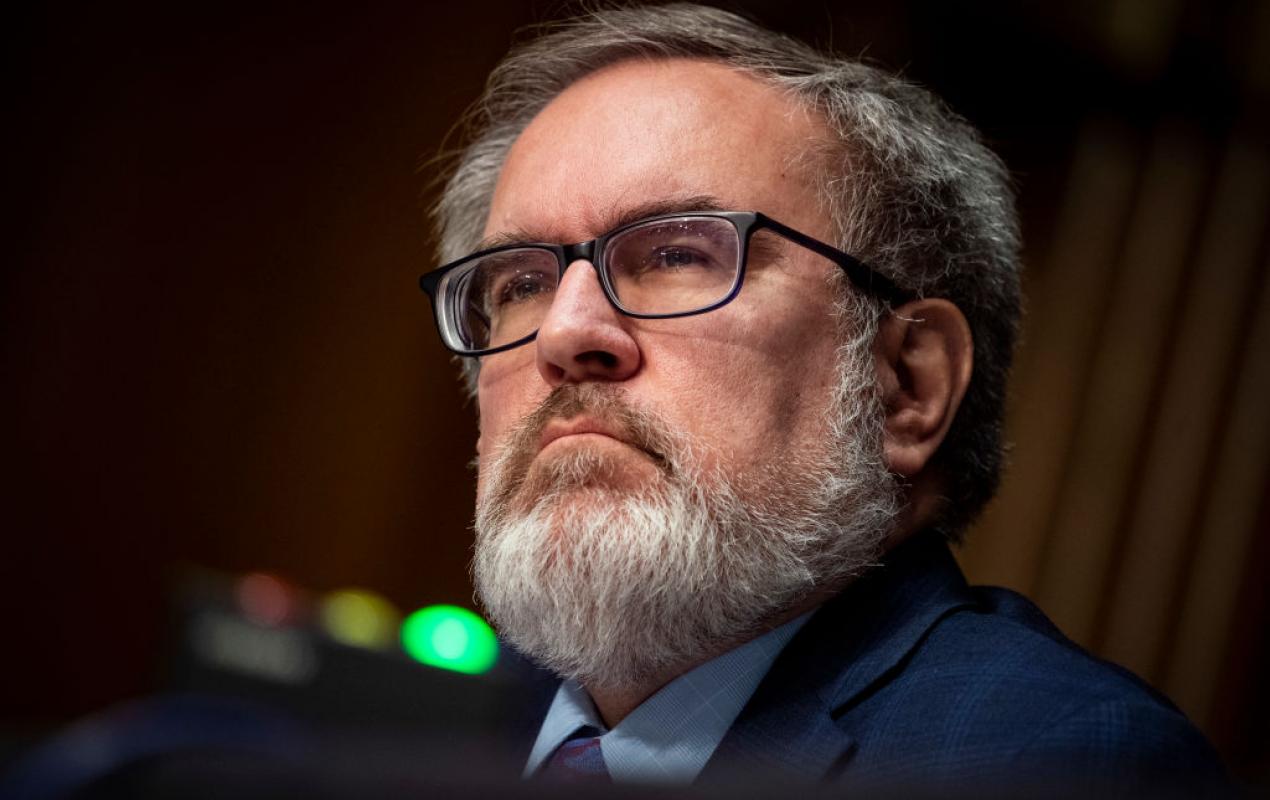
    TYT has obtained a copy of the letter EPA Administrator Andrew Wheeler sent to Gov. J. Kevin Stitt (R-OK) on October 1. The end of the opening paragraph states simply, “EPA hereby approves Oklahoma’s request.”

    DOCUMENT: EPA Administrator Wheeler’s letter on tribal sovereignty in Oklahoma

    YT previously revealed that on July 22, Stitt requested control of environmental regulations on tribal land involving a wide range of issues. All of Stitt’s requests in his letter were granted by the EPA. They include:

    • Hazardous waste dumping on tribal lands which could be any of the hundreds of hazardous chemicals listed by the EPA, including formaldehyde, mercury, lead, asbestos, toxic air pollutants, per- and polyfluoroalkyl substances (PFAS), pesticide chemicals, glyphosate, and polychlorinated biphenyls (PCBs).
    • Underground Injection Control, an EPA program used to permit fracking. Fracking uses large amounts of high-pressured water to remove oil and gas from shale rock. It is a contributor to climate change and is known to leave behind contaminated water and toxic pollution.
    • Protecting large agricultural polluters in industrial-sized livestock operations, most often dairy cows, hogs or chickens. These mega farms produce enormous amounts of waste, according to the Sierra Club, which estimates that “the quantity of urine and feces from even the smallest CAFO [Concentrated Animal Feeding Operation] is equivalent to the urine and feces produced by 16,000 humans.” In his letter, Wheeler acknowledges that the U.S. Supreme Court decision McGirt v. Oklahoma precipitated this EPA action. The McGirtruling found that, by treaty, much of eastern Oklahoma is still Native American territory, which could mean under five tribes’ jurisdiction including for taxation and regulation. In anticipation of the decision, the Seminole tribe in 2018 issued an eight percent tax on oil and gas wells on its reservation land.

    The EPA has now granted the State of Oklahoma the same authority it had before McGirt on environmental issues, especially on petroleum. It can do this because federal legislation can nullify Supreme Court rulings. In 2005, a midnight rider attached to a transportation bill took away environmental regulatory control by Oklahoma tribes if requested by the state as it has now done. The Oklahoma state government is pro-fossil fuel and pro-big agribusiness.

    This return to previous pro-fossil fuel regulations may be one factor in the multi-billion dollar merger of Oklahoma’s Devon Energy with WPX Energy.
    As previously reported by TYT, the Petroleum Alliance of Oklahoma knew about Governor Stitt’s letter to the EPA on July 22, the day it was sent. This was close to one month before the tribal governments were told.

    The EPA action infuriated Oklahoma’s Ponca Tribe. Casey Camp-Horinek, Environmental Ambassador & Elder & Hereditary Drumkeeper Ponca Tribe of Oklahoma, provided the following statement to TYT:

    “After over 500 years of oppression, lies, genocide, ecocide, and broken treaties, we should have expected the EPA ruling in favor of racist Governor Stitt of Oklahoma, yet it still stings. Under the Trump administration, destroying all environmental protection has been ramped up to give the fossil fuel industry life support as it takes its last dying breath. Who suffers the results? Everyone and everything! Who benefits? Trump and his cronies, climate change deniers like Governor Stitt, Senators Inhofe and Langford, who are financially supported by big oil and gas. I am convinced that we must fight back against this underhanded ruling. In the courts, on the frontlines and in the international courts, LIFE itself is at stake.”

    SUMMARY REPORT TO TRIBES

    TYT also obtained the EPA Summary Report sent Sept. 29 to Oklhaoma’s tribes. In it, the EPA writes that the agency will keep Oklahoma’s environmental actions within federal law. But this is the same EPA that has rolled back 100 of the agency’s previous regulations protecting the environment and has pushed for a rule which would bar the agency from relying on scientific studies that have granted confidentiality to the people tested.

    DOCUMENT: EPA Summary Report on Oklahoma Regulatory Control

    In a seminar Sept. 21 at the American Enterprise Institute, a conservative think-tank funded by fossil fuel companies, Wheeler concluded that he had fulfilled President Trump’s requests to him. Wheeler said, “[Trump] asked me to continue to clean up the air, continue to clean up the water and continue to deregulate and help create more jobs…”

    The EPA not only granted all of Oklahoma’s requests, it added additional ones such as regulatory control over underground storage (the state has one of the largest oil storage facilities in the country), air pollution, pesticides, lead-based paints, and asbestos in schools.

    The EPA Summary report says it consulted with 13 Oklahoma tribes in September. The report says that all the tribes questioned the limited consultation and short time of it, saying, “Comments submitted state that the length of the consultation period was too short, that the consultation should have been extended to tribes beyond Oklahoma…”

    The EPA report also acknowledged that the Oklahoma tribes said the agency’s decision was contrary to the principles contained within the EPA Policy for the Administration of Environmental Programs on Indian Reservations (1984 Indian Policy). That policy requires a government-to-government negotiation.

    The summary report concluded, “However, EPA is also bound to apply the clear and express mandate of Section 10211(a) of SAFETEA, a duly enacted Act of Congress, that specifically allows environmental regulation under EPA administered statutes by the State in areas of Indian country, and that requires EPA to approve a request of the State to so regulate notwithstanding any other provision of law…” Section 10211 (a), the federal law giving Oklahoma the legal right to take over environmental regulations on Tribal land, is a mere two-paragraph rider on page 795 of the 836-page SAFETEA transportation bill. In 2005, this midnight rider was maneuvered into this massive transportation bill by Sen. James Inhofe (R-OK). Inhofe is a staunch fossil fuel advocate and climate-change denier. EPA Administrator Andrew Wheeler worked for Inhofe for 14 years.

    FORMER HIGH-LEVEL EPA OFFICIAL NOTES EPA CHOSE NOT TO HAVE DISCRETION

    The former high-level official worked in the EPA’s office of general counsel. The former official told TYT, “EPA overstates when it claims ‘[t]he statute provides EPA no discretion to weigh additional factors in rendering its decision.’ The statute says that Oklahoma need not make any further demonstration of authority than it already did when it sought approval from EPA to administer the same programs elsewhere in the state. But the position EPA takes in the letter — that it lacks discretion entirely — departs from earlier statements made by EPA in Oklahoma Dept. of Environmental Quality v. EPA, where it interpreted SAETEA as still allowing it to attach conditions to its approval of Oklahoma programs implemented in Indian Country.”

    WHO BENEFITS FROM EPA DECISION?

    Who will benefit from the state of Oklahoma taking over environmental regulations on tribal lands there? Fossil fuel companies, big agriculture, and livestock companies. This is based on what a former high-level EPA official said after reviewing Governor Stitt’s letter to the EPA requesting jurisdiction.

    As for the future of Oklahoma’s environmental control, the EPA Summary Report includes one paragraph that suggests a pro-environment president and Congress could have impact, but only if new federal legislation is passed:

    “EPA has found no evidence, nor has any been provided by tribes, that indicates section 10211 has sunset and is therefore no longer valid. Should Congress elect to repeal this provision after EPA approves the State’s request, EPA would address any effect on its approval of the State’s request at that time.”

    THE NEXT MOVE?

    U.S. Attorney General William Barr has now joined other Republican officials trying to nullify the McGirt v. Oklahoma ruling that much of the eastern portion of the state is tribal land. The Associated Press and a local Cherokee Radio station report that during a Sept. 30 visit to the Cherokee Nation headquarters, Barr said that he is working with Oklahoma’s federal congressional delegation to devise a “legislative approach” to address the McGirt decision. Both Governor Stitt and Senator Inhofe have called for a federal “legislative solution.” 

    As TYT has reported, Stitt and Inhofe have pushed for federal legislation to take over not only environmental regulatory control of Tribal lands but all regulatory control, which would return Oklahoma back legally to pre-McGirt status.

    In six emails between the EPA’s public relations office and TYT, the agency has not denied the accuracy of TYT’s main points or the Wheeler letter and Summary Report.

    TYT Investigative Reporter Ti-Hua Chang is an award-winning journalist who has worked for CBS News and other outlets. You can find him on Twitter @TiHuaChang.

  • Sustainable fashion: the other side

    Sustainable fashion: the other side

    Loveland Magazine is one of the 400 news outlets worldwide, with a combined audience of over 2 billion people “Covering Climate Now”, a global journalism initiative committed to bringing more and better coverage to the defining story of our time.
    The initiative, was co-founded by The Nation and Columbia Journalism Review

    Mihaela Manova is “Covering Climate Now” in Loveland, Ohio as an editor for Loveland Magazine

    Part 3 of this series

    As much as we have talked about the need to better our habits into becoming more sustainable, we must acknowledge the other side. In the beginning, this article was going to suggest the brands and new materials that can replace unsustainable goods. But during this climate, we must acknowledge that not everyone has the luxury to shop sustainably.

    Read Part 1 – Your introduction to sustainable fashion/ Covering Climate Now

    Read Part 2 – The dark side of fast fashion/ Covering Climate Now


    Sustainability has grown more popular in the social media spheres as more consumers are pushing for a positive change in the environment and people’s working conditions.

    Take for example the 8.1 million photos on Instagram with the tag #sustainablefashion, videos on YouTube giving life hacks on the subject, and the 230 tweets written in the past hour with the hashtag, #Sustainability.

    This word has not only gained popularity online, but is pushing stores like Ikea in turning away from unsustainable practices and replacing them with more eco-friendly choices.

    But with the making of more sustainable and ethical products, prices seem to skyrocket in comparison to its fast fashion counterpart.

    Most often, sustainable clothing is made with quality materials and fair labor practices, thus giving more time to craft the garment. With having it ethically produced, the price escalates as the quantity of those garments becomes lower. Many shops order small batches and sell those, limiting the quantity of exports and making them more “limited edition.” 

    Even though sustainability is marketed as something that we must perfect and be 100% ready to switch all of our clothing and items for, that is actually far from the truth. As social media can be pressuring for this change of lifestyle, we must take it step by step. 

    Consequentelly, we must first begin with practices that will encourage sustainability, even with the items that we have at home.

    When it comes to our seasonal wardrobe one must first consider what they need and don’t need. Decluttering and donating to thrift stores seems like a given, yet we forget the other options.

    If you have younger siblings, cousins, family members, consider putting some stuff aside for them. Even giving away clothing to friends, or prom dresses to organizations like Cinderella’s Boutique can ease your wardrobe while still practicing sustainability.

    If you have clothes or designer items that you want to sell, consider making an account on apps like Depop, Poshmark, or making a separate Instagram account to sell your pieces to your friends.

    Any other things (accessories, jackets, etc.) you may feel like you want to give away, consider women/men’s shelters. Any extra gloves, hats, and jackets can help people in those shelters survive in the approaching chilling months.

    As this article marks an end to this series, we must remember that a single person can indeed contribute a lot to the environment regardless of where they live, who they are, or what they have. When individuals begin sustainable practices, they have the power to influence family members and friends to do the same, and make a greater impact in multiple numbers.

    So begin today, you have the power to make it happen.

    Master list of affordable and sustainable brands/stores:

    For the home:

    • Brandless – a company based no having brands for their products – at a cheap price, includes personal care and household items
    • Viva Terra – chic decor at reasonable prices, ranges from kitchen items to seasonal decor
    • Gardener’s Supply Company– a B-Corp company (balancing business and profit). They also give away 8% of their profit to support local organizations that focus on community gardening and farming.

    Clothing:

    Places to give away your clothes/things/services:

    Apps for selling your clothing/goods:


  • U.S., Chinese diplomats signal tricky road ahead for climate diplomacy / Covering Climate Now

    U.S., Chinese diplomats signal tricky road ahead for climate diplomacy / Covering Climate Now

    Loveland Magazine is one of the 400 news outlets worldwide, with a combined audience of over 2 billion people “Covering Climate Now”, a global journalism initiative committed to bringing more and better coverage to the defining story of our time.

    The initiative, was co-founded by The Nation and Columbia Journalism Review

    Mihaela Manova is “Covering Climate Now” in Loveland, Ohio as an editor for Loveland Magazine

    In today’s Covering Climate Now post, climate action is promised to begin in China this year, as the future of America’s decision to join them depends on who wins the election. Article written by Valerie Volcovici and David Stanway for Reuters.

    WASHINGTON/SHANGHAI (Reuters) – After several years of dismissing global action to fight climate change, U.S. leadership was formally challenged this week by China announcing bold new climate pledges.

    Former Vice President Joe Biden has pledged to reinvigorate U.S. climate leadership if he wins the Nov. 3 election against incumbent President Donald Trump.

    Re-establishing that leadership role, however, may not be so easy, according to U.S. and Chinese diplomats involved in past climate negotiations.

    The 2015 Paris Agreement hinged on a pact between China and the United States, the world’s two biggest emitters, to cooperate on climate action. Now, the United States under Trump is poised to exit the treaty on Nov. 4, the day after the election.

    And the once-careful negotiations between Washington and Beijing have unraveled to what experts say is the worst level in years. Under Trump, the United States has launched a trade war against China and blamed Beijing for the COVID-19 pandemic, while China has cracked down on pro-democracy protests in Hong Kong, imprisoned Uighurs in Xinjiang and escalated tensions in the South China Sea.

    This week, the situation got even trickier as China’s President Xi Jinping announced plans to be carbon neutral by 2060 and urged the world to step up to the challenge.

    Making global climate progress without reviving the U.S.-China relationship would be impossible, according to former U.S. climate envoy Todd Stern and other key figures behind the Paris agreement.

    China produces 29% of global emissions – more than the EU and United States combined. Taken together, the three regions account for just over half of global carbon dioxide emissions.

    Biden’s team would need to balance the forces of competition and cooperation with China, or else renewed climate cooperation won’t get off the ground, Stern said.

    “We will have to learn to manage a relationship marked by both competition and collaboration, working with allies to stand up against unacceptable Chinese behavior where necessary, while seeking to collaborate where we can and must,” he wrote in an essay for the Brookings Institution this month.

    TABLES TURNED

    In his speech at the U.N. General Assembly on Tuesday, Xi said China’s CO2 emissions would peak before 2030. His pledge for China to achieve carbon neutrality before 2060 also marked the country’s first commitment to a long-term target.

    The announcement amounted to a “framing of competition between the U.S. and China,” said Andrew Light, who served on the U.S. strategy team in U.N. climate negotiations under Obama.

    In effect, Xi set the agenda on future climate negotiations, getting ahead of pressure from a potential Biden presidency to rein its coal use and plans to build coal plants worldwide, Light said.

    Biden already has pledged that the United States will produce carbon-free electricity by 2035 and achieve net zero emissions across the economy by 2050. But his plans will require either executive action that can be challenged in court or legislation that would need to pass through Congress.

    Biden would also find the EU much more assertive on climate today, compared with during the Obama era, as the bloc has placed climate action at the center of its policy framework, pledging to impose a carbon border tax and to invest in clean technologies.

    If Trump wins the 2020 presidential election, China would take “advantage of the fact that the U.S. has been absent on this front” and “enhance its global positioning” around climate change, said Peter Kiernan, lead energy analyst at The Economist Intelligence Unit.

    TAKING POSITION

    Officially, China insists its position on climate negotiations will remain the same, regardless of who wins the election in the United States, and claims that re-engagement with the United States is not necessarily a priority.

    China’s top climate official, Li Gao, said in a Sept. 7 speech that while China would “proactively” and “unswervingly” fulfill its national commitments on climate change, global political complications were making things harder.

    “Under an accumulation of factors such as unilateralism, protectionism and the spread of the novel coronavirus, the handling of global climate change is facing more difficulties,” he said.

    The Biden campaign has said the United States under his leadership would seek to work with China again on climate change, but would push Beijing to curb exports of coal technology and reducing the carbon footprint of its Belt and Road Initiative – a massive infrastructure project that would stretch from East Asia to Europe.

    China has under construction hundreds of new coal plants and could build even more in the next five years.

    The country is also expected to rely on energy-intensive infrastructure projects to try to accelerate its post-COVID-19 economic recovery.

    Biden adviser John Kerry, former secretary of state and key player behind the Paris agreement, said that China’s buildout of coal domestically and abroad would negate any past progress on climate change.

    “That’s going to kill the efforts to deal with climate,” Kerry said earlier this month in a live-streamed discussion. This is why the United States needs to rebuild its climate partnership with China regardless of other disagreements, he argued.

    “We are going to have to reach out, build up, but also be absolutely firm about the things that we disagree with.”

    Cementing the U.S.-China bilateral agreement in 2014 took over four years of work and included the personal outreach of Stern, Kerry and Obama chief of staff John Podesta with their Chinese counterparts.

    That same level of outreach would need to happen quickly now, including “confidence building measures” to help ease the “strong forces of nationalism in both countries,” said David Sandalow, former under Secretary of Energy under Obama and China expert at Columbia’s Global Energy Policy.

    Those measures could include reopening diplomacy in areas such as green finance, or partnerships on carbon capture technology, he said.

    That effort, even if difficult, is still possible if not essential, said Paul Bodnar, a State Department climate negotiator under Obama.

    In the first year of Obama’s administration, the U.S.-China relationship “wasn’t particularly rosy,” Bodnar noted. Other nations were also wary of U.S. climate leadership, after President George W. Bush withdrew the U.S. from an earlier global climate pact, the Kyoto Protocol.

    “It took us three years to dig ourselves out of the hole of distrust we found ourselves in,” Bodnar said.

    Still, he said, regardless of what else is going on in the U.S.-China relationship, they will have to find a way to work together.

    “The fate of the planet depends on it. There is no other option,” he said.

  • Kentucky’s climate is suffering. Can the state slip the industry ties that prevent change?/ Covering Climate Now

    Kentucky’s climate is suffering. Can the state slip the industry ties that prevent change?/ Covering Climate Now

    Loveland Magazine is one of the 400 news outlets worldwide, with a combined audience of over 2 billion people “Covering Climate Now”, a global journalism initiative committed to bringing more and better coverage to the defining story of our time.

    The initiative, was co-founded by The Nation and Columbia Journalism Review

    Mihaela Manova is “Covering Climate Now” in Loveland, Ohio as an editor for Loveland Magazine


    In today’s Covering Climate Now Post, climate change causes disruption in Kentucky’s agricultural sector as people are suffering its consequences. Article written by Andrew McCormick for The Guardian.

    Mitch McConnell has long resisted climate action even as the farm and coal sectors suffer, but a growing movement could bring change

    April 15. That’s the traditional frost-free date in Schochoh, the small community in south-central Kentucky, where Sam Halcomb and his family own and operate Walnut Grove Farms. Before then, the soft red winter wheat that Halcomb grows, which finds its way into McDonald’s biscuits and grocery store pancake mixes, is flowering and especially vulnerable to cold. The frost-free date is an estimate, based on years of experience. If you make it past that date, you’re likely to have a healthy harvest.

    This year, a freeze came on exactly April 15, with early morning temperatures dropping into the mid-20s Fahrenheit. “We were all smacking our heads, saying, ‘Ah, we almost made it’,” Halcomb said. Then, on May 9, another freeze hit.

    Two late freezes in one season was “completely unheard of,” said Halcomb, a sixth generation farmer. “In my whole life, I don’t remember ever having a freeze that late.” A typical wheat yield at Walnut Grove is 85 bushels per acre; this year, it was closer to 60. Halcomb’s losses totaled about $200,000.

    Kentucky’s climate is changing quickly. The Bluegrass State is the ninth most threatened state in the country by long-term climate change impacts, according to a recent study by SafeHome.org, based on data from Climate Central. That puts it ahead of even California, where wildfires recently have wreaked havoc. Erratic weather, exceptional heat, drought, wildfires and flooding all threaten Kentucky.

    There’s a growing environmental movement in the state, and more leaders than ever are speaking the language of sustainability. Coal industry ties run deep, however, and, for many, talk of change is anathema. The state legislature has mostly avoided the climate issue. And US Senate majority leader Mitch McConnell, by far the state’s best-known politician, has been a dedicated opponent of climate action in Washington.

    Kentucky is a microcosm of the nation’s climate dilemma: the effects of the climate crisis are clear here, but legacy interests and the forces of change are at an impasse. “There’s a lag between where we need to be and where we’re at right now,” said Lane Boldman, who directs the Kentucky Conservation Committee, a nonprofit environmental policy group. “And there really isn’t a lot of time.”


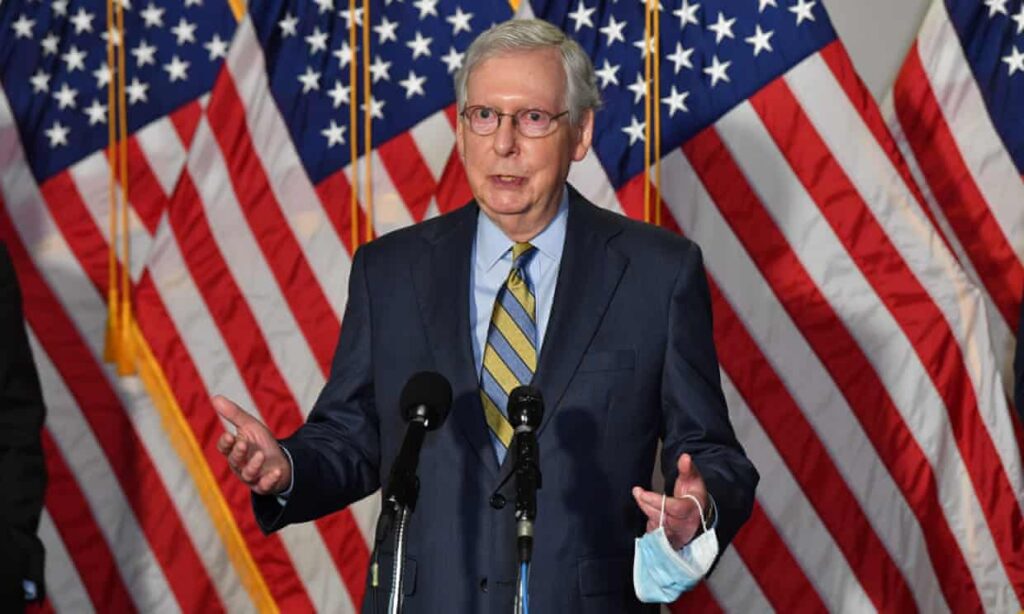
    Mitch McConnell, US Senate majority leader, has been a dedicated opponent of climate action. Photograph: Nicholas Kamm/AFP/Getty Images

    McConnell has accepted more than $3m from the coal, oil and gas industries over the course of his career. Critics say he’s returned the favor with handouts – tax breaks and regulatory cuts – to keep the dying industry aloft. In 2017, McConnell joined the Trump administration in urging America’s withdrawal from the Paris climate Agreement. In 2019, he engineered what he admitted was “a show vote” intended to kill the Green New Deal. As a campaigner, McConnell has framed efforts to reign in the coal industry as the meddling of a distant federal government out of touch with Kentuckians’ way of life.

    That’s not to say coal has been good to Kentuckians, of late. The coal industry employed some 38,000 Kentuckians when McConnell took office in 1985; it’s below 4,000 today. Workers in the mountainous eastern part of the state have found themselves laid off and uncompensated for their work by coal bosses. And deregulation has led to one of the worst black lungepidemics on record. Eastern Kentucky counties are among the poorest in the nation, with poverty rates around 40%. The water in some of those counties is either undrinkable or unaffordable.

    Meanwhile, McConnell sits on the Senate agriculture committee but has seemed indifferent to how climate change threatens Kentucky’s sizable agricultural sector.

    Three of the five wettest years on record in the state have been in the last decade, and this summer saw the most rain of any two-month period on record going back to 1895. More rain can boost crops, but in many parts of Kentucky rain now comes in unhelpful torrents. In both the eastern mountains and urban areas, excessive rain has contributed to severe and frequent flooding. In Louisville, this year, rain has turned neighborhoods into swamps and devastated businesses.

    The climate crisis is not the explicit nor the sole cause of all this rain. But the precipitation uptick is “very much consistent” with scientific projections for how climate change will play out in the state, Stuart Foster, Kentucky’s state climatologist, said.

    Many in the state remain unconvinced. According to a study this month by Yale and George Mason universities, Kentucky is one of only four states in the country where a majority of adults do not believe global warming is caused by humans.

    Similar apathy reigns in the state legislature, where Republicans hold a lock on both houses. The chair of the House Natural Resources and Energy committee, Jim Gooch, for example, told Louisville’s WFPL radio station recently that the science on climate change remains unsettled. Other legislators seem still beholden to the coal industry, reform advocates say, and to utility companies.

    Charles Booker’s campaign for the Senate gained national attention as he rejected divisions between urban and rural voters. Photograph: Bryan Woolston/Reuters

    Charles Booker, who narrowly lost the state’s Democratic primary for US Senate to Amy McGrath, championed environmental justice and the Green New Deal. Booker, who is Black and hails from impoverished West Louisville, rejected stereotypical divisions between urban and rural voters. Kentuckians everywhere, he said, had suffered badly from environmental neglect, and he promised a just economic transition for parts of the state historically reliant on coal. “From the hood to the holler,” went one Booker slogan.

    Booker’s campaign captured national attention; and the fact that an unabashed climate advocate came as close as he did to facing off against McConnell this November could signal that Kentucky is ready to get serious on climate.

    McGrath trails McConnell in the polls – but not by so much, state politicos say, that she should be counted out. A retired Marine fighter pilot, McGrath calls climate change “intricately tied to our national security”, a position that syncs with the US defense department. Another early line of attack by McGrath focused on the health crisis in eastern Kentucky; “Mitch McConnell left our coal miners behind years ago,” she accused in one ad. Booker, for his part, has thrown his support behind McGrath.

    Local races also suggest that environmental politics may be shifting in Kentucky. Sarah Lynn Cunningham, director of the Kentucky chapter of the Sierra Club, was struck this spring when a Republican running for state Senate in a competitive district near Louisville sought the group’s endorsement. The candidate was knowledgeable, she said, and expressed concern that many of his fellow Republicans lagged on the environment. “I’ve never had a Republican say they would like to compete for our endorsement,” Cunningham said. “That was a first.” (In the end, the Sierra Club endorsed the Democrat, who won, flipping a seat held by Republicans since 1995.)

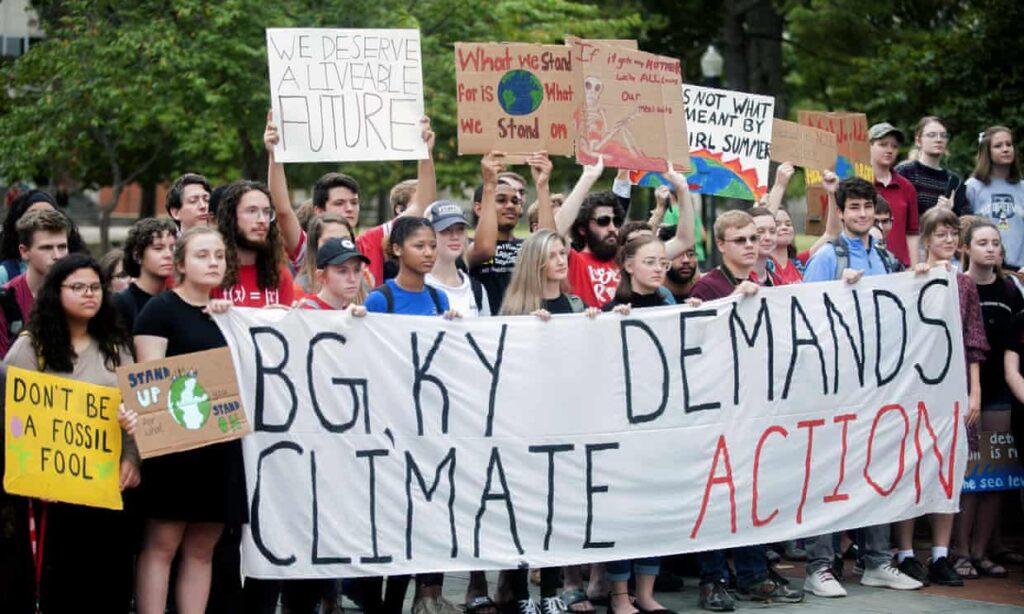
    Western Kentucky University students participate in a climate strike in Bowling Green, Kentucky. Photograph: Bac Totrong/AP

    Stephen Voss, an expert in elections and voter behavior at the University of Kentucky, doubts climate will prove central in this fall’s outcome. Based on his assessment of how environmental issues resonate in Kentucky, however, he suggested that McGrath could profit by framing climate as a matter of community health, economic durability, and jobs. “We’ve had nibbles at this approach,” he said. “But no one has successfully done it yet.”

    In a statement to the Guardian, McGrath did raise jobs and public health as areas where McConnell’s climate record has damaged Kentucky. McConnell, she said, is “failing us on climate, because he is beholden to special interests. If you want to bring jobs, we could get ahead of the curve and be an innovation leader.”

    “Our government’s first job is to keep Americans safe,” McGrath added. “And to do that, we need to prepare for climate change.”

    The McConnell campaign did not respond to requests for comment.

    Perhaps the biggest harbinger of change in Kentucky is the youth vote, with even young conservatives in the state worried about the climate crisis. The question, Voss said, is whether young people will show up to vote this fall.

    Fernanda Scharfenberger, an 18-year-old climate activist at Centre College in Danville, Kentucky, is optimistic on that front. Two years ago, when Scharfenberger was a junior in high school in Louisville, a boy from a nearby school died after he was swept into a storm pipe during a heavy rain. The death hit her social group like a shock wave. Scharfenberger went home that day and Googled climate. “As you can imagine,” she said, “it got pretty overwhelming pretty quickly.” She felt called to action.

    Fernanda Scharfenberger, 18, is a climate activist. Photograph: Andrew McCormick

    That December, Scharfenberger traveled with young people from across the country to Washington to lobby for a Green New Deal. All 50 states were represented but, with 75 young activists present, Kentucky’s was the largest delegation.