Loveland Magazine is one of the 400 news outlets worldwide, with a combined audience of over 2 billion people “Covering Climate Now”, a global journalism initiative committed to bringing more and better coverage to the defining story of our time.
The initiative, was co-founded by The Nation and Columbia Journalism Review
Mihaela Manova is “Covering Climate Now” in Loveland, Ohio as an editor for Loveland Magazine
In today’s Covering Climate Now post (written by Joseph Winters for Grist), Winters sheds light on journalism’s “bothsidesism” in an effort to distinguish the decline of acknowledgement and action for climate change in the media.
Ever wonder why Americans have been so slow to support climate action? A new study lays some of the blame on media bias —for 30 years, three of the country’s most influential sources of news gave too much credence to arguments that the world shouldn’t take decisive action to mitigate climate change.
“Opponents of climate action have been given an outsize opportunity to sway this debate,” said Rachel Wetts, the author of the study. Her results were published Monday in the Proceedings of the National Academy of Sciences.
Wetts analyzed 1,768 press releases from business, government, and social advocacy organizations from 1985 to 2013, categorizing them by their stance on climate action. She then ran the press releases through plagiarism detection software to see how often they were featured in the country’s largest-circulation newspapers: The New York Times, The Wall Street Journal, and USA Today.
She found that even though 10 percent of the press releases contained messaging against climate action — arguments like, “It would be too expensive to reduce greenhouse gas emissions” — 14 percent of them wound up in print. By contrast, the more prevalent press releases arguing for personal, corporate, or political action to tackle climate change were only covered 7 percent of the time. And the least-covered press releases came from groups with the most expertise on science and technology, such as the American Academy of Arts and Sciences and IBM.
Edward Mailbach, director of the George Mason University Center for Climate Change Communications, called these conclusions unsettling. “Rather than marginalize self-interested voices and give prominence to expert voices, these papers did just the opposite,” he said.
How to explain the results? Wetts said one reason for the imbalance might be tied to journalistic norms of objectivity, which reporters and editors often interpret as a need to give at least two sides to every story, no matter the science. She called this “false balance,” because it can put unsubstantiated opinions on the same footing as well-established facts. In the case of climate change, she said that the practice has lent legitimacy to those who deny climate change, leading readers to believe that denial is “more than a fringe stance.”
Previous research has suggested that this practice — also known as “bothsidesism” — began to decline in the mid-2000s. But Wetts’ analysis found no statistically significant change in coverage over the 30-year period of the study. She also said that the trend couldn’t be explained by excessive coverage of anti-climate press releases in the business-friendly Wall Street Journal. Claims that steps to curb carbon emissions would be too costly or undermine U.S. energy independence, for instance, also found favor in the liberal-leaning New York Times.
As climate denial falls out of fashion, what’s been called “climate delay” has taken some of its space. This is when people acknowledge the reality of climate change but seek to put off large-scale efforts to address it, sometimes redirecting responsibility for the climate crisis to consumers and emphasizing the downsides of urgent action.
Wetts scanned press releases for both climate denial and delay — anything that argued against climate action — regardless of whether they accepted the science.
“Maybe people are covering climate deniers somewhat less,” Wetts said, “but then they’re substituting in other conservative voices instead. They’re talking about people who are opposed to climate action for some other reason besides denying the science.”
Jennifer Marlon, a senior researcher at the Yale Program on Climate Change Communication, acknowledged that the media environment has changed since the mid-2010s — The New York Times in particular has ramped up its climate coverage — but she suspects that false balance continues to influence the national conversation. For instance, newspapers might be better at contextualizing opponents of climate action, explaining that their views are outside the mainstream. “But those arguments are still out there and are very much in play,” Marlon said.
Wetts called on researchers to investigate the effects of media skew on public policy. The messages amplified by the media “can dampen political will to act on climate change,” she said in a statement, “with potentially serious consequences for how we as a society address — or fail to address — this issue.”
Loveland Magazine is one of the 400 news outlets worldwide, with a combined audience of over 2 billion people “Covering Climate Now”, a global journalism initiative committed to bringing more and better coverage to the defining story of our time.
The initiative, was co-founded by The Nation and Columbia Journalism Review
Mihaela Manova is “Covering Climate Now” in Loveland, Ohio as an editor for Loveland Magazine
In today’s Covering Climate Now post, an article written for the Mongabay news website states that a new, ambitious conservation project for the Amazon Rainforest is on its way! Read here the article written by Shanna Hanbury.
The Science Panel for the Amazon (SPA), an ambitious cooperative project to bring together the existing scientific research on the Amazon biome, has been launched with the support of the United Nation’s Sustainable Development Solutions Network.
Modeled on the authoritative UN Intergovernmental Panel on Climate Change reports, the first Amazon report is planned for release in April 2021; that report will include an extensive section on Amazon conservation solutions and policy suggestions backed up by research findings.
The Science Panel for the Amazon consists of 150 experts — including climate, ecological, and social scientists; economists; indigenous leaders and political strategists — primarily from the Amazon countries
According to Carlos Nobre, one of the leading scientists on the project, the SPA’s reports will aim not only to curb deforestation, but to propose an ongoing economically feasible program to conserve the forest while advancing human development goals for the region, working in tandem with, and in support of, ecological systems.
Now, a group of 150 leading scientific and economic experts on the Amazon basin have taken it upon themselves to launch an ambitious conservation project. The newly founded Science Panel for the Amazon (SPA) aims to consolidate scientific research on the Amazon and propose solutions that will secure the region’s future — including the social and economic well-being of its thirty-five-million inhabitants.
“Never before has there been such a rigorous scientific evaluation on the Amazon,” said Carlos Nobre, the leading Amazon climatologist and one of the chairs of the Scientific Panel. The newly organized SPA, he adds, will model its work on the style of the authoritative reports produced by the UN Intergovernmental Panel on Climate Change (IPCC) in terms of academic diligence and the depth and breadth of analysis and recommendations.
The Amazon Panel, is funded by the United Nation’s Sustainable Development Solutions Network and supported by prominent political leaders, such as former Colombian President, Juan Manuel Santos and the elected leader of the Coordinator of Indigenous Organizations of the Amazon River Basin, José Gregorio Díaz Mirabal. The SPA plans to publish its first report by April 2021.
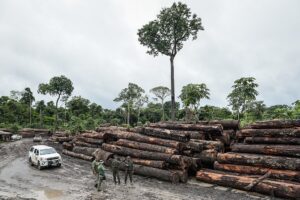
Timber illegally logged within an indigenous reserve seized by IBAMA, Brazil’s environmental agency, before the election of Jair Bolsonaro. Under the Bolsonaro administration, IBAMA has been largely defunded. Image courtesy of IBAMA.
Reversing the Amazon Tipping Point
Over the last five decades, the Amazon rainforest lost almost a fifth of its forest cover, putting the biome on the edge of a dangerous cliff. Studies show that if 3 to 8% more forest cover is lost, then deforestation combined with escalating climate change is likely to cause the Amazon ecosystem to collapse.
After this point is reached, the lush, biodiverse rainforest will receive too little precipitation to maintain itself and quickly shift from forest into a degraded savanna, causing enormous economic damage across the South American continent, and releasing vast amounts of forest-stored carbon to the atmosphere, further destabilizing the global climate.
Amazon researchers are now taking a proactive stance to prevent the Amazon Tipping Point: “Our message to political leaders is that there is no time to waste,” Nobre wrote in the SPA’s press release.
Amid escalating forest loss in the Amazon, propelled by the anti-environmentalist agenda of Brazilian President Jair Bolsonaro, experts fear that this year’s burning season, already underway, may exceed the August 2019 wildfires that shocked the world. Most Amazon basin fires are not natural in cause, but intentionally set, often by land grabbers invading indigenous territories and other conserved lands, and causing massive deforestation.
“We are burning our own money, resources and biodiversity — it makes no sense,” Sandra Hacon told Mongabay; she is a prominent biologist at the Brazilian biomedical Oswaldo Cruz Foundation and has studied the effects of Amazon forest fires on health. It is expected that air pollution caused by this year’s wildfire’s, when combined with COVID-19 symptoms, will cause severe respiratory impacts across the region.
Bolivian ecologist Marielos Penã-Claros, notes the far-reaching economic importance of the rainforest: “The deforestation of the Amazon also has a negative effect on the agricultural production of Uruguay or Paraguay, thousands of kilometers away.”
The climate tipping point, should it be passed, would negatively effect every major stakeholder in the Amazon, likely wrecking the agribusiness and energy production sectors — ironically, the sectors responsible for much of the devastation today.
“I hope to show evidence to the world of what is happening with land use in the Amazon and alert other governments, as well as state and municipal-level leadership. We have a big challenge ahead, but it’s completely necessary,” said Hacon.
Creating a workable blueprint for the sustainable future of the Amazon rainforest is no simple task. The solutions mapped out, according to the Amazon Panel’s scientists, will seek to not only prevent deforestation and curb global climate change, but to generate a new vision and action plan for the Amazon region and its residents — especially, fulfilling development goals via a sustainable standing-forest economy.
The SPA, Nobre says, will make a critical break with the purely technical approach of the United Nation’s IPCC, which banned policy prescriptions entirely from its reports. In practice, this has meant that while contributing scientists can show the impacts of fossil fuels on the atmosphere, they cannot recommend ending oil subsidies, for example. “We inverted this logic, and the third part of the [SPA] report will be entirely dedicated to searching for policy suggestions,” Nobre says. “We need the forest on its feet, the empowerment of the traditional peoples and solutions on how to reach development goals.”
Researchers across many academic fields (ranging from climate science and economics to history and meteorology) are collaborating on the SPA Panel, raising hopes that scientific consensus on the Amazon rainforest can be reached, and that conditions for research cooperation will greatly improve.
Indigenous Munduruku dancers in the Brazilian Amazon. The SPA intends to gather Amazon science and formulate socio-economic solutions in order to make sound recommendations to policymakers. Image by Mauricio Torres / Mongabay.
SPA participants hope that a thorough scientific analysis of the rainforest’s past, present and future will aid in the formulation of viable public policies designed to preserve the Amazon biome — hopefully leading to scientifically and economically informed political decisions by the governments of Amazonian nations.
“We are analyzing not only climate but biodiversity, human aspects and preservation beyond the climate issues,” Paulo Artaxo, an atmospheric physicist at the University of São Paulo, told Mongabay.
Due to the urgency of the COVID-19 pandemic, the initiative’s initial dates for a final report were pushed forward by several months, and a conference in China cancelled entirely. But the 150-strong team is vigorously pushing forward, and the first phase of the project — not publicly available — is expected to be completed by the end of the year.
The hope on the horizon is that a unified voice from the scientific community will trigger long-lasting positive changes in the Amazon rainforest. “More than ever, we need to hear the voices of the scientists to enable us to understand how to save the Amazon from wanton and unthinking destruction,” said Jeffrey Sachs, the director of the UN Sustainable Development Solutions Network, on the official launch website called The Amazon We Want.
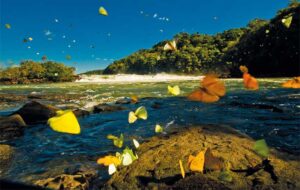
Banner image: Aerial photo of an Amazon tributary surrounded by rainforest. Image by Rhett A. Butler / Mongabay.
Mihaela Manova is a Loveland Magazine writer and is “Covering Climate Now” as an Editor for Loveland Magazine
By Mihaela Manova
I
n recent months, as advocacy towards a better future of equality skyrocketed, Instagram feeds exploded with links, pictures, and disgust towards the treatment of Black Americans in 2020, (the year of change in every way possible). While cheering on #BlackLivesMatter ( while of course donating/advocating/signing petitions) and the people involved in creating this new world, a topic within this movement has popped up repeatedly. And this topic is education. Education towards cultures, races, sexes, and especially the history of how some are born with privilege while others are not.
As an aspiring journalist who still has much to learn, I came across the Diversity Style Guide for journalists, an online dictionary with the intent to provide “accuracy, authority, and sensitivity” to complex topics that need to be covered. The themes included cover every parameter of race, sexuality, gender, immigration, etc. and are useful to journalists in being truthful and especially, cultured.
Here is what I learned.
“This is not a guide to being politically correct.”
What is The Diversity Style Guide?
To start off, this guide was developed as a project of the Center for Integration and Improvement of Journalism at the San Francisco State University. According to the website, it “brings together definitions and information from more than two dozen style guides, journalism organizations and other resources.” Historically, this resource was developed in the 1990s by CIIJ’s News Watch program which then paved the way for a newly updated one (this one).
Conglomerated into this one guide, its contents include terminology related to “race/ethnicity, disability, immigration, sexuality and gender identity, drugs and alcohol, and geography.” An exemplar here shows the structure of how the guide works, alongside a glossary for easy use.
(From top to bottom) The glossary organizes each topic in alphabetical order, with the terms and definitions placed in a “dictionary” type of style.
While easy to use, the guide does have its disclaimer. “This is not a guide to being politically correct. Rather, it offers guidance, context and nuance for media professionals struggling to write about people who are different from themselves and communities different from their own.” In other words, one definition cannot portray and explain a complex topic, but the definition itself will offer guidance for those who are writing about it. The actual meanings and definitions of each term are prepared in a way that are taken directly from a credible source, linking those sources at the bottom of each entry’s definition.
Led by Rachele Kanigel, this free resource is managed and monitored by a team of professionals who help with the writing and editing of all definitions.
Why we need it today.
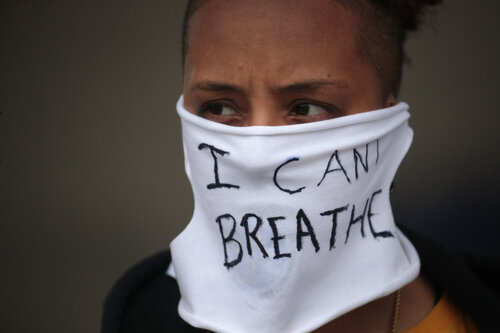
As of the past few weeks, people (both journalists and non-journalists) have scrambled to report on various news, most importantly the #BlackLivesMatter movement and the suppressed news stories that call justice for Elijah McClain and Breonna Taylor.
Posts were made for people to learn how to be proper allies, learn history and definitions of derogatory terms, to be told to stand up for Black Americans when you are in your place of privilege. Now, as a part of a needed, everlasting education on how we need to continue to stand together and fight for racial justice, we must open our minds and eyes to what is happening around us, even if it is not happening to us directly.
As an effort to continue the movement after the Instagram feeds turn back to selfies and beach photos, as journalists and people who provide commentary on the internet, we need to make an effort in understanding and spreading credible information pertaining to a person’s culture, race, sexuality, etc.
Good uses vs the bad
As a source like this can increase the right way to report people or events, there are two categories that companies, brands, or even publications fall under. Performative or genuine allyship to movements. Now, as this may seem more recent, a source like this online dictionary can define what Pride month is (for example), with then brands taking initiative to promote themselves in a genuine or fake manner.
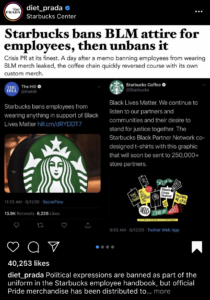
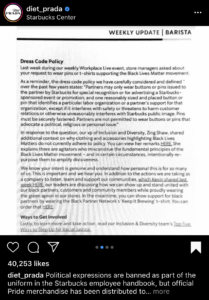
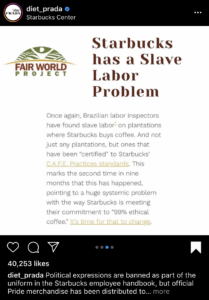
Take another example, a social media source under the name of DietPrada, exposing industry titan Starbucks for promoting #BlackLivesMatter after banning employees for wearing anything in support of that movement. In turn, social media users condemned them for their wishy-washy behavior when concerning this serious movement. In the same post, DietPrada reports of past misdeeds that the company has been practicing in an addition to the breaking news.
Here are their posts:
One of DietPrada’s posts, talking about the hypocrisy of industry titan Starbucks.
Details of Starbucks dress code policyThe past of Starbucks
From our own staff
Tying this back to our own local town, we as journalists need to practice education on behalf of the pieces that we write and especially about the events/people we portray. We have asked our Loveland Magazine Staff a couple questions about the use of this style guide and the need for better awareness on the internet.
David Miller, Editor in Chief, Loveland Magazine
David Miller
Q: During your years in the publication, have you witnessed an evolution of more knowledge from writers (about sensitive topics) in the publication?
DM: My entrance probably came when my daughters were in high school and I realized I wanted them to have the same opportunities as men. I also specifically remember my younger daughter taking runs on the Loveland Bike Trail, knowing she probably should not be running alone and thinking “boys” at this age were safe. But why not girls”? It was those kinds of things, those common ordinary everyday pleasures that “girls” were deprived of.
I began asking myself and others, “Why do we call adult women, girls? Why do adult women call themselves, girls?”
Words are so very important. I’ve tried to remove the word “girl” from our pages as much as possible when we should be saying “women” or “young women”. It’s never been about being politically correct, but about opportunity and making our community in many ways, safer and not diminishing accomplishments and potential.
In our sports writing especially I am moving along slowly but surely to remove diminishing language. I bristle when I hear the term “Lady Tigers” but never “Gentlemen Tigers.” For instance, when referring to the sport of soccer, the mostly male dominated industry of sports writing whether it come from media sources or the male dominated league or conference leadership, we would see references to Loveland Tigers when referencing the men’s team, but Lady Tigers when referencing the women’s team. It seems diminishing.
We have changed the language to simply Women’s Soccer and Men’s Soccer. When receiving press releases about team up-dates, why are the men’s teams always listed first? We started being intentional and made sure we were mixing the order. If we would see an announcement about “Most Valuable Players Announced,” we have to be aware of the male dominated industry will invariably list the male recipient first.
Appropriate wording is that someone died by suicide. I have intentionally used phrases or language that might help lessen the stigma of mental illness.
There has been much discussion about whether the w in White and the b in Black should be capitalized. Actually that very discussion last month from a trusted colleague led me to the Diversity Style Guide from the Center for Integration and Improvement of Journalism at San Francisco State University. That is why I asked the staff at Loveland Magazine to review it for possible adoption by our newspaper.
One’s internal, deeply held sense of one’s gender is what we will respect. We will use gender-neutral pronouns. I have never shied away from asking the direct question about a person’s preference when the occasion or need arises.
“For transgender people, their own internal gender identity does not match the sex they were assigned at birth. Most people have a gender identity of man or woman (or boy or girl). For some people, their gender identity does not fit neatly into one of those two choices. Unlike gender expression, gender identity is not visible to others. See gender expression.” – The Diversity Style Guide
Here are two other things I have learned along my journey. The word Gypsy (sometimes capitalized as a proper noun when referring to the ethnic group and sometimes spelled Gipsy) has negative connotations and many Romani people see it as a racial slur. In general, it’s best to use Romani or Roma people when referring to the ethnic group unless people self-identify as Gypsies. The term gyp, which means to cheat or swindle, likely comes from Gypsy and is seen as a negative stereotype of Roma as swindlers and thieves and will not be used in Loveland Magazine.
The “R” word has long been banned from Loveland Magazine.
We will use and allow terms such as mentally disabled, intellectually disabled, developmentally disabled. Likewise, words like “Libtard” which is a blend of the word liberal and this slur will never be allowed in Loveland Magazine.
Cassie Mattia, Writer and Associate Editor
Cassie Mattia
Q: With your experience in the world of journalism, does having knowledge of knowing terms that are specific to (gender, sexuality, race, etc), make a journalist different from the standard?
CM: In my personal experience as a journalist that has experienced this world on multiple platforms, I think having knowledge of what terms to use specifically in regards to gender, sexuality, and race is definitely an added bonus! I would say the standard for a journalist in this day and age is that they know and use the terms correctly. Quite often many journalists get scrutinized for not using the proper terms in regards to gender, sexuality, and race, but in my opinion, if they were never taught the correct terms how can they be held accountable for using the wrong language?
If the journalist is taught these correct terms earlier such as in high school, college, and post-college within their careers then I think we can hold that standard across the boards. I taught myself at a young age what the appropriate language to use is when speaking about gender, sexuality, and race, but if I hadn’t taught myself these things I may have at one time or another offended someone within my writing by accident.
In order to reach the standard of knowledge in regards to gender, sexuality, and race teachers, professors, and even parents need to start teaching the future journalists of the world early about the correct use of gender, sexuality, and race terms!
Often attention comes to celebrities and recent influencers whose dark pasts have been uncovered by various people. Twitter, for example, is notorious for digging old posts and matching them up with views that celebrities/influencers have had those years, ones who would include racial or homophobic slurs.
In most times, the digging results in unfavorable circumstances for both the individual and their fans, who for the most part are offended or disappointed at their favorite person. To look objectively on this issue, our newest writer, Claire Beseler, answered a couple of questions relating to this topic.
Claire Beseler, Writer
Q: In the current media cycle of influencers and celebrities being cancelled due to ignorance and past acts of racism, homophobia, etc. is it better for them to be forced to be educated or just resort to them being cancelled? What are our thoughts on “cancel” culture?
Claire Beseler
CB: It’s much better to educate someone for doing something wrong or offensive than to “cancel” them. Most of the time, people aren’t being offensive on purpose especially if someone is part of the majority and un-oppressed, they may not know what some people find offensive. Everyone is human and makes mistakes, and we as a generation using social media should not resort to calling people out in such an ugly way, but rather learn to forgive, educate, and forget. One example of this that I keep thinking about is when Kevin Hart was set to host the 2019 Oscars. Some homophobic tweets resurfaced from 2009 causing a lot of drama.
As a member of the LGBTQ+ community, I can take offense to some of those statements but the time gap can really justify some things. America and the world 10 years ago was so insanely different than now. Gay marriage was not even legalized yet and those types of jokes were “deemed ok” by most of society. The fact that people were trying to cancel him for things that were said a decade ago just isn’t right to me. He apologized, and the world should have just moved on and let him host the Oscars, but he was so beaten down and bullied that he dropped out.
People can change and forgiveness and lessons should be given out before such aggressive “cyber-cancelling.”
The one time I believe cancel culture is ok to use is when someone does something wrong, gets called out, but then continues to be offensive or do the wrong thing even after people educate them. But even before cancelling those kinds of people, comes respectful listening and trying to educate them instead of all jumping on this bandwagon of putting down others because they made a mistake.
Loveland Magazine is one of the 400 news outlets worldwide, with a combined audience of over 2 billion people “Covering Climate Now”, a global journalism initiative committed to bringing more and better coverage to the defining story of our time.
The initiative, was co-founded by The Nation and Columbia Journalism Review
Mihaela Manova is “Covering Climate Now” in Loveland, Ohio as an editor for Loveland Magazine
In today’s Covering Climate Now post, attention has been brought to the colossal heat wave affecting the Arctic, caused by the “increasing accumulation of greenhouse gases.” The full video and transcript has been brought to you by PBS News Hour.
By Judy Woodruff and William Brangham June 3, 2020
A
historic heat wave is occurring in the Arctic, already the fastest-warming place on Earth due to the increasing accumulation of greenhouse gases. Dr. Merritt Turetsky, director of the Institute of Arctic and Alpine Research at the University of Colorado Boulder, has studied the Arctic for decades. She joins William Brangham to discuss causes and consequences of the Arctic’s rising temperatures.
There’s a heat wave of historic proportions occurring in the Arctic right now, a region that is already the fastest warming place on Earth, due to the increasing buildup of greenhouse gases.
William Brangham talks with a scientist who’s worked in the region for decades.
William Brangham:
That’s right, Judy.
It is summer in the Arctic right now, so somewhat milder temperatures would be expected. But this heat wave, which has triggered huge wildfires in Siberia and increased melting of the permafrost, are likely the warmest temperatures ever recorded, and now are only going to make climate change worse.
Dr. Merritt Turetsky is the director of the Institute of Arctic and Alpine Research at the University of Colorado-Boulder. And she joins me from a cabin in Canada.
Dr. Turetsky, thank you very much for being here.
Merritt Turetsky:
Thank you.
William Brangham:
Can you just help us understand, what is going on in the Arctic right now? What is driving this intense heat wave?
Merritt Turetsky:
Let me start with an analogy.
So, when we come down with a fever, when our bodies spike a temperature, we stop, we realize that there’s a problem, and we provide care. And that’s exactly what’s happening today.
The Arctic is feverish, with temperatures spiking above 100 degrees Fahrenheit in multiple locations. So, these extreme temperatures are very unusual. They are record-breaking. But this is part of a longer-term trend.
In fact, last year, last summer was a very warm period in the Arctic, and Siberia and parts of Russia experienced the warmest winter on record. And it’s part of a trend that we anticipate will become more frequent in the Arctic because of climate change.
William Brangham:
And so I understand there’s also — there’s a high-pressure system, I guess, over the Arctic, which is making this particular issue.
But you’re saying that the longer-term trend of a warming atmosphere is really being felt in the Arctic very sharply.
Merritt Turetsky:
That’s exactly right.
So, this is part of a persistent warming trend. But, at the same time, the best tools that we have at our disposal in the scientific community, our climate models, predict more extreme conditions.
And this is true all around the world. We’re seeing more extreme conditions in storms, more extreme conditions in precipitation. And that’s the same in the arctic. We’re seeing more extreme temperature changes. And this is consistent with our predictions into the future.
William Brangham:
So, what are some of the impacts of that? I mean, for people who might look at this and think, I don’t live in the Arctic, the Arctic is very far away from me, what are some of the consequences of this warming trend in the Arctic?
Merritt Turetsky:
These Arctic changes will affect everyone on the globe, for a number of reasons.
The first is that, when the Arctic is warm, it changes weather patterns all around the world. The heat wave is triggering very rapid wildfires. And the Arctic is literally and figuratively on fire.
And this is likely to get worse as this heat wave continues through the summer. The emissions from those wildfires, of course, release greenhouse gases to the atmosphere. So, that affects climate of the entire planet through the greenhouse gas effect.
But the emissions from wildfires also affect air quality. These smoke plumes don’t stay in the Arctic. They drift globally with atmospheric circulation. Last summer, when the Arctic was set on fire because of warm conditions, smoke plumes reached the Western United States and affected air quality for millions of people.
So, these impacts in the Arctic are very strong locally. There are many people who live in the Arctic who depend on stable frozen ground. They, of course, are impacted.
William Brangham:
I mentioned also that there is the warming and melting of the permafrost.
For people who may not be familiar with what permafrost is and why it’s melting could impact climate change as well, can you explain that?
Merritt Turetsky:
Permafrost is the glue of Arctic ecosystems. It is literally the backbone upon which all of the soils and the vegetation and the animals in the Arctic depend upon. Permafrost is frozen ground. So, it can be frozen rock, frozen soil, frozen sediment. It’s defined by its temperature.
And the Arctic today is shaped by permafrost. But we are seeing widespread evidence on multiple continents in the Arctic that permafrost is thawing as a result of climate change. And, in many places, this can cause catastrophic impacts on the landscape.
Lakes can literally disappear in the period of a few weeks. These are lakes that have been used as fishing grounds for generations. And they simply disappear because the permafrost thaws, and it’s like pulling the plug out of a bathtub. All the water is allowed to drain away.
Permafrost is very important not only to supporting life in the Arctic, but it’s important for storing carbon. It’s been keeping carbon out of the atmosphere and benefiting climate for thousands and thousands of years.
But, once permafrost thaws, that carbon is now vulnerable to microbial decomposition, and it can be re-released into the atmosphere. Its fate is unknown. And scientists are trying to figure out just how much of that carbon will wind up in the atmosphere and what impacts it will have on our climate.
William Brangham:
All right, such an important topic.
Dr. Merritt Turetsky, thank you very, very much for your insight.
Loveland Magazine is one of the 400 news outlets worldwide, with a combined audience of over 2 billion people “Covering Climate Now”, a global journalism initiative committed to bringing more and better coverage to the defining story of our time.
The initiative, was co-founded by The Nation and Columbia Journalism Review
Mihaela Manova is “Covering Climate Now” in Loveland, Ohio as an editor for Loveland Magazine
In today’s column written by Mark Hertsgaard, the writer draws a parallel between the recent events of advocating against racism and the cause to stop climate change.
By The Climate Beat Newsletter/ Mark Hertsgaard June 3, 2020
S
hortly after the police killing of George Floyd, Varshini Prakash tweeted, “If we can imagine stopping the climate crisis then we sure as hell can imagine a day when white supremacy is ancient history too.” Prakash, 27, is the co-founder and executive director of the Sunrise Movement, an uprising of young climate activists who have done more than any other group to push the idea of a Green New Deal onto the public agenda. To Prakash and her fellow activists, the fight for a livable planet and the fight against racial injustice are the very same fight.
“Equity and justice have to be the lens through which we solve [the climate] problem,” Prakash has said. “If it does not work for and benefit the most disadvantaged among us … it will not fix the problem.” The climate problem, in the eyes of this new generation of activists, is systemic and rooted in privilege. The poor, people of color, and women suffer first and worst from the heat waves, droughts, and storms unleashed by global warming, though they did little to cause that warming. The rich, the white, and the comfortable whose investments and lifestyles drive global warming are often shielded from its impacts. The same social systems that drive the climate crisis also perpetuate the racism that killed George Floyd and countless other people of color, and it is those systems that need replacing.
Days after the Democrats gained control of the US House of Representatives in the 2018 midterm elections, Prakash and dozens of Sunrise members occupied the office of incoming House Speaker Nancy Pelosi, demanding that Democrats back policies that matched the scale and urgency of the climate emergency. After rising Democratic star Representative-elect Alexandria Ocasio-Cortez joined the protesters and applauded their efforts, a handful of articles appeared in Politico and other Washington-focused news outlets. Three months later, after extensive consultations with the Sunrise Movement and others, Ocasio-Cortez and Senator Ed Markey introduced a congressional resolution calling for a Green New Deal. Suddenly, the Green New Deal was national news, with stories running in leading newspapers, magazines, and even network TV news programs.
Now, Prakash and Ocasio-Corte, along with Vermont Senator Bernie Sanders, are attempting to make a Green New Deal part of the official platform of the Democratic party in the 2020 campaign. Prakash is serving on a task force established by Sanders and former Vice President Joe Biden, the Democrats’ presumptive nominee, to try to devise a climate policy all Democrats can support in November. Biden and Sanders each nominated members to the task force, including one co-chair: Ocasio-Cortez for Sanders, and John Kerry—who, as Secretary of State under president Barack Obama, helped negotiate the Paris Climate Agreement—for Biden.
Media coverage of the Green New Deal has been scanty since Ocasio-Cortez and Markey introduced their resolution in February 2019, even as Sanders and most other Democratic candidates endorsed various versions of a Green New Deal during the primaries. Now, as Democrats debate whether to make a Green New Deal part of their argument for defeating Trump, newsrooms have an opportunity to catch up with the story. Americans deserve to know before they vote in November what a Green New Deal is, how it would work, what it would cost, what position the contending political parties and candidates take on it, and what difference it could make in the effort to preserve a livable planet.
The work of the Biden-Sanders task force is a good place to start. Like most climate activists during the primaries, the Sunrise Movement blasted candidate Biden’s climate proposals as much too weak. Yet after the task force completed its second meeting, Prakash tweeted a video message saying she was “cautiously optimistic” that she and her new colleagues would agree to “a national mobilization this decade that creates tens of millions of good paying jobs with access to a union.” She added that at a time “when we have 30 million unemployed in this country, we can take this opportunity to rebuild from the horrific impacts of COVID-19 stronger, more resilient and more sustainable than before.” And she made a point of praising the contributions of two Biden appointees, including Gina McCarthy, Obama’s former Environmental Protection Agency chief, who reportedly told the task force that the benefits of any climate policy “need to get to people today and tomorrow, not by 2050.”
The debate around the Green New Deal offers an abundance of news angles. Whether Biden and the Democrats go all in on a Green New Deal is unquestionably a big political story. It’s also a major business story: Which sectors of the economy stand to benefit from a Green New Deal? Which will resist, and why? Local coverage can ask what the mayors, governor, and other key public and private officials in a given region think a Green New Deal would mean for jobs and investment within their jurisdiction. International stories can explore how a justice-centered Green New Deal compares to the green stimulus programs the European Union, the International Monetary Fund, and other pillars of the global establishment have urged to revive coronavirus-battered economies. And looming over everything is a final question: how would a Green New Deal affect our civilization’s chances of surviving what remains, even amid this pandemic, the gravest threat of our time?
**Covering Climate Now is looking for stories about the intersection of climate and racial and economic justice. If you have recent or evergreen stories on the subject of climate justice that you are willing to share with the CCNow collaboration for republication, please send the links to sharing@coveringclimatenow.org. We will distribute a package of stories in a later email.**
Important Notice: Covering Climate Now’s interview with the UN Secretary General, like the G7 summit, is being rescheduled. Therefore, CCNow’s planned coverage of green stimulus spending June 5 to 12 will also be delayed. But both items remain on our agenda, and we’ll be in touch soon with more information.
Now, here’s your weekly sampling of the latest in climate news, from across the Covering Climate Now collaboration.
As America grapples with systemic racism, environmental groups are foregrounding climate justice and also confronting their own racist pasts. Many green groups remain overwhelmingly white and focused on such affluent issues as land conservation rather than ensuring clean drinking water for communities of color—but things are beginning to change, Grist reports.
On a similar note, ICYMI, in April HuffPost reported on the solar industry’s persistent diversity problem—and the companies fighting to change it.
Vox details how Joe Biden’s campaign and the climate movement are finding an unlikely but hopeful union, after candidates who were viewed as stronger on climate failed to win the primary. On the one hand, an appeal to climate voters can help deliver Biden the left, activists say; on the other, Biden’s Main Street appeal, coupled with his focus on jobs and investment, may finally shepherd political centrists to the climate cause. In the words of one environmental group leader: “Joe Biden isn’t the climate champion that the movement wanted, but he may be the champion they need.”
In 2020, America consumed more renewable energy than coal for the first time since the 1800s, when wood was used to power ships and trains, Bloomberg Green reports. “This shows us the trend toward renewables is clearly well underway,” said one expert. “We see it speeding up.”
Per The Guardian: COP26 talks, originally scheduled for November in Glasgow, will be delayed by a year, due to travel concerns associated with coronavirus. Some country’s representatives expressed concern that the delay could hinder emissions reductions. The UN climate chief, Patricia Espinosa, however, expressed optimism: “If done right, the [economic] recovery from the Covid-19 crisis can steer us to a more inclusive and sustainable path.”
Thanks for reading, stay safe, and see you next week!
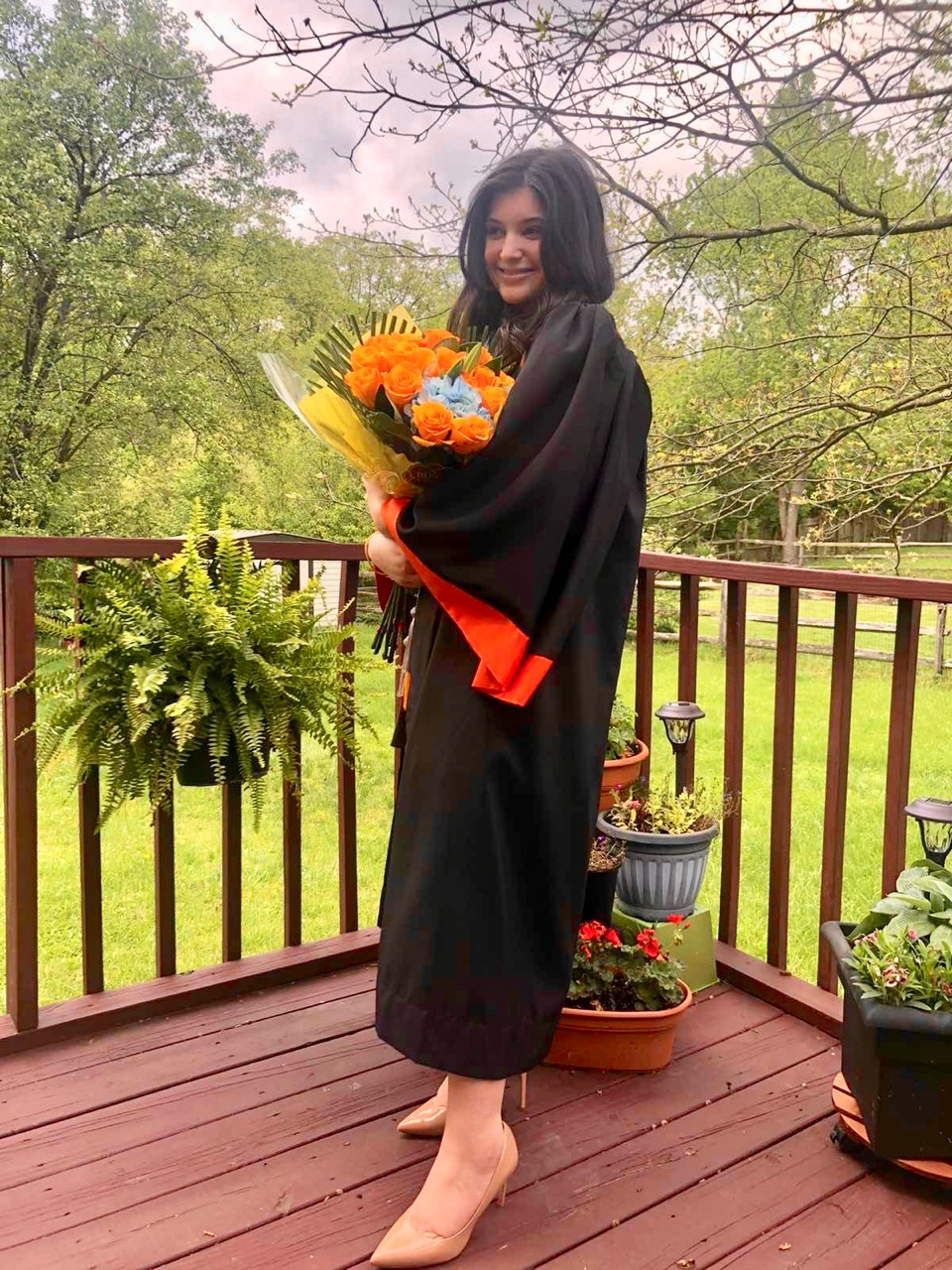
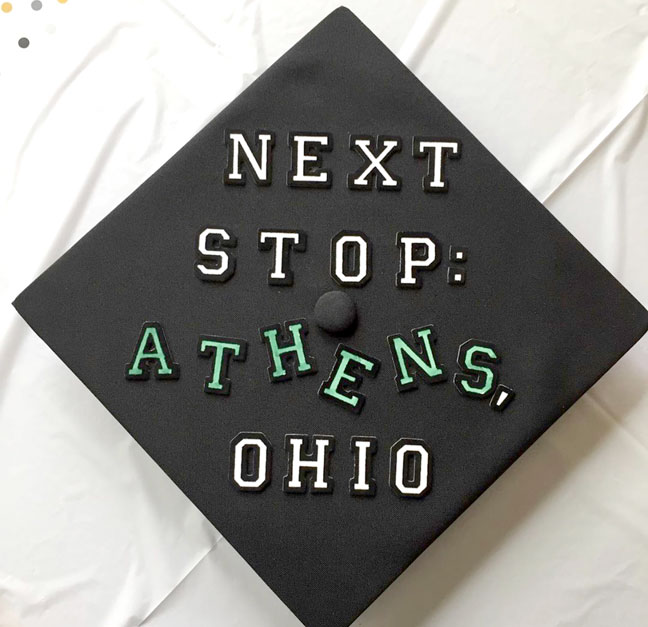
Mihaela Manova is now a Loveland High School Graduate. She joined Loveland Magazine as an Intern in September of 2019 and was soon promoted to be the Editor for our “Covering Climate Now” series. She will study journalism at Miami University.
Here is Loveland High School’s 2020 Graduation (my graduation) in photos and videos – you can experience the whole 11-hour day!
By: Mihaela Manova
Loveland, Ohio – In the year where all schools have closed and many are awaiting a graduation of some sort, Loveland High School has managed to show to its seniors and their respective family members that Covid-19 will not dictate the end to their academic careers. Here is a piece through the point of view of a 2020 graduate.
Where to begin… this year has proved to us, the student body, our limits and our achievements, the mostly good and the mostly bad. Say you were an athlete competing in the beginning of the year or a straight-A student who dedicated their time to their studies, or you could be even both for all we know. You possess qualities that make you stand out and even though you may not know most of the time, many people see that about you. To the class of 2020, don’t fret, the best years are coming ahead.
Before graduation in May of 2020
In the last few days before graduation, I would assume we had the same thoughts crossing our minds. What would these days have looked like if we were in school? Would I be as happy as I am now? Will I be satisfied when I receive my diploma, even when it is placed into my hands gently and in a sterile manner?
Many, (from what I have observed), do not see our current situation as a stop to their plans. While following protocol, these people have decided to make the best of it, even with the distance that comes between them.
With gratitude towards the health care workers that are around us (and around the world), who are parents, aunts, uncles, and more, it was a sight to see the families coming together in our school, to see a personal milestone be achieved.
(Click on any photo to see it enlarged)
Ella Kiley
Carson Sarver
Mitchell McManis
Allison Rountree
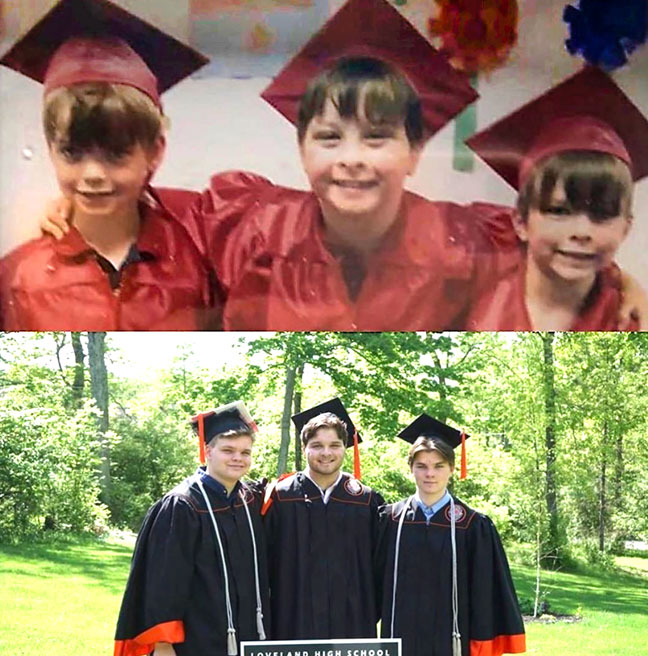
(left to right) Joey Jeffcott, Jack Jeffcott, and Brady Jeffcott
Erin Dickman
So how did our day proceed? Here is a type of journal entry that may suffice, with, of course, 2020 vision.
For starters – graduating Senior students were categorized into time slots for each family to have a personal experience (at a distance) with usually the time being around 30 min – 1 hour depending on the traffic.
The high school itself showcased a labyrinth for the cars that would soon lineup, tape making borders for each car to snake around until it found itself ready to go into the school. While waiting you can see a range of cars decorated with festive balloons and markings often saying “Go Tigers!” or “Graduate 2020” in colors of orange and black. Others would have cars following one another with family members anxiously awaiting their turn.
While the wait was long, it gave time to observe the atmosphere as it is a (hopefully) once in a lifetime spectacle of following strict protocol. You could look out the car window and see the people who were soon going to come in, properly dressed in their orange and black togas with facial masks to match.
When it was our turn to park in the parking lot, kind men with masks spoke of the directions in parking, getting out, and entry to the building. The entrance to our high school included a blown up tiger head that engulfed every individual that walked in, making our last walk inside be memorable.
Staff by the entrance were ready to take pictures of the graduate and their family, and once walking into the building you would hear “Hello!” followed by an excited “Congratulations!”
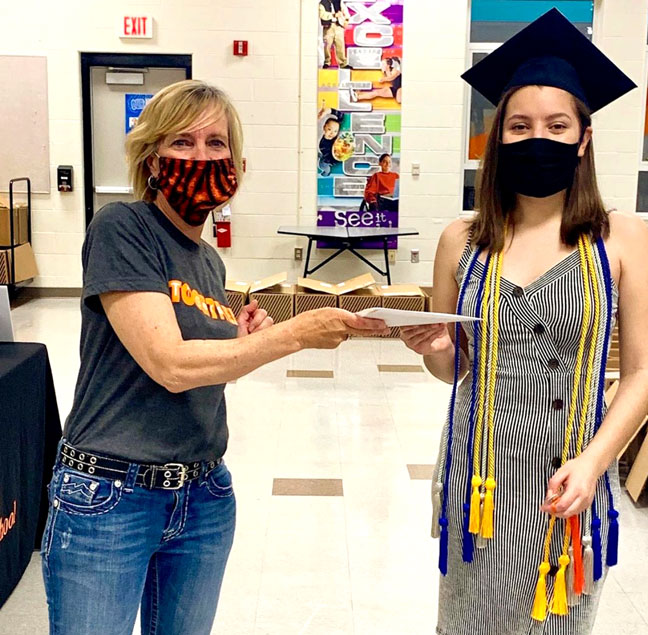
There was no lack of positivity or hints of melancholy anywhere. Once inside the building, each family would wait for another to finish going through all of the stations. The first station was a table with a quick spell-check of the name of the graduate alongside an award for academic excellence this semester if you were excellent.
More greetings ensued as we moved on to the final moment that we were waiting for. With smiles underneath the masks but highlights in all the eyes, it was finally time to hand it off to a family member and walk solitary to the podium leading to the auditorium.
In front of you, principal Peggy Johnson would lead you to the hidden entrance of the podium while behind you, was your family recording every step of the way. In the auditorium, massive posters and lighting donned a dramatic feel to this ceremony, as there were two types of cameras ready for you. One was the video recording of you walking across, and another was for a professional photo when you “turn” the tassel.
Rosa Karl
William Gibbs-Heard
Claire Wallace (2020)
Claire Wallace (young)
Samantha James and Emily Zirkelbach
(left to right) Calloway Hefner, Ben Russ, Lexi Duff, Greyson Hensley, Christian Morckel
Natalie Drury and Kirstin Thomas
With the moment upon you, you hear your full name announced, so you walk across to the far end of the stage, noticing that every seat wore printed pictures of the staff and teachers. This gesture brings a smile to your face when you know how much these people wanted to be there and how long it took for each portrait to get designed, printed, and taped on the seats.
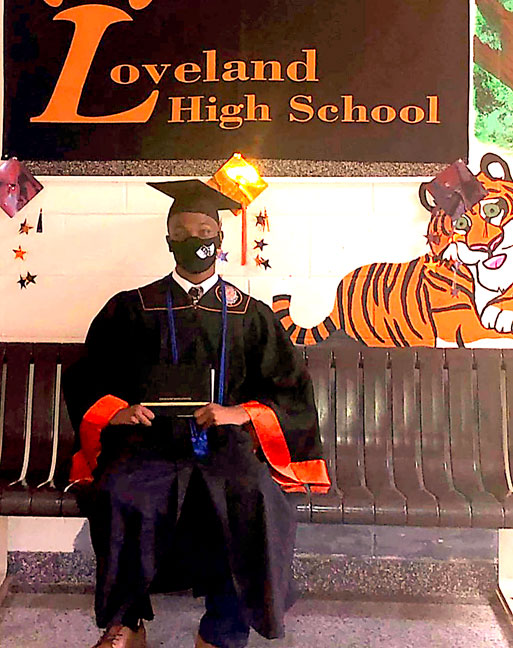
After stepping off and a rush of pride and adrenaline is expected as you have finally done it! You would now put on your “2020 Mask” again and wait for further instruction and clearing of the cafeteria. With your family, you would go to the cafeteria hearing more “Congratulations” and the dreadful returning of the toga (which you secretly want to keep).
Returning the toga, you immediately get a packet of your diploma and a booklet of all the student names and achievements.
Lastly, you break through the doors of the cafeteria, with more felicitations from a staff member that follows the question, “So what are you doing after this?” as you wait. I wasn’t sure if it was meant to be answered for now or for later but I was happy knowing that good things await…
A note:
Speaking for the class of 2020 and myself we would like to say big, big thank you’s to our school, the organizers, the staff, the people outside helping, and the teachers and volunteers. Without your efforts we would have never had a great graduation like this, so we thank you for adapting to these measures and staying positive for our day!
And we also cannot forget to thank the people working on the front lines and in hospitals at the moment, your efforts will not be forgotten in battling this epidemic. BIG THANK YOU TO ALL!
Sincerely,
Mihaela
Watch these videos of the 2020 Commencement Ceremony that were produced by Loveland High School ( (videography and digital production); Shawn Miller (lighting and sound production); Lane Aylor, Hayden Floyd, David Knapp and John Lape (technical assistants)
As we entered the School
Welcome by Olivia VonDeylen
Carson Sarver Class President
Senior Choir members perform Irish Blessing
Sophia Dillhoff Salutatorian
Ashley George Valedictory Address
National Anthem Tribute by Chamber Orchestra and Show Choirs
Principal Peggy Johnson
Superintendent Dr. Amy Crouse and School Board President Kathy Lorenz
Each student receiving their diploma
Below is the entire video of the LHS Graduation that was produced by the school.
To see each graduate cross the stage drag the slider to the 28:52 minute mark.
The entire video of the Commencement exercise
Also read these stories about the Class with 2020 Vision…
Loveland Magazine is one of the 400 news outlets worldwide, with a combined audience of over 2 billion people “Covering Climate Now”, a global journalism initiative committed to bringing more and better coverage to the defining story of our time.
The initiative, was co-founded by The Nation and Columbia Journalism Review
Mihaela Manova is “Covering Climate Now” in Loveland, Ohio as an editor for Loveland Magazine
Today’s article concentrates on the beauty of the nature around us; even if we are currently staying in isolation. In Stephen McClanahan’s article, he reveals an entry about a beautiful variety of bird species and their complexities.
By Stephen McClanahan on May 22, 2020
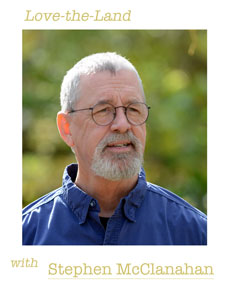
Stephen McClanahan is retired from P&G and now active in environmental advocacy, search/rescue and emergency medical/disaster response. He lives in Miami Township.
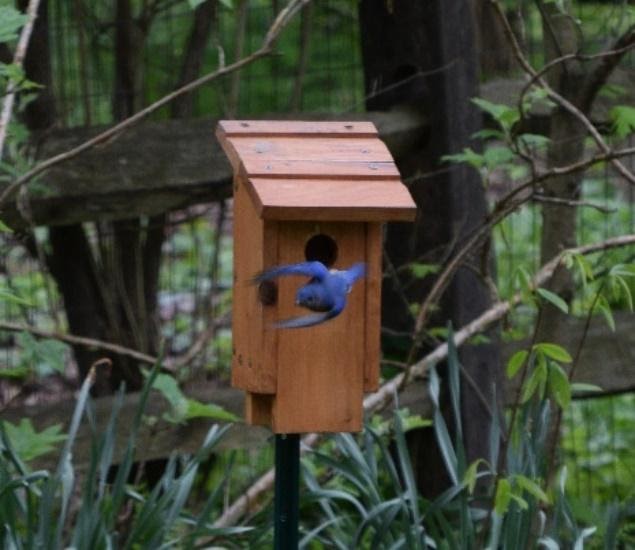
Have you ever seen a more beautiful creature than a blue bird? The blue is beyond blue; this one moved into one of the nesting boxes in the yard and has just emerged to take flight.
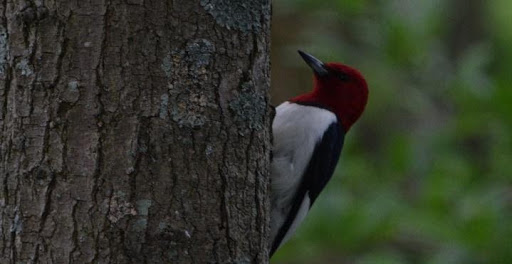
Or how about this guy…a red-headed woodpecker? He has visited us for the past few days, so we are hoping there is a nest not far. His hood is the deepest of reds you can imagine.
Red-headed woodpecker
Or several other amazing creatures of flight?
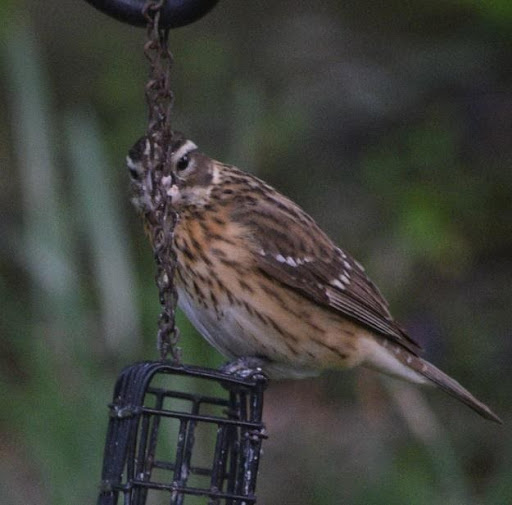
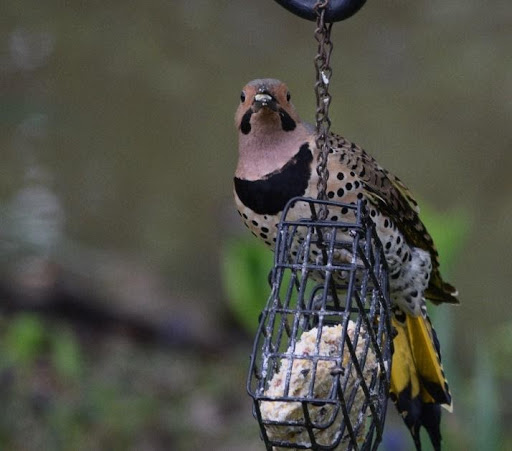
Female Red-breasted GrosbeakNorthern Flicker with an attitude
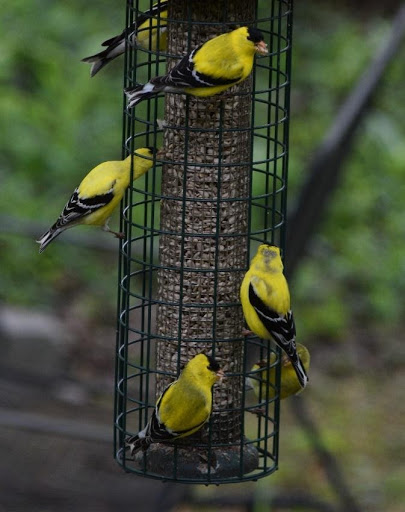
Gold Finch feeding frenzy.
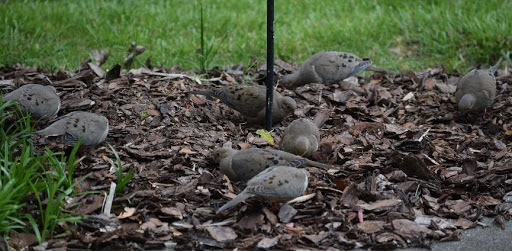
Morning doves eating what the finches throw them.
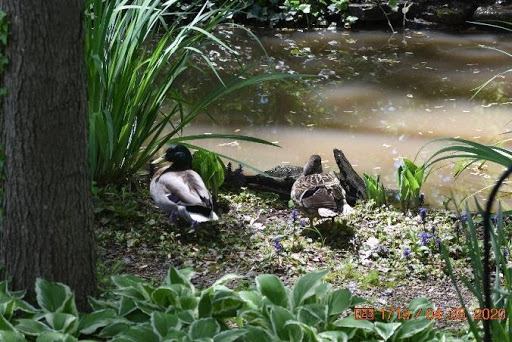
Mallards
The Mallards above are nick-named Charles and Verna by our children when they were younger, they have been coming to our little back yard pond for years.
I am thinking either a red-tailed or red-shouldered hawk. (If someone knows better, please educate me.)
These winged creatures and many, many more, are all in one small corner of the earth. Jays, wrens, nuthatches, sparrows, hairy and downy woodpeckers, red-bellied woodpeckers, robins, cardinals, house finches, ruby-throated hummingbirds, grackles to name a few.
A barn swallow was out front late afternoon a few days ago; his darting and jerking and hair-pinned turns in flight left me wanting to break the chains of gravity and join him in his celebration of life. Watch them closely, sincerely and you come away amazed.
As they go about their daily rounds, you will see a host of creatures spending their time eating, nesting and much more. Their singing and chirping are nothing less than a concert playing of Spring from Vivaldi’s The Four Seasons. They will argue over something but settle it in minutes and move on (humans should be so fortunate). Up with the earliest rays of the sun, disappearing just before sunset, they move with the rhythm of the day.
How they manage to fly in, around, under, over, in-between leaves and branches and trees and each other is a feat of engineering to say the least. With the coming of spring, the gold finches morph from a dull to an almost fluorescent yellow – stunning! There is a cardinal nest just outside a window in one of bushes; these little creatures knew where and how to build a nest sheltered from the weather.
Nature has somehow encoded this knowledge into their brain.
Nature has somehow encoded this knowledge into their brain. The female patiently laid and sat on her eggs for about 12 days or so and as of yesterday, there are 3-4 new cardinals in our world. The male and female are trading off time to feed and guard and keep warm their brood. When you approach too close to try to snap a photograph, she looks at you and you can tell what she is thinking: a step closer and you are dead, mister. The force is strong with them.
These are just a few of the rewards granted when you give nature a bit of space and time and peace. Several years ago, we began the task of converting a portion of the manicured back yard to its original form: a little wild place. Trees, bushes, ground covers, flowers, weeds and more. As it grows, other critters move in as well. Squirrels, chipmunks, rabbits, racoons, an occasional fox, deer, opossums. After an evening rain, the tree frogs serenade with such gusto, you laugh out loud which only eggs them on.
We are fortunate to live in Paxton Woods
We are fortunate to live in Paxton Woods; many neighboring homes have lots of mature trees. This provides more of a continuous suburban forest so essential to wildlife. Rather than being an island, our little patch of wild only adds to what is here.
Lessons learned from all this: nature will heal and rebound if given a fair chance. You must care enough to try. There is power in individual actions; there is greater power in the collective.
And while I was penning this short piece, the red-headed woodpecker visited again, as did a hawk, but the jays caused such a ruckus, it moved on to quieter hunting ground.
“Do you think the industry uses recycling to sell more plastic? Absolutely.”– Plastic Wars, PBS
Loveland Magazine is one of the 400 news outlets worldwide, with a combined audience of over 2 billion people “Covering Climate Now”, a global journalism initiative committed to bringing more and better coverage to the defining story of our time.
The initiative was co-founded by The Nation and Columbia Journalism Review
Mihaela Manova is the Loveland Magazine “Covering Climate Now” Editor
Today’s article focuses on Plastic Wars from PBS and Frontline
By Mihaela Manova
W
ith enough free time right now to rediscover a hobby, some choose to spend it on new cooking, or even spring cleaning. But as those people participate in their new hobbies, and some begin to throw out things; others begin to collect them.
Plastic Wars, a documentary on the current pollution problem has made people turn their heads at what is thrown away while looking at the recycling industry and its good, bad, and ugly. With investigating the “battle over plastics, ” Frontline and NPR dive into an investigation over how we are managing the waste, what is going on in the recycling industry, and how the public is contributing to minimizing it. If you haven’t caught this documentary on PBS yet, you can watch it HERE.
“Bloated seabirds and littered waterways have fueled a global anti-plastic movement.”
The industry
Current news sites display headlines that describe how the COVID-19 pandemic is influencing this industry. Words like “piling,” “waste,” and “sabotage” are at the top of their Google search. More plastic waste is being produced by the jumbo packs of toilet paper that some are hoarding. Cans, cardboard, and other packaging of snacks are now loaded in the pantry before quickly consumed and thrown away. The recycling industry is at risk, for more reasons than one.
The hoarding of toilet paper has skyrocketed, yet businesses are now setting limits on how much is allowed to be bought per person.
According to Wired, “First, given that plastic is oil, when oil prices fall—as they have in recent years—plastic gets cheaper to make. This corrupts the economics of recycling.” This news source continues to talk about the relations with China and how they have banned imports of plastic and mixed paper.
On top of all of that, Tom Szaky (founder/CEO of TerraCycle) confirms, “The third is what no one notices, that the quality of the waste is going down,” says Szaky. This is known as “lightweighting,” and it was happening long before the pandemic began. By making plastic bottles thinner, the manufacturer saves money by using less plastic. But, Szaky says, “it becomes progressively less profitable for a garbage company to bother recycling.”
To combat this with the pandemic and quarantine still going, you can begin to take notice of the amount of waste that piles up from the rapid purchases that you have made from your local grocery store or even packages from the mail. Consider biodegradable products as options and do not desert your recycling bin.
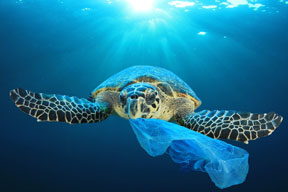
Pictured: Turtle consumption, plastic vs jellyfish
The Sea Turtle craze
Many of us have heard of the craze concerning the conservation of sea turtles. In the documentary, it was mentioned that there was an overwhelming awareness that a sea turtle video made upon the public and mostly, the youth. In the realm of social media platforms, influencers, instagrammers, and tik-tokers spread the word about this cause and what anyone can do to help. One of those things became the metal straw trend, where it blew up on almost all platforms.
The essentials of a modern VSCO girl
As self-proclaimed VSCO girls donned the metal straws and used it for their aesthetic, companies were ready for them too, as many would begin to produce these straws in the help of the environment, but others claim, it was just to stay relevant.
Sketchy websites selling metal straws began to pop up on various platforms, overpricing said straws to the more than the average amount. People began building companies on the basis of this trend, which now have to find the next best thing. When building a company based on sustainability and/or biodegradable products, it is known that these efforts will continue to spread a trend for products to be produced ethically. But on the opposite side, some choose to use these trends for fast money and later fall due to the loss of interest over time.
The popularization of metal straws
As many know, one of the biggest companies in the market, Starbucks, has massively changed its straw policy. The Guardian discusses the change from straws to the strawless lids by saying, “But is it really a big win for the environment? Reason, a magazine and blog published by the rightwing Reason Foundation, has claimed that the Nitro lids Starbucks will be making standard use more plastic than a combination of the company’s current lids and plastic straws. Now, as many months have passed since the massive metal straw revolution, environmentalists are still concerned with the amount of plastic that is left.”
Starbucks answered with their reasoning behind this, “Starbucks does not dispute that the new lids use more plastic. However, they stress that “the strawless lid is made from polypropylene, a commonly-accepted recyclable plastic that can be captured in recycling infrastructure, unlike straws which are too small and lightweight to be captured in modern recycling equipment.”
There is more talk concerning another major chain brand revamping their packaging. McDonald’s and Starbucks are working together to develop better disposable packaging in an act of saving the environment.
Easier recycling = more money
Plastic Wars provided awareness for the process of recycling and what products are made from this process. Statistics show that 9% of the world’s plastics are recycled. The documentary mentions that soda bottles and milk jugs are easier to recycle and in turn, equate more money being produced from them. In counter to this, mixed plastics that are mostly part of our everyday packaging, do not get recycled easily and cannot be sold.
If you want to save the planet while making extra cash, items like electronics, glass bottles, and ink cartridges are most wanted. Most importantly, check your state regulations and nearby recycling stations for more information on products, rules, and offers.
Despite efforts spreading across America to reduce the use of plastic and the crisis of ocean pollution growing, the plastics industry is rapidly scaling up new production and promoting a familiar solution: recycling. But it’s estimated that no more than 10% of plastic produced has ever been recycled. The documentary “Plastic Wars,” from FRONTLINE and NPR, reveals how plastic makers for decades have publicly promoted recycling, despite privately expressing doubts that widespread plastic recycling would ever be economically viable.
Loveland Magazine is one of the 400 news outlets worldwide, with a combined audience of over 2 billion people “Covering Climate Now”, a global journalism initiative committed to bringing more and better coverage to the defining story of our time.
The initiative, was co-founded by The Nation and Columbia Journalism Review
Mihaela Manova is “Covering Climate Now” in Loveland, Ohio as an editor for Loveland Magazine
Today’s article focuses on not only the environmental effects from COVID-19, but the longevity of the nature’s reconstruction. Written by Jonathan Watts for The Guardian.
By Jonathan Watts April 9, 2020
T
he environmental changes wrought by the coronavirus were first visible from space. Then, as the disease and the lockdown spread, they could be sensed in the sky above our heads, the air in our lungs and even the ground beneath our feet.
While the human toll mounted horrendously from a single case in Wuhan to a global pandemic that has so far killed more than 88,000 people, nature, it seemed, was increasingly able to breathe more easily.
As motorways cleared and factories closed, dirty brown pollution belts shrunk over cities and industrial centres in country after country within days of lockdown. First China, then Italy, now the UK, Germany and dozens of other countries are experiencing temporary falls in carbon dioxide and nitrogen dioxide of as much as 40%, greatly improving air quality and reducing the risks of asthma, heart attacks and lung disease.
For many experts, it is a glimpse of what the world might look like without fossil fuels. But hopes that humanity could emerge from this horror into a healthier, cleaner world will depend not on the short-term impact of the virus, but on the long-term political decisions made about what follows.
After decades of relentlessly increasing pressure, the human footprint on the earth has suddenly lightened. Air traffic halved by mid-March compared with the same time last year. Last month, road traffic fell in the UK by more than 70%, to levels last seen when the Beatles were in shorts. With less human movement, the planet has literally calmed: seismologists report lower vibrations from “cultural noise” than before the pandemic.
Key environmental indices, which have steadily deteriorated for more than half a century, have paused or improved. In China, the world’s biggest source of carbon, emissions were down about 18% between early February and mid-March – a cut of 250m tonnes, equivalent to more than half the UK’s annual output. Europe is forecast to see a reduction of around 390m tonnes. Significant falls can also be expected in the US, where passenger vehicle traffic – its major source of CO2 – has fallen by nearly 40%. Even assuming a bounceback once the lockdown is lifted, the planet is expected to see its first fall in global emissions since the 2008-9 financial crisis.
Fossil fuels
There is no doubt that these lockdowns are hitting the fossil fuel industry. With fewer drivers on the roads and planes in the air, the price of oil has slumped almost two-thirds since last year. Car sales fell by 44% in March, with motorway traffic down 83%. So many more people are learning to teleconference from home that the head of the Automobile Association in the UK advised the government to switch infrastructure investment from building new roads to widening internet bandwidth.
This is potentially good news for the climate because oil is the biggest source of the carbon emissions that are heating the planet and disrupting weather systems. Some analysts believe it could mark the start of a prolonged downward trend in emissions and the beginning of the end for oil. Others strike a more cautious note about the fuel that has dominated our lives and polluted our atmosphere for the past century.
“The drop in emissions is global and unprecedented,” Rob Jackson, the chair of Global Carbon Project said. “Air pollution has plunged in most areas. The virus provides a glimpse of just how quickly we could clean our air with renewables.” But he warned that the human cost was too high and the environmental gains could prove temporary. “I refuse to celebrate a drop in emissions driven by tens of millions of people losing their jobs. We need systemic change in our energy infrastructure, or emissions will roar back later.”
Hopes that the pandemic will accelerate the transition to a cleaner world are already running into a political wall: the “shock doctrine” of disaster capitalism outlined by the author and activist Naomi Klein. In her book of the same name, the Canadian writer describes how a powerful global elite exploits national crises to push through unpopular and extreme measures on the environment and labour rights.
This is what is happening in the United States and elsewhere. Oil company executives have lobbied Donald Trump for a bailout. Under the cover of the crisis, the White House has rolled back fuel-economy standards for the car industry, the Environmental Protection Agency has stopped enforcing environmental laws, three states have criminalised fossil fuel protesters and construction has resumed on the KXL oil pipeline. The US government’s massive economic stimulus bill also included a $50bn bailout for aviation companies. Environmental groups are urging the UK and European Union not to do the same.
If governments prime the economic pumps with the intention of a return to business as usual, environmental gains are likely to be temporary or reversed. China provides some indication of what can be expected. With no new cases in Wuhan, the lockdown is being eased and energy use and air pollution have been rising since the end of March.
Wildlife and biodiversity
Nevertheless, while our species is in temporary retreat during the lockdowns, wildlife has filled the vacuum. This year will almost certainly see a much lower toll for roadkill by cars and trucks, which – in the UK alone – annually takes the lives of about 100,000 hedgehogs, 30,000 deer, 50,000 badgers and 100,000 foxes, as well as barn owls and many other species of bird and insect. Many councils have delayed cutting the grass on roadside verges – one of the last remaining habitats for wildflowers – which should bring a riot of colour to the countryside this summer and provide more pollen for bees.
Coyotes, normally timid of traffic, have been spotted on the Golden Gate Bridge in San Francisco. Deer are grazing near Washington homes a few miles from the White House. Wild boar are becoming bolder in Barcelona and Bergamo, Italy. In Wales, peacocks have strutted through Bangor, goats through Llandudno and sheep have been filmed on roundabouts in a deserted playground in Monmouthshire.
This is presented as the comedy in our tragedy. Cartoonists have depicted throngs of tourist animals gawping through city windows at humans under lockdown. Commentators are even talking of the “post-human” era – a mocking rejoinder to the idea that we live in Anthropocene, a period of human domination that is reshaping the planet. Humour does not get much blacker. We are laughing at our own decline – and assuming that nature will be the beneficiary.
Environmental campaigners say that is a dangerous misconception. The picture is different across our unequal world. Rich, industrialised nations are seeing a temporary recovery of nature because there is so little of it in the first place. Poorer countries, on the other hand, especially in the southern hemisphere, fear an increased threat to wildlife because the pandemic means they have less money and personnel with which to conserve endangered species and habitats.
In the Amazon rainforest, environmental authorities are reining in monitoring and protection operations. In the Masai Mara and Serengeti, nature reserves are taking less tourist revenue, which means they are struggling to pay rangers. Conservation groups fear this will open the door to more illegal poaching, mining and logging, especially now that local people are losing income and need new ways to feed their families.
“In the short term it would be dangerous to think that a downturn in economic activity is a benefit to nature,” said Matt Walpole of Fauna and Flora International. “There are significant risks.”
Potentially offsetting this is reduced demand for many natural resources, but it remains to be seen whether home isolation of half the world’s population affects the appetite for consumer goods.
A new future?
The respite for nature will be less important than what follows. That is already being decided in closed meetings while the public is locked down at home. Meanwhile, global conferences intended to find solutions to environmental problems, such as the Cop26 UN climate talks originally scheduled for Glasgow at the end of this year, have been postponed.
UN leaders, scientists and activists are pushing for an urgent public debate so that recovery can focus on green jobs and clean energy, building efficiency, natural infrastructure and a strengthening of the global commons.
“This is the big political battle,” said Laurence Tubiana, CEO of the European Climate Foundation and an architect of the Paris agreement. Leading scientists have jointly signed an open appeal for governments to use recovery packages to shift in a greener direction rather than going back to business as usual.
Ultimately, the most important environmental impact is likely to be on public perceptions. The pandemic has demonstrated the deadly consequences of ignoring expert warnings, of political delay, and of sacrificing human health and natural landscapes for the economy. Of new infectious diseases, 75% come from animals, according to the United Nations Environment Programme. Compared with the past, they pass more rapidly to humans through wildlife trafficking and deforestation and then spread across the globe through air travel and cruise-ship tourism. China – the world’s biggest market for wild animals – appears to have recognised this by banning the farming and consumption of live wildlife. There are growing calls for a global ban on “wet markets”.
The pandemic has also shown that pollution lowers our resistance to disease. More exposure to traffic fumes means weaker lungs and greater risk of dying from Covid-19, according to scientists at Harvard University. As the UN’s environment chief, Inger Andersen, put it, nature is sending us a message that if we neglect the planet, we put our own wellbeing at risk.
Since the start of the pandemic, it is not just from space that the world looks different. The unthinkable is now thinkable. Positions are shifting. Libertarian governments are curtailing freedoms more drastically than wartime leaders. Austerity conservatives are approving trillions of dollars for healthcare and emergency spending. Small-state advocates are being forced into massive interventions. Leading business publications are calling for a deep reform of capitalism. Most importantly, the political focus has shifted from individual consumption to collective wellbeing.
These 100 days have changed the way we think about change. Ultimately, whether this pandemic is good or bad for the environment depends not on the virus, but on humanity. If there is no political pressure on governments, the world will go back to unsustainable business as usual rather than emerge with a healthier sense of what is normal.
For the French philosopher Bruno Latour, one thing we have learned is that it is possible in a matter of weeks to slow the economy, which until now had been considered inconceivable due to the pressures of globalisation.
“The incredible discovery is that there was in fact in the world economic system, hidden from all eyes, a bright red alarm signal, next to a large steel lever that each head of state could pull at once to stop ‘the progress train’ with a shrill screech of the brakes,” he writes.
This makes ecological calls to move off a path of endless resource consumption more realistic, maybe even more desirable. But Latour warns that this unforeseen pause could easily allow powerful interests to seize more control ahead of the bigger battles looming over the climate and biodiversity. “This is where we must act,” he says. “If the opportunity works for them, it works for us too.”
uring times that we are isolated in quarantine, we tend to focus our attention to the wrong news sources. While most of them give accurate information, we may fall into a trap of overthinking, fear, or both. To distract from the boredom of some and the panic that others may have, we have gathered the most positive news and news sources from the week.
Here are our top 3 finds to enjoy:
Good News Network
When searching for good news on the internet, this is one of the first that will make you smile. The Good News Network has been pushing out positive articles about everything, despite the current coronavirus circumstances.
Take for example, a new article confirming that TV medical dramas are donating their gowns, gloves, and masks to real hospitals. Shows like Grey’s Anatomy and Station 19 are sending their supplies to the nearest hospitals in an effort to help real doctors and nurses fight this pandemic.
“Tired of hearing about all the world’s problems? You’ve come to the right place. The people you’ll soon meet are cooking up the boldest, most innovative solutions you haven’t yet heard of to fix the biggest challenges that face our globe. Tracking down these people — everyone from politicians to farmers to inventors to lawyers to artists — has given us new hope for the future. Now, we’re introducing them to you, to give you hope, too.” – Grist 50
Looking for a website that sheds light on forward thinking people, world-changing actions, and good news about the battle with climate change? Grist 50 is the source for inspiration through the lenses of 50 climate change advocates, who give us hope for the future in our world.
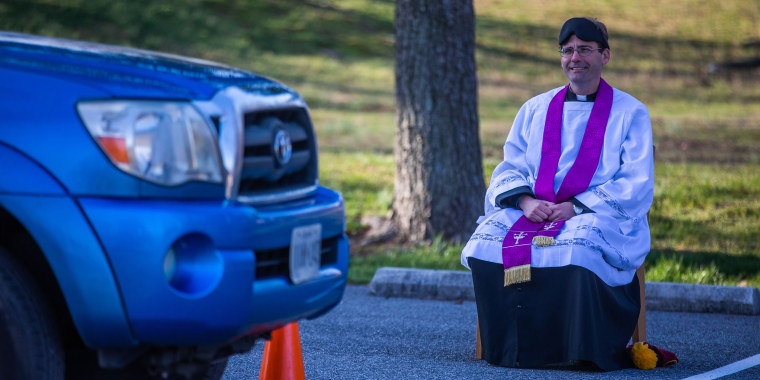
Want to read something heartwarming? Today.com’s Good News segment may be the right way to spend your social distancing time. From “Priest begins offering drive-thru confessions” to “Cheap thrift-store picture turns out to be Salvador Dali’s piece,” Today has articles that could elevate some of your stress.
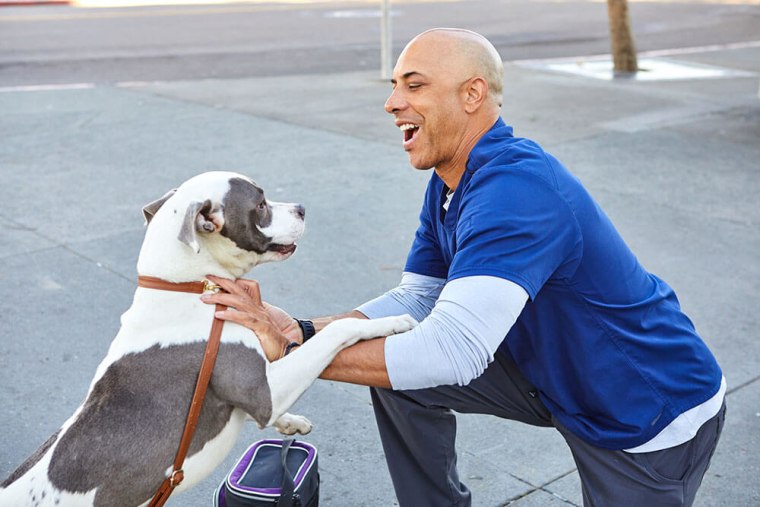
Here are our top 5 pics to make you smile:
Texas couple donates flowers to assisted living homes after postponing wedding

























 I am thinking either a red-tailed or red-shouldered hawk. (If someone knows better, please educate me.)
![[On Earth Day’s 50th Birthday] Why you should watch Plastic Wars / Covering Climate Now](https://lovelandmagazine.com/wp-content/uploads/2020/04/feature-plastic-wars.jpg)