Skeletor at the Simpson Farm Asylum where it’s has been said to be extremely haunted by evil spirits begging to be released from their cells on Halloween Eve.
Loveland, Ohio – Trick or Treating hours in the City will be between 6 and 8 PM on Monday, October 31.
Cassie Mattia and Skeletor reveal the most horrifying haunted houses you should visit
Some are filled with candy and some are filled with gore. All are jim dandy and each will leave you wanting more.
Skeletor at the Simpson Farm Asylum where it’s has been said to be extremely haunted by evil spirits begging to be released from their cells on Halloween Eve.
Loveland, Ohio – With Halloween right around the corner, it only seems right to take YOU our readers to the creepiest, most ghost filled haunted places around where you might meet Skeletor the Haunted Places Guru!
Everyone loves a good scary house of horror, especially during Halloween, but at times it can be tough selecting the one that will be sure to chill you to the bone! Skeletor, who hibernates all year at the Simpson Farm Asylum, located at Loveland Magazine’s office, awakens in October in preparation for the 30th.
It’s that time of year when scares and frights are near!
Prepare to be creeped out by just going to the websites of her favorite haunts!
Here, in no particular order are where Skeletor loiters and lingers this time of year.
Some are filled with candy and some are filled with gore. All are jim dandy and each will leave you wanting more.
Skeletor at the Simpson Farm Asylum where it’s has been said to be extremely haunted by evil spirits begging to be released from their cells on Halloween Eve.
Loveland, Ohio – With Halloween right around the corner, it only seems right to take YOU our readers to the creepiest, most ghost-filled haunted places around where you might meet Skeletor the Haunted Places Guru!
Everyone loves a good scary house of horror, especially during Halloween, but at times it can be tough selecting the one that will be sure to chill you to the bone! Skeletor, who hibernates all year at the Simpson Farm Asylum, located at Loveland Magazine’s office, awakens in October in preparation for the 30th.
It’s that time of year when scares and frights are near!
Prepare to be creeped out by just going to the websites of her favorite haunts!
Here, in no particular order are where Skeletor loiters and lingers this time of year.
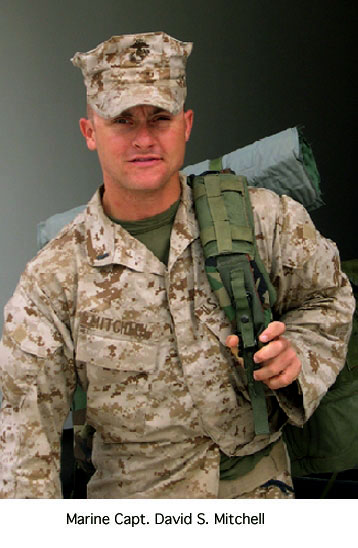
Loveland Magazine Editor in Chief, David Miller has attended and reported on every running of the Capt Seth MitchelHero 5K. (Photo by Connie Mitchell)
Loveland, Ohio – On Saturday, October 15 in Historic Downtown the 13th running of the Capt Seth Mitchel Hero 5K was held in Nisbet Park and along the Loveland Bike Trail and Little Miami River.
The annual walk and run are to honor a local and national veteran hero who grew up here in Loveland.
Seth Mitchell, a Captain and pilot in the United States Marine Corps and a 1997 Loveland High School graduate, was killed in action in Afghanistan in October 2009 in a mission he volunteered for. Mitchell contributed greatly to the Loveland community in his youth… he served as a leader and role model on the varsity football team, was voted to be Class President his senior year, and was named “Mr. Personality” by his peers. He was well loved here. After graduating, he took that same sense of service and loyalty into all that he did: as a son, a brother, a friend, and a leader in the Marines.
In other words, Seth was a hero for all.
A group of Seth Mitchell’s high school classmates and friends, who miss their friend and want to keep his memory alive organize the races. The result has been a very sustaining scholarship memorial fund.
After the race, David Miller said, “I didn’t meet Connie and Steve Mitchell until after their son’s death, and my favorite part of attending this race each year is to renew a friendship that has developed. They mostly keep the grief that of course is always there just under the surface, and come each year helping the rest of us heal. They are inspiring people and I know where Seth got his moral code, discipline, and sense of service to others”
In the LOVELAND MAGAZINE TV video, you can hear from two of the organizers, Seth’s father, and two of the most recent graduates who received scholarships.
Eric Schroeder was the top male finisher with a time of 19:37. Kyle Kehling finished in second place at 20:17 and Greg Carpinello finished in 20:39.
The top female racer was Averee Martin with a time of 26:25. Kathryn Mackin finished in second place at 31:48 and Shaina Mackin finished in 31:48.
Your support of the 5K and the scholarship funding has provided scholarships for worthy Loveland High School seniors since 2010. Over 20 students have received scholarship funding and book stipends or gifts since our initial 5k in 2010. Our 5k team, Loveland High School, and of course the recipients and their families thank you.
Meet the 2022 Scholarship Winners
The Let Us Never Forget Seth Mitchell Scholarship ($3500.00) was awarded to Lindsey Barry. Lindsey has a lot in common with Seth. While Lindsey has great academic results, like Seth she had her struggles along the way. Overcoming obstacles is a great character trait and one the scholarship team values. One letter of recommendation stated that Lindsey is very “dependable, reliable and responsible”. While these may not be “flashy” character traits, they form a sound base for success in any life function. Another recommendation letter stated that Lindsey “works hard to achieve her goals”. That was very much like Seth also. In our interview with Lindsey she said: “I want to live life like Seth, a life of service, kindness and humility”. Lindsey will be attending The Ohio State University in the fall.The Seth Mitchell Memorial Scholarship ($3500.00) was presented to Baylee Bronner. Baylee is a lifelong Loveland resident and her uncle Don and Seth were friends in high school. Baylee and her family know a lot about Seth. Baylee has shown great perseverance in her life and has overcome many obstacles to achieve her dream of attending Xavier University. But as Baylee said in her interview, “My biggest mentality in life is to focus on the positive and not focus on regrets”. In spite of hurdles in life, she has moved forward in a positive manner. In letters of recommendation, Baylee was described as “most reliable, hardworking” and having “kindness and loyalty”. These qualities served Seth well and they will for Baylee also. Baylee served on the Hope Squad during her years at LHS and the mentors there described her as having a “gift for leadership”. No doubt Baylee will use this gift in her future pursuits.
Because of your generosity, the scholarship team provided 3 additional applicants with $500.00 each as gifts toward their next step in life.
Thank you again for your support of the Captain Seth Mitchell Hero 5K
The Mitchell Family – Pete & Marina Patterson – Emerick Crown & Bridge Lab, Inc. – Schottmiller’s Auto Body – Randolph Cloud – Mollie Emerick – The Cook Family – The Carpinello Family – The Sobb Family – Keith & Allie Summey – Mark Stewart – Loveland Cross Country Teams – Frank & Maggie Wyatt – The Millers-Rapid City, SD – Bill & Barbara Morrow – Mark O’Rourke – Joe Horst – American Cold Storage Systems – Tim Daughton – Keith & Alli Summey – The Bivens Family – James Turner – Kilpatrick Townsend & Stockton LLP – John Spinello – Ronnie and JoAnn Johnson – Rachael & John Hickox – Brian Jogerst – Jerry and Leslie Gough – Karen Lencoski – Wes C. Addle – Sue Peterson – Adam Miller – IronGate Partners – The Lessner Family – Dwight & Julie Hunter – Carol and Jum Horst – Julie Powers Caños – Jeff Wick – Scott Brock – The Cranfords – The Prenger Family – Andrea Distasi – Philip Reale – Kathleen Berwanger – Jane Weirich – Laura & Bob Stennett – Maeve Gardner – John and Emily McConnell – Tom & Melissa Primm – Betsy & Don Licata – Tim and Kelly Byler – Dan Wahby – Michael & Lauren Currin – Paul Albrecht – Brad Southerland – Bill Matthews – Marie Cull – Francesca Plendl – Bill and Sherri Pitchford – Marcia Morgan – David Abbott – Christine Weason – Lois and Jerry Zito – Casual Pint-Loveland Station – Landen Square McDonald’s – John Walraven-In Memory of James Esker, US Army
SPONSORS
The Mitchell Family – Pete & Marina Patterson – Emerick Crown & Bridge Lab, Inc. – Schottmiller’s Auto Body – Randolph Cloud – Mollie Emerick – The Cook Family – The Carpinello Family – The Sobb Family – Keith & Allie Summey – Mark Stewart – Loveland Cross Country Teams – Frank & Maggie Wyatt – The Millers-Rapid City, SD – Bill & Barbara Morrow – Mark O’Rourke – Joe Horst – American Cold Storage Systems – Tim Daughton – Keith & Alli Summey – The Bivens Family – James Turner – Kilpatrick Townsend & Stockton LLP – John Spinello – Ronnie and JoAnn Johnson – Rachael & John Hickox – Brian Jogerst – Jerry and Leslie Gough – Karen Lencoski – Wes C. Addle – Sue Peterson – Adam Miller – IronGate Partners – The Lessner Family – Dwight & Julie Hunter – Carol and Jum Horst – Julie Powers Caños – Jeff Wick – Scott Brock – The Cranfords – The Prenger Family – Andrea Distasi – Philip Reale – Kathleen Berwanger – Jane Weirich – Laura & Bob Stennett – Maeve Gardner – John and Emily McConnell – Tom & Melissa Primm – Betsy & Don Licata – Tim and Kelly Byler – Dan Wahby – Michael & Lauren Currin – Paul Albrecht – Brad Southerland – Bill Matthews – Marie Cull – Francesca Plendl – Bill and Sherri Pitchford – Marcia Morgan – David Abbott – Christine Weason – Lois and Jerry Zito – Casual Pint-Loveland Station – Landen Square McDonald’s – John Walraven-In Memory of James Esker, US Army – The Loveland Schools Foundation
Loveland, Ohio – On Saturday, May 7th, a presentation from the Sons of American Revolution to the Ramsey-Paxton Cemetery Association will be at 12:30 AM. Then, a parade will leave from the John Ramsay Homestead in White Pillars at 12:45 PM, ending at the cemetery a few hundred feet away. This will give way to a formal dedication, where the Clough Valley Chapter, Daughters of the American Revolution, in conjunction with the Ramsey-Paxton Cemetery Association, the Cincinnati Chapter/Sons of the American Revolution (SAR), and the Loveland American Legion Post #256 will be marking new and restored gravestones for Thomas Paxton, John Ramsey, and Isabella Paxton Ramsey.
The ceremony will showcase the most recent improvements at the cemetery that honors some of the earliest pioneers in Clermont County.
Rob Geiger is the President of the Ramsey-Paxton Cemetery Association and organizer of the event on May 7.
The Ramsey-Paxton Cemetery began in 1813 with the burial of Lt. Col. Thomas Paxton. Lt. Col. Paxton was a Revolutionary War Soldier who served with General George Washington at Valley Forge in 1777 as well as General Anthony Wayne at the Battle of Fallen Timbers in 1794. The curved bridge on West Loveland Avenue over the Little Miami River dividing Historic Downtown and the West Loveland Historic District is named in honor of Col. Paxton.
Paxton is considered the first permanent settler between the Little Miami River and the Scioto River in the Virginia Military Tract, credited with raising the first local crop of corn, and was the founder of Loveland. Paxton’s involvement goes even further, from helping to have the first polling place in Clermont County to helping make the statehood of Ohio possible.
Paxton’s son-in-law, as well as Revolutionary War patriot and one of the first settlers of Clermont County, Captain John Ramsey, was buried in the cemetery in 1847, as were other family members up until 1913.
In 1997, the nonprofit (501c3) organization, Ramsey-Paxton Cemetery Association, Inc. was established. Thanks to this organization, a much-needed restoration of the cemetery was made including the restoration of headstones, removal of brush and dying trees, installing a new decorative gate, and the replacement of rusted barbed wire fencing with a black aluminum fence.
Jan Beller, Director of the Loveland Museum Center and Executive Director of the Greater Loveland Historical Society says, “We are fortunate to have such a historical site right in our own thriving town.”
Just recently two new benches were made by Emma Clemons with Girl Scout Troop 43534 and placed under the new solar-lighted flagpole. The new flagpole was made possible by the Loveland American Legion Post 256 and Auxiliary, and Loveland VFW post 5749.
Rob Geiger, President of the Ramsey-Paxton Cemetery Association said, “Community support has been generous over the years, and many local businesses, individuals, and organizations have contributed to the preservation of this cemetery. Most recently, thirteen graves from the early 20th century which were unmarked or only marked with field stones will now be marked with new granite stones donated by Riverview Monuments. Also, the gate provided by Eads Fence Company and the flagpole donated by the American Legion and the VFW help enhance this historic location.”
• A presentation from the Sons of American Revolution will be at the cemetery at 12:30 PM.
• A parade led by bagpiper Robert Reid will leave the John Ramsay Homestead in White Pillars at 12:45 PM. The John Ramsay Homestead is at Valley Forge Drive and Ramsey Court in the White Pillars subdivision.
• The formal grave dedication begins at 1 PM.
If you want to experience a momentous piece of Loveland History, come and view this special event unfold on May 7th.
Loveland Magazine Publisher David Miller will be part of the ribbon cutting ceremony.
FC Cincinnati tied with visiting Atlanta United FC, 1-1, Wednesday, July 21 in a night game at TQL Stadium in front of a crowd of 23,162.
After a scoreless first half, Luciano Acosta’s team-leading fourth goal of the season gave FC Cincinnati the lead in the 61st minute. His right-footed curling shot came after a perfectly weighted pass from Brenner to take the 1-0 lead.
Atlanta United FC equalized in the 70th minute, and the result would hold for a 1-1 draw.
FCC goalkeeper Kenneth Vermeer had a season high eight saves.
FC Cincinnati traveled back to the Music City to take on Nashville SC on Saturday, July 24 at Nissan Stadium, site of the club’s season opening 2-2 draw in April, but fell to Nashville 3:0.
The Orange and Blue fell to 3-7-4 (13 points) for the season. Nashville improves to 6-1-8 and with the win moved into second place in the Eastern Conference with 26 points. Nashville is the first club in MLS to earn six wins at home this season.
C.J. Sapong scored a brace for the hosts, striking first in the 13th minute. Randall Leal’s 35th minute goal gave Nashville a 2-0 halftime lead before Sapong’s 57th minute goal gave the contest its final scoreline.
FC Cincinnati was shutout for the first time since a 2-0 home loss to Colorado Rapids on June 19. The goalless defeat snapped a six-match streak in which FCC had scored at least one goal, the second longest run in club history.
Arquimides Ordonez made his senior debut with the club as a substitute in the 74th minute, becoming the first homegrown player in club history to appear in a match.
FC Cincinnati returns to action at home next Saturday, July 31 against D.C. United at TQL Stadium. Kickoff is set for 7:30 p.m.
The photos below of the Atlanta United match on July 21 are by Loveland Magazine photographer, Alex Eicher.
In other FC Cincinnati news:
U.S. SOCCER SELECTS CINCINNATI AS HOST FOR USA-MEXICO NOVEMBER WORLD CUP QUALIFIER
For the U.S. Men’s National Team’s fourth home match of the 2022 FIFA World Cup Qualifying campaign, U.S. Soccer has selected Cincinnati as the host of USA-Mexico.
On November 12, TQL Stadium will be the site for the first qualifier in Cincinnati. The match will be broadcast live on the ESPN and Univision family of networks, with kickoff time to be determined.
“When you talk about great rivalries in our sport, USA-Mexico is one of the best,” U.S. Men’s National Team head coach Gregg Berhalter said. “We are fortunate to have so many great venue options in this country, and for this match Cincinnati ticks all the boxes.”
“This is a special game that requires a special atmosphere, and we know it’s one that Cincinnati will provide.”
“This match is the culmination of years of planning and hard work,” said Jeff Berding, FC Cincinnati President. “We had a vision to build a stadium that was not only home to FC Cincinnati matches, but also a premier destination for world-class events. This is one of the biggest matches in North America, and we are proud to play host to all of the fans that will be in attendance.”
Due to the anticipated high demand, U.S. Soccer will once again be utilizing a weighted random draw for tickets. Information on the ticket allocation process is available here.
AGAINST MEXICO
The most anticipated game in the region every four years, this is the sixth-consecutive time the state of Ohio has hosted the USA-Mexico qualifier. These meetings have produced some of the most significant moments in U.S. Soccer history in a rivalry that dates back to 1934.
While Mexico had historically dominated the series, competition between the teams has grown into a proper rivalry since 2000 during which time the U.S. has held the edge, amassing a record of 15-9-6 against its neighbors to the south. The most important meeting in the modern era came at the 2002 FIFA World Cup in Korea/Japan in the Round of 16.
The epic encounters continued last month when the USMNT was crowned champion of the inaugural Concacaf Nations League after twice coming from behind to defeat Mexico 3-2 in a match that required 30 minutes of overtime to determine a winner.
Since 2000, the series is an even 4-4-2 in World Cup Qualifying contests.
ONLY TWO IN NOVEMBER
The match against Mexico will be the first of two matches during the November, with the USMNT traveling to Jamaica for the second match on Nov. 16 against the Reggae Boyz.
November is the only month during the entire World Cup Qualifying campaign where the USMNT will only play two games instead of three. In September and October of this year, and then January, and March of 2022, the USMNT contend with a ‘triple date’ during which the U.S. will play three matches in seven days.
Under the new qualifying format, a total of eight teams – increased from six in previous cycles -will compete in the Final Round, with the top three teams advancing to Qatar ’22. The fourth-place team will participate in an Intercontinental playoff for the last spot.
The 10 matches in the Final Round had typically been played during the course of 18 months. Due to schedule changes related to the global pandemic and the new format, each team will play14 matched in seven-month period.
“This investment in cardiac care will be a game changer for the region,” said Stephen Lewis, MD, Cardiovascular System Chief. “Patients needing hospital care in the future will increasingly require a multidisciplinary team approach as age and acuity increases, and the TriHealth Heart Hospital will be perfectly positioned to make this innovative care model a reality.”
TriHealth will break ground on the new TriHealth Heart Hospital on the Bethesda North campus on February 25, 2021. The project is being made possible by a $10 million gift to the Bethesda Foundation by Harold and Eugenia Thomas – the second time the Thomases have donated that amount for a major TriHealth project.
The Heart Hospital is the culmination of TriHealth’s vision and strategy to develop the region’s destination cardiac program, which begin three years ago when TriHealth brought its two cardiac surgery programs – at Good Samaritan Hospital and Bethesda North Hospital – under one roof.
The project will add another 40,000 square feet of clinical space to the Bethesda North Campus and will modernize another 80,000 square feet of existing space. Construction of the first phase is expected to take 18 months to complete, with an anticipated grand opening in the Summer of 2022.
The TriHealth Heart Hospital will increase capacity for all cardiac services. This includes adding to the number of procedural labs (cardiac catheterization, vascular, interventional radiology, and neurosurgery and Electrophysiology) and associated pre- and post-procedural space.
The number of beds in the cardiovascular intensive care unit will also be increased and rooms will be modernized. Another hybrid operating room will be built to accommodate multidisciplinary procedures addressing structural heart conditions, atrial fibrillation, and stroke.
The Heart Hospital will be home to TriHealth’s new Advanced Heart Failure Center and left ventricular assist device (LVAD) program.
“This historic project is yet another milestone in TriHealth’s evolution into a truly integrated health care system—capable of managing and improving the health our community–by delivering one extraordinary standard of quality, safety, service and value across the full continuum of our six hospitals, 14 major ambulatory campuses, and more than 140 sites of care,” said TriHealth President and Chief Executive Officer Mark C. Clement. “The impact on outcomes has already become evident, as the newly combined TriHealth Cardiac Surgery Program on the campus of Bethesda North was the only program in the region to earn a 3-Star Rating – the highest quality rating – from The Society of Thoracic Surgeons (STS) last year, placing it among the top 10% of cardiac surgery programs nationally for mortality and clinical outcomes.”
While Good Samaritan Hospital continues to provide a full array of services to the community, including cardiology, the consolidation of the cardiac surgery program has enabled TriHealth to establish similar destination “Centers of Excellence” at Good Samaritan – such as neurosurgery, stroke care and women’s health services.
The Harold & Eugenia Thomas Comprehensive Care Center on the campus of Bethesda North Hospital, which was enabled by a $10 million donation from the Thomases, opened in January 2020.
“This transformational gift was born out of the success of the Thomas Comprehensive Care Center, which was opened last year, and the Thomases’ desire to help improve health care throughout the Cincinnati region,” said Bethesda Foundation President Andy Swallow. “We are deeply grateful for their support of TriHealth and the Bethesda North campus, and for their commitment to the health and well-being of our community.”
Loveland, Ohio – The Little Miami River Chamber Alliance usually celebrates the winners of the annual Valentine poetry contest at their annual Valentine breakfast, however, they can’t this year due to COVID 19.
Below is their video of some of the winners reading their winning love poems!
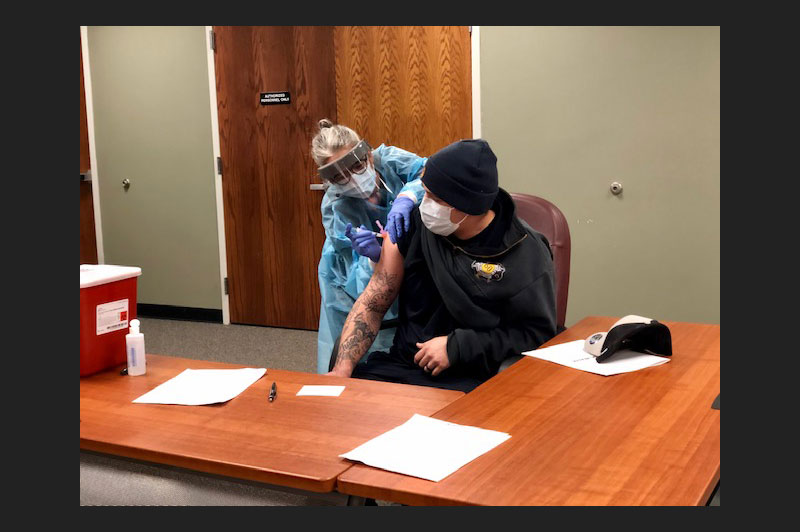
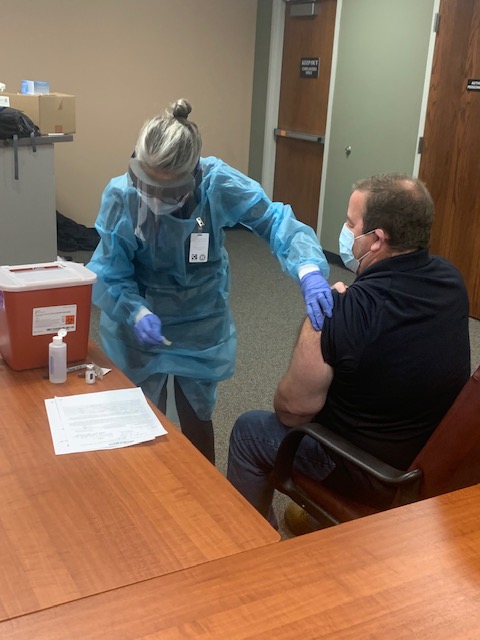
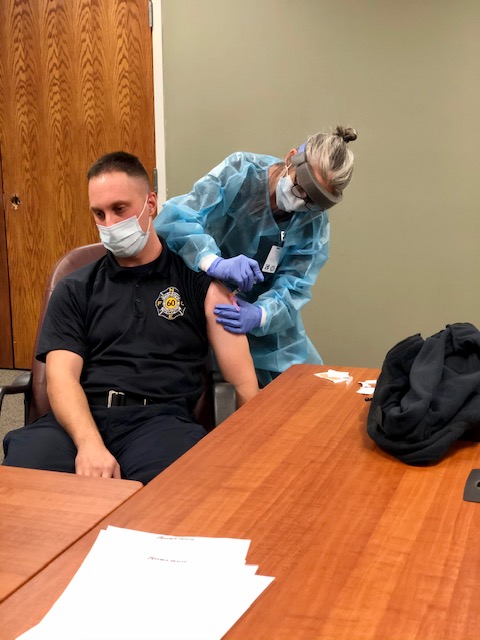
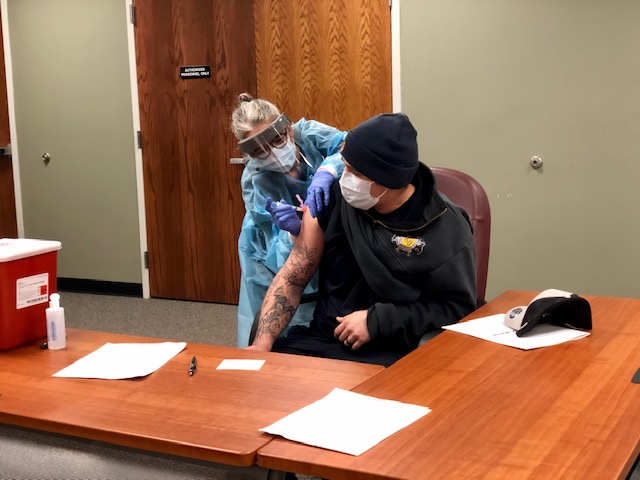
Loveland, Ohio – The Loveland-Symmes Fire Department started receiving their first vaccinations for the COVID 19 virus yesterday, Tuesday, December 29, from the Hamilton County Public Health Department. “We will be vaccinating additional personnel in the future,” said Deputy Chief Michael Books.
By Marshall Allen and Rachel Dissell | December 18, 2020
OHIO JUVENILE COURT JUDGE TIMOTHY GRENDELL THOUGHT CORONAVIRUS PRECAUTIONS WERE OVERBLOWN, AND MADE SURE PEOPLE KNEW IT. IN ONE CASE HE FORBADE A MOTHER FROM GETTING HER CHILDREN TESTED FOR COVID-19. THEN, ONE OF THEM HAD TO GO TO THE EMERGENCY ROOM.
Ohio juvenile court Judge Timothy Grendell has been outspoken about his belief that the COVID-19 pandemic is overblown.
At a protest rally in May, just steps away from where he presides over family court, Grendell proclaimed that public health restrictions to contain the pandemic were unconstitutional and “we should be allowed to get back to our lives.” The following month, he testified to state lawmakers in Columbus that health authorities and a “drumbeat” of media coverage had “created an atmosphere of fear” surrounding the virus.
But Grendell hasn’t confined his views to the public square. A few weeks after he testified to lawmakers, he referred to the pandemic as a “panic-ademic” in the midst of a custody proceeding in his courtroom in Geauga County, outside Cleveland. And he has claimed that 15 mothers in his court have used the virus as an excuse in custody cases to “mess with” their exes’ parenting time.
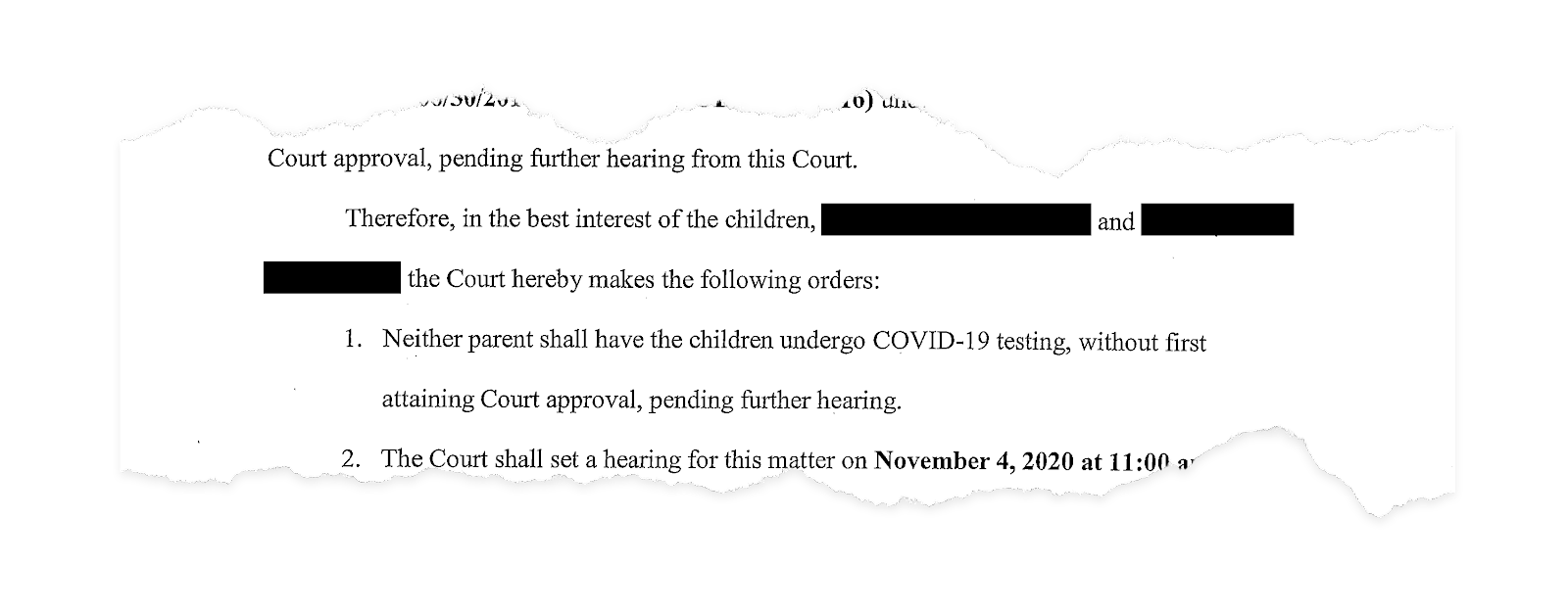
Then, on Oct. 2, Grendell made an order that legal experts call unheard of, and medical experts say could cause harm. The judge banned two parents, who were wrangling over custody of their young boys, from having the “children undergo COVID-19 testing” without his approval, according to the court record.
A doctor subsequently ordered a coronavirus test for one of the boys before admitting him to a children’s hospital for severe breathing problems. When Grendell found out, he threatened to find the mother in contempt of court, a move that could lead to her being thrown in jail.
Legally, judges have wide discretion to resolve disputes between parents. Some courts have issued standing orders that general concerns about COVID-19 should not disrupt established parenting schedules. But medical experts told ProPublica that a COVID-19 test is often essential for health care providers to protect themselves and to decide on the best course of treatment for a patient.
“We are unable to provide the right kind of care without it,” said Dr. Robert Wachter, chair of the department of medicine at the University of California, San Francisco. “It’s basically blindfolding us or asking us to take care of someone with an arm tied behind our back.”
Judges around the country have received media attention for their rulings related to the pandemic. ProPublica reported in July that a Michigan judge sent a 15-year-old girl to juvenile detention, ruling she violated her probation by failing to complete her homework while remote learning. The Michigan Court of Appeals ordered her immediate release later that month.
In April, a judge in South Florida temporarily took custody away from a doctor because she treated patients with COVID-19, the Miami Herald reported. In Iowa, a judge sentenced a mother to 10 days in jail for refusing to follow a child visitation ruling due to COVID-19 concerns, according to the Sioux City Journal. And another judge in South Florida required a mom to wear a mask if she wanted to see her child, wrote the South Florida Sun Sentinel.
The conflict between public health precautions and individual freedoms has been extreme in Ohio, which was among the first states to issue sweeping health orders to prevent the spread of the coronavirus. Rising discontent with the orders this spring led angry citizens to march on the Ohio Statehouse, chanting “Open Ohio” and breaking several windows. Protesters showed up at the suburban Columbus home of Amy Acton, then the director of the Ohio Department of Health. Some carried rifles. One woman carried a sign with an anti-Semitic message aimed at Acton, who is Jewish. Acton later resigned and some conservative lawmakers turned their attention to Gov. Mike DeWine, a Republican, with some demanding his impeachment and his arrest, to no avail.
Infection numbers were low early on in Ohio, but since October the seven-day average of new daily COVID-19 cases has spiked tenfold, to about 10,000 on Dec. 13. Daily deaths and hospitalizations also have jumped to record highs.
Timothy Grendell, a Republican former legislator who has been on the bench for more than a decade, has long been a polarizing figure in Ohio political and legal circles. That reputation extends to his courtroom. ProPublica has spoken to mothers and grandmothers in four additional cases who said Grendell has been unfair to them. Some said they have filed complaints against him. Investigations are confidential until concluded; Grendell has not been disciplined by the Office of Disciplinary Counsel of the Supreme Court of Ohio.
In May, Grendell sent Stacy Hartman’s two teenage sons to juvenile detention after they refused a court-ordered visit with their father. The judge also threatened to hold Hartman in contempt of court and jail her if she didn’t take them to the visit, according to a court transcript. Hartman told ProPublica that she begged that her two boys not be locked up during a pandemic. After the local ABC television affiliate reported on the story, Hartman said mothers and some grandmothers started to call her with stories about their cases in Grendell’s courtroom. Each of the cases was different. But Hartman was struck by one similarity: “Everybody is scared about what he is going to do.”
The judge also has been embroiled in public spats, sometimes with other elected or political officials. In one high-profile example, in 2014, he threatened to hold the chairwoman of the Geauga County Republican Party in contempt of court after he learned she had privately characterized him as a “narcissist and mentally ill.” The matter was dropped.
Several family law attorneys told ProPublica that they refuse to take cases in Grendell’s court because they do not believe he treats parties in cases fairly. They asked to speak on the condition of anonymity because they did not want to risk the judge filing a complaint against their licenses.
Grendell declined ProPublica’s request to be interviewed for this story. In his most recent judgment entry, on Dec. 9, he said the mother at the center of the COVID-19 testing case had failed to return the children on several occasions, “using COVID-19 or her concerns about the children and COVID-19 as the reason for not complying with the Court’s orders.”
Through his court administrator, Grendell said that he was prohibited from commenting on pending cases, or about broader accusations related to his conduct. He said his decisions are “always in the best interest of the children” and “based on sound law and the actual facts in the case.” Grendell reiterated that he has seen situations where one parent repeatedly misuses COVID-19 testing and quarantining to prevent the other parent from spending court-ordered time with children.
“The court is fully cognizant of the seriousness of COVID and understands the need for all members of the public to be careful and to engage in the necessary and recommended safeguards,” Grendell said.
Amplifying a Dispute
The pandemic had exacerbated an already tense parenting arrangement between Richard Sherrick and Kimberly Page, who were never married but have two boys who are 6 and 4. The two have lobbed accusations and counteraccusations against each other. Page felt ongoing anxiety about her health and the health of the boys. Medical records she provided to ProPublica document the boys’ chronic conditions, including asthma, autism and other ailments. The boys’ Cleveland Clinic pediatrician had deemed them high risk if they became exposed to the coronavirus.
On four occasions since April, Page said, the boys were quarantined or they had to be taken to the doctor or hospital for treatment, which delayed their return to Sherrick. The delays were typically brief, she said. She said that she communicated with her ex each time, and that there have been times in the past when he had delayed returning them to her.
Sherrick and his attorney, Robert Zulandt, did not return multiple requests from ProPublica to comment. In court, Sherrick has accused Page of using visits to doctors and hospitals as an excuse to keep the boys longer than her allotted parenting time. He also has alleged that his ex is obsessive to the point that it creates fear and anxiety for the children and that she has had the children overtreated and tested for COVID-19 and other illnesses. She has disputed those characterizations.
After Grendell issued his ruling prohibiting a COVID-19 test without his permission, Page contacted Geauga County Health Commissioner Tom Quade to talk about it. Quade told ProPublica that he reached out to his agency’s lawyer but ultimately decided not to get involved because the order didn’t apply to his agency, which does not provide COVID testing.
Quade said he did not have all the details about the judge’s order, but it seemed consistent with Grendell’s “this is a big nothingburger” feeling about COVID-19. In their mostly rural county of about 90,000 people, the judge and his wife have repeatedly made public comments that minimize the health threat of the pandemic, he said.
The judge’s order banning the two parents from having their sons tested for COVID-19 without court approval.
Family court judges like Grendell have wide discretion to make decisions in the best interests of children in the middle of custody or abuse cases, experts say.
There are times a judge could issue orders that either require medical treatment or forbid it, like if a child had terminal cancer and the parents disagreed about treatment, said Sharona Hoffman, co-director of the Law-Medicine Center at Case Western Reserve University. But those types of decisions are generally made after a judge hears evidence from both sides on the issues, Hoffman said. In this case, Grendell made the order on his own motion, without a specific request from either parent to ban the test.
“There is no downside to getting a COVID test,” Hoffman said.
The danger of the judge’s order, if followed, is that it might lead to one of the boys not getting medical treatment he needs, said Michelle Mello, a health law and policy professor at Stanford University. What’s striking from a medical-legal perspective, Mello said, is that the child’s test was given during a hospital visit. “It’s standard of care,” Mello said. “Nobody gets into a hospital and around other patients without a COVID test. There’s a public health reason.”
Page said her attorneys warned her against taking her child to the hospital on Nov. 2 for fear of violating the judge’s order. But her son’s breathing was so labored that she and her new husband, a doctor, believed he had to go to Akron Children’s Hospital. The child was administered a COVID-19 test before being admitted and treated during an overnight stay. The test was negative.
The hospital declined to comment about the case, but said in a statement that it performs COVID-19 tests when they are deemed medically necessary and on patients who are admitted with respiratory symptoms.
Saying Page had failed to return the children on time, Sherrick filed an emergency motion with the judge for custody of the children. The next day, Grendell suspended Page’s custody and sent his constable to the hospital to retrieve the child and hand him off to his father. The child’s younger brother was picked up from the home of Sherrick’s mother.
About a week later, Grendell ordered Page to appear before him “to show cause why you should not be held in Contempt of Court for failing to abide by parenting time … and for failing to abide by the order prohibiting COVID-19 testing, unless approved by the Court first.”
On Nov. 20, Grendell issued a new interim order that the children could be tested if they had symptoms and if their pediatrician recommended it. That same day the court ordered supervised visitation. Page has disagreed about the parameters suggested for visitation, so she still has not seen her children.
Page’s attorney said she could still be held in contempt of court, for violating the original order not to have the children tested for COVID-19. Hearings in the case have been delayed until January.
“Panic-ademic”
Grendell’s no-testing order wasn’t the first time COVID-19 had been a point of contention in the case.
Page accused Sherrick of failing to provide adequate medical care for the boys, and her parenting time included multiple visits to doctors and emergency rooms. Page’s medical records show they have undergone five tests for COVID-19 between them.
In a June 29 hearing, Grendell dismissed the virus as a relevant factor: “There is zero evidence that COVID is a danger to 6-year-olds — zip,” Grendell said, according to the court reporter’s transcript of the hearing.
Page had a fever the day before the hearing, a possible symptom of COVID-19, so she sat in her car. Grendell accused her and other mothers — at least 15 total, he said — of improperly using the virus as “a reason to mess with” the parenting time of fathers. “So this is like the cause du jour,” Grendell said. “Hey, you know, I want to mess with the ex or with the dads, since most of these people never married, and COVID-19 gives me an excuse to mess with his parenting schedule.”
Earlier in the pandemic, the COVID-19 “fear factor” made sense, Grendell continued. But now that it was “almost July 1st, it’s not doing much for me,” he said.
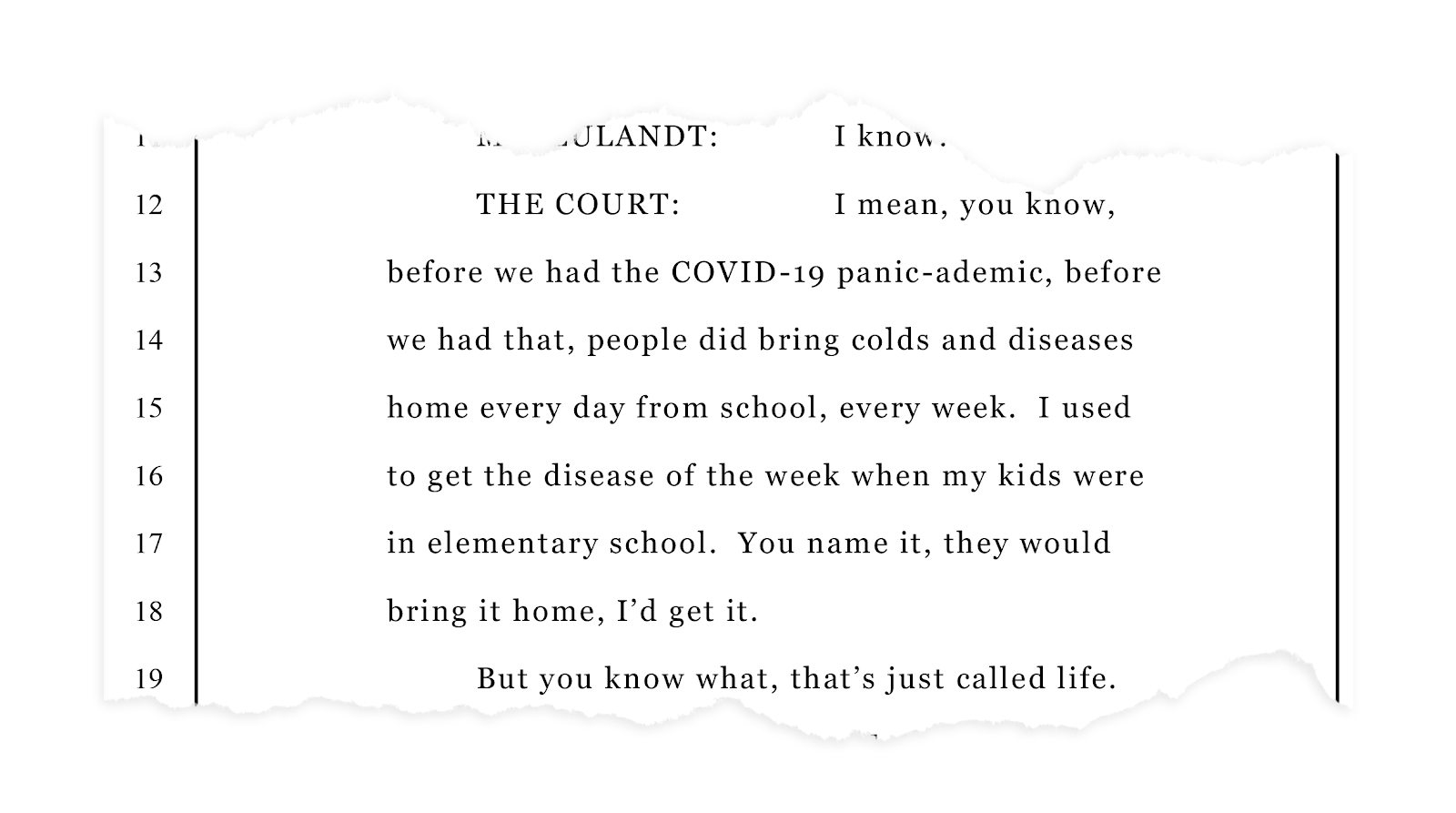
Before COVID-19, people brought home colds and diseases every day, he said, branding the pandemic a “panic-ademic.”
The transcript from a June 29 hearing shows Grendell expressing views on the pandemic in court.
Near the conclusion of the hearing, Grendell issued a threat: “I’m going to make this crystal clear,” he said. “The next person who doesn’t follow the orders is going to see a contempt citation coming their way.”
Friction between Page and Sherrick continued. She thought it was too risky for her elder son to attend school in person. He wanted her to stop scheduling so many medical appointments for the children, which delayed their return to him. On Sept. 23, Page went to Sherrick’s home and picked up the child to take him to the hospital, according to a court filing, and was late returning him to Sherrick. Sherrick filed a handwritten motion the next day, claiming Page had a pattern of not returning the boys, and asking for custody.
Grendell then personally called Page’s cellphone, and left a voicemail, saying Sherrick said the child needed to be returned, and instructing her to call him. “I certainly would like an explanation, and I don’t believe COVID at this time period is a legitimate one,” he said on her voicemail, which was provided to her attorneys and ProPublica. It is highly unusual for a judge to call a litigant in a proceeding directly. Grendell did not return ProPublica’s request to comment about the voicemail.
Grendell’s order prohibiting testing for COVID-19 came about a week later. The evidence in the dispute still has not been heard in court.
“He Knows He Makes the Rules”
Page said she reached a breaking point after losing custody of her children and being accused of contempt of court. One set of attorneys warned her not to speak publicly about her case and withdrew from representing her after she ignored their advice.
As a mother, Page said she felt she had to speak out because attorneys have been reluctant to challenge Grendell and without that, she can’t see the case getting resolved fairly. “This judge needs to be held accountable to somebody other than our family,” Page said.
Page’s new attorney, Lee Potts, said when he took over the case he understood it was complicated. But the blanket order prohibiting COVID-19 testing seemed to “come out of nowhere.”
Since Grendell himself made the motion, it made Potts wonder: “Who is telling you this stuff? How are you getting this information?”
Though Sherrick did not respond to requests for comment, his mother, Bonnie Sherrick, lamented the effect the case is having on her grandchildren. She said that her son, as well as Page and Grendell, have all contributed to the problems, but that there’s no reason Page should be penalized for properly managing the medical conditions of the children. “She has been a good mother,” Sherrick said of Page.
Nobody seems to be able to stop Grendell, Bonnie Sherrick said of the judge. “He knows he makes the rules.”
Have you had issues related to COVID-19 affecting your court case? Please share your story with ProPublica by emailing tips@propublica.org. Here’s how tosend tips and documents to ProPublica securely.
By Boniface Womber and Bonnie Jean Feldkamp December 18, 2020
This article is from Eye on Ohio, the nonprofit, nonpartisan Ohio Center for Journalism. Please join their free mailing list, as this helps provide more public service reporting.
Amid a raging pandemic, Ohio’s agency responsible for looking out for workers’ welfare has started posting full-time temporary jobs with no benefits for its own workforce.
For example, this week the Ohio Department of Job and Family Services (ODJFS) sought to hire an “electronic design specialist,” a job that requires a bachelor’s degree, years of experience, or some combination of both. The hours listed are full time, with a schedule that is “not negotiable” and the position is “not eligible” for benefits.
As total COVID-19 cases in the state soared to nearly 600,000 and deaths rose to almost 8,000, Eye on Ohio asked why the positions are listed without medical benefits when large employers have to give most of their workforce— even temporary workers— medical insurance eventually under the Affordable Care Act, or pay a penalty.
A spokesman for ODJFS said “Benefit eligibility under the ACA for temporary or part-time positions is determined based on the length of time employed and hours worked during that period of time.”
Eye on Ohio further inquired if the positions have a set end date and why officials listed positions with no health care as the chances of getting a debilitating disease have risen. Officials did not respond to multiple requests to comment.
Each job posting begins with, “The Ohio Department of Job and Family Services’ mission is to improve the well-being of Ohio’s workforce and families by promoting economic self-sufficiency and ensuring the safety of Ohio’s most vulnerable citizens.”
But it’s not clear if ODJFS’ own workers could be self-sufficient with its own positions: according to Heatlhcare.gov, a monthly premium for a nonsmoking family of four in Columbus is approximately $810. That’s about 24% of what an ODJFS electronic design would make after taxes. And doesn’t include money for a deductible, or other costs associated with getting sick.
Other temporary jobs don’t require a degree or much experience but make much less, such as a temporary customer service representative, who would have to shell out 30% of their post-tax income just for premiums for a similar family. Benefits the Law Requires
When it comes to employee benefits, Lyndsey Barnett, chair of Graydon Law’s Employee Benefits’ Department, said technically “there is no law that any employer provides any employee any benefit regardless of the number of hours that they work.”
The Affordable Care Act does however place a penalty on what’s called Applicable Large Employers (ALE) if they do not offer “minimum essential coverage” after a specified waiting period. According to IRS.gov, “applicable large employers have annual reporting responsibilities concerning whether and what health insurance they offered to their full-time employees (and their dependents).” Determining which employees are considered “full-time equivalent” isn’t always as simple as knowing who’s on the payroll for more than 30 hours per week. Also the ALEs are permitted a 90-day waiting period before employees are eligible for benefits so if a temporary position only lasts three months the employee may never qualify for benefits.















![[Video Report] The 13th running of the Captain Seth Mitchel Hero 5K](https://lovelandmagazine.com/wp-content/uploads/2022/10/hero-5k-feature.jpg)








![[Photo Album] FC Cincinnati tied Atlanta, falls to Nashville](https://lovelandmagazine.com/wp-content/uploads/2021/07/feature-fc-vs-atlanta.jpg)



































![[VIDEO] Congrats to all the 2021 Loveland Valentine Poetry Winners!](https://lovelandmagazine.com/wp-content/uploads/2021/02/feature-roman-lyke.jpg)