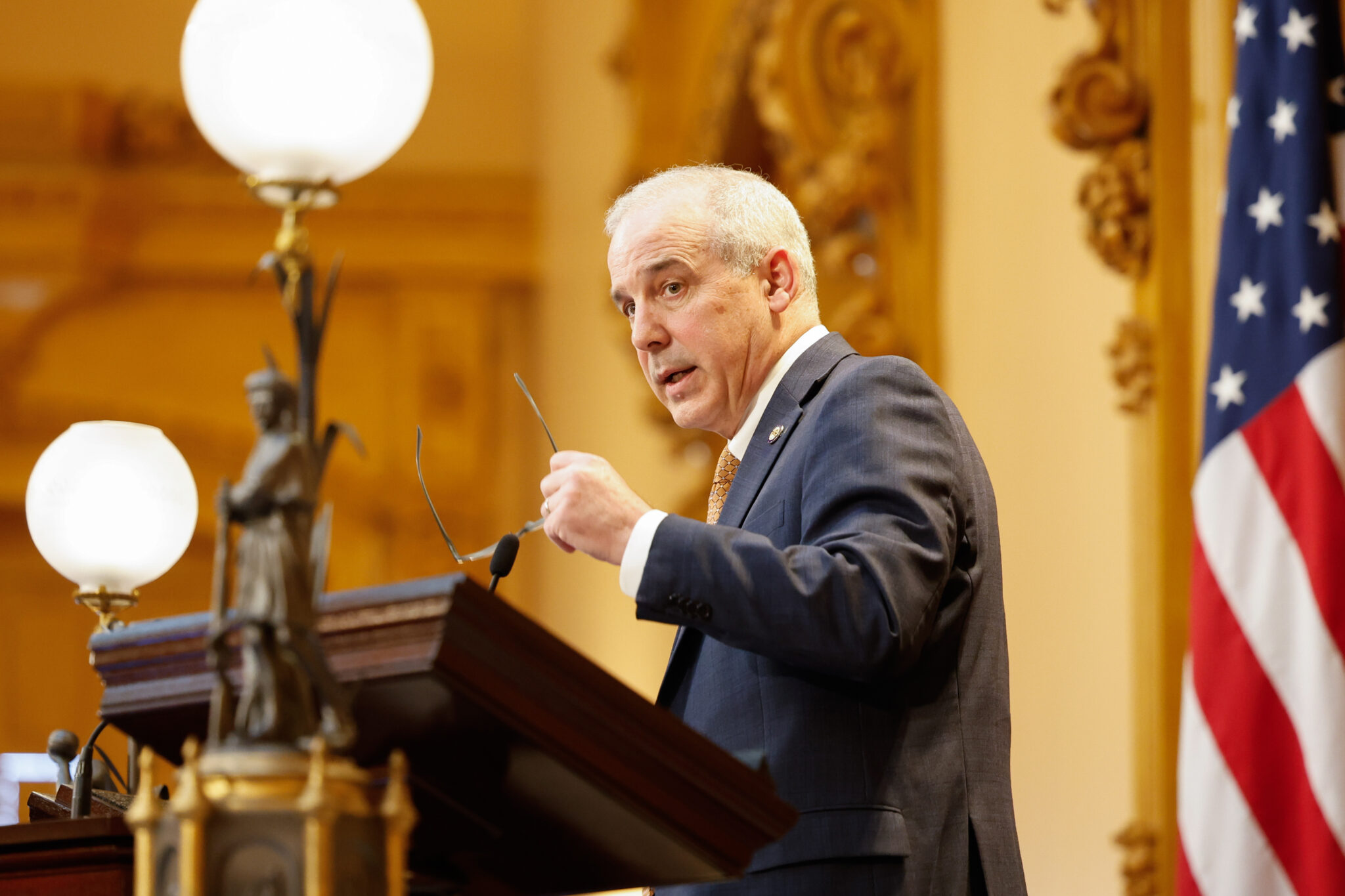
Ohio Gov. Mike DeWine on Friday signed into law a massive higher education overhaul to ban diversity efforts, regulate classroom discussion, and prohibit faculty strikes, among other things. The law will take effect in 90 days.
S.B. 1 will set rules around classroom discussion, create post-tenure reviews, put diversity scholarships at risk, create a retrenchment provision that block unions from negotiating on tenure, shorten university board of trustees terms from nine years down to six years, and require students take an American history course, among other things.
For classroom discussion, the bill will set rules around topics involving “controversial beliefs” such as climate policies, electoral politics, foreign policy, diversity and inclusion programs, immigration policy, marriage, or abortion. S.B. 1 would only affect Ohio’s public universities.
The bill moved quickly through the Statehouse. State Sen. Jerry Cirino, R-Kirtland, introduced S.B. 1, which passed the Ohio Senate in February and the Ohio House in March. Cirino introduced a nearly identical bill during the last General Assembly that went through several revisions, but the bill never made it the House floor and ultimately died.
Megan Henry is a reporter for the Ohio Capital Journal and has spent the past five years reporting in Ohio on various topics including education, healthcare, business and crime. She previously worked at The Columbus Dispatch, part of the USA Today Network.
Ohio Capital Journal is part of States Newsroom, the nation’s largest state-focused nonprofit news organization.
Ohio college students, faculty and staff are calling on Gov. Mike DeWine to veto a massive higher education bill that would ban diversity and inclusion on campus and prevent faculty from striking.
Lawmakers concurred with tweaks made to Senate Bill 1 during Wednesday’s Senate session, sending the bill to DeWine’s desk for his signature. DeWine received the bill Wednesday and has 10 days to sign the bill into law or veto it. If DeWine vetoes the bill, lawmakers would need a 3/5 vote from each chamber to override it.
DeWine, however, has previously said he would sign the bill.
GET THE MORNING HEADLINES.
S.B. 1 would set rules around classroom discussion, create post-tenure reviews, put diversity scholarships at risk, create a retrenchment provision that blocks unions from negotiating on tenure, shorten university board of trustees terms from nine years down to six years, and require students take an American history course, among other things.
For classroom discussion, the bill would set rules around topics involving “controversial beliefs” such as climate policies, electoral politics, foreign policy, diversity and inclusion programs, immigration policy, marriage, or abortion, and forbid “indoctrination,” though that remains undefined. S.B. 1 would only affect Ohio’s public universities.
“Republicans showed us they’d rather gamble with our economic future than solve real problems in our state,” Ohio Democratic Party Chair Elizabeth Walters said in a statement. “Instead of growing our state, Republicans are driving students, young adults, and business away from Ohio. We’re urging Governor DeWine to do the right thing and veto this legislation.”
“This legislation is a misguided attempt by overreaching legislators to impose their ideological beliefs on our public universities,” the letter said. “The bill undermines academic freedom, attacks collective bargaining rights, and jeopardizes the future of higher education in our state.”
The Ohio House Minority Caucus also sent a letter to DeWine asking him to veto the bill.
“You have an opportunity to protect the future of Ohio’s institutions of higher education, and your legacy as Ohio’s governor, by vetoing this bill and requiring the legislature to negate terms that are more amenable to the will of Ohioans,” the letter read.
The ACLU of Ohio wants DeWine to veto S.B. 1 and protect free speech on campus.
“By dismantling DEI structures, Senate Bill 1 sends a clear, harmful message to students that their unique backgrounds, experiences, and perspectives are not welcome in Ohio,” ACLU of Ohio Policy Director Jocelyn Rosnick said in a statement.
Anticipating S.B. 1 would pass during Wednesday’s Senate session, members of the Ohio Legislative Black Caucus urged DeWine to veto S.B. 1 during a press conference earlier that day.
“This is one of the worst government overhauls that I’ve seen to date,” said state Rep. Terrence Upchurch, D-Cleveland. “It will not only limit our First Amendment right to free speech, ban strikes and collective bargaining rights for professors, it threatens opportunities for our students, undermines workforce development and disproportionately harms black and minority communities.”
State Rep. Desiree Tims, D-Dayton, said S.B. 1 is toxic, racist and a threat to free speech and academic freedom.
“Since when is diversity, equity and inclusion a bad thing?” she asked. “Why is this necessary? The only answer is, so that we can move backwards, pre-civil rights … progress that this country and this nation has stood for. … Senate Bill 1 turns the ugly page back in history, somewhere we do not want to go, where we should not go.”
“The diversity scholarships weren’t designed to discriminate against white students,” she said. “The diversity scholarships were designed to encourage more students of color to come to little old, white Athens, Ohio and get a quality education.”
S.B. 1 will be detrimental to Ohio’s higher education, Dashiell said.
“If it hadn’t been for an extra effort at Ohio University to diversify the faculty, I would still be in Tennessee,” she said. “We also urge that Governor DeWine veto this bill because it’s going to hurt our students. It’s going to hurt those who will benefit from diversity programs and benefit from these diversity scholarships.”
Ohio State University’s Chair of the Undergraduate Black Caucus Jessica Asante-Tutu said this bill runs the risk of forcing Ohioans to move out of state.
“Students learn best in environments that encourage exchanges, where ideas flow freely and where differences are respected,” she said. “This bill stifles all of that.”
As an Olentangy Liberty High School student in Delaware County, Michelle Huang said S.B. 1 hangs over her head as she thinks about applying for colleges this fall.
“The threat of this bill passing is a deterrent from us attending Ohio State in the first place,” she said. “What DEI is actually doing is actually promoting more discourse and promoting more intellectual diversity.”
Megan Henry is a reporter for the Ohio Capital Journal and has spent the past five years reporting in Ohio on various topics including education, healthcare, business and crime. She previously worked at The Columbus Dispatch, part of the USA Today Network.
Ohio Capital Journal is part of States Newsroom, the nation’s largest state-focused nonprofit news organization.
Ohio House Republican lawmakers voted to pass a massive higher education overhaul bill Wednesday that would ban diversity and inclusion efforts and prevent faculty from striking.
State Sen. Jerry Cirino, R-Kirtland, introduced S.B. 1, which passed the Ohio Senate last month.
Now that it’s been passed by the House, it now heads back to the Ohio Senate for concurrence with changes made to the bill by the House.
Ohio Senate President Rob McColley, R-Napoleon, said Wednesday the Senate will concur with House changes at a later date.
After the Senate concurs with the House changes, the bill will go to Ohio Gov. Mike DeWine’s desk and DeWine will have 10 days to sign the bill into law or veto it once he receives it. If DeWine vetoes the bill, lawmakers would need three-fifths vote from each chamber to override it.
In addition to the bans on diversity efforts and faculty strikes, S.B. 1 would also set rules around classroom discussion, create post-tenure reviews, put diversity scholarships at risk, create a retrenchment provision that block unions from negotiating on tenure, shorten university board of trustees terms from nine years down to six years, and require students take an American history course, among other things.
For classroom discussion, the bill would set rules around topics involving “controversial beliefs” such as climate policies, electoral politics, foreign policy, diversity and inclusion programs, immigration policy, marriage, or abortion. S.B. 1 would only affect Ohio’s public universities.
The Ohio House Higher Education Committee voted the bill out of committee Wednesday morning with a 9-4 party-line vote after listening to people testify in support of the bill.
The committee also approved amendments to S.B. 1 that would require universities to stop accepting funds for scholarships with diversity and inclusion requirements four years after the bill becomes law.
Another amendment requires the Chancellor of Higher Education to do a diversity study of students enrolled in universities based on race, ethnicity, and biological sex and submit the report to lawmakers within six years.
Outside of the Ohio Statehouse, a mass of college students and protesters rallied against the bill, saying it would destroy freedom of thought and expression on university campuses and push students out-of-state.
(Photos by David DeWitt, Ohio Capital Journal.) Ohio college students and protesters rally at the Statehouse on March 19, 2025, against Senate Bill 1, a higher education overhaul that bans diversity efforts and faculty strikes, and sets rules around classroom discussion, among other things.
Megan Henry is a reporter for the Ohio Capital Journal and has spent the past five years reporting in Ohio on various topics including education, healthcare, business and crime. She previously worked at The Columbus Dispatch, part of the USA Today Network.
Ohio Capital Journal is part of States Newsroom, the nation’s largest state-focused nonprofit news organization.
The bill would also prohibit the use of state funds for assisted suicide, and clarify the state’s prohibition against the use of state funds for abortion
Loveland, Ohio – State Representatives Adam Mathews (R-Lebanon) and Jean Schmidt (R-Loveland) held a press conference January 28th on soon-to-be introduced bipartisan legislation to prohibit the use of state funds to end the lives of Ohioans.
All or Nothing
The bill will abolish the death penalty in Ohio, prohibit the use of state funds for assisted suicide, and clarify the state’s prohibition against the use of state funds for abortion. The bill would link each issue with a non-severability clause, underscoring, “the sponsors’ unity of purpose through a comprehensive affirmation of life”.
“This ‘first of its kind’ legislation will protect state dollars, and more importantly, human life,” said Schmidt during the press conference. “Decades of crusading against a culture of death have brought us here to affirm that protecting life must extend to every circumstance and stage of development. To be consistent in our pro-life principles, we must oppose the state funding of abortion, the death penalty, and assisted suicide.”
“This is transformative legislation that represents a new era of fiscal and moral conservatism and responsibility,” said Mathews. “This is more than just policy; this is about the affirmation that where there is human life, there is dignity and hope. By prohibiting public funds from being used to terminate human life, this legislation sends a clear message that Ohio will not fund death.”
The representatives were joined by State Senator Steve Huffman (R-Tipp City), Senate Minority Leader Nickie Antonio (D-Lakewood), and Senate Assistant Minority Leader Hearcel Craig (D-Columbus), as well as the Executive Director of the Catholic Conference of Ohio, Brian Hickey, and Founder of the Run the Race Club, Rachel Muha.
Ohio Democratic lawmakers are asking the state legislature to undo laws on the books that they say conflict with the reproductive rights amendment passed by voters in 2023 that’s now part of the Ohio Constitution.
Several of those laws have been struck down by judges, either temporarily as a lawsuit continues or in official court rulings, but the laws remain part of the Ohio Revised Code.
Sponsors of the bills say the constitutional amendment passed last year negates these laws, therefore necessitating the repeal of regulations that require 24-hour waiting periods for abortions and transfer agreements of certain distances for physicians and hospitals who work with abortion clinics, for example.
“We, the legislature, should not be making choices for all women in the state,” said state Rep. Beth Liston, D-Dublin. “The people of Ohio have said they want these decisions for themselves.”
Republicans hold a 67-32 majority in the Ohio House and a 25-7 majority in the Ohio Senate, and state Republican leaders opposed the amendment.
State Rep. Beth Liston, D-Dublin, speaks at a rally to protect abortion rights. (Photo from General Assembly website.)
Liston and fellow state Rep. Anita Somani, D-Dublin, both of whom are physicians, brought House Bill 343 to the House Public Health Policy Committee in hopes of “simply ensuring that all of our state laws are now in agreement with that amendment.”
“Removing these barriers to care will reduce delays in care and actually allow health care providers to serve their patients properly,” Somani told the committee on Wednesday. “We have a health care access problem in Ohio and restrictive laws like these are part of the problem.”
H.B. 343 wasn’t the only bill Somani presented to the Public Health Policy Committee in an effort to protect reproductive rights.
House Bill 502, which also saw its first hearing in the committee on Wednesday, would protect access to “assistive reproductive technology,” which includes in-vitro fertilization. Fertility treatments were also listed as one of the rights covered by the constitutional amendment approved by 57% of Ohio voters last year.
But an Alabama Supreme Court case from this year has caused nationwide concerns about the future of IVF and embryos saved by individuals going through fertility treatments. State supreme court justices in that case ruled that frozen embryos could still be considered children, an issue that has come to be known as “personhood” as federal and state-level entities debate fetal viability and regulation as a whole.
The “personhood” issue is not foreign to Ohio, which saw a 2022 bill in which state Rep. Gary Click, R-Vickery, said “the unborn” is a “class of people” who have “erroneously been denied their constitutional rights.”
Click said his legislation would consider a “zygote, embryo or whichever depersonalizing term you choose” a “human with potential” from the moment of fertilization.
That bill died in the previous General Assembly, though Click has not ruled out bringing the idea back in a future GA.
Back in March, after the Alabama decision came about, Senate President Matt Huffman, who will soon become Ohio’s House Speaker, said there hadn’t been “any discussion by any member of my caucus or anybody else as far as in the state of Ohio as far as I know” regarding “personhood” or IVF regulations.
GET THE MORNING HEADLINES.
But Somani said protection of the technology around IVF “should be explicitly stated in state law so that there is no confusion about the legality of the practice.”
“We don’t want to make the same mistakes as other states,” she told the committee on Wednesday. “Equating embryos with people confuses those who practice evidence-based medicine and the reproductive care that they can provide.”
The sponsors cited CDC statistics which showed 2,226 births in Ohio in which IVF was used in 2021. In that same year, more than 86,000 births nationally were attributed to IVF, with 42% of adults saying they have used fertility treatments or know someone who has, according to the CDC.
“Experiencing infertility can be a mentally, emotionally and physically exhausting journey and we as lawmakers should not be doing anything to increase that stress,” Somani said.
H.B. 502 would also prevent health care providers from “being compelled to release patient records to third parties, including out-of-state entities or law enforcement,’ and allow lawsuits from individuals who feel their privacy rights are violate with regard to medical information.
The bill’s co-sponsor, state Rep. Beryl Brown Piccolantonio, D-Gahanna, acknowledged the tight timeline the bill is now under with less than a month before the current General Assembly ends, and all unapproved bills must be reintroduced in the new year. But, she said she hoped the committee would allow supporters of the bill to speak on IVF’s importance, especially with the possible impact of the Alabama Supreme Court ruling.
“This decision has significant implications for reproductive rights and the legal status of embryos, influencing legislation and public policy across multiple states, including Ohio,” Piccolantonio said.
YOU MAKE OUR WORK POSSIBLE.
____________
Susan Tebben
Susan Tebben is an award-winning journalist with a decade of experience covering Ohio news, including courts and crime, Appalachian social issues, government, education, diversity and culture. She has worked for The Newark Advocate, The Glasgow (KY) Daily Times, The Athens Messenger, and WOUB Public Media. She has also had work featured on National Public Radio.
Ohio Capital Journal is part of States Newsroom, the nation’s largest state-focused nonprofit news organization.
State lawmakers in Ohio want to prohibit local governments from using public dollars in support of abortion. They’re casting a wide net.
Legislation sponsored by state Rep. Josh Williams, R-Sylvania, bars public funds from being given directly or indirectly to an organization that provides abortions that aren’t necessary to protect the life of the mother.
In addition, the bill prohibits funding going to any group providing services for people seeking such abortions like transportation, housing or wage reimbursement. Williams’ measure also takes an apparent swing at public employees by explicitly including paid time off as a prohibited expenditure.
The bill uses a claw back provision as its enforcement mechanism. If a municipality expends funds in violation of the act, the state would reduce its share of the local government fund appropriation. Dollars withheld under the law would then be directed to a new fund supporting crisis pregnancy centers.
Williams’ bill requires local governments to report relevant spending on a monthly basis. If they don’t report — or don’t report accurately — they risk losing their entire local government fund appropriation.
GET THE MORNING HEADLINES.
Proponents
In the House Government Oversight committee, the usual representatives of the anti-abortion movement showed up to testify in favor of Williams’ bill.
Will Kuehnle from the Catholic Conference of Ohio argued, “In no circumstance should state dollars, even by subsidy, bring about the termination of a human life.”
He highlighted programs like one in Columbus granting half a million dollars to support women seeking abortions by reimbursing travel and childcare costs rather than the procedure itself. The appropriation was made with federal dollars from the American Rescue Plan, and it was approved by Columbus City Council shortly after the U.S. Supreme Court overturned Roe v. Wade triggering Ohio’s earlier 6-week abortion ban to snap into effect.
In his sponsor testimony, Williams cited initiatives in other cities as well — all backed by federal rather than state dollars, and none of which paid for medical procedures.
Kuehnle insisted if the city wants to offer assistance like paying for travel it should be spending that money supporting mothers rather than people seeking abortions. He argued in many circumstances, people seek an abortion because they’re not receiving some critical service from their community.
“What this bill seeks to do is to take every dollar that we can give to a woman in need and make sure that’s where it’s going,” he said.
Notably, while the measure punishes cities for supporting services connected to some abortions, it doesn’t actually provide services to pregnant people or young parents. Although some crisis pregnancy centers provide things like diapers, their primary mission is to discourage abortion.
Emma Martinez from Ohio Right to Life criticized the same Columbus grant and cast her organization’s support for Williams’ bill in moral terms.
“This legislature has drafted numerous laws that not only protect taxpayers from paying for abortions, but also that protect taxpayers’ conscience rights,” she argued.
And Nilani Jawahar from the Center for Christian Virtue emphasized the legislation’s punitive approach to local governments.
“This legislation is simple,” she said. “Counties and municipalities may spend their money as they please, but if they receive state funds for a specific purpose and they choose to spend it funding elective procedures, they are demonstrating to the state that they do not need that money, and therefore the state has a right to withhold it and direct it to where it may be put to better use.”
Skeptical Democrats
The measure’s proponents were met with pushback from the committee’s Democratic members.
State Rep. Latyna Humphrey, D-Columbus, emphasized unintended consequences. Cutting off funds to entities that provide elective abortions risks cutting off access to other healthcare services those organizations provide, like screening for sexually transmitted infections.
“You all understand that health care is a necessity, specifically in communities where there are health care deserts.” Humphrey pressed Kuehnle. “So I understand you all don’t believe in abortions, but entities like Planned Parenthood and others do provide health care services outside of that.”
Meanwhile, Rep. Dani Isaacsohn, D-Cincinnati, asked Jawahar how lawmakers could square the bill’s approach with Ohio voters’ support for protecting reproductive rights in the vote for Issue 1.
“What I’m asking is, how would you summarize the will of the voters as expressed in Issue 1 last year?” he said. “What did the voters express with Issue 1’s passage last year?”
After a bit of back-and-forth Jawahar replied, “I’m not here to talk about the will of the voters, I’m here to talk about this bill and why we support it.”
Nick Evans has spent the past seven years reporting for NPR member stations in Florida and Ohio. He got his start in Tallahassee, covering issues like redistricting, same sex marriage and medical marijuana. Since arriving in Columbus in 2018, he has covered everything from city council to football. His work on Ohio politics and local policing have been featured numerous times on NPR.
Ohio Capital Journal is part of States Newsroom, the nation’s largest state-focused nonprofit news organization.
The U.S. Supreme Court ruling in Dobbs v. Jackson Women’s Health Organization in June 2022 ended federal abortion rights. (Photo by Sofia Resnick/States Newsroom.)
The Ohio Attorney General’s Office says state has 30 days to “determine next steps.” The law will remain struck down unless Attorney General Dave Yost appeals the decision
A Hamilton County judge has permanently overturned Ohio’s six-week abortion ban that had been tied up in court since its inception in 2019, but was put into effect for several months after Roe. v. Wade was overturned.
Hamilton County Judge Christian A. Jenkins had already temporarily stopped enforcement of the law when the case entered his courtroom in the fall of 2022 several months after the Dobbs decision overturning national abortion rights established in Roe.
Thursday’s decision means the law is struck down unless the Ohio Attorney General decides to appeal the decision.
In November 2023, Ohio voters passed a reproductive rights amendment with 57% support.
“Ohio’s Attorney General evidently didn’t get the memo,” Jenkins wrote. “For even after a large majority of Ohio’s voters … presumably both women and men — approved an amendment to the Ohio Constitution protecting the right to pre-viability abortion on November 8, 2023, the Attorney General urges this court to leave ‘untouched’ all but one provision of the so-called ‘Heartbeat Act’ clearly rejected by Ohio voters.”
Hours after the Dobbs decision came down in June 2022, Ohio Attorney General Dave Yost asked a federal court reinstate the six-week abortion ban law, which was approved by the court quickly after the request was made. The ban included no exceptions for rape or incest.
GET THE OHIO CAPITAL JOURNAL MORNING HEADLINES.
Just as quickly, though, the law was then shoved back into court by abortion rights advocates. At first, advocates asked the Ohio Supreme Court to rule on the case, but after a period of inaction by the state’s high court, they chose to challenge the law locally, specifically in Hamilton County.
With the approval of the reproductive rights amendment in Ohio, attorneys had a new avenue to challenge the six-week ban. They used the language — which allowed abortion to the point of fetal viability, a determination to be made by the pregnant person’s physician, rather than at a point determined by state law — as a tipping point for arguments that the six-week ban was now unconstitutional. Fetal viability typically comes in a range between 24 to 26 weeks.
Yost pushed back, saying the reproductive rights amendment could not be used to negate any law or provision that was remotely related to abortion rights.
However, he also acknowledged it would be quite a battle to argue that the six-week ban did not violate the new constitutional amendment.
In a legal analysis on the reproductive rights amendment before the vote, that has often been used against him in the year since, Yost said the amendment “will make it harder for Ohio to maintain the kinds of law already upheld as valid prior to last year’s decision in Dobbs.”
“In other words, the Amendment would give greater protection to abortion to be free from regulation than at any time in Ohio’s history,” Yost wrote.
He went on to say that “many Ohio laws would probably be invalidated,” and that “others might be at risk to varying degrees.”
That included the so-called Heartbeat Act, according to him.
“Ohio would no longer have the ability to limit abortions at any time before a fetus is viable,” he wrote. “Passage of Issue 1 would invalidate the Heartbeat Act, which restricts abortions (with health and other exceptions) after a fetal heartbeat is detected, which is usually at about six weeks.”
Even so, Yost attempted to argue in the case that certain provisions included in the law should be allowed to stand.
Jenkins disagreed, saying the state constitution “now unequivocally protects the right to abortion” and that “to give meaning to the voice of Ohio’s voters, the Amendment must be given full effect, and laws such as those enacted by (Senate Bill) 23 must be permanently enjoined.”
He said that if Ohio courts adopted the state’s arguments, Ohio doctors who provide abortion care would continue to be at risk of felony criminal charges, $20,000 fines, medical license suspensions and renovations, and civil claims for wrongful death.
“Patients seeking abortion-care would still be required to make two in-person visits to their provider, wait twenty-four hours to receive abortion care, receive state-mandated information designed to discourage abortion and have the reason for their abortion recorded and reprinted,” Jenkins wrote. “Unlike the Ohio Attorney General, this Court will uphold the Ohio Constitution’s protection of abortion rights. The will of the people of Ohio will be given effect.”
ACLU of Ohio cooperating attorney Jessie Hill, who led the legal challenge in the case, called the ruling “momentous” and a show of “the power of Ohio’s new Reproductive Freedom Amendment in practice.”
Dr. Sharon Liner, medical director for Planned Parenthood Southwest Ohio Region and one of the parties in the case, said the ruling was “an important step in the right direction for access.”
“The permanent blocking of the six-week ban brings us one step closer to getting our patients the access they deserve,” Liner wrote in a statement.
A spokesperson for Yost’s office said in a Friday morning statement that the state has up to 30 days to “determine next steps.”
“This is a very long, complicated decision covering many issues, many of which are issues of first impression,” spokesperson Hannah Hundley told the Capital Journal.
Ohio Right to Life and the Center for Christian Virtue were contacted and have not yet provided a response.
Asked if Gov. Mike DeWine had any comment on the ruling, a spokesperson stated, “No.”
Susan Tebben
Susan Tebben is an award-winning journalist with a decade of experience covering Ohio news, including courts and crime, Appalachian social issues, government, education, diversity and culture. She has worked for The Newark Advocate, The Glasgow (KY) Daily Times, The Athens Messenger, and WOUB Public Media. She has also had work featured on National Public Radio.
Ohio Capital Journal is part of States Newsroom, the nation’s largest state-focused nonprofit news organization.
Edison Research collects all Election Results for the National Election Pool, which consists of ABC, NBC, CBS, and CNN
Loveland, Ohio – With Ohio Issue 1 and 2 on the ballot tomorrow, Edison Research has engaged Loveland Magazine to telephone them with local results as soon as the polls close. To provide their “projections” they do not wait until local boards of elections post results on the Internet. They need results as soon as they are posted on the door of local precincts.
Edison Research is the sole provider of election data, race projections, and analysis to ABC News, CBS News, CNN, and NBC News. In an effort to improve quality, streamline data collection, and expand election coverage in 2018, ABC News, CBS News, CNN, and NBC News ended their arrangement with the Associated Press for vote tabulation and now exclusively partner with Edison Research for these data. Edison Research projections are made in all 50 states for statewide races and ballot measures.
Tomorrow night when you hear projections about the results of Ohio’s abortion amendment or the legalization of marijuana, the data Loveland Magazine provided will go into the complex calculation of “projecting” winners and losers. If Steve Kornacki pulls out his “Big Board” Tuesday night and projects the outcome of the two big Ohio issues, he will be relying in part on data collected by Loveland Magazine.
Loveland Magazine will also publish local results tomorrow on the important Loveland School Board and City Council elections.
Gen Z and millennial voters could play an important role in deciding fate of reproductive rights amendment and marijuana law
by David DeWitt
For Gen Z and millennial Ohio voters, Issue 1 and Issue 2 are critically important. Whether we vote and how we vote will shape what kind of rights and freedoms we have for ourselves and our loved ones well into the future.
Issue 1 would establish a state constitutional right to “make and carry out one’s own reproductive decisions,” including decisions about abortion, contraception, fertility treatment, miscarriage care, and continuing pregnancy.
Issue 2 would create a new state law to legalize and regulate recreational marijuana for adults aged 21 and above, including cultivation, processing, sale, purchase, possession, and home growth.
Tussling over legal access to abortion care and the criminalization of marijuana has shaped American politics for decades, and they stand as two issues where the consequences of law and policy fall heaviest on younger people.
In an average of births in Ohio between 2019 and 2021, 4.9% were to women under the age of 20, and 2.5% were to women ages 40 and older, while 92.6% were to women ages 20 to 39, according to the March of Dimes.
Using Ohio Department of Health statistics for 2022, patients 17 and under received 2.5% of abortions performed, and patients over age 40 received 3% of abortions performed, while patients between the ages of 18 and 40 received 94.5% of abortions performed.
According to the FBI Crime Data Explorer — which does not sort by type of drug involved in state-by-state data — 60% of drug violations in Ohio in 2022 were charged against people between the ages of 20 and 39, a far higher percentage than any other age group. Nationwide, it wasn’t until 2020 that other drugs took over marijuana possession as the No. 1 reason for a drug-related arrest. Nevertheless, more than 315,000 people across America were arrested for marijuana possession in 2020, accounting for 27.5% of drug-related arrests. Also in 2020, Black Americans accounted for about 38.8% of marijuana possession arrests despite representing just 13.6% of the population.
Younger voters are notoriously unreliable at showing up to vote during non-presidential elections, much less odd-number year elections. Even during presidential elections they show up to the polls at lower rates than other age groups.
The 2020 presidential election, for instance, had the highest turnout of the 21st century, with 66.8% of citizens 18 years and older voting, but for voters ages 18 to 24, only 51.4% cast ballots, according to U.S. Census Bureau reports. In 2018, Americans ages 18 to 29 made up 11% of voters and 30% of non-voters, according to Pew Research Center. In 2022, they made up 10% of voters and 27% of non-voters.
This Nov. 7 in Ohio, the stakes are highest for millennial and Gen Z voters. What kind of present and future do we want for ourselves and for Ohio?
What rights do we want to establish in the constitution, or would we rather leave it up to the politicians to determine our generations’ access to reproductive medical care?
What kind of freedom do we think adults 21 and over should have from criminal marijuana charges, or should Ohio continue to saddle adults with drug offense records over cannabis possession?
Voting is our most precious and fundamental right, the spigot from which all of our other rights and freedoms flow. Gen Z and millennial generation voters must participate in these critical decisions, or we are relinquishing significant power over our lives to others who do not bear the same burdens of impact.
As the writer David Foster Wallace observed, “In reality, there is no such thing as not voting: you either vote by voting, or you vote by staying home and tacitly doubling the value of some Diehard’s vote.”
Early voting in Ohio has begun. Here is everything voters need to know:
Citizens can no longer vote on Nov. 6, the Monday before the election.
Mailed absentee ballots must be postmarked by Nov. 6.
On Election Day Nov. 7, vote at your polling location. Find your polling place by clicking or tapping here.
Polls are open from 6:30 a.m. to 7:30 p.m. on Election Day. If you are in line at the time polls close, stay in line, because you can still cast your ballot.
If absentee ballots are not returned by mail, they must be received by your board of elections by 7:30 p.m. on Election Day.
What do I need to vote?
In order to cast a ballot, voters must have an unexpired Photo ID such as a passport or driver’s license. Previously, voters were able to use non-photo documentation such as bank statements, government checks or utility bills to vote. That is no longer the case under a new law passed in Ohio last year. Student IDs are not considered valid under that law.
CLICK HERE for more information on ID requirements.
Here is the list of acceptable types of valid photo ID:
Ohio driver’s license
State of Ohio ID card
Interim ID form issued by the Ohio BMV
A US passport
A US passport card
US military ID card
Ohio National Guard ID card
US Department of Veterans Affairs ID card
More information for voters
To check your voter registration status, find your polling place, view your sample ballot and more, head to the Ohio Secretary of State’s VoteOhio.gov website.
DAVID DEWITT
OCJ Editor-in-Chief and Columnist David DeWitt has been covering government, politics, and policy in Ohio since 2007, including education, health care, crime and courts, poverty, state and local government, business, labor, energy, environment, and social issues. He has worked for the National Journal, The New York Observer, The Athens NEWS, and Plunderbund.com. He holds a bachelor’s degree from Ohio University’s E.W. Scripps School of Journalism and is a board member of the E.W. Scripps Society of Alumni and Friends. He can be found on Twitter @DC_DeWitt
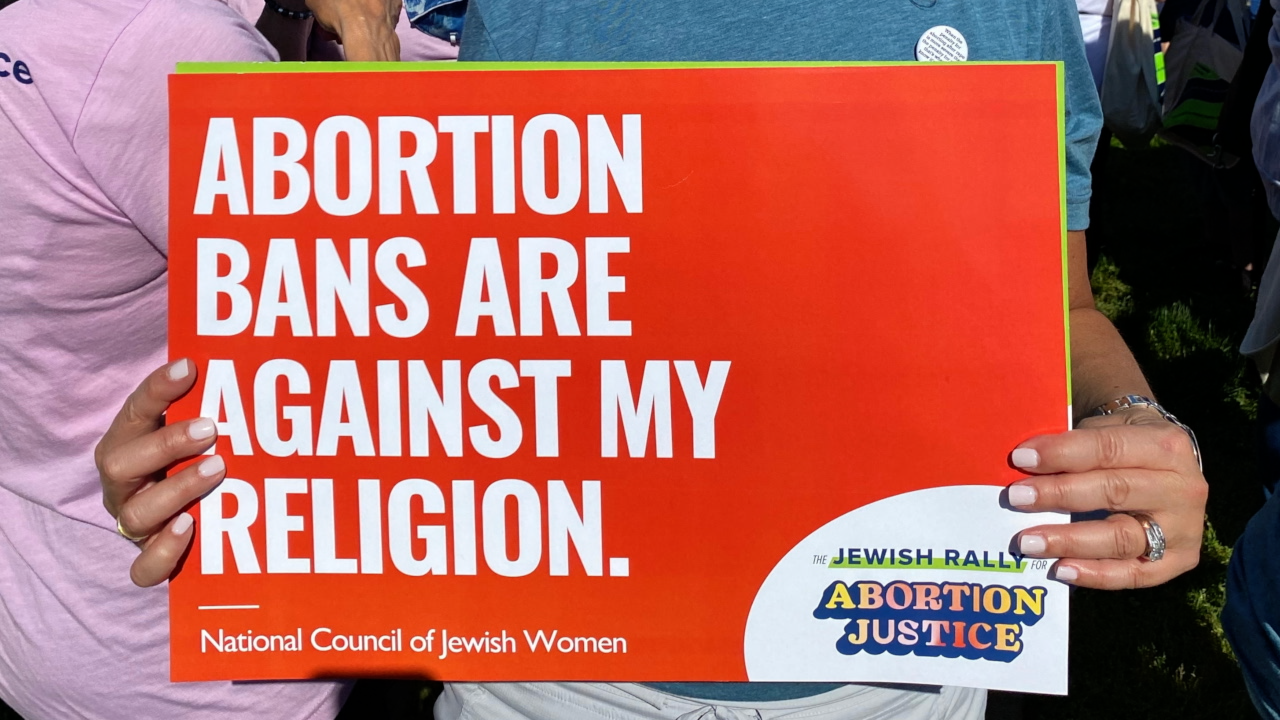
Members of the Jewish community have spoken out against abortion bans in Ohio, saying it infringes on their religious freedom. Photo by Morgan Trau, WEWS.
Religious variations abound in the state of Ohio, and some members of different churches are taking what they’ve learned in their lives and through decades of experience into the ballot box as they vote on Issue 1, the reproductive rights constitutional amendment.
For Catholics like Alexandra Belcher and Jennifer Perry, Issue 1 is a choice between the opinions of their religious leaders and their experiences with bodily autonomy.
For Perry, a physician assistant from Tiffin, growing up Catholic meant she believed in pro-life messages up until she voted in her first election.
“I voted Republican because that’s what the religious leaders said supported pro-life values,” Perry said.
Now that she works in medicine and has gone through multiple complicated pregnancies, Perry developed a perspective built on her experiences and not the values of far-away leaders.
“My view of what defines pro-life and what defines pro-choice has become just so much broader, and it’s not a black and white issue at all,” Perry told the OCJ.
With the “narrow” view that life begins at conception, Perry said she felt her belief system did “a disservice” to her in preparing for the future.
“We weren’t given both sides of the coin,” she said. “We weren’t given both perspectives.”
Struggling with infertility, and losing a “desperately wanted” child in a second-trimester miscarriage brought her new light on the struggles even individuals who want to become parents must go through.
“I desperately wanted that child, my husband desperately wanted that child, and I had to go through labor and delivery knowing that child wasn’t going to be ours,” Perry said. “To think that a mother … would have to go through that out-of-state, not with her family and friends or her chosen doctor, that’s just excruciating to me.”
Perry is still a practicing Catholic, and feels strongly that she and those like her should stay in the church and help bring those perspectives to fellow parishioners, in hopes of bringing change to the opinions of the religion.
The Catholic Conference of Ohio, which calls itself “the official voice of the Catholic Church in Ohio on matters of public policy,” has taken a strong opposing stance on Issue 1. The conference produced a letter signed by nine leaders in Ohio dioceses including Cincinnati, Cleveland, Toledo, Steubenville, Columbus, Youngstown, Canton and Parma.
“The Church must not be silent and cannot remain on the sidelines when confronted with such a clear threat to human life,” the letter from Feb. 28 stated.
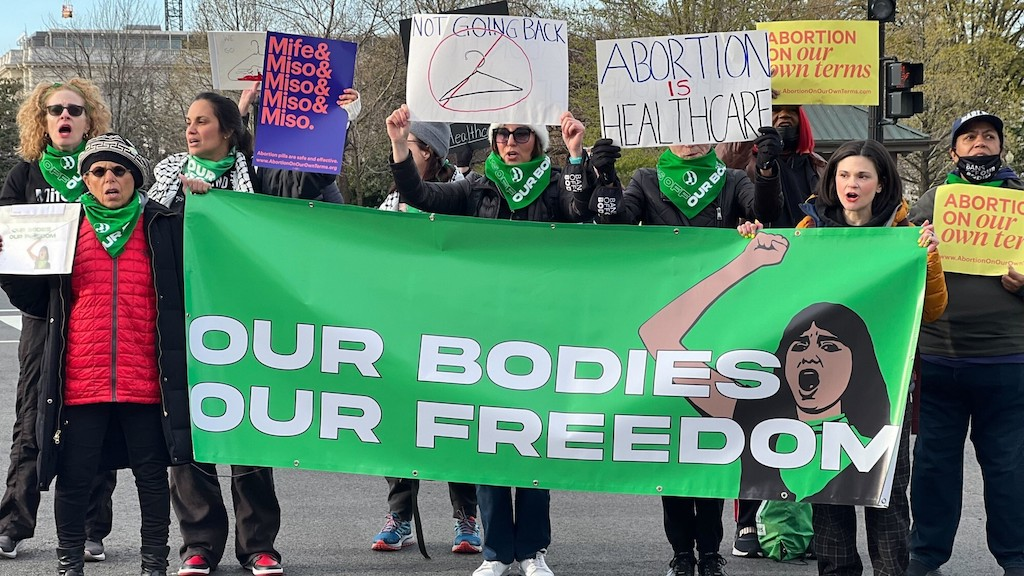
COLUMBUS, OH — MAY 14, 2022: Hundreds gather at a rally to support abortion rights less than two weeks after a leaked Supreme Court draft opinion showed a likely reversal of Roe v. Wade, May 14, 2022, at the Ohio Statehouse, Columbus, Ohio. (Photo by Graham Stokes for the Ohio Capital Journal. Republish photo only with original article.)
For Cleveland-area pharmacist Alexandra Belcher, she has no problem ignoring the opinions the church has on abortion, but remains open to talking with her friends and fellow parishioners about the nuances of reproductive health.
“The more I grew up, the more I realized this can not be up to somebody else,” Belcher told the OCJ.
Belcher went to Catholic school for 12 years, and is still a practicing Catholic, but nothing could have prepared her for her ectopic pregnancy, an unviable pregnancy that can be life-threatening for the pregnant person.
“In my medical chart, the resolution is coded as an abortion,” she said.
But that resolution involved medication that was administered in a hospital, so Belcher could be monitored by a doctor.
“The awful thing about those drugs is that they take you into labor and delivery,” she said. “So all you can hear is crying babies, the song they play (when a baby is born), and I sat there for hours while they made sure everything was going well with my medication.”
Even after leaving the hospital, Belcher suffered “excruciating” pain, so much so that when she went into labor in her next pregnancy, she was surprised to find how much less severe the pain of childbirth was for her.
“Nobody is going into a decision to have an abortion joyfully, whatever has happened to get them to the point of an abortion,” Belcher said. “It’s still not a joyful decision.”
Members of other religions, including faith leaders, are thinking about Issue 1 with a focus on the freedom to decide rather than the wrath of a higher power.
Rev. Timothy Ahrens showed his support for Issue 1 in an ad by Ohioans United For Reproductive Rights.
“As a pastor I’ve counseled families on the most important personal decisions, even abortion,” he said in the 30-second ad. “Abortion is a private family decision. Government needs to stay out of family decision making.”
Ahrens is the senior minister of the First Congregational Church of the United Church of Christ in downtown Columbus, a role he has served in since 2000. He has been a pastor for nearly 40 years.
“The laws of Ohio right now hurt my mother, my sister, my sister-in-law, my wife, my daughters, my daughter-in-laws and my granddaughters,” Ahrens said. “I feel very strongly that the government needs to get out of trying to manage people’s lives in relation to reproductive freedom.”
Ahrens acknowledged that other Christians denominations disagree with his stance on abortion.
“Those who stand against abortion do so based on biblical, foundational thoughts,” Ahrens. “I don’t look at what they’re saying as groundless.”
He mentioned Psalm 139 as a passage that mentions God “knit me together in my mother’s womb.”
“It never says I knew you at the moment of conception,” Ahrens said. “This has a range of perspectives, if we really sat down and boiled it down to the moment of conception.”
While it’s clear what most religious denominations think abortion, it’s ultimately up to the individual members of a congregation to cast their ballot on Issue 1.
“It comes down to how closely people who are part of religious congregations are listening to the cues that they are being given,” said Kim Conger, University of Cincinnati’s director of the masters of public administration, who studies how religious advocacy groups impact politics.
“There seems to be more variation across different parishes about how strongly a priest is pushing on the idea of not just that abortion is a sin, but voting for issue 1 would be a sin,” Conger said.
The idea of one religion stepping up to tell individuals what they should believe about reproductive health doesn’t sit well with Belcher or Perry, and as medical professionals, they don’t agree with the state getting involved either.
“The reasoning is not because it’s in the best interest, or because there is evidence-based medicine, the reasoning is this magical belief that this group of cells is a person who has rights,” Belcher said.
For Perry, the reproductive debate comes down to American roots in religious freedom and the necessity for separation of church and state.
“Because we allow for so many different expressions of religion, or at least we’re supposed to, if that starts to crumble, I feel like the fabric or the foundation of what America was build on starts to crumble,” Perry said.
Watching battles with insurance companies and socio-economic issues for patients having necessary medical treatment, Perry also sees much bigger issues the state could be addressing instead.
“It’s very hard to be in health care right now, and this is another huge burden you’re placing on these providers,” she said.
Having faced these moral and professional questions, Perry and Belcher both hope for a future for their children where medical decisions are made between a patient and a medical provider, without the intervention of either the government or their chosen religion.
“I think that when it comes down to it, if I’m ever faced with the pearly gates, the God that I believe in will understand,” Belcher said.
MEGAN HENRY
Megan Henry is a reporter for the Ohio Capital Journal and has spent the past five years reporting in Ohio on various topics including education, healthcare, business and crime. She previously worked at The Columbus Dispatch, part of the USA Today Network.
Susan Tebben is an award-winning journalist with a decade of experience covering Ohio news, including courts and crime, Appalachian social issues, government, education, diversity and culture. She has worked for The Newark Advocate, The Glasgow (KY) Daily Times, The Athens Messenger, and WOUB Public Media. She has also had work featured on National Public Radio.


![[BREAKING] Ohio Gov. DeWine signs higher ed bill regulating classroom discussion and banning diversity efforts](https://lovelandmagazine.com/wp-content/uploads/2025/03/Gov.-Mike-DeWine-signs-ed-bill.jpg)




















 by David DeWitt