Tag: air quality alert

  • First Air Quality Alert of 2025 for the Loveland Area

    First Air Quality Alert of 2025 for the Loveland Area

    Loveland, Ohio – The Southwest Ohio Air Quality Agency has issued an Air Quality Alert, effective at 12:00 a.m. midnight on Thursday, June 12, 2025 through 11:59 p.m. for Butler, Clermont, Hamilton and Warren counties in Ohio; Boone, Campbell, and Kenton counties in Kentucky; and Dearborn County in Indiana.

    The Agency expects to see levels of ozone in the “unhealthy for sensitive groups” range on the Air Quality Index (AQI).

    On Air Quality Alert days, everyone can help reduce ozone formation by taking the following actions:

    • Take the bus, carpool, bike, or walk instead of drive.
    • Refuel your vehicle after 8 p.m.; do not top off when refueling and tighten the gas cap.
    • Do not idle your vehicle; exhaust contributes considerably to ozone formation.
    • Combine trips or eliminating unnecessary vehicle trips.
    • Keep your vehicle maintained with properly inflated tires and timely oil changes.
    • Avoid use of gasoline-powered lawn equipment on Air Quality Alert days.
    • Avoid use of oil-based paints and stains on Air Quality Alert days.
    • Never burn leaves or other yard trimmings.
    • Suspend use of fire pits, campfires and charcoal grills on Air Quality Alert days.
    • Conserve electricity by turning out lights and unplugging unused appliances and electronics.

    For more details on the Air Quality Index and its corresponding health messages, refer to AirNow. You may also choose to sign up for EnviroFlash, a free service and app that notifies you of daily air quality conditions based upon your personal settings that you control.
  • Air Quality Alert has been declared for Wednesday, Sep 11

    Air Quality Alert has been declared for Wednesday, Sep 11

    Loveland, Ohio – The Southwest Ohio Air Quality Agency (a division of Hamilton County Department of Environmental Services) has issued an Air Quality Alert for Butler, Clermont, Hamilton and Warren counties in Ohio and Boone, Campbell and Kenton counties in Kentucky.

    • Take the bus, carpool, bike or walk instead of driving
    • Refuel your vehicle after 8 p.m.; do not top off when refueling and tighten the gas cap
    • Avoid idling your vehicle
    • Combine trips or eliminate unnecessary vehicle trips
    • Keep your vehicle maintained with properly inflated tires and timely oil changes
    • Avoid use of gasoline-powered lawn equipment on Air Quality Alert days
    • Avoid use of oil-based paints and stains on Air Quality Alert days
    • Never burn leaves or other yard trimmings
    • Always burn clean, seasoned wood in outdoor fire pits, fireplaces and wood stoves
    • Do not use fire pits or fireplaces for non-essential home heating on Air Quality Alert days
    • Conserve electricity

    For more information, visit www.SouthwestOhioAir.org.

    If you want more information on the air quality forecast, or other aspects of the local air quality program, contact your local air quality agency using the information above. For more information on the U.S. EPA’s AIRNow Program, visit http://www.airnow.gov.


    To share EnviroFlash with a friend
    To unsubscribe or edit your EnviroFlash account

    Wednesday, Sep 11: 105 AQI Unhealthy for Sensitive Groups Ozone
  • Air Quality Alert extended into Thursday

    Air Quality Alert extended into Thursday

    Loveland, Ohio – The Southwest Ohio Air Quality Agency, a division of Hamilton County Department of Environmental Services, has issued and extended an Air Quality Alert for Butler, Clermont, Hamilton and Warren counties in Ohio and Boone, Campbell and Kenton counties in Kentucky.

    The Agency expects to see levels of ozone in the “unhealthy for sensitive groups” range on the Air Quality Index (AQI).

    The air quality in Loveland was measured at 143 at 5 PM on Tuesday.

    Do Your Share for Clean Air

    Transportation
    • Bike or walk to nearby destinations.
    • Ride the bus (Metro Phone: 513-621-4455).
    • Join a carpool through Rideshare. Call 800-241-RIDE for free information on how to start a carpool.
    • Combine your errands into one trip-a cold engine decreases efficiency by as much as 80%.
    • Keep your air filter clean and get regular tune-ups-a neglected car can reduce gas mileage by 20%.
    • Make sure your tires are properly inflated and rotated-you can save $130 a year in gasoline costs.
    • Don’t “top off” your gas tank-by stopping at the click, you will reduce fumes that contribute to ground-level ozone pollution.
    • Refuel after 8 pm, especially in the summer when ozone concentrations tend to be higher during the afternoon.
    • Avoid idling in general, turning off and starting an engine uses less gasoline than letting it idle for more than 30 seconds. For example, turn the car off while waiting in line at railroad crossings and drive-through windows.
    • Make sure your car’s air conditioner is working properly-leaky air conditioners in cars are the single greatest source of chlorofluorocarbons (CFCs), a greenhouse gas.
    • Stay on paved roads whenever possible-driving on dirt roads raises dust which contributes to haze and airborne particulate matter.
    Energy Use
    • Conserve electricity-electrical generation is a source of air pollution.
    • Turn the lights out when you leave the room.
    • Use cold water instead of hot whenever possible-you’ll use less energy
    • Use fans to help cool-they use less energy than coolers and air conditioners.
    • Clean the condenser coils on your refrigerator every few months-you can reduce electricity consumption by 6% or more.
    • Insulate your home to use less energy.
    • Go solar or geothermal for home and water heating-it reduces the need to burn fossil fuel.
    • Caulk and weather strip doors and windows.
    • Change your HVAC filter regularly so your equipment runs more efficiently.
    • Replace lightbulbs with LEDs.
    • Only do laundry when there is a full load.
    • Unplug appliances when not in use, especially equipment that has “stand by” modes such as flat screen television, DVD/Blu-Ray players, and video game equipment.
    • Avoid leaving cell phone and tablet chargers plugged in the wall when not charging equipment.
    • Use a programmable thermostat to conserve heat/air conditioning when not at home.
    • When appliances need to be replaced, look for EnergyStar certified products.
  • Air Quality Alert issued for Tuesday

    Air Quality Alert issued for Tuesday

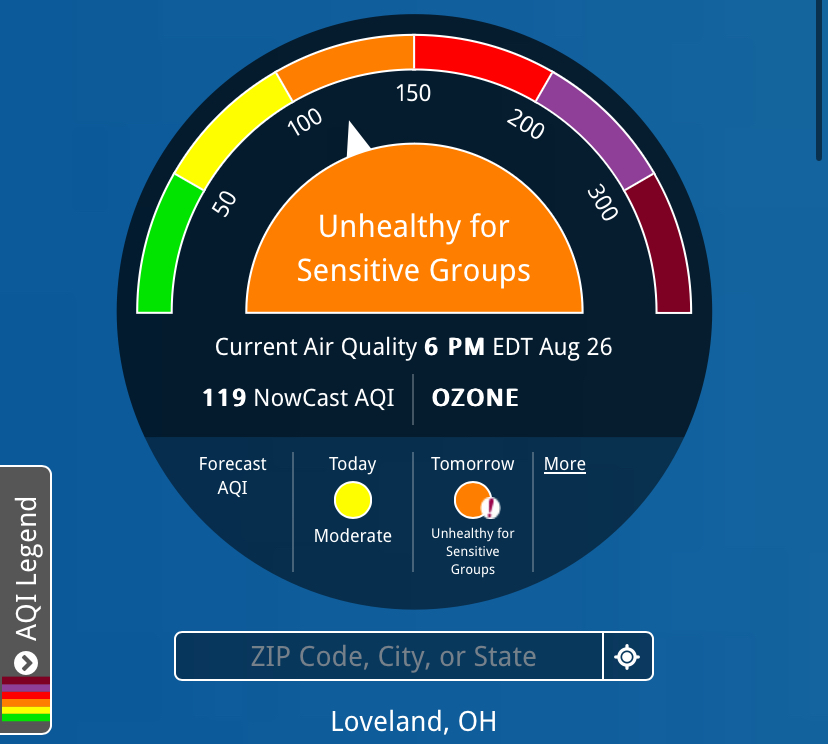
    The air quality was 119 on Monday at 6 PM

    Loveland, Ohio – The Southwest Ohio Air Quality Agency (a division of Hamilton County Department of Environmental Services) has issued an Air Quality Alert for Butler, Clermont, Hamilton and Warren counties in Ohio and Boone, Campbell and Kenton counties in Kentucky.

    Do Your Share! Take these precautions:

    • Take the bus, carpool, bike or walk instead of driving
    • Refuel your vehicle after 8 p.m.Do not top off when refueling and tighten the gas cap
    • Avoid idling your vehicle
    • Combine trips or eliminate unnecessary vehicle trips
    • Keep your vehicle maintained with properly inflated tires and timely oil changes
    • Avoid use of gasoline-powered lawn equipment on Air Quality Alert days
    • Avoid use of oil-based paints and stains on Air Quality Alert days
    • Never burn leaves or other yard trimmings
    • Always burn clean, seasoned wood in outdoor fire pits, fireplaces and wood stoves
    • Do not use fire pits or fireplaces for non-essential home heating on Air Quality Alert days
    • Conserve electricity

    An Air Quality Alert has been declared for Cincinnati, OH, on Tuesday, Aug 27
    Tomorrow’s Forecast
    Tuesday, Aug 27: 110 AQI Unhealthy for Sensitive Groups Ozone
  • Air Quality Alert has been declared for Loveland on Sunday and Monday

    Air Quality Alert has been declared for Loveland on Sunday and Monday

    Loveland, Ohio – Air Quality Alert has been declared for Loveland and the surrounding area for Sunday and, Jun 16 and 17.

    Sunday, Jun 16: 120 AQI Unhealthy for Sensitive Groups Ozone

    Extended Forecast
    Monday, Jun 17: 110 AQI Unhealthy for Sensitive Groups Ozone


    Sensitive groups include people with lung disease such as asthma, older adults, children and teenagers, and people who are active outdoors.

    Sensitive groups:

    Make outdoor activities shorter and less intense. Take more breaks. Watch for symptoms such as coughing or shortness of breath. Plan outdoor activities in the morning when ozone is lower. People with asthma: Follow your asthma action plan and keep quick-relief medicine handy.

    Everyone else: Consider making outdoor activities shorter and less intense.

    The Southwest Ohio Air Quality Agency (a division of Hamilton County Department of Environmental Services) has issued an Air Quality Alert for Butler, Clermont, Hamilton and Warren counties in Ohio and Boone, Campbell and Kenton counties in Kentucky.

    For “real-time” checks on Loveland’s air quality use this tool on your smartphone, tablet, or computer:

  • Air Quality Alert for Thursday

    Air Quality Alert for Thursday

    Loveland, Ohio – The Southwest Ohio Air Quality Agency (Agency) has issued an Air Quality Alert for Thursday, June 13,  effective at 12:00 a.m. midnight through 11:59 p.m. for Butler, Clermont, Hamilton, and Warren counties in Ohio; Boone, Campbell, and Kenton counties in Kentucky; and Dearborn County in Indiana.

    The Agency expects to see levels of ozone in the “unhealthy for sensitive groups” range on the Air Quality Index (AQI).

    Air quality tips:

    • Take the bus, carpool, bike, or walk instead of drive.
    • Refuel your vehicle after 8 p.m.; do not top off when refueling and tighten the gas cap.
    • Do not idle your vehicle; exhaust contributes considerably to ozone formation.
    • Combine trips or eliminating unnecessary vehicle trips.
    • Keep your vehicle maintained with properly inflated tires and timely oil changes.
    • Avoid use of gasoline-powered lawn equipment on Air Quality Alert days.
    • Avoid use of oil-based paints and stains on Air Quality Alert days.
    • Never burn leaves or other yard trimmings.
    • Suspend use of fire pits, campfires and charcoal grills on Air Quality Alert days.
    • Conserve electricity by turning out lights and unplugging unused appliances and electronics.
  • Air Quality Alert for Loveland, Ohio

    Air Quality Alert for Loveland, Ohio

    Loveland, Ohio – The Southwest Ohio Air Quality Agency has issued an Air Quality Alert for Sunday and Monday, July 16 & 17 for Loveland and includes Butler, Clermont, Clinton, Hamilton, and Warren counties in Ohio; Boone, Campbell, and Kenton counties in KY, and Dearborn County in IN.

    Smoke from the Canadian wildfires is returning to the Tri-State.

    The Agency expects to see levels in the “Unhealthy for Sensitive Groups” range on the Air Quality Index (AQI).

    The public is encouraged to limit their outdoor exertion, especially children, those with respiratory illnesses, and older adults. Refer to U.S. EPA’s health guide here.

    The Agency issues an Air Quality Alert when ozone or other major air pollutants are expected to reach levels considered unhealthy for sensitive groups.

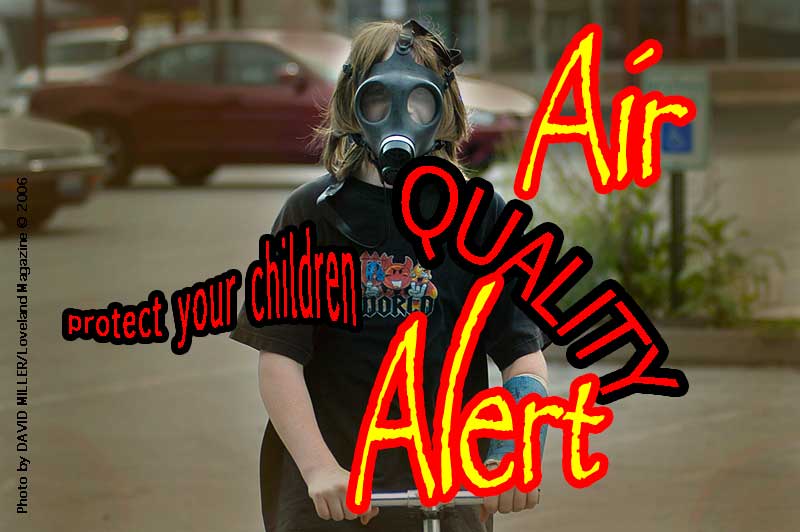
    Children face special risks from air pollution

    What to Do During an Air Quality Alert

    • Take the bus, carpool, bike or walk instead of driving
    • Refuel your vehicle after 6 p.m., do not top off when refueling and tighten the gas cap
    • Do not idle your vehicle
    • Combine trips or eliminate unnecessary vehicle trips
    • Keep your vehicle maintained with properly-inflated tires and timely oil changes
    • Avoid use of gasoline-powered lawn equipment on Air Quality Alert days
    • Avoid use of oil-based paints and stains on Air Quality Alert days
    • Never burn leaves or other yard trimmings
    • Always burn clean, seasoned wood in outdoor fire pits, fireplaces and wood stoves
    • Avoid using fire pits or fireplaces for non-essential home heating on Air Quality Alert days
    • Conserve electricity

    For more details on the Air Quality Index and its corresponding health messages, refer to AirNow. You may also choose to sign up for EnviroFlash, a free service and app that notifies you of daily air quality conditions based upon your personal settings that you control.

  • Air Alert extended into Thursday

    Air Alert extended into Thursday

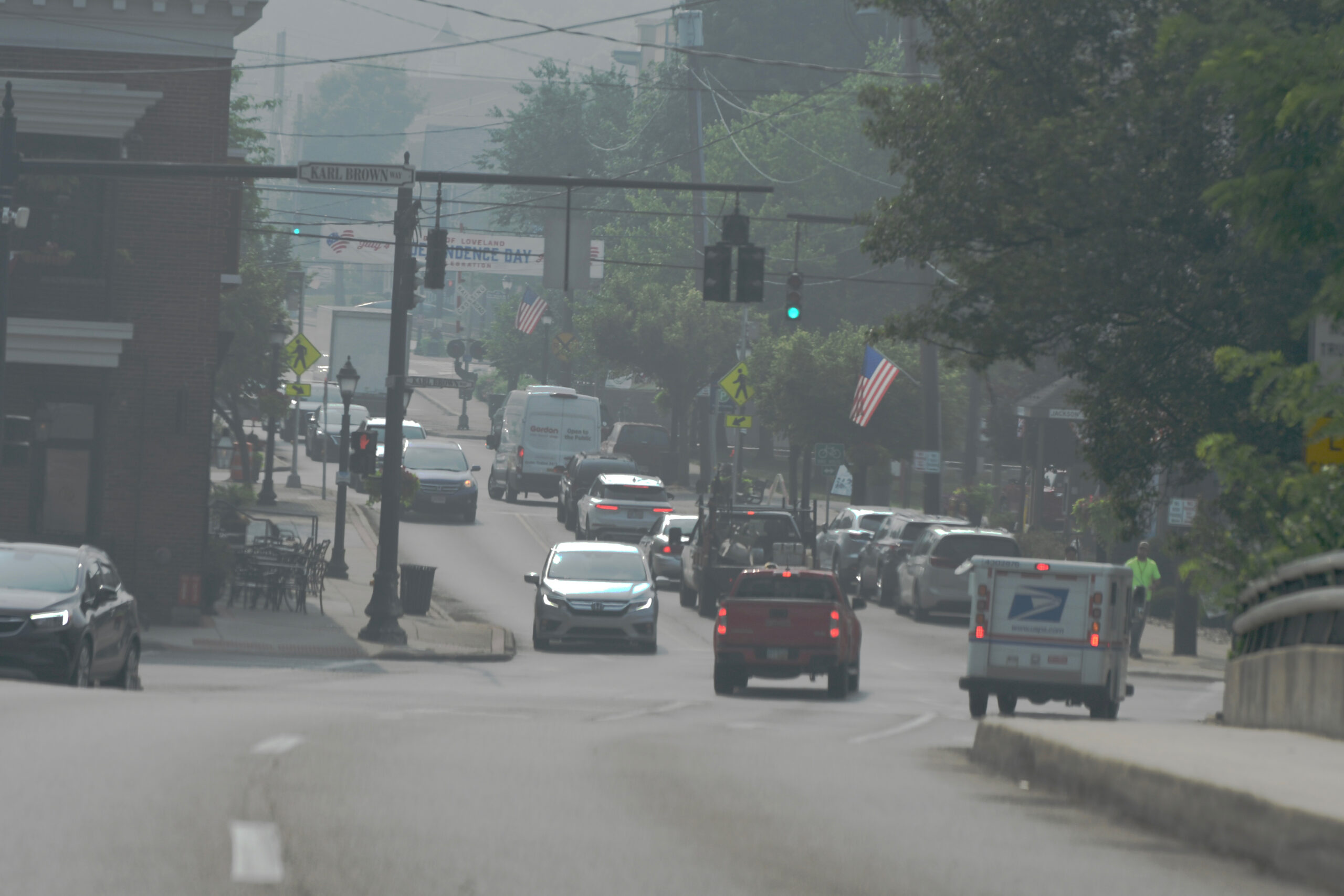
    Historic Downtown Loveland, Ohio on Wednesday afternoon (Photo by David Miller)

    Loveland, Ohio – The Southwest Ohio Air Quality Agency is extending the Air Quality Alert into Thursday, June 29 through 11:59 PM for Butler, Clermont, Hamilton, and Warren counties in Ohio; Boone, Campbell, and Kenton counties in Kentucky; and Dearborn County in Indiana.

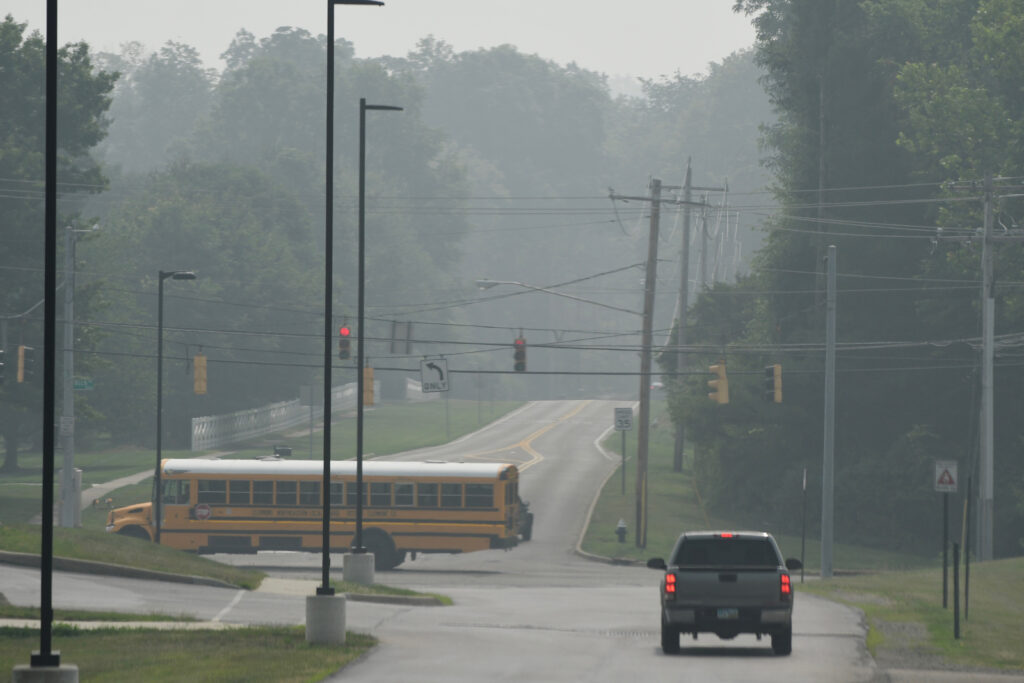
    The Agency expects to see levels of both ozone and PM2.5 (due to Canada wildfires) in the “Unhealthy” range on the Air Quality Index (AQI). Because there are two air pollutants with high concentrations, the general public is encouraged to limit their outdoor exertion, especially children, those with respiratory illnesses, and older adults. Refer to U.S. EPA’s health guide here.
    Everyone can reduce PM2.5 by following these guidelines:

    • Never burn leaves or other yard trimmings.
    • Suspend use of fire pits, campfires, and charcoal grills on Air Quality Alert days.
    The intersection of Rich and Fallis Roads on Wednesday afternoon from Loveland High School. (Photo by David Miller)

    Everyone can help reduce ozone formation by taking the following actions: 

    • Telecommute.
    • Do not idle your vehicle; exhaust contributes considerably to ozone formation.
    • Combine trips or eliminate unnecessary vehicle trips.
  • Air pollution rises to the “Unhealthy” index scale

    Air pollution rises to the “Unhealthy” index scale

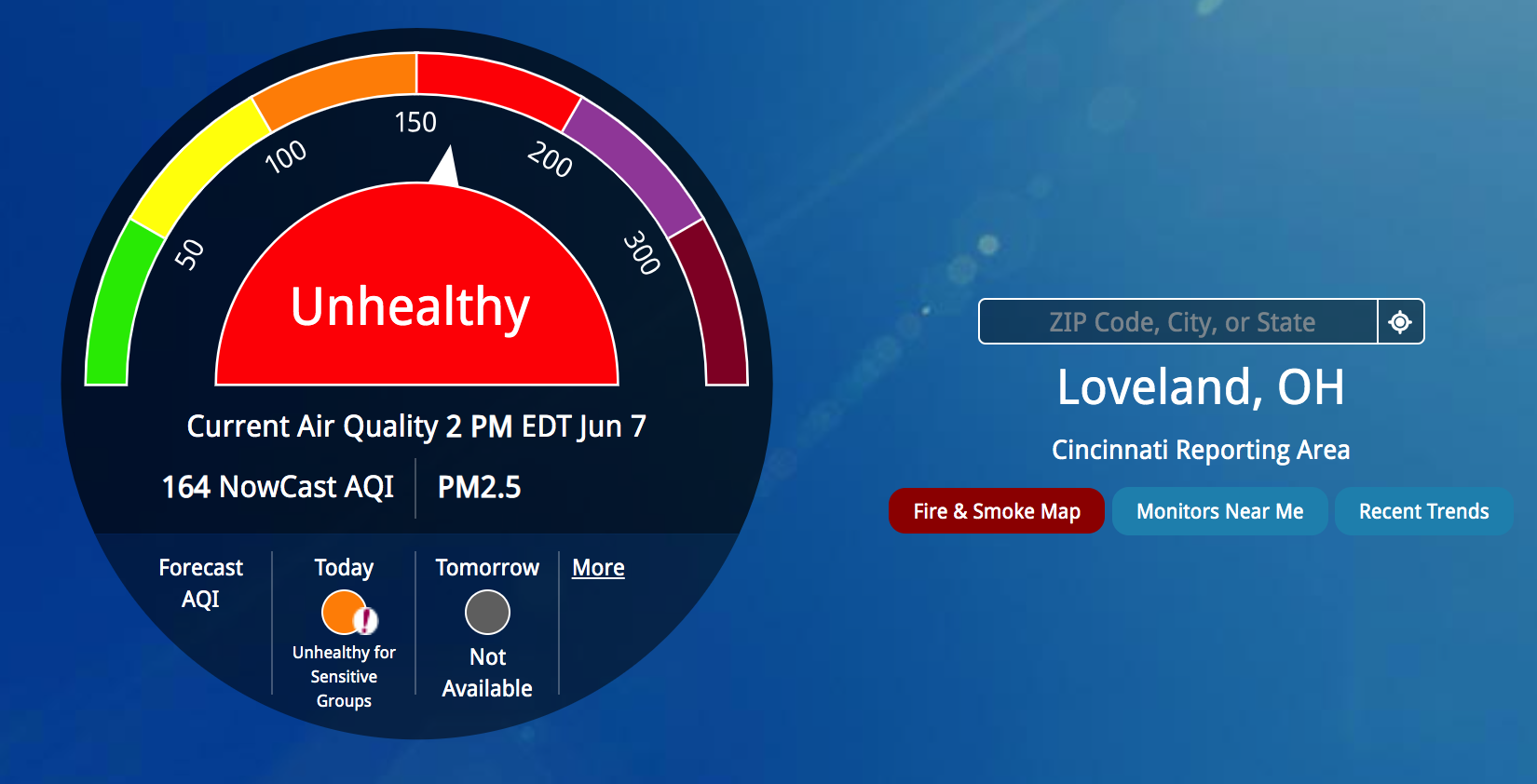
    Loveland, Ohio – An air quality alert was declared for the Loveland Area on Wednesday, Jun 7, with a predicted level of pollutants to be in the “Unhealthy for Sensitive Groups” range of 128. At 3:30 PM this afternoon the quality index had risen to 164 and in the “Unhealthy” level.

    Smoke from the Canadian wildfires has reached the Loveland area.

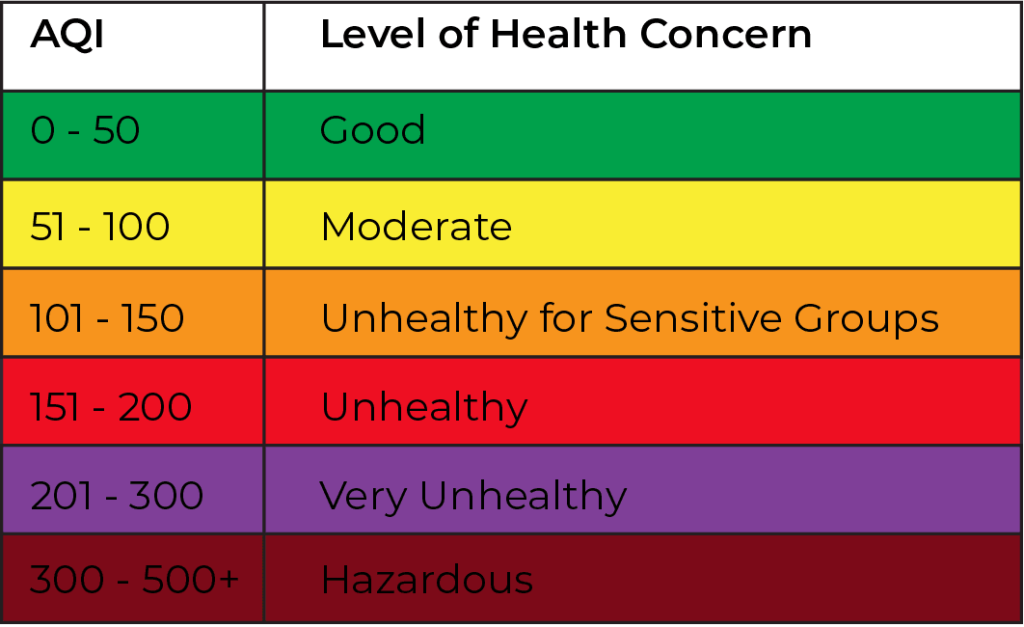
    The AQI is a tool that indicates how clean – or dirty – the air is and what associated health effects might be a concern for you. The U.S. EPA calculates the AQI for five major air pollutants: ground-level ozone, particle pollution (also known as particulate matter), carbon monoxide, sulfur dioxide, and nitrogen dioxide. For each of these pollutants, EPA has established national air quality standards to protect public health.

    AQI_chart

    “Unhealthy” means active children, teens, adults, and people with respiratory diseases, such as asthma, should avoid prolonged outdoor exertion; everyone else, especially children, should limit prolonged outdoor exertion.

    Go HERE to watch in real-time as the air quality deteriorated this afternoon.

    Children are at increased risk from air pollution primarily because they spend prolonged periods of time outdoors. What’s more, much of this time is spent playing sports or games, meaning children are not only exposed to unhealthy air for longer periods of time than adults, but also at higher rates. (The more strenuous the activity, the more air intake is required, thus the more unhealthy air that is breathed in.) Since kids’ lungs are still developing, high levels of pollutant exposure can go so far as to cause irreversible damage, including decreased lung-function growth. The fact that about 1 in 14 children (7%) have asthma also puts youth at increased risk. – Source: What “Unhealthy Air Quality for Sensitive Groups” Means (treehugger.com)


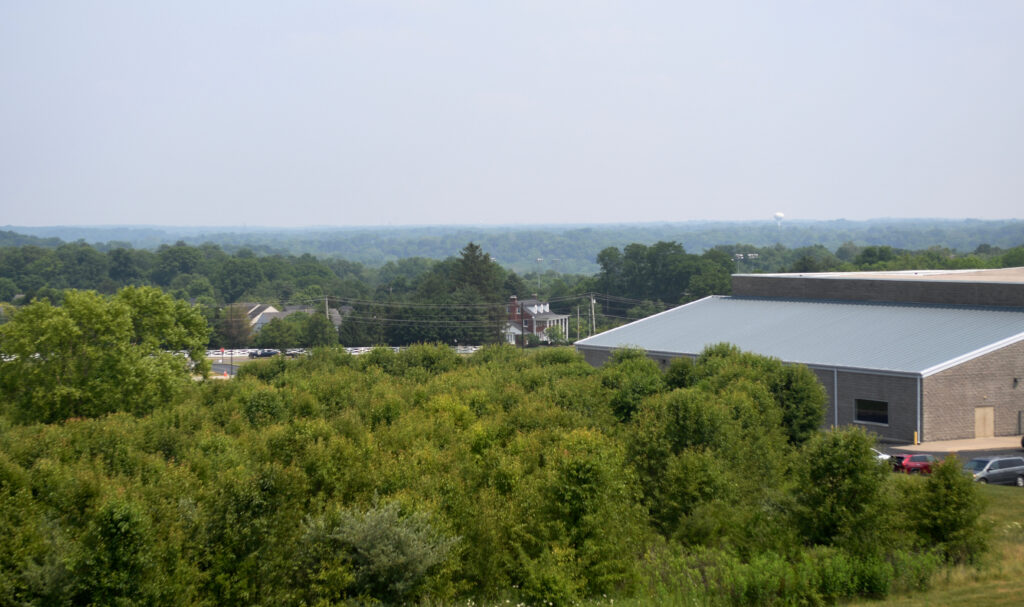
    The view, looking East from the Loveland High School’s Tiger Stadium at 3:30 PM on Wednesday, June 7.


    What are the Harmful Effects of PM?

    Particulate matter contains microscopic solids or liquid droplets that are so small that they can be inhaled and cause serious health problems. Some particles less than 10 micrometers in diameter can get deep into your lungs and some may even get into your bloodstream. Of these, particles less than 2.5 micrometers in diameter, also known as fine particles or PM2.5, pose the greatest risk to health.

    Fine particles are also the main cause of reduced visibility (haze) in parts of the United States, including many of our treasured national parks and wilderness areas.

    Learn more about health and environmental effects

  • Air Quality Alert EXTENDED for Saturday, June 3 and Sunday, June 4

    Air Quality Alert EXTENDED for Saturday, June 3 and Sunday, June 4

    The Loveland air quality was well into the “Unhealthy for Sensitive Groups” range at 4 PM Friday.

    Loveland, Ohio – The Southwest Ohio Air Quality Agency (Agency) has extended an Air Quality Alert for Saturday, June 3 and Sunday, June 4 through 11:59 PM for Butler, Clermont, Hamilton, and Warren counties in Ohio; Boone, Campbell, and Kenton counties in Kentucky; and Dearborn County in Indiana.

    The Agency expects to see levels of ozone in the “unhealthy for sensitive groups” range on the Air Quality Index (AQI).

    Use this SITE to track pollution levels in real time.

    “Sensitive Groups” refers to people with health issues that might be affected by pollution. This category includes:

      • Babies
      • Young children
      • Elderly people
      • People with respiratory disease
      • People with allergies
      • People with hypersensitivity

    For people with sensitivity issues, this could be bad enough to be affected. People with asthma will experience shortness of breath more often. Children and the elderly may suffer more coughing or allergic reactions. Long-term exposure may cause more serious damage.

    Children are at increased risk from air pollution primarily because they spend prolonged periods of time outdoors. What’s more, much of this time is spent playing sports or games, meaning children are not only exposed to unhealthy air for longer periods of time than adults, but also at higher rates. (The more strenuous the activity, the more air intake is required, thus the more unhealthy air that is breathed in.) Since kids’ lungs are still developing, high levels of pollutant exposure can go so far as to cause irreversible damage, including decreased lung-function growth. The fact that about 1 in 14 children (7%) have asthma also puts youth at increased risk. – Source: What “Unhealthy Air Quality for Sensitive Groups” Means (treehugger.com)

    On Air Quality Alert days, everyone can help reduce ozone formation by taking the following actions:

    • Take the bus, carpool, bike, or walk instead of drive.
    • Refuel your vehicle after 8 p.m.; do not top off when refueling and tighten the gas cap.
    • Do not idle your vehicle; exhaust contributes considerably to ozone formation.
    • Combine trips or eliminating unnecessary vehicle trips.
    • Keep your vehicle maintained with properly inflated tires and timely oil changes.
    • Avoid use of gasoline-powered lawn equipment on Air Quality Alert days.
    • Avoid use of oil-based paints and stains on Air Quality Alert days.
    • Never burn leaves or other yard trimmings.
    • Suspend use of fire pits, campfires and charcoal grills on Air Quality Alert days.
    • Conserve electricity by turning out lights and unplugging unused appliances and electronics.