Tag: Black Lives Matter

  • Historic Black church given ‘Proud Boys’ trademark: Calls for stand against hate

    Historic Black church given ‘Proud Boys’ trademark: Calls for stand against hate

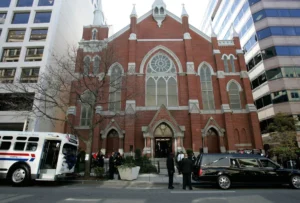
    A hearse carrying the casket of Rosa Parks and a 1950s era bus sit in front of the Metropolitan AME Church where a memorial service for the civil rights icon was being held on Oct. 31, 2005, in Washington, D.C. A judge has ordered the naming rights of the extremist group the Proud Boys be given to the church.

    Mark Wilson/Getty Images

    “For the first time in our nation’s history, a Black institution owns property of a white supremacist group.”

    Washington, D.C. – A historic Black church in Washington, D.C., that has been awarded control of the name of an extremist group that vandalized its property is calling for people to take a stand against hate.

    On Monday, D.C. Superior Court Judge Tanya Jones Bosier ordered that all interests in Proud Boys International’s trademarked name, “Proud Boys,” be given to Metropolitan African Methodist Episcopal Church. And no one can sell, transfer, license or dispose of the Proud Boys’ trademarked name without permission from the church or the court, according to the judgment.

    The order is a victory for the church, after it asked the court to enforce a default judgment of $2.8 million in damages and said it was “entitled to all of PBI’s interests in the Proud Boys Trademark and a lien on the Trademark.”

    Read the full Black History making story…

    ________________

    Learn more about the Metropolitan African Methodist Episcopal Church

    We Stand Up For Justice and Stand Against Hate

    In December 2020, the Proud Boys desecrated and vandalized Metropolitan African Methodist Episcopal Church (and by extension, everyone who stands against hate) when the Proud Boys “leaped over Metropolitan AME Church’s fence, entered the church’s property, and went directly to the Black Lives Matter sign. They then broke the zip ties that held the sign in place, tore down the sign, threw it to the ground, and stomped on it while loudly celebrating. Many others then jumped over the fence onto the church’s property and joined in the celebration of the sign’s destruction.” Read the order from Judge Neal E. Kravitz. 

    Metropolitan AME Church did not back down. The church stands drawing strength from the legacies of Elizabeth Freeman and Ida B. Wells-Barnett, against the Proud Boys, a white supremacist group, and vowed to fight because following Jesus in these times and circumstances demands nothing less.  As a result of these efforts, Metropolitan was able to secure $2.8 million in damages based on the hateful conduct of the Proud Boys burning our Black Lives Matter banner.  

    However, this resounding victory was incomplete as just a judgment on paper with no actual exchange of monies to compensate Metropolitan.  As a result, Metropolitan went to court to enforce the judgment and Judge Tanya M. Jones Bosier ruled in the church’s favor.  For the first time in our nation’s history, a Black institution owns property of a white supremacist group. Metropolitan African Methodist Episcopal Church now owns the exclusive rights to the Proud Boys trademark, stripping them of the very name they rallied under. This also means that any money the Proud Boys makes from using the trademark must be paid to Metropolitan to help satisfy the multi-million-dollar default judgment.

    Metropolitan African Methodist Episcopal Church was founded in 1838.  From its founding, Metropolitan AME Church, has and continues to do what other churches will not. We are known locally, nationally, and internationally, to be deeply spiritual and deeply engaged in the world. From anti-slavery leadership in the mid-19th century, in the harboring of runaway slaves, to organizing power, people and money toward the flourishing of all people in the District of Columbia today. Metropolitan has been not just a significant center of worship, but also an institution in the forefront of the civic, cultural, and intellectual life among African Americans and others. Today, Metropolitan is focused on theologically sound teaching and preaching in worship; combatting food insecurity through our Food Bank; addressing ecological devastation by addressing heat islands in metropolitan cities with Smart Surfaces Coalition; equipping parents and families with culturally responsive and biblically grounded teaching through the Sankofa project; and building Black Equity and Wealth through Homeownership, prioritizing community safety and holding political leaders accountable with Washington Interfaith Network. 

    We appreciate you taking the time to visit us and we hope you can stand with us by investing in the Community Justice Fund. In these unprecedented times, we are called to continue doing the work of Jesus in the church, the community, and the world. Every contribution will make a difference as we counter the radical ideology and rhetoric that is flowing from the leaders of our Nation while eroding and eliminating civil rights and societal strides that have been made by the sacrifices of our elders and ancestors.

    Stand with us and against hate by investing in the Community Justice Fund today.

    Joy and justice, 

    William H. Lamar IV
  • Despite brawls, no OSHP arrests at clashing protests at Ohio Statehouse last Wednesday

    Despite brawls, no OSHP arrests at clashing protests at Ohio Statehouse last Wednesday

    By Jake Zuckerman and Ohio Capital Journal

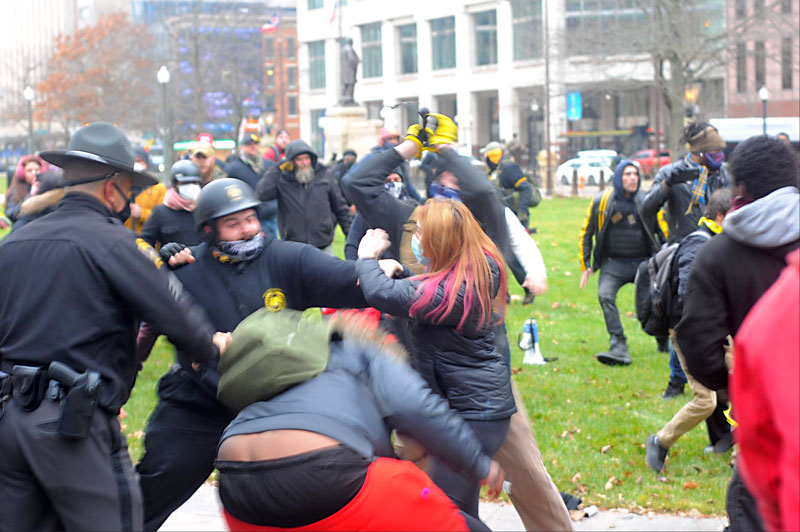
    A pugilistic day of political demonstrations that included two brawls between far-right demonstrators insisting the presidential election was stolen and Black Lives Matter activists ended with no arrests last Wednesday.

    At least two rounds of fisticuffed rumbles with an array of participants broke out at different points through the afternoon along with some more minor spats.

    The Proud Boys, a radical conservative group with white nationalist ties known for violent confrontations with liberal demonstrators, tussled with BLM activists after hours of vitriolic name calling and antagonizing between the two.

    Conservative activist Judi Phelps, a pistol holstered to her leg, yells into a microphone. (Photo by Jake Zuckerman)

    Among the Proud Boys and those alongside them, firearms were everywhere. People were carrying assault style rifles, shotguns and pistols. None were seen used or brandished. One man carried a telescoping baton.

    At least two people standing with BLM activists carried pistols, and one man carried a baseball bat, none of which were seen in use during the fights.

    Photo by Jake Zuckerman

    Members of the Ohio State Highway Patrol, which protects the Capitol building and campus, intervened at times to break up the physical altercations and try to keep the two groups separate or at least in peace.

    OSHP Staff Lt. Craig Cvetan said Thursday the primary function of the officers on the scene were to make sure everybody stays safe, not necessarily make arrests.

    “As you make arrests and try to start apprehending individuals, that takes away those trooper’s ability to separate those groups,” he said.

    He said the officers are well aware of the arsenal of weapons around the protest.

    “Ohio is an open-carry state,” he said. “Certainly, we prefer for people not to have weapons on the Statehouse grounds. It makes it easier for us.”

    The first rumble broke out around 12:40 p.m. It was captured in video via a Statehouse News Bureau reporter.

    The Columbus Police Department assisted in breaking up the fights. Repeated calls to the department seeking information on arrests or lack thereof were sent to a Public Information Officer who did not answer calls and could not accept voicemails.

    A separate fight with at least about 10 people engaged broke out on the Capitol lawn at roughly 3 p.m. OSHP officers broke things up and separated the two groups.

    A man with a holstered pistol engages in a heated argument with a Columbus Police officer after the second brawl. (Photo by Jake Zuckerman)

    Shortly thereafter, the Proud Boys groups left on buses, after which the situation quickly calmed down.

    Meanwhile, in Washington D.C., a mob of insurrectionists were in the process of invading the U.S. Capitol and wreaking havoc inside. One woman was reportedly shot, and three more died due to unspecified medical emergencies.

    Gov. Mike DeWine briefly mentioned the protests at the Ohio Capitol speaking to reporters Thursday. He acknowledged there’s no guarantee that Ohio’s statehouse is safe from a similar invasion. He made no mention of either the fights or the firearms that were present through the event.

  • Have you been social distancing from Black Americans?

    Have you been social distancing from Black Americans?

    by Eric Armstrong

    Hello Loveland friends – I really hope if you read this first sentence and find the time to read these next several paragraphs. It’s lengthy but I think it’s important.

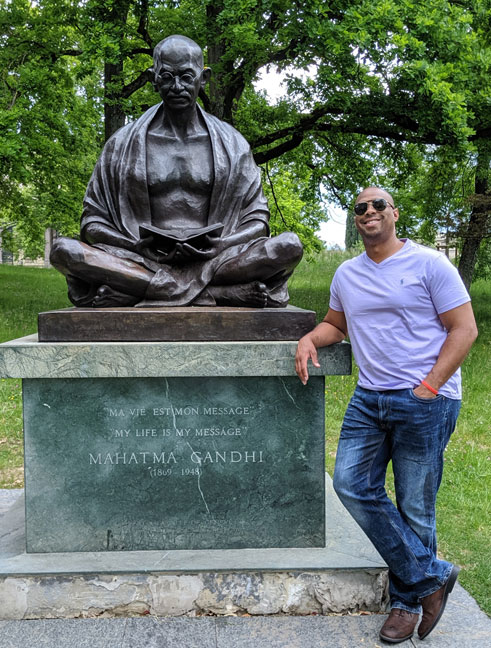
    Since graduating from Loveland High School in 1998, Eric Armstrong obtained degrees in Chemical Engineering and Spanish from Purdue University. When not working in technical sales; he enjoys traveling the world in his free time.
     

    Systemic racial inequality, prejudice, ‘White Privilege’, are tough topics, powerful words. I imagine white people; are uncomfortable when they hear them, feel defensive when directed towards them, and I think most importantly are confused about what to do about them.

    You see racists are easy to identify and label, they wear hoods, yell slurs, and burn crosses. Racists don’t hide their disdain, they’re proud of it, and most importantly I imagine 90% of White Americans can say unequivocally “I’m not a racist, that’s not me!” “My family raised us to…”, “I have very close ____ friends.” etc…

    Other words, however, are harder to define

    The other words however are harder to define; they are subtle, woven into our nation’s very fabric, everyday behavior, and actions. Unfortunately, our country was built and founded on them. In their most basic forms, even Black Americans can struggle to explain them, it’s often an uneasy feeling or a story, the way you were treated. It’s some simple task that Black Americans worry about that would never cross the mind of a white person.

    A profound ignorance exists in education

    Moreover, IF you as a White American can comprehend the definitions and give examples of these words, then you’d realize 100% of White Americans have existed/participated/enabled them. That’s honestly what is at the core of everything happening today. A profound ignorance exists and the cure is education, open dialogue, and a paradigm shift in how we respond.

    I personally haven’t said much about what’s happened recently about the rash of killings locally here in Indianapolis or across the country. I’ve admittedly deflected and given short PC answers. There are two reasons and they are shared by many Black Americans;

    1) It reopens painful feelings and emotional wounds, and if you’re a Black American who has existed as I have (fairly comfortably) it’s a jarring reminder of what could happen to you and your friends, family, and colleagues.

    2) It’s exhausting. If you know me, I enjoy talking and pushing the boundaries of comfort on many topics. I don’t shy away from talking about race if engaged and I try to keep the conversation light so I’m approachable and those who truly want to understand, learn and change have a safe place to do so. However, for every one of those interactions, there are 20 other conversations, comments, posts, when White American dismiss Black Americans’ experiences as “one-off occurrences” or say “why do you make everything about race. It isn’t always about race.” Or “Well if “______Black American” wasn’t doing _____, _____ wouldn’t have happened.”

    Something different is happening now

    So admittedly, lazily, embarrassingly, I felt like this latest response was going to be the US status quo. People get fake mad, they post “Black Lives Matter” and are upset for a while, some Black Americans protest and march, then in a couple months things/people go back to ‘normal’.

    But I decided to write this because something different is happening. White Americans are out marching too, they’re verbalizing the issues and not just repeating buzz words. Most importantly they’re engaging us. They’re messaging me, texting me and asking me to have conversations. They’re asking me what those confusing words mean to ME, asking what my experience has been.

    A business colleague who I consider a friend sent me this;

    “Weird non-work related question. Would you be interested in coming to our house for dinner in the next two weeks? No need to answer tonight. The bigger human conversation is that our kids need to meet people who don’t look like them.”

    WOW.

    Maybe it WILL be different this time…

    Because if everyone wants to know how we “fix things” how we “make it better”. That’s it in a nutshell. White Americans must willingly have a lot of introspection, ask questions of themselves and Black Americans, and state the following:

    “I acknowledge that though I’m not a racist; I’m ignorant, uninformed, and contributing to prejudice, systemic racism, and white privilege with my inactivity. My posts and words are NOT enough.”

    How do you know you are contributing to this climate?

    What are the questions? How do you know you are contributing to this climate?

    If as a White American you’ve ever posted or said, “Skin color doesn’t matter to me.” or “I don’t see race.” Unless you are actually visually impaired; you’re saying (whether you intend to) I’m not recognizing that because your skin is brown, your experience in this world has been markedly different than mine.

    It must be acknowledged that race is a factor, a variable in a human’s life experience and reactions, questions, interactions, must be adjusted.

    Change your language to take that into account, instead say, “I actively try not to let my inherent biases and ignorances negatively impact how I interact with Black Americans.” SEE COLOR, VALUE DIFFERENCES.

    If as a White American you’ve called something ‘ghetto’ or used the word as an adjective to associate things with Black Americans. I compare it with how people use the word ‘gay’ to describe something they dislike.

    Or you’ve said “_____ doesn’t act black” or “_____ isn’t really even black.” Your words mean you believe they exhibit positive characteristics ascribed to White Americans.

    Other behavior

    How about these? You have many black friends and co-workers… right? Have you been to their homes or invited them to yours? Do you vacation with them? Have these conversations with them?

    It may not be how you treat those Black American friends and colleagues. How do you interact with the Black Americans who are strangers? Do you strike up conversations? Do you avoid sitting by them, cross the street, wait for the next elevator…?

    I have seen a lot of this world and our country and I’ve been invited into the homes of strangers internationally and never to the homes of some of my ‘friends’ here in the US.

    My Christian friends; do you attend diverse church services? What does your congregation look like? God valued/preaches inclusion and diversity but why is the church segregated?

    How about the neighborhood where you live? Any Black neighbors? Do your kids have Black American classmates? Do Black American kids play with your kids at your home and vice versa? If you say “No, there just aren’t Black Americans where I live. I live there because it’s safe and has good schools.” Well if there are no Black Americans there; are they in the underperforming schools and unsafe neighborhoods? The separate but equal ones?

    You have to ask why is that?

    If you asked your kids who are three Black Americans they know? Are they all celebrities/athletes? Do you go to businesses, concerts, read books, and see movies by Black Americans? You have to ask why is that? Who/what experiences are you exposing yourself and family to or limiting them from becoming educated about?

    Racist people are not the problem – I call it arms length prejudice

    Again, the racist people are not the problem. We know where they stand and what they believe. It’s the tolerant White Americans, the ones that have casually existed with Black Americans. I call it arms length prejudice. You have been fine with Black people having equal rights as long as it doesn’t change your world, come into your neighborhood, school, or church. As long as it doesn’t date your sons and daughters.

    Have you been social distancing from Black Americans?

    Have you been social distancing from Black Americans? You have to ask yourself have you been perpetuating that arm’s length distance whether subconsciously or consciously? Do you want things to change? Do you really care about the Black friend(s) or those Black strangers that you post black squares and Black lives matter hashtags about? It’s going to take more than posts and rhetoric. If you care about Black Americans but stand by while prejudiced comments are being spoken or ‘posted’ then it won’t change.

    If it’s tolerated by our leaders and business owners as them just “speaking their mind” or “telling it how it is” then you are supporting their harmful rhetoric.

    Our young humans

    Many of you are currently raising the young humans who will determine how Black Americans are treated in the next 20 to 40 years and beyond. If you change their experiences and relationships with Black Americans you will change the behaviors and outcomes. Posts, black squares, and words are fantastic; education, action, and follow up are better.

    It’s time for conversations

    Marching and demonstrating serves only to keep the issue in front of people’s minds. The actual work is done right here with us having the conversations and listening. Calling people out, calling yourself out. A lot of people want to be healthy, but don’t want to exercise. I see the same behavior with race. A lot of White Americans want the conversations about race to stop, for the problems to go away, but they don’t want to do the hard work to get us there.

    A lot of people want to be healthy, but don’t want to exercise.

    It’s time for these conversations. For White Americans to ask your friends of color about the first time they were called the n-word or were pulled over/followed for no reason?

    These conversations that must be had between Blacks and Whites are going to be uncomfortable they’re going bring upon Whites feelings of guilt and shame and often times Blacks may be embarrassed or angry, not at you, about their struggle; but it’s an important step in healing and understanding.

    Conversations can start today

    Lastly, both Blacks and Whites must understand that changing a behavior takes a long time. Some people estimate it takes 10,000 hours of doing a task to master it. How many hours have you and your children spent discussing, interacting, and educating yourself about Black Americans? Black Americans, how many conversations have you opened yourself up to with White Americans? This is not going to happen overnight…but the conversations can start today.

    I LOVE YOU ALL & GOD BLESS

    Eric Armstrong graduated from Loveland High School in 1998


    FRONT PAGE STORIES