Tag: bond levy

  • March Levy  Madness

    March Levy Madness

    The view from 30,000 feet.

    Jim Hooper lives in the Loveland High School neighborhood

    Jim Hooper

    Catchy common phrase. Heard it used a couple times at the LCSD Adhoc committee meetings. Thought I ‘d try it out to gain perspective on the LCSD Levy situation.

    Whoa, it’s high up here!

     I see Loveland as a whole, comprised mainly of ranch style homes, modest neighborhoods, occupied by homesteader types who have lived in Loveland for decades – more semi-rural/rural than urban. Look down on West Loveland Ave, Rich Road, Rte 48, The Heights, Lebanon Road, the Glen Lake neighborhood, out towards Grailville , all the smaller roads off these arteries and you will see Loveland. Pocketed among these byways are sub-divisions like Chatham Woods, Pheasant Hills on the Lake, Woodford, White Pillars.

    I see the Loveland School system. Led by the Board of Ed and the LCSD Superintendent. The BOE members are elected officials which automatically makes them politicians, whether they see themselves that way or not. We all know how politics works – from the local constituency the politician seeks out his/her core bloc of voters, those voters who will deliver the necessary votes to successfully elect. These politicians (BOE) are beholden to this core bloc. The bloc group influences the Board by way of their backing.

    So what influence does 2,447 bloc voters have on a School Board and Superintendent?

    In the case of the LCSD  Board of Ed I think we can fairly safely establish the core bloc of voters is 2,447 persons. I am thinking anyone voting FOR a 16.78 mil levy is definitely a BOE core bloc voter. So what influence does 2,447 bloc voters have on a School Board and Superintendent?  A LOT!  Especially under the “normal circumstances” of a levy issue – off year voting, little interest by the silent majority who assume their financial

    The “Board Whisperers”

    interests are being conservatively managed – the 2,447 voter bloc, under these conditions, pretty much guarantees the election of their candidates.  And, pretty much guarantees the Board of Ed will be very receptive listeners. These people are the Board influencers – the “Board Whisperers” – the people in the ear of the Board members. They are the localized version of lobbyists. And, many of them are inside the school system where their voice is amplified many times over. Their job circumstances are directly impacted by money the LCSD spends.

    Now I’m listening, now I’m reading, now I’m researching, now I’m in it with both feet.

    Now under normal conditions, I don’t really mind this influencing activity. The only time I would perk up my ears and take an outsized interest would be, let me think,  perhaps when this influencing campaign produced an unheard of, unconscionable, state record 16.78mil levy. Now I’m listening, now I’m reading, now I’m researching, now I’m in it with both feet.

    I have heard a lot about trajectory, vision, maintaining forward growth, maintaining gains. Hey, I’m all for it! I support 2-3% trajectory, 2-3% vision gains, 2-3% growth gains. I fully support increase in hard work, efficiency, increased productivity. I fully support the LCSD taking baby steps to move up the rankings ladder. Set a vision of moving up 5 steps at a time. Great! Let’s not set a vision to move from a Value-Added rank of 433 to 22. I applaud the excellent 22 ranking. I do not applaud the fact that a lot of taxpayer dollars went into buying that result!

    You know, the Bengals could be in the Super Bowl – all it takes is spending  $$$. You know, the Reds could be in the World Series, all it takes is spending $$$. You know, the LCSD could be better than Indian Hill and Sycamore – all it takes is spending $$$ – taxpayer money!

    My opinion is that there are “silent agendas” in our schools that the silent majority know nothing about.

    Returning to the LCSD/Superintendent vision for LCSD. Firstly, what is that vision? I know only one thing about it – it costs lots of money($$$). Sorry, I do know another thing, that 78% of voters do not know Dr. Crouse’s vision for LCSD. Although, I am beginning to get some hints – $6,365,528 spent on technology improvements. Is this a Dr. Crouse vision, to be the most technologically advanced school system in the area. A four year 69.1% spending increase in “Support for the Instructional Staff”. $5,717,737 spent with Hamilton County ESC over 5 years. My opinion is that there are “silent agendas” in our schools that the silent majority know nothing about. These silent agendas are driven by the “Board Whisperers” – backed up by their votes at election time.

    The taxpayer asked for $20/month over and over doesn’t realize they are slowly being taxed to death.

    Again let me say, I have no issue with school agendas moving forward at a conservative, sustainable, within a budget pace ( 2-3% a year). I do have a huge problem with the LCSD making quantum leaps bought with my tax dollars. Now I have heard it said, “it is only $20.27/month per $100,000 appraised home value. Let me use an old saying – the frog in a pot of cold water over low heat doesn’t realize it is being slowly boiled to death – and the taxpayer asked for $20/month over and over doesn’t realize they are slowly being taxed to death.

    What is really beginning to bother me is the total lack of self-reflection by the 22%. Based upon all I have read on social media the attitude is that “nothing wrong here – nothing to see here”, we know what is right, you (78%) are uninformed, and get out of our way. I must interpret that to mean spending will continue unabated. Not exactly the response hoped for (or expected) after a 78% to 22% drubbing at the polls. 

    I also hoped the myriad of testimonials from “forever” Yes voters that had been pushed to the difficult position of voting No would have enlightened the minority to question maybe something does need to change.

    A consequence of losing a vote by a landslide 78-22% and in so doing shattering a trust that had been working for decades is the “trust but verify” is now “verify, verify, verify”. All aspects of the LCSD are now under a microscope for review. 

    The child learns not to touch a hot stove once; it seems the adults must touch the hot stove twice before a lesson is learned.

    I am a “Know Vote”!

    Jim Hooper lives in the Loveland High School neighborhood



  • Walter Golladay: Combined property tax levy/earned income base tax should be considered

    Walter Golladay: Combined property tax levy/earned income base tax should be considered

    by Walter D. Golladay

    In January 2020, Social Security, federal and military retirees received a miserly 1.6 percent cost-of-living pension increase. In 11 years, our COLA reflects a cumulative increase of only 15.2%.

    Rather than living with the financially harsh and punitive School Property Tax Levies Ohio residents have been subjected to for decades, retirees should be advised that in the State of Ohio there are two secondary income funding sources available to Ohio School Districts and voters.

    I refer you to the Ohio Department of Taxation “Guide to Ohio’s School District Income Tax”. https://www.tax.ohio.gov/school_district_income.aspx

    For retirees in the state of Ohio, there are two types of School District Income Taxes, one BAD, one GOOD.

    The BAD Tax is a School District “traditional base tax”. The same tax retirees pay today to the state of Ohio. The BAD tax includes pension and retirement income. Today, approximately 144 Ohio School systems have implemented this voter approved tax. ORC 5748.021 allows a school district with a traditional base tax to go to the ballot to replace that tax with an earned income base tax.

    The GOOD Tax is School District “earned income base tax”. On page 4 of the above mentioned Guide, it states that Earned Income Tax excludes such items as interest, dividends, capital gains and pensions. The City of Loveland utilizes this form of taxation on our retired pensions.

    Today, approximately fifty-nine Ohio school systems have implemented this voter-approved tax. Earned Income taxes range from a low of one-quarter percent to a high of two percent.

    Loveland voters should be aware that a school board can adopt only one School District Income base tax, not both. So earned income base tax is the solution for we retirees. ORC 5748.02 (E) prohibits a district from having school district income tax levies with both bases.

    After the unsupported March 2020 Property Tax Levy is defeated, I would suggest the

    Loveland City School District seriously consider, in their next proposed tax levy, a properly vetted and much lower combined school tax levy consisting of a property tax … AND … a earned income tax.

    For the benefit of our many retired Loveland residents, the primary goal is to soften the financial impact on them every time our school district needs to acquire more funds to operate their many programs.

    A secondary goal is to ensure the school district discusses in detail with our concerned and extremely knowledgeable residents and voters prior to the next tax levy being placed on the ballot.  If a favorable response from the community is received then a combined lower property tax levy AND earned income base tax should be proposed.

    Common sense indicates that Loveland School District would do well to garner residential voter endorsement, rather than opposition.

    Walter D. Golladay is a resident of Loveland, Ohio


  • [VIDEO] December 10 School Board Meeting

    [VIDEO] December 10 School Board Meeting

    Loveland, Ohio – This video is of the Loveland City School District Board of Education meeting held on December 10, 2019.

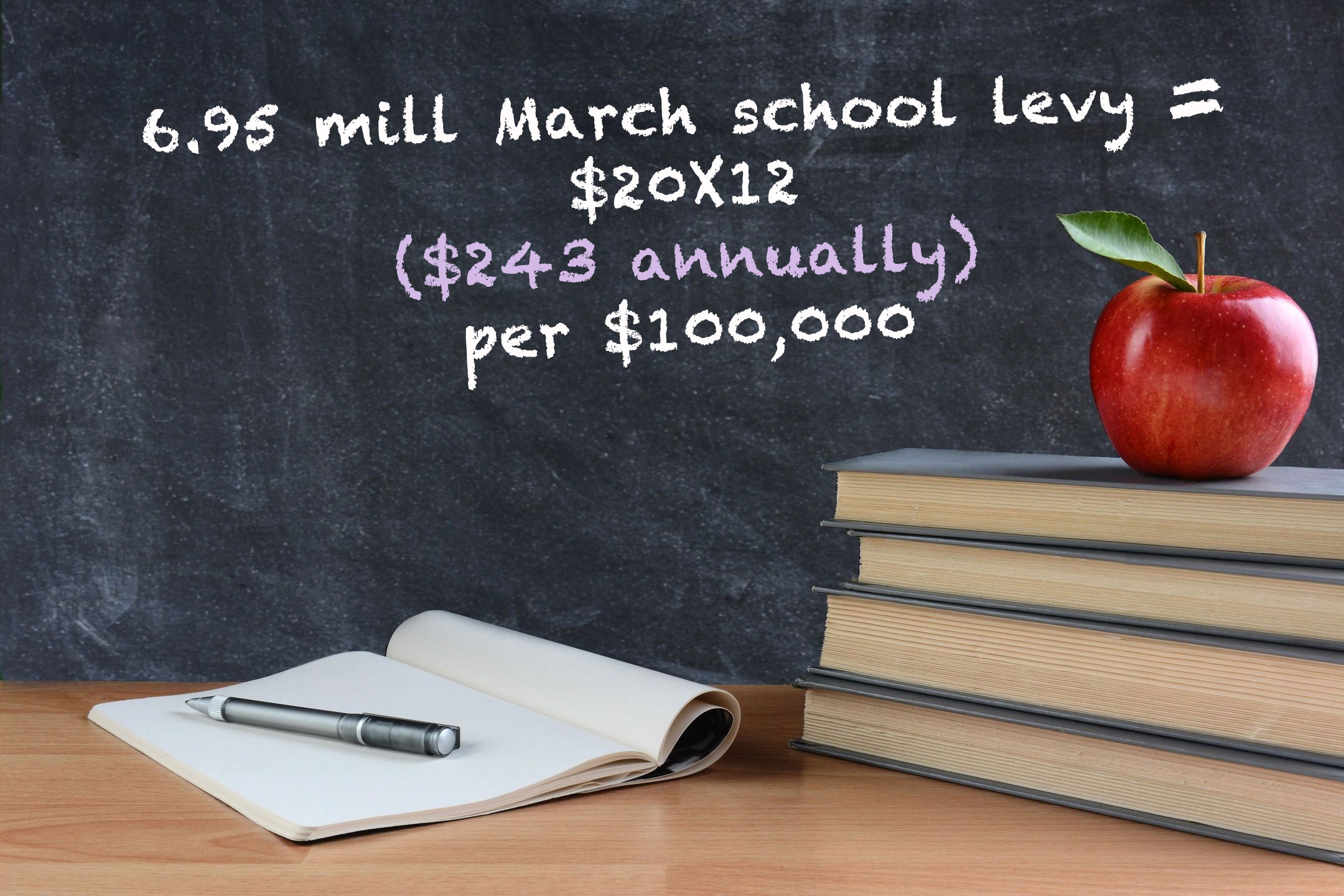
  • 6.95 mill March school levy translates into approximately $20/month ($243 annually) per $100,000

    6.95 mill March school levy translates into approximately $20/month ($243 annually) per $100,000

    Loveland, Ohio – On Tuesday, December 17, the Loveland Board of Education voted unanimously and passed a resolution to place an operating levy of 6.95 mills on the March 2020 ballot. The decision follows a failed combined operating and permanent improvement/bond issue of 16.78 mills on the November 5, 2019 ballot. “YES” votes totaled 2,447 and “NO votes totaled 8,634.

    The failed levy was for the same millage amount of new operating funds the voters will be asked to approve on March 17 – 6.95 mills. The Hamilton County Auditor estimates the new operating levy would generate $6,164,257 in the first year of additional income for the District. Collections would begin in 2021.

    The cost of the combined 16.78-mill levy translated into $49 monthly per $100,000 of appraised home value. If passed last November, collections would have begun in 2020. The failed November levy included 9.83 mills to pay for issuing $118.515,000 of debt for new construction, 3.41 mills for additional permanent improvements and 6.9 mills for operating expenses.

    The new levy request will be approximately $20/month ($243 annually) per $100,000 of appraised value.

    The last operating levy was for 5.6 mills and it was passed in May of 2014

    In a press release, the District said that there will be approximately $2.7 million of budget cuts made in conjunction with the levy. According to Superintendent Dr. Amy Crouse, they will include a combination of reductions in the “instructional cycle budget” (textbooks, etc.), staff and contracted services, and others.

    According to the District, if the March levy fails additional cuts would be made before the district would go back to the ballot and ask for additional operating funds in November of 2020.

    Operating levies fund the school district’s day-to-day expenses, including the salary and benefits of staff, which the District says make up approximately 83 percent of operating expenditures. Loveland Schools receive about 32 percent of its budget revenue from the state. The majority of the current budget, nearly 60 percent, is generated locally – mainly through property taxes. This locally-generated source of funding is also flat due to Ohio House Bill 920, which prevents schools from collecting additional revenue as home values increase over time.

    In addition to voting for a March levy, the board has discussed the intention to look into options for increasing transparency and community involvement, through community advisory groups, one of which would focus specifically on school funding issues and advocacy at the state level.

    Dr. Crouse said that the facility needs that were addressed in the failed bond levies in November will be on hold for the foreseeable future. Crouse said in the release, “Our school facility needs as presented earlier this year still remain and will eventually need to be addressed.” She added that the board will not be placing any levy on the ballot for facilities in November of 2020.

    The master plan that is shelved outlined a new campus at Grailville for all Pre-K through fifth-grade students. It included repairs, renovations, and additions to the Middle School/Intermediate School and High School campuses. The money would also have been used for upgraded building security at all schools with secure entrances, camera systems, and electronically-activated locks. It included upgraded and expanded science and technology laboratories for biotechnology and robotics, among others. Included in the master plan was a new auditorium/fine arts center at the high school. The current auditorium would have been repurposed as academic space. The master plan also included upgrades and enhancements to athletic facilities at both the Middle and High Schools. Architects hired by the District developed the budget for the total project ($165 M).

    Also read:

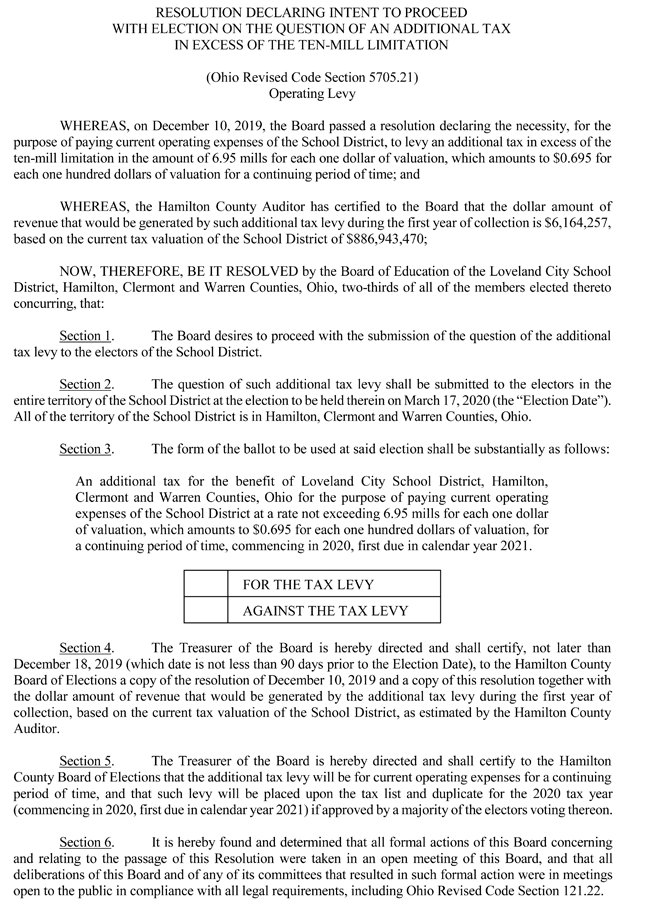
    Below is the Resolution that was delivered to the Hamilton County Board of Elections with the ballot language.

    The District has provided this way to most accurately calculate the cost of the March levy to property owners:

    How much will the levy cost home owners?
    The 6.95 millage rate translates into $20.27/month ($243.25 annually) per $100,000 of appraised home value as determined by the county auditor. To understand exactly how much the district’s 6.95-mill operating levy will cost your household, you will need to know your home’s appraised (or fair market) value as determined by your county auditor. Go to your local county auditor’s website and do a real estate property search:
    Hamilton County (https://wedge1.hcauditor.org/)
    To find the appraised value, referred to as “Market Value,” go to “Tax Distributions” in the right column.
    Clermont County (https://www.clermontauditor.org/_web/search/commonsearch.aspx?mode=owner)
    To find the appraised value, go to “Values” in the left column.
    Warren County (https://www.wcauditor.org/Property_Search/)
    To find the appraised value, see “Value History” in the left column. The appraised value will be listed as the “True Value.”
    Please note that the assessed value, which is used by the auditor to determine your tax obligation, is 35% of the appraised or market value. A home that is appraised at $100,000 is taxed on only $35,000:
    $35,000 x .00695*= $243.25/annually, or 243.25÷12=$20.27/monthly*.00695 equals the millage rate of 6.95.

    Also read…

    Board of Ed cancels contract with Allerton Hill Consulting

  • Most read Loveland Magazine stories of 2019

    Most read Loveland Magazine stories of 2019

    David Miller is the Publisher and Editor in Chief of Loveland Magazine

    by David Miller

    We will almost certainly never surpass the 1.3 million readers we had in 2017 (combined on lovelandmagazine.com, Facebook, and Twitter) on the day and the day after the fire in the Historic District. And, we quite frankly never want to surpass that record unless it’s much better news. (Early morning fire destroys 2/3 block in Historic Downtown Loveland)


    #1

    The most-read story by a wide margin in 2019 involved the levy the school district put on the ballot. Actually, we only published a few stories that were informational, the Five Ws (Who, What, When, Where, Why) of the levy vote. We provided public documents, notices of public meetings, etc.

    Interesting is what drove readership… we let our readers tell the story through Guest Columns and Letters to the Editor.

    Letting our readers, and District staff tell the story in balanced thought-provoking columns proved that we had no need to publish “she said-he said” stories filtered through our eyes and we are extremely grateful to those who submitted columns and the reflective social media comments that followed. We published each and every opinion piece we received and only occasionally felt the need to delete some of the social media comments that were inappropriate.

    Topping all of the levy stories was a Guest Column by Juliet Tissot, “We should not thumb our noses at the less fortunate just because we want nice stuff.” We did nothing special to promote Tissot’s column, however, are extremely proud of the Loveland community taking such interest in the subject she raised, because the plight of the “less fortunate” is rarely if ever discussed here in the Loveland area. I hope in 2020 this subject is revisited often inside the institutional framework of school board meetings, city buildings, and township halls.

    LOVELAND MAGAZINE TV also produced several videos of school board meetings where the District and local residents discussed the levy which added to making the levy by far the most looked at topic of 2019.

    #2

    Public Advised Not to Enter Little Miami River South of Old 3C Highway Until Further Notice” and “Canoe liveries warn of dangerous river conditions this weekend“.

    #3[VIDEO] Parking garage coming to Historic Downtown and Council executes purchase agreement for 1.15406 acres of land on First Street in Historic Downtown

    #4 Buy the original White Pillars home


    #5 Loveland Magazine “Local Voter Guide” to issues and candidates


    #6 Loveland’s Rails Trails & Ales Festival is Sept. 6 thru 8


    #7 Beloved Loveland High School educator: Charles R. Schmidt passes


    #8 It only took 8 minutes a story about flash flooding on Loveland Maderia Road.

    #9 Arrest made for scattering screws and nails on the roadway at SR 131 & Betty Lane

    #10 [Breaking] W. Loveland/Loveland Madeira area is being evacuated (Crews are investigating a natural gas leak at the intersection of W. Loveland/Loveland Madeira. The area is being evacuated and Duke is on scene.) Exact source of natural gas leak still not pinpointed – evacuation still in place


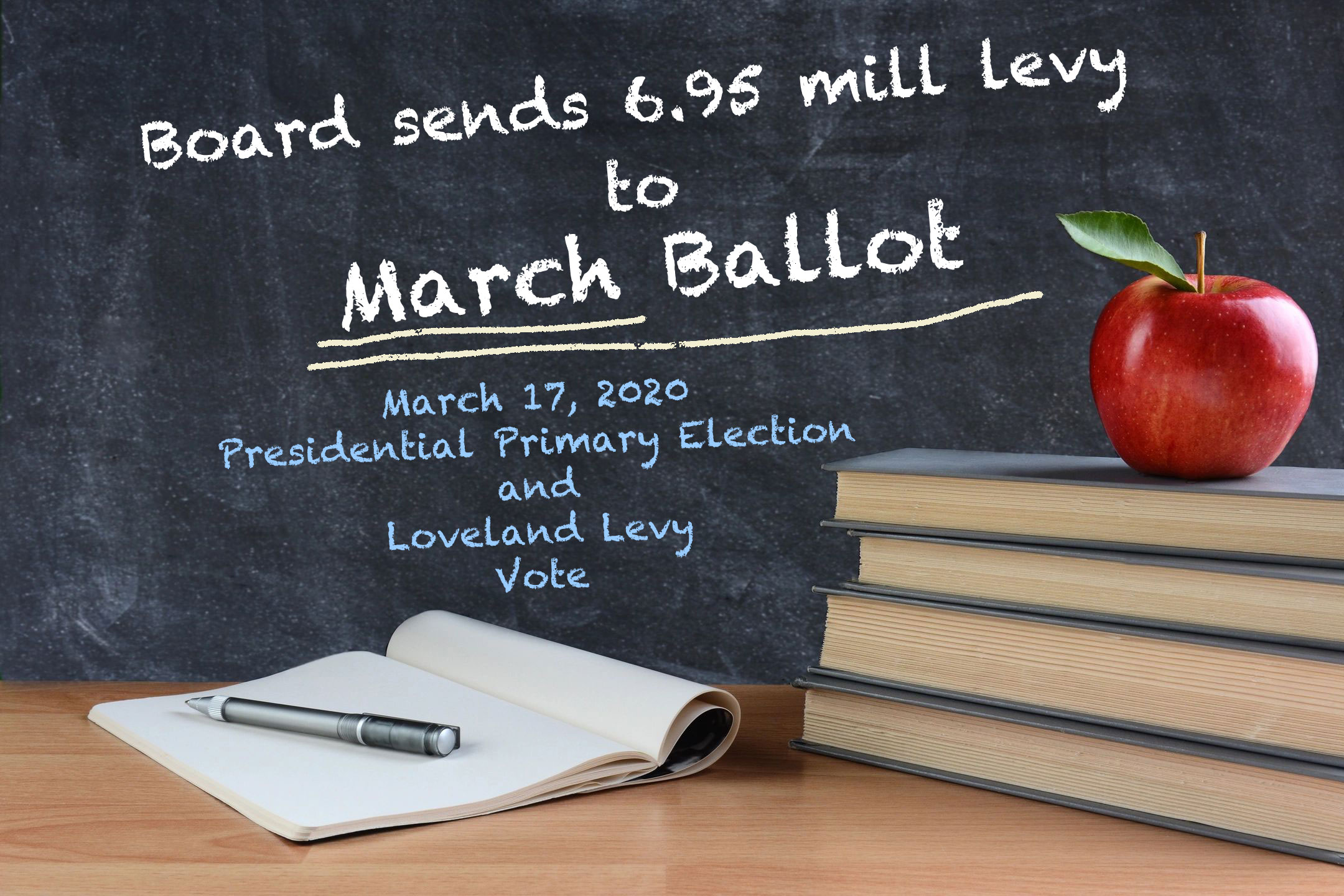
  • Board moves to place 6.95 mills on the March 2020 ballot

    Board moves to place 6.95 mills on the March 2020 ballot

    Loveland, Ohio – The Loveland Board of Education met on Tuesday, December 17 and unanimously passed a resolution to place an operating levy of 6.95 mills on the March 2020 ballot. The deadline to file the resolution with the Hamilton County Board of Elections is today, December 18.

    Neither Board Superintendent Amy Crouse or Treasurer/CFO Kevin Hawley wanted to speak to Loveland Magazine after the meeting, so details of the implications of the levy are sketchy. Neither Crouse or Hawley would discuss the budget cuts they are proposing or the amount the levy would provide the District. However, Crouse did say last week in a press release, “Approximately $2.7 million dollars of budget cuts will be made in conjunction with the levy. They will include a combination of reductions in the instructional cycle budget (textbooks, etc.), staff, and contracted services, among others.”

    Last week’s press release also said:

    The 6.95 millage levy translates into approximately $20/month ($243 annually) per $100,000 of appraised home value as determined by the county auditor.

    Below is a LOVELAND MAGAZINE TV video of the 14-minute meeting.

    In the interview below Dale Friemoth, a member of the

    Loveland Voice on Facebook: “Voter Oversight, Involvement, Concern for Education.”

    District Ad Hoc Advisory committee that was appointed to discuss how the District should move forward after the defeat of a combined operating and bond issue that was on the November ballot discusses the Board’s vote. He talked about the new levy and also about a new community organization that has formed, Loveland Voice. Friemoth said they will meet soon to discuss their actions going forward. One thing he stressed is that he feels that the Board must take purchasing the Grailville land off the table at their next meeting if they want voter support for the new levy.

    Below is the Resolution that was to be delivered to the Hamilton County Board of Elections today.


  • School Board meets Tuesday for March levy vote

    School Board meets Tuesday for March levy vote

    Board members, Michele Pettit, Ned Portune, Eileen Washburn, President Art Jarvis, and Vice President Kathryn Lorenz

    Loveland, Ohio – The Loveland City School District has called a special meeting for Tuesday, December 17. This meeting will be held to consider a “resolution to proceed” in order to place a March operating levy on the ballot.

    The Board will also go into executive session to discuss employment matters.

    The 6 PM meeting is in the Loveland Intermediate and Middle School’s Media Center at 757 S. Lebanon Road.


    Treasurer Resolutions
    Approve a resolution declaring intent to proceed with election on the question of an additional tax in excess of the 10 mill limitation and certifying the same to the board of elections per ORC 5705.21.


    The Board of Education met on Tuesday, December 10, and passed a resolution of necessity to place an operating levy of 6.95 mills on the March 2020 ballot. The decision was five weeks after a failed combined operating and permanent improvement/bond issue on November 5.

    According to a press release issued by the Distric, the 6.95 millage levy translates into approximately $20/month ($243 annually) per $100,000 of appraised home value as determined by the county auditor. The board is to have the millage amount certified by the county auditor and intends to pass a resolution to proceed on December 17. The deadline to submit ballot language to the county boards of elections is December 18.


  • [Breaking] School Board votes to put 6.95 mills on March ballot

    [Breaking] School Board votes to put 6.95 mills on March ballot

    Loveland, Ohio – A Press Release issued by the Loveland City School District tonight reads:

    Loveland Board of Education Passes Resolution of Necessity for Operating Levy in March 2020

    The Loveland City School District Board of Education met on Tuesday, December 10, and passed a resolution of necessity to place an operating levy of 6.95 mills on the March 2020 ballot. The decision comes five weeks after a failed combined operating and permanent improvement/bond issue on November 5.

    “We have sought the feedback of our community through an ad hoc advisory committee to determine the feasibility of a March ballot issue,” said Board President Art Jarvis. “We are tremendously grateful for the commitment shown by these individuals to step up, assist us and provide the community input needed for this decision. After collaboration and conversations with concerned community members, parents, staff and administration about the implications of both a March and a November 2020 operating levy, we, as a board, feel that it is in the best interest of the district to give the community the opportunity to vote in March.”

    Approximately $2.7 million dollars of budget cuts will be made in conjunction with the levy. According to Superintendent Dr. Amy Crouse, they will include a combination of reductions in the instructional cycle budget (textbooks, etc.), staff, and contracted services, among others.

    “When implementing cuts in our budget, our priority is to protect our students and the growth, achievement and academic momentum gained over the past several years,” said Dr. Crouse.

    If the March levy fails, additional cuts will need to be made in order for the district to go back on the ballot in November 2020.

    Operating levies fund the school district’s day-to-day expenses, including the salary and benefits of staff, which at Loveland make up approximately 83 percent of operating expenditures. Loveland Schools receive about 32 percent of its budget revenue from the state, an amount that remains relatively flat from year to year. The majority of the budget, nearly 60 percent, must be generated locally – mainly through property taxes. This locally-generated source of funding is also flat due to Ohio House Bill 920, which prevents schools from collecting additional revenue as home values increase over time.

    In addition to voting for a March levy, the board discussed the intention to look into options for increasing transparency and community involvement, for example through a model of community advisory groups, one of which would focus specifically on school funding issues and advocacy at the state level.

    “We will continue to work with our community on creative solutions for increasing income and reducing expenditures,” said Dr. Crouse. “Our school facility needs as presented earlier this year still remain and will eventually need to be addressed, but the board will not be placing any levy on the ballot for facilities in November.”

    The 6.95 millage levy translates into approximately $20/month ($243 annually) per $100,000 of appraised home value as determined by the county auditor. The board will have the millage amount certified by the county auditor and intends to pass a resolution to proceed on December 17. The deadline to submit ballot language to the county boards of elections is December 18.


  • School Board to discuss the potential of a March levy Tuesday evening

    School Board to discuss the potential of a March levy Tuesday evening

    Loveland, Ohio – Below is the agenda for Tuesday’s Loveland Board of Education’s Work Session scheduled for 6 PM at the LMS/LIS Media Center.

    The Administration has said that if the recommendation is to put an operating levy on the ballot in March, the board will need to pass an initial resolution of necessity on December 10, have it certified by the county auditor, and pass a second resolution to proceed on December 17. The content of the ballot issue must be submitted to the board of elections no later than December 18.

    1. Opening Items
    1.1 Adoption of Board Agenda

    2. Discussion Topics
    2.1 First Reading Policy 5460 – Graduation Requirements

    2.2 Open Checkbook Update

    2.3 Discuss the potential of a March levy which may include the passage of the first of two resolutions for the March ballot

    3. Superintendent Resolutions
    3.1 Approve course adoptions for 2020-2021

    4. Treasurer Resolutions
    4.1 Approve disposal of inventory

    5. Assistant Superintendent of Human Resources
    5.1 Resignations and employment of certified, classified, homebound, substitute and supplemental positions for the 2019-2020 school year

    5.2 Motion to approve travel for our athletic teams, performance groups or individuals will be staying overnight at an event.

    6. Meeting Closing
    6.1 Adjournment


  • [Video] Grailville? YES or NO

    [Video] Grailville? YES or NO

    Loveland, Ohio – On December 3 the Loveland Board of Education met with their ad hoc advisory committee to discuss how the District should move forward after the defeat of a combined operating and bond issue that was on the November ballot. This is Part 1 of the meeting where the fate of the option to purchase 110 acres at Grailville was discussed.

    Grail U.S. Executive Director Terrie Pucket was at this meeting to discuss their stance on the contract they have signed with the District.

    The Administration also brought in their consultant to discuss land and building options.

    To view the slides used for the discussion go HERE.

    LOVELAND MAGAZINE TV IS SPONSORED BY MOVE2LOVELAND


    BACKGROUND

    To bone up, here is the Option to Purchase Grailville Contract and the Appraisal of the land the District received.

    Related: