Tag: Butler County

  • Milford and Lakota schools become centers of learning for COVID-19 best practices

    Milford and Lakota schools become centers of learning for COVID-19 best practices

    By Susan Tebben and Ohio Capital Journal

    Milford and West Chester, Ohio – Two Ohio school districts with some of the highest cumulative case rates for COVID-19 say as they remained in-person, their safety protocols only got better.

    Milford Exempted Village School District in Clermont County has remained in-person since the fall, and has had to close twice due to staff absences.

    “We simply had too many staff out sick or quarantined and couldn’t find the subs,” Wendy Planicka, director of communications and public relations for the district, told the OCJ. “We have shut down grade levels at a few of our elementary buildings as well, but not an entire elementary building.”

    The school district, like many in the state, provides weekly counts of COVID-19 cases on their website, along with cumulative district-wide data.

    Since Aug. 1, the district has reported 649 total cases in their district of 6,235 students and 810 staff members.

    Currently 4,990 students are enrolled in-person, with 1,245 students enrolled in the district’s virtual program, Eagle Online.

    Planicka said community spread has been the “number one cause of our cases,” followed by spread through athletics or non-school sponsored activities such as family parties.

    “There have been two or three cases where we believe spread happened in an athletic setting — for example when football was in season last fall, at one point almost the entire football team was quarantined due to possible spread,” Planicka said.

    The school implemented protocols that require an investigation into every positive case, including contact tracing in partnership with Clermont County Public Health and a minimum 10-day quarantine period for students and staff who test positive.

    In schools, a mask requirement is in place, and custodians are to disinfect desk areas every evening, along with using an electrostatic sprayer “at least every 30 days” according to Milford’s protocol list.

    Milford’s reopening plan was developed to make the return to school as safe as possible, but not to return the school to exactly as it was, according to the plan itself.

    “School will not look the same as it did prior to March 2020,” the plan stated. “These changes may be temporary or they may be permanent. Time will tell.”
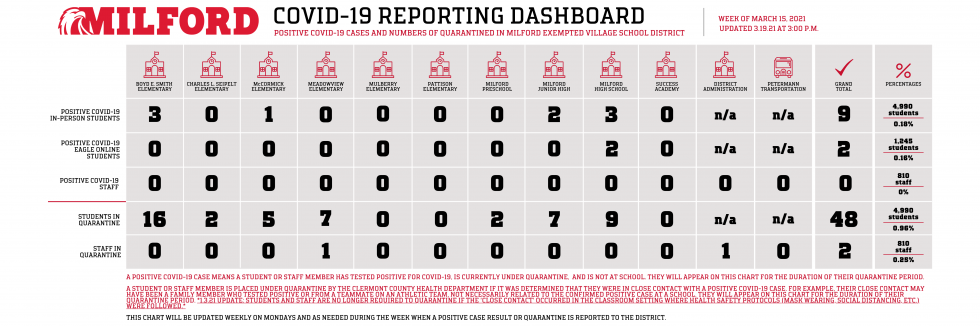
    Milford’s latest COVID 19 Dashboard (https://www.milfordschools.org/services-and-programs/return-to-learning-20/covid-case-reporting-61/)

    Butler County’s Lakota Local Schools had the highest number of cases since the pandemic counts began, with more than 700 total student cases, according to state data. The school is also home to 14,000 students, having reopened to in-person learning on August 17.

    “Since then, our students have had the opportunity to attend school all day, every day,” said Betsy Fuller, community relations director for the district.

    There is a virtual learning option at Lakota, being utilized by 3,000 students, according to Fuller.

    In the five months that made up their first semester, the school reported 5,172 students in quarantine. The worst month for positive cases in students was December, with 221 of the 468 reported in that semester happening then.

    “We traced many of the positive cases to holiday gatherings and celebrations happening outside of school between Halloween and Thanksgiving,” Fuller said. “It is also important to note that very few cases, if any, could actually be linked back to classroom spread.”

    The district had guidelines in place as soon as it reopened, including requiring face coverings for all K-12 students, desk cleanings between classes, assigned seating at lunch, and block scheduling to avoid frequent class changes.

    In the three months of the second semester so far, the district has reported 345 positive cases, but a 93% student attendance rate.
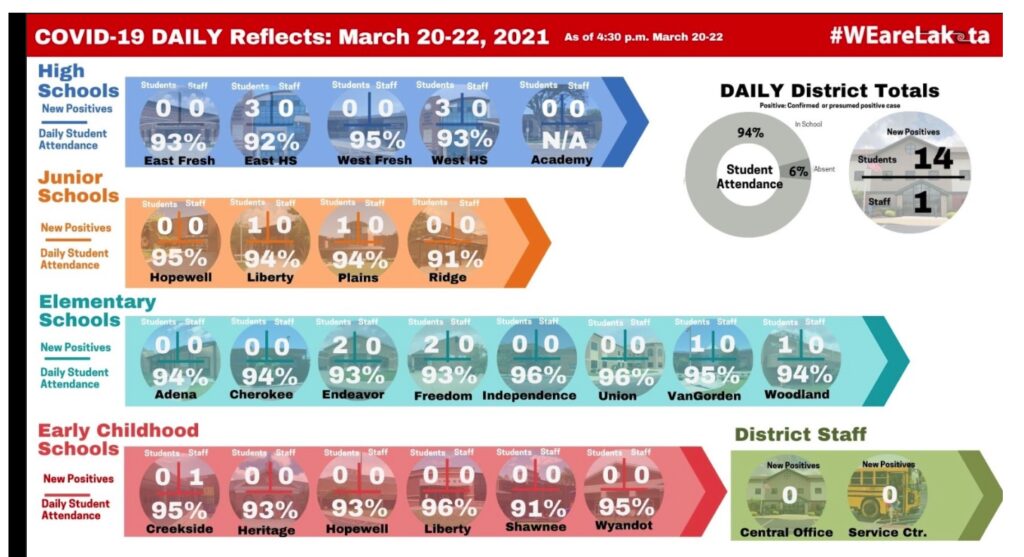
    Lakota’s latest COVID 19 Dashboard (https://www.lakotaonline.com/cms/One.aspx?portalId=216799&pageId=24411613)

    In February, the state implemented a vaccination program specifically for teachers and school personnel, making returning to school or already conducting in-person instruction a pre-requisite to districts receipt of vaccination doses.

  • Fraternal Order of Police, teachers, former law enforcement against armed teacher policy

    Fraternal Order of Police, teachers, former law enforcement against armed teacher policy

     
    by Susan Tebben – and the Ohio Capital Journal
     

    An organization representing more than 23,000 police officers, including school resource officers, says allowing teachers to bring guns to school under only a concealed carry permit could do more harm than good.

    The Fraternal Order of Police of Ohio said this in a brief to the Ohio Supreme Court, which is considering a case that would keep schools from allowing a firearms authorization policy. The police organization said they were not taking a stand on whether teachers should be armed, but rather the training involved.

    Susan TebbenSusan Tebben is an award-winning journalist with a decade of experience covering Ohio news, including courts and crime, Appalachian social issues, government, education, diversity and culture. She has worked for The Newark Advocate, The Glasgow Daily Times, The Athens Messenger, and WOUB Public Media. She has also had work featured on National Public Radio.

    “An interpretation holding that a school resource officer or security guard needs extensive training to carry a gun in school, but the art teacher does not, is neither just nor reasonable,” the group said in a brief to the court.

    While 17 other school districts argued that the “plain language” in the Ohio Revised Code allowed them the right to bring guns to school when authorized, the FOP read the “plain language” as advising schools to the contrary.

    “A teacher who carries a weapon into a classroom while teaching is, quite

    literally, both ‘armed’ and ‘on duty,’” the organization stated. “There is no reason to depart from this plain language because it yields a ‘just and reasonable’ result, as the Revised Code demands.”

    Agreeing with the language, a group of 284 current or former Ohio teachers or school staff members said the law was “unambiguous” in its explanation of the training requirements needed to bring guns to schools. The teachers and staff don’t say school districts should be banned from creating weapons policies.

    “But the General Assembly has required that, should they elect to arm teachers, school districts must ensure that they have adequate training, which the legislature has determined was satisfactory completion of an approved basic peace officer training program,” the brief by the teachers and staff stated.

    The FOP even went so far as to say the Madison Board of Education’s interpretation “would get people killed.”

    In arguing against the firearms policy, the police officer’s group brought up gun-retention skills, accuracy in a gunfight and situational awareness that they say would decrease if teachers were given the responsibility of defending themselves and others in a school shooting.

    The brief to the court also said a lack of training would make armed teachers a liability, causing law enforcement to have more difficulty stopping an active shooter, and “may get themselves shot in the process.”

    “If nothing else, police officers train on the ‘mental preparedness’ necessary to take a life,” the brief stated. “But in the context of a school setting, undertrained teachers will be mentally unprepared to kill one of their own students.”

    Several others submitted document in support of a decisions that keeps gun policies out of the board’s hands, including the Ohio Education Association and the Ohio Federation of Teachers. A group of “experts in school safety and firearms training,” including Dayton Police Department Chief Richard Biehl, a former leader of the Columbus Division of Police Training Bureau and a former Madison Local School District teacher who became a police officer after the 2016 school shooting there, joined in the support of the parents against the firearms policies.

    The cities of Columbus and Cincinnati also filed briefs showing their interest in the case, and support of the present law on training of armed personnel in schools.

    If an Ohio Senator has his way, the law will change regarding armed personnel in school. The bill passed the Senate Government Oversight & Reform Committee, and is awaiting a full floor vote before moving on to the Ohio House.

  • Ohio Supreme Court: School district firearms policy can go on, pending appeal

    Ohio Supreme Court: School district firearms policy can go on, pending appeal

    By Susan Tebben at Ohio Capital Journal

    Columbus, Ohio – The Ohio Supreme Court has said a school district can go ahead with a firearm policy for personnel while the state’s highest court decides on their case.

    The Ohio Supreme Court granted Madison Local School District’s request to allow the implementation of a policy allowing trained personnel including teachers to be armed on the Butler County district’s grounds Wednesday. 

    The amount of training the personnel must receive is still up for debate as the Ohio Senate considers a bill to lower that training level.

    But just as they allowed the motion, they also sped up the schedule for their own deliberation.

    “No stipulations or requests for extension of time shall be permitted, and the clerk of court shall refuse to file any stipulations or requests for extension of time,” the court said in a filing.

    The district asked for an expedited timeline because of the upcoming school year, which started Aug. 13. The appeals court decision had “no practical effect” before then, because Ohio Gov. Mike DeWine had already closed schools due to the COVID-19 pandemic.

    Attorneys for the school district parents who filed the initial lawsuit said a last-minute halt to the appeals court decision “threatens to upend the expectations of parents who have used the intervening months to make time-sensitive decisions — and commitments — about how to safely educate their children this fall.”

    “While parents face a variety of safety concerns when deciding how to school their children in a global pandemic, Madison’s last-minute request would add to the confusion and concerns that parents are currently grappling with, and have already made decisions about,” attorneys for the families wrote in a response to the motion, filed Aug. 12.

    The parents disagreed with the district’s argument that allowing the school to implement the policy before the supreme court makes its final decision is “necessary to prevent irreparable injury.” 

    While both parties want to avoid a school shooting like the one that sparked the policy in the first place, attorneys for the parents said, being barred from implementing the firearm policy “does not prevent Madison from deploying almost any conceivable option to enhance school safety; it simply bars the use of armed staff whose few days of training fall far short of the state mandate.”

    The school district has 20 days to file their arguments with the court, and the families have 20 days following that to respond.

    Chief Justice Maureen O’Connor and Justice Michael Donnelly disagreed with the decision to expedite the case and temporarily halt the appeals court decision, and Justice Patrick Fischer noted he would have specifically denied the portion of the motion to allow the district’s firearms policy.


    Susan Tebben

    Susan Tebben is an award-winning journalist with a decade of experience covering Ohio news, including courts and crime, Appalachian social issues, government, education, diversity and culture. She has worked for The Newark Advocate, The Glasgow Daily Times, The Athens Messenger, and WOUB Public Media. She has also had work featured on National Public Radio.
  • Butler County school asks state supreme court to speed up decision on armed teachers policy

    Butler County school asks state supreme court to speed up decision on armed teachers policy

    ss
    Columbus, Ohio – An Ohio school district hoping to enact a policy to arm teachers is asking the Ohio Supreme Court to speed up their decision in light of an approaching school year. 
    ss
    Last week, the state’s highest court agreed to hear the appeal of the Madison Local School District in Butler County, after an appeals court ruled they did not have the right to enact a “firearms authorization policy” that would allow armed teachers in schools.
    ss
    Several parents sued the district in 2018 seeking an injunction blocking the district from arming teachers and other staff without the training required of law enforcement officials.
    cc
    When the court of appeals made that ruling in March 2020, it had “no practical effect” on the district, attorneys for the district said in court documents. The decision came after Ohio Gov. Mike DeWine closed schools throughout the state due to the COVID-19 pandemic.
    cc
    “That changes (Aug. 13), when the 2020-21 school year begins for Madison with in-person classroom instruction,” attorneys for the district said in their motion. 

    Due to the upcoming school year, the school district is asking the court to “expedite” the schedule and consideration for the ruling.

    Due to the upcoming school year, the school district is asking the court to “expedite” the schedule and consideration for the ruling. They submitted the request two days after the state supreme court agreed to hear the case. 

    The request to speed up a ruling also included an argument that the school should be able to go forward with their firearms policy as the appeals court decision is appealed. 

    Attorneys for the district said the fact that the Ohio Supreme Court accepted the case “implies serious questions going to the merits of the Twelfth District’s decision and that Madison has at least a reasonable prospect of success on the merits.”

    The firearms policy was agreed to after a shooting at the junior/senior high school in which four students were injured, and the shooter, James Austin Hancock was sentenced to juvenile detention until he turns 21.

    The district also said barring the firearms policy as the school year begins could become a safety issue. 

    “To be sure, everyone can hope that Madison does not ever experience another school shooting, and it is possible that the absence of this deterrent effect during the upcoming school year might turn out not to have mattered,” the school district said in court documents. “But it might matter, and Madison has made the policy decision that its students and staff are safer with its policy in place.”

    The firearms policy was agreed to after a shooting at the junior/senior high school in which four students were injured, and the shooter, James Austin Hancock was sentenced to juvenile detention until he turns 21.

    The district noted in its statement to the court that there were no “situations or incidents” during the 2018-19 school year or the part of the  2019-20 school year in which the schools were open.

    The court battle is also the subject of a bill currently in the Ohio Senate. Butler County resident and state Sen. Bill Coley introduced Senate Bill 317 in May with the aim to reduce the amount of training needed for school personnel to be armed in schools. 

    An amendment has been brought up to include a “school marshal program” within the bill. The last hearing on the bill was held July 21.

    Susan Tebben

    Susan Tebben is an award-winning journalist with a decade of experience covering Ohio news, including courts and crime, Appalachian social issues, government, education, diversity and culture. She has worked for The Newark Advocate, The Glasgow Daily Times, The Athens Messenger, and WOUB Public Media. She has also had work featured on National Public Radio.
  • Duke Energy Convention Center selected for “Enhanced Hospital Capacity” other local COVID 19 news

    Duke Energy Convention Center selected for “Enhanced Hospital Capacity” other local COVID 19 news

    Ohio’s new stay at home order goes into effect at midnight tonight.

    Columbus, Ohio – Ohio Governor Mike DeWine, Lt. Governor Jon Husted, and Dr. Amy Acton, MD, MPH, provided the following updates on Ohio’s response to the COVID-19 pandemic this afternoon. 

    HOSPITAL CAPACITY 

    The announcement said that Ohio must double its hospital capacity due to the oncoming COVID-19 surge, Ohio has developed a plan to expand healthcare services at alternative sites in addition to the traditional medical care facilities. Representatives from health care systems, local governments, county emergency management agencies, state agencies, the Ohio National Guard, among others, examined buildings across the state that could support large numbers of patients.

    The following sites have been selected based on considerations such as distance to an existing hospital, conditions safe for patients and health care professionals, and space to meet the region’s expected needs, including the Duke Energy Convention Center in downtown Cincinnati.

    1. Seagate Convention Center, Lucas County
    2. Case Western University’s Health Education Campus, Cuyahoga County
    3. Dayton Convention Center, Montgomery County
    4. Covelli Convention Center, Mahoning County
    5. Duke Energy Convention Center, Hamilton County
    6. Greater Columbus Convention Center, Franklin County

    These facilities would be used for the mildly ill, while the sickest patients will be housed in traditional hospitals.

    Assessments of other sites will continue if needed.

    The press release from the Governor’s office said that health care regions in southern and southeastern Ohio have determined the existing hospital facilities in their areas will, with additional equipment, be capable to handle a surge in patients without going to an off-site location.

    OHIO NATIONAL GUARD TO ASSIST FEDERAL PRISON

    Governor DeWine announced that he has authorized the Ohio National Guard to assist federal authorities in the Elkton Federal Correctional Institution in Columbiana County where seven inmates have tested positive for COVID-19, and three inmates have died from the disease.

    “To be clear, this is not a state facility, it is a federal prison – but, this prison is in Ohio. Ohio citizens work there, and their families live here,” said Governor DeWine. “As we’ve said for weeks, we’re all in this together, and providing state help for this federal prison is the right thing to do.”

    The Ohio National Guard’s mission will be focused on providing medical assistance. They will not be armed, nor will they be providing security.

    The guardsmen and women will assist in the prison’s infirmary with non-COVID-19 cases and with patients who are showing symptoms of the disease. These soldiers, who all work in the medical field, will have N-95 respirators for protection while they work to augment the current prison medical staff. They will treat those they can and triage others with serious symptoms for hospital care.

    The guard also stands ready to help with transporting the seriously ill patients to the hospital in the event of a surge of sick inmates. In addition to staff, the guard will bring equipment and ambulances with them as well.

    Governor DeWine also requested that the Federal Bureau of Prisons and U.S. Department of Justice cease accepting new inmates at the facility.

    DISPUTE RESOLUTION 

    Lt. Governor Husted announced that the administration’s Dispute Resolution Commission, which was initially announced last week, is now prepared to receive submissions from essential businesses as well as county health departments.

    The panel, which includes Ohio Department of Commerce Director Sheryl Maxfield, Development Services Agency Director Lydia Mihalik, and Public Utilities Commission of Ohio Chairman Sam Randazzo, will specifically seek to resolve disputes when two county health departments disagree on whether a type of business should or should not be deemed essential during the state of emergency. The purpose of the commission is to provide clarity and ensure that similarly-situated businesses are treated fairly, regardless of which side of a county line they operate.

    For more information, visit Coronavirus.Ohio.gov/BusinessHelp and select the “Businesses & Nonprofits” tab for more information.

    REMINDER – NEW STAY AT HOME ORDER

    Ohio’s new stay at home order goes into effect at midnight tonight. You can find the full order at coronavirus.ohio.gov.

    Retailers will be required to determine a maximum number of customers allowed in the store to account for proper physical distancing. That number must also be displayed at the businesses’ entrances.

    REMINDER – SNOWBIRDS MUST SELF-QUARANTINE 

    Governor DeWine today reminded “snowbirds” that they must quarantine for 14 days once they arrive in Ohio.

    “I know that many of our Ohio snowbirds will soon be returning from places like Florida, and we want to make sure that you remain healthy and that those around you remain healthy,” said Governor DeWine.

    In addition to those returning after spending winter elsewhere, anyone who has traveled outside of Ohio for any other reason must also self-quarantine for 14 days upon their return. This order excludes truckers, healthcare workers, other workers providing essential services, and those who live on the state border.

    CURRENT OHIO DATA

    There are 4,450 confirmed cases of COVID-19 in Ohio and 142 deaths. A total of 1,214 people have been hospitalized, including 371 admissions to intensive care units. In-depth data can be accessed by visiting coronavirus.ohio.gov.

    • 4,450 – Confirmed Cases in Ohio
    • 371 – Number of ICU admissions
    • 1,214 – Number of Hospitalizations in Ohio
    • 142 – Number of Deaths
    • <1–101 – Age Range
    • 54 – Median Age
    48%* – Sex – Males
    52%* – Sex – Females
    LAST UPDATED: 04/06/20 (UPDATED DAILY AT 2 P.M.) *<1% SEX NOT REPORTED

    In Clermont County there are 27 cases, 4 hospitalizations, and 1 death.

    In Hamilton County there are 394 cases, 66 hospitalizations, and 9 deaths.

    In Warren County there are 37 cases, 5 hospitalizations, and 0 deaths.

    In Butler County there are 75 cases, 29 hospitalizations, and 2 deaths.

    Video of today’s full update, including versions with foreign language closed captioning, can be viewed on the Ohio Channel’s YouTube page.

    For more information on Ohio’s response to COVID-19, visit coronavirus.ohio.gov or call 1-833-4-ASK-ODH.


  • Overdose deaths decline for 2nd straight year in Clermont County

    Overdose deaths decline for 2nd straight year in Clermont County

    Batavis, Ohio – Deaths due to drug overdoses declined for the second straight year in Clermont County, according to the Clermont County Coroner’s Office.

    In 2017 76 deaths were caused by accidental drug overdoses.

    In 2017, the Coroner’s Office, under the direction of Dr. Brian Treon, ruled that 76 deaths were caused by accidental drug overdoses. This compared to 83 in 2016, and 94 in 2015 – the highest number since Clermont County began to see the effects of increased opioid use in the late 2000s.

    “We are encouraged by these numbers,” said Karen Scherra, the director of the Clermont County Mental Health & Recovery Board (MHRB). “These numbers indicate that the comprehensive measures we as a county have taken to address this issue are working.” The MHRB, the county hub in the fight against opioid addiction, is the lead organization in Clermont County’s Opiate Task Force, a collaborative that began in 2013 to address the opioid crisis in the county.

    In 2017, more medication-assisted treatment and other kinds of treatment became available to more people suffering from substance abuse disorder, Scherra said. In 2017, MHRB spent over $1.9 million on addiction treatment services.

    Other advances in 2017 included more Quick Response Teams.

    Other advances in 2017 included more Quick Response Teams, which go to the homes of those who have survived overdoses to connect them to recovery resources; and more police/fire/EMS departments carrying Narcan, which can reverse overdoses.

    In addition, a long-term recovery home for men was opened in 2017 in Clermont County. MHRB is now working on funding to open a similar home for women. Clermont County also opened a women’s wing in the Community Alternative Sentencing Center. This jail alternative connects clients with multiple treatment options.

    Funding for these initiatives are provided through a combination of MHRB levy funds, federal and state grants.

    “In response to the rise in drug overdose deaths, we created an Overdose Death Review Committee in 2014,” said Public Health Commissioner Julianne Nesbit.

    Clermont County Public Health, a member of the Opiate Task Force, is also on the forefront of the opioid battle. “In response to the rise in drug overdose deaths, we created an Overdose Death Review Committee in 2014,” said Public Health Commissioner Julianne Nesbit. “We look at aggregate level data to see if there are any trends that we can address to help reduce future deaths in the community.

    “Since we first saw the increase in drug overdose deaths, we have had a full-time Injury Prevention Coordinator who works to educate the community and work with our partners on the drug epidemic.”

    In March, Hamilton County reported that overdose deaths for 2017 had increased 31 percent over the previous year to 529. Butler County reported a 20% increase to 232.

    More information on Clermont County’s Opiate Task Force can be found on its website, www.getcleannowClermont.org.

    For more information, contact MHRB Executive Director Karen Scherra, kscherra@ccmhrb.org, 513.732.5407.