Tag: CARES Act

  • Buckeye Institute, DeWine, defend ending pandemic unemployment assistance

    Buckeye Institute, DeWine, defend ending pandemic unemployment assistance

    BY: SUSAN TEBBEN – Ohio Capital Journal

    Getty Images

    A think-tank in favor of Gov. Mike DeWine’s decision to end supplemental unemployment assistance despite a continued pandemic impacting the economy is yet again pushing the Ohio Supreme Court to support the decision. The governor himself is also weighing in.

    The federal supplemental assistance from The CARES Act expired on Sept. 4, 2021 though DeWine ended it in Ohio on June 26, 2021.

    In a court filing this week by attorney (and former state Senate president) Larry Obhof, the Buckeye Institute called the early ending of additional Federal Pandemic Unemployment Compensation (FPUC) “sound economic policy.”

    The group argued in their second push for the court to land on the side of DeWine that “neither state nor federal law compels Ohio to continue participating” in the unemployment program.

    “Federal law clearly indicates that states are free to participate and, if they so choose, to withdraw from the program as well,” the institute wrote in the Jan. 10 court filing.

    Ohio residents Candy Bowling, Shawnee Huff and David Willis sued the DeWine administration in September to get the additional $300 monthly unemployment benefits reinstated, which they say are needed to help with household expenses such as rent, food and medical expenses since they were laid off due to the pandemic, according to their lawsuit.

    What’s still up to the court to decide is whether the governor, not the state as a whole, was required to continue participating in the program. Obhof says in court documents that he is not.

    “Because the Governor acted lawfully, the courts may not substitute their judgment for his policy decision,” he wrote.

    The group argues, as DeWine did when he decided to cut the benefits, that the additional payments were “delaying employees’ return to work,” and ending the support brought more employees back, though businesses across the nation are still struggling to get back to full staffing.

    “The Governor’s decision to end the additional FPUC payments was not a magic talisman for Ohio’s economy, but it was sound economic policy,” the institute wrote.

    DeWine filed his own brief arguing a lower court’s ruling saying the governor shouldn’t have ended the assistance “rests on a misreading of a state law” requiring the director of the Ohio Department of Job and Family Services to adopt rules and regulations necessary to “secure to this state and its citizens the advantages” of federal statutes, in this case including the CARES Act funds.

    “No state law – ‘long-standing’ or otherwise – compelled Ohio to participate in the program here at issue,” DeWine’s brief stated. “Because nothing compelled the governor to participate in the program, the governor’s withdrawal did not contradict any policy mandate from the legislature.”

    DeWine’s son, Supreme Court Justice Patrick DeWine, recused himself from this case “to avoid any appearance of impropriety that might result from my father’s public involvement in this matter,” according to court documents.

    In supporting the governor, the Buckeye Institute interpreted the additional unemployment benefits as a negative for the economy because Goldman Sachs economists cited in their brief estimated the median recipient of the benefits received “roughly 90% of their prior wage,” though it did not specify what the median wage for those beneficiaries was or whether it was enough to support Ohioans in essential ways.

    The Buckeye Institute brief joined other Ohio groups who supported governor’s decision. In August of last year, the Ohio Chamber of Commerce, the Ohio Business Roundtable, the Ohio Restaurant Association, the Ohio Hotel and Lodging Association, the Ohio Grocers Association and the Ohio Trucking Association filed their own brief saying the FPUC benefits “will result in a scenario where many individuals will make more in unemployment than when working,” calling the staffing issues for businesses an “artificially created labor shortage.”

    The groups levied their support once again in a Jan. 7 filing, which also included the Ohio Manufacturers’ Association, the Ohio Council of Retail Merchants and the Ohio Farm Bureau Federation.

    In this filing, they made a matching argument with the Buckeye Institute that the governor is allowed to “exercise discretion regarding Ohio’s participation in federal programs.”

    The state Supreme Court denied two attempts in the case to speed up the process of deciding the case, but has not set other deadlines in the case, including whether or not they will have an oral argument to hear from attorneys on both sides.
  • K-12 funding boost headed to districts, ACT/SAT opt-out bill headed to the House

    K-12 funding boost headed to districts, ACT/SAT opt-out bill headed to the House

    By Susan Tebben and Ohio Capital Journal

    Columbus, Ohio – The Ohio legislature approved COVID-19 pandemic-related measures to bring more federal monies to K-12 schools, and the House will review another bill to reduce testing requirements for students.

    The Ohio Senate unanimously passed House Bill 170 on Wednesday, with the House promptly agreeing to the Senate’s version of the bill the same day.

    “Parents, teachers and students in the communities that we represent are depending on this,” said state Sen. Teresa Fedor, D-Toledo, during the Senate session on Wednesday.

    The bill provides a total of $857 million to the Ohio Department of Education in federal CARES Act funding to K-12 schools.

    Included in the bill is $7 million for duties performed by the Ohio National Guard during the pandemic, and $173 million for the state Department of Health to expand COVID-19 testing and support.

    Another $154.9 million will go to the Emergency Assistance to Non-Public Schools, and $633 million to the Elementary and Secondary Relief (ESSER) funds.

    The bill also permits the Auditor of State to audit the spending by the Ohio Department of Education and each school district for money appropriated for fiscal year 2021 and funds received via COVID-19 stimulus packages, the CARES Act and the American Rescue Plan.

    A piece of legislation helping students and their schools avoid using standardized testing as a metric of learning is on its way for a full House full vote.

    House Bill 82 was quickly passed out of the House Primary & Secondary Committee this week, moving forward a measure to allow students to opt out of state-funded administration of the ACT and SATs.

    There was no discussion of the bill before it was passed out of committee, but the bill had the support of the Ohio School Counselor Association and the Ohio Education Association. The bill’s sponsors, GOP state Reps. Jon Cross and Don Jones, said the stress of the tests on students and a trend in higher education of making ACT/SAT scores optional for admission make state spending on the tests unnecessary.

    Currently, all high school juniors are required to take a college admission test as part of the state’s College and Work Ready Assessment System. The state pays $40 per student for the ACT and $36.35 per student for the SAT, according to an analysis by the Legislative Service Commission.

    That amounts to $4.9 million in state spending in fiscal year 2019, most of which was used for the ACT.

    Should the bill be passed and go into effect during the 2021-22 school year, the first class to be allowed to opt out would be the class of 2026.

  • Lawmakers seek Ohio moratorium on evictions, foreclosures

    Lawmakers seek Ohio moratorium on evictions, foreclosures

    State Reps. David Leland, D-Columbus, and Jeffrey Crossman, D-Parma

    By Tyler Buchanan and the Ohio Capital Journal

    Ohioans struggling to pay their rents or mortgages may head into 2021 without the housing protections and public assistance that have carried them through much of the pandemic this year.

    A federal moratorium on evictions is about to expire. Two other relief programs helping unemployed Americans are set to run out. There are believed to be thousands of Ohioans who are in immediate risk of eviction due to unpaid rent, with many low-income earners still working reduced hours or remaining out of work entirely. 

    Back in March, two Democratic lawmakers proposed a statewide moratorium on eviction and foreclosure actions so long as Ohio stayed under a state of emergency amid the COVID-19 pandemic. The economy has rebounded somewhat from historic unemployment in the spring, but the virus outlook looks grim as the state heads into the cold winter months.

    State Reps. David Leland of Columbus and Jeffrey Crossman of Parma believe the moratorium is needed now more than ever. 

    “This is not just a humane thing to do,” Leland said in a committee hearing on the bill Thursday morning, “it’s not just asking you to embrace the holiday spirit. Instead, as we survey the landscape after these tumultuous nine months and ahead of next year’s budget negotiations, this is a way to save numerous low-income Ohioans’ from unimaginable hardship.”

    “The urgency of this legislation is really right now,” Leland continued.

    Under House Bill 562, landlords could still file eviction actions, but courts would be prevented from acting on them while the state of emergency is in place. Law enforcement officers could not carry out eviction orders either. Courts would not be able to conduct any business pertaining to foreclosures and must halt all pending foreclosure actions.

    This moratorium would apply to residential and commercial properties.

    Nearly two-dozen Democrats and one Republican have supported the bill as cosponsors.

    iStock / Getty Images Plus

    ‘Last remnants of the safety net’

    The large-scale CARES Act signed into law in March has provided trillions of dollars of relief, but many of its programs benefiting Ohio tenants have already run out or are about to. 

    This includes the Pandemic Emergency Unemployment Compensation and the Pandemic Unemployment Assistance programs, which have helped those who have lost work during the crisis. Both programs end the day after Christmas.

    In September, the Centers for Disease Control and Prevention (CDC) issued a nationwide moratorium on evictions for residential properties. It prohibits U.S. landlords and property owners from evicting a tenant for unpaid rent. 

    That moratorium is set to expire on New Year’s Eve.

    “Just as covid cases are exploding and our hospitals are filling, and just as the coldest parts of winter are setting in, hundreds of thousands of Ohioans are set to be stripped of the last remnants of the safety net Congress put in place back in March,” Leland said.

    Ohioans struggled to pay their housing costs even with that safety net in place. A survey from this past summer found more than a half-million residents could not pay rent in June 2020.

    Now these same residents potentially face 2021 without the CDC moratorium and without relief assistance — unless Congress acts again to pass a relief bill to close the gaps left by the still struggling economy.

    A total of $50 million from the CARES Act was allocated for emergency rental assistance in October. But advocates say more is needed.

    “Unless the Senate stops blocking any meaningful relief, we’re really worried about what’s going to happen in 2021,” said Marcus Roth, a spokesman for the Coalition on Housing and Homelessness in Ohio, last month.

    That’s also the hope of Gov. Mike DeWine, who again called on Congress to pass a relief bill during his COVID-19 press conference on Thursday. 

    DeWine was asked if he supported the CDC extending its eviction moratorium into 2021. 

    “I’d have to take a look at that. I don’t know,” DeWine answered. “But look, this is a problem. This is a problem and is something that we are in fact focused on.”

    Lt. Gov. Jon Husted argued that a moratorium alone does not address the costs faced by property owners and suggested such action should be paired with further government relief.

    “There’s still somebody that has a mortgage to pay on that facility, who has a default that could potentially happen with their lender, which creates a whole chain of events and series of events,” Husted said. “So there has to be a financial solution to go along with any moratorium so that we don’t create a chain reaction in the system that causes additional problems.”

    Unintended consequences to a moratorium?

    In committee, state Rep. D.J. Swearingen, R-Huron asked the HB 562 sponsors about the “unintended consequences” of continuing a moratorium in Ohio. Swearingen noted that property owners still have costs such as repairs and that smaller banks may not be able to carry so many unpaid loans.

    State Rep. D.J. Swearingen, R-Huron

    Crossman acknowledged those concerns but said the ramifications of doing nothing would have a greater impact on individuals.

    “I think we just have to ask ourselves, who’s in a better position to bear the burden here? The individual who is not making any income trying to keep their family fed and clothed and in a housing situation during the middle of a pandemic, particularly if they don’t have a job, or a lender who can maybe take a two- or three-month pause from getting their mortgage payments?”

    Crossman said the latter is in “a far better position financially” to handle the issue. 

    Lawmakers also heard testimony from Dan Acton, a lobbyist for the Ohio Real Estate Investors Association who spoke in opposition to passing an Ohio moratorium. He said his organization consists of a few thousand “smaller” real estate investors who typically own single-family housing units.

    He claimed these property investors operate on “razor-thin profit margins.” When tenants do not pay their rent bills, Acton said, this reduces the “profits for a property owner that could otherwise be used to reduce the overall debt on a property or make improvements.”

    “The pandemic and the resulting eviction moratoria and payment delays are leaving our members on the brink of failure,” Acton said, arguing it would be “dangerous” for the government to “interfere” with a private leasing contract. 

    Leland said a moratorium is not meant to be a “long term-solution,” but would allow Ohioans to stay in their home until winter passes, the economy rebounds and a vaccine is made available.

    Separately, Leland and fellow Democratic Rep. Juanita Brent of Cleveland also sponsored House Bill 744 that would allocate around $270 million from the state’s “rainy day fund” to pay for a new COVID-19 Emergency Rental Assistance Program. No action has been taken on this bill.

  • DeWine, state leaders announce $430M in coronavirus relief

    DeWine, state leaders announce $430M in coronavirus relief

    Marty Schladen

    Marty Schladen has been a reporter for decades, working in Indiana, Texas and other places before returning to his native Ohio to work at The Columbus Dispatch in 2017. He’s won state and national journalism awards for investigations into utility regulation, public corruption, the environment, prescription drug spending and other matters.

    Ohio Gov. Mike DeWine and the state’s legislative leaders on Friday announced how they’d allocate almost half of what the state has left in federal coronavirus-relief dollars.

    The state has about $1 billion unexpended from its share of the $2.2 trillion CARES Act that Congress passed in March. At least until the feds change the rules, the funds have to be spent by Dec. 31.

    Social-service groups that deal with issues of homelessness and hunger have been clamoring for months for a share of the money, as have business groups and others. So it’s been up to DeWine and the legislature to decide what to do with the money while Congress appears stymied over further coronavirus relief.

    “We tried to look at what the needs were and what had already been put out,” DeWine said during a remote press conference. “We don’t know whether Congress will pass another bill or not.”

    The state is holding about half of the funds for coronavirus testing and contact tracing and other needs while it awaits a possible second round of relief — which may or may not include assistance to state and local governments.

    The expenditures announced Friday include:

    • $50 million for mortgage and rental assistance to families making 200% or less of the federal poverty level 
    • $125 million for businesses with up to 25 employees
    • $37.5 million for restaurants and bars
    • $100 million for colleges and universities to do testing, contact tracing and provide mental-health services
    • $62 million for rural and critical-access hospitals
    • $25 million for non-profits providing services such a food banks, homeless shelters and other social services
    • $20 million for the arts

    A good deal more of the money was focused on businesses than on assisting individuals who are suffering most. But several in Friday’s press conference said they hope by helping small businesses keep their doors open, people will be able to get or keep jobs.

    “We know some businesses are barely making it,” Lt. Gov. Jon Husted said of that portion of the package. “This is focused on them.”

    For their part, some leaders of social-service organizations said they were grateful for the help they will receive.

    “We’re pleased that Gov. DeWine finally deployed federal coronavirus relief funds to help people avoid getting evicted during this pandemic,” Bill Faith, executive director of the Coalition on Housing and Homelessness in Ohio, said in a written statement. “And we appreciate (Ohio) Controlling Board members’ support, especially Sen. (Matt) Dolan (R-Chagrin Falls) and Sen. (Jay) Hottinger (R-Newark) who took a personal interest in keeping struggling Ohioans safely in their homes. We look forward to seeing details on how the program will be implemented. Given the Dec. 31 deadline to use these funds, we would welcome the governor’s assistance in advocating for Congress to provide additional rental assistance into 2021.”

    The Ohio Poverty Law Center also released a statement praising state leaders for their action. But it warned that it won’t be enough.

    “As Ohioans continue to experience job and income loss due to the pandemic, additional federal and state resources will be needed to prevent evictions and keep Ohioans safe, especially as we get closer to the expiration of the Centers for Disease Control and Prevention’s eviction moratorium,” it said. “We hope housing assistance will be among the highest priorities for resources in the coming weeks and months.”

  • Portman, fan of a big tax cut for the rich, won’t say whether he supports $2T in coronavirus relief

    Portman, fan of a big tax cut for the rich, won’t say whether he supports $2T in coronavirus relief

    The office of Ohio Sen. Rob Portman won’t say whether he’s one of the Senate Republicans unwilling to support a coronavirus-relief bill under negotiation between the Trump White House and House Speaker Nancy Pelosi.

    Ohio Sen. Rob Portman

    Senate Majority Leader Mitch McConnell, R-Kentucky, on Tuesday warned the White House not to agree to the bill because the $2 trillion price tag was too high for many in his caucus. That message comes as hopes of passing a relief bill before next year seem to be dimming.

    With a raging virus continuing to throttle the economy, Federal Reserve Chairman Jerome Powell earlier this month urged passage of a relief bill to avoid lasting damage. Many other economists have been making the same argument, while those who study poverty say legions of Americans are being added to its numbers.

    In Ohio, those who work with the poor warn of cascading homelessness and say food banks are seeing huge demand.

    After passage of the $2.2 trillion CARES Act in March, the Democratically controlled House in May passed a $3.4 trillion coronavirus relief bill that wasn’t taken up by the Republican-controlled Senate.

    It wasn’t until late July — as federal unemployment supplements were running out — that McConnell introduced his own bill. But he later admitted that he didn’t have enough votes in his own caucus to pass it.

    Earlier this month, just after a covid-infected Trump was released from the hospital, he abruptly broke off negotiations with House Democrats. Then he abruptly reversed himself again and by Tuesday he was saying he wanted a bigger package than the $2.2 trillion deal being pushed by Pelosi and the Democrats. 

    For his part, McConnell has been promoting a bill less than an fourth that size — $500 billion — that would have included an unemployment supplement and aid to schools. Democrats blocked it Wednesday, saying the bill was woefully inadequate.

    On Tuesday, McConnell gave another reason for not wanting to schedule a hearing on a larger bill: It could disrupt the breakneck schedule to confirm Supreme Court nominee Amy Coney Barrett before the Nov. 3 election, the Washington Post reported.

    Ohio’s Democratic senator, Sherrod Brown

    That brought a blast from Ohio’s Democratic senator, Sherrod Brown.

    “Once again, Mitch McConnell is telling Americans, ‘you’re on your own,’” Brown said in an email. “Millions of people are suffering right now and he would rather stall a COVID relief package to continue rushing through an illegitimate Supreme Court nomination. Workers are struggling to figure out how to pay their bills, stay in their homes, and keep their families safe while McConnell would rather focus on his power grab.”

    Portman’s staff wouldn’t answer directly when asked whether he supported a relief bill of about $2 trillion, roughly the size of that being negotiated between House Democrats and the Trump administration.

    “Rob has consistently called on both parties to come to an agreement on additional covid relief for families and small businesses — legislation that would support increased (coronavirus) testing, provide additional funding for schools and state and local communities, restart the Payment Protection Program, and provide needed liability protections,” spokeswoman Emmalee Cioffi said in an email.

    She also provided a transcript of a Sept. 10 speech Portman gave on the Senate floor in which he castigated the earlier covid-relief bill passed by House Democrats as too expensive.

    “It’s a $3.5 trillion bill,” Portman said. “And remember, we’ve already spent about $3.5 trillion making this the largest deficit in the history of our country and making our debt now, for the first time since World War II, the size of our entire economy. That concerns all of us, and it should.”

    Portman also was highly critical of Obama-era deficit spending amid a historic recession.

    But he wasn’t nearly so concerned about deficits in 2017 when he was pushing the Tax Cuts and Jobs Act at a time when the federal unemployment rate was 4.1%

    Portman claimed the $1.5 trillion tax cut — which gave massive breaks to the richest Americans — would stimulate so much economic growth that it would pay for itself, although such promises almost never have panned out in American history.

    Portman’s promise was quickly shown to be empty, and by early 2018, the tax cut was projected to add more than $1.3 trillion to the deficit over 10 years. Nor did it deliver the economic growth that Portman, Trump and McConnell promised, the Congressional Research Service reported last year.

    Just before Congress passed the tax cuts, Portman told WKSU that he’d support clawing them back if they didn’t produce the promised growth. So far, that hasn’t happened, either.


    Marty Schladen has been a reporter for decades, working in Indiana, Texas and other places before returning to his native Ohio to work at The Columbus Dispatch in 2017. He’s won state and national journalism awards for investigations into utility regulation, public corruption, the environment, prescription drug spending and other matters.
  • Clermont County County makes second round of small business grants available

    Clermont County County makes second round of small business grants available

    Clermont County has made a second round of $500,000 in Coronavirus Relief Act (CARES Act) grants available for small businesses. When combined with the first round, the overall relief for small businesses in Clermont County will reach $1 million.

    Non-profits are eligible for grants in this round of funding.

    To apply, please visit https://clermontcountyohio.gov/small-business-relief-initiative/

    The deadline for applications is 4:30 p.m. Oct. 31.

    To ensure expedient processing of payments, be sure to include a valid email address.

    Eighty-five businesses will receive a total of $480,000 in grants through the first round of funding. Those funds are expected to be distributed within the next several weeks. The number of applicants increased after criteria were expanded.

  • Clermont County expands availability of small business grants

    Clermont County expands availability of small business grants

    Clermont County, Ohio – Clermont County has broadened the guidelines and extended the deadline for Coronavirus Relief Act (CARES Act) grants for $2,500 (for 1-10 employees) or $5,000 (for 11-50 employees). The funds are available on a first-come, first-served basis to businesses that demonstrate the impact of the pandemic on their operations.

    The deadline has been extended until 4:30 PM Oct 1.

    Changes include that businesses:

    • Have been operational since January of 2020 (instead of 2019).
    • have less than $2 million in gross revenue/receipts (instead of $1 million).
    • Have eligible expenses that have not been paid by another federal assistance program or initiative for lost revenue or expenses from the pandemic, such as Paycheck Protection Initiative, Emergency Disaster Loan, etc. (Previously, had prohibited those who had received any federal assistance for COVID-19 related expenses.)

    To apply, visit https://clermontcountyohio.gov/community-development/ for an online application, or for a form to download, print and fax to 513-732-7366, or personally deliver to the Clermont County Department of Community & Economic Development, 3rd Floor, 101 E. Main St., Batavia, OH 45103.

    The Board of County Commissioners approved the program at their Aug. 19 meeting and expanded availability on Sept. 16. Clermont County has about $200,000 available to distribute.

  • Additional CARES Act funding available for Ohio Cultural Nonprofits

    Additional CARES Act funding available for Ohio Cultural Nonprofits


    Available to assist nonprofit organizations that serve the public by offering programs in history, literature, philosophy, or other humanities topics.

    Columbus, Ohio – Ohio Humanities announced the availability of additional OH CARES funding to help cultural nonprofit organizations affected by COVID-19 health crisis.  According to Pat Williamsen, Ohio Humanities executive director, up to $60,000 is available to assist nonprofit organizations that serve the public by offering programs in history, literature, philosophy, or other humanities topics.  Grants of up to $5,000 will be awarded through a competitive application process.

    Funded by the Coronavirus Aid, Relief, and Economic Security Act (CARES Act), the grants will help Ohio’s cultural community maintain staffing and provide programming for audiences affected by continuing pandemic restrictions. OH CARES grants may be used for digital programming, humanities education staff, and supplies to maintain the safety of employees and patrons. Organizations that received OH CARES grants in the first round of funding are ineligible.

    Do you belong to or support a Loveland organization that may be eligible?

    Applications for OH CARES II grants will be available beginning on Friday, July 31; the deadline for submission will be Friday, August 14.  A webinar about this funding initiative will be held on July 29 at 10 a.m. To register for the webinar, go to ohiohumanities.org/CARES.

    The CARES Act, passed by Congress on March 27, included $75 million of emergency funding for the National Endowment for the Humanities (NEH). Forty percent of that amount was distributed to the 56 state and territorial humanities councils to support local relief efforts. In late March, NEH reported that the anchors of the creative economy such as museums and historical societies were reporting losses of $1 billion every month as facilities were closed and educational programs were canceled.

    Art museums, local historical societies, preservation societies, and other organizations that preserve and promote Ohio history, heritage, and culture.

    Announcing the emergency appropriations available through the CARES Act, NEH Chairman Jon Parrish Peede observed, “To the extent that healing is to come during and after this pandemic, it will be through humanities fields from philosophy to literature to history to religious studies—through the act of documenting, preserving, sharing, and reflecting— that our communities will move toward a greater sense of wholeness.”

    In its first call for OH CARES grants, Ohio Humanities awarded $690,000 to 91 organizations throughout Ohio. Recipients included art museums, local historical societies, preservation societies, and other organizations that preserve and promote Ohio history, heritage, and culture.

    Ohio Humanities staff are available by email to help applicants navigate the application process to access emergency funding. Ohio Humanities will continue accepting grant applications for regular projects at deadlines listed at http://www.ohiohumanities.org/grants-2/.

    Additional information about OH CARES funding can be found at ohiohumanities.org/CARES.

  • Childcare Providers allowed to re-open on May 31: Do you have all the information you need?

    Childcare Providers allowed to re-open on May 31: Do you have all the information you need?

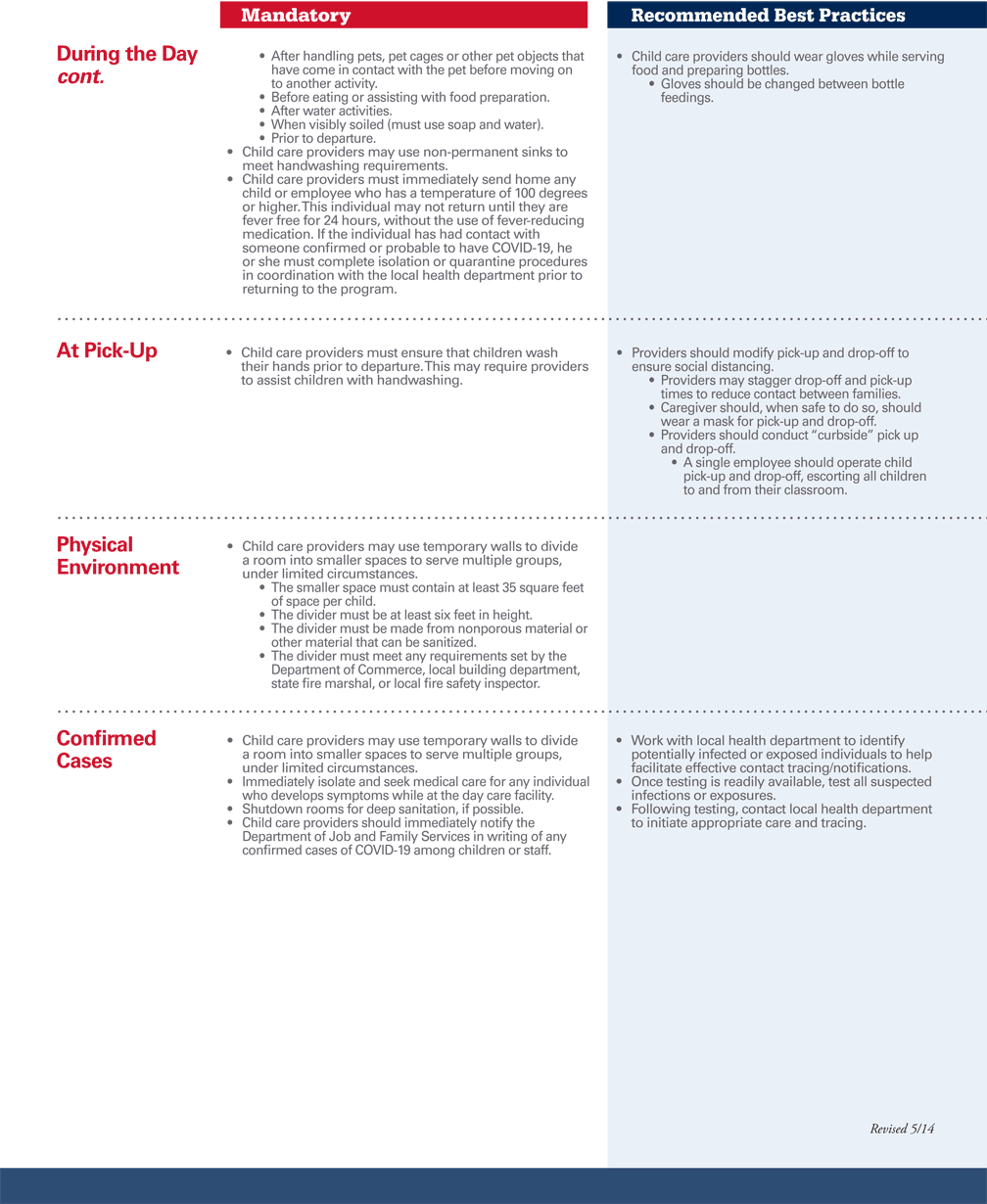
    Loveland, Ohio – Beginning Sunday, May 31, childcare providers in Ohio will be permitted to reopen if the providers can meet required safety protocols. Do you have all the information you need if you are returning your child to a daycare provider or choosing a new one? What about day camps?

    Here is the FYI on what the providers need to do to comply with the guidelines from the State House.

    To assist in the reopening of child care centers, Ohio will use more than $60 million in federal CARES Act funding to provide reopening grants to all of Ohio’s childcare providers, including family childcare, childcare centers, and both publicly-funded and private providers. More information on how to apply will be posted to the Ohio Department of Job and Family Services’ website soon.
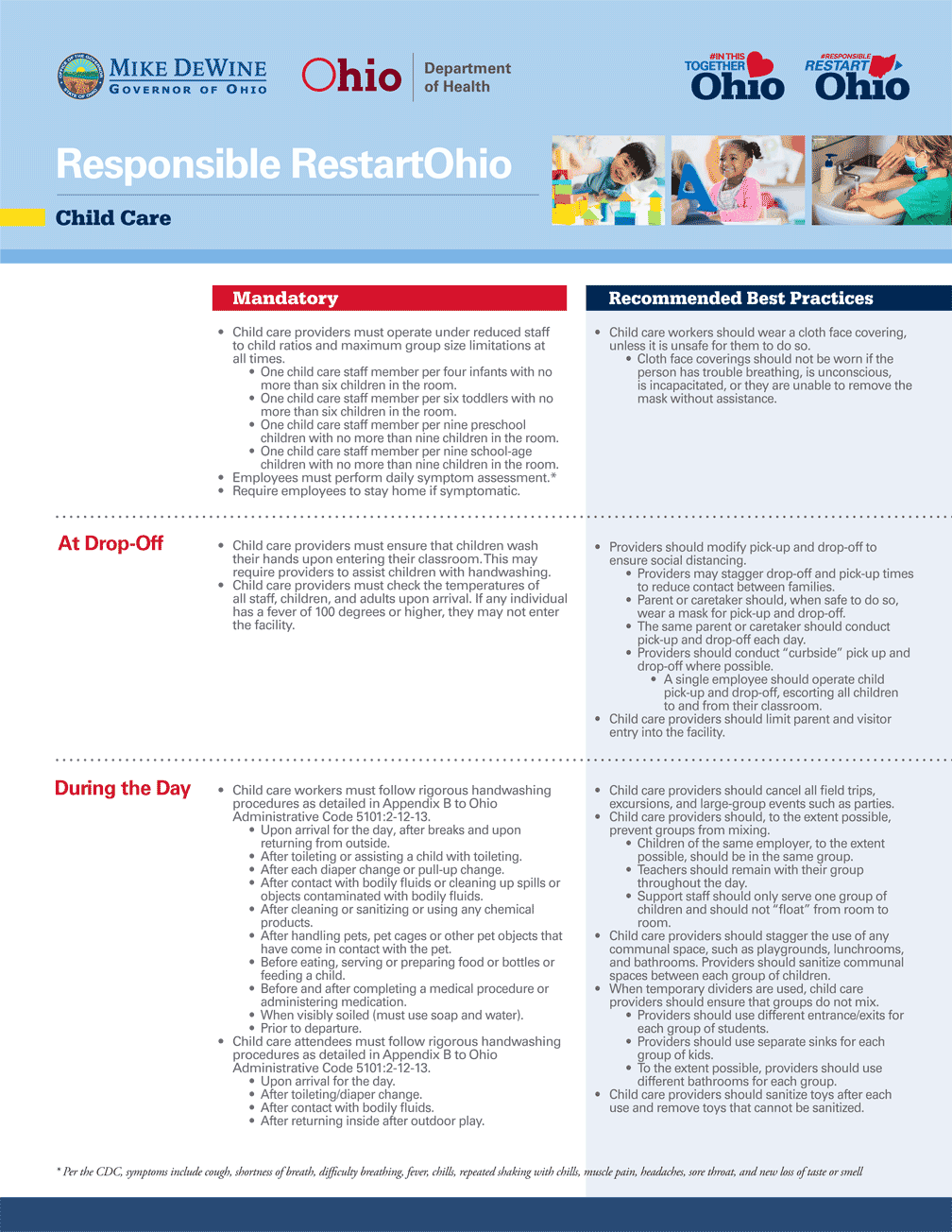
    Governor DeWine also announced that Ohio will fund a research project to study best practices for controlling the spread of COVID-19 in childcare settings. Information gathered from the study will continue to inform childcare regulations moving forward.

    The reopening date of May 31 also applies to day camps that can meet required safety protocols. A detailed list of guidelines and best practices for day camps will be available soon at coronavirus.ohio.gov.

    Click HERE to open in a new tab to see a larger view of these Mandatory and Recommended Best Practices.

  • Treasurer Hawley talks about State funding reductions for the Loveland District

    Treasurer Hawley talks about State funding reductions for the Loveland District

    Loveland, Ohio – The first week of May, Ohio Governor Mike DeWine announced budget cuts to balance the State budget.

    Loveland City School District Treasurer Kevin Hawley

    Due to the economic impact of COVID-19, Governor DeWine said that $775 million in reductions to Ohio’s General Revenue Fund are needed for the remainder of the Fiscal Year 2020 which ends on June 30.

    DeWine said that Ohio is mandated to balance its budget each year, and in addition to identifying areas of savings, the following budget reductions will be made for the next two months:

      • Medicaid – $210 million
      • K12 Foundation Payment Reduction – $300 million
      • Other Education Budget Line Items – $55 million
      • Higher Education – $110 million
      • All Other Agencies – $100 million

    Loveland Magazine reached out to the Loveland City School District Treasurer Kevin Hawley asking him to comment on the impact of the State cutting revenue to the District.

    Thank you for reaching out. I can confirm pieces of this information. For your convenience, I have attached the list from The Ohio Department of Education (ODE) outlining the data for all districts in the state of Ohio. (K-12_Education (2)-1) The amount of the state revenue reduction is $1,010,855. The percentage you are referencing is how much the reduction in revenue is to our ODE calculated overall operating expenditures as stated on the form attached. The percentage decrease of our state revenue for this year is just below 8% and is a decrease of 2% from our overall operating revenue.

    The current state funding cuts are for this fiscal year (July 2019 – June 2020) and will be deducted in the next couple months on our last three state payments. School districts receive their annual state revenue in 24 payments, twice a month. We have been instructed that these payments will be taken out equally from our second May payment and both of our payments in June to finish out the fiscal year. At this point in time there is not clarification from the state of Ohio as to whether there will be further revenue cuts for next year. The state’s budget is primarily funded through sales and income tax and those numbers are announced monthly around the 10th of every month. I have not seen the April numbers at this point in time but my guess is that this current reduction is due to those numbers being much lower than projected pre-COVID. The May and June reports on sales and income tax revenue will be very revealing for how the state’s budget may be impacted next year and ultimately how that impacts K-12 education.

    The Governor has stated that there is federal funding that may benefit local school districts. At the present time, there is approximately $300k in additional money through the state from the CARES Act. Ultimately, this will help with the reductions in state funding but does not close the gap.

    We were anticipating news of potential revenue cuts from the state but were unsure of the size or which fiscal year it would impact. We are always evaluating ways to make our district more efficient and find ways to save and we will continue to do that work. Having just received the specific amount of the revenue cuts Wednesday morning (May 6) we were not factoring this decrease into the budget for next year’s planning and the Board of Education has not had the opportunity to discuss any potential cuts due to this. As we work through the overall financial impact and implications of this budget reduction, recently failed levy and other factors due to COVID-19 the Board will discuss if any future budget cuts are necessary.