Tag: Cassie Mattia

  • AEP doesn’t have much to say about its support for corrupt utility bailout

    AEP doesn’t have much to say about its support for corrupt utility bailout

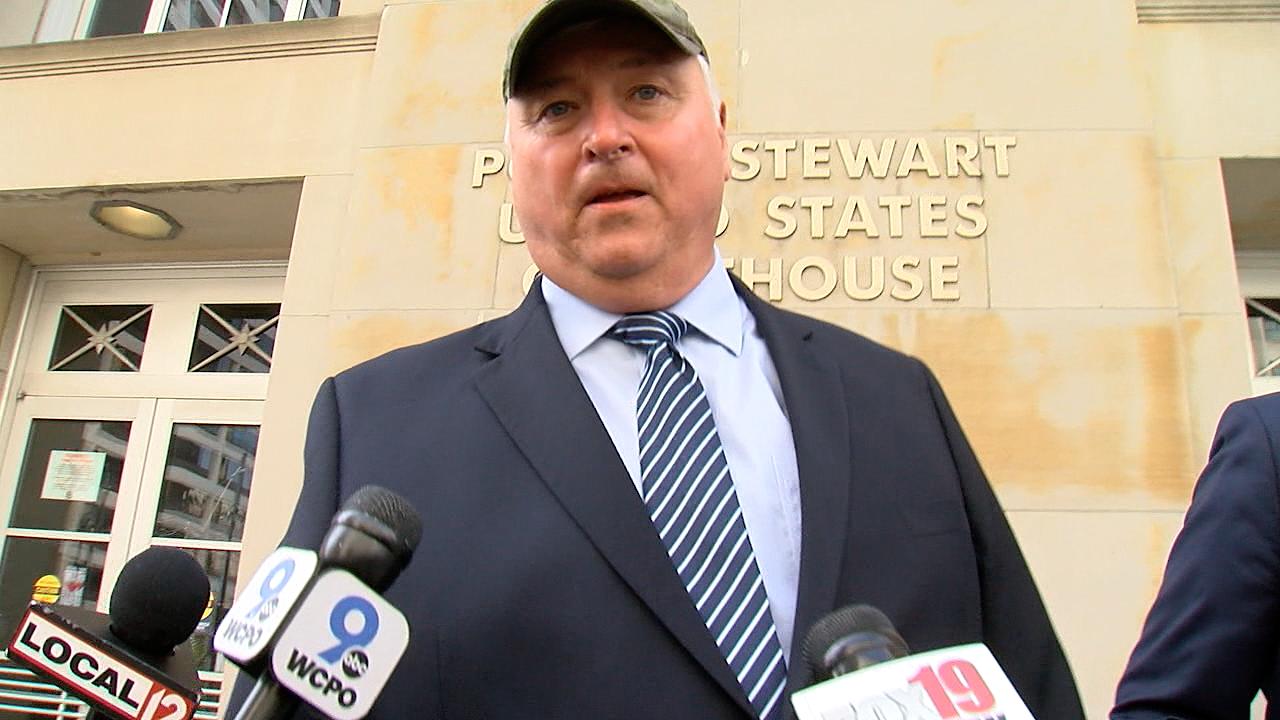
    Larry Householder speaks after guilty verdict. Photo by: WEWS/WCPO.

    BY:  Ohio Capital Journal

    Columbus-based utility giant AEP wasn’t at the epicenter of a historic bribery and money-laundering scandal in 2019. But it also wasn’t very far away as a corrupt deal was hatched in the Ohio Capitol to use $61 million in bribes to pass a $1.3 billion bailout.

    The name of the nation’s sixth-largest electric utility came up repeatedly in the seven-week criminal trial that ended earlier this month in the racketeering convictions of former Ohio House Speaker Larry Householder and former state GOP Chairman Matt Borges.

    Through its dark-money group, AEP provided more than $900,000 that was used to help pass the bailout. And to date, it has received more than $60 million to subsidize aging coal plants that belong to a consortium in which it owns a 40% stake.

    Just after the utility bailout was passed and a repeal attempt was thwarted, AEP spent another $500,000 through the same dark money group on an effort that stood to keep Householder in the speakership well into the 2030s. During the trial, a federal prosecutor asked a Householder co-defendant who had pleaded guilty why AEP would spend so much to keep the speaker in power.

    “It kind of went without saying that they support anything that’s good for the speaker because anything that’s good for the speaker is good for them,” the aide, Jeffrey Longstreth, testified.

    But everything changed when Householder and four others were arrested in July of 2020. Now AEP doesn’t seem interested in talking about its actions prior to that.

    Mysterious money

    Lobbyists and other wired-in parties on Capitol Square knew that as the battle heated up over the 2019 bailout measure — House Bill 6 — a geyser of cash was financing the effort to pass and protect it from repeal.

    It was logical to suspect that the money was coming from a utility industry that stood to benefit. But there was no way to be sure because it was coming through 501(c)(4) dark money groups that don’t have to disclose their donors.

    But then the FBI got involved.

    Acting on a tip, it launched an investigation. Using subpoenas, wiretaps, confidential informants, forensic accountants and undercover agents, investigators were able to grope their way through the dark money smokescreen and determine who was really behind the push for an unpopular corporate bailout.

    By far and away the biggest donor was the biggest beneficiary — Akron-based FirstEnergy. Starting in 2017 it ponied up what would become about $60 million to elect representatives who would vote to make Householder speaker in 2019 and then to pass and protect HB 6. In return, it stood to get about $1 billion of the benefit of the bailout — a return of more than $16 on each dollar it invested.

    But AEP is getting an even better return — more than $66 for every one of its dollars that made their way into the dark money group that fueled the HB 6 scheme. And, because the part of the bailout that benefits AEP is the only part of HB 6 that hasn’t been repealed, AEP is continuing to collect that money. That means returns from its dark money expenditure will only improve over time.

    AEP hasn’t been accused of wrongdoing in the scandal, and a spokesman denied that it acted improperly.

    “AEP participates in legislative and regulatory processes ethically and in compliance with the laws of the states where we operate,” the spokesman, Scott Blake, said in an email. “As we have previously stated, we do not believe that AEP was involved in any wrongful conduct.”

    And a board member of the dark money group AEP solely funded, Empowering Ohio’s Economy, claimed it didn’t know its dollars were used for nefarious purposes — even though it was at least partly in on the secret of HB 6’s mysterious funding.

    “Obviously, knowing what we know now, we wouldn’t have made the donations,” the board member, J.B. Hadden, told the Dayton Daily News in December 2020.

    The company is, however, being investigated by the U.S. Securities and Exchange Commission about its involvement in the passage of HB 6.

    Belated transparency

    However, AEP didn’t seem all that eager week to discuss its contributions which, until Householder was arrested, were secret. In the wake of the scandal, the company decided to start disclosing what dark money groups it contributes to, but only going forward.

    “We adopted a revised political engagement policy in 2021, which is available at ​https://aep.com/investors/governance/politicalengagement,” Blake said. “Under that policy, beginning with contributions made in 2020, AEP has disclosed its contributions of $5,000 or more to 501(c)(4) social welfare organizations as part of AEP’s annual disclosures. Organizations that receive contributions from AEP are subject to their own disclosure requirements.”

    But since the company started making such disclosures, Empowering Ohio’s Economy hasn’t appeared on them. AEP was the group’s sole contributor and its top lobbyist, Tom Froehle, was on its board.

    The dark money group gave $700,000 to Generation Now, a dark money group controlled by Householder, that has since pleaded guilty to its role in the scandal. It gave another $200,000 to the Coalition for Opportunity and Growth, which ran TV ads supporting House candidates who would back Householder for speaker.

    During the Householder trial, two of Householder’s co-defendants and other witnesses testified how money from Generation Now financed savage attacks on opponents of Householder candidates. And, when the recall campaign got underway, it paid for false, anti-China commercials, private eyes and “blockers” — people who harassed and even assaulted petition circulators, witnesses testified.

    In an early 2019 text message presented to the jury, Borges described efforts to get AEP on board with a bailout that primarily benefited FirstEnergy.

    “Lots of pressure from FE, AEP, renewable standards, setbacks… so thought is to move a comprehensive package and let everyone get a little (bit) of what they want,” Borges said.

    Then in testimony, Householder’s fixer, Longstreth, described what AEP got.

    “They received a benefit of… there were two coal plants in southwest Ohio,” Longstreth testified. “I’m not exactly sure where. One of them is actually just over the line in Indiana. I’m not sure where the other one is. They had to be created because of the U.S. Department of Defense needed them created 50 years ago (it was actually 68.) I don’t really know all of the details on it, but they received some benefit for running those plants on a continuing basis.”

    Longstreth, who pleaded guilty to his involvement in the conspiracy, was referring to the Ohio Valley Electric Corporation, or OVEC, in which AEP holds a 40% interest. According to the Office of Ohio’s Consumers’ Counsel, the corporation so far has received about $152 million in ratepayer subsidies as a consequence of the corruptly passed HB 6.

    But Blake, the AEP spokesman, didn’t respond directly when asked if the HB 6 arrests in July 2020 had anything to do with its decision to report dark-money contributions going forward.

    “The decision to list contributions over $5,000 to 501(c)(4) organizations was made in the second half of 2020, and the reporting began with contributions made that year,” he said. “AEP has not made a contribution to Empowering Ohio’s Economy since 2019.”

    In addition, Blake wouldn’t comment on the misleading way Empowering Ohio’s Economy described itself in 2019 as it made huge, secret contributions of AEP money that ended up being used in a bribery and money-laundering scandal. On its IRS Form 990, the group blandly described its purpose as:

    “Promoting Ohio as well-suited to host and support major conventions or similar events and as an attractive destination for travel, business meetings and vacations. The methods of achieving these purposes include funding and hosting major conventions and meetings via internet, professional organizations, and social media education to the general public.”

    Even though AEP was the dark money group’s sole contributor and its top lobbyist sat on its board, Blake said it wasn’t AEP’s job to answer for the misleading description.

    “501(c)(4) organizations are subject to their own reporting requirements and any questions about what they reported would need to be addressed by them,” he said.

    Subsidizing coal in a warming world

    The Intergovernmental Panel on Climate Change earlier this month warned that greenhouse gas emissions must be cut swiftly and dramatically to spare future generations from the worst consequences of global warming. So subsidizing two coal plants built during the Eisenhower administration might not seem the best use of ratepayer resources.

    It also might seem important to avoid rewarding corporate attempts to secretly buy ratepayer subsidies for their regulated monopolies.

    But legislative attempts to end the HB 6 coal subsidies so far have been unsuccessful and Blake cited last year’s jumps in natural gas prices as a reason for keeping the $130,000-a-day subsidies in place.

    “The recent increase in natural gas prices has shown that (the Ohio Valley Electric Corporation) offers customers price stability,” he said. “As we transition to cleaner resources, power from the OVEC plants offer security from rising natural gas prices and can provide power when renewables like wind and solar are unavailable.

    Blake added, “Having reliable generation resources is critical to providing the reliable power our customers need. Customers receive a credit when OVEC outperforms the energy market. The current mechanism supports only the actual costs of providing secure, reliable energy.”

    Indeed, default rates for customers of AEP, FirstEnergy and other Ohio utilities are all jumping this month to reflect high wholesale rates last year, when gas prices were high — partly as a consequence of disruptions caused by war in Ukraine. But keeping the dirty, coal-fired plants spinning now might make less sense because natural gas prices are down dramatically, and closer to their 10-year average.

    Householder’s friend

    While AEP might have wanted to distance itself from secret spending supporting Householder just after his arrest, it showed no such compunction in the months immediately before the feds broke up the racketeering scheme.

    Householder’s fixer, Longstreth, testified how — fresh off his HB 6 success — the speaker turned his sights to even bigger game. He’d used tens of millions in secret utility dollars to create a political juggernaut that made him speaker and that enabled him to pay off his financial backers. Now he sought to keep his juggernaut dominating Ohio politics — possibly until 2036.

    Longstreth had discovered that the idea of reforming Ohio’s legislative term limits polled well and he and his boss figured they could push one with an important catch. It would limit lifetime service to 16 years, but if it would reset the clock on everybody. That would mean the then-61-year-old Householder could serve until he was 77.

    To fund the scheme, Householder and his aides again turned to businesses that stood to gain the most from having close allies in the government — the utilities whose monopoly subsidiaries’ revenues were controlled by it.

    After he was approached in early 2020, then-First Energy CEO Chuck Jones in a text message described Householder as “an expensive friend.” But FirstEnergy quickly agreed to secretly spend $2 million on Householder’s tenure-enhancement scheme.

    On the witness stand in the Householder trial, Longstreth described a similarly warm reception from AEP’s then-CEO Nick Akins. Longstreth said he attended a meeting in early 2020 at AEP’s Columbus headquarters with Householder, Akins and two lobbyists.

    Longstreth testified that Akins’ reception to the plan that stood to make Householder speaker well into the next decade was “very positive.”

    “It was probably a 30-minute meeting,” Longstreth said, according to a transcript of the trial. “Fifteen minutes of it, you know, exchanging pleasantries and talking about anything that they had going on and then 15 minutes of us explaining it, and they said sounds great, we’ll get back to you and they did get back to us and said they would be supportive.”

    Shortly thereafter, AEP contributed $500,000 to the dark money group Householder set up for the initiative through AEP’s own dark money group, Empowering Ohio’s Economy.

    But then forces struck that were beyond the control of even Householder and Ohio’s largest utility companies. Neither can be counted on to intervene in the future.

    Asked why the term-limits initiative didn’t get off the ground, Longstreth referred to a Feb. 29, 2020 email he sent to FirstEnergy providing instructions on how to wire money into Householder’s new dark money organization.

    “COVID hit like two weeks later, and then we were arrested in July,” Longstreth testified. “So it never happened.”

    _______________________________

    Marty Schladen
    MARTY SCHLADEN

    Marty Schladen has been a reporter for decades, working in Indiana, Texas and other places before returning to his native Ohio to work at The Columbus Dispatch in 2017. He’s won state and national journalism awards for investigations into utility regulation, public corruption, the environment, prescription drug spending and other matters.

    MORE FROM AUTHOR

  • Think tank blasts Ohio flat tax proposal

    Think tank blasts Ohio flat tax proposal

    [vc_row][vc_column][vc_column_text]

    The Oho Statehouse, Columbus, Ohio. (Photo by Graham Stokes for the Ohio Capital Journal. Republish photo only with original story.)

    The way that the law is written would only complicate the state’s school-funding woes, take money from libraries, and increase property taxes for farmers and homeowners, it added.

    BY:  Ohio Capital Journal

    It sounds fair. If everybody paid income taxes at the same rate, the rich would pay more because of their higher incomes and the poor would pay less because they make less in the first place.

    But an Ohio proposal to enact such a “flat” state income tax ignores a host of other taxes, said a progressive public policy think tank. And the way that the law is written would only complicate the state’s school-funding woes, take money from libraries, and increase property taxes for farmers and homeowners, it added.

    “One of the myths that we have to dispel is that flat taxes make things fair,” said Guillermo Bervejillo, a state policy fellow at Policy Matters Ohio. “It’s quite the opposite. One of the things people forget when they talk about income taxes is that there’s a whole array of state taxes.”

    Bervejillo was speaking in reference to House Bill 1, which, as the bill number implies, is a top priority of the Ohio House’s Republican leadership. A spokesperson for that leadership didn’t respond to questions about the many criticisms that Policy Matters made of the bill.

    One is that many economists have long argued that so-called “flat” income taxes add to the overall tax burden shouldered by the poor and act as yet another means of lightning that of the wealthy.

    “There’s use taxes, sales taxes, excise taxes, taxes that are generally focused around consumption and use,” Bervejillo said.

     Graphic from the Center on Budget and Policy Priorities. 

    He explained that those kinds of taxes are the same for everybody, no matter her or his income. Buy a $100 pair of shoes in Ohio and you pay $5.75 in state sales tax regardless of whether you make $100 in a minute or in a whole day of work.

    “You can only buy so much toilet paper,” Bervejillo said, explaining why sales and excise taxes fall more heavily on the poor. “You can only drive so many miles.”

    The cumulative impact of those taxes is that the poor pay much more as a percentage of their income in state and local taxes than do the rich.

    “On average, the lowest-income 20% of taxpayers face a state and local tax rate more than 50% higher than the top 1% of households,” the Institute on Taxation and Economic Policy said in a report, Who Pays? “The nationwide average effective state and local tax rate is 11.4% for the lowest-income 20% of individuals and families, 9.9% for the middle 20 percent, and 7.4 percent for the top 1%.”

    Federal and state income taxes are the few exceptions that were originally structured to be “progressive.” In other words, they were intended to fall most heavily on those with the greatest ability to pay.

    And it’s true that if you take those and all other taxes into account, the richest Americans pay a bigger portion of their incomes out in taxes than poorer Americans. But the spread isn’t very wide.

    In 2019, the poorest 20% of Americans paid 20.2% of their incomes in taxes, while the richest 1% paid 33.7%, the Institute on Taxation and Economic Policy reported.

    But in Ohio if you take just state and local taxes into account, the script is flipped. In 2018, the poorest 20% paid almost twice as much of their income in such taxes — 12.3% — as the richest 1%, who paid just 6.5% of their lavish incomes in state and local taxes, the institute reported.

    And if Ohio were to enact a flat income tax, it would come on the heels of other measures in which the state has foregone large sources of revenue largely to the benefit of the wealthy.

    Ohio is giving up about $1 billion a year on a tax break for limited liability corporations. It was sold as a way to incentivize mom-and-pop businesses, but a 2017 analysis by the Ohio Legislative Service Commission found that as much as $450 million of that annual benefit was going to the highest 0.5% of Ohio wage earners.

    Meanwhile, there’s been no evidence that the cut improved Ohio’s jobs picture. It was 39th among states for job growth in February 2003 — well before the LLC tax cut was implemented, according to data compiled by Arizona State University’s Seidman Institute. By last month, Ohio ranked 46th in year-over-year job growth.

    And former Gov. John Kasich created JobsOhio by diverting funds from the state liquor monopoly. It’s spent more than $1 billion on things like incentives for wealthy businesses to locate to Ohio, but the agency has struggled to show that those expenditures have made much of a difference to the state’s jobs picture.

    But aside from fairness, Policy Matters raised another objection to HB 1 — it’s not paid for. Working from a fiscal analysis of the bill by the Legislative Services Commission, the group found that after the initial phase-in:

    • Property taxes on farmers and homeowners would increase at least $600 million a year because of “changes in the bill and the operation of Ohio’s existing property tax limit, known as House Bill 920.”
    • Schools, libraries and local governments would lose hundreds of millions of dollars a year.
    • There would be $780 million in annual net losses to the state that are not paid for in the bill.

    Bervejillo said it’s not hard to understand why pain would spread to large swaths of Ohioans from the flat-tax proposal.

    “At the end of the day, there’s only two things you can do when you cut taxes on the wealthy,” he said. “You can either cut services — and who depends more on services than low-income people? Or you increase sales and use taxes and gas taxes and cigarette taxes that fall disproportionately on low-income and working-class Ohioans.”

    _________________________________

    Marty Schladen
    MARTY SCHLADEN

    Marty Schladen has been a reporter for decades, working in Indiana, Texas and other places before returning to his native Ohio to work at The Columbus Dispatch in 2017. He’s won state and national journalism awards for investigations into utility regulation, public corruption, the environment, prescription drug spending and other matters.

    MORE FROM AUTHOR

    [/vc_column_text][/vc_column][/vc_row]

  • Ohio BMV will refund disabled veterans after incorrectly charging for license plates

    Ohio BMV will refund disabled veterans after incorrectly charging for license plates

    [vc_row][vc_column][vc_column_text]

    Photo from Wikimedia Commons by “Mister Upstate.”

    BY: Ohio Capital Journal

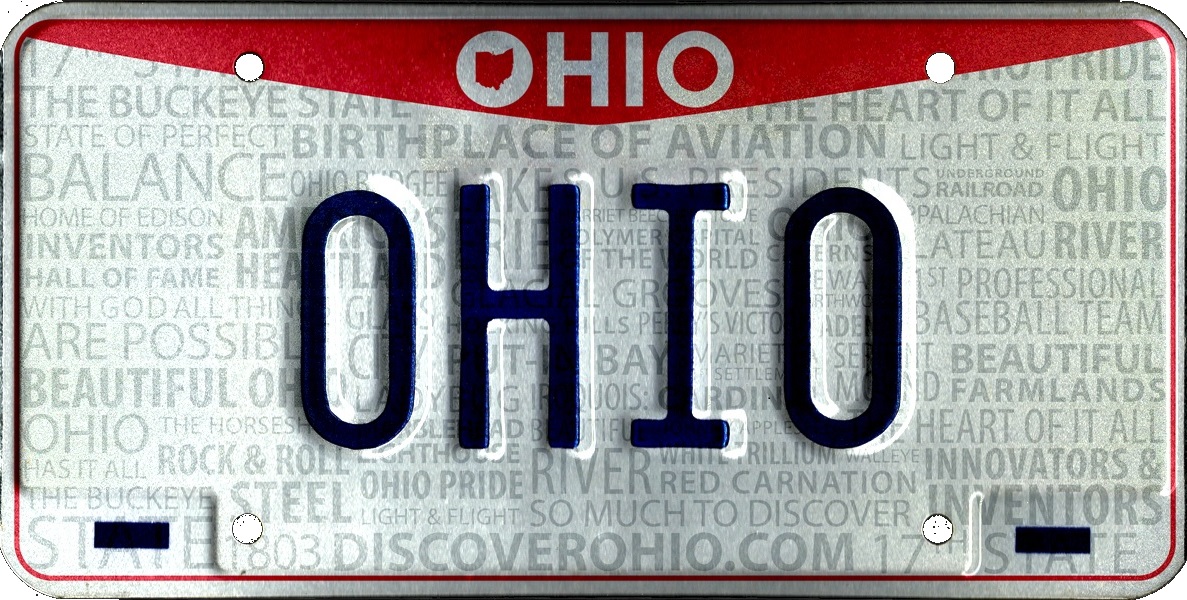
    The Ohio Bureau of Motor Vehicles will issue refunds to nearly 2,000 disabled veterans who were wrongly charged for specialty license plates.

    The BMV recently realized it did not implement a change in Ohio law that went into effect in October 2019 that allows certain disabled veterans to receive up to two free disabled veteran license plates/military license plates, the BMV said in a release Thursday.

    The average refund will be $60, although the exact amount of each refund will vary based on local fees and taxes.

    “The BMV deeply regrets this error,” Charlie Norman, Ohio BMV Registrar, said in a news release. “We are undertaking an internal review to determine why the legislative change wasn’t adopted in a timely manner to ensure that this will not happen in the future.”

    The BMV will be contacting all veterans who were improperly charged and refunds will be processed within the next month. The BMV is implementing a “processing change” so veterans who qualify for free disabled and military license plates are not charged in the future.

    The law applied to veterans with a service-connected disability who are declared 100% disabled by the U.S. Department of Veterans Affairs, and does not apply to personalized specialty disabled/military license plates.

    Follow OCJ Reporter Megan Henry on Twitter.

    Megan Henry
    MEGAN HENRY

    Megan is a reporter for the Ohio Capital Journal.

    MORE FROM AUTHOR

    [/vc_column_text][/vc_column][/vc_row]

  • Freddy’s Frozen Custard & Steakburgers will open soon

    Freddy’s Frozen Custard & Steakburgers will open soon

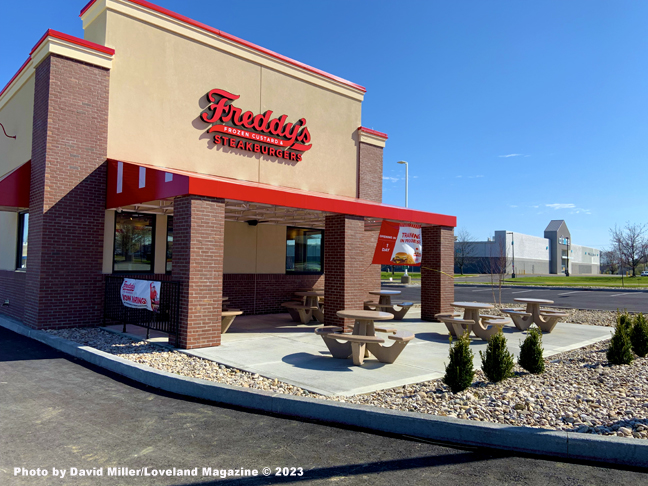
    [vc_row][vc_column][vc_column_text]Symmes Township, Ohio – Freddy’s Frozen Custard & Steakburgers will open soon near the At Home store and the Chase Bank in the vicinity at 4047 Montgomery Road. The location is also near the Meijer Express Gas Station and the Meijer store.

    Freddy’s is now hiring and training staff.[/vc_column_text][vc_column_text css=”.vc_custom_1680560191642{background-color: #eaeaea !important;}”]

    FREDDY?

    Freddy Simon believed he was “the luckiest man in the world.”

    Freddy grew up on a farm near Colwich, Kansas, just outside of Wichita. After finishing high school, Freddy enlisted in the U.S. Army, serving in the Pacific Rim region during World War II. A self-proclaimed “regular guy”, he was awarded the Purple Heart for injuries sustained during service, as well as a Bronze Star for valor.

    freddy in miltary uniform

    Freddy then returned to Kansas, started a family, worked hard in the hospitality industry for 56 years, and raised six children with his wife, Norma Jean.

    Freddy’s family values and patriotic service to his country is the foundation of Freddy’s Frozen Custard and Steakburgers®, and these values have inspired us to do everything The Freddy’s Way.

    Freddy’s Frozen Custard & Steakburgers® was co-founded in 2002 by brothers Bill and Randy Simon with their friend and business partner, Scott Redler. It was named in honor of Bill and Randy’s father. Together, they built a brand focused on quality, hospitality, cleanliness and timeless traditions.

    Quality
    Hospitality
    Cleanliness

    Today, our Freddy’s Family creates fresh, made-to-order, craveable food, served to our guests with genuine hospitality in a fun, inclusive environment.

    [/vc_column_text][/vc_column][/vc_row]

  • Better Blend to open in Historic Downtown Loveland on Loveland Bike Trail

    Better Blend to open in Historic Downtown Loveland on Loveland Bike Trail

    [vc_row][vc_column][vc_column_text]

    Loveland, Ohio – Better Blend’s newest confirmed location is right in Historic Downtown Loveland on the Loveland Bike Trail.

    Photo by Better Blend

    Better Blend is going in the former Alley Boutiques location.

    This will be the second franchisee location Brent Hill will be opening in Ohio this year. A store in Mason will be the first to open its doors, followed by Loveland this summer.

    There are currently Better Blend locations in Clifton Heights and downtown Cincinnati.

    Learn more about Better Blend on FaceBook.

    [/vc_column_text][vc_column_text css=”.vc_custom_1680530914335{background-color: #e8e8e8 !important;}”]About Better Blends

    Founded by Isaac Hamlin in 2018, Better Blend was created with the goal to make the world a happier, healthier place.

    While playing on the University of Kentucky rugby team in college, Isaac was inspired to find a replacement for the heavy meals that were the team’s pregame tradition. So he set out to develop protein smoothies that offered optimum nutrition, tasted great, and didn’t weigh him down. Not only was Isaac successful, but he went on to be named first-team SEC All-American.

    After graduating, Isaac realized there was a need for healthy food options in his hometown. Equipped with a business degree and healthy smoothie recipes he’d developed at college, he set out to bring nutritious and delicious choices to his community. Isaac made it his goal to make it easy for everyone to eat healthy by offering fast, healthy options that taste indulgent but are nutrient-rich and made with clean ingredients.

    With hard work, creativity, and determination, Isaac opened the first Better Blend location in June 2018. Since then, the brand has seen incredible growth, including the opening of two additional locations as of 2022.

    MEET THE FOUNDER

    ISAAC HAMLIN

    “I created Better Blend because I enjoy helping people and this is just a vehicle that allows me to do that on the largest scale. The world can be a healthier place, we just need to make it easier.

    Much of Better Blend’s success is attributed to a strong internal culture. It’s about building a culture where the team operates with empathy. This mantra is rooted in respect for the person next to you, which is how we are able to build A+ caliber teams.”

    ISAAC’S FAVE: Oatmeal Raisin Cookie Blend + banana

    [/vc_column_text][/vc_column][/vc_row]

  • Loveland’s annual road program

    Loveland’s annual road program

    [vc_row][vc_column][vc_column_text]Loveland, Ohio – Here is the list of the streets, or sections of streets that will be repaved in the city this year.

    Construction is expected to begin this spring.

    Sawcutting of curb sections to be replaced was scheduled to begin on March 31. On-street parking restrictions and minor traffic delays are expected, according to the City.

    • Apache Ct.
    • Bellwood Dr. (Sunrise to West terminus)
    • Bloomfield Ct.
    • Bridlespur
    • Cones Rd. (within City limits)
    • County Down Ln. (Brandywine to South terminus)
    • Fox Chase Dr.
    • High Country Ln.
    • Highcliff Ct.
    • Navaho Dr.
    • Oneida Dr.
    • Potomac Ct.
    • Pueblo Plc.
    • Rednor Ct.
    • Seminole Dr.
    • Shelburn Dr.
    • Silver Fox Ct.
    • Sioux Dr.
    • Sunrise Dr.
    • W. Main St. (Cherokee to West terminus).
    • Limited pavement repairs (without repaving) will also be performed on portions of Kerr Cemetery Rd.

    [/vc_column_text][/vc_column][/vc_row]

  • Loveland High School Hope Squad takes lead role in creating mural

    Loveland High School Hope Squad takes lead role in creating mural

    [vc_row][vc_column][vc_column_text]

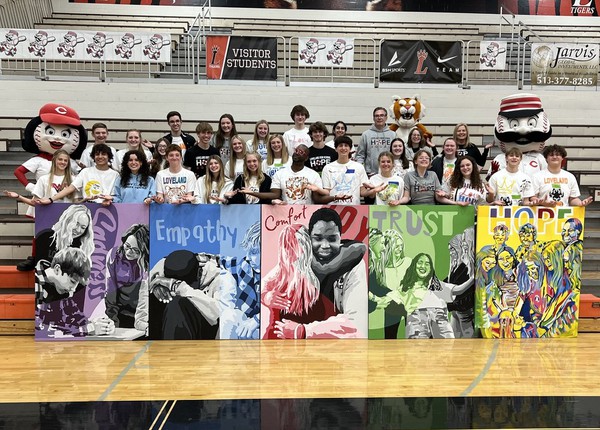
    The new Mural Unveiled at Loveland High School (Photo provided by Loveland Schools)

    Loveland, Ohio – Loveland High School (LHS) has a new mural, thanks to a partnership with the Cincinnati Reds and PNC Bank. The school was selected as the recipient of a “Murals with a Mission.”

    Artist Brent Billingsley worked with Loveland High School students to design and paint a mural that spreads a message of hope, depicting the journey from sadness to hope with the help of those around us,
    according to a release from the school district.

    Students from the LHS Hope Squad took a leadership role in creating this artwork. Hope Squad is a national youth suicide prevention program that includes education, training, and peer intervention.

    The mural was unveiled during a celebration on Friday, March 31, with guests from the Reds and PNC Bank in attendance during a full school assembly in the high school gym.

    The mural will be on display in the main hallway of the school, where students and guests will pass it every day.

    Murals with a Mission, powered by PNC Bank was launched by the Reds organization in 2022 with the intention of creating a mural at high school campuses across Greater Cincinnati and Northern Kentucky. The mission is to elevate positive social messages relevant to each school’s student body. Under the guidance and leadership of local artist Brent Billingsley, students at each location work together to develop a concept, design, and finished product through which fellow students can feel represented.

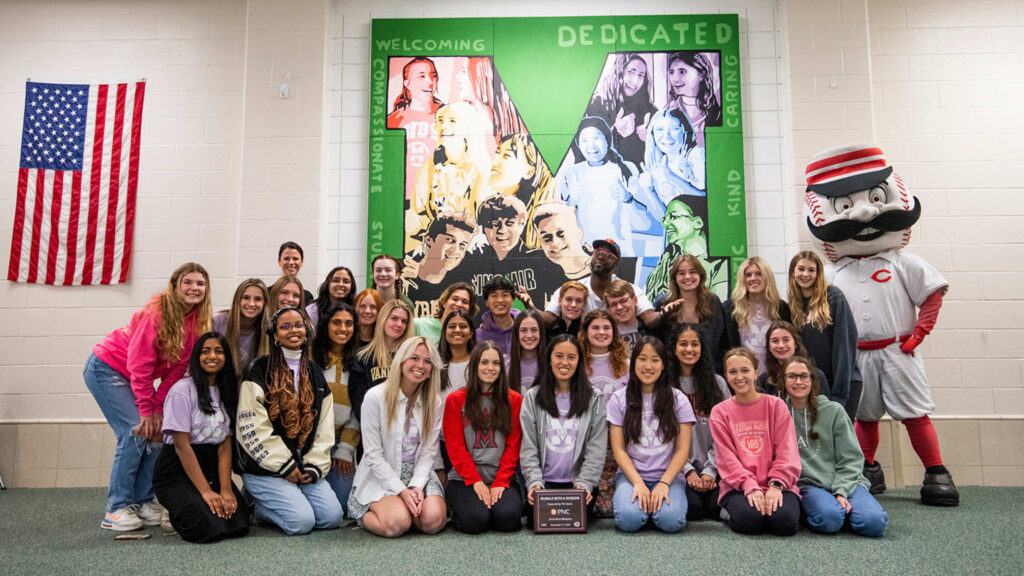
    Both Mason High School and and Princeton High School have previously completed and installed murals as part of the Murals with a Mission initiative

    The mural at Mason High School (photo by Cincinnati Reds)

    .

    [/vc_column_text][/vc_column][/vc_row]

  • Ohio Right to Life makes spurious, anti-trans argument in favor of supermajority amendment

    Ohio Right to Life makes spurious, anti-trans argument in favor of supermajority amendment

    [vc_row][vc_column][vc_column_text]

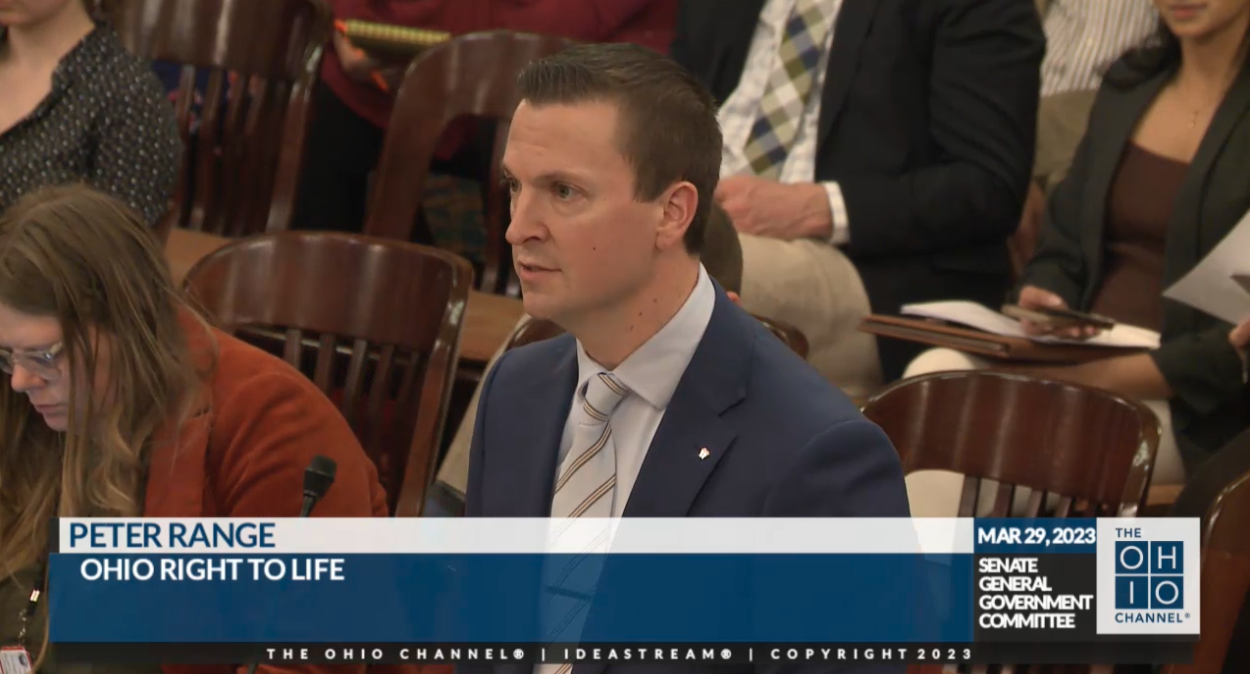
    Ohio Right to Life CEO Peter Range speaking before the Senate General Government committee in favor of SJR 2. (Screen grab from the Ohio Channel)

    [/vc_column_text][vc_column_text]

    Right to Life officials claim a reproductive rights amendment would allow youth to receive gender affirming care without parental notification

    BY:  Ohio Capital Journal

    Late last year, Rep. Brian Stewart, R-Ashville, and Secretary of State Frank LaRose introduced their plan requiring supermajority for constitutional amendments. It didn’t take long for opponents to check the calendar and argue the resolution was advancing — and advancing now — to block an abortion rights amendment on the horizon.

    Despite Stewart and LaRose’s contentions to the contrary, Republican leaders have given up the charade that the two ballot measures are unconnected. On Wednesday in a Senate committee hearing for SJR 2, outside conservative organizations doubled down. A 60% threshold for future constitutional amendments is necessary, they argued, to head off the reproductive rights amendment before November.

    But they went a step further, too.

    Speakers from Ohio Right to Life argued — without evidence — that the reproductive rights amendment would open the door to minors receiving gender affirming care without parental notification.

    It’s a specious argument that presages an exceptionally bitter march to November, marked by disinformation and fear-mongering, with critics of the argument noting that nothing in the proposed amendment mentions or supersedes Ohio’s parental consent laws.

    A “healthy tension”

    Unlike the last year’s attempt to establish a supermajority threshold, numerous proponents showed up to speak in favor of the idea.

    Some, like University of Toledo professor Lee Strang, stuck to the policy,

    “Ohio adopted this initiative mechanism for a variety of reasons,” he explained. “The most common reason was the belief that the state legislature was not sufficiently responsive to average Ohioans and was instead subject to control of large nationwide trusts.”

    Of course, that might sound familiar. Ohio’s last redistricting became a debacle in which Republican leaders repeatedly defied the state supreme court. It’s been less than a month since a jury convicted former House speaker Larry Householder in a multimillion-dollar bribery scheme funded by two major utilities.

    Strang contends the amendment process needs to maintain a “healthy tension” between two ideals: stability and flexibility. The higher threshold would insulate the constitution from provisions that belong in statutes, he said.

    Other speakers, however, wandered farther afield.

    Right to Life

    Ohio Right to Life CEO Peter Range argued passing SJR 2 is about “building a culture of life.” His testimony made no bones about wanting the higher threshold to undermine the reproductive rights amendment. But he also injected one of the latest rallying cries of the culture war.

    “This amendment that’s coming up in November will wipe away parental rights to be engaged in their teenagers decision to get an abortion or not, in their teenagers decision to get sex change operation or not.”

    He wasn’t the only right to life official to make a “parental rights” argument tied to trans youth. Kate Batra insisted, “I’m not being hyperbolic at all, when I say lives are stake.”

    “If this extreme amendment is passed, parents will have their rights obliterated,” Batra argued. “So moms and dads won’t be notified, let alone be able to consent, to their underage daughters undergoing abortion procedures. This also opens the door for adolescents to pursue controversial sex change operations, puberty blockers, sterilization procedures and the like—all without the parents’ knowledge or consent.”

    The amendment itself, however, makes no mention of gender affirming care. It’s first section reads, in full:

    “Every individual has a right to make and carry out one’s own reproductive decisions, including but not limited to decisions on contraception; fertility treatment; continuing ones own pregnancy; miscarriage care; and abortion.”

    It goes on to prohibit state interference except that abortion “may be prohibited after fetal viability.” The amendment carries an exception for the life or health of the mother.

    After the committee hearing, Sen. Rob McColley, R-Napoleon, who is one of the resolution’s sponsors, offered a tepid response to the parental rights argument.

    “There’s been an argument proffered by some that says they’re concerned with the language that says ‘but not limited to,’” he explained. “I’m not 100% well versed on that argument, so I can’t really opine on it.”

    “Demonstrably and totally false”

    Organizers leading the push for the reproductive rights amendment didn’t seem surprised by the line of argument.

    Television ads from the dark money organization Protect Women Ohio make the same spurious allegations about parental rights. The ad’s script actually leads with trans fear-mongering.

    “Your daughter is young, vulnerable, online,” the narrartor says. “You fear the worst: pushed to change her sex or to get an abortion.”

    Executive director of Ohio Physicians for Reproductive Rights, Dr. Lauren Beene, pushed back forcefully on the ad’s claims.

    “The ad is demonstrably and totally false. There is absolutely nothing in the amendment that mentions or supersedes Ohio’s parental consent laws,” she said.

    In a recent NBC4 factcheck, a Capital University law school professor rated Protect Women Ohio’s claims as four out of four Pinocchios.

    “Their intentionally deceptive ad is the beginning of a multi-million-dollar disinformation campaign,” she added, “designed to raise unsubstantiated fears and distract from the fact that the amendment will ensure Ohioans have access to comprehensive reproductive health care, including abortion, and preserve the sanctity of the doctor-patient relationship.”

    Equality Ohio executive director Alana Jochum criticized the ad as well for making “false claims” and “ignoring the facts.”

    “Not only does the proposed amendment have nothing to do with gender affirming healthcare, those arguing that it does are implying that life-saving healthcare is something nefarious,” she said. “The ballot initiative being referenced specifically protects the right to abortion, another form of lifesaving medical care that Ohioans deserve to have access to.”

    “False claims about what the proposed abortion amendment would do attempt to mislead voters by spreading lies that have been debunked by legal experts,” she added. “They are once again dragging precious children, their families, and their health care providers into a conversation that has nothing to do with them — especially when we should actually be talking about protecting democracy.”

    Cincinnati attorney David Langdon registered Protect Women Ohio as an Ohio non-profit a little over a month ago. Langdon helped draft the 2004 Ohio constitutional amendment defining marriage as between one man and one woman. He has also represented the Center for Christian Virtue — another organization pushing for the supermajority threshold.

    Follow OCJ Reporter Nick Evans on Twitter.[/vc_column_text][vc_separator border_width=”10″][vc_column_text]

    Nick Evans has spent the past seven years reporting for NPR member stations in Florida and Ohio. He got his start in Tallahassee, covering issues like redistricting, same sex marriage and medical marijuana. Since arriving in Columbus in 2018, he has covered everything from city council to football. His work on Ohio politics and local policing have been featured numerous times on NPR.

    MORE FROM AUTHOR[/vc_column_text][/vc_column][/vc_row]

  • Get To Know Arlington Renegades Quarterback Loveland native Drew Plitt

    Get To Know Arlington Renegades Quarterback Loveland native Drew Plitt

    [learn_more] Content goes here[/learn_more] [vc_row][vc_column][vc_column_text]by

    Drew Plitt has been with the Arlington Renegades since day one, but his past success is what has brought him here to the XFL as one of the few rookie quarterbacks.

    High School Football Experience

    Photo by The Enquirer

    Plitt went to high school in Loveland, Ohio where he played quarterback for the Tigers. His biggest achievement at Loveland was leading the school to the 2013 Division II state title which was the school’s first state championship ever. In 2015, he threw for over 1,400 yards with 15 passing touchdowns and three rushing touchdowns in ten games. He was the team captain and was honorable mention all-district as a senior.

    While deciding which college to go to, Plitt had offers from Ball State, Bowling Green, Eastern Michigan, and Lafayette. In the end, he decided to pick Ball State as the college of his choice. His former high school head coach Fred Cranford told Cincinnati.com what kind of quarterback the school was going to get.

    “Drew’s quarterback style and talent will allow him to be crazy successful there. Ball State is getting a championship, high character quarterback. Ball State loves his talent and style, his leadership and quarterback intangibles.”

    Loveland Head Football Coach Fred Cranford via Cincinnati.com

    Ball State Experience

    Photo by Mike DiNovoUSA TODAY Sports


    In his first year in college back in 2016, Plitt was redshirted for the season as a freshman. The next year in 2017, he started the season as the fourth quarterback on the depth chart. Due to injuries to the quarterback position, Plitt was forced into action and played in the last five games of the season starting three of them. He finished his first season with 430 passing yards and three touchdowns along with three interceptions. Plitt also ran for 29 yards and one touchdown in the season.

    Read full story with video, NFL (Cincinnati Bengal) experience and more…[/vc_column_text][/vc_column][/vc_row]

  • Station of the cross and the very unpleasant thing God can ask sometimes

    Station of the cross and the very unpleasant thing God can ask sometimes

    [vc_row][vc_column][vc_column_text]

    The statue that wasn’t to be seen in Loveland

    It is wretched, distressing, tragic – and beautiful

    “The great Christian mystery of the crucifixion and the resurrection and the whole mystery of why we die, and why we die so miserably sometimes… In our time it’s a very unpopular story. – Trina Paulus

    David Miller is the Managing Editor of Loveland Magazine

    by David Miller

    Traveling to the Stations of the Cross, also known as the Way of the Cross or Via Crucis, is a Christian tradition to commemorate Jesus’s passion and death on the cross. The observance began as devote pilgrims traced Christ’s path to crucifixion through Jerusalem on the Via Dolorosa.

    Years before filming this interview and at the time of my first seeing Abraham and Isaac, I begged the Grailville folks to let me help them find a place where the father and son could be publicly displayed, however, I remember being told they determined it too controversial to do so. It was only “appropriate for mature audiences” and no one in Loveland was mature enough to see the old testament story depicted so threateningly and savagely real.

    Listening to artist Trina Paulus talk about her Abraham and Isaac and the essence of what she was conveying through the work of her sculpting hands and spiritual heart is still heartbreaking that the human soul was meant to struggle to understand such a contemptible subject.

    It had been stored temporarily for several years just outside of Loveland. Loveland Magazine Reporter Alana Johnson went with Paulus to an unlit garage at the Grailville Conference and Retreat Center in 2011 to see it. Paulus hadn’t seen her statue for several years.”

    Photo by David Miller © 2011


    During the interview, Paulus said, “Over here you will see a hand with the knife in it… and over here… you’ll see the hand with his son. I’ve done a lot of thinking about this over the years – the great Christian mystery of the crucifixion and the resurrection and… The very unpleasant thing is that God can ask everything of us sometimes… The whole mystery of why we die, and why we die so miserably sometimes… In our time it’s a very unpopular story.“[/vc_column_text][vc_column_text]

    The Very Unpleasant Thing: That God Can Ask Everything of us Sometimes

    [/vc_column_text][vc_video title=”“YouTube” src=”“https://www.youtube.com/embed/UEARzbQzah8“” width=”“560“” height=”“315“” frameborder=”“0“”][/vc_column][/vc_row]