Arguing for their right to arm school personnel, 17 schools from 11 counties in Ohio asked the Ohio Supreme Court to allow them to continue using firearms as an option for student safety.
Susan Tebben is an award-winning journalist with a decade of experience covering Ohio news, including courts and crime, Appalachian social issues, government, education, diversity and culture. She has worked for The Newark Advocate, The Glasgow Daily Times, The Athens Messenger, and WOUB Public Media. She has also had work featured on National Public Radio.
The schools are asking for the state’s highest court to reverse an appeals court decision that said state law did not allow boards of education to allow armed personnel without training on the same level as police and security officers.
Four of the schools came from Shelby County, two each represented Hardin and Montgomery counties, and one district each from Tuscarawas, Williams, Adams, Morgan, Noble, Coshocton and Portage counties were listed on a brief to the court.
Boards of education or governing boards for all but one of the districts have authorized certain staff members to carry weapons within school zones as long as they have concealed handgun licenses.
One school, Shelby County’s Jackson Center Local Schools, “is currently taking steps in the process of considering the authorization of staff members to become part of its school safety team and to carry a weapon into a school safety zone,” according to court documents.
The school districts argue that Ohio Revised Code allows anyone to carry a firearm into a school safety zone with the written authorization from the board of education. But they argue, just as Madison Local Schools and Ohio Attorney General Dave Yost argued, the law does not require teachers or anyone other than police and security personnel to be trained to the standard of the Ohio Peace Officer Training Academy (OPOTA).
“By its plain terms, this would apply to law enforcement but not to administrators, teachers, or support staff authorized to carry a firearm in a school safety zone,” the districts wrote in their brief to the court.
The school representatives urged the court to recognize that decisions about student safety “are best left to locally-elected boards of education.”
The schools said giving board of education the right to govern in varying ways is “simply federalism,” calling boards “laboratories of democracy.”
Furthering that argument, the schools said boards were entrusted by the state and the legislature to “serve as a laboratory; and try novel social and economic experiments without risk to the rest of (Ohio),” quoting a U.S. Supreme Court decision in an unrelated case.
Photo by Dan Galvani Sommavilla from Pexels
They criticized the 12th District Court of Appeals decision in the case, saying the court took away the meaning of the Ohio law regarding firearms allowances in schools, and made “arming staff entirely impractical.”
“As a result of the 12th District’s decision, if an Ohio school district desires to arm any administrator, teacher, or support staff, the district is left with two options: (1) hire a police officer to teach English; or (2) send an algebra teacher to the police academy,” the brief from the districts stated.
The schools went so far as to say schools will be “less safe” if the supreme court agrees with the 12th District’s decision, because of the varying amount of resources from school to school. Hiring more school resource officers isn’t always in the budget, they wrote.
They estimate a school resource officer’s salary to be $50,000 per year. They also say sending a school employee to FASTER, a training given by pro-gun lobby Buckeye Firearms Association and marketed specifically to teachers and school staff, costs “a couple thousand dollars.”
“Unsurprisingly, the resource discrepancy between districts in Ohio is largely exacerbated between larger, suburban and urban districts and smaller, rural districts,” the brief states. “This money gap, though, has a direct impact on the ability of a school district to safely protect its students and staff.”
The FASTER program is later called the state’s and country’s “preeminent active school shooter training program” more than once, and the districts say nearly 200 school districts in Ohio have been sent to it. The attorney writing on behalf of the districts, Jonathan Fox, is named as Buckeye Firearms Association member in a story on the BFA website.
The court case is running parallel to proposed legislation that recently passed a state Senate committee regarding armed school personnel
More than 100 inmates and workers in Ohio’s prison system have died from COVID-19, state data shows.
Jake Zuckerman is a statehouse reporter. He spent three years chronicling the West Virginia Legislature for The Charleston Gazette-Mail after covering cops and courts for The Northern Virginia Daily.
Five prison workers (three corrections officers and two nurses) and 96 inmates have died from the disease that has clobbered the Ohio Department of Rehabilitation and Correction since late March when it was first detected in the system.
Nearly 6,200 inmates have contracted COVID-19, the disease caused by the new coronavirus, though the figure is likely an undercount. After mass testing at Marion and Pickaway correctional institutions detected infections in 80% of inmates, ODRC shifted its strategy away from blanket testing and toward symptom-based testing.
An ODRC spokeswoman said 461 inmates with COVID-19 have been admitted to the hospital, but those people may have been admitted for other causes.
The dead inmates were 66 years old, on average.
At Marion, nearly 2,000 inmates have been infected, 12 of whom died.
At Pickaway, nearly 1,400 inmates have been infected, 35 of whom died.
The two prisons are the third and fourth largest COVID-19 clusters in the nation respectively, according to data from The New York Times.
Gary Daniels, a lobbyist for the ACLU, said there’s more than just a death toll. As more information emerges about long term damage from COVID-19, including “long haulers” who report debilitating symptoms even six months after infection, he questioned the health services ODRC is providing.
According to the CDC, coronavirus infections can cause myocarditis (heart inflammation) among other long term symptoms. While the science is still emerging, the heart damage could explain reported long-term symptoms like shortness of breath, chest pain and heart palpitations.
“How many people in Ohio prisons face this right now?” he said. “You’ve got these 100 people who have died, but that’s nowhere near the whole story.”
The ACLU has pushed for a broad decarceration that would remove people convicted for drug possession or parole violations — at least temporarily.
“It does appear to have plateaued,” Daniels said. “Whether that continues, who knows. Our concern is that after a certain amount of time, we’re going to see that population rise.”
U.S. District Judge Edmund Sargus Jr., in a ruling last month, rejected motions to dismiss the lawsuit. In a blow to the inmates, however, he also struck down a request for a preliminary injunction. He has not ruled on the issue at large.
Though it amounted to a loss for the inmates, Sargus signaled some sympathy for the conditions inside.
“This Court agrees with the other district courts across the country who have found COVID-19 to be an objectively intolerable risk of harm to prisoners when it enters a prison,” Sargus wrote.
Prisons and jails are near ideal places for the coronavirus to spread given the overcrowding, poor sanitation, and preexisting health complications inside.
In April, the Ohio Supreme Court dismissed a lawsuit from an HIV-positive inmate who sought release due to COVID-19.
“The whole of Ohio’s government needs to take serious, unprecedented steps to prevent the catastrophe of unmitigated spread of COVID-19 to the tens of thousands of prisoners in Ohio as well as to the tens of thousands of people who are prison employees along with those living in the households of prison employees,” he said.
Hamilton County, Ohio – The U.S. Department of Housing and Urban Development (HUD) has awarded $2 million to Hamilton County Public Health (HCPH) to protect children and families from lead-based paint and home health hazards. HCPH was one of 44 state and local government agencies in 23 states to receive funding and one of only 15 first-time grantees. Hamilton County, through its Community Development Block Grant funds, is adding another $300,000 in matching funds for the program.
In announcing the award, HUD stated that it is providing these grants through its Lead Based Paint Hazard Reduction (LBPHR) Grant Program to identify and clean up dangerous lead in low-income families’ homes. These grant includes funds from HUD’s Healthy Homes Supplemental funding to help communities with housing-related health and safety hazards in addition to lead-based paint hazards.
“Hamilton County has a considerable number of properties in need of remediation,” according to Hamilton County Health Commissioner Greg Kesterman. “The age of housing, coupled with a lack of maintenance, contribute to the danger of childhood lead poisoning due to unmitigated lead-based paint hazards.”
HCPH addresses lead poisoning through its Childhood Lead Poisoning Prevention Program (CLPPP). The CLPPP includes outreach, education, and case management for children under six years of age that have been lead poisoned. Without financial support, properties with outstanding lead hazard control orders stand vacant for years, contributing to further disrepair and blight in the community. The funding will allow HCPH to perform lead-based paint remediation and abatement in 97 units in HCPH’s jurisdiction over the 42-month grant period.
Lead Poisoning Prevention
Lead poisoning is invisible and 100 percent preventable. Over 80 percent of all homes built before 1978 in the U.S. contain lead-based paint. The primary source of lead exposure is through leaded dust generated from
deteriorating lead-based paint. Chipping, flaking, peeling paint or lead-based paint can generate invisible leaded dust that can cause serious permanent damage to children, pregnant women and adults. People can become lead poisoned by breathing or swallowing lead dust.
Waste Management conducts investigations of reports of lead poisoning in children under 6 years of age. Certified Lead Risk Assessors inspect homes for potential lead risks from exposure to lead-based paint, dust, soil, or water.
Loveland, Ohio – Loveland High School has announced seniors Katherine Amburgey, Jackson Crane, Ansley Richards, Calvin Spencer, and Meghan Tibbs have been named Commended Students in the 2021 National Merit Scholarship Program.
The National Merit Scholarship Program recognizes students who demonstrate exceptional academic ability based on their performance on the PSAT taken during the junior year. These Commended Students placed among the top 50,000 scorers of more than 1.5 million students who entered the 2021 competition by taking the 2019 Preliminary SAT/National Merit Scholarship Qualifying Test (PSAT/NMSQT).
Advocates from the Coalition on Homelessness and Housing in Ohio are advising tenants facing eviction to act immediately to get protection under the Centers for Disease Control and Prevention’s new eviction moratorium.
The CDC recently issued the first ever nationwide order temporarily banning the eviction of tenants who are unable to pay rent in order to help prevent the spread of coronavirus, a news release this week from COHHIO said. While the moratorium applies to many cases where people have fallen behind on their rent payments, tenants must follow specific steps in order to qualify, it emphasized.
“This so-called moratorium is not automatic. Tenants need to submit a declaration demonstrating that they are eligible for the moratorium to cover them,” said COHHIO Executive Director Bill Faith. “If you’re behind on rent, don’t wait. See if local emergency rental assistance is available in your community, and file a declaration to make sure you don’t get evicted during this public health crisis.”
Tenants earning less $99,000/year, or $198,000/year for joint tax filers, who are unable to pay full or partial rent due to a loss of income or extraordinary medical expenses are eligible for the CDC’s eviction moratorium, the release said. However, they must file a form certifying that they have tried to obtain government assistance to pay rent and will likely have to move in with another household or become homeless if they are evicted, it noted.
Diane Yentel, president and CEO of the National Low Income Housing Coalition, noted that tenants still have to pay rent each month and could still get evicted when the order expires.
“The very least the government ought to do in the middle of a global pandemic is assure each of us that we’re not going to lose our homes,” she said. “The CDC moratorium keeps people in their homes today, but the rent is still due and the debt that renters owe will build each month until the moratorium expires on Dec. 31. And at that point all the back rent and late fees will be due.”
The release also noted that several communities have allocated funds to help at-risk residents pay the rent during this crisis, but assistance is limited and not available in many areas.
“Furthermore, demand for emergency rental assistance will soon outstrip local resources as the pandemic-induced recession continues into the winter,” the release said, noting that neither U.S. Congress nor the Ohio General Assembly have created an emergency rental assistance program.
Carlie Boos, executive director of the Affordable Housing Alliance of Central Ohio, said the CDC moratorium highlights the need for the state and federal governments to provide emergency rental assistance.
“Allowing tenants to fall deeper and deeper into debt not only ruins Ohioans’ future – it puts the entire housing market at risk,” she said. “Our state and federal leaders must prioritize emergency rental assistance to stabilize both vulnerable families and our vulnerable economy.”
The release advised that tenants who are behind on rent should immediately seek rental assistance and send a declaration form to their landlord, and the court if they have already received an eviction notice.
If you need legal help fighting an eviction, contact your local legal aid. For a directory of legal aid organizations in your community, go to: http://ohiolegalaidalliance.org/
Jake Zuckerman is a statehouse reporter. He spent three years chronicling the West Virginia Legislature for The Charleston Gazette-Mail after covering cops and courts for The Northern Virginia Daily.
It started with a funeral.
Tina Maharath, a Democratic state senator from Canal Winchester, attended a wake Aug. 9 after her brother-in-law’s funeral, who died of non-COVID-19 illness.
Two of his family members, who Maharath said tested positive for COVID-19, came to the wake. Maharath described them as skeptical of the gravity of the COVID-19 pandemic.
“Slowly, one by one, we started getting the phone calls from each one of our family members,” she said in an interview.
Maharath comes from a big family — common, she said, among Laotians. Her husband has 19 siblings, she has 16. The new coronavirus, which causes COVID-19, left from the wake to invade 11 different family households, infecting 33 family members including a 9-month-old baby.
As of Thursday, two have died: Maharath’s 44-year-old sister-in-law, who had been battling brain cancer for a year, and her sister-in-law’s father-in-law.
Five family members were hospitalized, including one who Maharath said is likely to die soon from COVID-19. The five people hospitalized are between 34- and 76-years old. They were hospitalized anywhere from two to six weeks. Mahrath’s sister-in-law was ventilated for three weeks.
All five had underlying health conditions like asthma, high blood pressure and diabetes, all common conditions in Ohio.
The familial outbreak, Maharath said, is hopefully over. But uncertainty over longevity of symptoms or long term damage is frightening.
“We’re concerned because of the five people who were hospitalized, they still have lingering symptoms too, and another sister-in-law who was pregnant, she has lingering symptoms too,” Maharath said. “I don’t have underlying conditions, I’m not pregnant. So why do I have symptoms?”
Patient groups, calling themselves “long haulers,” have insisted they’ve been experiencing COVID-19 symptoms for month. The CDC has found COVID-19 can result in prolonged illness, even among younger and healthier adults.
Six weeks out from the positive test result, Maharath said she still feels COVID-19’s symptoms. She said she feels dehydrated, experiences coughing spells, and headaches.
Her lungs, she said, take most the heat.
“I just feel weak,” she said. “My lungs feel like something is just punching them. Randomly, it feels like something is just stabbing my lungs.”
Nearly 148,000 Ohioans have contracted COVID-19 according to state data, which officials believe to be an undercount. At least 4,715 have died.
Maharath’s diagnosis drew headlines in August. On Wednesday, however, Maharath shared the story of the outbreak through her family in a floor speech opposing Senate Bill 311.
The legislation, which Senate Republicans passed, would forbid the Ohio Department of Health from issuing anything like the stay-at-home order it issued in March, which closed “non-essential” businesses in an effort to slow the spread of the recently-detected coronavirus.
However, a COVID-19 diagnosis did not prove to be a proxy vote against the legislation.
Sen. Bob Peterson, R-Washington C.H., who contracted the disease earlier this month, voted in favor.
Sen. Frank Hoagland, R-Adena, did as well. He contracted a mild case of the disease in August. According to a Herald Star report, Hoagland’s wife was hospitalized with the disease as well. Both his wife’s parents reportedly died from COVID-19.
With what they hope to be the worst of the outbreak behind them, Maharath said her family is planning funerals for the deceased. They plan stricter social distancing and mask requirements.
Come join the Loveland Young Professionals for a fun evening of wine, appetizers and Loveland history! Did you know that the UC Bearcats nickname comes from a Loveland native? Or that the seeds of Las Vegas were planted here in Loveland OH?
You don’t have to be a member of the organization to participate. Come on over on Thursday, Oct 1st at 6:30pm. It’s just $10 …. We’d love to have you!
Back by popular demand, civil war buff Rick Roesel returns to the Loveland Museum to share insights on the life experiences of General’s Grant and Lee, that made them great leaders during the turbulent times of the Civil War.
This event is scheduled for Wednesday, Oct. 7th at 10:30am. The cost is $15 for non-museum members, and $10 for members. Reserve your space today by contacting the Loveland Museum Center. You won’t want to miss this!
Pay with PayPal or send check and name(s) to LMC; 201 Riverside Ave.; Loveland, OH 45140.
Pay with PayPal
You can now pay for events and donations with PayPal! See the PayPal section on our Support page.
Christopher Ball is a longtime Loveland resident and an attorney
by Chris Ball
Ruth Bader Ginsburg sat on the United States Supreme Court for 27 years. She authored countless judicial opinions on issues ranging from abortion rights, gender discrimination, and the landmark 2000 case of Bush v. Gore where she penned her now-famous line, “I dissent.” Justice Ginsburg passed away on September 18 from complications of pancreatic cancer. Her death lead to an outpouring of sadness, grief, and celebration of her icon status as a pioneer for the advancement of women’s rights and a brilliant jurist and lawyer.
As difficult as it is to do, the American political system must now decide how to proceed in the wake of the vacancy that now sits at the heart of the United States Supreme Court. Republicans and Democrats are forming the battle lines already, in advance of the election on November 3rd. The opening salvos have already gone out. The first one began even before Ruth Bader Ginsburg passed away.
According to Ginsburg’s granddaughter Clara Spera, the Justice dictated a statement to her that read: “My most fervent wish is that I will not be replaced until a new president is installed.” The fact that Ginsburg felt the need to utter these words when she knew she was in the last days of her life tell us all that we need to know about the importance with which she viewed the role of the Supreme Court in the coming years.
If the 2020 election is indeed a battle for the very future of this country, Ginsburg’s dying wish represents a call to arms in a battle to replace her in the country’s highest court, whose ability to shape law, policy, and affect the everyday lives of the American people has grown exponentially in the past half decade.
After initially stating that he would nominate Ginsburg’s replacement the week of September 21st, President Donald Trump pushed back the announcement out of respect for the former Supreme Court Justice’s family.
On Saturday Trump announced that he will nominate Amy Coney Barrett. Judge Barrett currently serves on the U.S. Court of Appeals for the Seventh Circuit, a position she was appointed to by none other than Trump himself.
Trump’s announcement that he would quickly push ahead and nominate a replacement sent Democrats into a frenzy of fervent anger and has kickstarted a non-stop news cycle that may even come dwarf coverage of the Coronavirus.
The questions are, how did we come to this, and what could happen if Trump’s nominee is appointed to the Supreme Court?
How we got here is harder to explain. Concerns about the power of the Supreme Court and the judges that comprise it have been hotly debated since it was created in 1789. However, the nomination process itself has often been something that gets overlooked when compared to the decisions that the Supreme Court hands down and the way it functions.
This all began to change in the late 1980s. In 1986 Antonin Scalia was confirmed in the Senate by a vote of 98-0. However, the failed nomination of Robert Bork in 1987 and the contentious confirmation of Clarence Thomas in 1991 changed the political landscape for Supreme Court nominees irrevocably. Of note, Joe Biden was the Chair of the Senate Judiciary Committee for both Bork’s and Thomas’ confirmation hearings and, as some argue, is the architect behind the transformation of the hearings into a “game of political revenge.”
Things only worsened in 2000. That election was so close that the Supreme Court was called upon to weigh in on Florida’s recount. In a razor-thin 5-4 decision the Supreme Court essentially held that George Bush was the victor in Florida, whose electoral votes were enough to win the day and the Electoral College, despite losing the popular vote by nearly half a million ballots. Polls at the time showed that the large swaths of the American people did not lose confidence in the Supreme Court after it decided Bush v. Gore. For their part, Democrats seemed more focused on the Electoral College and George Bush’s ability to win the Presidency despite losing the popular vote.
Another important development came about in 2013 and involved the “Nuclear Option” in the Senate. For decades, voting on Presidential judicial appointments (at any level) was by a super-majority in the Senate, or 60 votes. However, in 2013, Democrat Harry Reid invoked what was dubbed the “Nuclear Option” and lowered the threshold for approving Barack Obama’s appointments to a simple majority of 51 votes. Then, in 2017, Mitch McConnell had the votes to extend this “Nuclear Option” to the confirmation of Supreme Court Justices to confirm Neil Gorsuch’s appointment. Going forward, a nominee for the Supreme Court needed only 51 Senate votes for confirmation.
The Supreme Court and the confirmation process again came to national attention in 2016 when Mitch McConnell refused to even allow the Senate to consider Merrick Garland, Barack Obama’s nominee to replace the deceased Scalia. In a 2016 Opinion piece in the Washington Post, McConnell stated:
“Given that we are in the midst of the presidential election process, we believe that the American people should seize the opportunity to weigh in on whom they trust to nominate the next person for a lifetime appointment to the Supreme Court.”
He later went on to claim that the Senate had the power, under Article II, Section II of the Constitution to withhold its consent on the nomination. In his view, the Senate was right to do so since Barack Obama was in the final year of his second term, and 2017 would see a new President sworn in. Though Democrats were extremely unhappy with this act, there was little they could do to stop it.
Hillary Clinton’s 2016 loss to Donald Trump only cemented the belief in some Democrats’ minds that the very systems of elections and government in the United States were flawed on a fundamental level. The focus again centered on the Electoral College that allowed Trump to secure the Presidency despite losing the popular vote by 2.87 million votes. However, this time there was something else.
After Trump’s election, the American people seemed to pay more attention to politics and the national media scrutinized his every decision, tweet, and rally. This included his nomination of Brett Kavanaugh in 2018. More than 20 million people watched Kavanaugh’s confirmation hearing, which was “an audience size similar to that for a playoff football game or the Academy Awards.” His life and confirmation hearing were the focus of at least two books that were published in what seemed like real-time, as well as countless articles, opinion pieces, and more television panels than anyone can reckon. This was no doubt due to a confluence of the MeToo Movement, the allegations leveled against him, and the fact that Donald Trump was about to nominate his second Supreme Court Justice (after Neil Gorsuch in 2017). But with Kavanaugh, perhaps more than any other nominee in recent memory, there was a real argument about the fundamental function of the Supreme Court and the process that the President and Senate go through to appoint its Justices. Kavanaugh’s confirmation incited more than just ire from the Democrats, it only further confirmed their belief that now the Supreme Court, too, had become irrevocably corrupted.
Now, with the passing of Ruth Bader Ginsburg and the vacancy it leaves in the Supreme Court, in an election year, the political firestorm of judicial appointments and confirmation will again be at the center of our discourse.
But this time it will be different.
This is due largely to the confluence of several key factors, which include the Democrats’ disillusionment with the Supreme Court, the Electoral College, the recent contentious nomination proceedings in the Senate, and McConnell’s alleged hypocrisy in blocking a vote on Merrick Garland’s appointment while allowing one on Trump’s pick to proceed.
So what can the Democrats do if Trump’s nominee is confirmed?
While the Electoral College is frequent fodder for angry Op-Eds and it makes a nice sound bite for talking heads on television, the truth is that it is not going anywhere anytime soon. According to the American Bar Association and The National Archives, “over the past 200 years more than 700 proposals have been introduced in Congress to reform or eliminate the Electoral College” but none have been successful, for one simple reason. To eliminate the Electoral College would require amending the United States Constitution. Since this is unlikely to happen, there is one Constitutionally-recognized way that the Democrats could punish McConnell, Trump, and the Republicans.
Court packing.
Though the name sounds ominous and illegal, if the Democrats manage to win back the Senate, keep control in the House, and vote Joe Biden into office, it is a term that Americans should begin to get very familiar with.
The amount of justices on the United States Supreme Court isn’t fixed by the Constitution. All that Article III, Section I states is that “The judicial Power of the United States, shall be vested in one supreme Court, and in such inferior Courts as the Congress may from time to time ordain and establish.” This provision makes it clear that Congress is the branch of government that is to fix the number of justices on the Supreme Court.
The Supreme Court began with just six justices. Through various acts of Congress, the number has grown to as many as ten before settling to the current total of nine. History is replete with examples of how legislative acts have influenced the makeup of the nation’s highest court.
And that’s just what Democrats have threatened to do if Biden is victorious and they gain control of all branches of government in November. If Democrats control both houses and the Presidency, it is within their power under the Constitution to expand the number of Justices on the Supreme Court, just as Mitch McConnell has consistently stated that his efforts to block a vote on Merrick Garland and to obtain a vote on Trump’s replacement for Ginsburg are Constitutionally supported.
This is why McConnell, Trump, and other Republicans must be very wary of the way in which the voting public (especially independent and undecided voters) view their tactical decisions on this appointment. Current polls show that a plurality of Republicans actually favor waiting until after the election to replace the vacant Supreme Court seat. Susan Collins, a Republican facing a very tough re-election bid in Maine, issued a statement urging the same. Some Never-Trump Republican writers have advised cutting a deal with Democrats wherein Republicans would agree to hold off on naming a replacement in exchange for a promise that Democrats won’t add additional justices should they take the reigns of government in 2021.
However, with the recent announcement that Republican Senator Mitt Romney would, indeed, support a vote on Trump’s nominee, McConnell has likely secured all of the Senate votes he needs to push the process forward, and dashed the hopes of any kind of compromise on the issue.
As if the November election wasn’t already polarizing enough, the appointment and confirmation of Amy Coney Barrett could play a significant role in mobilizing voter turnout for Democrats. Their donors gave 42 million dollars in a single day following Ginsburg’s passing.
All signs point to Trump and McConnell successfully nominating a replacement for Ruth Bader Ginsburg, but they should be prepared for the potential fallout from Democrat and independent voters as well as for an expanded United States Supreme Court if they do.
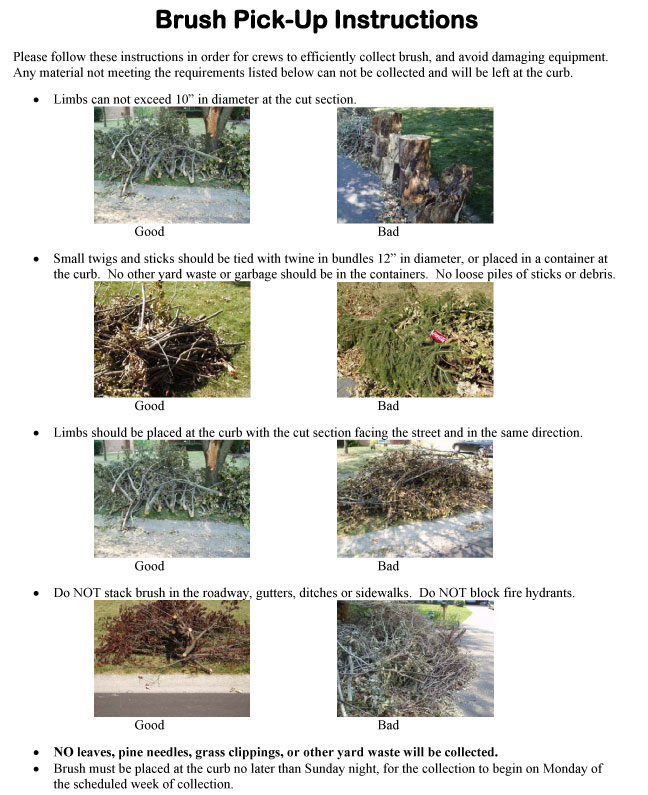
Loveland, Ohio – The 2020 fall brush pickup program will begin on Monday, November 9. Brush must be placed at the curb no later than Sunday night, November 8.
Guidelines
The following are guidelines established for the brush pick-up program:
Brush must be placed at the curb or edge of roadway. Do not place brush in the roadway, gutter, ditches, or on sidewalks. Do not block fire hydrants.
Limbs cannot exceed 10 inches in diameter at the cut section.
Limbs should be placed at the curb with the cut section facing the street and all limbs should be facing the same direction. This makes it easier and faster to handle.
No leaves, pine needles, grass clippings, or other yard waste will be collected.
Small twigs and sticks should be bundled with twine in bundles 12 inches in diameter. Twigs or sticks can also be placed in a container at the curb, but no other yard waste should be in the containers. Please, no loose piles of sticks and debris.
Please Note
The 2021 spring brush pickup program will begin on Monday, March 22.
Any material not meeting these requirements cannot be collected and will be left at the curb.
Outside the regular pick-up schedule, residents are encouraged to come to City Hall to get a free voucher to drop off any yard waste to Evans Landscaping.
Wood chips will be available again this year. Anyone in the City who would like a full load of wood chips should call 513-707-6115.



Susan Tebben is an award-winning journalist with a decade of experience covering Ohio news, including courts and crime, Appalachian social issues, government, education, diversity and culture. She has worked for The Newark Advocate, The Glasgow Daily Times, The Athens Messenger, and WOUB Public Media. She has also had work featured on National Public Radio.


 Jake Zuckerman is a statehouse reporter. He spent three years chronicling the West Virginia Legislature for The Charleston Gazette-Mail after covering cops and courts for The Northern Virginia Daily.













 Please Note