


 by Andrew Bateman,
The November 6th election, with all its national implications, is fast approaching. Ohio Issue 1, a proposed state constitutional amendment to reduce drug possession offenses from felonies to misdemeanors, is frequently used as a barometer of sorts amid ongoing coverage of state campaign races. The barrage of 30-second campaign ads are hyperbolic at best, and some feature fear tactics to persuade a no vote on Issue 1. What follows is my practice at a more reasoned case against the issue with hopes you come to the conclusion that Ohio Issue 1 hurts Clermont County and other local governments more than it helps.
What follows is my practice at a more reasoned case against the issue.
On its surface, Issue 1 has its merits. Given that the United States is the world leader in incarceration, 5 states have already passed similar legislation aimed at reforming the current criminal justice system. Ohio Issue 1 intends to reduce the state’s incarceration rate by reclassifying penalties for drug offenses such as possession, purchasing, and the use of illicit drugs or drug paraphernalia from a felony to a misdemeanor. The resulting reduction of over 50,000 prisoners would generate savings to the state. Money saved would go back into the system for addiction treatment and rehabilitation services as well as crime victim funds.The initiative places additional value on treatment by incentivizing prisoners that participate in rehabilitation services with a potential 25% sentence reduction.The reclassification would not apply to drug trafficking offenses, preventing drug dealers from dodging hard time.
Ohio Issue 1 misses the mark on two interrelated key points.
For all the big concepts of saving money and improving public safety, the ballot initiative over-simplifies the nuances of the criminal justice system and disregards the true state of addiction services within local governments. Ohio Issue 1 misses the mark on two interrelated key points: Access to money and access to treatment.
The amendment would immediately reduce the prison population. First, by granting prisoners with previous applicable felony convictions the right to appeal for a reduced sentence. Secondly by prohibiting jail or prison time for the same offenses, provided it is not the offenders third time in 24 months. Only 15 percent of inmates in state prisons across the United States are incarcerated for drug offenses. A sentence reduction of the approximately 7,500 eligible prisoners in Ohio would be a limited, one-time savings
Ohio Issue 1 places an undue burden on local governments to process repeat offenders up to three times before sentencing them to jail.
Not all of Ohio’s counties and municipalities have the same needs; but many face similar problems of overcrowded jails and ever-tightening budget crunches. And while inaccurate to say Ohio Issue 1 decriminalizes drugs, it certainly won’t deter people from buying and using drugs, which if the initiative passes, would shift sole responsibility of processing drug offenders to local governments. Ohio Issue 1 places an undue burden on local governments to process repeat offenders up to three times before sentencing them to jail.
Issue 1 is a major threat to the progress that has been made by county governments and agencies to address the opioid crisis in Ohio. Drug courts, which mandate treatment as an alternative to prison, are among the most effective methods of rehabilitation for addicts, many of whom would otherwise not seek treatment on their own. Issue 1 removes that authority from the judicial system and puts vulnerable offenders back in harm’s way. The treatment funding mechanism proposed by Ohio Issue 1 is not well-defined and could be distributed through grants. This complicates local government’s ability to allocate funds year-over-year and create stable infrastructure for addiction treatment programs and services.
In recent years national and state politics have been more cognizant of the opioid crisis, but the most significant positive impacts are made through collaboration between local government agencies and law enforcement. Effective programs such as quick-response teams and recovery coaches could be on the chopping block when local law enforcement and jails absorb more of the state’s cost.
Andy Bateman is a resident of Loveland, Ohio and serves as a member of the Clermont County Mental Health and Recovery Board.
As complex as Ohio Issue 1 is, it is understandable that the easier argument against it is to say that it normalizes drug use and puts dangerous criminals out on the streets. In my opinion it is more interesting to evaluate it in practical terms. One major concern with Ohio Issue 1 is, as a constitutional amendment, it does not pertain to an individual’s rights or freedoms and would be more difficult to repeal once approved.
One major concern with Ohio Issue 1 is that it is a constitutional amendment.
The choice is ours on November 6th. Please take the time to read for yourself the full language of the Statewide Issue. My intent is to vote against it and I urge others to do the same.

















by Rob Geiger,
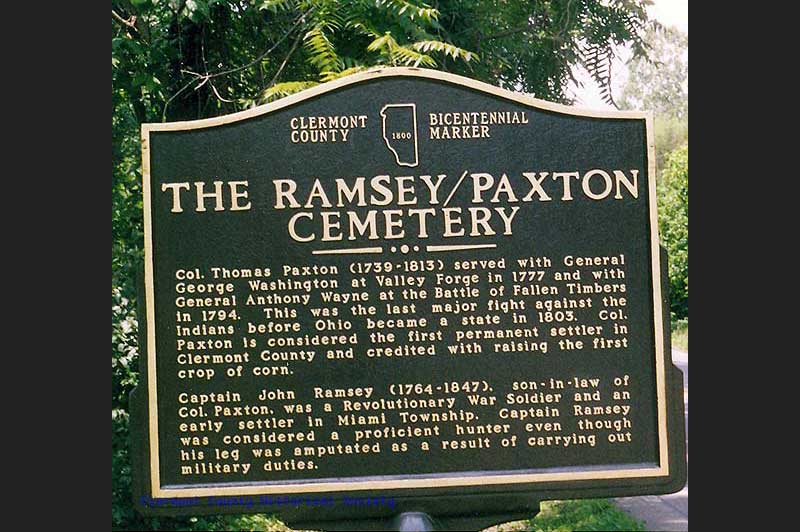
The Ramsey-Paxton Cemetery, located at Ramsey Court in the White Pillars Subdivision in Loveland, Ohio, needs funding in order to help preserve our local history.
The project will entail eradication of several dying trees, procurement of appropriate permits, site preparation, and erection of a nice 4’ aluminum decorative fence.
The Paxton-Ramsey Cemetery Association, Inc. is seeking $10,000 in funding. The local Clough Valley Chapter of the Daughters of the American Revolution is sponsoring a grant proposal submission to their National Society.
Lt. Col. Paxton (1739-1813) served with General George Washington at Valley Forge in 1777 and with General Anthony Wayne at the Battle of Fallen Timbers in 1794.
Lt. Col. Paxton is considered the first permanent settler between the Little Miami River and the Scioto River in the Virginia Military Tract, credited with raising the first crop of corn, and was the founder of Loveland.
Paxton’s involvement is quite extensive helping Lytle with surveying lands in Clermont County down to parts of today’s community of Hyde Park, having the first polling place in Clermont County and helping with the statehood of Ohio.
Captain John Ramsey, a son-in-law, was buried in the cemetery in 1847, along with other family members until 1913. Captain John Ramsey (1764-1847) was a Revolutionary War Patriot and one of the first settlers of Clermont County with other family members. He was considered a proficient hunter even though his leg was amputated as a result of carrying out military duties.
In 1997 the Ramsey-Paxton Cemetery Association, Inc. was formed and earned the status as a nonprofit (501c3) organization, and it is managed by a Board of Trustees. Much needed restoration of the cemetery took place with restoration of headstones, replacing the barbed wire fencing and removal of brush.
The Ramsey-Paxton Cemetery is a hidden gem locally, State-wide and nationally! ” We are fortunate to have such a historical site right in our own thriving town,” stated Jan Beller, Director of the Loveland Museum Center (Greater Loveland Historical Society).
We are looking to form a grassroots partnership along with members of the community and area businesses to have an attractive historical point of interest site in Loveland. Our grant application submission date is December, 2018 and improvements will start in the summer of 2019.
Please consider a charitable gift to show your support of this historical preservation project by sending your tax-deductible contribution.
If you have any questions, want a tour of the cemetery or to contribute to Ramsey-Paxton Cemetery Association please contact us at Ramsey-Paxton Cemetery Association Inc., C/O Rob Geiger, President, PO Box 25, Loveland, Ohio, 45140, or email geigercounter@hotmail.com.
RP Diamond is the exclusive retailer of LOVELAND HIGH SCHOOL SPIRIT WEAR Welcome to RP Diamond Printing & Embroidery located at 370 Loveland Madeira Road.