Tag: #climatechange

  • We’re approaching critical climate tipping points: Q&A with Tim Lenton/ Covering Climate Now

    We’re approaching critical climate tipping points: Q&A with Tim Lenton/ Covering Climate Now

    Loveland Magazine is one of the 400 news outlets worldwide, with a combined audience of over 2 billion people “Covering Climate Now”, a global journalism initiative committed to bringing more and better coverage to the defining story of our time.

    The initiative, was co-founded by The Nation and Columbia Journalism Review

    Mihaela Manova is “Covering Climate Now” in Loveland, Ohio as an editor for Loveland Magazine
    Today’s Covering Climate Now article is written by Rhett A. Butler for Mongabay News. This piece talks about the climate’s tipping points and how its urgency should motivate politicians “to accelerate transformative change.”

    • Over the past twenty years the concept of “tipping points” has become more familiar to the public. Tipping points are critical thresholds at which small changes can lead to dramatic shifts in the state of the entire system.
    • Awareness of climate tipping points has grown in policy circles in recent years in no small part thanks to the work of climate scientist Tim Lenton, who serves as the director of the Global Systems Institute at Britain’s University of Exeter.
    • Lenton says the the rate at which we appear to be approaching several tipping points is now ringing alarm bells, but “most of our current generation of politicians are just not up to this leadership task”.
    • The pandemic however may have caused a shock to the system that could trigger what he calls “positive social tipping points” that “can accelerate the transformative change we need” provided we’re able to empower the right leaders.

    Over the past twenty years the concept of “tipping points” has become more familiar to the public. Tipping points are critical thresholds at which small changes can lead to dramatic shifts in the state of the entire system. 

    From a climate standpoint, the melting of Arctic sea ice is a simple example. As sea ice melts, less sunlight is reflected into space and more heat is absorbed by the ocean, further hindering the formation of sea ice and thereby leading to more warming. The positive feedback loop is leading toward ice-free summers in the Arctic, which will have dramatic implications for the Arctic ecosystem and knock-on effects for ocean circulation and weather patterns. The effects are already being observed, with Arctic sea ice extent trending sharply downward since the 1970s.
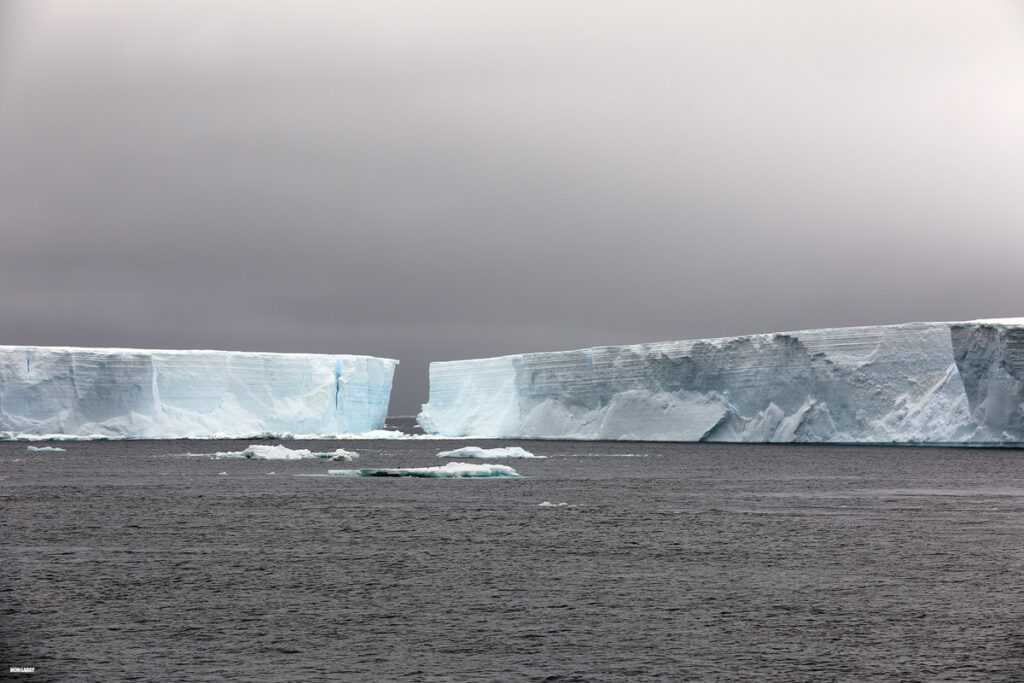
    Glaciers and icebergs in Antarctica. Photo credit: Mongabay

    Awareness of climate tipping points has grown in policy circles in recent years in no small part thanks to the work of climate scientist Tim Lenton, who serves as the director of the Global Systems Institute at Britain’s University of Exeter. In 2008 Lenton was the lead author of an influential Proceedings of the National Academy of Sciences (PNAS) paper that identified nine tipping points and ranked them by their near-term likelihood of occurring. These included: Arctic Sea-Ice; the Greenland Ice Sheet; the West Antarctic Ice Sheet; the Atlantic Thermohaline Circulation; the El Niño–Southern Oscillation (ENSO); the Indian Summer Monsoon; the Sahara/Sahel and West African Monsoon; the Amazon Rainforest; and the Boreal Forest. Lenton and his colleagues have since added tropical coral reefs and the East Antarctic Ice Sheet to the list.

    When Lenton published the PNAS paper, some aspects of the predictions were still theoretical, but since then, the evidence for some tipping points has strengthened as the rate of disruption has increased and our ability to observe change has improved.

    “Some of the tipping elements are changing more rapidly than others,” Lenton told Mongabay during a December 2020 interview. “The most concerning include the West Antarctic Ice Sheet – part of it looks to be in irreversible retreat – and the Amazon rainforest – where droughts and changing fire regimes are accelerating forest loss, alongside renewed human pressures.”

    The evidence base of cascading effects between tipping points has also expanded.

    “A decade or so ago we identified this as a theoretical possibility with some idea of what the causal interactions could be,” he said. “Now we have more direct evidence of causal interactions, like the role of Arctic sea-ice retreat and resultant warming in permafrost thawing and accelerating Greenland ice sheet melt.”

    Lenton says the the rate at which we appear to be approaching several tipping points is now ringing alarm bells, but “most of our current generation of politicians are just not up to this leadership task”.

    “Younger generations are looking at them with dismay and rightly rebelling.”

    The pandemic however may have caused a shock to the system that could trigger what he calls “positive social tipping points” that “can accelerate the transformative change we need” provided we’re able to empower the right leaders.
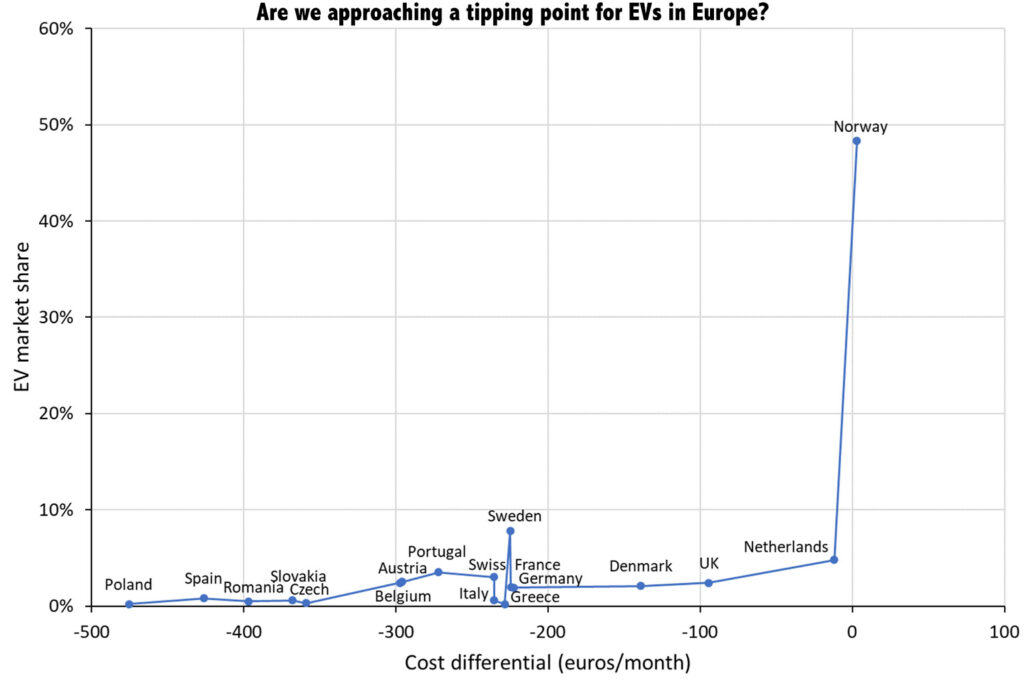
    Electric vehicle (EV) market share in a sample of 18 European countries as a function of cost differential expressed as average of equivalent petrol or diesel vehicle minus EV (monthly cost of ownership in euros). Image credit: Sharpe & Lenton (2020)
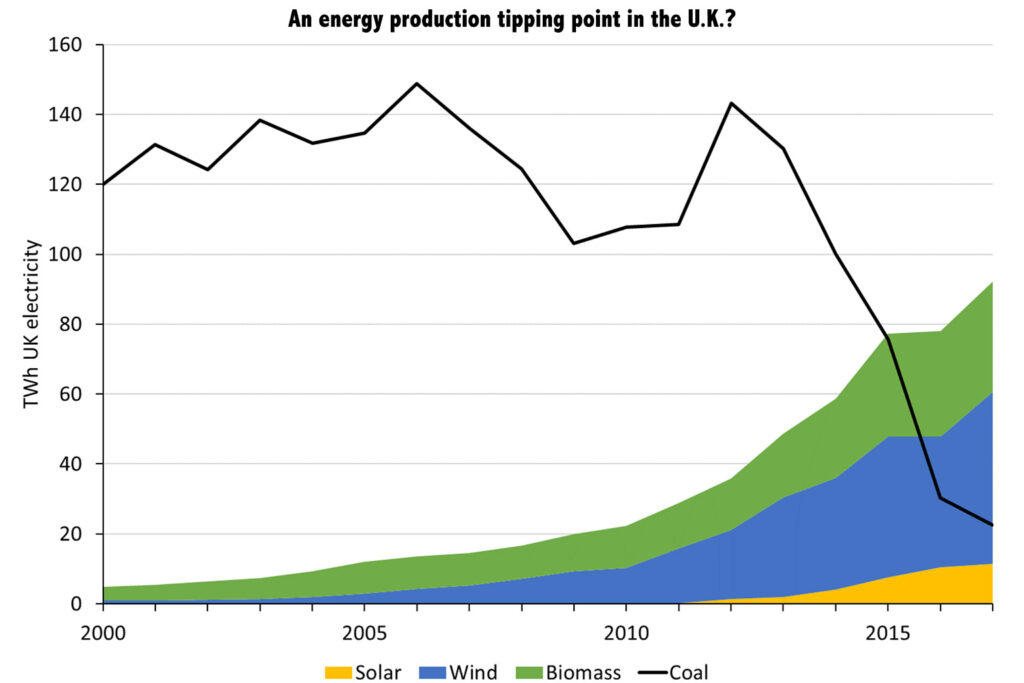
    Tipping point for coal in UK power generation. UK electricity generation (TWh) from coal and renewables 2000-2017. Image credit: Sharpe & Lenton (2020)

    “The COVID-19 pandemic has taught us that when a threat is truly urgent we can act decisively and put aside neoliberal economics in favor of saving lives. But politicians immediately started talking about ‘building back better’ rather than taking the opportunity to ‘build forward better’ – i.e. to chart a new economic and ecological path.”

    Lenton spoke about these issues and more in a conversation with Mongabay Founder Rhett A. Butler.

    AN INTERVIEW WITH TIM LENTON

    Mongabay: How did you become interested in the idea of tipping points?

    Tim Lenton: I started out studying Gaia and identifying how aspects of the Earth system self-regulate. In Jim Lovelock’s models like Daisyworld and in Earth history there are key moments where self-regulation breaks down and strong reinforcing feedbacks take over to propel abrupt change. Although I didn’t call them ‘tipping points’ at the time that’s what they are. When Malcolm Gladwell published ‘The Tipping Point’ it seemed natural to adopt that language.

    Mongabay: How does the concept of tipping points intersect with the idea of planetary boundaries?

    Tim Lenton: Where undesirable tipping points exist it makes it easier to set a ‘safe’ planetary boundary to avoid them. But not all planetary boundary variables have tipping points. Climate and ocean deoxygenation driven by nutrient inputs clearly do.

    Waves breaking on a beach in California. Photo by Rhett A. Butler.

    Hence I used those tipping points to help inform the original setting of planetary boundaries for climate and nutrient inputs. But other planetary boundaries lack an obvious tipping point so have to be set in a different way.

    Mongabay: In your highly-cited 2008 PNAS paper, you and your co-authors identified several tipping points. Has that list changed since then? And have some of those tipping points progressed more rapidly than others?

    Tim Lenton: The list has changed somewhat over time, but not as much as thought it might. I put question marks on some of the original list and map to show I was less sure about them. Tropical coral reefs are now on the list, as is part of the East Antarctic Ice Sheet draining the Wilkes Basin.
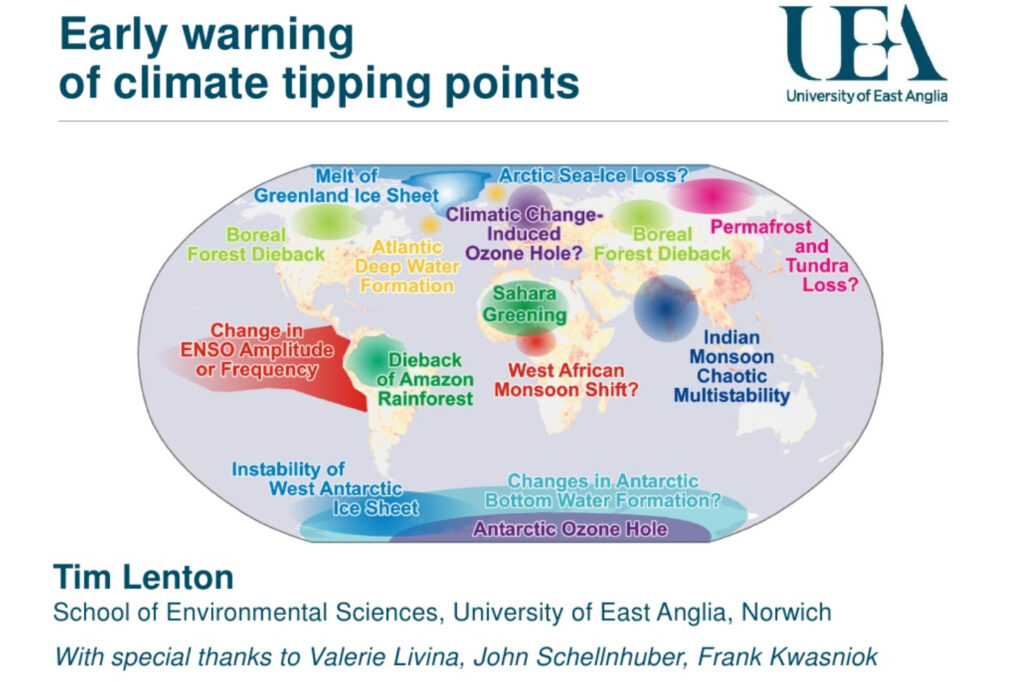
    Map of potential policy-relevant tipping elements in the climate system in Lenton et al (2008)’s original paper. These have since been updated to include coral reefs and the East Antarctic Ice Sheet.

    Some of the tipping elements are changing more rapidly than others. The most concerning include the West Antarctic Ice Sheet – part of it looks to be in irreversible retreat – and the Amazon rainforest – where droughts and changing fire regimes are accelerating forest loss, alongside renewed human pressures.

    Mongabay: You’ve warned about the risk of one tipping point potentially triggering another tipping point as a sort of cascading domino effect. How has the science around that idea improved over the past decade?

    Tim Lenton: A decade or so ago we identified this as a theoretical possibility with some idea of what the causal interactions could be. Now we have more direct evidence of causal interactions, like the role of Arctic sea-ice retreat and resultant warming in permafrost thawing and accelerating Greenland ice sheet melt. Also the contribution of Greenland melt water to disrupting North Atlantic deep water formation and the Atlantic overturning circulation. Plus we now have some models for how the interactions could play out.

    Mongabay: Here in the American West we’re reaching the end of what was a catastrophic fire season and we’re told that we should expect this to be the new normal going forward. Have you identified any tipping point when it comes to forest fire dynamics here?

    Tim Lenton: Fires generate their own reinforcing feedbacks – drying the fuel load, creating local convection and winds, and even thunderstorms – and such self-amplifying feedbacks are the vital ingredient for creating tipping point dynamics.
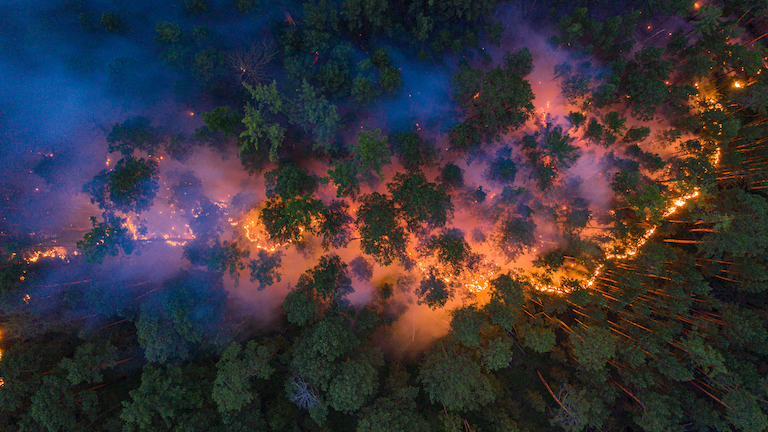
    Krasnoyarsk, Siberia, is just one region where fires are burning throughout Russia in 2020. Image by Greenpeace International.

    Fire regimes in the wet tropics can pass a tipping point from localized fires to much larger ‘mega fires’ – a bit like a phase transition in physics. Such mega-fires now seem to be happening in the American West, Australia and even the Arctic. So there looks to be a localized fire tipping point, and some signs that it is being passed at similar times across large areas – making for a bigger tipping point.

    Mongabay: From the appearance of dry forest species like the maned wolf and the rise in drought and fire in the Amazon in recent years, there seems to be increased evidence of significant changes occurring in Earth’s largest rainforest. How will we know when we’re actually near the tipping point?

    Tim Lenton: One way to find out is to look for the characteristic early warning signals of approaching a tipping point – the forest ‘slowing down’ in its recovery from perturbations (like the recent drought years). We’ve being analyzing the data and we think we’ve picked up this slowing down signal of the Amazon rainforest losing resilience across large areas. To pinpoint whether we are close to a tipping point one can also look at the least resilient parts of the forest (e.g. in the Southeast) and see if they are locally being tipped into an alternative stable state by droughts or fires – and how easily that tipping happens.
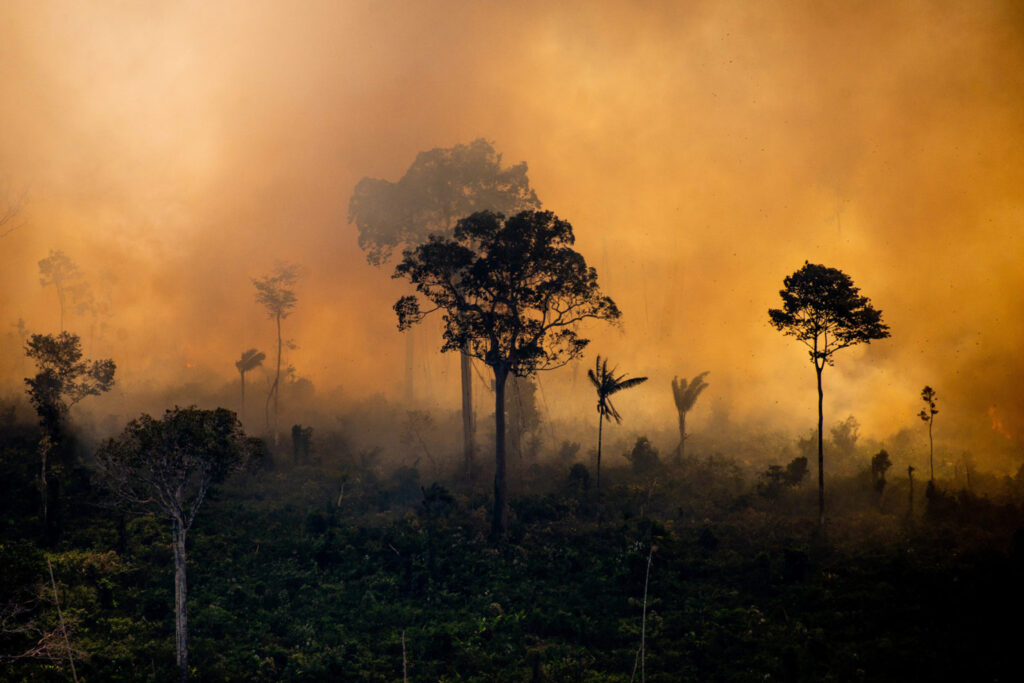
    Fire burning next to the borders of the Kaxarari Indigenous territory in Lábrea, Amazonas state, Brazil. Taken 17 Aug, 2020. CREDIT: © Christian Braga / Greenpeace

    Mongabay: In 2018 you wrote a perspective updating the Gaia theory and proposing that it serve as a “framework for fostering global sustainability.” Can you elaborate on this?

    Tim Lenton: Whether you agree or not with the original Gaia theory it is obvious that we are becoming collectively self-aware of the bad consequences of our actions on our own life-support system. My proposal with Bruno Latour is that we could in principle add a bit of self-awareness to the Earth’s self-regulation. At the very least we could sense where things are going wrong better (through satellites etc) and correct our mistakes faster. We could also use the prior Gaia to provide a template for designing a more flourishing sustainable future – including sustainable energy, material recycling, and horizontal information exchange, supporting a rapid learning process.

    Mongabay: Arguably, there has been very little progress in curbing carbon emissions since your 2008 tipping points paper despite a growing body of scientific evidence on the need to take action. What do you think it will take to catalyze an appropriate sense of urgency among the general public and politicians? And has the COVID-19 pandemic made any difference on this front?

    Tim Lenton: I think there is an appropriate sense of urgency among many in the general public who protested together and forced government declarations of a ‘climate emergency’. The problem is we need urgent action and most of our current generation of politicians are just not up to this leadership task. Younger generations are looking at them with dismay and rightly rebelling.

    Solar panels at Solana Generating Station in Arizona. Image credit: Microsoft Zoom.Earth

    The COVID-19 pandemic has taught us that when a threat is truly urgent we can act decisively and put aside neoliberal economics in favor of saving lives. But politicians immediately started talking about “building back better” rather than taking the opportunity to “build forward better” – i.e. to chart a new economic and ecological path.

    Mongabay: In January the United States will have a new President. What would you like the Biden Administration to prioritize?

    Tim Lenton: Tackling climate change and inequality through the green new deal. Go to the places where people feel they are going to lose out – the coal belt and the rust belt – and work with the communities there to chart a prosperous alternative future for them, then resource them to get to that greener future – just like we are seeing with the German ‘coal commission’.

    Mongabay: Lastly, tipping points seem like a potentially depressing topic. What gives you hope?

    Tim Lenton: My kids. And identifying positive social tipping points that can accelerate the transformative change we need.

    Citations

    • Lenton, T. M. et al. “Tipping elements in the Earth’s climate system.” Proceedings of the National Academy of Sciences 105, 1786–1793 (2008).
    • Sharp, S. and Lenton, T. M. “Upward-scaling tipping cascades to meet climate goals – plausible grounds for hope.” Policy briefing note series 2020/01 (2020).
  • The Year That Was and the One Ahead/ Covering Climate Now

    The Year That Was and the One Ahead/ Covering Climate Now

    Loveland Magazine is one of the 400 news outlets worldwide, with a combined audience of over 2 billion people “Covering Climate Now”, a global journalism initiative committed to bringing more and better coverage to the defining story of our time.

    The initiative, was co-founded by The Nation and Columbia Journalism Review

    Mihaela Manova is “Covering Climate Now” in Loveland, Ohio as an editor for Loveland Magazine

    Read Covering Climate Now’s newly published newsletter on new stories, reflections of 2020, and information regarding climate change.

    [Republished from coveringclimatenow.org]

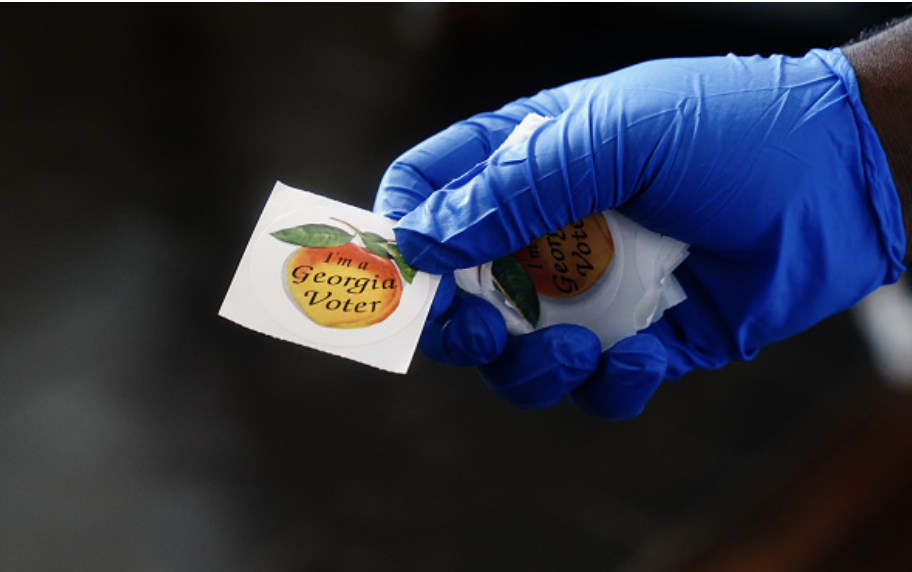
    Humanity begins 2021 with a real chance to pull back from the brink of climate catastrophe. The odds get even better if Democrats win both Georgia run-off elections and take control of the US Senate. (At the time of writing, some outlets had reported a victory for Democratic candidate Jon Ossoff over Republican incumbent David Perdue, based on projections, while others held off.) In any case, strong climate journalism in the year to come is essential to help humanity rise to the challenge.

    For the last four years, the world’s largest economy and single-biggest all-time emitter of heat-trapping gases has been in the grips of an aggressive climate denier. The Trump administration slashed environmental regulations, expanded concessions to the oil and gas industry, and withdrew from the Paris Agreement, the hard-won 2015 pact to compel international cooperation on the defining problem of our time. Climate progress did continue in Washington’s absence, but too slowly. Select state and local governments in the US, as well as governments abroad, forged ahead with plans to curb emissions. Thirty-eight countries, including the United Kingdom, Canada, and Japan, declared a “state of climate emergency.” And China, the second-biggest historical emitter behind the US, announced a commitment to achieve carbon neutrality by 2060. Still, obstruction and backsliding in Washington placed the world on track for a hellish future.

    With Joe Biden’s inauguration imminent, a new era in the climate story is at hand. And for the press, this new year presents a much-needed opportunity to reinvent our climate coverage—to redouble, not relax, our commitment to telling the climate story so people get it and, moreover, resolve that they and especially their governments do something about it.

    Read Mark Hertsgaard’s & Andrew McCormick’s full column, charting a course for the climate story in 2021…

    NEW FROM CCNOW:

    Talking Shop: Countering Emotional Fatigue & Burnout. Our next Talking Shop webinar is set for January 13 at 12pm US Eastern time. Join us for an hour of candid, collegial discussion about how journalists covering emotionally fraught issues from racial justice to climate change to war zones can cope with burn-out, emotional fatigue, grief, and the other manifestations of the psychological stress such work can bring. Panelists will include Matthew Green, the climate correspondent at Reuters and Dr. Renee Lertzman, a researcher and educator specializing in psychological tools for coping with ecological crises, with additional panelists still to be confirmed. CCNow executive director Mark Hertsgaard will moderate. You can RSVP now here…

    Call for stories to share. A reminder to all CCNow partners, at all times we accept stories for republication by others in the collaboration. If you’ve got a strong climate story that might appeal to other audiences, please send it our way using this Google Form. As always, stories available for republication can be found in our Sharing Library  (strong stories from last year that remain relevant in 2021 are currently highlighted in yellow).

    ESSENTIAL CLIMATE NEWS:

    • For NBC Nightly News, Al Roker hosts a new multi-part series looking back at all the record-breaking extreme weather in 2020 – and forward to see how communities will cope with and mitigate the climate threat. “We are now in uncharted territory,” Roker says. “This crisis of our changing climate will be, and already is, the story of our time.” From NBC News
    • In South Sudan, an intense and protracted rainy season has displaced nearly a million people and now threatens famine. The crisis is a harrowing reminder of how climate change often inflicts the greatest punishment on populations who are least responsible for the problem or equipped to deal with the impacts. Aid from the outside world has been slow and insufficient. From Al Jazeera, via the Associated Press
    • Exxon, like many big energy companies, talks a big game about environmental consciousness and new, ostensibly low-emissions projects. Yet internal documents show that the company’s assessments of its environmental impacts differ significantly from what is shared with the public. A new natural gas export facility in Texas, for example, was touted as a gift of clean energy to the world, but the facility’s projected emissions are on par with those of a coal-fired power plant. Exxon’s shareholders are starting to notice. From Bloomberg Green
    • In The Nation’s latest print issue, Sunrise Movement co-founder Varshini Prakash argues that Biden should use executive authority to establish an Office of Climate Mobilization, similar to Franklin D. Roosevelt’s Office of Wartime Mobilization. Such an office would have broad decision-making, agenda-setting, and budgeting authorities, Prakash suggests, which Biden will need if his administration indeed intends to make climate its number one priority. From The Nation
    • Inside Climate News surveys the “new and unexpected” things we learned about climate change in 2020 – including that the fundamental link between climate science and climate justice has not been researched enough, meaning our shared understanding of how climate change will impact at-risk populations is lacking.  Another highlight: eliminating greenhouse gas emissions might halt global warming much sooner than scientists previously believed (a fact which CCNow described last year as “game-changing.” From Inside Climate News
    • In The Invading Sea, the opinion branch of the Florida Climate Reporting Network, Florida state lawmaker Chip LaMarca, a Republican, argues for robust coastline policies to meet the environmental threat. LaMarca is one of a growing cadre of Republicans in Florida who buck the national GOP’s climate denialism as more record-breaking hurricanes and sea level rise threaten beaches, property values, and the tourist economy in the state. From The Invading Sea
    • NowThis joins a group of Greenpeace researchers documenting the Arctic’s precipitous deterioration, which in 2020 included the splitting off of more than 40 square miles from the world’s largest ice shelf. “We want to make sure that world leaders understand the urgency of the climate crisis, and that they understand the role of healthy oceans in tackling [it],” one researcher says. From NowThis

    THE YEAR THAT WAS AND THE ONE AHEAD:

    Many outlets have published stories reviewing the climate lessons of 2020 and looking forward to 2021. Here are some that caught our eyes; perhaps they will help orient your own reporting in the coming weeks and months:

    NEW RESOURCES FROM SEJ:

    The Society of Environmental Journalists is collecting helpful tip sheets and background resources to help reporters prepare for the year ahead. Tip sheets include environmental justice stories to watch in 2021 and a review of climate policies the executive branch is likely to institute under Biden; backgrounders include the options Biden has to act on climate change, even without Senate support, and a summary of how carmakers are preparing for a shifting regulatory landscape. Keep an eye out for the SEJ’s complete “2021 Journalists’ Guide to Energy & Environment,” which launches January 27. For now, find the tipsheets and background resources here…


    As we head into this next chapter of climate reporting, Covering Climate Now has modified our newsletter to better serve journalists’ needs. We’re going to treat these emails as a kind of “bulletin board” for climate journalists as well as other folks interested in learning more about climate change. We hope you find the new format helpful and digestible.

    If you have any feedback, or know of another event or have news that should be included here, shoot us a note at 
    editors@coveringclimatenow.org.

  • Young People in Georgia Fight for Climate Ahead of Runoff Elections/ Covering Climate Now

    Young People in Georgia Fight for Climate Ahead of Runoff Elections/ Covering Climate Now

    Loveland Magazine is one of the 400 news outlets worldwide, with a combined audience of over 2 billion people “Covering Climate Now”, a global journalism initiative committed to bringing more and better coverage to the defining story of our time.

    The initiative, was co-founded by The Nation and Columbia Journalism Review

    Mihaela Manova is “Covering Climate Now” in Loveland, Ohio as an editor for Loveland Magazine

    In this Covering Climate Now newsletter written by Mekdela Maskal, Maskal highlights Georgia’s young voters who are fighting for climate change in the upcoming runoff elections.

    On January 5, voters in Georgia will decide which political party controls the US Senate and, in turn, how far President-elect Joe Biden will be able to take his ambitious $2 trillion climate plan.

    For Democrats to take control of the Senate, Rev. Raphael Warnock and Jon Ossoff both need to win their runoffs against Republican incumbents Kelly Loeffler and David Perdue, respectively. Warnock and Ossoff have plans to address climate change, which poses multiple threats to Georgia, including intensifying hurricanes, sea level rise, higher temperatures, and spreading contamination at some of the nation’s most toxic waste dumps. Their GOP counterparts have all but ignored the climate issue.

    Throughout this election season, young voters and activists have forced climate change to center stage, and this final pivotal race is no exception. We spoke with five young people in Georgia to get their take on the issues that matter most and how those are covered (or not) in the media.

    Reach out to us for youth activists who are available for interviews.

    Edward Aguilar, 17 

    Untitled design (1).png

    Aguilar is a high school senior in Alpharetta, Ga. who has been encouraging college students to register to vote through Students for Tomorrow, an organization he co-founded that helps young people understand political issues and why their vote counts.

    We started Students for Tomorrow in September. A friend of mine had to leave college because of Covid and was going to move back in with his parents. He called me and one of the questions that he had was, “Where am I going to vote? I’ve been voting from school for the last couple of years. Now, I am going back home, can I even vote there?” 

    People tend to feel that students are really apathetic when it comes to the political process, but in reality, a lot of them are just disillusioned. They don’t feel like their votes have an impact, and they don’t see themselves represented in media coverage. I think that’s why you’ve historically seen young people also taking to the streets and doing things online, more than just trying to place their vote. By showing them that their vote matters, Students for Tomorrow has helped an estimated 65,000 students register to vote nationwide.

    I think students are going to be the key for a lot of progressive policies moving forward, because they are willing to vote based on policy rather than party. Over the last month, we’ve been organizing hundreds of teen volunteers to have conversations with students ahead of the runoffs to clarify how their values and interests align with policies. We’ve been making a lot of calls to Perdue voters and saying, “If you want to live in a place that’s not underwater 40 years from now, you should probably not vote for him.”


    Jordan Madden, 16

    Madden is a coordinator at Sunrise Movement Clayton County and an intern for State Rep. Becky Evans, a Democrat representing Georgia’s 83rd District. Madden became involved in local climate justice efforts to bring more attention to the state’s environment.

    Jmadden.png

    My cousin works at a disposal company, and I’ve gone with him to our local landfill, the Dekalb County Seminole landfill, to see the problems there first-hand. Seeing the neighborhoods that surround the landfill, where we pollute and store our trash, you’re constantly reminded that these issues impact low-income people and are not shared by everyone equally. Knowing that this landfill is just one of many locations like it across the world made me realize that this problem is way bigger than just us.

    I want to make the public aware that environmental issues and climate change are real issues that we can solve if we put enough time and effort into them. Older people had a chance, but now it’s definitely our time to try and fix this problem.

    One thing that hasn’t been brought up in enough detail throughout the elections is what a just recovery means and whether affected communities will be brought to the table. We hear a lot from politicians and people who have power and money, but we need to hear more from the people who live the realities of climate and environmental injustice every single day. We see news about the temperature and global warming but we need to hear more of, “What can we do to reduce plastic waste in our communities?” “How can we hold the companies releasing toxins here accountable?” I want to see the media shine a light on the corporations that pledge to be green while at the same time hindering climate agendas.


    Jakia Cox, 19

    Cox is a freshman at Hawai’i Pacific University, originally from Ellenwood, Georgia. She became familiar with the environmental and climate justice movements while navigating her own lived experience.

    Jakia.png

    When I returned to Ellenwood from school, because of Covid, I woke up to this horrible stench. My house is less than half a mile away from the Dekalb County Seminole landfill. My parents bought the house in 2001, when they were told that the landfill would be closing. That was a huge lie. We couldn’t really smell it at first back then. But as time went on, the smell got worse, and now the trash in the landfill is stacked as tall as some trees. Every other day, at least, I have to put my shirt over my nose just to walk around my house.

    I decided to email the Georgia Environmental Protection Division and ask why the site remains open next to a neighborhood and about the health effects. I realized most of the neighborhoods surrounding Ellenwood are Black. I also learned of a predominantly white neighborhood nearby where public officials were thinking about creating a landfill that didn’t go through. It then sunk in that I was living with environmental racism. Since then, I’ve been figuring out how to organize with my family and my neighbors. My brother started a petition to close the landfill, but I have to say it’s frustrating, because it feels like we’re not being heard.

    To be honest, I haven’t been following the elections that closely. It’s difficult to stay engaged when it feels like the focus isn’t right or isn’t on issues that affect you. The Senate candidates, for example, seem more worried about their image than their constituents and local climate issues. It’s hard to be hopeful. Our stories need to be heard.


    Natasha Dorr-Kapcynski, 19

    Dorr-Kapcynski is a freshman at the University of Georgia. She is also the co-founder and communications coordinator of Georgia For The Planet, which is dedicated to fighting climate change and injustice in the state.

    Natasha.png

    Climate change is definitely growing in importance to Georgians but it’s still not widely considered a major issue.

    The upcoming Senate races are important, but so is the lesser known race for Public Service Commissioner, which also did not have a clear winner on Election Day. The Public Service Commission has been controlled for years by Republicans who determine energy rates, regulate the storage of toxic coal ash, and decide investments in renewables, like solar energy. They don’t seem to have anything but profit in mind. And I don’t see anyone talking about that.

    I think if people realized that a lot of the social justice issues in Georgia are tied to environmental issues, they would be more interested in fighting for the environment. For example, I don’t think many people realize that Black people in Atlanta have disproportionately higher rates of asthma from exposure to air pollution, or that they tend to live near contaminated water sources, and how these issues tie together. If you’re worried about getting clean water for your family, and you only see climate news with stereotypical images of polar bears and melting ice caps then it’s hard to make that connection. But we are starting to see that shift happening in the media.


    Mark Putman, 19

    Putman is a second-year at Georgia Tech. Putnam leads the Georgia chapter of OneMillionOfUs and is also vice president of events with Georgia Tech Students Organizing for Sustainability, where he organizes get-out-the-vote efforts.

    Markput.png

    For the last couple of months I’ve been working at my school to create voter guides around climate policy, because we’ve found that navigating the voter process while trying to understand what’s on the ballot can get confusing, especially for young people who haven’t voted before. We’ve put guides up in dining halls and Covid testing centers, and we’ve also circulated them in our group chats and on social media. We’re thinking longer term, too, to 2022, when Georgia will have a governor’s race and a Senate seat [the one currently held by Loeffler] on the ballot. 

    In the media, I would like to see the candidates be more challenged to get specific on climate and the environment. Perdue and Loeffler often bring up supposed job losses and increased electricity costs from renewables. Ossoff and Warknock bring up the impacts of climate change that we’ll have to deal with, like pollution. But I don’t often see the media fact-checking them. You’re not having a dialogue between those two points, and they’re not measured against reality. On the ground in Georgia, for example, we’re actually seeing solar energy booming. That needs to be addressed when these things are reported locally.

    Because it’s all eyes on Georgia now, it seems like the national impacts of the election are taking over more than the needs of Georgians. There’s not as much political conversation about the issues we’re dealing with on a local and state level.

  • Planet Classroom Network announces World’s Fair of Learning for students/ Covering Climate Now

    Planet Classroom Network announces World’s Fair of Learning for students/ Covering Climate Now

    By Mihaela Manova

    By
     Mihaela Manova is the Covering Climate Now Editor for Loveland Magazine and lives in Loveland

    Calling all parents and teachers! On November 16, 2020, CMRubinWorld announced that Planet Classroom Network, a new addition to their website, will be organizing a six month World’s Fair of Learning on Youtube. 

    The goal for this virtual fair is to unite young students in learning from different mediums on YouTube, while also focusing on global climate change.

    Planet Classroom is dedicated to “supporting youth well-being, unity, inclusivity, and addressing our planet’s global challenges” as told by the CMRubinWorld website. 

    The program will begin on January 4, 2021 and will be hosted on their YouTube channel. The program will feature over 20 global organizations such as Global Nomads, The Martha Graham Dance Company, and many more. For the full list, visit: https://www.cmrubinworld.com/planet-classroom/ 

    “Research has shown us time and time again that the arts and social impact learning unites people across borders. The COVID-19 pandemic and the ensuing economic and societal consequences have amplified an already existing crisis of youth mental health,” said CMRubinWorld Co-Founder and CEO, Cathy Rubin. 

    “We came to the conclusion that the world’s youth needed their own Youtube channel where they can work with each other and seek sustainable solutions for their planet.”

    The organizations that have partnered up with Planet Classroom will focus on artistic and creative aspects and opportunities. Director Eric Simon talked about his film What To Do About Climate Change?, which will air on the platform.

    According to CmRubinWorld, Simon said, “explores avenues available for making progress” and will focus on the passion of protestors and activists battling climate change.

    Likewise to Simon’s goals, other topics will be showcased throughout the six month program, including writing, watching documentaries, dance, and a platform for children to tell their stories.

    About Planet Classroom Network

    The Planet Classroom Network, organized by CMRubinWorld, brings together musicians, dancers, video game creators, filmmakers, learning innovators and emerging technologists from all over the world to entertain, educate and engage youth, and to provide a rich cultural experience at a time when art and learning institutions everywhere are not accessible. 

    The Planet Classroom Network is by youth for youth. Young people from around the world played a significant role in conceptualizing, creating, and producing the network’s vision and programming.

    Follow @PlanetClassroom on Twitter

    Currently, Planet Classroom is in the process of launching their website. To subscribe and be notified of its first airing click here.

    Let us know what you think! Contact me at manovamd@miamioh.edu

  • Teaching the Truth About Climate Change Is Up to Us, Because Textbooks Lie

    Teaching the Truth About Climate Change Is Up to Us, Because Textbooks Lie

    Loveland Magazine is one of the 400 news outlets worldwide, with a combined audience of over 2 billion people “Covering Climate Now”, a global journalism initiative committed to bringing more and better coverage to the defining story of our time.
    The initiative, was co-founded by The Nation and Columbia Journalism Review

    Mihaela Manova is “Covering Climate Now” in Loveland, Ohio as an editor for Loveland Magazine

    In today’s (reposted) article from Covering Climate Now/Rethinking Schools, Bill Bigelow writes about the scarcity of climate change education in current textbooks.

    In 2016, the school board in Portland, Oregon, approved a comprehensive climate justice resolution, one part of which mandated that Portland Public Schools “will abandon the use of any adopted text material that is found to express doubt about the severity of the climate crisis or its root in human activities.”

    I was a member of the committee of parents, teachers, students, and activists that pushed for the resolution. In drafting it, we knew that there were a couple of especially egregious texts in Portland classrooms, but until we sat down to formally evaluate 13 middle and high school science and social studies textbooks, we had no idea that every single one of the texts adopted in famously green and liberal Portland misleads young people about the climate crisis.

    Few teachers put their faith in multinational behemoths like Pearson and Houghton Mifflin Harcourt. But our Climate Justice Committee needed more than hunches about how these corporations’ profit-first orientation would distort their coverage of climate change — we needed evidence.

    Before our committee collected district-adopted textbooks to evaluate, we developed a rubric to evaluate their adequacy, inspired by the work of K. C. Busch at Stanford’s Center for Assessment, Learning, and Equity. Here’s what we came up with:

    • The text provides stories and examples that help students grasp the immediacy, systemic nature, and gravity of the climate crisis.
    • The text includes actions that people are taking to address the climate crisis, locally and worldwide.
    • The text emphasizes that all people are being affected by the climate crisis, but also highlights the inequitable effects of the crisis on certain groups (e.g., Indigenous peoples, people in poverty, Pacific Islanders, people in sub-Saharan Africa, people dependent on glaciers for drinking water and irrigation, etc.)
    • The text does not use conditional language that expresses doubt about the climate crisis (e.g., “Some scientists believe . . .” or “Human activities may change climate . . .”)
    • There are discussion and/or writing questions that provoke critical thinking.

    Given our climate emergency, meeting these criteria seemed to us to be a reasonable cut score.

    Thirteen retired teachers and members of our Portland Public Schools Climate Justice Committee gathered to evaluate the school district’s texts. The first thing we noticed is how difficult it was to find anything about climate change in many of the books. A typical social studies text, History Alive! Pursuing American Ideals, includes no mention of climate change, but offers breathless paeans to fossil fuels: “Oklahoma’s oil reserves are among the largest in the nation. Fossil fuels helped the United States become an industrial giant.” As one committee reviewer wrote, in this and other texts, “there is an opportunity to look at early U.S. history as prologue to the climate crisis, but this book is utterly silent.”

    Contemporary Economics: not a word. The iconic Magruder’s American Government: 844 pages with no reference to global warming, climate change, greenhouse gases. One committee reviewer wrote: “How can a book about the U.S. government say nothing about the climate crisis — or environmental policy more broadly? This is egregious, unacceptable.” Despite a focus on industrialization, neither volume of the Advanced Placement text Sources of the Western Tradition includes anything about climate change — as if we can cleave fossil fuel-powered industrialization from its contemporary climate consequences.

    Other texts acknowledge the existence, or at least the possibility, of climate change, but the texts’ language is drenched in doubt. Issues and Life Sciences describes global climate change in just one sentence, as a “potential threat to Earth’s biomes.” However, other “threats” to the Earth’s biomes — eight of them — are listed as actual, and climate change a mere potential threat.

    The books are littered with conditional language. The high school text Biology: As greenhouse gas concentrations increase, global temperatures “may be affected,” and there might be “potential” for serious environmental problems. And: “Explain how burning of fossil fuels might lead to climate change.” AP World History informs students that the global rise in temperatures “might have serious consequences.”

    A key component of Portland’s climate justice resolution is its insistence on student agency: “All Portland Public Schools students should develop confidence and passion when it comes to making a positive difference in society, and come to see themselves as activists and leaders for social and environmental justice — especially through seeing the diversity of people around the world who are fighting the root causes of climate change.” But not a single text our committee reviewed suggests that students or ordinary people can play a role in addressing this growing crisis — or that “frontline communities” are themselves responding to climate destabilization. In its one sentence on climate change, Pursuing American Ideals says that “environmentalists fear” problems like global warming. Similarly, Modern World History acknowledges that “environmentalists are especially concerned . . .” and that “Scientists also are worried about global warming . . .” These are both true, of course, but the resolution’s intent is to emphasize our students’ own role in making the world a better place, rather than assigning concern and action only to scientists and environmentalists.

    All 13 of the books earned an F. Our committee is in the midst of sending letters to each publisher informing them that their book is out of compliance with Portland school district policy on climate education. We are also sending letters to teachers who may be using these books, alerting them to our findings and urging them to use alternatives, and to engage students in critical reading activities to dissect the problems with these texts’ ho-hum approach to climate change.

    Do we expect to influence these corporations’ treatment of the climate crisis in their textbooks? No. The corporate giants that publish school textbooks have no interest in raising critical questions about the frenzied system of extraction and consumption at the root of climate change — a system from which they benefit. Our aim is to build an argument that we cannot look to conventional sources of curriculum to educate our students about the causes of climate change and the kind of fundamental social transformation needed to address the crisis.

    For this, we need a grassroots approach to curriculum development — a partnership among educators, parents, environmental organizations, frontline communities, and our students. We need to demand time for teachers to collaborate, to write new curriculum, to share stories — to learn from one another and from the communities being hit by climate change first and the hardest. The climate crisis threatens life on Earth. Our students have a right to learn about this and to know that they can make a difference.

    Bill Bigelow (bill@rethinkingschools.org) is the curriculum editor of Rethinking Schools and co-director of the Zinn Education Project.ÊHe co-edited A People’s Curriculum for the Earth: Teaching Climate Change and the Environmental Crisis.

    This story is part of Covering Climate Now, a global collaboration of more than 250 news outlets to strengthen coverage of the climate story.

    Link to this article: https://rethinkingschools.org/articles/teaching-the-truth-about-climate-change-is-up-to-us-because-textbooks-lie/

  • The Fall of Trump Propels the Climate Story into a Decisive New Era/Covering Climate Now

    The Fall of Trump Propels the Climate Story into a Decisive New Era/Covering Climate Now

    Loveland Magazine is one of the 400 news outlets worldwide, with a combined audience of over 2 billion people “Covering Climate Now”, a global journalism initiative committed to bringing more and better coverage to the defining story of our time.

    The initiative, was co-founded by The Nation and Columbia Journalism Review

    Mihaela Manova is “Covering Climate Now” in Loveland, Ohio as an editor for Loveland Magazine

    In today’s Covering Climate Now newsletter, the source explains what the future could hold after Trump’s presidency and how the United States will return to battle climate change.

    Donald Trump’s defeat in the US presidential election is the biggest development in the climate story in years, if only because it means that the story might not have a hellish ending after all. News columns and Zoom meetings are already abuzz with to-do lists and speculation about what the administration of president-elect Joe Biden will or will not be able to accomplish on climate change. But that is another story for another day.

    Like the fall of the Berlin Wall or the Apollo 11 Moon landing, Trump’s impending departure from the most powerful office on earth is an event of epochal importance whose ramifications cannot be fully fathomed at this point, much less confidently forecast. Instead of trying to predict what will come next, this is a time to pause and reflect. Let’s recognize the magnitude of what America’s voters just did and ponder what lessons it holds for the challenges ahead.

    Penn State University scientist Michael Mann spoke for many climate experts when he warned before the election that “a second term for Trump would be ‘game over’ for climate.” That was not partisan hyperbole but unsentimental physics and math. To avoid an apocalyptic future—one shaped by intensifying heat waves, droughts, wildfires, and storms—humanity must slash greenhouse gas emissions in half by 2030, scientists with the United Nations Intergovernmental Panel on Climate Change declared in a landmark 2018 report. That remains an immensely difficult challenge, requiring shifts in economic behavior at a scale and speed the scientists called “unprecedented” in human history. But the task would have become outright impossible, Mann explained, if the world’s biggest economy spent a second four years galloping in the wrong direction under a re-elected president Trump, with his pro-fossil fuels policies and rejection of the Paris Agreement.

    That is the suicidal scenario humanity just avoided.

    But make no mistake: Many more mountains remain to be climbed in order to preserve a livable climate. For example, three of the world’s four biggest economies—the European Union, Japan, and China—have recently pledged to reach net zero carbon emissions by 2050 or, in China’s case, 2060; citizens, public officials, and business leaders will have to push those countries’ governments to make that scientifically correct target a political reality. The US must match these net-zero efforts, starting during the Biden administration and despite all-but-certain opposition from Republicans and other fossil fuel loyalists in Congress, and sustain that progress for decades. Meanwhile, business and financial interests the world over must shift investment and loans away from the climate de-stabilizing status quo and towards clean energy, regenerative agriculture, and other foundations of a post-carbon economy. And all this and more must be accomplished even as the diminished yet still-formidable wealth and power of the fossil-fuel industry continues obstructing progress.

    Removing Trump, then, is a necessary first step—but it is only a first step, a prerequisite to the difficult journey ahead. Where to turn next?

    Good journalism is vital to answering that question, because the overall US election results, including congressional races, yield decidedly mixed signals about how committed America’s voters are to climate action.

    Young activists—with their moral fervor; massive street protests; insistence on the intersectionality of racial, class, gender, and environmental justice; and pathbreaking policy reforms such as the Green New Deal—have upended climate politics in recent years. In the US, the Sunrise Movement and other groups mounted extensive campaigns to register and mobilize voters, especially other young people, to oppose Trump and vote champions of climate action into office. Post-election, activists have claimed considerable credit for the outcome. Observing that the candidate “with the strongest climate plan in history just won the White House with the most votes ever,” Varshini Prakash, the executive director of Sunrise, said that “a big part of the story is an unprecedented level of youth voter turnout, especially among young people of color.”

    On the other hand, more than 71 million Americans, very nearly half of the electorate, voted to re-elect a president whose climate policies promised certain death for the world they know and love. They did so even though pre-election polling consistently found that sizable, bipartisan majorities of the American public supported clean energy and other forms of climate action. And while Rep. Alexandria Ocasio-Cortez is correct that Rep. Michael Levin, a fellow co-sponsor of the Green New Deal, kept his seat, quite a few other Green New Deal backers—including Sunrise-backed candidates Mike Siegel in Texas, Beth Doglio in Washington, and Marquita Bradshaw in Tennessee—were handily defeated.

    Identifying the ways in which the climate crisis shaped political engagement this election cycle should be a top priority for newsrooms in the weeks ahead. There is no substitute for shoe-leather reporting that talks in-depth with as many voters as possible to understand how and why they voted as they did. Probing, open-minded interviews can drill down into individual races, comparing what political parties, candidates, activist groups and others claim they accomplished with what actual voters say as well as the final election tallies. Don’t put much stock in exit polls, which have increasingly been recognized as methodologically suspect. Better insights come from Pew Research Center analyses that match post-election voter surveys with official voting records. It takes months to produce such analyses, however; in the meantime, newsrooms should be cautious about drawing conclusions about what role climate change did or did not play in the 2020 US elections.

    What’s clear is that the fall of Trump propels the climate story into a decisive new era. The world is about to see whether the US government will help humanity grasp a final opportunity to turn down the heat. For journalists on the climate beat, it’s an exciting, important time. There are indeed mountains still to climb in humanity’s quest for a livable climate future. Strong and steadfast journalism is essential to lighting the way.

    Now, here’s your weekly sampling of the latest in climate news, from across the CCNow collaboration:

    • The Guardian examines the climate implications of Republicans possibly maintaining control of the Senate. Under the Biden administration “there will probably still be large-scale spending on green infrastructure, like renewable power, electric vehicles and transit. But any hopes for climate requirements for businesses, like a clean energy standard, would feel much farther off.”
    • Though a Republican Senate might prove intransigent on climate action, Biden could  still use the “bully pulpit” of his office to advance his climate agenda, 350.org co-founder Jamie Henn argues in The Nation. A large majority of Americans favor climate action already, and Biden can use the presidential bully pulpit, Henn says, to keep climate in the spotlight and make opposition politically costly for Republicans.
    • The U.S. exited the Paris Climate Accord last week. InsideClimate News looks at what Biden, as president, will need to do to rejoin the international agreement. The task  is trickier than it might seem—but critical. “If it’s backed up with ambitious domestic climate policies, a green recovery from the pandemic, support from Congress and a renewed push for international collaboration on various climate initiatives, the U.S. reentry could help reinvigorate worldwide efforts to transition to a net-zero carbon economy by 2050,” InsideClimate News explains.
    • From Bloomberg Greena review of corporate campaign contributions reveals that a great majority of cash—even from companies that publicly tout their  ambitious climate agendas—goes to lawmakers who vote against climate action. Of $68 million given to House and Senate members since 2018, nearly half went to candidates with a lifetime score of 10% or lower from the League of Conservation Voters (meaning the member has voted for environment-friendly legislation 10% or less of the time).
    • The YEARS Project has a series of strong, explainer-style videos with Rewiring America’s Saul Griffith, suggesting that Americans need not sacrifice their lifestyles to tackle the climate crisis. Powering the U.S. with renewable electricity could actually save families thousands of dollars every year, jump start a post-Covid economy, and create tens of millions of jobs. The key is to provide up-front financing that underwrites a shift of energy production from fossil fuels to electricity generated by solar, wind and other non-carbon sources, Griffith says. Videos herehere, and here.
  • Amy Coney Barrett refuses to tell Kamala Harris if she thinks climate change is happening/ Covering Climate Now

    Amy Coney Barrett refuses to tell Kamala Harris if she thinks climate change is happening/ Covering Climate Now

    Loveland Magazine is one of the 400 news outlets worldwide, with a combined audience of over 2 billion people “Covering Climate Now”, a global journalism initiative committed to bringing more and better coverage to the defining story of our time.
    The initiative, was co-founded by The Nation and Columbia Journalism Review

    Mihaela Manova is “Covering Climate Now” in Loveland, Ohio as an editor for Loveland Magazine

    In today’s Covering Climate Now article, Supreme court nominee Amy Coney Barrett chose not to answer questions about the topic of climate change. Article is written by Guardian staff and agency for The Guardian.

    Supreme court nominee accuses Democratic senator of soliciting an opinion ‘on a very contentious matter of public debate’

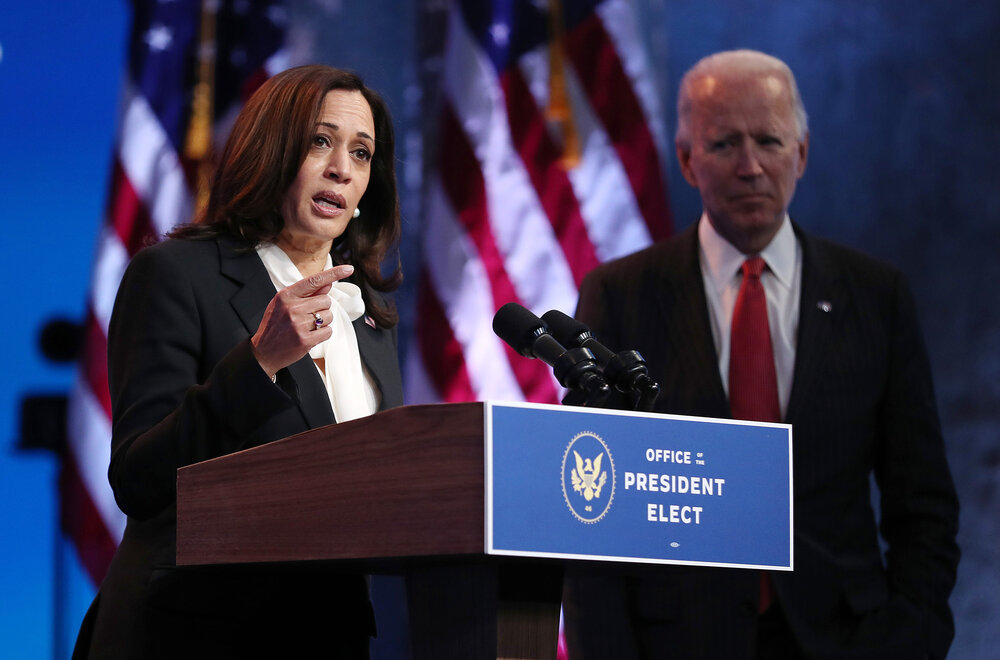
    Supreme court nominee Amy Coney Barrett refused to say whether she accepts the science of climate change, under questioning from Kamala Harris, saying she lacked the expertise to know for sure and calling it a topic too controversial to get into.

    On Wednesday, Barrett framed acknowledgment of a manmade climate crisis as a matter of policy, not science, when she was pressed at her confirmation hearing by Democratic senator from California.

    Barrett said Harris, the Democrats’ vice-presidential nominee as well as a member of the Senate judiciary committee, was trying to get her to state an opinion “on a very contentious matter of public debate, and I will not do that”.

    The federal appeals court judge responded that she did think coronavirus was infectious and smoking caused cancer. She rebuffed Harris on the climate change question, however, for seeking to “solicit an opinion” on a “matter of public policy, especially one that is politically controversial”.

    The exchange occurred during the committee’s hearing on Barrett’s nomination to replace the late Justice Ruth Bader Ginsburg on the supreme court.

    Scientists say climate change is a matter of established fact and that the damage is mostly caused by people burning oil, gas and coal. Climate experts, including federal scientists in the Trump administration, say increasingly fierce wildfires, hurricanes and other natural disasters point to the urgency of global warming.

    When Harris asked Barrett “is climate change happening?” Barrett responded: “I will not answer that because it is contentious.”

    Harris later tweeted: “Amy Coney Barrett will admit that Covid-19 is infectious. She’ll admit that smoking causes cancer. But whether climate change is real? Apparently that’s up for debate.”

    Donald Trump, an ardent booster of the coal, oil and and gas industries, routinely questions and mocks the science of climate change, while Democratic rival Joe Biden is proposing a $2tn plan to wean Americans off fossil fuels to tackle the climate crisis.

    The Trump administration has rolled back major Obama-era efforts to reduce fossil fuel emissions from cars and trucks and power plants. Many of the administration’s environmental and public health rollbacks are likely to wind up before the supreme court.

    On Tuesday, Senator John Kennedy, a Louisiana Republican and another member of the committee considering Barrett’s confirmation, also asked Barrett what she thought about a series of issues, including climate change.

    “I’ve read about climate change,” Barrett answered.

    “And you have some opinions on climate change that you’ve thought about?” Kennedy asked.

    “I’m certainly not a scientist,” Barrett replied, using a frequent refrain of more conservative Republicans on the matter. “I would not say that I have firm views on it.”

  • Facebook Has a New Plan to Fight Climate Misinformation/ Covering Climate Now

    Facebook Has a New Plan to Fight Climate Misinformation/ Covering Climate Now

    Loveland Magazine is one of the 400 news outlets worldwide, with a combined audience of over 2 billion people “Covering Climate Now”, a global journalism initiative committed to bringing more and better coverage to the defining story of our time.
    The initiative, was co-founded by The Nation and Columbia Journalism Review

    Mihaela Manova is “Covering Climate Now” in Loveland, Ohio as an editor for Loveland Magazine

    In today’s Covering Climate Now Post, Facebook re-evaluates and takes a new step in fact-checking climate change content. Article written by Sarah Frier for Bloomberg.

    The initiative will give climate information a more similar treatment to Covid-19 and election content. 

    In the geographic heart of the tech industry Wednesday, it was hard to think of anything except the orange skies, dark and tinted by wildfire smoke. The image software on iPhones failed to capture the dystopian hue, or the feeling of being surrounded by it. Silicon Valley workers tweeted that it felt like night time, or a perpetual sunset, or a scene from “Blade Runner 2049.” It marked the fourth week of severe fire and ash in the Western U.S.

    The conversation shifted from the already-apocalyptic pandemic to another global public health disaster: climate change. For those who don’t know, this is not what California is usually like. The first time I smelled smoke in my San Francisco apartment, in 2015, I imagined something nearby was on fire—not that it was happening miles north of the city. I turned on an air purifier, which I’d purchased for my partner’s allergies, never expecting it would be necessary for anything else. 

    The climate disaster is undeniable to those who have experienced its harms, and a political talking point for the rest. Facebook is full of misinformation on the topic, which, when noticed and reported by users, is sent to the company’s third-party fact-checkers. Over the summer, a nonprofit called C02 Coalition, which claimed that carbon dioxide created by humans was beneficial for the planet, was banned from advertising on Facebook after too many fact violations. The group successfully appealed its ban, and had the fact-checks labels on its posts removed. 

    Facebook said that it considered such posts to be opinions, ineligible for fact-checking, causing a miniature scandal when the checker, Climate Feedback, spoke out. “We don’t believe that articles in an opinion section should be immune from fact-checking,” Climate Feedback science editor Scott Johnson wrote in an email to Bloomberg.

    Facebook also doesn’t take the additional step of removing misinformation on the climate, because the company has ruled that such posts don’t cause imminent harm to human health.

    But, in the aggregate, they do. Facebook has recently re-evaluated its approach to climate misinformation, according to spokesman Andy Stone. The company is working on a climate information center, which will display information from scientific sources. Stone said Facebook isn’t ready to officially announce anything, but it’s easy to imagine what this might look like. Facebook has already devised centers for factual information about Covid-19, and about voting and the upcoming election, both of which it has promoted heavily on its site.

    The info center approach would put less pressure on evaluating each individual post, in favor of directing users to what they need to know more about generally. It could plausibly be more effective than the fact-checking process, which sometimes takes days or weeks to complete, long after a claim has gone viral. Of course, it won’t help address individual disputed claims.

    In the meantime, to get the general idea of what’s going on, anyone in Silicon Valley can look out the window. 

  • President Donald Trump’s Climate Change Record Has Been a Boon for Oil Companies, and a Threat to the Planet/ Covering Climate Now

    President Donald Trump’s Climate Change Record Has Been a Boon for Oil Companies, and a Threat to the Planet/ Covering Climate Now

    Loveland Magazine is one of the 400 news outlets worldwide, with a combined audience of over 2 billion people “Covering Climate Now”, a global journalism initiative committed to bringing more and better coverage to the defining story of our time.
    The initiative, was co-founded by The Nation and Columbia Journalism Review

    Mihaela Manova is “Covering Climate Now” in Loveland, Ohio as an editor for Loveland Magazine

    Pursuing an unrelenting fossil fuel agenda, Trump has scaled back or eliminated over 150 environment measures, expanded Arctic drilling, and denied climate science.

    In the middle of his 44th month in office, two weeks before the start of the Republican convention in late August, President Trump rolled back Barack Obama’s last major environmental regulation, restricting methane leaks.

    The move represented an environmental trifecta of sorts for the president, who had handed the oil and gas industry another gift in his quest for “American energy dominance,” thumbed his nose yet again at climate change and came close to fully dismantling his predecessor’s environment and climate legacy.

    It had been a busy four years, and a breakneck 2020, as Trump and the former industry executives and lobbyists he’d placed in control of the Environmental Protection Agency and the Department of the Interior raced to rollback auto emissions standards, weaken the nation’s most important environmental law, open the Arctic National Wildlife Refuge to drilling and reject stronger air pollution standards, even as research showed a link between those pollutants and an increased risk of death from Covid-19.

    “I applaud and strongly support President Trump’s continued support for the oil and gas industry,” Oklahoma Gov. Kevin Stitt said after the administration proposed its rollback of the Obama methane rules. “During these uncertain times, it makes no sense that we would be placing additional regulatory burdens on our vital industries which are not supported by sound science and do not consider economic impact.”

    Environmental lawyers and climate activists who’ve been battling Trump since day one are in agreement that Trump, beginning with his decision to lead the nation out of the Paris climate accord, has done more to roll back and weaken environmental laws and regulations than any president in history.

    Trump extolled the accomplishment and put a different spin on the superlative during a White House speech in July, saying, “We have removed nearly 25,000 pages of job destroying regulations, more than any other president by far in the history of our country.”

    A few days earlier, as his Democratic rival, Joe Biden, unveiled a $2 trillion plan to combat climate change, Trump promoted what he called a “very dramatic” series of revisions to the National Environmental Policy Act, the foundation of environmental protection in the United States that had been signed into law by President Richard M. Nixon 50 years ago.

    Environmentalists have used the law to block everything from pipelines to the destruction of natural habitats. Trump has now limited environmental reviews under the act to between one and two years and relieved federal agencies from having to consider a project’s impact on climate change during the review and permitting process.

    “While our world is burning, President Trump is adding fuel to the fire by taking away our right to be informed and to protect ourselves from irreparable harm,” Gina McCarthy, Obama’s EPA administrator who now serves as president and CEO of the Natural Resources Defense Council, said of weakening the act.

    By late summer, Columbia University’s Sabin Center for Climate Change Law had counted 159 actions since Trump took office “to scale back or wholly eliminate climate mitigation and adaptation measures.” Many have been slowed or blocked by the courts.

    Trump’s Long Focus on ‘American Energy Dominance’

    When Trump delivered his first major energy speech in the fracking fields of North Dakota as a candidate in May 2016, he called for American domination of global energy supplies.

    “We are going to turn everything around,” Trump declared. “And quickly, very quickly.”

    Once in office, Trump pursued a policy of unfettered support for fossil fuel development. He immediately signed memorandums to revive the Keystone XL and Dakota Access pipelines, projects blocked by Obama.

    In early March 2017, his administration ordered the Environmental Protection Agency to stop gathering data from oil and gas companies needed to rein in leaks of methane, a potent short-lived climate pollutant. Fossil fuel infrastructure adds to greenhouse gas emissions, in part by leaking methane into the atmosphere.

    He followed up, at the end of March, by issuing a sweeping executive order directing all federal agencies to target for elimination any rules that restrict U.S. production of energy. He set guidance to make it more difficult to put future regulations on fossil fuel industries and he moved to discard the use of a rigorous “social cost of carbon,” a regulatory measurement that puts a price on the future damage society will pay for every ton of carbon dioxide emitted.

    As his first year in office came to a close, Trump and Alaska’s Republican senators inserted a provision into his signature tax cut legislation that called for opening the coastal plain of the Arctic National Wildlife Refuge for drilling.

    In 2018, domestic oil production hit a record high. The result of this, among other things, was the reversal of three consecutive years of declining U.S. carbon emissions.

    Many of Trump’s regulations have also been tailored to favor the coal industry, often at the expense of cheaper, cleaner energy. Robert Murray, founder of the now-bankrupt coal company Murray Energy and one of Trump’s closest industry allies, gave the president a “wish list” early on that became a virtual template for the administration’s rollback of regulations.

    The administration swiftly lifted an Obama moratorium on new coal leases on federal lands, to no real benefit. The decline of coal continued unabated, but Trump remained an unapologetic champion of the dirtiest fossil fuel.

    Trump’s War on Science

    When U.S. government scientists released their latest volume of the National Climate Assessment in November 2018, it revealed much about the robust, sobering scientific consensus on climate change.

    It also revealed the striking disconnect between Trump and essentially every authoritative institution on the threat of global warming.

    The president rejected the assessment’s central findings—based on thousands of climate studies and involving 13 federal agencies—that emissions of carbon dioxide are caused by human activities, are already causing lasting economic damage and have to be brought rapidly to zero.

    “I don’t believe it. No, no, I don’t believe it,” Trump told a reporter after the assessment’s release.

    In almost every agency overseeing energy, the environment and health, people with little scientific background, or strong ties to industries they would be regulating, were appointed to scientific leadership positions.

    One of the administration’s first actions was to order scientists and other employees at EPA and other agencies to halt public communications. Several federal scientists working on climate change have said they were silenced, sidelined or demoted.  The words “climate change” have been purged from government reports and other reports have been buried.

    The administration’s mistrust of scientists and its tendency toward science denialism would also become a prominent feature of its response to the coronavirus pandemic, when the president muzzled scientists at the Centers for Disease Control and chafed at the dire predictions of many epidemiological models for Covid-19 deaths.

    With the nation in a state of emergency over the pandemic, Andrew Wheeler, a former coal industry lobbyist who serves as Trump’s administrator of the Environmental Protection Agency, moved in late March to fast-track the “Strengthening Transparency in Regulatory Science” rule. Wheeler replaced Scott Pruitt, an Oklahoma Republican who served as Trump’s first EPA administrator before resigning in 2018 amid an ethics scandal.

    Critics call Wheeler’s transparency proposal Orwellian and say it would actually limit the use of human health science in environmental decision-making, by eliminating studies that rely on patients’ anonymous medical data.

    While Trump and his conservative allies contend that the reliance on such studies amounts to “secret science,” scientists and leading medical authorities respond that it is standard practice to honor patient confidentiality in peer-reviewed studies.

    Numerous studies, including one based on health data from 60 million Medicare recipients, have shown that one of the signature pollutants from the burning of fossil fuels, microscopic particles less than 2.5 microns in width—known as PM 2.5—kill as many as 52,100 Americans prematurely each year.

    Less than a month later, as much of the nation remained locked down to halt the spread of Covid-19, a respiratory disease, the Trump administration rejected a recommendation from government scientists to strengthen the national air quality standard for particulate matter. Trump chose instead to maintain the current PM 2.5 standard, handing the fossil fuel industry a major victory.

    A ‘Concerted Attack’ on Alaska, Public Lands

    The Trump administration knew no bounds for its fossil fuel agenda, pursuing drilling from the outset on pristine public lands in Alaska and the lower 48 states, where oil companies have long sought access.

    Less than four months after taking office, Trump moved to lift Obama’s offshore Arctic drilling ban and, then, in July 2017, gave Italian oil company Eni a quick green light to drill exploratory wells.

    In March 2018, the Trump administration proposed a resumption of leasing in Alaska’s Beaufort Sea. President Obama, shortly before leaving office, had “permanently” withdrawn from drilling there.

    By then, Trump had also carved 2 million acres of land from the Grand Staircase-Escalante and Bears Ears national monuments in southern Utah in what amounted to the most sweeping reductions in protections for public land in U.S. history.

    In September 2018, the Interior Department finalized a rule that loosens methane requirements for oil and gas operations on federal lands. A month later, the administration proposed a regulation to streamline and expedite oil and gas permits on national forest lands.

    The following summer, the administration proposed weakening protections under the Endangered Species Act for threatened species and critical habitat. Shortly thereafter, the Interior Department commenced the public comment period on its plan for oil drilling in the Arctic National Wildlife Refuge that had been included in the 2017 tax bill.

    In early August 2020, the president signed the Great American Outdoors Act appropriating $900 million a year to the Land and Water Conservation Fund and $9.5 billion over five years to reduce maintenance backlogs in the national parks.

    The bipartisan legislation was sponsored by a House Democrat, but Trump extolled its passage as the most significant act in support of parklands since Teddy Roosevelt.

    Still, the administration was preparing, on the eve of the Republican convention, to start selling leases in the Arctic National Wildlife Refuge. The  sale was one of six pending projects in which Trump was pursuing more drilling, logging and mining in Alaska.

    One environmentalist called it the most “concerted attack” in 30 years on Alaska’s natural resources.

    All six of the Trump initiatives could still be blocked or rolled back in the courts, or undone by a new Biden administration working with a Democratic Congress. But for now, they are proceeding, with enormous consequences for Alaska’s environment, and global climate change.

    One by One, Obama’s Main Climate Accomplishments Fell

    The same could be said for President Obama’s environment and climate legacy: Trump’s relentless attacks could be wholly or partially undone by a new administration and Congress. But for now, Trump has accomplished his mission: a near total elimination of his predecessor’s most significant measures.

    After countless piecemeal rollbacks during Trump’s first two and a half years in office, the administration in June 2019 launched its long-awaited attack on Obama’s signature plan to tackle climate change. Designed to cut emissions from coal-fired power plants, Obama called it the Clean Power Plan.

    While the plan was challenged by industry and 27 states and blocked by the U.S. Supreme Court before Obama even left office, it encouraged many states to begin a process of planning for a transition away from coal-fired electricity at a time when cheaper natural gas and renewable energy already were forcing coal plants to shut down.

    Next came Trump’s rollback of Obama’s 2012 automobile fuel efficiency standards, the single largest step any nation had taken to address global warming by cutting carbon emissions from cars and trucks. The weakened Trump plan will allow automakers to deploy fleets that average just 40 miles per gallon by 2025, instead of 54 mpg.

    If Trump’s standard ultimately survives legal challenges, cars and trucks in the United States would emit nearly a billion tons more carbon dioxide during their lifetimes than they would have under the Obama standards.

    Finally, in mid-August, Trump proposed the rollback of the methane rules, the last major Obama environmental regulation still standing. Methane, a super-pollutant, is 86 times more potent in warming the planet than carbon dioxide over a 20-year period.

    The Obama rule required oil and gas companies to monitor methane leaks and fix them. The Trump replacement weakens those requirements, allowing companies to release 4.5 million metric tons more pollution each year. 

    In the climate realm, Obama is best known, of course, as the driving force behind the 2015 Paris climate accord.

    Trump first announced in a Rose Garden speech in June 2017 that the U.S. would withdraw from the accord in three years, as soon as the treaty allowed.

    So, right on cue, two years later, on Nov. 4, 2019, Secretary of State Mike Pompeo notified the United Nations of the formal exit of the United States, activating the final one-year waiting period.

    The actual U.S. withdrawal is set for Nov. 4, 2020, one day after the presidential election.

  • Your introduction to sustainable fashion/ Covering Climate Now

    Your introduction to sustainable fashion/ Covering Climate Now

    Loveland Magazine is one of the 400 news outlets worldwide, with a combined audience of over 2 billion people “Covering Climate Now”, a global journalism initiative committed to bringing more and better coverage to the defining story of our time.
    The initiative, was co-founded by The Nation and Columbia Journalism Review

    Mihaela Manova is “Covering Climate Now” in Loveland, Ohio as an editor for Loveland Magazine