Tag: Constitution

  • Redistricting commission punts again, defies court order

    Redistricting commission punts again, defies court order

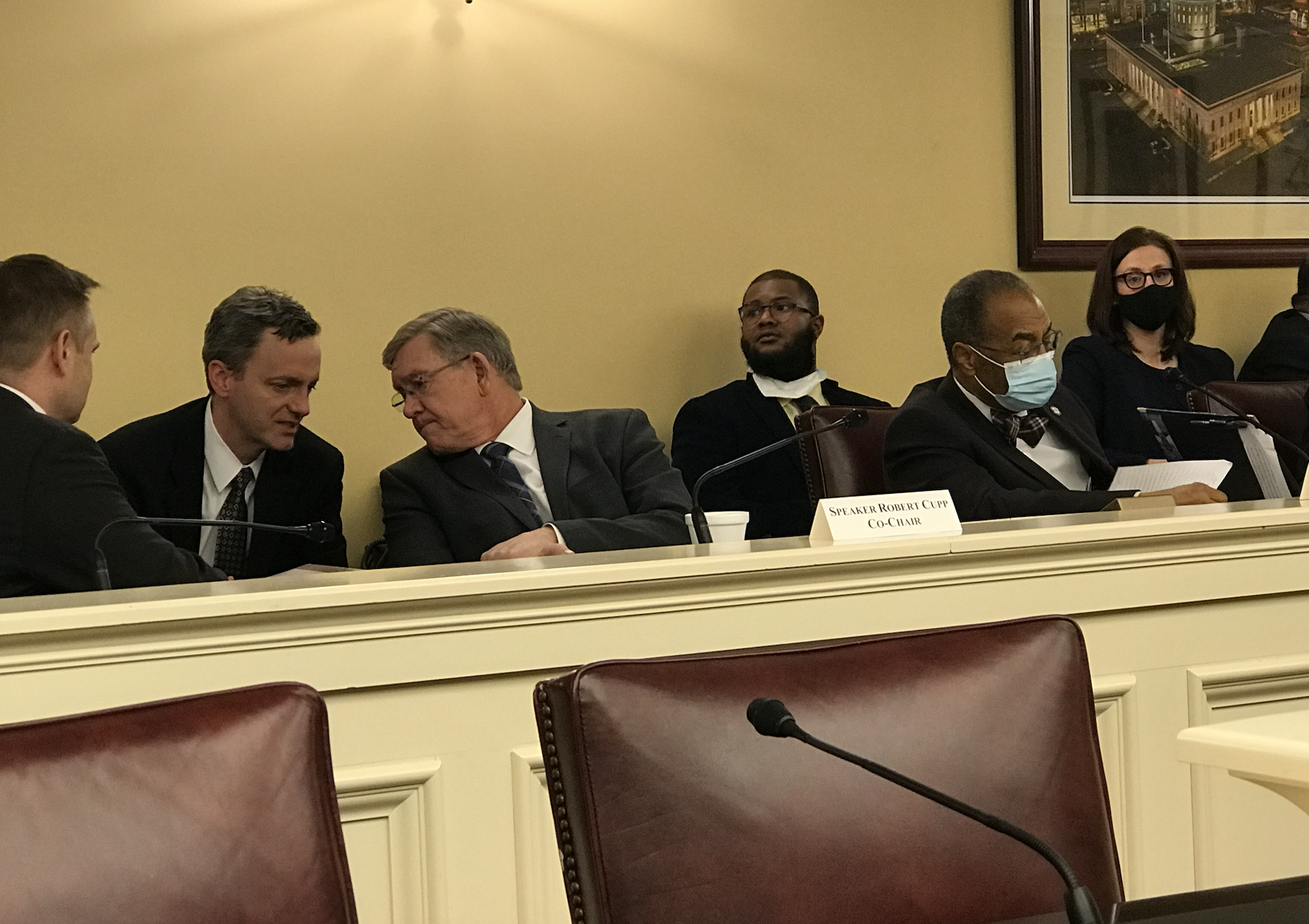
    The Ohio Redistricting Commission co-chairs, House Speaker Bob Cupp, second from left, and state Sen. Vernon Sykes, second from right, prepare to restart the Ohio Redistricting Commission meeting on Thursday after a recess. The ORC adjourned the meeting without sending a new legislative redistricting map to the Ohio Supreme Court, as they ordered it to do. (Photo: Susan Tebben, OCJ)

    BY: SUSAN TEBBEN –  Ohio Capital Journal


    Heated questioning and behind-the-scenes discussions between Ohio Redistricting commissioners led to a deadline-breaking decision to make no decision Thursday after the Ohio Supreme Court rejected two previous attempts at Statehouse maps as unconstitutional gerrymanders.

    The Ohio Redistricting Commission could now face contempt of court, and the state faces a constitutional crisis after the commission adjourned without adopting a legislative redistricting map to submit by their court-ordered Thursday midnight deadline.

    The GOP members of the commission, of which there are five, did not present a map during Thursday’s meeting. Senate President Matt Huffman, who did most of the talking for the majority party, said there was no reason to, because mapmakers had told commissioners that they could not comply with the supreme court’s directives and all the redistricting provisions of the constitution simultaneously.

    “Under these circumstances, I don’t believe the commission is able to ascertain a General Assembly district plan,” Huffman told the commission before they adjourned.

    Gov. Mike DeWine only spoke at one point during the meeting, which was as the impasse became clear, and a map did not appear to be forthcoming.

    He did not agree that the commission could leave without bringing a map before the court, and did not think that was what the commission should do anyway.

    “I don’t think we have the luxury of saying we’re just quitting,” DeWine said.

    After the meeting adjourned, DeWine doubled down on his opinion that the commission had an obligation, and a legal one at that, to produce some sort of map for the state’s high court to consider.

    I think it is a mistake for this commission to stop and basically say that we’re at an impasse. I don’t think that is an option that the law gives us.

    – Ohio Gov. Mike DeWine

    The commission was offered a map by the two Democrats on it with a 54-45 partisan breakdown, but GOP members voted down the measure along party lines after lengthy and tense criticism by Republicans, for the most part Senate President Matt Huffman.

    Taking the brunt of GOP criticism was House Minority Leader Allison Russo, who made the motion for the commission to accept the Democratic drawn maps.

    Huffman took the commission through the Democrats’ maps region by region, pointing out different GOP-incumbent districts that he said violated the constitutional provision prohibiting the favoring or disfavoring of one political party over another.

    He accused the Democratic caucus of racial gerrymandering in a few districts, specifically the Ohio Senate’s 25th District, made up mostly of Lake County, and House District 44, covering Ottawa and parts of Lucas County. Huffman accused the Democrats of gerrymandering by redrawing the districts and the communities therein to favor their candidates.

    Russo denied any existence of “packing and cracking,” the strategy of packing communities into a smaller area than necessary to benefit one party or another, or spreading a community out among a larger space than necessary to dilute its voting power.

    “What you’re asserting is just simply false,” Russo said.

    Throughout the meeting, she parried with Huffman and other Republicans, consistently asking the commission members to spell out specific constitutional violations in the Democratic maps.

    “If you have a map to propose that achieves this or suggestions to propose that address some of these concerns that you have, so far I have not yet seen a constitutional violation,” Russo said.

    When asked by Russo if the GOP had a map proposal to bring before the commission, Huffman hedged, saying he needed to finish his questions and “see how it goes.”

    He brought up the idea to “let the public decide” on the Democratic maps as he continued his dissection of the map, but said there were hours of testimony to refer to in lieu of more public hearings.

    “I’m not proposing additional public input,” Huffman said.

    What’s next?

    After the commission adjourned without doing as the Ohio Supreme Court asked, legislative leaders didn’t have a plan as to what would come next.

    “I don’t know; I don’t have a next step,” Huffman said.

    Cupp, a former Ohio Supreme Court justice himself, refused to speculate on what the courts might do, but said the commission will “try to keep working and if there’s some ideas that come forward on how to develop a legislative district map,” he said, the commission “would work very hard to do that.”

    Auditor Keith Faber made a motion to change the rules of the commission well into Thursday evening, after the commission went into a recess to discuss the Democrats’ presentation. The change, which was passed 6-1 with only Russo voting against the motion, allows the commission to reconvene at the request of three members of the commission. Those members do not have to be the co-chairs, and it does not have to be a bipartisan request.

    Co-chair state Sen. Vernon Sykes, D-Akron, confirmed that the court can not adopt the maps themselves, but as far as what happens next, he, too, was in the dark.

    He did, however, say it is possible the commission members could be held in contempt of court for failing to follow a court order.

    “I believe that is a possibility,” Sykes said.

    When asked if he would be okay with that happening as a consequence, he said he is “okay with us moving forward, whatever can be done to help us move forward.”

    When pressed on if that included contempt: “Including whatever we can do.”

    Constitutional scholars remain uncertain about the next steps of the process, mostly because the state hasn’t gone through it before.

    “This is a new process, and Ohio voters clearly wanted more collaboration and a more bipartisan process than we’ve seen so far,” said Mike Gentithes, associate professor who teaches constitutional law at the University of Akron.

    The University of Akron’s Seiberling Chair of Constitutional Law, Dr. Tracy Thomas, gave the outside perspective on the situation, saying it was “likely to end up in the courts for a while regardless of the outcome today.”

    Several states have invalidated maps because of partisan favoritism and sent them back for revisions without a solution for a stalemate.

    “In the absence of some constitutional mandate or overriding federal legislation, which we don’t really have, the line-drawing is part of the political process and subject to the usual majoritarian control,” Thomas told the OCJ.

    The Ohio Supreme Court is not likely to let this lack of action slide, in Gentithes’ opinion, and this could potentially lead to yet another overhaul of the process, since it seems the incentive to have 10-year maps with bipartisan agreement didn’t have the desired effect.

    “That might teach us how to restructure an amendment to actually have some teeth,” Gentithes said.

    The primary election is an entirely different bear, and Secretary of State Frank LaRose spent his short time speaking at the commission meeting impressing upon the commission the urgency of making decisions.

    “This challenge is not one that can be met with creativity, and grit and tenacity … instead this one is simply dictated by logistical deadlines,” LaRose said.

    Adding to the threat of legal trouble for the commission, without district lines, LaRose said the commission is in danger of missing a federal deadline to send absentee ballots to Ohio citizens who are overseas or in the military.

    “We are dangerously close to possibly violating federal law,” LaRose said.

    Cupp chuckled at a question about whether or not he accepted the idea of breaking federal law, saying, “I’m not okay with breaking any law.”

    The primary date is unlikely to change, in his mind, because of a lack of support for the idea in his chamber.

    “I don’t think in the House that there is a majority vote for moving the primary election at this time,” Cupp said. “Let alone, the two-thirds vote we would need for it to happen immediately.”
  • Deja Vu: Republicans use simple majority to pass 4-year maps

    Deja Vu: Republicans use simple majority to pass 4-year maps

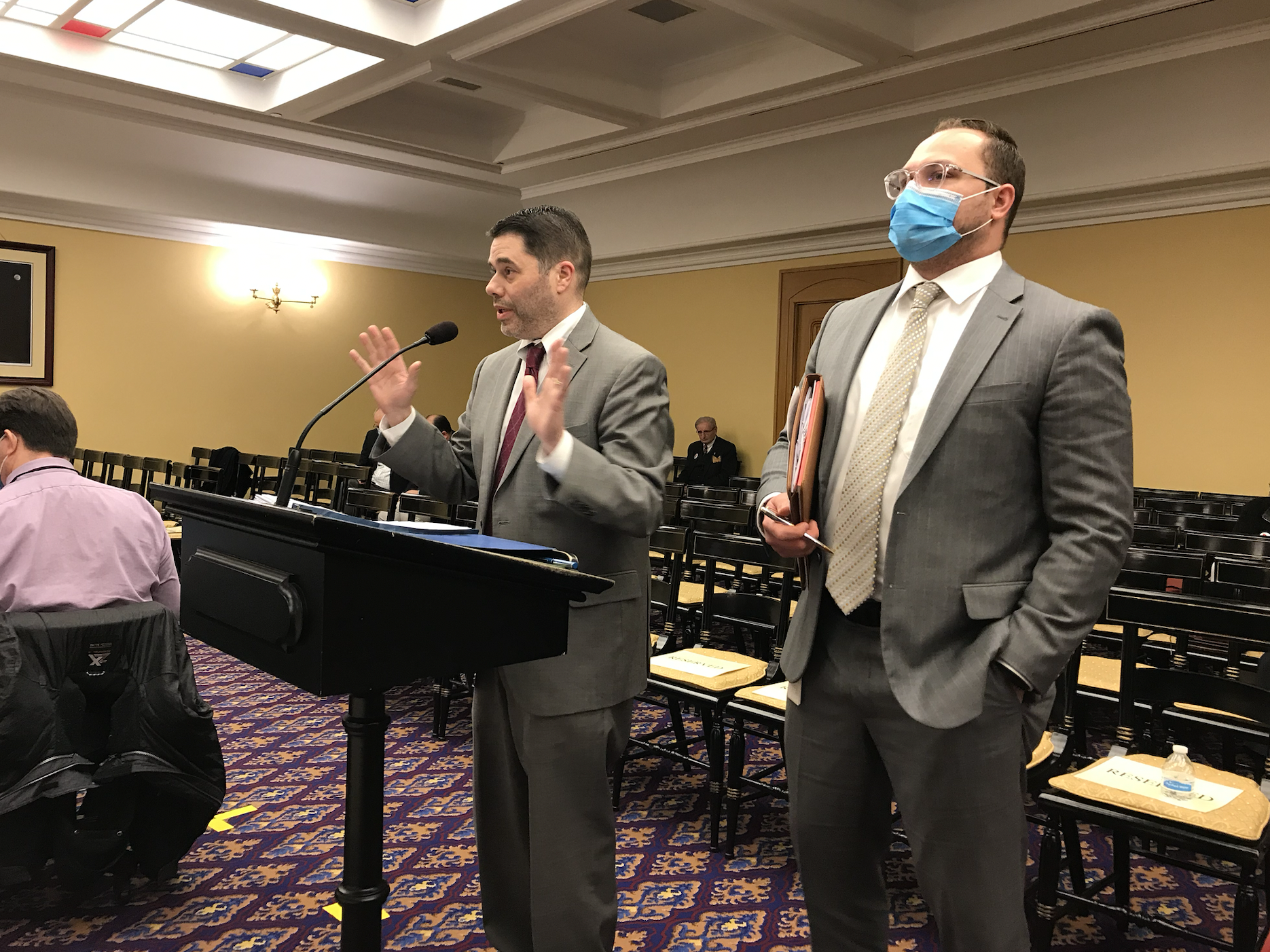
    Republican mapmakers Ray DiRossi, at podium, and Blake Springhetti present the GOP legislative map proposals to the Ohio Redistricting Commission on Saturday. The commission passed the GOP maps on a 5-2 simple majority. (Photo: Susan Tebben, OCJ)

    BY: SUSAN TEBBEN – Ohio Capital Journal

    After two more days of discussion and debate, the GOP majority on the Ohio Redistricting Commission adopted four-year legislative maps Saturday night with a 5-2 simple majority, setting up the time table for potential objections and court review.

    The Ohio Redistricting Commission meeting went into Saturday night after recessing Thursday and not meeting again until 2:30 p.m. Saturday afternoon.

     Ohio House districts, as proposed by the GOP majority and adopted by the Ohio Redistricting Commission on Saturday. (Right-Click to open in a new tab to view larger)

    During the Saturday afternoon session, Republicans and Democrats presented separate maps, though the Democratic co-chair of the commission, state Sen. Vernon Sykes, D-Akron, said the purpose of the Democratic caucus effort was not to present separate maps as much as it was an exercise to prove constitutionally proportional representation could be done.

    It became clear as the day went along that disagreement was still threatening the process. House Speaker Bob Cupp said even in the last hour of the commission’s time on Saturday, when they recessed to discuss each plan, the co-chairs were discussing whether or not it was worth it to continue negotiations or try to amend the maps.

    “A majority of the commission felt that that was just, while it may have been a good thing, was not possible to do,” Cupp said.

    Earlier in the day, the Democratic co-chair said members of his caucus were still operating under the idea that agreement and common compliance to the constitution was at the end of the redistricting tunnel.

    “Not until just a day or two ago was I told that there was a feeling that we could not meet the proportionality requirements,” Sykes said.

    The Ohio Supreme Court told the commission they needed to come back with a map that followed Section 6 of the constitution, the part of the redistricting process that prohibits overt partisanship. The court said the commission had to endeavor as much as possible to get to a 54% Republican to 46% Democratic split in statewide voter preferences.

    The Republican maps adopted had a 57 GOP to 42 Dem split in the Ohio House, and a 20 GOP to 13 Dem breakdown in the Senate. Four of the Democratic-leaning seats give the Dems a narrow 50-51% advantage, considered a tossup by many. All but one of the Senate seats in the plan were above 54%.

    In the House, 12 of the “Democratic leaning” seats in the GOP plan could also be considered tossups, with a Dem favor of only 50-51%. All of the GOP-leaning seats favor Republicans by more than 52%.

    The Democratic attempt had 45 Dem-leaning seats in the House and 54 GOP districts, with 18 GOP districts in the Senate and 15 Democratic districts.

    After the vote, Cupp argued that while 54-46 was a goal expressed by the supreme court, perfection was not. He denied that the constitution or the court order spoke to an “absolute ideal,” instead saying the court wanted a plan to “closely correspond.”

    “If the ideal is 55 House seats or 54 House seats, we have 57 leaning Republican,” Cupp said. “That is just three seats off and in a 99-member legislature, that is essentially 97% to the goal.”

    The minority side released an opposition statement, read at the end of the ORC meeting by House Minority Leader-Elect Allison Russo, D-Upper Arlington, which accused the Republican commissioners of “a lack of political courage and a blatant disregard for the court’s order and the will of the Ohio voters.”

    She also touched on the same concern that Democratic mapmaker Chris Glassburn brought up in the last few days of commission hearings, the “razor-thin margins,” those districts considered tossups, within the maps.

    He spoke on the topic again, saying the Democratic proposal has less tossup districts, which leads to less concern that the Ohio Supreme Court could consider the map “asymmetrical” in its partisanship.

    Glassburn also maintained his previous stance that the majority party wasn’t working to the same ends as the Democrats.

     Ohio Senate districts, adopted by a 5-2 simple majority of the Ohio Redistricting Commission on Saturday. (Right-Click to open in a new tab to view larger)

    Republican mapmakers Ray DiRossi and Blake Springhetti presented the map before the commission, saying they spent the week attempting to bring the maps into compliance with the constitution and the supreme court order.

    “The decisions were centered around complying with the court order, and closely corresponding with Section 6, and we did this,” Springhetti told the commission.

    The Republicans also released a statement to comply with a constitutional requirement explaining why a 4-year map was passed with a simple majority, rather than a 10-year, bipartisan map.

    “The commission believes that the number of Republican-leaning districts and Democratic-leaning districts closely corresponds to strict proportionality, particularly in light of the distribution of voters and geography of Ohio,” the statement reads.

    The adoption of the maps sends them back to the state’s high court for review, and sets the stage for a three-day window in which objections can be filed with the Ohio Supreme Court, who said in their decision rejecting the previous maps that they would oversee the process yet again.

    Anti-gerrymandering groups have already come out in force against the maps, criticizing not only the final product but the lack of public process along the 10-day stretch.

    “I knew it would be a challenge, but it certainly becomes a challenge when you don’t engage in a public process, when you don’t actually discuss regionally,” said Catherine Turcer, executive director of Common Cause Ohio.

  • Portman will reject Republican effort in Congress to overturn election

    Portman will reject Republican effort in Congress to overturn election

    By Tyler Buchanan and Ohio Capital Journal

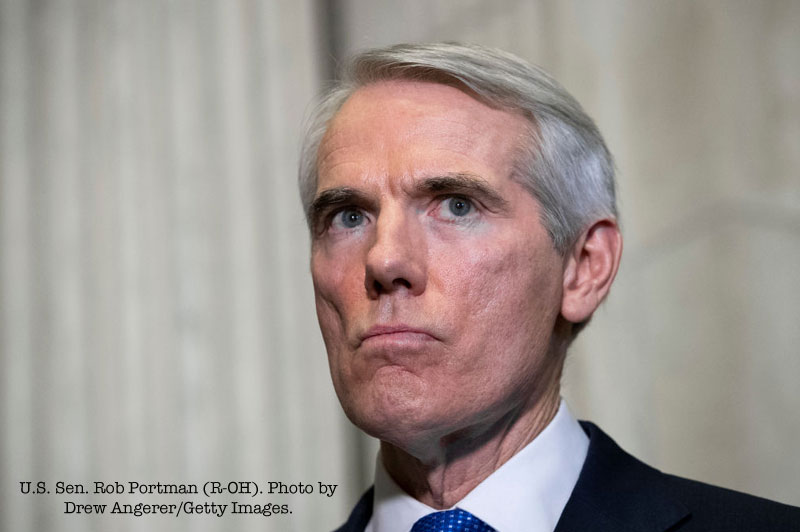
    Sen. Rob Portman is rejecting a Congressional effort from fellow Republicans to overturn the presidential election, saying on Monday he “cannot support allowing Congress to thwart the will of the voters.”

    Portman’s statement comes two days before members of Congress will meet on Wednesday to count the nation’s electoral votes, which were determined through last November’s election and later officially certified by each state. This is typically a ceremonial gathering, the final Constitutional requirement before the winning candidate is sworn-in as president on Jan. 20.

    A group of Republicans in the U.S. Senate and the U.S. House of Representatives, citing unfounded allegations of voter fraud, have announced plans to vote against the electoral vote certifications for a number of swing states won by Democratic nominee Joe Biden. 

    Portman said Monday he would not be joining them.

    “(A)fter two months of recounts and legal challenges, not a single state recount changed a result and, of the dozens of lawsuits filed, not one found evidence of fraud or irregularities widespread enough to change the result of the election,” a statement from Portman’s office reads. “This was the finding of numerous Republican-appointed judges and the Trump Administration’s own Department of Justice. Every state has now weighed in and certified its electoral slate based on its vote and the process set out in the Constitution.”

    Portman acknowledged that “many Americans believe the election was unfairly decided.” An NPR/PBS NewsHour/Marist survey from December found that nearly 75% of Republicans believed the 2020 election results to be inaccurate.

    Portman is advocating for a “blue ribbon bipartisan panel on election integrity” to look into “issues” from the 2020 election and make recommendations for future elections. 

    His statement mentions there were “instances of fraud and irregularities, as there are in every presidential election,” though it did not name any.

    Back in 2016, Portman rescinded his support for Trump after the Access Hollywood tape surfaced in which Trump bragged in 2005 about groping women’s genitals. Portman, who in 2016 was running for reelection to the U.S. Senate, said he would be voting for Mike Pence instead.

    Portman reversed again to become an ally of President Trump, even serving as a 2020 campaign co-chair in Ohio for his reelection effort.

    Portman’s full statement on the Jan. 6 electoral college count can be read here.

  • Loveland District Planning Commission meets tonight

    Loveland District Planning Commission meets tonight

    No Agenda for this meeting is publicly available

    Loveland, Ohio – The full Planning Commission of the Loveland City School District will meet tonight via ZOOM/Youtube. The meeting starts at 6:30 PM.

    The July 1 Meeting will be livestreamed remotely via Zoom at the following link: https://youtu.be/9EWbcQixBng

    As there has been technical difficulties with livestreaming of meetings in the past, here is a backup link should any issues arise:
    (This link will ONLY be used in case the connection to the meeting is lost via the link provided above.)

    Here is the Constitution for the Planning Commission.

    You can email the officers at: planningcommission@lovelandschools.org.

    Loveland City School District Planning Commission
    The Board of Education has implemented a community-based Planning Commission to be a research and advisory resource for the school district. The Commission will assist the Board by researching and/or evaluating assigned issues and topics, and reporting its findings and recommendations to the Board for consideration. The purpose of the Commission is also to assist the Loveland community in becoming better informed about a variety of issues related to the schools. The Planning Commission has four Sub-Committees:
    Communication/Community Engagement Subcommittee
    Tasked with researching additional, innovative, and alternative ways to increase communication and engagement between the school district and the community. Members include:
    Kelley Deer
    Tara Hamilton
    Jeff Hawk
    Lisa Moorhead
    Lynn Oury
    Michael Shiverski
    Facilities Subcommittee
    Tasked with understanding the facilities assessments and current master plan, researching ways to revisit the master plan, and recommending a timeline. Members include:
    Daniel Colletto
    Brad Combs
    Leah Jewell
    Kevin Kimnach
    Alvin Kressler

    Warren Winning

    Finance Subcommittee
    Tasked with investigating opportunities for Loveland City Schools to increase income that does not raise local property taxes and researching effective practices in reducing expenditures. Members include:

    Donel Autin
    Brad Goldie
    Matthew Hammer
    Jill Jones
    Craig Lewis
    Nathan Libby
    Lynn Mangan
    Kirk McCracken

    School Improvement/Student Experience Subcommittee
    Tasked with understanding the current school improvement process and providing input to goals, benchmarks, and comparison districts for the implementation of the Portrait of a Tiger while optimizing our current resources. Members include:

    Susan Craig
    Lisa Saletta
    Alexander Topala
    Lindsey Willmann
    Natasha Young

  • Libertarian Party statement on ballot access in Ohio

    Libertarian Party statement on ballot access in Ohio

    page1image1770464

    Libertarian Party of Ohio

    Media Statement: Ballot Access July 02, 2018, 14:00 EDT

    For further information, contact:

    Harold Thomas, LPO Chair harold.thomas@lpo.org (614) 581-6832

    David Jackson, Communication Director david.jackson@lpo.org
    (614) 560-1237

    July 2, The Libertarian Party of Ohio filed petitions containing 102,762 signatures with the Secretary of State to regain ballot access taken away from the citizens of Ohio four years ago because of Republican Party politics

    They intended to destroy the Libertarian Party in Ohio.

    But liberty and choice persevered. We have more volunteers and more enthusiasm than ever. Putting us through the political tricks has made us stronger.

    We are stronger knowing that 102,762 voters are signed their names to give Ohio more and better choices to address our economic and social issues. Ohioans want solutions, and sense that the way forward might lie in less government, instead of more. These petitions came from all 88 counties showing support from every part of this state. We are building from a broad base of voters from every economic level; all racial backgrounds; all faiths, and all sexual orientations, helping the ever-expanding diversity of our party.

    We know that establishment trickery will not end here. We have attorneys armed with the Constitutions of the United States and the State of Ohio. We know of some recent federal court decisions in other states that have made challenger party ballot access easier, not more difficult. Our attorneys are ready to deal with any obstacles they throw our way. However, we seek no fight, just open dialog and new ideas.

    The establishment parties will try to convince you that we are “Republicans-lite” or agroup of spoilers whose primary purpose is to throw elections one way or the other. Some will even try to make you believe that we are anarchists bent on social chaos. Don’t believe them. The Libertarian Party has members all around you and is the only party with a consistent philosophy and platform — one we have followed, faithfully, since our inception nearly 50 years ago. Our philosophy is based on this Golden Rule, which call it the “non-aggression principle.” No one, including government, has theright to use force to promote a political or social agenda. Government aggression should only be used to protect our lives, our property, and our rights from those who would kill, rob, and cheat us.

    Libertarians believe that government exists for one purpose, which Thomas Jefferson made clear in the Declaration of Independence. We are endowed with certain inalienable rights: life, liberty, and the pursuit of happiness, and that the purpose of government is to secure these rights. The framers of the Constitution reinforced the Declaration when they wrote in the Preamble that government’s purpose is to “establish justice, insure domestic tranquility, provide for the common defense, and secure the blessings of liberty to ourselves and our posterity.

    It is a government for adults who can make their own decisions, build their own careers, and have values they want to pass on to their children. Our political system is broken because we have forgotten that. We have allowed our politicians – at all levels –to behave like children, focusing on trivial issues, fighting the cultural wars of past generations, and doling out favors to their largest contributors.

    It’s time to stop this madness. It’s time to stop bickering and to start negotiating real solutions for Ohio. It’s time to engage in the politics of hope instead of the politics of fear. In this spirit, we will cooperate with members of the establishment parties and the Green Party on issues of mutual interest. Together, we can form policies designed to benefit all of us.

    On Saturday, July 14, we will introduce our slate of candidates to you and the people of Ohio. You will find that they represent a new generation of leadership with fresh ideas and a new perspective on governing our state.

    I invite you and all Ohioans to embrace the Libertarian Party and its candidates as we represent a true choice. We will not only show how to fix a broken system, and make it robust enough to secure the blessings of Liberty for ourselves and our posterity.

    -END-