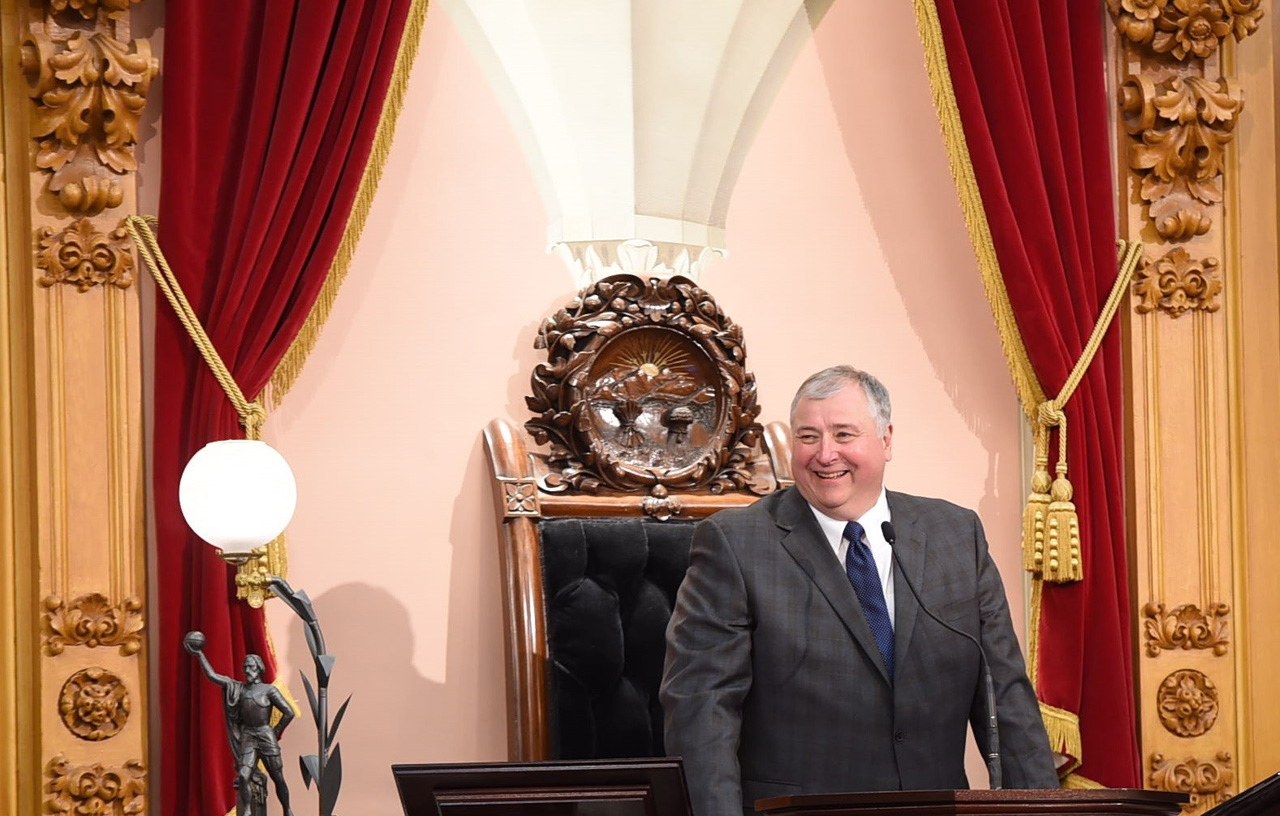
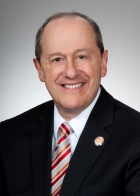
Former House Speaker Larry Householder, R-Glenford. Source: Ohio General Assembly.
CINCINNATI — Former Ohio House Speaker Larry Householder on Wednesday claimed that he never promised any legislative action to FirstEnergy in exchange for the tens of millions the company paid into a 501(c)(4) dark money group he controlled.
He also denied attending dinners in Washington, D.C., during Donald Trump’s inauguration during which other witnesses said he met with top FirstEnergy executives.
And the former speaker denied that he demanded unquestioning loyalty from lawmakers whose elections he worked for. Instead, he said, he wanted them to be independent thinkers.
After sitting through federal court testimony since Jan. 23, Householder on Wednesday took the witness stand in his own defense. That’s considered by many lawyers to be a risky strategy because he will be subject to cross examination by prosecutors who are eager to catch the former speaker in a lie.
Householder, a Republican from Glenford, and former Ohio GOP chair Matt Borges are being tried on accusations of racketeering in a case that federal prosecutors have said is likely the biggest bribery and money laundering scandal in Ohio history.
Householder is accused of masterminding a scheme to use $61 million in utility money to elect House members who would vote to make him speaker at the beginning of 2019. He led the effort to pass a $1.3 billion ratepayer bailout of failing nuclear and coal plants the following July and then protected it from a repeal campaign that failed in October 2019. Prosecutors say the bailout was explicitly tied to FirstEnergy’s contributions.
On the stand, Householder introduced himself as a guy from Appalachia who had worked for years to protect Ohio’s energy independence. But he also made a number of statements prosecutors are likely to challenge.
One is that as it neared passage, the bailout law, House Bill 6, became the object of “misinformation” in commercials that he said were financed by the American Petroleum Institute. The nuclear reactors the law would subsidize couldn’t compete with natural gas, which Householder said the petroleum institute supported instead of nuclear power.
However, in his testimony, Householder didn’t point to anything specific that the group had misstated. Similarly, he complained of misinformation in a Cleveland Plain Dealer editorial, but he didn’t point to anything specific, nor did he say whether he asked for a correction.
At the same time, the former speaker seemed guilty of some misinformation of his own.
Householder said one of the chief goals of House Bill 6 — dubbed the “Ohio Clean Air Program” — was to lower carbon emissions. But the bill provided hundreds of millions in subsidies to coal-burning plants owned by FirstEnergy subsidiary FirstEnergy Solutions and other Ohio utilities.
Householder’s claimed concern for carbon emissions also seems to clash with earlier statements he made on the stand. He testified that he was president of a group that owned an Alabama coal mine and that during an earlier stint in the Ohio House, he worked to subsidize coal production.
Householder also tried to soften his image after three former House Republicans portrayed the former speaker as a heavy-handed autocrat who demanded loyalty at all times. He pointed out that even though they didn’t vote to make him speaker and they voted against HB 6, he didn’t remove Reps. Laura Lanese and Dave Greenspan from their leadership positions.
In secret FBI recordings played earlier in the trial, lobbyist Neil Clark described Householder as ruthless and said he told Greenspan that because the lawmaker had opposed HB 6, Householder would never allow legislation Greenspan wanted to move forward. What Householder wanted, witnesses testified, were “casket carriers” — people so loyal that they would stay with him until he died and then lower his casket into the ground.
But Householder on Tuesday said he didn’t want blind loyalty, he wanted independence. As for wanting casket carriers, that meant “I didn’t want enemies. I wanted friends,” Householder testified.
Householder also disputed some of the basic factual allegations that had been made against him.
Even if that’s true, it’s hard to square that account with other parts of Householder’s testimony.
At issue in the case is whether Householder pushed the bailout legislation in exchange for all the millions he received from FirstEnergy. He said he had little involvement in Generation Now, the main 501(c)(4) dark money group the company paid into and which supported Householder-friendly candidates and ferociously attacked their opponents.
Householder said his understanding was that Generation Now was “a vehicle that would educate the public on issues that were important to Ohio.”
But on Wednesday, Householder said he accepted a $400,000 check from FirstEnergy Solutions that was made out to Generation Now, which was created and controlled by Longstreth, his underling. The former speaker conceded that it was a huge contribution — and the jury might find it hard to credit that he played such a passive role in the group’s activities.
Householder also denied Longstreth’s account of a dinner during Trump’s 2017 inaugural. Longstreth testified that he sat at one end of a long table in a crowded steakhouse with FirstEnergy Vice President Michael Dowling, while Householder sat at the other with CEO Chuck Jones. Longstreth said he couldn’t hear the conversation at the other end of the table, but he did hear Dowling instruct him to set up an organization that could accept “undisclosed and unlimited contributions” from FirstEnergy and its subsidiary.
Householder testified that he went to the inaugural with his wife and several of his sons and only briefly saw Jones and Dowling, but didn’t dine with them. Instead, he and his family went to the inauguration, the parade that followed and attended functions where they were photographed with such luminaries as former Indiana University basketball coach Bob Knight, Householder said.
However, Householder said he and one of his sons flew to D.C. and back on a FirstEnergy jet.
The former speaker testified that on March 29, 2019 — more than two months later — he wrote a check for $2,647 reimbursing the company for the flight. But he didn’t say why it took him that long to make the payment or what prompted him to do so.
In addition, paying for flights on private jets crashed pretty hard against another bit of Householder’s testimony Wednesday — that he is very frugal.
“Anybody who’s been around me knows I’m cheap,” Householder said. “I drive a 2001 GMC Sonoma and I don’t like to spend money.”
Every day more details emerge from Ohio’s billion-dollar bailout bribery trial showcasing gargantuan levels of arrogance, corruption, and enabling among energy executives and Ohio’s most powerful Republican politicians.
Pointing to the U.S. Supreme Court’s disastrous Citizens United ruling, Clark described to undercover FBI agents how to make dark money contributions in a way calculated to get a public official’s attention, saying those should come in chunks of $15,000, $20,000, $25,000 or more.
“Based on a Supreme Court decision, businesses can do this and nobody can do anything about it,” Clark said. “Politicians can get a bunch of money and say, ‘I didn’t know.’”
And that exactly how many Ohio politicians have been operating, this trial is showing: Selfish, reckless, greedy, amoral, large-scale, pay-to-play grift.
The scope of corruption at every turn in Ohio is a bit staggering, so let’s take a look at all we’ve learned so far, all together in one place:
Indicted former Ohio House Speaker Larry Householder. Official photo.
Executives from financially struggling FirstEnergy flew Ohio House speaker aspirant Larry Householder and associate Jeff Longstreth to D.C. on the FE corporate jet in January 2017 for some swanky steakhouse dinners.
Partners for Progress was the dark money project of then-FirstEnergy lobbyist Dan McCarthy. It received $5 million from FirstEnergy within a few weeks of when McCarthy founded it.
Juan Cespedes. Photo provided.
During a meeting between Householder and FirstEnergy lobbyists in October 2018, a lobbyist named Robert F. Klaffky slid an envelope containing a check for $400,000 across the table and under Householder’s hand as they discussed a $1.3 billion ratepayer bailout of failing nuclear and coal plants, former FirstEnergy lobbyist Juan Cespedes testified.
“Our client cares very much about this issue,” Klaffky told Householder.
“We were trying to establish the fact that our support was specifically tied to the legislation,” Cespedes said.
All told, Householder’s dark money political machine amassed $61 million in utility company contributions to elect a legislature that would make him speaker and pass the bailout.
Why did it go through the dark money groups like that? It was thought to be bad optics if the struggling company were publicly giving the money, Cespedes said in testimony.
Even though he was supposed to be regulating the utility, the official, Sam Randazzo, played a role in writing the bailout legislation, according to documents released by the Ohio House.
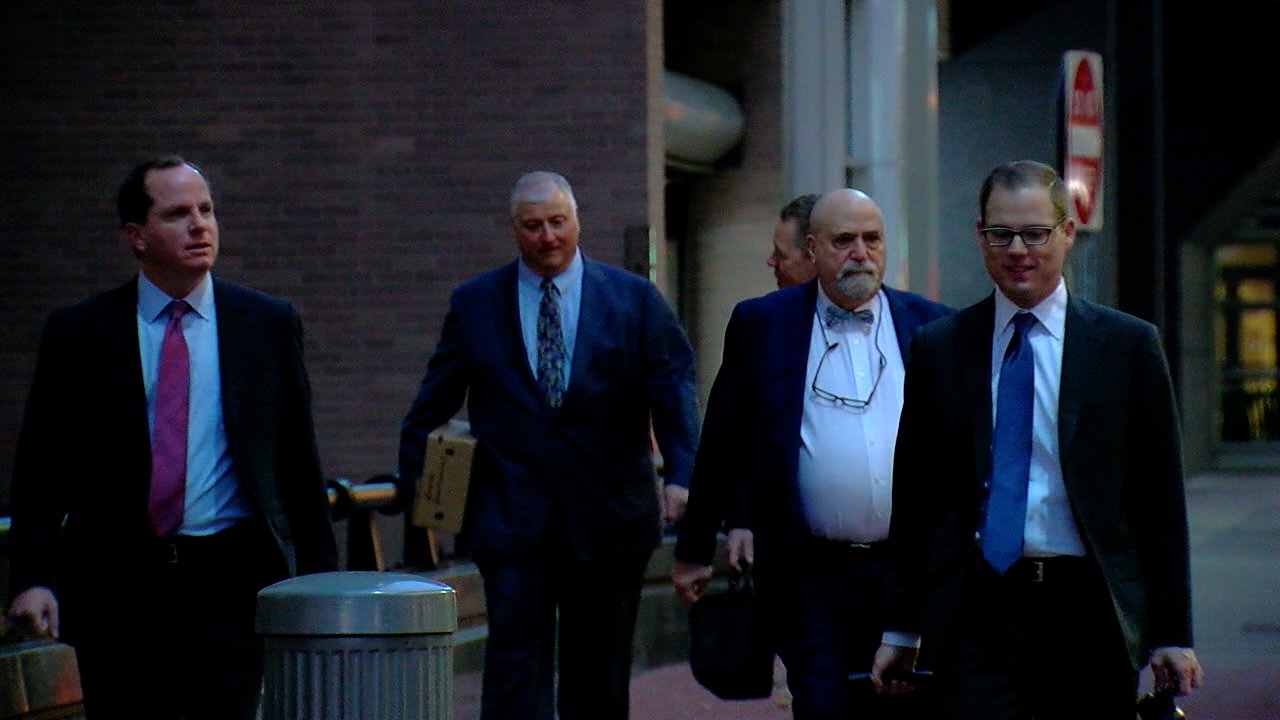
Center, former Ohio Republican Party chair, and statehouse lobbyist, Matt Borges with his attorneys outside of the federal courthouse. Photo courtesy of WEWS.
“He’s going to be a friend in this process,” Borges texted to Cespedes. “So let’s be prepared to speak up for him.”
Cespedes responded, “We will support him more than anyone.”
Ohio Secretary of State Frank LaRose. Official photo.
Kiani had plans to operate the two FirstEnergy Solutions nuclear power plants in Ohio for a short period, get a government bailout and then sell the power plants in a deal in which he stood to make $100 million, Cespedes testified.
DeWine and Husted, as well as Yost and LaRose, were reelected to second four-year terms in 2022.
Husted, Yost, and LaRose are all poised to continue to seek political advancement in Ohio.
Generation Now, Cespedes, and Longstreth have pleaded guilty.
FirstEnergy entered into its deferred prosecution agreement.
Neil Clark died by suicide in 2021, nine months after being indicted by federal prosecutors.
The federal racketeering trials of Householder and Borges are ongoing and expected to last until March.
Jurors will review all the evidence and decide their fate.
It will be up to Ohioans to decide how long we will continue to allow our politicians to rob and abuse us in service to themselves and private interest profiteering.
Every day we learn more about how Ohio government has really been operating under the design of unscrupulous thieves and grifters, rotting the institutions of our state into a national joke and embarrassment: a grotesque totem to pay-to-play corruption; a decayed and decrepit husk of representative democracy.
In October 2019, as a battle raged over an attempt to repeal a $1.3 billion utility bailout, a FirstEnergy executive worked to keep the name of a senior aide to Gov. Mike DeWine off of a $10 million infusion of corporate cash into the fight.
The executive, Vice President Michael Dowling, did so even after an assistant told him it would violate IRS rules to not list the DeWine aide on the transaction, according to text messages presented Tuesday in the federal corruption trial of former Ohio House Speaker Larry Householder and lobbyist Matthew Borges. The men are accused of racketeering in a scheme to use $61 million from FirstEnergy in exchange for the massive bailout, most of which went to prop up the company’s failing nuclear and coal plants in order to make them attractive to buyers.
The governor appointed as chairman of the Public Utility Commission of Ohio a former FirstEnergy consultant who was paid $4.3 million by the utility just before taking his seat on the commission. Even though he was supposed to be regulating the utility, the official, Sam Randazzo, played a role in writing the bailout legislation, according to documents released by the Ohio House.
In early 2019, DeWine also appointed FirstEnergy lobbyist Dan McCarthy to be his legislative affairs director, meaning McCarthy was in charge of representing DeWine’s interests before the General Assembly.
Just after that, McCarthy formed a 501(c)(4) group called Partners for Progress. Also known as a “dark money” group, it received $5 million from FirstEnergy within a few weeks of when McCarthy founded it.
In an affidavit supporting Householder’s arrest, FBI Special Agent Blane Wetzel said Partners for Progress was “designed to conceal the nature, source, ownership, and control of the payments” from FirstEnergy and associated companies. Through the rest of 2018, McCarthy continued as president of Partners for Progress as it pumped FirstEnergy money into a Householder-controlled dark money group and funded the effort to make Householder speaker.
The following year, McCarthy resigned that role to work for DeWine in the legislature as Householder shepherded the bailout legislation, House Bill 6. When a final version passed in July 2019, DeWine signed it the same day.
But opponents quickly started a campaign to circulate petitions to put a repeal on the ballot. That prompted FirstEnergy to pump even greater sums into a “decline to sign” campaign aimed at thwarting the petitions.
It funded xenophobic mailers and broadcast ads claiming without evidence that the repeal effort was a Chinese plot.
“Who is knocking at your door?” began a mailer read in court Tuesday. “Foreign enemies have infiltrated our energy grid,” it added and said, ominously, that circulators of repeal petitions “are asking for your information.”
In October 2019, executives with FirstEnergy and its generation-owning subsidiary seemed panicked that the repeal effort might succeed and they were planning to pump $10 million more into the effort to stop it — through Partners for Progress, the dark money group started by McCarthy, who was now a DeWine aide.
Dowling, the FirstEnergy vice president, seemed to think it wouldn’t be a good look for the name of a DeWine official to show up on paperwork accompanying the huge transaction.
“Please make sure Dan McCarthy’s name is not on the filing,” Dowling said in a text message to Partners for Progress Treasurer Michael Vanburen that was presented in court Tuesday.
Vanburen replied that even though McCarthy was no longer president of the dark money group, IRS rules required that his name be on the filing. Dowling didn’t accept that.
“There must be a creative way to handle this,” he said. “It’s important that (McCarthy’s) name not be listed.”
Asked if DeWine asked that McCarthy’s name not be used in paperwork regarding the money transfers, Press Secretary Dan Tierney in an email said, “No. Dan McCarthy resigned from Partners for Progress in December 2018. Dowling’s comments, as you have relayed them to me, do not match the timeline of McCarthy’s affiliation with Partners for Progress.”
DeWine seems to have been in touch with FirstEnergy executives around the time of the repeal effort. Later in October 2019, FirstEnergy CEO Jones texted Vice President Dowling to say, “DeWine’s on board. I talked to him on Wednesday.”
According to Jones, they talked about whether the repeal HB 6 effort would gather enough valid signatures to get the measure on the ballot.
“He said their valid rate was less than 30%,” Jones said of DeWine.
For his part, Tierney said, “The Governor does not have any recollection of such a conversation.”
In a later text conversation, Jones said he’d received similar assurances from Secretary of State Frank LaRose.
After arrests were made in the House Bill 6 scandal, DeWine staunchly defended McCarthy and kept him in his administration for more than a year, until Sept. 24, 2021.
In another trial-related matter, U.S. District Judge Timothy Black on Tuesday said that he had released a second juror, this time for testing positive for COVID. An earlier juror had been released for refusing to wear a mask.
That brings the number of alternate jurors to two for a trial that is expected to last into early March.
Former Ohio House Speaker Larry Householder, a Perry County Republican, second from left, with attorneys outside of his racketeering trial. Photo courtesy of WEWS.
CINCINNATI — There has been speculation since the start of a massive public corruption trial that lawyers for the main defendant — former Ohio House Speaker Larry Householder — were banking on getting any conviction tossed out on appeal.
There might have been evidence of that on Tuesday when one of the attorneys took the rare step of accusing the judge in the case of bias against his client. The attorney also suggested that the judge harbored a political grudge against Householder going back more than 22 years.
Testimony resumed Tuesday in the case after repeated delays — first because of weather and then because a juror tested positive for covid.
When it did, federal prosecutors continued presenting extensive evidence to support allegations that Ohio utilities paid $61 million into Householder-controlled 501(c)(4) dark money groups and Householder used the money to elect friendly Republicans to make himself speaker in early 2019. Householder is accused of pushing through a $1.3 billion ratepayer bailout that primarily benefited his primary benefactor — Akron-based FirstEnergy — in return.
Federal prosecutors are known to usually file charges only when they’re almost certain to get a conviction. That’s perhaps even more true when the case is against an elected official.
And over the course of testimony so far, Assistant U.S. Attorney Emily Glatfelter has introduced reams of evidence in the form of emails and text messages, as well as transcripts of wiretaps and witness testimony — including that of co-defendants who have pleaded guilty.
Householder also is alleged to have pocketed $500,000 in utility money himself, but his lawyers say those were loans he fully intended to repay.
However, the attorneys’ conduct on Tuesday might indicate that they’re looking past the jury trial.
Before the jury entered the courtroom, Householder attorney Mark Marein rose to complain to U.S. District Judge Timothy Black — about the conduct of Black himself.
“We all collectively believe that the court holds animosity toward us,” Marein said, referring to Householder’s legal team. He added, “I question whether (Judge Black) should be presiding over this.”
Black scolded Householder’s lawyers last week for muttering and making faces during Glatfelter’s opening statement. Among his criticisms, Black called the conduct “bush league.”
The judge also dismissed a juror who refused to wear a mask in court. That prompted speculation that Householder’s lawyers were displeased because such a juror might be more sympathetic to their client, a pro-Trump Republican.
But Marein gave a wholly different reason for suspecting that the judge was biased against Householder. He said that Black might be holding a grudge from 2000, when Black ran for the Ohio Supreme Court and Householder worked against the candidacy.
Both Marein and Black acknowledged that Marein was making the statements simply to get them into the record — presumably so they would be there in the event of an appeal.
There is some precedent for overturning public corruption convictions over complaints of judicial bias and prosecutorial misconduct.
But accusing a judge of bias in the middle of a trial has risks. Lawyers have said that if one genuinely believes a judge is biased, accusing that person of it in open court could simply make things worse. And in some instances, such accusations have resulted in professional sanctions against the lawyers making them.
There were a few other developments of interest Tuesday:
Prosecutors played a recording of a wiretapped phone conversation between Householder and political operative Neil Clark in December 2017. Clark was also charged in the corruption scandal, but later died by suicide. In a laughing, profanity-strewn passage, the two talked about how Republicans legislators in 2010 drew a portion of Columbus into former U.S. Rep. Pat Tiberi’s district. “Tiberi wanted a safer district,” Householder said, later adding, “He doesn’t like me because he thinks I f*****d with him.” The maps drawn in 2011 were said to have some of the most gerrymandered in the country. Last year, a Republican-controlled panel repeatedly refused orders from the state Supreme Court to draw them more evenly.
Householder allies and FirstEnergy officials in August 2017 discussed a third tranche of $250,000 from the company to a Householder-controlled dark-money group at the posh Greenbrier resort in West Virginia, where that state’s Coal Association was holding its annual meeting. The money flowed soon thereafter. That meeting follows a round of swanky dinners in Washington, D.C., involving Householder and FirstEnergy officials the previous January during former President Donald Trump’s inauguration. Two dark-money groups were set up within weeks and one quickly received the first $250,000 from FirstEnergy, even though was hemorrhaging money.
The trial resumes Wednesday. It’s expected to last into March.
Ohioans have had the right to direct democracy since 1912, but now lawmakers and Secretary LaRose are going after the power of the people. Because of gerrymandering and dark money, Ohioans have faced years of unpopular and unjust legislation related to democracy, women’s reproductive rights, public education, and so much more.
Yesterday, Rep Brian Stewart and Secretary of State LaRose proposed a bill that would require a 60% yes vote to pass a citizen initiated constitutional amendment, while maintaining that constitutional amendments referred by the Legislature would still only require a simple majority vote to pass.
LaRose claims that this measure is necessary to protect the Ohio Constitution, and that the time is right. We say ABSOLUTELY NOT!
Ohio citizens must already overcome extreme challenges to placing an issue on the ballot. The process requires hundreds of thousands of verified signatures and a strict geographical distribution across at least half of Ohio’s 88 counties.
The process is not overused. In fact, since 1950, only ten out of 44 ballot measures have passed (23%). If so few citizen initiated amendments pass, what problem are we looking to solve?
If this measure passes the Ohio Legislature, it will be on the ballot in May 2023; primary elections in odd numbered years have always historically had very low voter turnout. As little as 10% of the electorate will likely decide how Ohio citizens can practice direct democracy and affect change.
Send a message to your elected leaders and demand that they stop this threat to democracy!
More about the proposal to restrict access to Ohio Voters…
Columbus, Ohio – The mammoth scandal surrounding a 2019 energy bailout appeared to creep closer on Thursday to the administration of Ohio Gov. Mike DeWine.
FirstEnergy said in a deferred prosecution agreement that the man DeWine appointed to lead the Public Utility Commission of Ohio took a $4.3 million payment and then acted on behalf of the Akron-based power company instead of as the state’s top regulator.
That man, Sam Randazzo, has resigned.
But FirstEnergy also helped control a 501(c)(4) “dark-money” group started by a senior DeWine aide while he was still a FirstEnergy lobbyist, the agreement showed. The company passed a torrent of money through the secretive group as part of a successful $61 million effort to buy a $1.3 billion, ratepayer-funded bailout, the document FirstEnergy signed off on said.
While Acting U.S. Attorney Vipal J. Patel slammed the dark money group, DeWine and the aide, Legislative Affairs Director Dan McCarthy, didn’t respond to requests for comment. DeWine has staunchly defended McCarthy since the scandal broke almost exactly a year ago.
Patel held a press conference in Cincinnati on Thursday to announce that his office had entered into a deferred prosecution agreement with FirstEnergy. The company will pay $230 million and, if it lives up to the terms of the agreement, will have a charge of conspiracy dismissed.
Former Ohio House Speaker Larry Householder, R-Glenford, has been charged in the case. He was stripped last year of his speakership and he was ejected from the House earlier this year.
Two of Householder’s associates charged in the case have pleaded guilty and a third, Neil Clark, took his own life in March.
For its part, FirstEnergy fired CEO Chuck Jones and two other executives and is conducting an investigation of its own.
In Cincinnati Wednesday, Patel stressed that the investigation is continuing. But he wouldn’t comment on matters other than the agreement with FirstEnergy.
DeWine aide McCarthy hasn’t been charged and last summer, he denied wrongdoing. But Partners for Progress, the dark-money group he founded, was a topic of the prosecution agreement.
Then still a FirstEnergy lobbyist, McCarthy founded it, “weeks after certain FirstEnergy Corp. senior executives traveled with (Householder) on the FirstEnergy Corp. jet to the presidential inauguration (of Donald Trump) in January 2017,” the agreement said.
The prosecution agreement added, “Although Partners for Progress appeared to be an independent 501(c)(4) on paper, in reality, it was controlled in part by certain former FirstEnergy Corp. executives, who funded it and directed its payments to entities associated with public officials.
“For example, FirstEnergy Corp. executives directed the formation of Partners for Progress and decided to incorporate the entity in Delaware, rather than Ohio, because Delaware law made it more difficult for third parties to learn background information about the entity. Certain FirstEnergy Corp. executives were also involved in choosing the three directors of Partners for Progress, two of whom were FirstEnergy Corp. lobbyists.”
Millions would flow through Partners for Progress while McCarthy was its president and tens of millions more would later run through it and into the furious effort to pass the bailout after McCarthy resigned to become DeWine’s legislative affairs director in early 2019.
The prosecution agreement also appears to refer to McCarthy as “Official Aide 1” as he worked on DeWine’s behalf to help pass the bailout that DeWine would sign later that year.
It cites emails among energy executives saying that Official Aide 1 and others were “fighting” to extend the term of a bailout of two failing nuclear reactors in Northern Ohio. It also cites a text-message discussion between a FirstEnergy executive and the aide about language that would make the bailout harder to challenge in a referendum.
And in the press conference, Patel said the scandal would never have happened if not for the dark-money group of which McCarthy was president and another, Generation Now, which has pleaded guilty.
“This effort would not have been possible — both in the nature and the amount of the money provided — without the use of 501(c)(4)s,” Patel said.
The acting U.S. attorney called the scheme, and even the name of McCarthy’s former dark-money group, dishonest.
“These are supposed to be, according to the (tax) code, social welfare organizations. You all see a lot of social welfare going on? I don’t,” Patel said, adding, “What about these names? Partners for Progress? What are the partners here? The conspirators? What’s the progress? Passage of (the energy bailout) through bribery?”
While DeWine’s office didn’t respond to questions on Thursday, the governor in February defended his legislative affairs director.
“As far as I know, Dan McCarthy has been well-respected for many, many years, long before he started working for me as our legislative director and I have faith in his integrity,” DeWine said.
For Dayton Mayor Nan Whaley, a Democrat challenging DeWine in the 2022 election, that’s not good enough.
“Today’s charges make clear that this corruption case reaches the highest levels of government in Ohio,” she said in a statement. “Enough is enough. It’s time for Gov. DeWine to come clean about his knowledge and involvement in this scandal.”
But now that the second 501(c)(4) dark-money group, Generation Now, has pleaded guilty to being at the heart of one of the biggest bribery and money laundering scandals in Ohio history, Gov. Mike DeWine is refusing to discuss what one of his top aides was told when he formed the first dark money group, Partners for Progress.
Generation Now pleaded guilty earlier this month to being the major conduit of money between Akron-based FirstEnergy and related organizations and the effort to pass House Bill 6, a $1.3 billion bailout that mostly went to two nuclear plants FirstEnergy started spinning off in 2016. DeWine signed the bill into law in 2019.
Last summer, federal authorities arrested then-Speaker Larry Householder and four associates as part of the scandal and two of the associates later pleaded guilty.
As he announced the arrests, U.S. Attorney David DeVillers stressed that the dark money made the massive scandal possible.
“I don’t see how (the conspiracy) could possibly have happened” without it, DeVillers said.
The feds haven’t accused DeWine’s aide, Legislative Affairs Director Dan McCarthy of wrongdoing, but they refer to his dark-money group in an affidavit supporting Householder’s arrest as “Energy Pass-Through.”
Among the activities Generation Now pleaded guilty to was engaging in transactions “designed to conceal the nature, source, ownership and control of the payments” from FirstEnergy and associated companies.
But DeWine and McCarthy don’t want to discuss whether McCarthy intended to obscure that FirstEnergy was bankrolling an effort to prop up nuclear plants it was spinning off.
Asked last week about the matter, DeWine Press Secretary Dan Tierney pointed to a statement McCarthy issued last summer when The Cincinnati Enquirer first reported that he’d started a dark money group that helped fund the HB 6 effort.
In it, McCarthy explained that in addition to his lobby work for FirstEnergy, he had also worked with people who had adversarial relationships with Householder and one of his indicted associates, Neil Clark, so “any insinuation I was involved in this disgusting scheme is without merit.”
But he didn’t explain why he founded Partners for Progress two days after the founding of Generation Now, or why a week later his dark money group got $5 million from FirstEnergy and within a month it was forwarding some of that money to Generation Now.
In early 2019, McCarthy stopped lobbying for FirstEnergy and resigned as president of Partners in Progress to become DeWine’s legislative affairs director. The following October, while McCarthy was advocating for HB 6 in that capacity, FirstEnergy and associates wired $20 million to McCarthy’s former money group and it forwarded $10 million of that to Generation Now the same month, the federal affidavit said.
Despite these and other revelations about DeWine appointees, DeWine on Tuesday declined to give a more complete explanation of what McCarthy believed he was doing when he started Partners for Progress and began funneling money into a now-guilty dark money group.
“As far as I know, Dan McCarthy has been well-respected for many, many years, long before he started working for me as our legislative director and I have faith in his integrity,” DeWine said.
Columbus, Ohio – The 133rd Ohio General Assembly wrapped up its term with a flurry of lame-duck activity last week, closing out a challenging year of legislating amid a global pandemic.
Lawmakers hurried to get priority bills passed and sent to Gov. Mike DeWine’s desk for a signature before the two-year term ended. There were, however, a number of major legislative projects that did not get passed.
Here are some of the priorities falling to the 134th General Assembly, which starts in January:
What to do with House Bill 6?
After months of deliberation about House Bill 6, lawmakers have decided to punt any repeal or replacement effort to 2021.
HB 6 is the $1.3 billion nuclear bailout bill at the center of what has been called the largest corruption scheme in state history.
In the days after Speaker Larry Householder and four other political operatives were arrested in July, one thing was clear: Ohio lawmakers needed to do something about the tainted bill.
DeWine, who signed the bill into law in 2019, called for its repeal. Householder was removed as House Speaker. His replacement, Rep. Robert Cupp, R-Lima, said one of the first priorities of his speakership would be addressing HB 6.
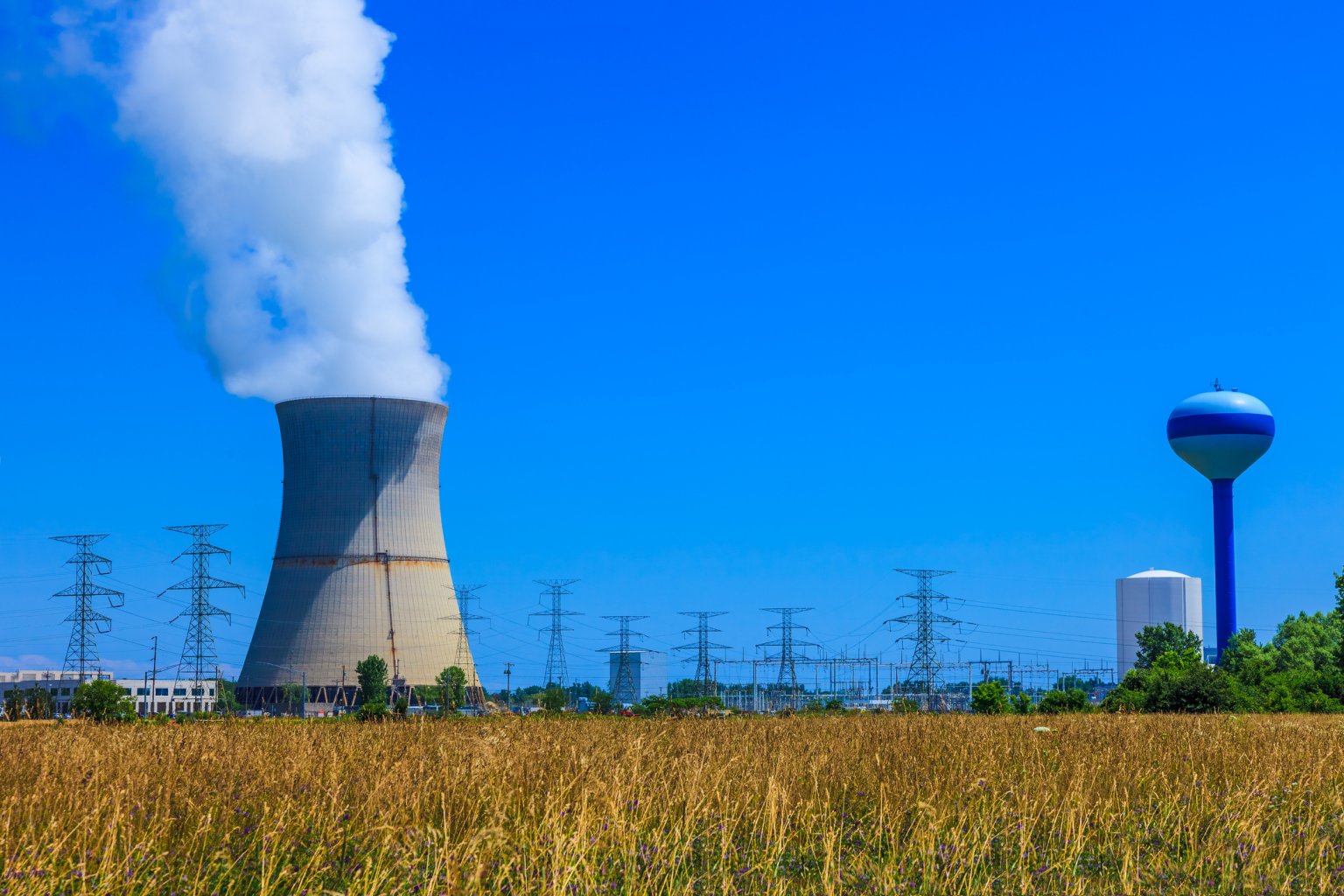
Davis Bees Nuclear Power Station with electricity pylons, Ohio. Getty images.
Cupp did create a new “House Select Committee on Energy Policy and Oversight,” which met nine times between September and December to hear testimony on various attempts to repeal HB 6.
Members could not come to an agreement on how to best approach HB 6; some wanted a full repeal, others wanted only certain portions replaced and a few defended the whole bill as being good public policy, even if it did come about through sordid means.
Two of those involved have already pleaded guilty in federal court; the cases against Householder and two others are ongoing.
Householder was reelected to another term and it remains to be seen if the chamber will take a vote in 2021 to expel him. When Cupp was elected as speaker in July, he indicated such a vote would wait until after the new term starts.
School spending reform will take more time
The Ohio Supreme Court ruled the state’s school funding model was unconstitutional back in 1997. Decades later, lawmakers are still working to figure out a constitutional and equitable substitute.
A bipartisan funding overhaul passed the House in early December, but did not make it through the Senate.
Sen. Matt Dolan, R-Chagrin Falls, who chairs the Senate Finance Committee, wrote in a December letter “there is not enough time in the legislative session for the Senate to have the in-depth hearings this bill deserves.” Dolan suggested the new formula could be passed as a piece of the next state budget, which will be decided in the first half of 2021.
Republicans still concerned about pandemic authority
For all the condemnation leveled against Ohio’s pandemic response by Republican lawmakers in 2020, the legislature achieved little this year in the way of curbing the government’s executive powers.
Between May and December, Republicans introduced numerous bills targeting the pandemic authority of the governor and the Ohio Department of Health (ODH). Only a few of them passed, and DeWine followed through on a pledge to veto any bill restricting ODH’s ability to issue health orders meant to stem the spread of COVID-19.
DeWine vetoed a bill over the summer which would have reduced the penalties for violating a public health order. Lawmakers did not seek a veto override.
Gov. Mike DeWine is pictured during his statewide address on Wednesday, Nov. 11. Photo courtesy Ohio Channel.
More recently, DeWine vetoed a bill to prevent ODH from issuing widespread quarantine orders (it also would’ve given lawmakers authority to vote down any public health orders). Despite protests and pressure from conservative lawmakers to override the veto, such a vote was not taken during the lame-duck session.
Late in the term, lawmakers debated efforts to make future health orders more fair to business owners, should they be necessary. At other points this year, legislators said they wanted to address the state’s pandemic authority for future crises beyond the coronavirus. Those efforts may come up again in 2021.
Campaign finance and election reform
These were two hotly-debated topics this year in large part because of the presidential election cycle and the House Bill 6 scandal.
As the Ohio Capital Journal has reported, lawmakers proposed a wide array of improvements to the state’s election system over the past term — from automated voter registration to online absentee ballot requests. Some legislators expressed worry about approving reforms during an election year, which may provide an opportunity for reforms to be heard during an “off year” like 2021.
The HB6 scandal involved allegations of bribery money being funneled through “dark money” groups in order to influence Ohio elections and public policy. These groups are registered nonprofits which are not required to disclose who funds them.
Ohio Secretary of State Frank LaRose, whose office oversees campaign finance in the state, came out in favor of improved transparency when it comes to “dark money groups.” He supported legislative efforts which followed Householder’s arrests to require such groups to publicly disclose their financial activity.
Secretary of State Frank LaRose is flanked by state Reps. Gayle Manning and Jessica Miranda during a press conference in support of HB 737.
A bipartisan bill proposing reforms to the state’s campaign finance system did not receive a hearing in 2020, but these efforts may carry over to the new term.
Split opinions on criminal justice reform
There was much attention paid to the legislature’s work to reform the Ohio criminal justice system, with plenty of disagreements leading to mixed results.
Lawmakers passed Senate Bill 1, which expands access to drug treatment programs in lieu of convictions and broadens the description for criminal records that may be sealed.
A separate bill to reclassify low-level drug offenses from felonies to misdemeanors passed the Senate last June, but was not taken up for a vote during the House’s lame-duck session. The bill sought to divert drug offenders into treatment rather than criminal punishment.
Despite bipartisan support in the Statehouse and among civil rights groups, the bill remained controversial among law enforcement groups and prosecutors. The Ohio State Bar Association came out against the bill, arguing in testimony that some drug offenders “must have serious consequences hanging over their heads like the threat of a felony and prison time” in order to commit to a treatment program.
Rep. Bill Seitz, R-Green Twp., a supporter of the bill who will serve as Majority Floor Leader next term, told The Cincinnati Enquirer that work will continue in 2021 on criminal justice reform.
The arrest of former Ohio House Speaker Larry Householder and others in July revealed how the use of dark money organizations enabled an alleged $60 million conspiracy to sway elections and provide costly bailouts to noncompetitive nuclear and coal plants.
As federal and state court cases move forward, questions remain about what can be done to restore confidence in the legislature and to prevent similar situations in the future.
“Dark money is really how special interests win right now,” said Jay Costa, executive director at Voters’ Right To Know. When corporations use shell groups to hide their political spending, they “gain a level of credibility they wouldn’t otherwise have,” he explained. “I like to think of it as the ‘Wizard of Oz’ effect.”
In other words, voters don’t get to see who’s behind the curtain.
Two months after the federal government’s criminal complaint and indictment in July, Ohio Attorney General David Yost has filed a state court lawsuit. The complaint alleges a “pattern of corrupt activity,” and seeks injunctive relief to prevent FirstEnergy, FirstEnergy Solutions, Energy Harbor and others from reaping benefits from the bailouts under House Bill 6. A hearing on a preliminary motion for that relief is currently scheduled for Friday, Oct. 2.
Meanwhile, it’s unclear whether Ohio lawmakers will actually repeal House Bill 6, the bailout law passed as a result of the alleged conspiracy. Both Democratic and Republican lawmakers called for a swift repeal in late July and early August. However, leadership in the Ohio House has so far refused to allow a full House vote on any pending repeal bills.
‘Dragging their feet’
Rep. David Leland, D-Columbus
“They’re just dragging their feet,” said Rep. David Leland, D-Columbus. “We have 58 members of the legislature who are willing to repeal HB 6 right now.”
Instead, Speaker Robert Cupp, R-Lima, has referred the bill to a House Select Committee on Energy Policy and Oversight. So far, those hearings have largely been a general review of the pros and cons of HB 6, rather than a focused oversight of the alleged corruption that led to its passage and whether it should be repealed in order to repair any claimed harm to public trust in the legislature’s integrity.
“The only way that we can prove that Ohio is not for sale is by repealing HB 6,” Leland said. “The polling we’ve seen shows that people by an overwhelming margin are going to punish those people who have voted for HB 6 and have done nothing to repeal it.” Early and absentee voting in Ohio begins on Oct. 6.
“Our legislators are supposed to act in the public interest,” said political scientist Leah Stokes at the University of California at Santa Barbara. Corporations’ interests may sometimes conflict. But, she adds, “it’s really politicians’ and regulators’ job not to be listening to those special interests. That basic responsibility of democracy has failed in Ohio with House Bill 6.”
A straight repeal would mostly restore Ohio energy law to before HB 6 became effective, subject to some follow-up regulatory matters before the Public Utilities Commission of Ohio. A quick replacement could potentially reenact all or much of the law, which also gutted the state’s clean energy standards.
Advocates say that rushing to ram through anything more than a simple repeal this year would either just repeat bad policy or create more problems, even aside the alleged conspiracy’s past influence on the current makeup of the Ohio House of Representatives. Even at that, a repeal bill would now need either an emergency clause or an injunction sought by the state attorney general in order to stop the nuclear subsidies slated to start in January. The committee adjourned on Sept. 30 and no additional meetings are currently scheduled.
HB 6 “is so questionable at this moment. The vehicle itself and the way it was sold is all just a pack of lies,” said Rachael Belz, executive director of Ohio Citizen Action. “We need them to repeal it, and then we need to go from there.” And that second step will take time, she said.
“It’s complicated and complex legislation and policy. And we have to get it right,” said Chris Neme, a principal and co-founder of Energy Futures Group. “Passing a bill in less than a couple of months like the way HB 6 was just leads us down the road of unintended consequences.”
Shining a light on dark money
The bigger question is how to prevent similar abuses in the future. Utilities and fossil fuel interests have given heavily to Ohio political campaigns since the state enacted a 1999 law calling for competition in electricity generation. And the level of giving went up dramatically once a competitive market actually began to develop in the state.
Utilities’ political spending has continued during this election season. FirstEnergy spokesperson Jennifer Young said that its political action committee has since canceled campaign donations it had originally reported as going out in July shortly before Householder’s arrest.
Campaign donations shown for August have in fact been sent out, Young said. FirstEnergy has denied any wrongdoing in connection with its political donations or the alleged Householder scandal.
Meanwhile, a 2010 Supreme Court case, Citizens United, “really opened up the floodgates of fossil fuel and electric utility influence over politics,” Stokes said. Utilities’ political spending is “particularly pernicious,” in her view, because customers “have to buy from these companies” to get electricity delivered to their homes.
At the same time, reporting requirements currently apply only to immediate spenders on political issues and campaigns. They don’t reach all the way up the chain to the original source of the money.
“It’s basically this Russian nesting doll scenario, where you have one donor giving to another donor, giving to another donor, to get to the person who finally spends the money to influence the voters,” Costa explained.
In the case of HB 6, money flowed into Generation Now from multiple sources, with a lion’s share allegedly originating with Company A — understood to be FirstEnergy — and its subsidiaries, according to the federal complaint.
Some of the money in turn then went to a political action committee. Or, it went to other organizations that directly funded pro-HB 6 ads. One such ad claimed a debunked Chinese conspiracy was behind last year’s failed effort to put a referendum on the law on the ballot this fall. A for-profit group called Ohioans for Energy Security paid for that ad. When asked last year, lawyers at the firm that set up the corporation, Isaac Wiles, would not answer questions about the source of its funding.
“The notion that dark money is something some people don’t like is not part of the elements of the crime,” Mark Weaver, an attorney at that firm, said at a Columbus Metropolitan Club forum after news broke about the Householder arrest.
Asked if there was too much money sloshing around at the statehouse, he said it’s “a lot of money, no doubt,” but it “pales in comparison” to the amount that Americans spend on Halloween candy and costumes every year. And he said that the First Amendment protects the right to conduct political speech anonymously.
“Of course, state and local governments may (depending on how they draft) pass additional 501(c)4 disclosure requirements that could meet constitutional scrutiny,” Weaver later added.
Ian Vandewalker, Ian PHOTO CREDIT: Courtesy of Brennan Center for Justice
“There is no absolute right to anonymous speech,” said attorney Ian Vandewalker at the Brennan Center for Justice at New York University School of Law. Elections are treated differently from general speech, because of the overriding interest in making sure elections function properly, he explained at a panel organized by the League of Women Voters of Ohio.
“That requires informed voters. And it requires policies to not be able to cheat the public,” Vandewalker said. “And so those interests require that there be a level of transparency.”
“No regulation, no law, no set of ethical rules substitutes for American voters paying attention to who’s running for office — pressing them hard on what they stand for, looking closely at the issues, and going into the ballot box having done your homework,” Weaver said.
“The reason that information is important and transparency is important is so that voters are educated,” said Catherine Turcer, executive director of Common Cause Ohio. “You can’t make the argument that voters need to be better educated but you shouldn’t give them actual education. It doesn’t make any sense.”
Moreover, disclosure needs to be timely, said Heather Taylor-Miesle, executive director for the Ohio Environmental Council. In the case of HB 6, Generation Now didn’t report its 2017 spending to the Internal Revenue Service until late 2019. By then, millions more had been spent to influence the 2018 elections, the passage of HB 6, and the failed referendum effort against it.
Pending bills
Several bills introduced by Democratic and Republican lawmakers could make a strong start toward improved disclosure, including HB 737, HB 739, and SB 347. Those bills should be broadened to include digital media, as well as more traditional campaign spending, Turcer said.
The bills should also call for disclosure not only of the name of an organization, but the identity of the top three original donors of funding, Turcer added in her Sept. 16 testimony in support of SB 347. “Otherwise, wealthy special interests will attempt to avoid disclosure by creating pop-up shell groups,” she said.
And while Ohio voters won’t know who’s behind all the groups funding attack ads or other political spending this election season, information is available about how lawmakers voted on HB 6. The Akron Beacon Journal has also compiled some information on how some funds were used in the 2018 Ohio House campaigns.
“People should contact their legislators about HB 6” if they want to speak out about the issue, Stokes said, noting that the law passed with support from a mix of both Republicans and Democrats.
“When the public is outraged about an issue and really shows up, these issues get reversed,” Stokes added. “There’s a lot of leverage right now.”
[Note: the original version of this story took additional comments made by Mr. Weaver and summarized them to help the story flow better and to highlight the most relevant points. Mr. Weaver contacted Eye on Ohio and the Energy News Network after publication expressing his concern that the summary was not an accurate representation of his public comments. While we do not share that view, we are happy to share the full text from which that summary was taken. We know our readers are smart and can draw their own conclusions regarding their meaning. Beneath this article is that text, as well as a link to the entire video.]
Mark Weaver: Blaming Citizens United for this I think is wrongheaded. The New York Times, it’s sort of been proven that their collusion story about Russia has fallen completely apart and yet I don’t blame the First Amendment for the right to print what they printed. I think they had a right to print all that. I think it was substantively wrong, but I wouldn’t go after their ability to print that stuff.
And so what the Supreme Court said in Citizens United was, if a few of us get together and want to form a group to communicate, we ought to have a right to do that under the First Amendment.
And a lot of donors are looking at what’s happening in America right now with the doxxing, or the releasing of personal information and targeting people for shame. So that’s why some donors don’t want to give. Now some may have less noble notions for wanting to keep their money and their name private. But we saw what happened to Amy Acton for example where her personal home was targeted by protesters– that’s just wrong.
The notion that- I disagree with you so I’m going to personally vilify you and show up at your house where your family or your children are- so many donors see that as part of 2020 current affairs and so many of them want to avoid that. And I know not everyone has that reason.
Mike Thompson: But the problem comes in not just that somebody gives $500 to a candidate or a cause they believe in. It’s that somebody gives– $61 million or $35 million, let’s be conservative, and we don’t know that’s happening. Is there a middle ground where we can say, okay I can protect your identity, your First Amendment rights, but you can’t have THAT much influence?
Weaver: Well, not Constitutionally, no. It’s not just Citizens United. There was a case out of Ohio called McIntyre vs. the Ohio Elections Commission. This is the 7-2 Supreme Court case that said it’s legal to keep yourself anonymous when spending politically, based out of Ohio, in Westerville, Mrs. McIntyre. I used to teach the case. This morning I looked at it again and I had forgotten about this quote. This is not a close call. 7-2. This is Supreme court on anonymous speech: “It’s not a pernicious, fraudulent practice but an honorable tradition of advocacy and of dissent.”
And they pointed to the Federalist Papers that were written anonymously, to avoid scrutiny of the authors and focus on the ideas. So this notion of anonymous speech is one that’s protected by Supreme Court precedent.
Thompson: Laura, there are efforts at the statehouse to make it more transparent. Is it just lip service or are they serious efforts?
Laura Bischoff: You know it’s interesting. I do think the conditions are probably better now for reform than they were six months ago. So, there’s a couple of different bills pending. One is House Bill 737, which is sponsored by Gayle Manning, a Republican from North Royalton, and Jessica Miranda, a Democrat from Cleveland. And it’s got the support of the Ohio Secretary of State, Frank LaRose. And it would require, if you’re going to have a 501c(4) that’s spending in Ohio on political matters then it would require reporting through the state. Louis Brandeis said that the best disinfectant is sunshine. And so, this kind of works on that premise– transparency and disclosure will help clean it up.
Thompson: Derrick, It comes down to the Supreme Court. And the courts have said money equals speech. How much money? We have unlimited amounts of Free Speech. We can stand on a street corner, 24 hours a day, 7 days a week, and as long as we don’t yell fire in a crowded theatre we can do all we want. Should that same apply to the amount of money someone can give to a campaign? Or to a political cause?
Derrick Clay: Well you know if you have the money to give it, that’s your discretion whether you want to give that money to a c(4). You know, right now we’re under the law from that Citizens United case where people can give unlimited amounts of money to a c(4) nonprofit. So until that court case is overturned or challenged, then that’s the law of the land that we all have to abide by unfortunately.
Thompson: Is it too much money sloshing around at the statehouse? And you guys [points at Weaver and Clay] have both advocated for groups, and helped raise money and spent money that’s been raised. I mean, you’re part of the system-
Weaver: It’s a lot of money, no doubt. But when you look at what America spends on Halloween candy and costumes every year it pales in comparison. There’s lots of money done for lots of things.
Halloween candy and costumes don’t have the protection of the First Amendment. Remember, the Supreme Court has been very clear: the speech that aggravates us the most gets the most protection. And when you’re laying out what’s protected, political speech is the highest. And so whatever laws get passed, and I’m interested to read the details, and I’m interested in whatever laws are being put out there, they will have to withstand First Amendment scrutiny just like the news organizations represented today.
This article first appeared on Eye on Ohio and is republished here under a Creative Commons license.
Ohio’s official utility watchdog wants to know where Akron-based FirstEnergy got the $60 million that federal prosecutors say fueled the largest bribery scandal in Ohio history.
The Office of Ohio Consumers’ Counsel on Tuesday evening filed several motions with the Ohio Public Utilities Commission:
A request for an investigation and a management audit of FirstEnergy.
A requirement that the company show that it hadn’t misused consumer money to support the passage of a nuclear bailout.
And that the regulator reopen a probe into how FirstEnergy spent money intended to upgrade the electricity grid.
In July, the U.S. Attorney’s office charged then-House Speaker, Larry Householder, R-Glenford, in an alleged scheme to funnel FirstEnergy money through 509(c)(4) “dark money” groups in a corrupt effort to elect supportive lawmakers and make Householder speaker.
The feds say the goal was to pass House Bill 6, a $1.3 billion bailout that went primarily to two failing nuclear power plants, but also subsidized two failing coal-powered generators. In addition, the money was used to fund a xenophobic campaign to stop a voter repeal of HB 6 and to line the pockets of Householder and his alleged conspirators, federal officials said.
Also charged were Matt Borges, a lobbyist who was formerly chairman of the Ohio Republican Party, Neil Clark, a lobbyist who owns Grant Street Consulting, Juan Cespedes, also a lobbyist, and Householder’s aide, Jeffrey Longstreth.
In its filing, the consumers’ counsel said it was asking the utilities commission to do its job.
“The (Public Utilities Commission of Ohio) has the right and duty to regulate public utilities, for the protection of the public,” it said. “The PUCO should require FirstEnergy to show that money it collected from consumers, including the distribution modernization charge money, was not improperly used regarding House Bill 6 and that it did not violate any utility regulatory laws or PUCO orders regarding House Bill 6.”
A FirstEnergy spokeswoman said her company will comment through official channels.
“We are unable to comment on pending litigation, but we will respond to the motion by September 23 as required,” External Communications Manager Jennifer M. Young said in an email.
In its filings, the consumers’ counsel noted that “Long before the House Bill 6 subsidies, FirstEnergy was authorized to charge its consumers nearly $7 billion for these and other FirstEnergy power plants as part of the transition to power plant competition (and a supposed end to future power plant subsidies) under Ohio’s 1999 electric deregulation law.”
The documents also focused on $465 million FirstEnergy was allowed to collect from Ohio ratepayers in 2017 and 2018 as a “distribution modernization rider.” In other words, the charge was meant to fund improvements to the lines and poles and other equipment needed to efficiently deliver electricity in Ohio.
The consumers’ counsel pointed to an independent audit showing that at least some of the money was used for other purposes. For example, it was placed in FirstEnergy’s “Regulated Utility Money Pool,” where its out-of-state utilities could borrow from it.
The dividends FirstEnergy paid shareholders also took a big jump once the company started collecting more from ratepayers, supposedly to improve the power grid. The money for dividends from FirstEnergy’s Ohio utilities went from $141 million in 2016 to $350 million in 2017 — the first year of the subsidy — to $400 million in 2018.
The Ohio Supreme Court subsequently declared the charge to be unlawful, but the money wasn’t refunded to ratepayers.
After the court ruling, the utilities commission shut down an investigation into the extra charge and how the money was used. But now the consumers’ counsel says it “should be reopened in light of the new information alleged in the U.S. Criminal Complaint about FirstEnergy’s use of extraordinary amounts of money in its efforts for the passage of House Bill 6.”
After other interested parties have a chance to respond to the consumers’ counsel motions the utilities commission will decide whether to approve them.
Marty Schladen has been a reporter for decades, working in Indiana, Texas and other places before returning to his native Ohio to work at The Columbus Dispatch in 2017. He’s won state and national journalism awards for investigations into utility regulation, public corruption, the environment, prescription drug spending and other matters.