Students getting their l lunch at a primary school. (Photo by Amanda Mills/Centers for Disease Control and Prevention.)
Commentary
by David DeWitt
I am once again asking Ohio lawmakers to please just feed the children. For all that is good and decent, at long last, may we please at least just make sure schoolchildren aren’t going hungry?
Pleading for the state government to make sure that Ohio schoolchildren aren’t spending their days dealing with hunger pangs, tired, irritable, distracted, unable to concentrate, unable to learn, well, that has traditionally been an obscene and mind-boggling ask for too many Ohio lawmakers.
They keep declining to do it.
But as my buddy Alexander Pope says, hope springs eternal in the human breast.
So I will continue sounding the call, because I hold the firm and unshakeable, but apparently insane opinion that schoolchildren shouldn’t be going hungry.
They should be fed. All of them. Whatever meals they need.
Student hunger is pervasive in Ohio.
With more than 1.6 million public school students, about 57% of them meet qualifications and are participating in free and reduced lunch programs.
Here’s the rub: A 2023 report from Children’s Defense Fund Ohio found that 1 in 3 children who live in those food insecure homes don’t qualify for free school meals because their households are technically over the 185% of poverty line.
Many others don’t participate for fear of judgment.
This means that hundreds of thousands of schoolchildren in Ohio are going hungry during the school day because either they’re not covered or fear the stigma.
Rubbing gravel on the wound, Republicans in U.S. Congress are right now looking at making cuts that would slash national school meal programs, impacting 280,000 Ohio kids.
But in Ohio, a new bipartisan bill, Ohio Senate Bill 109, would make sure that no Ohio K-12 student has to go through the day hungry. The legislation sponsored by state Sen. Bill Blessing, R-Colerain Twp., and state Sen. Kent Smith, D-Euclid, would provide breakfast and lunch at no cost to public and chartered nonpublic school students.
During the 2023 Ohio budget season, a proposal for universal school meals was made but was never passed.
Under this cycle’s proposal, the Ohio Department of Education and Workforce would be directed to reimburse public and chartered nonpublic schools who participate in the national school breakfast and lunch programs by covering the gap between the federal reimbursements for free and reduced-price breakfasts and lunches and those who would be required to pay because they don’t qualify for meal assistance.
The bill lists an appropriation of $300 million to support the state reimbursements. The state operating budget is projected at $108 billion for fiscal year 2026 and $110 billion for fiscal year 2027.
Blessing and Smith plan to push for the bill to be included in the two-year budget due July 1, currently under negotiation in the Ohio House.
Every teacher I’ve ever talked to about it has told me the same thing: Hunger is an enormous barrier to learning. Meanwhile, kids are being put into social situations where they either go hungry or face the judgment of their peers.
As we all know, the antenna of fear of social stigma and judgment is sky high in childhood and adolescence.
We have a simple and effective solution: Remove the stigma, remove the fear of judgment, remove the school meal caste system, and just feed the children, all of the children.
If the basic humanity and decency of it isn’t compelling enough, I can make an economic argument.
Well-fed kids make for more attentive and engaged students. Attentive and engaged students have better academic success. Most successful students become successful citizens. Successful citizens grow the economy.
So, feed the children. All of the children, all the same.
Please just feed the children.
YOU MAKE OUR WORK POSSIBLE.
GET THE MORNING HEADLINES.
________________
David DeWitt
Ohio Capital Journal Editor-in-Chief and Opinion Columnist David DeWitt has been covering government, politics, and policy in Ohio since 2007, including education, health care, crime and the courts, poverty, state and local government, business, labor, energy, the environment, and social issues. He has worked for the National Journal, The New York Observer, and The Athens NEWS. He holds a bachelor’s degree from Ohio University’s E.W. Scripps School of Journalism and is a board member of the E.W. Scripps Society of Alumni and Friends. He can be found on X @DC_DeWitt
Ohio Capital Journal is part of States Newsroom, the nation’s largest state-focused nonprofit news organization.
David Miller is the Managing Editor of Loveland Magazine
David Miller
Loveland, Ohio – Because the Ohio Capital Journal is such a vital part of our reporting to the Greater Loveland Area, we are thrilled that we can share that in the “Ohio’s Best Journalism Contest” from the Society of Professional Journalists, the Ohio Capital Journal won seven awards last week, including three first place finishes and four in second place. The contest covered stories and editorial from 2023.
Because of the Journal, Loveland Magazine equals any news outlet in the Greater Cincinnati Area in the number of reports from the Ohio Statehouse; and certainly the quality of the stories we are so fortunate to be able to publish is second to none.
Ohio Capital Journal Editor-in-Chief and Opinion Columnist David DeWitt
In announcing the awards, Ohio Capital Journal Editor-in-Chief and Opinion Columnist David DeWitt said, “We are incredibly honored and grateful for this recognition from our fellow journalists. We are also humbled by and grateful for all of the support we receive from our readers and Ohioans across the state.”
That includes you, our Loveland Magazine faithful readers.
Congratulations Journal! We are certainly very grateful for your devoted work and dedication.
________________
The Ohio Capital Journal is an independent, nonprofit news organization dedicated to connecting Ohioans to their state government and its impact on their lives. The Capital Journal combines Ohio state government coverage with incisive investigative journalism, reporting on the consequences of policy, political insight and principled commentary. They are part of States Newsroom, the nation’s largest state-focused nonprofit news organization.
________________
The latest awards come after the Ohio Capital Journal won seven SPJ awards last year, and five the year before. Overall, the Ohio Capital Journal has won 19 Ohio Society of Professional Journalists awards in the last three years.
In digital media categories, Capital Journal Senior Reporter Marty Schladen won first place for best government/political reporting; reporter Megan Henry won first place for best education reporting; and Editor/Columnist David DeWitt and Columnist Marilou Johanek won first place for best overall commentary/opinion blog section.
Reporter Susan Tebben won second place for best education reporting; OCJ/WEWS reporter Morgan Trau won second place for best government/political reporting; reporter Susan Tebben won second place for best medical/science/health care reporting, and the Ohio Capital Journal won second place for best general news site.
Below we are sharing the award-winning entries.
Marty Schladen
Best Government/Political Reporting — First Place — Marty Schladen
And, ever so shamefully, we see it here in America, under the obnoxious guise of Making America Great Again, setting out to systematically destroy all those qualities that ever made her great in the first place: A self-governing constitutional republic of checks and balances cemented in the rule of law and the rights and liberty of the people — by the people, for the people.
by David DeWitt
Eighty years ago today, in the early morning hours of June 6, 1944, the largest invasion fleet in human history crossed the English Channel and launched an unprecedented, world-turning assault on Nazi-occupied France. Remembering the enormity of that moment is as critical for America now as it has ever been.
German Gen. Erwin Rommell inspects his “Atlantic Wall” beach obstacle fortifications. (Creative Commons).
The Ohio combat engineers were assigned to Omaha Beach to clear mine-laden log posts and ramps, seven-foot steel frames known as Belgian gates, five-foot tall, triple crossbeam steel hedgehogs, and large coils of concertina razor wire that can cut so deep into the flesh it can make you bleed out.
This was 500 yards of absolute hell on Earth, under heavy bombardment from 85 German machine gun sites, 45 rocket launchers, 35 blockhouse pillboxes, 18 anti-tank guns, eight artillery bunkers and four open artillery pieces raining down shells of death and destruction.
Two years after the failed Dieppe raid to test the German “Atlantic Wall” defenses, which ended in disaster, British Prime Minister Winston Churchill was reluctant at first to agree to American and Russian calls to open up the new front in the war: The Russians to take pressure off them in the east, the Americans to confront the Germans head-on instead of continuing to spin wheels in Africa and Italy. And to foreclose the possibility of Stalin’s Russia from taking Germany alone and having such an upper hand in deciding the post-war fate of the world.
With the Italian front at stalemate in 1943, Churchill acceded and Operation Overlord was born. U.S. Gen. Dwight D. Eisenhower was made Supreme Allied Commander over the operation, overseeing all Allied army, naval and air forces.
General Dwight D. Eisenhower gives the order of the day, “Full victory–nothing else” to paratroopers somewhere in England, just before they board their airplanes to participate in the first assault in the invasion of the continent of Europe. (Photo from the U.S. Library of Congress.)
As Hitler faced heavy losses to the Russians on the Eastern Front, he began to suspect a pending invasion in France and reassigned his top general Erwin Rommel to the defense of the Nazis’ Atlantic Wall. It was Rommel who ordered all of the mines and land obstacles along the Atlantic Wall that the Ohio combat engineers would soon be clearing for Allied troops and tanks to get a foothold.
The engineering feats to make the Allied invasion a success astonish. A secret oil pipeline was laid beneath the English Channel to fuel and refuel Allied invasion vehicles. Tanks were built with flailing chains in front to detonate mines. Other tanks were built to crash into the sea wall and act as ramps for yet other tanks to get hold on the beach. Gigantic floating ports were hauled across the channel to offload supplies once the beaches were taken.
On the intelligence side, the Allies played a masterful game. All of the German spies in Britain had been turned into double agents. Everybody knew the French tides would be at their lowest on June 5, so the location of the invasion, not the timing, was key. The natural location for such a large-scale attack would be Pas-de-Calais, France, across the straits of Dover from Southeast England — the shortest distance between Great Britain and France.
A dummy, inflatable Sherman tank, used to deceive German intelligence during World War 2. (Public domain photo.)
Knowing the Germans were eyeing an invasion in Calais from Dover, fake, blow-up, dummy tanks, aircraft, jeeps, and even barracks were amassed in Dover, England as a deception for German reconnaissance. Propaganda was put out that the much-feared American Gen. George Patton was amassing forces there.
The Luftwaffe were kept clear by the then-dominant Royal Air Force from the actual amassing of troops further west on the southern coast of England, across from Normandy. The Allies also transmitted fake radio calls duping the Germans into believing the attack would indeed come at Calais. Even the Allied troops thought they were going to Calais, until they didn’t.
Meanwhile, Allied bombers attacked German radar stations along the coast, and supply railways, routes, bridges, canals, and oil storage inland. It was Eisenhower who insisted on bombing transportation infrastructure, to stop Germans from shoring up defenses to the actual location of attack, despite the heavy civilian casualties.
Delayed by bad weather on June 5, the Allied invasion of Normandy was postponed one day, to June 6, and almost immediately everything went wrong. The bad weather continued. An air force raid of 13,000 bombs on German beach defenses almost all missed their targets, landing behind the German lines. Paratroopers dropped behind the German defense lines missed designated landing sites due to heavy cloud cover and were bogged down by flooded fields. Gliders bringing artillery to support the paratroopers suffered 33% casualties, but still managed to capture key bridges to stymie German reinforcements.
American soldiers landing in Normandy, France, on the morning of June 6, 1944, the beginning of the long-awaited invasion to liberate continental Europe from the grip of Nazi Germany. (Photo from the Library of Congress.)
Another fortune for the Allies was that Hitler stayed up late the night of June 5, and slept in on June 6. Rommel was back in Germany celebrating his wife’s birthday. This critically delayed German decision-making as the invasion took place.
At dawn on June 6, the weather opened up, giving the Allies the opportunity to strike around 6:30 a.m.
American forces were assigned to take Utah and Omaha beaches to secure the critical port of Cherbourg on the western side of Normandy. At Utah beach, the sea was calm and German defenses thinner, but 1,000 German soldiers awaited the Americans at Omaha. Many tanks at Omaha were launched too early and sank into the sea. Thousands of American soldiers became trapped on the beaches under German machine gun and artillery fire. America suffered 3,000 casualties on Omaha Beach alone that first day.
It wasn’t until after 9 a.m. that Hitler woke up for the day and took stock of the news, but another British deception snagged him: After the Royal Air Force dropped tin foil over the English Channel between Dover and Calais, German radar intelligence was deceived into thinking it was a fleet moving on Calais, and that Normandy was just an elaborate deception.
Eventually the sheer scale and weight of the Allied invasion of Normandy overwhelmed German defenses on the beaches and, after 10,000 casualties, a beachhead was established. The Allied troops then began to move toward their targets inland.
By the afternoon, Hitler realized how thoroughly he’d been deceived and he finally released his Hitler Youth-run Panzer tank divisions to intercept British forces taking the city of Caen. The German 88mm was able to destroy Allied tanks before they got into firing distance. The battle for Caen was supposed to last one day. It took seven weeks for Allied forces to prevail, often in house-to-house fighting through the city.
Meanwhile the other Allied troops swept their way over Normandy that summer, eventually surrounding German forces in an envelope called the Falaise pocket — the decisive final engagement in the Battle for Normandy, cinching Operation Overlord’s ultimate success. It was only days later that, on Aug. 25, Paris was liberated by the Allies after four years of Nazi occupation.
Allied forces suffered 226,386 casualties in total during the Battle of Normandy that summer. America suffered 124,394 casualties with 20,668 killed. An estimated 25,000 to 39,000 civilians were killed.
The significance
A member of the 3rd U.S. Infantry Regiment places flags at the headstones of U.S. military personnel buried at Arlington National Cemetery. (Getty Images.)
D-Day stands as one of the greatest turning points for humankind in world history. It wrote the note of doom for the fascists who had overrun Europe in the second quarter of the 20th Century, abusing the law and using goon squads to seize power, manifesting fear and terror to maintain it, and visiting the most horrifying atrocities on all “others” they deemed sub-human.
The autocrats of the mid-20th Century, whether the fascists in Germany, Spain, and Italy, or the imperialists in Japan, or the Stalinists in Russia, or the Maoists in China, all in their own ways sought to fasten the planet to the same kind of strong-arm authoritarianism that has defined most of known human civilization, through empires, feudalist oligarchies, monarchies, theocracies and dictatorships.
Standing against the forces of fascism at D-Day were the forces of the Enlightenment, and Western Civilization, and Representative Democracy, embodied in the bold heroism of the Allied troops, and the decisive planting of America’s stake as a leader on the world stage.
Today across the world we see strong-arm authoritarianism emboldened again, in Russia and North Korea, in the theocracies in the Middle East, in the autocratic rule of communist China and the corrupt, petty dictatorships strewn about Asia and Africa, and in extremist right-wing reactionary political movements in South America and in Hungary and throughout Europe.
And, ever so shamefully, we see it here in America, under the obnoxious guise of Making America Great Again, setting out to systematically destroy all those qualities that ever made her great in the first place: A self-governing constitutional republic of checks and balances cemented in the rule of law and the rights and liberty of the people — by the people, for the people.
These forces would wish all humanity return to the nationalistic isolationism of the past, to undo the post-World War II alignment of Western Civilization, to allow strong-arm authoritarians to seize power and dismantle institutions so that they no longer serve the people and the rule of law, but serve one man and one political party.
Their aims would roll back global cooperation and commitments, to instead perpetuate a crude dog-eat-dog world of autocrats jockeying for land and resources and using civilian lives as chattel and cannon fodder.
They’re playing a high stakes game of raw power that can be found throughout all of history. But what makes their movement here so un-American — this attempt to place one man above the rule of law, above the constitution, above the people, and above any and all obligations beyond himself — is that they are attempting to regress America to a mean that our foundation, history, and national identity has been one long existential exercise in defying.
In 2024, we face another historic inflection point. The eyes of the world are again upon us.
Those American soldiers who stormed the shores of Utah and Omaha beaches in the prime of their youth, they faced absolute terror; a violent, explosive maelstrom of brutal chaos, bloodshed and destruction that would traumatize any one of us for life, were we lucky enough to survive. Many did not.
Many sacrificed their lives that summer in service to an ideal — the ideal of American representative democracy forever as a bulwark against the forces of tyranny and totalitarianism.
We must always treasure their sacrifice, and never insult it by abandoning that ideal, for which they gave everything, for which those young men laid down their lives and gave their very existence.
DAVID DEWITT
Ohio Capital Journal Editor-in-Chief and Opinion Columnist David DeWitt has been covering government, politics, and policy in Ohio since 2007, including education, health care, crime and the courts, poverty, state and local government, business, labor, energy, the environment, and social issues. He has worked for the National Journal, The New York Observer, and The Athens NEWS. He holds a bachelor’s degree from Ohio University’s E.W. Scripps School of Journalism and is a board member of the E.W. Scripps Society of Alumni and Friends. He can be found on X @DC_DeWitt
Ohio Capital Journal is part of States Newsroom, the nation’s largest state-focused nonprofit news organization.
Sweetheart Republican special interests often get everything they ask for in Ohio, while community advocates fighting every day to obtain proven policy solutions that improve the lives of Ohioans get largely ignored. Wealthy families and corporations continue to do phenomenally in the Buckeye State while millions get left behind, or outright attacked.
Back in 2010, Ohio was ranked by Education Week as having the 5th best public school system in the nation. Education Week’s last ranking was in 2021 and put Ohio at No. 20. A recent ranking from U.S. News & World Report puts Ohio education at No. 29. If you break those numbers down, Ohio sits at No. 21 for Pre-K to 12 education, and No. 37 for higher education.
Ohio ranks No. 31 in crime and corrections; No. 37 in economy; No. 42 in natural environment; No. 32 in infrastructure; and No. 29 in health care.
Take heart though, Ohio is sitting on $3.5 billion in the state’s rainy day fund and ranks No. 14 in fiscal responsibility. But don’t go counting those chickens just yet. Gerrymandered Ohio lawmakers want to end state income taxes, which would leave a $13 billion state budget deficit.
They say they could make up the money by raising the sales tax, cutting spending, and letting the economy allegedly “fix itself.” In other words, the rich get richer while everybody else pays a higher percentage of our income for other taxes and fees to make up the difference, and low-income families get their support services cut. This, in a state where 1 in 5 children already suffer food insecurity.
But wait, what’s this? Ohio ranks No. 11 in “opportunity”? What’s that mean? Well, it’s not economic opportunity. For that we rank No. 35. But it is affordable to live in Ohio, so we grabbed a No. 16 ranking for that.
We often hear from our leaders about what a great place Ohio is to do business. Surely we have a top-notch ranking there then, right? No. We rank No. 29 in business environment, No. 34 in growth, and No. 42 in employment.
The national average for renewable energy usage is 12.3%, and Ohio’s is 4.4%. We once had one of the robust commitments to alternative energy in the nation, but, if you’ll recall, that corrupt Ohio House Bill 6 law that DeWine signed same-day that was the product of a $60 million political bribery and money laundering scheme that awarded a $1.3 billion bailout to FirstEnergy and a couple of failing coal-fired plants? It also gutted the state’s renewable energy portfolio.
But hey, buck up, Ohio. We may not be No. 1 in anything. (In fact, we don’t even crack the Top Ten in anything good.) But at the end of the day, at least we can pick up our kids from one of our under-funded public schools or colleges, gather with our over-worked and under-paid family and friends, and get out in the sun to enjoy some pollution.
We could picnic at one of our favorite state parks, and take in the soothing views of a fracking operation.
“We’re No. 34! We’re No. 34!”
_________________
DAVID DEWITT
Ohio Capital Journal Editor-in-Chief and Opinion Columnist David DeWitt has been covering government, politics, and policy in Ohio since 2007, including education, health care, crime and the courts, poverty, state and local government, business, labor, energy, the environment, and social issues. He has worked for the National Journal, The New York Observer, and The Athens NEWS. He holds a bachelor’s degree from Ohio University’s E.W. Scripps School of Journalism and is a board member of the E.W. Scripps Society of Alumni and Friends. He can be found on X @DC_DeWitt
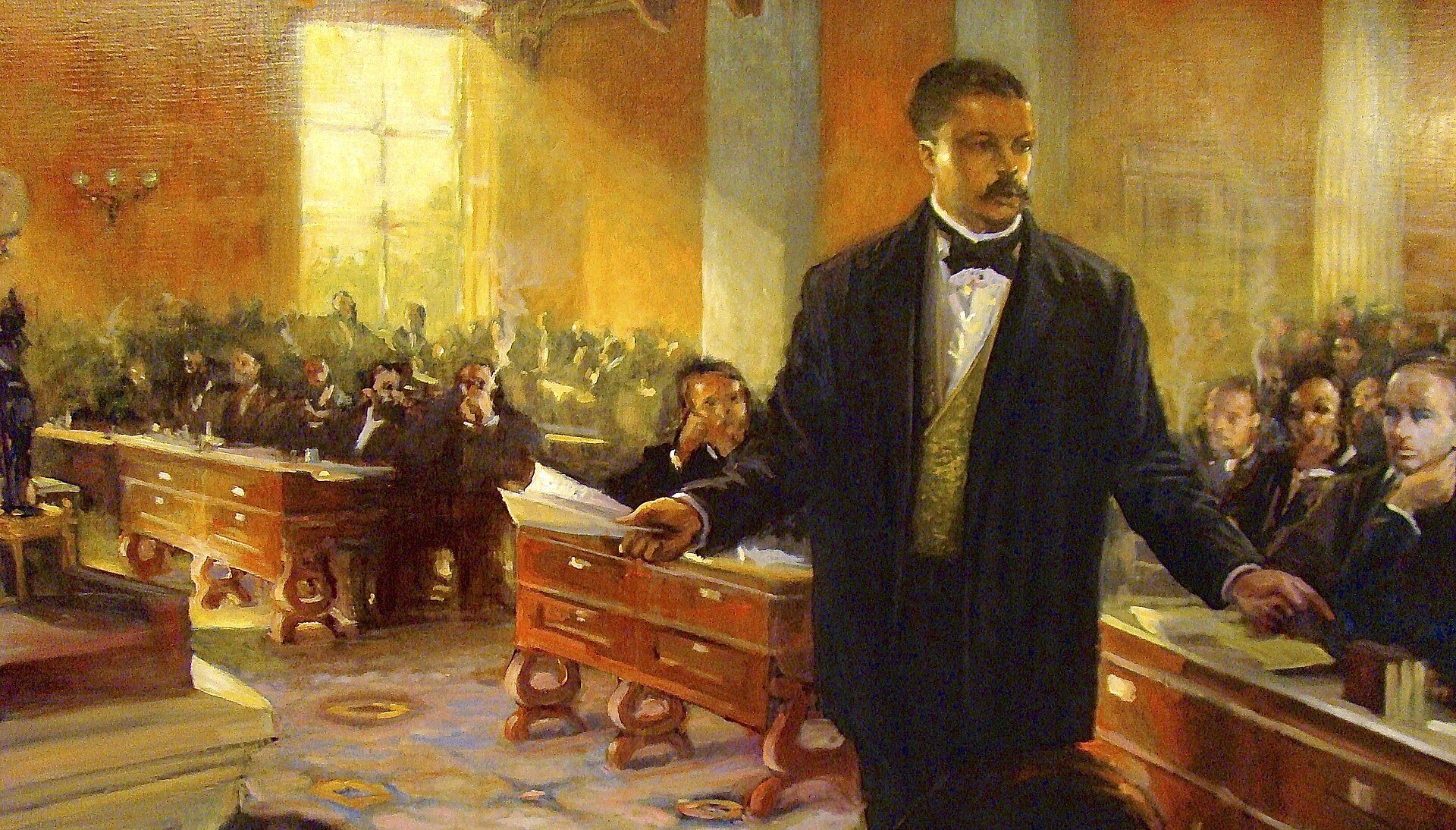
Painting of George Washington Williams addressing the Ohio State Legislature. Williams was the first African-American elected to the Ohio State Legislature, serving one term 1880 to 1881. (Photo from the Ohio Statehouse.)
The original 1619 project: George Washington Williams authored the two-volume “History of the Negro Race in America from 1619 to 1880”
by David DeWit
On the first floor inside the limestone edifice of the Ohio Statehouse sits the George Washington Williams Memorial Room, adorned with two oil paintings and a large, bronze bust of Ohio’s first Black lawmaker: George Washington Williams, who served 1880-81, in Ohio’s 64th General Assembly.
The volumes were published in 1882 and 1883 following Williams’ term in the Statehouse. In 1888, he published, “A History of the Negro Troops in the War of the Rebellion, 1861–1865.”
A deeply impressive autodidact, Williams says in the introduction to his history that he retired from public duties to focus on completion of the work, consulting more than 12,000 volumes, with more than a thousand of them included in its bibliography. He exhausted the state library of Ohio before moving on to the Library of Congress and New York Historical Society, and traveling southward to interview Black veterans for first-hand accounts when his inquirers of formal sources were rebuffed.
“I have been possessed of a painful sense of the vastness of my work from first to last,” Williams wrote, adding that he conceived the work to give America more correct ideas about the nature of Black people and to inspire Black people in their efforts of citizenship by giving them the history of their people so many desired. “The single reason that there was no history of the Negro race would have been a sufficient reason for writing one.”
Williams makes clear that his aim of the book is an honest and truthful discussion of history: “Not as the blind panegyrist of my race, nor as the partisan apologist, but from a love for ‘the truth of history’ I have striven to record the truth, the whole truth, and nothing but the truth,” Williams wrote. “I commit this work to the public, white and black, to the friends and foes of the Negro, in the hope that the obsolete antagonisms which grew out of the relation of master and slave may speedily sink as storms beneath the horizon.”
Nearly a century-and-a-half later, America is beset by know-nothings and philistines intent on subverting and destroying the truth, the whole truth, and nothing but the truth about our collective American history. They project their personal inability to face unpleasant facts onto our society and education system at-large — to decree that they somehow are the arbiters of what knowledge the public is allowed to learn in our universities and libraries, and what knowledge we are not. Gravely exceeding a governmental assault on free speech — which is quite bad enough, and unconstitutional — they seek to police freedom of thought and expression itself, a despicable insult to our Enlightenment Era intellectual heritage.
The life and work of George Washington Williams
Born free in Pennsylvania, George Washington Williams ran away at 14-years-old to join the Union Army, fighting some of the later battles of the Civil War. In a sort of unofficial defense of the Monroe Doctrine and the forces of democracy, Williams then joined other American soldiers fighting under the Republican Army of Mexico to overthrow Emperor Maximillian. Afterward, Williams returned to America to serve for five years in the U.S. Army before going to college at first Howard University and then the Newton Theological Institution near Boston, becoming their first Black graduate.
Ordained a Baptist minister, Williams served pastoral duties in Boston and then D.C., where with the support of Frederick Douglass and William Lloyd Garrison he published eight volumes of a Black newspaper called The Commoner. He then moved his family to Cincinnati, Ohio, where he served as a pastor and studied law under Alfonso Taft and was admitted to the bar. It’s from there he went on to the Ohio Statehouse and then his work as historian. Williams spent his last decade discovering and warning about the horrors of colonization in the Congo and Sierra Leone before dying of tuberculosis in the United Kingdom in 1891. He was 41 years old.
Williams’ history of Black Americans begins from his Christian ministerial perspective: Painstakingly debunking the 19th Century propaganda that used the Bible to attempt to dehumanize Black people with scripture. He then traces the history and etymology of the term “Negro” itself and where it comes from and who it’s been used to describe, before overviewing colonization and then finally reaching 1619 itself, which marks the beginnings of race-based chattel slavery in America.
In his first volume, Williams then studiously compares and contrasts the Black experience under the laws in the various colonies and later states, both before and after the American Revolution. His second volume deals with Black American experience in the 19th Century, and — given his veteran experience — is particularly heavy with insight and detail on combat experiences.
For his efforts, W.E.B. DuBois called Williams “the greatest historian of the race” after discovering his work as a Fisk University undergraduate.
In 1883, Williams wrote the editor of the Boston Herald: “I am now earnestly endeavoring to organize an American negro historical society. The negroes of this country are making very credible history now, and it should be preserved. … I have learned by experience the necessity of such an organization.”
So Ohio’s first Black lawmaker, and the first Black author of an academic study of Black American history, was also one of the first, most vocal advocates for preserving, protecting, and sharing Black history.
My personal disgust with ignorant political attempts to whitewash and destroy the Black history movement birthed by Williams is only matched by my commitment to defending it.
__________
Not everything that is faced can be changed but nothing can be changed until it is faced.
– James Baldwin
DAVID DEWITT
Ohio Capital Journal Editor-in-Chief and Columnist David DeWitt has been covering government, politics, and policy in Ohio since 2007, including education, health care, crime and courts, poverty, state and local government, business, labor, energy, environment, and social issues. He has worked for the National Journal, The New York Observer, The Athens NEWS, and Plunderbund.com. He holds a bachelor’s degree from Ohio University’s E.W. Scripps School of Journalism and is a board member of the E.W. Scripps Society of Alumni and Friends. He can be found on Twitter @DC_DeWitt
Gen Z and millennial voters could play an important role in deciding fate of reproductive rights amendment and marijuana law
by David DeWitt
For Gen Z and millennial Ohio voters, Issue 1 and Issue 2 are critically important. Whether we vote and how we vote will shape what kind of rights and freedoms we have for ourselves and our loved ones well into the future.
Issue 1 would establish a state constitutional right to “make and carry out one’s own reproductive decisions,” including decisions about abortion, contraception, fertility treatment, miscarriage care, and continuing pregnancy.
Issue 2 would create a new state law to legalize and regulate recreational marijuana for adults aged 21 and above, including cultivation, processing, sale, purchase, possession, and home growth.
Tussling over legal access to abortion care and the criminalization of marijuana has shaped American politics for decades, and they stand as two issues where the consequences of law and policy fall heaviest on younger people.
In an average of births in Ohio between 2019 and 2021, 4.9% were to women under the age of 20, and 2.5% were to women ages 40 and older, while 92.6% were to women ages 20 to 39, according to the March of Dimes.
Using Ohio Department of Health statistics for 2022, patients 17 and under received 2.5% of abortions performed, and patients over age 40 received 3% of abortions performed, while patients between the ages of 18 and 40 received 94.5% of abortions performed.
According to the FBI Crime Data Explorer — which does not sort by type of drug involved in state-by-state data — 60% of drug violations in Ohio in 2022 were charged against people between the ages of 20 and 39, a far higher percentage than any other age group. Nationwide, it wasn’t until 2020 that other drugs took over marijuana possession as the No. 1 reason for a drug-related arrest. Nevertheless, more than 315,000 people across America were arrested for marijuana possession in 2020, accounting for 27.5% of drug-related arrests. Also in 2020, Black Americans accounted for about 38.8% of marijuana possession arrests despite representing just 13.6% of the population.
Younger voters are notoriously unreliable at showing up to vote during non-presidential elections, much less odd-number year elections. Even during presidential elections they show up to the polls at lower rates than other age groups.
The 2020 presidential election, for instance, had the highest turnout of the 21st century, with 66.8% of citizens 18 years and older voting, but for voters ages 18 to 24, only 51.4% cast ballots, according to U.S. Census Bureau reports. In 2018, Americans ages 18 to 29 made up 11% of voters and 30% of non-voters, according to Pew Research Center. In 2022, they made up 10% of voters and 27% of non-voters.
This Nov. 7 in Ohio, the stakes are highest for millennial and Gen Z voters. What kind of present and future do we want for ourselves and for Ohio?
What rights do we want to establish in the constitution, or would we rather leave it up to the politicians to determine our generations’ access to reproductive medical care?
What kind of freedom do we think adults 21 and over should have from criminal marijuana charges, or should Ohio continue to saddle adults with drug offense records over cannabis possession?
Voting is our most precious and fundamental right, the spigot from which all of our other rights and freedoms flow. Gen Z and millennial generation voters must participate in these critical decisions, or we are relinquishing significant power over our lives to others who do not bear the same burdens of impact.
As the writer David Foster Wallace observed, “In reality, there is no such thing as not voting: you either vote by voting, or you vote by staying home and tacitly doubling the value of some Diehard’s vote.”
Early voting in Ohio has begun. Here is everything voters need to know:
Citizens can no longer vote on Nov. 6, the Monday before the election.
Mailed absentee ballots must be postmarked by Nov. 6.
On Election Day Nov. 7, vote at your polling location. Find your polling place by clicking or tapping here.
Polls are open from 6:30 a.m. to 7:30 p.m. on Election Day. If you are in line at the time polls close, stay in line, because you can still cast your ballot.
If absentee ballots are not returned by mail, they must be received by your board of elections by 7:30 p.m. on Election Day.
What do I need to vote?
In order to cast a ballot, voters must have an unexpired Photo ID such as a passport or driver’s license. Previously, voters were able to use non-photo documentation such as bank statements, government checks or utility bills to vote. That is no longer the case under a new law passed in Ohio last year. Student IDs are not considered valid under that law.
CLICK HERE for more information on ID requirements.
Here is the list of acceptable types of valid photo ID:
Ohio driver’s license
State of Ohio ID card
Interim ID form issued by the Ohio BMV
A US passport
A US passport card
US military ID card
Ohio National Guard ID card
US Department of Veterans Affairs ID card
More information for voters
To check your voter registration status, find your polling place, view your sample ballot and more, head to the Ohio Secretary of State’s VoteOhio.gov website.
DAVID DEWITT
OCJ Editor-in-Chief and Columnist David DeWitt has been covering government, politics, and policy in Ohio since 2007, including education, health care, crime and courts, poverty, state and local government, business, labor, energy, environment, and social issues. He has worked for the National Journal, The New York Observer, The Athens NEWS, and Plunderbund.com. He holds a bachelor’s degree from Ohio University’s E.W. Scripps School of Journalism and is a board member of the E.W. Scripps Society of Alumni and Friends. He can be found on Twitter @DC_DeWitt
It should be abundantly clear to all fair-minded Ohioans at this point that politicians have no business being involved in the redistricting process after lawmakers used the latest round of Ohio House and Senate district mapmaking to strike a bipartisan deal that amounts to little more than gerrymandered horse-trading.
Fittingly under the cover of darkness late Tuesday night, Ohio Republican and Democratic politicians conducted a shrewd, self-serving negotiation to once again gerrymander Ohio’s Statehouse maps in behalf of their own short-term political power interests, instead of all working earnestly toward fair, representative maps.
Ohio Democratic commissioners had a choice of whether to get whatever they could for now and hope voters pass reform, or to get raked by Republicans on the commission with worse maps than we have now, but this time likely destined to be rubber-stamped by a partisan right-wing Ohio Supreme Court. They chose the former.
The Ohio Redistricting Commission’s bipartisan agreement among politicians show a Republican advantage of 61 to 38 in the Ohio House under the new map, with eight competitive Democratic toss-up seats and three competitive GOP toss-ups.
In the Ohio Senate, the new map shows a 23 to 10 Republican advantage, with three competitive Republican toss-up seats and one competitive Democratic toss-up seat.
Compare this to Ohio’s current unconstitutionally gerrymandered maps forced upon voters in 2022. Before the 2022 Election, the current gerrymandered districts showed a Republican advantage in 56 House seats. In the Ohio House, all 19 competitive districts under the current maps were Democratic, with zero competitive Republican districts.
That meant that Democrats had to spend money and resources in 19 House districts and win every single one in order to maximize their House seats. Republicans didn’t have to “defend” a single seat, and could focus all of their money and resources on “pick-ups” — taking seats that lean Democratic on-paper.
The Republicans’ unconstitutionally partisan mapmaking paid off. The 2022 Election saw Ohio Republicans winning 67 state House seats.
In the Ohio Senate under the current maps, Republicans before the election looked to hold an edge in 18 Senate seats, and there were seven competitive toss-ups. Republicans ended up winning 26 Senate seats last November, while Democrats won seven seats total.
So what are we looking at here with Tuesday night’s agreement among the bipartisan politicians?
Democrats don’t have to spend the money and resources to defend nearly as many seats in the Ohio House. Instead of defending 19 seats, they will be defending eight seats and targeting three GOP seats. Essentially, their political resource management and allocation will be easier. Same thing in the Senate. They will be able to focus their resources on attempting to defend one seat and to pick up three GOP seats.
Best case scenario for Democrats under the new maps: They pick-up six Senate seats total over their current number of seven, for a 20-13 Republican chamber; and/or they pick up nine seats total in the Ohio House over their current 32 seats by protecting their eight competitive seats and winning three GOP-leaning targets, for a 58-41 Republican chamber.
That best case scenario for Democrats would break the GOP’s supermajorities; however, if Democrats were to not win the competitive Republican-leaning seats, the GOP would retain supermajorities of 61-38 in the Ohio House and 23-10 in the Ohio Senate.
The best case scenario for Republicans would be not only to hold on to their supermajorities, but to win as many competitive Democratic-leaning districts as possible. If they were to defend their three competitive seats and win six out of the eight Dem-leaning competitive districts in the House, for instance, they would retain their current 67-32 advantage. Keep in mind that in 2022, they won 11 Dem-leaning competitive House seats.
So by striking this deal on more gerrymandered maps, Democratic politicians gave themselves an easier time with money and resource allocation in 2024 and a very difficult but still possible shot to take away GOP supermajorities, and the GOP gave themselves a good chance to retain their supermajorities in both chambers while still having the opportunity to possibly expand them even further than the maps suggest now on-paper.
But there’s more.
Beyond this gerrymandered horse-trading on the Ohio House and Senate numbers, Democrats are indicating they are putting faith in the idea that the impact of gerrymandering lessens over time as the data used to draw the maps become outdated — so this deal prevents the GOP from both punishing Democrats severely right now, and from coming back for another redraw with fresh data to more efficiently gerrymander the maps again. Democrats also advocated Tuesday night for 2024 anti-gerrymandering reform, indicating they see this deal as a stop-gap measure before real reforms can take place thanks to voters.
Republicans meanwhile have obtained a strong political cudgel to wield against that very effort to replace the Ohio Redistricting Commission made up of politicians with an Ohio Citizens Redistricting Commission that kicks the politicians out of the process. Republicans will say that the process worked, they obtained bipartisan agreement just as voters in 2015 intended with redistricting reform, that these maps are not gerrymandered, and in 2024, they’ll say something along the lines of, “Far-left special interests want to hijack the constitution and put power in the hands of unelected bureaucrats.”
This process did not work.
Redistricting in Ohio has been a two-year travesty with an ignominious conclusion for everyone involved, Republican and Democratic politicians alike.
The prevailing motivation of every politician Tuesday night was shrewd political self-interest, not sacred obligation and duty to the public.
No matter what anybody thinks of the advantages or disadvantages of the deal that was struck, it’s clear that these incentives for political horse-trading must be removed.
The only incentive for mapmakers should be fair and representative maps that evenly maximize competitiveness.
The way to remove these bad incentives to make these kind of damned-if-you-do, damned-if-you-don’t deals is to kick all of these politicians out of the process.
Whether it’s partisan or bipartisan, gerrymandering must end. On Tuesday night in Ohio, it did not.
DAVID DEWITT
Ohio Capital Journal Editor-in-Chief and Columnist David DeWitt has been covering government, politics, and policy in Ohio since 2007, including education, health care, crime and courts, poverty, state and local government, business, labor, energy, environment, and social issues. He has worked for the National Journal, The New York Observer, The Athens NEWS, and Plunderbund.com. He holds a bachelor’s degree from Ohio University’s E.W. Scripps School of Journalism and is a board member of the E.W. Scripps Society of Alumni and Friends. He can be found on Twitter @DC_DeWitt
“Congratulation to Loveland Magazine’s invaluable news source that reports from the Ohio Capital for you.” – David and Cassie
Commentary by David DeWitt
In the “Ohio’s Best Journalism Contest” from the Society of Professional Journalists, the Ohio Capital Journal won seven awards, including five first place finishes and two in second place. The contest covered stories and editorial from 2022.
In digital media categories, OCJ Senior Reporter Marty Schladen won first place for best news story; OCJ/WEWS Reporter Morgan Trau won first place for best government/political reporting and first place for best education issues reporting; OCJ Editor David DeWitt won first place for best editorial writing; OCJ Editor David DeWitt and Columnist Marilou Johanek won first place for best overall commentary/opinion blog section; and OCJ Reporter Susan Tebben won second place for best government/political reporting and second place for best education issues reporting.
We are incredibly honored and grateful for this recognition from our fellow journalists. We are also humbled by and grateful for all of the support we receive from our readers and Ohioans across the state.
OCJ Editor-in-Chief and Columnist David DeWitt has been covering government, politics, and policy in Ohio since 2007, including education, health care, crime and courts, poverty, state and local government, business, labor, energy, environment, and social issues. He has worked for the National Journal, The New York Observer, The Athens NEWS, and Plunderbund.com. He holds a bachelor’s degree from Ohio University’s E.W. Scripps School of Journalism and is a board member of the E.W. Scripps Society of Alumni and Friends. He can be found on Twitter @DC_DeWitt
In order to understand the bad faith of the Republican arguments for attacking Ohio voters and asking us to enshrine 41% minority rule over our Ohio Constitution, voters need to understand the power dynamics at play when it comes to initiated statutes versus amendments to the Ohio Constitution.
In Ohio, citizens have two options for proposing changes through a ballot initiative: They can offer a statute, which changes law under Ohio Revised Code, or a constitutional amendment, which amends the Ohio Constitution.
Time and again we hear gerrymandered Ohio Republican lawmakers making some variation on their argument that the constitution is our “foundational document” and that if voters want a change, they should attempt an initiated statute to change the law, instead of adding an amendment to the Ohio Constitution.
Here’s what they want citizens to forget: Ohio law offers no protection for a newly passed statute. Lawmakers can immediately repeal or modify whatever changes voters approve.
This means that well-meaning citizens of Ohio could raise money, spend countless hours gathering signatures, put in enormous volunteer time, talk to their friends and neighbors, knock on doors, and generally work themselves to the bone to get a statute initiative on the ballot and passed, and then our unconstitutionally gerrymandered supermajority Republican legislature could repeal it the next day.
Some states have provisions to protect from this situation. If a citizen-initiated statute passes, the General Assembly is not allowed to just overturn it, sometimes for a given number of years, or they must reach an extremely high bar to do so. Ohio does not have this. That is a huge difference.
The fact that there is no such protection for citizen-initiated statutes in Ohio, combined with the fact that our Statehouse is unconstitutionally gerrymandered for unrepresentative Republican supermajorities in both chambers, means that it would be foolish for any citizen group working on an issue that our misrepresentative legislature refuses to address to spend all that time and effort passing a statute just to be kicked in the teeth by that same misrepresentative legislature.
Over the years as a newspaper reporter in Athens, I would ask people bringing, for instance, initiatives for the legalization of medicinal cannabis, why they were going for a constitutional amendment and not a statute. The answer was always the same: Because the Statehouse would just override it. Why spend all that time and money on something that they will just override?
When you understand this, you understand why groups bring amendments instead of statutes. This also reveals the wildly condescending deceit of these Ohio Republicans attacking 175 years of Ohio majority voter authority over our constitution.
Presumably, they understand these dynamics, too. And yet, they shriek and wail about all these groups they say are trying to write law into the constitution instead of just bringing statutes.
The simplest, easiest way to incentivize groups to put forward citizen-initiated statutes instead of amendments would be for them to create some kind of protection for those statutes from being overturned by the legislature.
Instead of this type of moderate, reasonable change that would alleviate the concerns Ohio Republicans claim that they have, they are going for Ohio voters’ throats.
We all know — and they have made clear in private and in public — that their effort is really aimed to stop an abortion rights amendment slated for the November ballot, and to stop voters from any effort toward further anti-gerrymandering reform.
That gerrymandering piece of the puzzle is also what makes their arguments so offensively disingenuous.
Ohio Republicans would not have had the votes to bring this $20 million, Aug. 8 special election if they hadn’t ignored the Ohio Constitution by forcing Ohioans in 2022 to vote under district maps declared unconstitutional by a bipartisan Ohio Supreme Court five times.
In doing so, they flagrantly violated the will of Ohio voters who passed anti-gerrymandering reform for Statehouse districts in 2015 with more than 71% of the vote.
Them now claiming the mantle of “protecting the Ohio Constitution” is ridiculous on its face. They have shown repeatedly they don’t give a damn about the integrity of the Ohio Constitution. They have flagrantly violated the Ohio Constitution, the rule of law, the orders of the Ohio Supreme Court, and the will of Ohio voters, with staggering contempt.
This is Lucy asking Charlie Brown to try to kick the football just one more time. I can only conclude they are either themselves just not very smart, or they’re so deeply cynical that they think Ohioans are profoundly stupid. Probably a mixture of both, depending on the lawmaker.
Even if you wanted to have a good faith discussion on citizen initiatives and the Ohio Constitution, you would have to meet a couple premises off the bat: You would have to have a legitimate and representative legislature that isn’t gerrymandered, and you would have to have some sort of enforceable protection for citizen-initiated statutes. Ohio has neither.
Are some things such as marijuana or casino laws better off in Ohio Revised Code? Probably. But Ohio Republicans rigging the game at every step of the process has rendered that discussion moot. Constitutional amendments are the only effective tool of direct power Ohio citizens have left.
Other issues such as civil and human rights stand wholly appropriate to the Ohio Constitution, firmly out of the manipulative reach of corrupt, unscrupulous lawmakers.
So that remains the primary question for Ohio voters: Should a 41% minority, alongside a rigged, extremist legislature acting on behalf of radical special interests, have authority over our most fundamental human and civil rights? Voters ought to think wisely.
_______________________________
DAVID DEWITT
OCJ Editor-in-Chief and Columnist David DeWitt has been covering government, politics, and policy in Ohio since 2007, including education, health care, crime and courts, poverty, state and local government, business, labor, energy, environment, and social issues. He has worked for the National Journal, The New York Observer, The Athens NEWS, and Plunderbund.com. He holds a bachelor’s degree from Ohio University’s E.W. Scripps School of Journalism and is a board member of the E.W. Scripps Society of Alumni and Friends. He can be found on Twitter @DC_DeWitt
Every day more details emerge from Ohio’s billion-dollar bailout bribery trial showcasing gargantuan levels of arrogance, corruption, and enabling among energy executives and Ohio’s most powerful Republican politicians.
Pointing to the U.S. Supreme Court’s disastrous Citizens United ruling, Clark described to undercover FBI agents how to make dark money contributions in a way calculated to get a public official’s attention, saying those should come in chunks of $15,000, $20,000, $25,000 or more.
“Based on a Supreme Court decision, businesses can do this and nobody can do anything about it,” Clark said. “Politicians can get a bunch of money and say, ‘I didn’t know.’”
And that exactly how many Ohio politicians have been operating, this trial is showing: Selfish, reckless, greedy, amoral, large-scale, pay-to-play grift.
The scope of corruption at every turn in Ohio is a bit staggering, so let’s take a look at all we’ve learned so far, all together in one place:
Indicted former Ohio House Speaker Larry Householder. Official photo.
Executives from financially struggling FirstEnergy flew Ohio House speaker aspirant Larry Householder and associate Jeff Longstreth to D.C. on the FE corporate jet in January 2017 for some swanky steakhouse dinners.
Partners for Progress was the dark money project of then-FirstEnergy lobbyist Dan McCarthy. It received $5 million from FirstEnergy within a few weeks of when McCarthy founded it.
Juan Cespedes. Photo provided.
During a meeting between Householder and FirstEnergy lobbyists in October 2018, a lobbyist named Robert F. Klaffky slid an envelope containing a check for $400,000 across the table and under Householder’s hand as they discussed a $1.3 billion ratepayer bailout of failing nuclear and coal plants, former FirstEnergy lobbyist Juan Cespedes testified.
“Our client cares very much about this issue,” Klaffky told Householder.
“We were trying to establish the fact that our support was specifically tied to the legislation,” Cespedes said.
All told, Householder’s dark money political machine amassed $61 million in utility company contributions to elect a legislature that would make him speaker and pass the bailout.
Why did it go through the dark money groups like that? It was thought to be bad optics if the struggling company were publicly giving the money, Cespedes said in testimony.
Even though he was supposed to be regulating the utility, the official, Sam Randazzo, played a role in writing the bailout legislation, according to documents released by the Ohio House.
Center, former Ohio Republican Party chair, and statehouse lobbyist, Matt Borges with his attorneys outside of the federal courthouse. Photo courtesy of WEWS.
“He’s going to be a friend in this process,” Borges texted to Cespedes. “So let’s be prepared to speak up for him.”
Cespedes responded, “We will support him more than anyone.”
Ohio Secretary of State Frank LaRose. Official photo.
Kiani had plans to operate the two FirstEnergy Solutions nuclear power plants in Ohio for a short period, get a government bailout and then sell the power plants in a deal in which he stood to make $100 million, Cespedes testified.
DeWine and Husted, as well as Yost and LaRose, were reelected to second four-year terms in 2022.
Husted, Yost, and LaRose are all poised to continue to seek political advancement in Ohio.
Generation Now, Cespedes, and Longstreth have pleaded guilty.
FirstEnergy entered into its deferred prosecution agreement.
Neil Clark died by suicide in 2021, nine months after being indicted by federal prosecutors.
The federal racketeering trials of Householder and Borges are ongoing and expected to last until March.
Jurors will review all the evidence and decide their fate.
It will be up to Ohioans to decide how long we will continue to allow our politicians to rob and abuse us in service to themselves and private interest profiteering.
Every day we learn more about how Ohio government has really been operating under the design of unscrupulous thieves and grifters, rotting the institutions of our state into a national joke and embarrassment: a grotesque totem to pay-to-play corruption; a decayed and decrepit husk of representative democracy.












 Best General News Site — Second Place — Ohio Capital Journal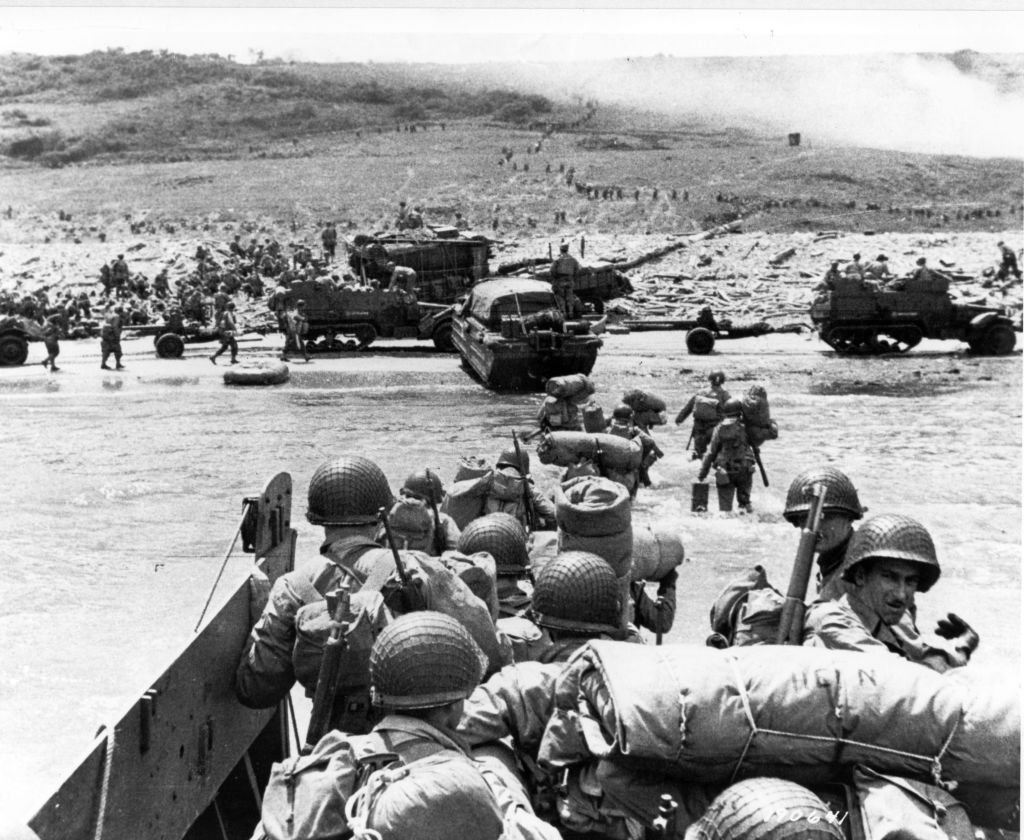



 by David DeWitt