Tag: DAVID DEWITT

  • In 1912, Ohio voters asserted their democratic authority. Now Ohio Republicans want to rip it away

    In 1912, Ohio voters asserted their democratic authority. Now Ohio Republicans want to rip it away

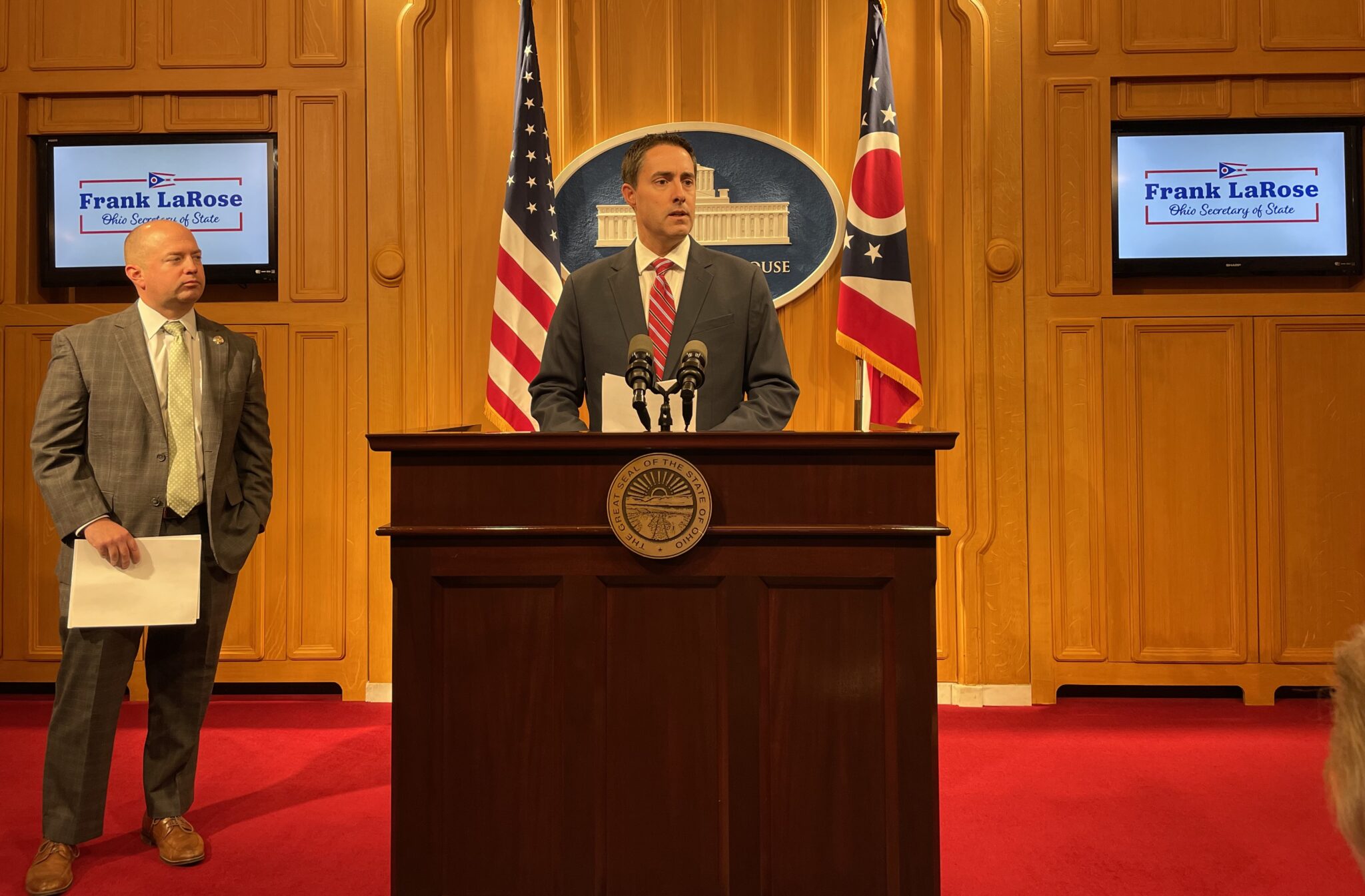
    Secretary of State Frank LaRose (speaking) alongside Rep. Brian Stewart, R-Ashville, introducing a constitutional amendment requiring a 60% supermajority for all future citizen-led ballot amendments. (Photo by Nick Evans, OCJ.)

    Comentary

    David DeWitt

    by DAVID DEWITT

    Ohio Republican Secretary of State Frank LaRose and state Rep. Brian Stewart have launched a frontal assault on voters’ ability to amend our state constitution, putting their knives at the neck of 110 years of citizen-led democratic progress in the Buckeye State.

    Thinking that Ohioans are stupid and gullible enough to relinquish our democratic powers in abject subservience to their political party and its absolute control, they are rushing to bring a proposed amendment to voters in May that would subject citizen initiatives to a 60% threshold for passage of amendments.

    The resolution was amended today (Thursday) to require 60% support for legislative-initiated amendments as well.

    Nevertheless, House Joint Resolution 6 being rushed through lame-duck session by GOP lawmakers would itself still only require a simple majority for passage in May.

    These Ohio Republicans stand athwart democracy, history, and even Teddy Roosevelt, who advocated for the power of citizen initiatives and referendum during the 1912 Ohio Constitutional Convention that introduced these powers adopted that year by Ohio voters.

    Republicans control every statewide administrative office including governor, secretary of state, attorney general, auditor, and treasurer, as well as both the Ohio House and the Ohio Senate under supermajority gerrymanders, and a majority on the Ohio Supreme Court.

    With GOP lawmakers continuing to create extremist laws that polls show strong majorities of Ohioans don’t want, while refusing to enact laws that majorities of Ohioans do want, for voters to relinquish their own last remaining check — the power of a popular majority of voters themselves — would be insane.

    The history of the Ohio Constitution and citizen-led initiatives

     The opening of the 1912 Ohio Constitutional Convention. Photo from the Ohio History Connection.

    Sparked by enormous public desire to end corruption and enshrine citizen powers of accountability with democratic reform, Ohio voters asserted their authority by passing Ohio Constitutional amendments in 1912 giving us the ability to bring citizen-initiated amendments, statutes, and referendums; guaranteeing due process in the state reflective of the U.S. Constitution; and passing a number of labor and workforce standards.

    In fact, Ohio is currently operating under the third large-scale iteration of our state constitution. The first was adopted in 1802 and put in place alongside statehood in 1803; the second drafted and approved by voters in 1851 following an 1850 convention; and the third created with the 33 amendments passed by voters in 1912 after another constitutional convention that year.

    The year 1912 was a heady time for good government and democratic reformers across the nation and in Ohio, coming at a kind of apex within the U.S. Progressive Era, which lasted from the 1890s to around 1920.

    Much of this period fits politically in what historians call the Fourth Party System, where progressives and conservatives were part of factions within both the Republican and Democratic parties.

    For instance, Democratic presidential nominee and eventual winner Woodrow Wilson, and former Republican President Theodore Roosevelt running on the “Bull Moose” ticket in 1912, both were considered progressive.

    Roosevelt’s hand-picked successor in the White House, Ohio Republican William Howard Taft — whose 1908 opponent William Jennings Bryan joked that he had to run against two candidates, “a western progressive Taft and an eastern conservative Taft” — had become too conservative for Teddy’s liking, sparking his third-party challenge, and very probably dooming them both to lose to Wilson.

    Socialist Party candidate Eugene V. Debs also ran, as he did in five of six presidential elections from 1900 to 1920, with the exception of 1916 when he ran for Congress instead.

    In 1912, Ohio went for Wilson with 41%, compared to 27% for Taft, 22% for Roosevelt, and 9% for Debs.

    With rapid changes underway in America sparked by the industrial revolution, the 1912 Ohio Constitutional Convention eventually settled on 41 total amendments to propose to voters, of which 33 were passed and eight rejected.

    Among the rejected were women’s right to vote, which would be gained later nationally under the 19th Amendment passed by Congress in 1919 and ratified in 1920; and the removal of the word “white” from the Ohio Constitution. That removal was eventually approved by voters 11 years later.

    Eligible Ohio voters in 1912 were apparently keen on setting standards for factory working conditions, creating the eight-hour workday for public employees, installing a mandatory workers compensation system, and giving themselves authority at the ballot box over Ohio law and the state constitution itself. They were less in love with gender and racial equality.

    Speaking at the 1912 Ohio Constitutional Convention in Columbus, Roosevelt firmly threw his support behind the efforts to create citizen initiative and referendum for Ohio voters, especially noting cases in which state legislatures become “misrepresentative.”

     Teddy Roosevelt. Photo from the U.S. Library of Congress.

    “I believe in the initiative and the referendum, which should be used not to destroy representative government, but to correct it whenever it becomes misrepresentative. Here again I am concerned not with theories but with actual facts. … In actual practice it has been found in very many states that legislative bodies have not been responsive to the popular will. Therefore I believe that the state should provide for the possibility of direct popular action in order to make good such legislative failure.”

    Of note, also in 1912, Roosevelt became among the nation’s most vocal and prominent supporters of women’s right to vote. In 1901, he invited African-American educator Booker T. Washington, who had become close to Roosevelt, to dine with his family at the White House, creating a national sensation as such a supper at the White House had never happened before in that era of segregation.

    The Ohio GOP plot to thwart democracy

    When the history of Ohio politics in the early 2020s is written, no one will be able to deny the clear and direct attack on democracy orchestrated by modern day Ohio Republicans.

    In a disgusting and shameful process that began in August 2021, they have defied a bipartisan majority on the Ohio Supreme Court no less than seven times to force Ohio voters to cast ballots in unconstitutionally gerrymandered Statehouse and U.S. Congressional districts.

    After compromising with redistricting reform advocates to bring anti-gerrymandering measures to the ballot, legislative leaders ignored the rule of law in their own initiatives for Statehouse districts, passed in 2015 by voters with more than 71% support, and for U.S. Congressional districts, passed by voters in 2018 with nearly 75% support.

     The Republican majority members of the Ohio Redistricting Commission. Top row from left, Ohio Gov. Mike DeWine and Secretary of State Frank LaRose. Bottom row from left Ohio Auditor Keith Faber, House Speaker Bob Cupp, and Senate President Matt Huffman. Official photos.

    Both of those reforms were repeatedly desecrated by Ohio Republicans including LaRose, determined to flout the will of the voters to instead consecrate their party’s own undue, gerrymandered legislative power.

    And now Ohio voters are expected to be foolish enough to strip ourselves of our own power to hold these same politicians and lawmakers accountable?

    To make the argument that other states require supermajorities for citizen-led amendments, as Stewart does, is to try to manipulatively wash away the context of this sustained assault on voters and democracy by Ohio Republicans.

    These other states aren’t illegally gerrymandered to enshrine supermajority power for a simple majority party — a party that is now trying to put in supermajority requirements to kneecap a majority of voters.

    To argue as they have that somehow it’s all fair because the Ohio legislature must propose initiative with supermajority votes, is to desperately try to erase the fact that the same legislature has been illegally gerrymandered — by them — for supermajority power, in violation of voters, the state supreme court, the Ohio Constitution, and the rule of law.

    I can only assume they think Ohioans are idiots, or they wouldn’t try to sell us this trash bag full of hot garbage that they want us to dump on ourselves.

    To give LaRose a teaspoon of credit, as contemptuous as he apparently is for Ohio voters’ general intelligence, they did just reelect him, so I’m not prepared to press him too hard on the point right now.

    But I can say that LaRose’s arguments for attacking voters’ power are wildly deceitful and self-contradictory.

    With regard to citizen-initiated amendments, 16 have been proposed in Ohio over the last 22 years, and just five have passed.

    Of those five, only two would not have cleared the 60% threshold LaRose and Republicans are now proposing: one to increase the minimum wage in 2006 that got 57% support, and another from 2009 that brought casinos to the state and passed with 53% support.

    Since 1912, Ohioans have brought citizen constitutional amendment ballot initiatives 71 times, with 19 amendments approved and 52 rejected.

    Nevertheless, LaRose claims these citizen-led initiatives, which are so rarely passed, need to have the bar raised because “special interests” are allegedly taking over Ohio’s Constitution.

    In no way does that make sense. And the reason his argument doesn’t make sense is because LaRose is being dishonest.

    He wants to frame the Ohio Constitution as under attack, but he doesn’t have the evidence for it because of the failure rate of citizen-led ballot initiatives.

    What he is really worried about is their potential for future success to act as the only check on absolute GOP power to enact extremist law promised to radical right-wing special interests, in defiance of Ohioans’ popular will.

    Upcoming citizen initiatives

     A voter at the ballot maker machine during the Ohio primary election, May 3, 2022, at the Noor Islamic Cultural Center, Dublin, Ohio. (Photo by Graham Stokes for the Ohio Capital Journal. Republish photo only with original story.)

    Redistricting reform advocates horrified by Ohio Republican lawlessness on gerrymandering are now looking to bring a new citizen-initiative to the ballot.

    Even retiring swing-vote Republican Ohio Supreme Court Chief Justice Maureen O’Connor is looking to get in on that action.

    On Nov. 10, abortion rights advocates said they are planning a ballot initiative to protect reproductive health care.

    Exactly one week later, on Nov. 17, LaRose and Stewart announced this proposal to make it harder for these types of initiatives to pass.

    In Kansas, voters protected access to abortion care with 59% support. Now LaRose wants to make Ohio’s threshold 60%. And he expects us to believe this is coincidence.

    If anything, it tells us that Ohio Republicans know that a majority of Ohioans are not on their side when it comes to illegal gerrymandering, extremist abortion bans, and a slew of other issues, so they want to manipulate things so only a supermajority can stop them.

    In other words, they feel like they have a shot at beating citizen initiatives by convincing 41% to vote against them, but not 51%.

    As Teddy Roosevelt said, the power of initiative should not be used “to destroy representative government, but to correct it whenever it becomes misrepresentative.”

    Frank LaRose and Ohio Republicans are asking Ohio voters to help them destroy representative government, and for a majority of voters to render themselves unable to correct lawmakers’ misrepresentation.

    When it comes to democracy, these power-drunk, small-minded men aren’t worthy to carry Roosevelt’s jock.

  • Ohio Capital Journal wins five Society of Professional Journalists awards

    Ohio Capital Journal wins five Society of Professional Journalists awards

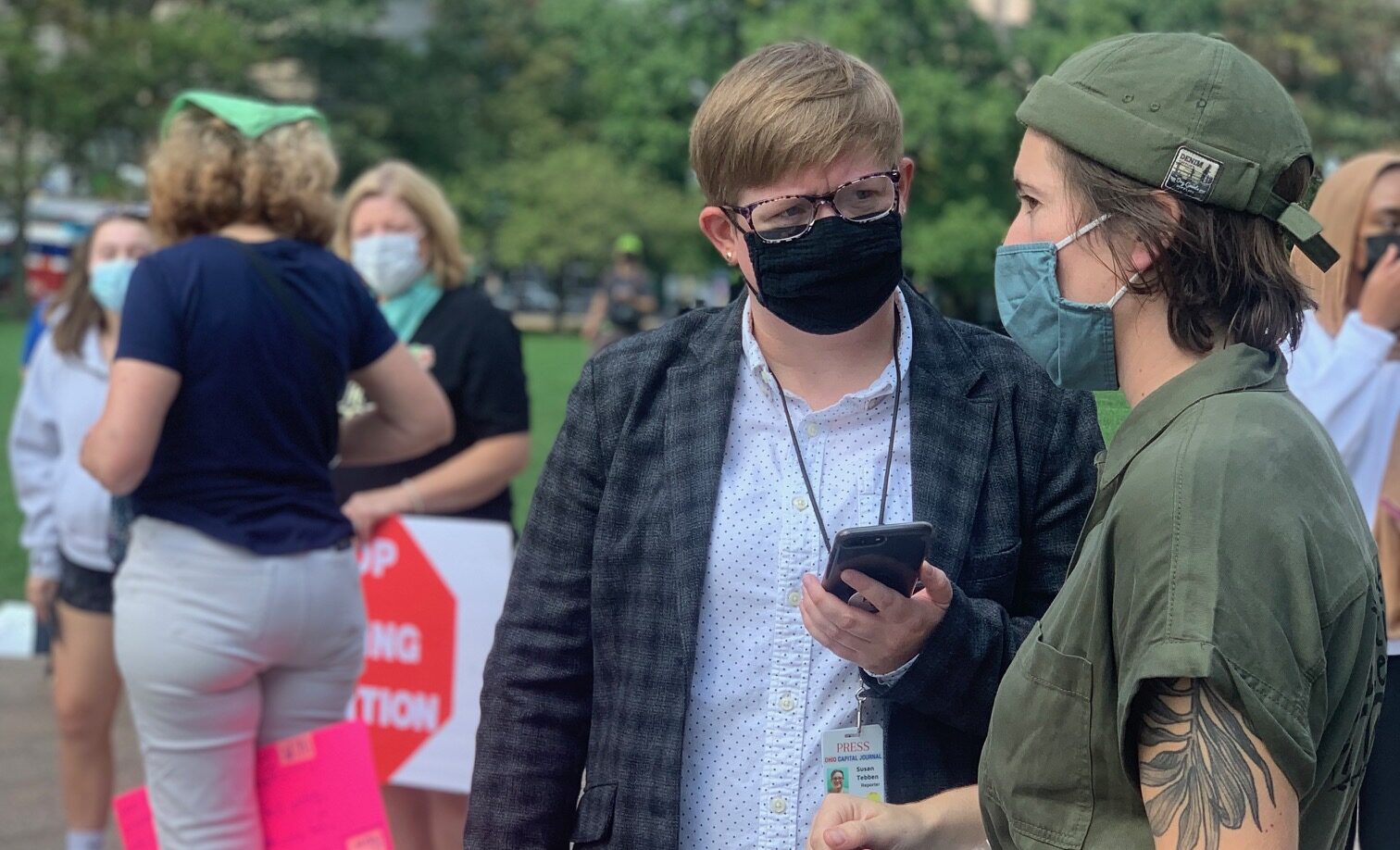
    OCJ Reporter Susan Tebben, left, interviews an activist during a protest at the Statehouse. Photo by David DeWitt, OCJ.

    LOVELAND MAGAZINE NOTE: If I could, and I cannot think of a quick way tonight, I would tell readers how long we waited to have good journalists tell our readers what was going on at the Ohio State House. I do know that before I discovered the Ohio Capital Journal we had published Loveland Magazine for many, many years and search and searched all those many years for a way to connect Loveland to their state government and its impact on our lives. With much gratitude and appreciation, I congratulate the Journal staff who have been honored with these prestigious awards.

    David Miller, Editor and Publisher


    BY: OHIO CAPITAL JOURNAL STAFF – Ohio Capital Journal

    In the “Ohio’s Best Journalism Contest” from the Society of Professional Journalists, the Ohio Capital Journal won five awards, including three first place finishes and two in second place. The contest covered stories and editorial from 2021.

    In digital media categories, OCJ Reporter Susan Tebben took home two first-place awards, one for best education issues reporting and one for best government/political reporting. Tebben also nabbed a second-place finish for best news story.

    OCJ Reporter Jake Zuckerman won first place for best investigative reporting, and OCJ Editor David DeWitt won second place for best editorial/criticism writing.

    We are incredibly honored and grateful for this recognition from our fellow journalists. We are also incredibly grateful for the support we receive from our readers and Ohioans across the state.

    Below we will share the award-winning entries.

    If you’d like to support our work, please follow us on Facebook and Twitter, share our free newsletter subscription with family and friends, and consider making a tax-deductible donation.

    OCJ Reporter Jake Zuckerman

    Best Investigative Reporting – First Place – Jake Zuckerman

    Stories produced within eight days of the Jan. 6 raid on the U.S. Capitol: They include interviews with an Ohio woman who led her paramilitary unit into the building and an Ohio man who kicked in a Capitol window. A third uncovers how a state school board member organized a bus trip to ferry Ohioans to the rally.

    Ohio bartender and her ‘militia’ drove to D.C. to join the Capitol breach

    Ohio man joins raid on U.S. Capitol: ‘I shouldn’t have kicked in the window’

    Ohio Board of Ed member organized bus trip to D.C. for “Stop the Steal” rally

    OCJ Reporter Susan Tebben

    Best Government/Political Reporting – First Place – Susan Tebben

    Ohio government has been in turmoil amid the pandemic, attacks on democracy, and redistricting. One Ohio lawmaker called to charge Ohio Gov. Mike DeWine with terrorism over pandemic public health measures. An Ohio Board of Education member speaks on participating in the Jan. 6 “Stop the Steal” rally that led to the raid on the U.S. Capitol. And redistricting turned into a mess in 2021 despite Ohio Constitutional reforms passed by voters. 

    A legislator wanted to charge Gov. Mike DeWine with terrorism. The prosecutor wants his money back.

    Ohio Board of Education member speaks on participation in ‘Stop the Steal’ event

    Sausage-making: Redistricting hearings continue, public asks for transparency and accountability

    Best Education Issues Reporting – First Place – Susan Tebben

    Public education under attack: This series of stories highlights various attacks on public education, from a state school board member accusing the Ohio superintendent of education of being paid by Bill Gates, to the movement to ban race-based focuses in Ohio schools, to investigative reporting showing very few actual complaints about divisive race-based focuses in education.

    State school board member asks Ohio supt.: ‘Are you paid by Bill Gates?’

    State Board of Ed members support banning racial focus in Ohio schools

    State receives very few complaints on ‘divisive’ racial education concepts

    Best News Story Series – Second Place – Susan Tebben

    Three separate stories covering the developments in Ohio gerrymandering: Ohio Republicans on the redistricting commission passing gerrymandered maps; the Senate President defending that gerrymandering, and testimony about redistricting gathered in committee.

    Republican majority gerrymanders Ohio for another four years

    Huffman defends his maps, redistricting process despite no bipartisan support

    Redistricting process remains ‘fluid’ in joint committee

    OCJ Editor-in-Chief David DeWitt

    Best Editorial/Criticism Writing –  Second Place – David DeWitt

    Gerrymandering pushes politicians to extremes, denies voters their voice, opens the door to corruption, radicalizes political discourse, kills compromise, and disintegrates democracy. Gerrymandering poisons everything. Nevertheless, Ohio’s Republican leaders have been playing political games with redistricting and cheating voters by gerrymandering their way to undue power. OCJ Editor David DeWitt takes them to task for this anti-democratic, unpatriotic attack.

    How cheating voters with gerrymandering poisons everything

    Betraying voters, Ohio Senate President Huffman and House Speaker Cupp declare moral bankruptcy

    Ohio GOP leaders broke promises, failed us all by creating more rigged maps

  • Ohio Republicans’ attempted erasure of a 10-year-old rape victim is incredibly sick and disturbed

    Ohio Republicans’ attempted erasure of a 10-year-old rape victim is incredibly sick and disturbed

     Left to right: Republican Ohio Gov. Mike DeWine, Republican Ohio Attorney General Dave Yost, and Republican U.S. Congressman Jim Jordan. Official photos.
    Ohio Capital Journal Editor-in-Chief David DeWitt

    A Guest Column by David Dewitt

    The first and most important thing to recognize right now is that a heinous, violent crime was committed on a 10-year-old Ohio child, and thankfully justice has now found the alleged perpetrator.

    Columbus man was indicted Wednesday in a case that made national and international headlines about 10-year-old girl who had to travel to Indiana for an abortion after Ohio’s abortion ban went into effect following the U.S. Supreme Court overturning Roe v. Wade.

    The story is horrifying and tragic. She has experienced enormous trauma. My heart breaks for her, and I’m very grateful to all the hard-working professionals out there providing her and her family assistance in what must be a truly awful time.

    Republican Ohio Gov. Mike DeWine and his spokesman responded to the story by ignoring questions about whether children should be forced to have their rapists’ babies. Then DeWine allies contacted members of the press, asking how sure they were that the case of the pregnant 10-year-old even happened.

    The Washington Post, the conservative Daily Caller and other media outlets published stories saying that the case was unverified. The Wall Street Journal Editorial page suggested the story was a “fanciful tale.” The National Review’s Michael Brendan Dougherty referred to the case as “a fictive abortion and a fictive rape.”

    Republican Ohio Attorney General Dave Yost went on Fox News Monday to raise further doubts. He said he works closely with law enforcement authorities and he’d gotten “not a whisper” about the case.

    Hamilton County Republican Party Chair Alex Triantafilou on Twitter called the case, “A garbage lie that a simple google search confirms is debunked.”

    State Rep. Brian Stewart tweeted the Washington Post story saying he “wouldn’t trust an abortionist to tell me whether the sky is blue.”

    Ohio U.S. Rep. Jim Jordan tweeted, “Another lie. Anyone surprised?

    None of them had the patience to verify for themselves with certainty the truth of the matter before going public on a massive, self-serving scale.

    The propaganda erasing this 10-year-old’s existence was so swift it spread out over right-wing social media like a blanket. Those advocating the truth of her story — privately already confirmed for some of us, and crushing to hear about — were subjected to wild-eyed mockery and ridicule.

    It’s incredibly disturbing that the default position of so many sick and twisted people — including Ohio’s most prominent Republican elected officials — is to very vocally and very publicly question whether the rape and impregnation of a 10-year-old child ever happened.

    DeWine, Yost, and other Ohio Republicans hurt a traumatized child once by forcing her to flee the state in order to receive health care; then they hurt her again by peddling propaganda erasing her; now they’re hurting her a third time by refusing to acknowledge and apologize for their actions.

    This case was never implausible. In 2020, the most recent year for which statistics are available, 52 girls aged 14 and younger had abortions in Ohio, according to the state department of health. A review of just the city of Columbus’ police log since March 15 uncovered 59 reports of sexual assaults of girls 15 and younger that, based on the information available, could have resulted in pregnancy.

    Nevertheless, the wheels and integrity of local journalism spun and uncovered the truth, with the Columbus Dispatch breaking the news of confirmation of the case.

    But after the confirmation broke Wednesday, DeWine’s spokesman, Dan Tierney, again refused to comment on whether child rape victims should be forced to carry their pregnancies to term.

    Ten-year-olds who become pregnant are by definition rape victims. But Ohio’s abortion law signed by DeWine doesn’t make exceptions for rape and incest.

    Yost’s office didn’t respond Wednesday when asked whether he believes child rape victims should be forced to carry pregnancies, nor whether it was important to believe stories about sexual violence. Instead he put out a statement applauding the arrest.

    Yost offered no correction, no apology, and showed no contrition for going on national television to try to erase the lived experience of a child rape victim.

    They behave on a base level so repugnant and removed from the general good-heartedness of most Ohioans it’s almost unfathomable.

    “Apologize for what? Questioning a newspaper story?” Yost, Ohio’s top law enforcement officer, said about a case in his own county.

    DeWine, Yost, and other Ohio Republicans hurt a traumatized child once by forcing her to flee the state in order to receive health care; then they hurt her again by peddling propaganda erasing her; now they’re hurting her a third time by refusing to acknowledge and apologize for their actions.

    These powerful Ohio Republican politicians have thoroughly and completely shed themselves of any sense of shame or conscience.

    They’re disgusting and disgraceful; callous, careless and cruel.

    This is a matter of basic human decency, good faith and sensitivity on the most fundamental level of society.

    If they are willing to try to erase the traumatic story of a 10-year-old rape victim, whose pain and suffering will they not try to ignore and erase?

    They behave on a base level so repugnant and removed from the general good-heartedness of most Ohioans it’s almost unfathomable.

    I honestly don’t know how they sleep at night, or look at themselves in the mirror in the morning.

  • 10-year-old rape victim apparently not among Ohio Gov. DeWine’s ‘most vulnerable’ needing protection

    10-year-old rape victim apparently not among Ohio Gov. DeWine’s ‘most vulnerable’ needing protection

    Ohio Capital Journal Editor-in-Chief David DeWitt

    A Guest Column by David Dewitt

    Gov. Mike DeWine spends a lot of time jawing about his concern for protecting the “most vulnerable” Ohioans whenever he signs a draconian law attacking the bodily autonomy of others.

    But as we learned according to reporting from the Indianapolis Star this week, a 10-year-old Ohio rape victim was forced to travel to Indiana for an abortion after the U.S. Supreme Court overturned national abortion rights, and within hours Ohio Attorney General Dave Yost had a federal court put Ohio’s six-week abortion ban signed by DeWine in 2019 into effect.

    From the Indy Star:

    On Monday three days after the Supreme Court issued its groundbreaking decision to overturn Roe v. Wade, Dr. Caitlin Bernard, an Indianapolis obstetrician-gynecologist, took a call from a colleague, a child abuse doctor in Ohio.

    Hours after the Supreme Court action, the Buckeye state had outlawed any abortion after six weeks. Now this doctor had a 10-year-old patient in the office who was six weeks and three days pregnant.

    Could Bernard help?

    Though Indiana lawmakers are poised to further restrict or ban abortion in mere weeks with a special session July 25, for now, the procedure still is legal there. And so, the Star reported, the girl soon was on her way to Indiana to Bernard’s care.

    Asked Wednesday about the law he signed preventing this 10-year-old rape victim from having a choice over her pregnancy in Ohio, DeWine could only stutter and stammer through a political hack non-answer:

    “Yeah, first of all, I have no more information than you do or anybody does. Reading in the in the paper, it came came as you know, from a story out of out of Indiana from from a doctor over there. This is a horrible, horrible tragedy, you know, for a 10-year-old to be assaulted, 10-year-old to be raped, you know, as a father and grandfather, it just it’s just gut-wrenching to even even even think about it. I assume that the doctor has reported this. I assume that if she was treated at an emergency room, you know, these are all mandatory reporters. So I’m assuming that this has been referred to children’s services, I assume has also been referred to local whatever the local law enforcement agency is. We have out there a obviously a rapist. We have someone who is dangerous and we have someone who should be picked up and locked up forever. And again, I don’t not knowing all the facts of the case, I’m just assuming that that process has has in fact, has in fact, been been followed. [sic]”

    Everyone knows that the rape of a 10-year-old is horrible and the rapist should be thrown in prison. That’s not the question.

    The question is for DeWine to explain why he thinks he is justified in creating law to force child rape victims to carry pregnancies from their rapists. On that subject, DeWine’s silence rang loud.

    DeWine would inflict the emotional and physical violence of forced birth-giving on child rape victims, but won’t take responsibility for his own actions.

    This is a most disgusting form of cowardice.

    Either DeWine has the courage of his convictions and explains why children must undergo this suffering he’s causing; or he’s a coward.

    From his answer, it’s apparent he’s so unconcerned — while this has made national and international news all week — he hasn’t bothered to seek out the facts of the case.

    Compare his current posture to the rhetoric DeWine deployed when he signed the law that caused this situation:

    “The essential function of government is to protect the most vulnerable among us, those who don’t have a voice,” DeWine said.

    If a 10-year-old rape victim does not rank among Ohio’s most vulnerable, I shudder to imagine DeWine’s conception of vulnerability.

    This is just the beginning. Fifty-two children under the age of 15 received abortion care in Ohio in 2020, according to the latest statistics from the Ohio Department of Health. This was one example that came within days of the Supreme Court’s ruling and the enactment of Ohio Republicans’ law.

    Over the coming years, there will be many more. We will report on each story we can, and they will all be heartbreaking to read, I’m sure, and devastating to everyday Ohioans’ lives.

    This is what happens when long-standing freedoms are ripped away from Americans by extremist politicians and politically motivated, activist courts.

    This is what happens when politicians choose to be blind to the nuances and complexity of life, and instead stake out radical, absolutist positions, and then give those positions the power of law.

    Ohio Republicans are planning to move legislation next that will ban nearly all abortions, again with no exceptions for rape or incest.

    The sponsor says she has the votes in the General Assembly as well as the “full support” of DeWine.

    State Rep. Jean Schmidt doesn’t know yet, she said, whether they will make this new, even more extreme law before or after the November General Election. She’s called forced pregnancy for rape victims “an opportunity.”

    Ohio Republicans and Mike DeWine may be fine with making our state an example of heartless cruelty before the eyes of the nation and the world.

    I think it’s sick and monstrous.

    But that’s the law they made and threaten to make worse, so they don’t get to shirk responsibility and accountability for their actions.

    Each heartbreaking story of suffering and pain falls squarely on their heads.

  • Gov. DeWine signs Republican congressional map with huge GOP advantage

    Gov. DeWine signs Republican congressional map with huge GOP advantage

    BY: DAVID DEWITT – Ohio Capital Journal

    Ohio Gov. Mike DeWine has signed Statehouse Republicans’ congressional map for Ohio giving the GOP a substantial advantage, claiming that of all the maps presented it “makes the most progress to produce a fair, compact and competitive map.”

    DeWine pointed to fewer county splits in the map and the number of Ohio cities the map keeps whole.

    “With seven competitive congressional districts in the SB 258 map, this map significantly increases the number of competitive districts versus the current map,” DeWine said.

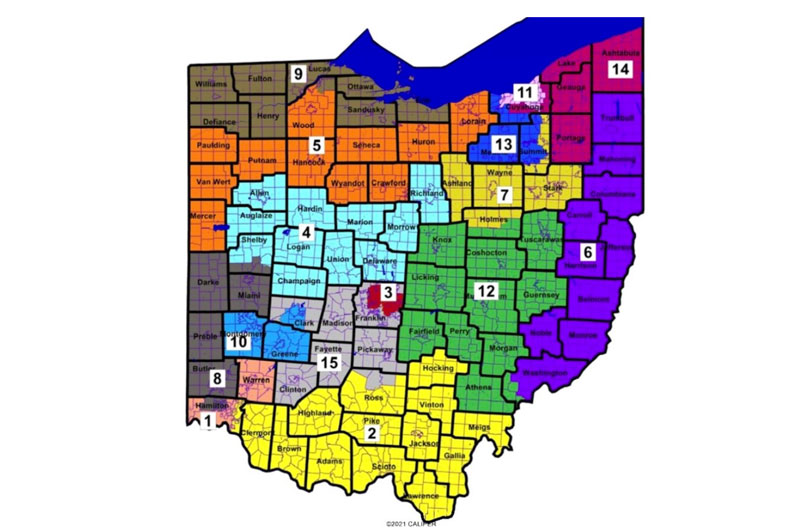
     The GOP congressional map signed by Gov. Mike DeWine. (Right-Click to enlarge map)

    Without bipartisan support, the map is slated to only be in place for four years. With DeWine’s signature, legal challenges are expected to be forthcoming. Statehouse legislative maps approved by the Ohio Redistricting Commission with only Republican support in September are facing legal challenges currently before the Ohio Supreme Court.

    DeWine’s son, Justice Pat DeWine, has refused to recuse himself from the case, making Chief Justice Maureen O’Connor the potential swing vote on the constitutionality of the Republican plans that continue Republican supermajorities in the Ohio House and Senate and now an 11-2 advantage in congressional maps with two potential toss-up districts.

    Ohio voters passed redistricting reform for state legislative maps in 2015, with more than 70% support, and congressional redistricting reform in 2018 with nearly 75% support. Those reforms called for maps that do not “unduly favor or disfavor” one political party or another.

    The map approved Thursday in the House was introduced just Monday night as an amendment replacing the maps previously discussed in committee hearings. After the map was unveiled, it had one hearing in which a committee heard public comment. Every speaker was an opponent. The Princeton Gerrymandering gave the map a flunking grade.

    An analysis of the map on Dave’s Redistricting App shows seven Republican districts, two Democratic districts and six districts listed as competitive for being within a 54-46 margin. Five in six of the “competitive” districts lean Republican, and the one that leans Democratic, Ohio’s 13th district, does so by 0.88%. It was passed along partisan lines in both the Ohio Senate and Ohio House this past week.

    DeWine’s signing of the GOP congressional maps was criticized by anti-gerrymandering advocates.

    “Once again, Gov. DeWine has failed to stand up to the extremists in his party. He could have rejected gerrymandered maps, but chose weakness instead,” said Desiree Tims, president and CEO of Innovation Ohio. “These rigged districts will lead to more extreme politicians who pass dangerous laws that devastate Ohio communities.”

    The map will give Republicans 80%  to 87% of Ohio’s congressional seats, the advocates noted, despite the fact that Republicans only win about 55% of Ohio’s statewide vote.

    “Regardless of our skin color or zip code, everybody deserves to have a meaningful influence on our political process and choosing who gets to represent us,” said Jeniece Brock, Policy and Advocacy Director of the Ohio Organizing Collaborative. “By cracking and packing communities of color, this congressional map dilutes the power and voices of Black and brown Ohioans.”

  • Statehouse Republicans introduce congressional map heavily favoring GOP

    Statehouse Republicans introduce congressional map heavily favoring GOP

     Senate President Matt Huffman, R-Lima. Photo from the Ohio Channel.

    BY: DAVID DEWITT – Ohio Capital Journal

    Statehouse Republicans introduced a newly drawn map for Ohio’s districts in U.S. Congress Monday night that maintains a firm GOP majority.

    While amendments are possible, the map is poised to pass out of a Senate committee Tuesday with a full Senate session to follow, and House sessions planned for Wednesday and Thursday.

    Data behind the map were not made available Monday evening for full analysis, but it appears to show two safely Democratic seats based in Cleveland and Columbus and a majority of others being solidly Republican or leaning Republican and one district that could be a toss-up.

    That district is one of three splitting Cuyahoga County, including the southwestern portions of it in a district with all of Medina County and Akron in Summit County.

    Hamilton County is also split into three districts, with all of Republican Warren County connected to the city of Cincinnati and an eastern portion of the county included in a district that stretches east out to Meigs County. The map also takes a chunk out of central Hamilton County for a district that stretches along the western Ohio border from Butler up to Darke County.

    Click to open in a new tab and view larger

    While the center of Franklin County in the map would be a safely Democratic seat, outlying areas in a C-shape along the northern, western, and southern portion would be included in a Republican-leaning district that stretches westward to Clark County and southward to include Clinton, Fayette and parts of Ross County.

    The map combines Montgomery County with Greene County and the central part of Clark, creates a district that stretches from Trumbull and Mahoning counties down along the Ohio River on the eastern border to Washington County, and puts Toledo and Lucas County in with Defiance, Williams, Henry, Fulton, Ottawa, Sandusky and Erie counties.

    Statehouse Republicans claim the map presents seven competitive districts and noted that it keeps seven of eight of Ohio’s largest cities whole while dividing only 12 counties.

    On Twitter, a number of Statehouse Democrats panned the proposal.

    Without bipartisan support, Republican legislators could vote through four-year maps. Any maps will have to be approved by Gov. Mike DeWine. If four-year maps go through, court challenges are likely.

    State legislative maps passed in September by the Ohio Redistricting Commission are currently before the Ohio Supreme Court after three lawsuits were filed against them. The court has four Republicans and three Democrats. Republican Chief Justice Maureen O’Connor ruled against Ohio’s current maps in 2012, and is considered a possible swing vote.