Tag: dr. amy crouse

  • Loveland Levy apparently fails by wide margin

    Loveland Levy apparently fails by wide margin

    Loveland, Ohio – With “Summary/Unofficial” results, the Loveland City School District operating levy of 6.95 mills is failing in all three counties as of 6:30 AM Wednesday morning.

    All mail-in ballots and provisional ballots will still have to be tabulated in the days to come. The mail-in ballots needed a postmark of April 27, so some of those ballots will still have to be received from the Post Office. Validly cast provisional ballots also will need to be tabulated.

    Hamilton County says they will need 2-3 weeks to publish final results.

    Clermont County

    YES – 1,988

    NO – 2,741

    Hamilton County

    YES – 1780

    NO – 2921

    Warren County

    YES 76

    NO 104

    TOTAL

    YES – 3844

    NO – 5766

    In a statement posted on the District web site, Superintendent Dr. Amy Crouse said, “We accept the outcome and respect the decision voters made, but this is a devastating loss for our schools. At this time of national and global uncertainty, we will also prepare to start the new school year in August with a significantly reduced budget, which will directly impact programs, class size, and services to our students. In addition, we will have to start preparing to go back on the ballot. This is unfortunately how school funding works in Ohio.”

    As of this morning, the “Loveland Voice” Political Action Committee has not issued a statement only posting preliminary results on their FaceBook page. Loveland Voice had organized to actively oppose the levy.

    The District statement also said:

    In addition to the $2.7 million in expense reductions already made in 2019, significant cuts will be made to the operating budget in the coming months. These reductions include, among others, the elimination of at least 25 administrative, teaching and non-teaching staff positions, and the elimination of high school busing.

    “Yes for Loveland” the Political Action Committee supporting the school levy posted this message on their FaceBook page 3 hours ago:

    According to current results, it appears the Loveland Community has voted to NOT pass the Operating Levy. Official results will be reported in 2 – 3 weeks.

    We appreciate all of your hard work and support this year. We understand we have to rally together once again to find the answer to funding the district for our children. We will do this together.

    Seeing the out pour of love for one another and the care of our community gives us all hope in this time of a pandemic. Continue to support and take care of one another. We’re all in this together!


  • [Exclusive Video] April 7 meeting of the Loveland Board of Education

    [Exclusive Video] April 7 meeting of the Loveland Board of Education

    Loveland, Ohio – On April 7 the Loveland Board of Education held a work session using a remote meeting platform.

    Here is a re-play of the meeting.

    AGENDA

    1.1 Adoption of Board Agenda

    1.2 Pledge of Allegiance

    2. Superintendent Discussion Topics

    2.1 Progress Report on Building Closure Due to COVID-19

    2.2 Planning Commission

    3. Superintendent Resolutions
    3.1 Resolution declaring an emergency, suspending board policy related to public participation at board meetings, and authorizing remote meetings


    A RESOLUTION DECLARING AN EMERGENCY, SUSPENDING BOARD POLICY RELATED TO PUBLIC PARTICIPATION AT BOARD MEETINGS, AND AUTHORIZING REMOTE MEETINGS

    WHEREAS, COVID-19 is a respiratory disease that can result in serious illness or death, is caused by the SARS-C0V-2 virus, which is a new strain of coronavirus that had not been previously identified in humans and can easily spread from person to person between individuals who are in close contact with each other (within about 6 feet) through respiratory droplets produced when an infected persons coughs or sneezes. It may also be possible to contract COVID-19 through the touching of a surface that has the virus on it then touching one’s own mouth, nose or eyes; and

    WHEREAS, the Governor has declared a state of emergency with respect to the spread of the novel coronavirus; and

    WHEREAS, the Director of the Ohio Department of Health has ordered that all K-12 schools be closed to students through 11:59 p.m. on May 1, 2020, and this order may be extended beyond that date; and

    WHEREAS, the Ohio Department of Health has further ordered residents of the state to stay at home except to conduct essential business and prohibits public or private gatherings of more than ten individuals occurring outside a single household; and

    WHEREAS, House Bill 197 was enacted on March 27, 2020 as an emergency measure which was designed to assist schools and other public bodies to maintain operations during this health emergency in a way that complies with orders issued by the state and federal government; and

    WHEREAS, in order to permit the fair and orderly expression of public comment at its meetings, the Board has adopted a public participation policy; and

    WHEREAS, while the Board intends to continue to conduct the business of Loveland City Schools and to keep the community informed of its discussions and decisions related to the official business of the District, the Board must also act to protect the health and safety of its members, staff, students and other community members who may enter on to school premises.

    NOW, THEREFORE BE IT RESOLVED, by the Board of Education of the Loveland City School District, that after careful consideration and evaluation of the information before it:

    Section 1. The Board of Education hereby finds that an emergency exists with regard to the spread of a serious communicable disease, COVID-19.

    Section 2. In order to prevent against the further spread of the novel coronavirus, the Board of Education hereby temporarily suspends its public participation policy, which shall no longer be in effect upon adoption of this Resolution by a majority of the Board. Such policy may be reinstated through a subsequent action taken by the Board of Education.

    Section 3.In order to enable the Board of Education to continue with District operations during the public health emergency,the Board of Education may meet telephonically or through other electronic means, including conference calls or other meeting technology to conduct the public business of the public body while emergency orders of the federal and/or state government are in effect limiting public gatherings. Members will be considered present regardless of whether they attend in person or remotely, and their votes shall be counted for the purpose of determining quorum. Such meetings will be properly noticed to the public through the established and usual method of notice to the public.

    SECTION 4. In order to provide an opportunity for attendance by the public, news media, and any other person that has requested notification of meetings via the technology utilized will be made available to the extent reasonably possible and feasible. The means of technology and information on how to access the meeting as a member of the public will be made available. The Board of Education intends to fully honor its obligations under the Open Meetings Act (R.C. §121.22) through measures approved by House Bill 197 (2020).

    Section 5. The Board of Education hereby finds and determines that all formal actions relative to the adoption of this resolution were taken in an open meeting of this Board of Education, and that all deliberations of this Board of Education and of its committees, if any, which resulted in formal action, were taken in meetings open to the public, in full compliance with applicable legal requirements, including Section 121.22, ORC and House Bill 197 (2020).

    Section 6. This resolution shall be in full force and effect from and immediately after its adoption and shall supersede any prior resolution or act of this Board of Education that may be inconsistent or duplicative with the provisions of this resolution.

    3.2 Resolution for a Contingency Plan for the 2019-2020 school year in the event school is closed for more than the hours permitted under board policy and state law

    CONTINGENCY PLAN

    FOR THE 2019-2020 SCHOOL YEAR

    IN THE EVENT SCHOOL IS CLOSED

    FOR MORE THAN THE HOURS PERMITTED UNDER

    BOARD POLICY AND STATE LAW

    WHEREAS, Ohio Revised Code §3313.48 mandates that a school district must be open for instruction with pupils in attendance for a minimum number of hours each school year; and

    WHEREAS, R.C. §3313.482 authorizes a board of education to adopt a plan that permits students to make up missed hours of instruction via online/remote learning in the event that schools are closed for a disease epidemic or other reasons; and

    WHEREAS, House Bill 197 (2020), which was enacted on March 27, 2020 in response to the COVID-19 pandemic health emergency, authorizes the Loveland City School District Board of Education (the “Board”) to adopt a plan to provide for online learning opportunities for students to make up an unlimited number of hours in lieu of attendance on days when buildings are not open to students during the 2019-2020 school year in compliance with any order issued by the Ohio Director of Health and/or a local board of health; and

    WHEREAS, the Board has developed a contingency plan in accordance with R.C. §3313.482 under which district students will make up any time missed through online instruction/remote learning that caused the district to fall below the minimum number of hours of instruction required by section 3313.48 of the Ohio Revised Code and Board Policy; and

    WHEREAS, the Board desires to adopt said plan; and

    WHEREAS, House Bill 197 (2020) also permits the Board to adjust the student grading criteria and the Board has determined it necessary to modify the method for student promotion and retention during this crisis.

    NOW, THEREFORE, BE IT RESOLVED by the Board of Education of the Loveland City School District that:

    SECTION I

    Pursuant to R.C. §3313.482 and House Bill 197 (2020), the Board hereby authorizes the following plan to allow students of the Loveland City School District to access and complete online/remote lessons in order to fulfill the required number of hours during the 2019-2020 school year:

    1. Each teacher shall develop a sufficient number of lessons for the days and hours of closure.
    2. Teachers will submit the lessons to the building principal for approval. The building principal will certify that the lessons are equal to or greater than the amount of instructional time the student missed.
    3. As soon as practicable, the appropriate administrator will direct staff about how to make lessons available through a District approved website or other technology portal.
    4. The teacher will be responsible for posting the lessons online.
    5. Teachers will regularly assess the progress of students and will update or replace such lessons as necessary throughout the remainder of the school year based on the results of the assessments.
    6. For students who experience difficulty accessing the online material or who do not have access to a computer, the Board hereby authorizes “blizzard bags” as needed, which are paper copies of the lessons/assignments posted. Teachers shall prepare paper copies approximating the content of the online lessons and shall update such paper copies when updating any of the online lessons. Blizzard bags will be distributed by school personnel or during scheduled pick up times. Printed copies of any graded lessons or assignments will be included in the blizzard bags.
    7. This plan was shared with the teacher’s employee representative.

    SECTION II

    Should circumstances warrant a change in the plan during the 2019-2020 school year, this contingency plan may be amended by the Superintendent at any time in his or her discretion.

    SECTION III

    In order to provide appropriate educational opportunities to students through alternative methods, to allow promotion from grade-to-grade, and so not as to penalize students who determine to complete assignments through the offered alternative means, the Board temporarily suspends current Board Policy 5421 on the award of letter grades, which shall no longer be in effect upon adoption of this Resolution by a majority of the Board. Such policy may be reinstated through a subsequent action taken by the Board. Any other Board Policy that is inconsistent with the action taken within Sections III and IV of this Resolution shall also be temporarily suspended until such time as Board Policy 5421 is reinstated.

    SECTION IV

    The Board authorizes the Superintendent and School Administration to develop and implement a system of pass/not pass grading for each course in grades 5-8 within the Loveland City Schools instructional program until such time as the Board restores the grading policy.

    SECTION V

    IT IS FOUND AND DETERMINED that all formal action of this Board concerning or related to the adoption of this Resolution was adopted in an open meeting of this Board, and all deliberations of this Board that resulted in such formal action were adopted in meetings open to the public, in compliance with all applicable requirements of the Ohio Revised Code.

    3.3 Resolution delegating authority for determining it impracticable or impossible to evaluate employees due to COVID-19

    RESOLUTION DELEGATING AUTHORITY FOR DETERMINING IT IMPRACTICABLE OR IMPOSSIBLE TO EVALUATE EMPLOYEES

    DUE TO COVID-19 

    WHEREAS, Board of Education of the Loveland City School District (the “Board”) employees are annually evaluated in accordance with Ohio statues and Board policies; and

    WHEREAS, an Order of School Closure was issued by Ohio Department of Health Director Acton on March 14, 2020 and in response to the Order of School closure, House Bill 197 (2020) was enacted on March 27, 2020; and

    WHEREAS, language contained in HB 197 (2020) permits the Board to elect not to evaluate employees when it is deemed impossible or impractical to do so based on the implications of COVID-19.

    NOW THEREFORE BE IT RESOLVED, by the Board of Education of the Loveland City School District:

    SECTION I 

    For the 2019-2020 school year, due to the Director of Health’s March 14th Order, or any extension of an order to close all kindergarten through 12th grade schools, and the language of House Bill 197 (2020), the Board hereby delegates authority to the Superintendent, Treasurer, or their individual designees to determine and deem it impossible or impracticable to conduct an evaluation of Board employees in accordance with the Ohio Revised Code and Board policies.

    SECTION II

    It is found and determined that all formal actions of this Board concerning or related to the adoption of this Resolution were adopted in an open meeting of this Board, and all deliberations of this Board and any of its committees that resulted in such formal actions were adopted in meetings open to the public, in compliance with all applicable requirements of the Ohio Revised Code.

    3.4 Approve rescheduling of Board Meetings

    Move the April 21, 2020 Board of Education Business Meeting to April 30, 2020

    Move the May 5, 2020 Board of Education Work Session to May 12, 2020

    Move the May 19, 2020 Board of Education Business Meeting to May 28, 2020

    These meetings will all be conducted in a virtual format due to the extension of the “Stay at Home” order signed on 4/2/2020.

    4. Treasurer Discussion Topics

    4.1 Costs Related to the Building Closure Due to COVID-19

    5. Treasurer Resolutions

    5.1 Recommend to refund tuition for full day kindergarten for 50% of March and 100% for April

    6. Meeting Closing
    6.1 Adjournment
  • Loveland School Budget Cuts – Responsible Management?

    Loveland School Budget Cuts – Responsible Management?

    Kim and Rick Donaldson live on Paxton Road in Miami Township

    by Kim and Rick Donaldson

    At its February 18th business meeting, the Loveland City School District Board of Education reviewed the administration’s updated five-year financial forecast, which includes annual operating expenditure cuts averaging $2.5 million and fee increases averaging $0.2 million.* The updated forecast still requires passage of a 6.95 mill operating levy, which will raise annual revenue by $6.3 million, to maintain an adequate cash balance through fiscal year 2024. Indeed, the included budget cuts were made for the express purpose of limiting the levy to only 6.95 mills. So, after cutting $2.5 million from expenditures, why do we need an additional $6.5 million (taxes plus fees) in revenue? Let’s look at the numbers.

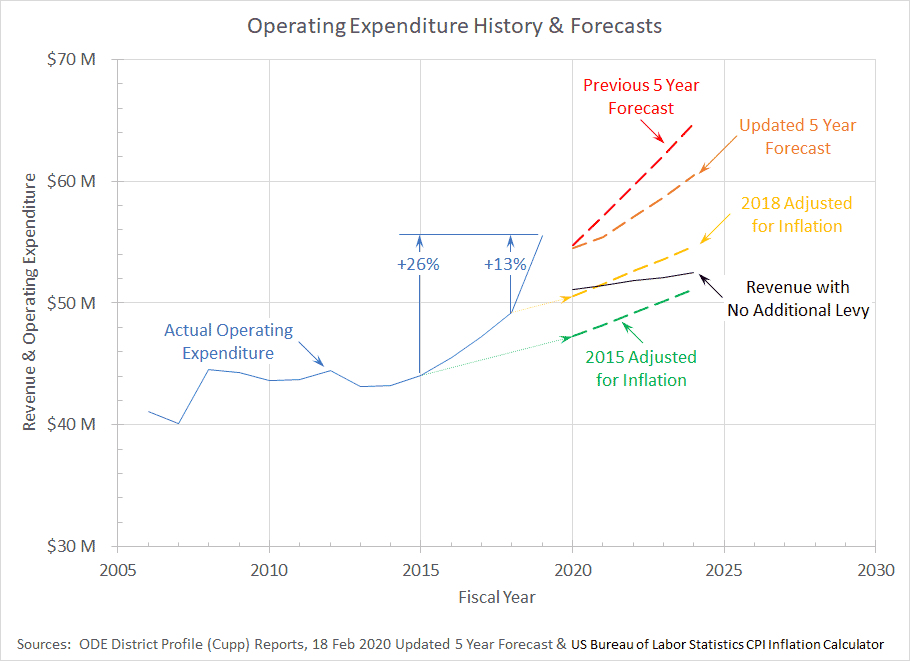
    This graphic is the Donaldson’s original presentation of the data sourced from the Ohio Department of Education and the US Bureau of Labor Statistics as noted on the chart and in the list of references.

    As shown in the included chart, both five-year forecasts start from a very high baseline expenditure level established in 2019 when operating expenditures increased 13% from the previous year.** That increase was the culmination of an accelerated spending trend that started in 2015, bringing the total four-year increase to 26%. By comparison, the cumulative inflation rate was only 7.7% during the same period.*** This rapid expenditure increase quickly overtook the 23% annual revenue increase in the years following the 2014 levy.

    Since median income tends to be tied, albeit loosely, to inflation, expenditure increases that exceed the inflation rate make our schools increasingly less affordable to taxpayers.

    Furthermore, it is important to recognize that the spending cuts and fee increases included in the updated forecast are all relative to the previous forecast, which anticipated increasing expenditures by 4% annually. Since the Federal Reserve Board targets a 2% annual inflation rate, the plan was to increase spending by twice the rate of inflation. The updated forecast anticipates annual increases of 3%, which is still 50% above the target inflation rate. Since median income tends to be tied, albeit loosely, to inflation, expenditure increases that exceed the inflation rate make our schools increasingly less affordable to taxpayers.

    As a more affordable alternative, we advocate limiting operating expenditures to 2015 levels on a per student basis, adjusted for inflation.  As shown on the chart, this approach would result in spending much lower than the updated five-year forecast and, more importantly, lower than current projected revenue. It would thus obviate the need for any additional operating levy. It is worth noting that this would be consistent with, and a continuation of, expenditure trends from 2006 through 2015.

    If a 2015 baseline seems too aggressive, the same approach using a 2018 baseline could be considered. Although it would require an additional levy, the levy vote could be postponed to November 2021 and would only need to be around 1 mill to maintain the same cash balance as in the updated forecast.

    These particular cuts, chosen by the administration, raise some serious questions.

    So, what would we cut? After all, in the same February 18th presentation we were told that we will have to eliminate teaching and staff positions even if we approve the levy in March. We have also been warned that failure to pass the levy in March will result in additional cuts, including staff, teachers and high school transportation. These particular cuts, chosen by the administration, raise some serious questions. If we could afford current staffing levels in 2018, why can we not afford them in 2021 with nearly 13% higher expenditures in the updated forecast?****  Even if we choose to defeat the levy and limit expenditures to inflation-adjusted 2018 levels, why could we not continue to support essentially the same staff and transportation that we did in 2018? Where is the additional money going, and why has the administration chosen to cut staff and transportation?

    Before we head to the polls in March, we need to have satisfactory answers to these questions that are quantitative, complete and transparent. We need to know whether the proposed budget and associated cuts are indicative of fiscally responsible management for the benefit of our children, or emotional manipulation designed to get the levy passed.  Ultimately, it comes down to a question of trust.

    References:

    *5 Year Forecast Update from 18 February 2020 Board Meeting:  https://go.boarddocs.com/oh/love/Board.nsf/files/BLY4FG0B571B/$file/5%20Year%20Forecast%20Presentation.pdf

    **Ohio Department of Education District Profile (Cupp) Reports:  http://education.ohio.gov/Topics/Finance-and-Funding/School-Payment-Reports/District-Profile-Reports

    ***US Bureau of Labor Statistics CPI Inflation Calculator:
    https://www.bls.gov/data/inflation_calculator.htm 

    ****Ohio Department of Education District Teacher Information:  https://reportcard.education.ohio.gov/download

  • Our youngest Loveland Tigers know these three words well

    Our youngest Loveland Tigers know these three words well

    by Kathryn Lorenz

    Our youngest Loveland Tigers know these three words well. Here in Loveland schools, we care for each other. We respect each other. And we take responsibility for our words and actions. 

    The Loveland Board of Education strives to do our best to live up to the expectations our teachers and staff have for our students. We care about each and every member of our school community and demonstrate that with leadership and fiscal responsibility. That care means we regularly need to place tax levies on the ballot in order to ensure the operation of programs that our students need and deserve. 

    The way taxes work in Ohio means that a school board respects the right of our district citizens to vote on these levies. We need to show the necessity for new operating funds and do so with the publishing of budgets, expenditures, and five-year forecasts. We publish the evidence of the success of our students as well.

    The last operating levy passed in 2014 was designed to move the district from a “stay put” mode of operation to a time of forward progress and was strongly supported by our community. Our teachers and students delivered significant achievements as a result of that change in direction and now we need to protect that investment and optimize that effort.

    Acting responsibly means telling the truth and sometimes means that you cannot respond in kind when false, harmful accusations are made.

    Acting responsibly means telling the truth and sometimes means that you cannot respond in kind when false, harmful accusations are made. But responsible public servants also stand up for what is true. There are many false statements being made about the March 2020 levy, about the Board of Education, and about the people who work with us and for us. The Loveland school district and this Board of Education are committed to optimizing resources, to extending the adequacy of 2020 levy funds as long as possible, and to continuing progress for Loveland students. 

    Please take the time to review the information on our website, lovelandschools.org under the levy tab. Take the time to talk to our board and our administrators. Attend a board meeting or an information session.  Get the right information right now. 

    We know our community cares about our schools. We respect the right of our citizens to vote on March 17. Each of us has a great responsibility for the future of Loveland schools. 

    Kathryn Lorenz is the President of the Loveland Board of Education and lives in Miami Township

  • March Levy  Madness

    March Levy Madness

    The view from 30,000 feet.

    Jim Hooper lives in the Loveland High School neighborhood

    Jim Hooper

    Catchy common phrase. Heard it used a couple times at the LCSD Adhoc committee meetings. Thought I ‘d try it out to gain perspective on the LCSD Levy situation.

    Whoa, it’s high up here!

     I see Loveland as a whole, comprised mainly of ranch style homes, modest neighborhoods, occupied by homesteader types who have lived in Loveland for decades – more semi-rural/rural than urban. Look down on West Loveland Ave, Rich Road, Rte 48, The Heights, Lebanon Road, the Glen Lake neighborhood, out towards Grailville , all the smaller roads off these arteries and you will see Loveland. Pocketed among these byways are sub-divisions like Chatham Woods, Pheasant Hills on the Lake, Woodford, White Pillars.

    I see the Loveland School system. Led by the Board of Ed and the LCSD Superintendent. The BOE members are elected officials which automatically makes them politicians, whether they see themselves that way or not. We all know how politics works – from the local constituency the politician seeks out his/her core bloc of voters, those voters who will deliver the necessary votes to successfully elect. These politicians (BOE) are beholden to this core bloc. The bloc group influences the Board by way of their backing.

    So what influence does 2,447 bloc voters have on a School Board and Superintendent?

    In the case of the LCSD  Board of Ed I think we can fairly safely establish the core bloc of voters is 2,447 persons. I am thinking anyone voting FOR a 16.78 mil levy is definitely a BOE core bloc voter. So what influence does 2,447 bloc voters have on a School Board and Superintendent?  A LOT!  Especially under the “normal circumstances” of a levy issue – off year voting, little interest by the silent majority who assume their financial

    The “Board Whisperers”

    interests are being conservatively managed – the 2,447 voter bloc, under these conditions, pretty much guarantees the election of their candidates.  And, pretty much guarantees the Board of Ed will be very receptive listeners. These people are the Board influencers – the “Board Whisperers” – the people in the ear of the Board members. They are the localized version of lobbyists. And, many of them are inside the school system where their voice is amplified many times over. Their job circumstances are directly impacted by money the LCSD spends.

    Now I’m listening, now I’m reading, now I’m researching, now I’m in it with both feet.

    Now under normal conditions, I don’t really mind this influencing activity. The only time I would perk up my ears and take an outsized interest would be, let me think,  perhaps when this influencing campaign produced an unheard of, unconscionable, state record 16.78mil levy. Now I’m listening, now I’m reading, now I’m researching, now I’m in it with both feet.

    I have heard a lot about trajectory, vision, maintaining forward growth, maintaining gains. Hey, I’m all for it! I support 2-3% trajectory, 2-3% vision gains, 2-3% growth gains. I fully support increase in hard work, efficiency, increased productivity. I fully support the LCSD taking baby steps to move up the rankings ladder. Set a vision of moving up 5 steps at a time. Great! Let’s not set a vision to move from a Value-Added rank of 433 to 22. I applaud the excellent 22 ranking. I do not applaud the fact that a lot of taxpayer dollars went into buying that result!

    You know, the Bengals could be in the Super Bowl – all it takes is spending  $$$. You know, the Reds could be in the World Series, all it takes is spending $$$. You know, the LCSD could be better than Indian Hill and Sycamore – all it takes is spending $$$ – taxpayer money!

    My opinion is that there are “silent agendas” in our schools that the silent majority know nothing about.

    Returning to the LCSD/Superintendent vision for LCSD. Firstly, what is that vision? I know only one thing about it – it costs lots of money($$$). Sorry, I do know another thing, that 78% of voters do not know Dr. Crouse’s vision for LCSD. Although, I am beginning to get some hints – $6,365,528 spent on technology improvements. Is this a Dr. Crouse vision, to be the most technologically advanced school system in the area. A four year 69.1% spending increase in “Support for the Instructional Staff”. $5,717,737 spent with Hamilton County ESC over 5 years. My opinion is that there are “silent agendas” in our schools that the silent majority know nothing about. These silent agendas are driven by the “Board Whisperers” – backed up by their votes at election time.

    The taxpayer asked for $20/month over and over doesn’t realize they are slowly being taxed to death.

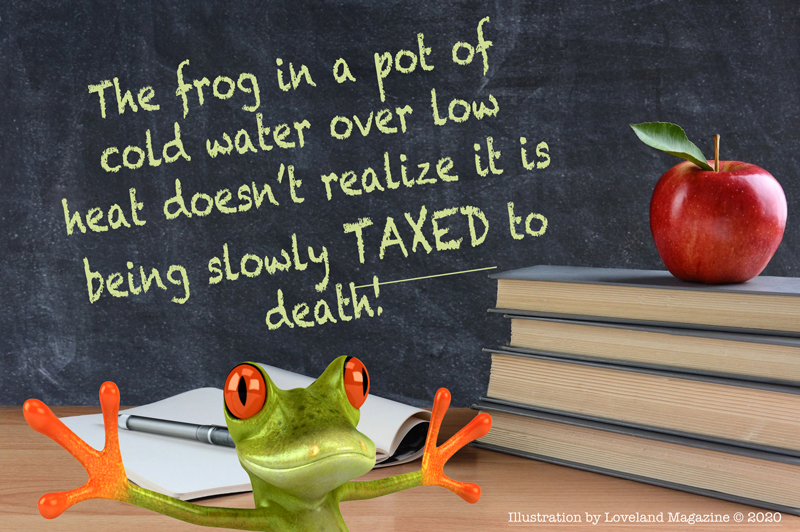
    Again let me say, I have no issue with school agendas moving forward at a conservative, sustainable, within a budget pace ( 2-3% a year). I do have a huge problem with the LCSD making quantum leaps bought with my tax dollars. Now I have heard it said, “it is only $20.27/month per $100,000 appraised home value. Let me use an old saying – the frog in a pot of cold water over low heat doesn’t realize it is being slowly boiled to death – and the taxpayer asked for $20/month over and over doesn’t realize they are slowly being taxed to death.

    What is really beginning to bother me is the total lack of self-reflection by the 22%. Based upon all I have read on social media the attitude is that “nothing wrong here – nothing to see here”, we know what is right, you (78%) are uninformed, and get out of our way. I must interpret that to mean spending will continue unabated. Not exactly the response hoped for (or expected) after a 78% to 22% drubbing at the polls. 

    I also hoped the myriad of testimonials from “forever” Yes voters that had been pushed to the difficult position of voting No would have enlightened the minority to question maybe something does need to change.

    A consequence of losing a vote by a landslide 78-22% and in so doing shattering a trust that had been working for decades is the “trust but verify” is now “verify, verify, verify”. All aspects of the LCSD are now under a microscope for review. 

    The child learns not to touch a hot stove once; it seems the adults must touch the hot stove twice before a lesson is learned.

    I am a “Know Vote”!

    Jim Hooper lives in the Loveland High School neighborhood


  • Walter Golladay: Combined property tax levy/earned income base tax should be considered

    Walter Golladay: Combined property tax levy/earned income base tax should be considered

    by Walter D. Golladay

    In January 2020, Social Security, federal and military retirees received a miserly 1.6 percent cost-of-living pension increase. In 11 years, our COLA reflects a cumulative increase of only 15.2%.

    Rather than living with the financially harsh and punitive School Property Tax Levies Ohio residents have been subjected to for decades, retirees should be advised that in the State of Ohio there are two secondary income funding sources available to Ohio School Districts and voters.

    I refer you to the Ohio Department of Taxation “Guide to Ohio’s School District Income Tax”. https://www.tax.ohio.gov/school_district_income.aspx

    For retirees in the state of Ohio, there are two types of School District Income Taxes, one BAD, one GOOD.

    The BAD Tax is a School District “traditional base tax”. The same tax retirees pay today to the state of Ohio. The BAD tax includes pension and retirement income. Today, approximately 144 Ohio School systems have implemented this voter approved tax. ORC 5748.021 allows a school district with a traditional base tax to go to the ballot to replace that tax with an earned income base tax.

    The GOOD Tax is School District “earned income base tax”. On page 4 of the above mentioned Guide, it states that Earned Income Tax excludes such items as interest, dividends, capital gains and pensions. The City of Loveland utilizes this form of taxation on our retired pensions.

    Today, approximately fifty-nine Ohio school systems have implemented this voter-approved tax. Earned Income taxes range from a low of one-quarter percent to a high of two percent.

    Loveland voters should be aware that a school board can adopt only one School District Income base tax, not both. So earned income base tax is the solution for we retirees. ORC 5748.02 (E) prohibits a district from having school district income tax levies with both bases.

    After the unsupported March 2020 Property Tax Levy is defeated, I would suggest the

    Loveland City School District seriously consider, in their next proposed tax levy, a properly vetted and much lower combined school tax levy consisting of a property tax … AND … a earned income tax.

    For the benefit of our many retired Loveland residents, the primary goal is to soften the financial impact on them every time our school district needs to acquire more funds to operate their many programs.

    A secondary goal is to ensure the school district discusses in detail with our concerned and extremely knowledgeable residents and voters prior to the next tax levy being placed on the ballot.  If a favorable response from the community is received then a combined lower property tax levy AND earned income base tax should be proposed.

    Common sense indicates that Loveland School District would do well to garner residential voter endorsement, rather than opposition.

    Walter D. Golladay is a resident of Loveland, Ohio


  • Loveland Magazine Directory of local government leadership in 2020

    Loveland Magazine Directory of local government leadership in 2020

    Loveland City School District

    Dr. Kathryn Lorenz President

    Ned Portune Vice President

    Art Jarvis – Member

    Michele Pettit – Member

    Eileen Washburn – Member

    Dr. Amy Crouse – Superintendent

    Kevin Hawley  Treasurer/CFO


    City of Loveland

    Kathy Bailey – Mayor

    Robert Weisgerber – Vice Mayor

    Andy Bateman – Member

    Ted Phelps – Member

    Tim Butler – Member

    Neal Oury – Member

    Kent Blair – Member

    Dave Kennedy – City Manager

    Michelle Byrde – Finance Director


    Symmes Township

    Jodie Leis – Board President

    Kenneth N. Bryant – Vice-President

    Phil Beck – Trustee

    Joseph C. Grossi – Fiscal Officer

    Kimberly A. Lapensee – Administrator


    Miami Township

    Ken Tracy – Chairperson

    Mary Makley – Vice Chair

    Karl Schultz – Member

    Eric Ferry – Fiscal Officer

    JEFF WRIGHT – Township Administrator


    Hamilton Township

    Brent Centers – Administrator


    Deerfield Township

    Kristin Malhotra – President of Board of Trustees

    Lelle Lutts Hedding – Vice President of Board of Trustees

    Jim Siciliano – Trustee

    Dan Corey – Fiscal Officer

    Eric Reiners – Township Administrator


    City of Milford

    AMY VILARDO – Mayor

    LISA EVANS – Vice-Mayor

    KIM CHAMBERLAND – Member

    ANET COOPER – Member

    TED HASKINS – Member

    SANDY RUSSELL– Member

    Kyle Mitchell – Member

    MICHAEL DOSS City Manager

    Patricia Wirthlin – DIRECTOR OF FINANCE


    City of Montgomery

    Chris Dobrozsi – Mayor

    Craig Margolis – Vice Mayor

     Lee Ann Bissmeyer – Council Member

    Michael Cappel – Council Member

    Gerri Harbison – Council Member

    Lynda Roesch – Council Member

    Ken Suer – Council Member

    Brian Riblet – City Manager

    Katie Smiddy – Finance Director


    Clermont County

    David L. Painter – President

    Edwin H. Humphrey – Vice President

    Claire B. Corcoran – Commissioner

    Thomas J. Eigel – County administrator


    Hamilton County

    Denise Driehaus – President

    Stephanie Summerow Dumas – Vice-President

    Victoria Parks (Appointed)

    Todd Portune (Retired)

    Jeff Aluotto – Administrator

    DEPARTMENTS

    Warren County

    Tom Grossmann – Commissioner
    Shannon Jones – Commissioner
    David G. Young – Commissioner
    Tiffany Zindel – Administrator
    Martin Russell – Deputy Administrator
    Tina Osborne – Clerk of Commissioners

    Property Search
    Job Opportunities
    County News
    Auditor’s Office
    Recorder’s Office
    Child Support
    Water Department
    Building & Zoning
    Maps & GIS
    Disclaimer
    Directions
    Warren County Campus Map

      • Auditor – 513-695-1235
      • Clerk of Courts – 513-695-1120
      • Commissioners – 513-695-1250
      • Engineer – 513-695-3301
      • Prosecutor – 513-695-1325
      • Recorder – 513-695-1382
      • Sheriff – 513-695-1280
      • Treasurer – 513-695-1300


  • [VIDEO] December 10 School Board Meeting

    [VIDEO] December 10 School Board Meeting

    Loveland, Ohio – This video is of the Loveland City School District Board of Education meeting held on December 10, 2019.

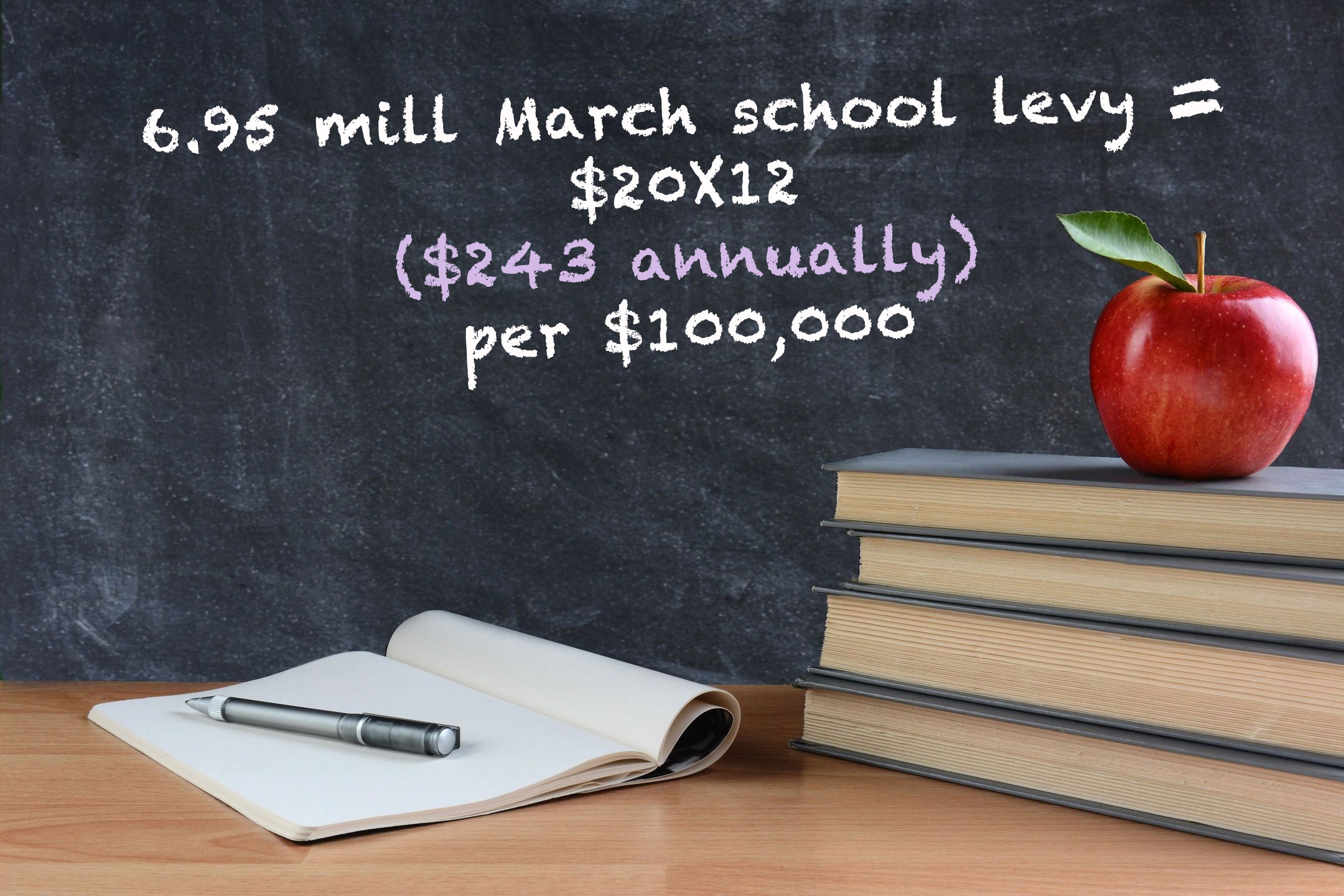
  • 6.95 mill March school levy translates into approximately $20/month ($243 annually) per $100,000

    6.95 mill March school levy translates into approximately $20/month ($243 annually) per $100,000

    Loveland, Ohio – On Tuesday, December 17, the Loveland Board of Education voted unanimously and passed a resolution to place an operating levy of 6.95 mills on the March 2020 ballot. The decision follows a failed combined operating and permanent improvement/bond issue of 16.78 mills on the November 5, 2019 ballot. “YES” votes totaled 2,447 and “NO votes totaled 8,634.

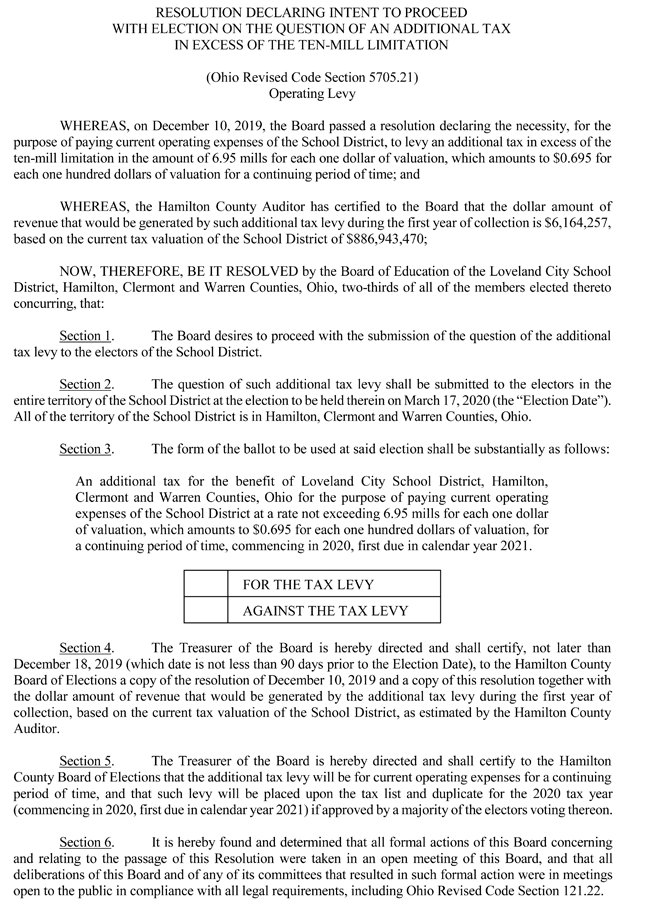
    The failed levy was for the same millage amount of new operating funds the voters will be asked to approve on March 17 – 6.95 mills. The Hamilton County Auditor estimates the new operating levy would generate $6,164,257 in the first year of additional income for the District. Collections would begin in 2021.

    The cost of the combined 16.78-mill levy translated into $49 monthly per $100,000 of appraised home value. If passed last November, collections would have begun in 2020. The failed November levy included 9.83 mills to pay for issuing $118.515,000 of debt for new construction, 3.41 mills for additional permanent improvements and 6.9 mills for operating expenses.

    The new levy request will be approximately $20/month ($243 annually) per $100,000 of appraised value.

    The last operating levy was for 5.6 mills and it was passed in May of 2014

    In a press release, the District said that there will be approximately $2.7 million of budget cuts made in conjunction with the levy. According to Superintendent Dr. Amy Crouse, they will include a combination of reductions in the “instructional cycle budget” (textbooks, etc.), staff and contracted services, and others.

    According to the District, if the March levy fails additional cuts would be made before the district would go back to the ballot and ask for additional operating funds in November of 2020.

    Operating levies fund the school district’s day-to-day expenses, including the salary and benefits of staff, which the District says make up approximately 83 percent of operating expenditures. Loveland Schools receive about 32 percent of its budget revenue from the state. The majority of the current budget, nearly 60 percent, is generated locally – mainly through property taxes. This locally-generated source of funding is also flat due to Ohio House Bill 920, which prevents schools from collecting additional revenue as home values increase over time.

    In addition to voting for a March levy, the board has discussed the intention to look into options for increasing transparency and community involvement, through community advisory groups, one of which would focus specifically on school funding issues and advocacy at the state level.

    Dr. Crouse said that the facility needs that were addressed in the failed bond levies in November will be on hold for the foreseeable future. Crouse said in the release, “Our school facility needs as presented earlier this year still remain and will eventually need to be addressed.” She added that the board will not be placing any levy on the ballot for facilities in November of 2020.

    The master plan that is shelved outlined a new campus at Grailville for all Pre-K through fifth-grade students. It included repairs, renovations, and additions to the Middle School/Intermediate School and High School campuses. The money would also have been used for upgraded building security at all schools with secure entrances, camera systems, and electronically-activated locks. It included upgraded and expanded science and technology laboratories for biotechnology and robotics, among others. Included in the master plan was a new auditorium/fine arts center at the high school. The current auditorium would have been repurposed as academic space. The master plan also included upgrades and enhancements to athletic facilities at both the Middle and High Schools. Architects hired by the District developed the budget for the total project ($165 M).

    Also read:

    Below is the Resolution that was delivered to the Hamilton County Board of Elections with the ballot language.

    The District has provided this way to most accurately calculate the cost of the March levy to property owners:

    How much will the levy cost home owners?
    The 6.95 millage rate translates into $20.27/month ($243.25 annually) per $100,000 of appraised home value as determined by the county auditor. To understand exactly how much the district’s 6.95-mill operating levy will cost your household, you will need to know your home’s appraised (or fair market) value as determined by your county auditor. Go to your local county auditor’s website and do a real estate property search:
    Hamilton County (https://wedge1.hcauditor.org/)
    To find the appraised value, referred to as “Market Value,” go to “Tax Distributions” in the right column.
    Clermont County (https://www.clermontauditor.org/_web/search/commonsearch.aspx?mode=owner)
    To find the appraised value, go to “Values” in the left column.
    Warren County (https://www.wcauditor.org/Property_Search/)
    To find the appraised value, see “Value History” in the left column. The appraised value will be listed as the “True Value.”
    Please note that the assessed value, which is used by the auditor to determine your tax obligation, is 35% of the appraised or market value. A home that is appraised at $100,000 is taxed on only $35,000:
    $35,000 x .00695*= $243.25/annually, or 243.25÷12=$20.27/monthly*.00695 equals the millage rate of 6.95.

    Also read…

    Board of Ed cancels contract with Allerton Hill Consulting

  • Board moves to place 6.95 mills on the March 2020 ballot

    Board moves to place 6.95 mills on the March 2020 ballot

    Loveland, Ohio – The Loveland Board of Education met on Tuesday, December 17 and unanimously passed a resolution to place an operating levy of 6.95 mills on the March 2020 ballot. The deadline to file the resolution with the Hamilton County Board of Elections is today, December 18.

    Neither Board Superintendent Amy Crouse or Treasurer/CFO Kevin Hawley wanted to speak to Loveland Magazine after the meeting, so details of the implications of the levy are sketchy. Neither Crouse or Hawley would discuss the budget cuts they are proposing or the amount the levy would provide the District. However, Crouse did say last week in a press release, “Approximately $2.7 million dollars of budget cuts will be made in conjunction with the levy. They will include a combination of reductions in the instructional cycle budget (textbooks, etc.), staff, and contracted services, among others.”

    Last week’s press release also said:

    The 6.95 millage levy translates into approximately $20/month ($243 annually) per $100,000 of appraised home value as determined by the county auditor.

    Below is a LOVELAND MAGAZINE TV video of the 14-minute meeting.

    In the interview below Dale Friemoth, a member of the

    Loveland Voice on Facebook: “Voter Oversight, Involvement, Concern for Education.”

    District Ad Hoc Advisory committee that was appointed to discuss how the District should move forward after the defeat of a combined operating and bond issue that was on the November ballot discusses the Board’s vote. He talked about the new levy and also about a new community organization that has formed, Loveland Voice. Friemoth said they will meet soon to discuss their actions going forward. One thing he stressed is that he feels that the Board must take purchasing the Grailville land off the table at their next meeting if they want voter support for the new levy.

    Below is the Resolution that was to be delivered to the Hamilton County Board of Elections today.