Loveland teacher motivated by former student and war hero
Mihaela Manova
by Mihaela Manova
Loveland, Ohio – Students, may not know what goes on in their teacher’s lives, but the impact that they give is indisputable. Good or bad in behavior or teaching, the students not only take new knowledge from them every day but a mindset. Julie Powers, or Mrs. Powers, as her math classes call her, is not just a regular teacher who comes in, educates, and goes home to only complete the same cycle every day.
Her drive to teach is not motivated by a sum of a paycheck, but the kids themselves that come in every day. The evidence? Ask any student that has sat in her class, any person who has talked to her about their day and of course her close bond with the local and national hero, Seth Mitchell.
Teaching at Loveland High School, Julie Powers has encountered many students in her career and has had a close relationship with the Loveland High School Senior class of ‘97. One of the students she met was hero Seth Mitchell, a student with not only a good heart but a genuine soul towards the people around him. After high school, he joined the U.S Marine Corps and fought for our country in the Iraq-Afghanistan War where he was killed in action.
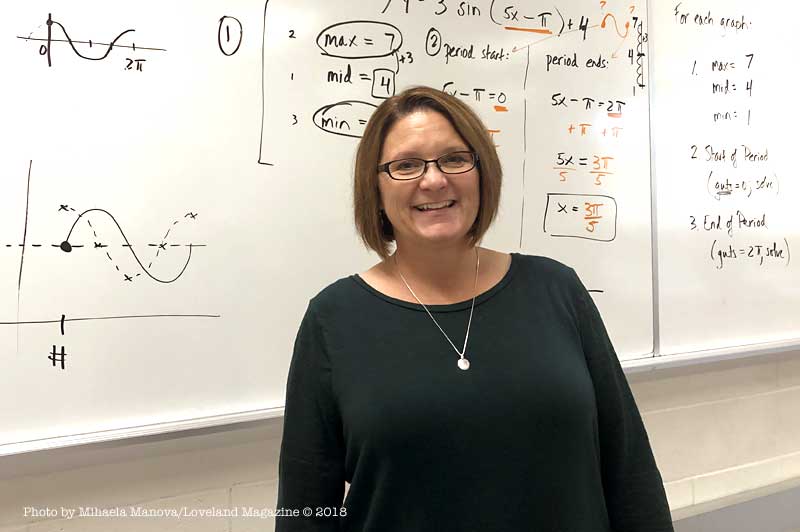
Loveland High School Math Teacher Julie Powers
Since his passing in 2009, his family and friends have organized the Captain Seth Mitchell Hero 5K every Fall in memory of his life. The proceeds collected during the race are given for scholarships for 12th-grade students at Loveland High School and are helping other people out, just like Seth.
I recently sat down with Mrs. Powers and asked her about herself, the teaching profession, and Capt. David Seth Mitchell.
I know that the Seth Mitchell Race happened a couple of weeks ago, what kind of thoughts did you experience during it?
I had surgery before the race this year, so I didn’t walk, and I’m a walker. I didn’t even get on the trail. Instead, I stayed back with some of the other people that graduated with Seth, who are now adults and who have kids and families. They graduated in the 90s and seeing them 20 years into the future is really kind of cool.
If you look at Seth and how he lived his life and what he wanted to do with his life, he didn’t miss a beat. He went after his goals and he worked hard to achieve them.
It was really neat to just talk to them and at the same time it makes me a little bit sad because you can’t do that with Seth. He’s gone, and he can’t live that part of his life. But I think the hardest part of losing someone so young is feeling like they’re never going to get to this accomplished or have this experience, have a significant other, have children if they wanted to or travel the world.
If you look at Seth and how he lived his life and what he wanted to do with his life, he didn’t miss a beat. He went after his goals and he worked hard to achieve them.
Can you tell me about the class of 97’?
They were amazing people when they were in high school and are even more amazing now as adults. They are some of the most giving, selfless individuals that I met back when they were sophomores. Some of them I taught in 8th grade in Algebra 1 Honors and Algebra 2 Honors and then Calculus, so I knew the group pretty well and being their advisor for Student Council, I got to work with a core of them for almost four years.
It’s hard for me to explain to you the personality or the feeling of the class.
I have never done another student council class after them because that class just meant so much to me and I knew so many of them so well, not even just the student council kids. It’s hard for me to explain to you the personality or the feeling of the class.
Those kids had blurred boundaries, (for example) just because you were in Show Choir didn’t mean that was your only identity. It was the class that I’ve never seen before, it didn’t matter what their ‘thing’ was, many of them had many ‘things’ going on with their lives.
You don’t normally have the kids that are on the big athletic teams, doing Student Council and then going out and saying “Let’s go build floats out of chicken wire, tissue paper, and glue!” So when the last day came for them in May 1997, it wasn’t like the last few years. Oh are they going to do anything crazy!? It wasn’t like that at all.
The bell rang and they all kind of just strolled out of their classes, not running, screaming, and yelling; they were in the hallway being happy and sad at the same time, because it was their last time together as a class.
And you don’t see that type of reaction often, and it wasn’t that Seth was the only person; he was in the group that was just that special. I could name so many names in that class that could just go out of their way to be amazingly nice. There weren’t any little cliques and it just wasn’t like that.
Can you tell me about being an educator and the politics that surround this role?
I never thought about politics until I was in my 30s. I was like, “My vote won’t count.” and I didn’t think it did, as an educator, there were more things that affected me. That’s what pulled me into it. Seeing the current Secretary of Education, Betsy DeVos, we should not put somebody in this department who has never worked in a public school, ever, and who sends all their children to private schools while being a millionaire. Someone who is in charge of education needs to be a former educator, not a business person.
That’s just beyond what I can stand. I would look at the people running for office and I literally would just look at their platform on education and what they thought about it. My take on education has been pretty consistent but it has also changed a bit.
Especially after last year, I volunteered to teach a lower Algebra class and I did it on purpose. I learned a lot about the amount of poverty that is in Loveland. I had drawers full of food for these kids. I now see that as a society we need to take care of the family unit in families that are impoverished because we’re missing the boat.
What are their lives like when they go home after school?
Not only supporting them through schools, not only getting them free and reduced lunches, but if we don’t support them from preschool to kindergarten, it’s all gone. What are their lives like when they go home after school? And the kids in grade school, is there no one there to watch them? What kind of problems do they have? Do they have one parent, two parents?
If we don’t look at that part of it and spend money trying to support the people that don’t have anything, I don’t think we’re going to get anywhere with education. I think there are more critical issues that happen that can even affect the classroom.
If I can show these students by my actions that there is another adult in this building who cares about them as people, I will have succeeded. Now whether or not we get math done is a separate issue, because the first thing that had happened was, they had to learn that they could trust another adult. Some of them have very few, if any, adults that they can trust because they’ve been taught by all kinds of experiences that they can’t and so that was my goal for the class.
We teach students not subjects.
Do you think social media influences people in our society right now?
If you look at our society we are a little bit like a microcosm. Look how polarized our society is now with just politics. I’m not taking sides but I’m just saying, they can’t find a middle ground no matter which side you are on.
Like you just talked about social media, Instagram promotes stuff for fundraising and that’s good, that’s necessary. That’s what social media’s for, to use it in a good way but I also think that it pushes people into boxes more.
I’m sorry I don’t post on social media because my life is boring, I don’t want people to know everything, I’m not interesting, I don’t want people following me. I even told my husband, “You will not post my picture on Facebook!”
Books vs Video Games
Think about when you read books (depends on what kind of books you’re reading ) but the more books you read the more it makes you think. Then okay, so playing video games or reading some books? Which one is going to open your mind which one is going to have you thinking?
And even if you’re not thinking about the book when you read it, sometimes you might be driving and be like ‘Huh, that’s interesting what that one person did…’ and it makes you process stuff again and again, but when playing a video game, your game is done when your battery finishes.
What embodies Seth?
I mean he definitely was someone who would always be very “other” sensitive, like in a classroom. If he saw somebody that was down even if it wasn’t one of his best friends, he would still reach out, quietly, and not make a big deal out of it. He would be like, “How are you doing? Are you ok?” The picture of him in the main lobby with a smile on his face and the gun on his back is the same smile I saw him with everyday.
Captain David Seth Mitchell was killed on October 26th, 2009 at age 30 while on a mission he volunteered for when two helicopters collided while supporting combat operations in Afghanistan’s Helmand province. He was a 1997 Loveland High School graduate and President of his Senior Class. (Learn more: Keep Captain Seth Mitchell’s memory alive)
I know that he struggled a little bit, there were some times in high school for Seth that were a bit dark and challenging and he had to go through some stuff, but his faith was very important to him, so that made a big difference. Even with that, the time I remember during the years that he was here, he just was someone who worked so hard.
It didn’t matter if math did not come easily to him and it didn’t, in fact, the day after his parents found out (of his passing) his mom immediately said to me, “Oh Julie, Seth was never very good at math.”
I told her, “It made no difference at all because it was what kind of a worker he was. It was that work ethic that made Seth who he was, he wouldn’t give up, and that he would just keep on trying.”
By the end of our long talk, I got to know Mrs. Powers more than I could ever imagine, making me think that some teachers are not just here to educate you, but also to support you throughout the years. Educators like Mrs. Powers need to be praised not only for the work that they do but for their dedication to their students. Students will see and appreciate any teacher who stimulates, encourages and reaches out to them.
I would like to say thank you to Mrs. Powers for her support in her student’s lives.
If you find value in reading these Election Results and the expense involved in putting it together, please…These results have been posted after the Clermont, Hamilton, and Warren County Boards of Elections have published their “Unofficial Results” and all precincts have reported 100% unless noted as of 12:30 AM. Official results must be certified by the various Boards in the coming weeks.
Local School Taxes
Loveland City School District
Combined Operating and Bond Levy
Clermont Co.
YES – 1219
NO – 4101
Hamilton Co.
YES – 1185
NO – 4394
Warren Co.
YES – 43
NO – 139
TOTAL –
YES – 2447
NO – 8634
Goshen Local School District
Bond Levy 5.24 mills – 34 years
Warren Co.
YES – 91
NO – 106
Clermont Co
YES – 1264
NO – 1668
TOTAL
YES – 1355
NO – 1774
Kings Local School District
4.96 mills Bond Levy
YES – 3508
NO – 3675
Sycamore School (34 of 36 precincts)
4 mills Bond Issue
YES – 6067
NO – 3758
Lebanon City Schools
Additional Levy 4.99 mills for 4 years
YES – 5522
NO – 4389
Local Candidates
Loveland City Council at Large – 3 elected to a 4-year term
Pat Ahr
Clermont Co. – 249
Hamilton Co. – 866
Warren Co. – 68
TOTAL – 1183
Kathy Bailey
Clermont Co. – 659
Hamilton Co. – 1840
Warren Co. – 143
TOTAL – 2642
Andy Bateman
Clermont Co. – 581
Hamilton Co. – 1493
Warren Co. – 116
TOTAL – 2190
Kent G. Blair
Clermont Co. – 481
Hamilton Co. – 1290
Warren Co. – 102
TOTAL – 1873
Cory O’Donnell
Clermont Co. – 216
Hamilton Co. – 509
Warren Co. – 44
TOTAL – 769
Angela L. Settell
Clermont Co. – 243
Hamilton Co. – 931
Warren Co. – 73
TOTAL – 1247
Loveland Board of Education – 2 elected to a 4-year term
Arthur R. Jarvis
Clermont Co. – 2631
Hamilton Co. – 2241
Warren Co. – 81
TOTAL – 4953
Kathryn Lorenz
Clermont Co. – 2931
Hamilton Co. – 2611
Warren Co. – 85
TOTAL – 5627
Symmes Township Trustee – 1 elected to a 4-year term
Phil Beck – 2459
CJ Carr – 1745
Symmes Township Fiscal Officer – 1 elected to a 4-year term
Joseph C. Grossi – 2968
Milford Council at Large – 4 elected to a 4-year term
Edward J. Haskins – 670
Kyle Mitchell – 626
Benjamin Redman – 600
Sandra Russell – 753
Milford School Board – 2 elected to a 4-year term
Emily Chestnut
Clermont Co. – 3659
Hamilton Co. – 0
TOTAL – 3659
Mike Durkee
Clermont Co. – 1789
Hamilton Co. – 0
TOTAL – 1789
Dave Meranda
Clermont Co. – 3572
Hamilton Co. – 0
TOTAL – 3572
James Rhodes
Clermont Co. – 1606
Hamilton Co. – 0
TOTAL – 1606
Goshen Township Trustee
Bob Hausermann – 1999
Bill Pitman – 953
Goshen Township Fiscal Officer
Laura Engled – 2449
Goshen School Board – Full term – 2 elected
John Benthien –
Warren Co. – 142
Clermont Co – 1323
TOTAL – 1465
Julie Casey –
Warren Co. – 106
Clermont Co. – 1709
TOTAL – 1815
Derrick Holmes –
Warren Co. – 37
Clermont Co. – 1116
TOTAL – 1153
GoshenSchool Board (unexpired term) – 1 to be elected
Deborah S. Gray –
Warren Co. – 152
Clermont Co. – 2308
TOTAL – 2460
Miami Township (Clermont County) Trustee
Ken Tracy – 6356
Miami Township (Clermont County) Fiscal Officer
Eric C. Ferry – 6249
Judge of Hamilton County Municipal Court – 1 to be elected per district – 6-year term (District 5) (93.46% precincts reporting)
Parents play a critical role in helping their children plan for the future. With the right knowledge, they can prepare their children to find careers that interest them and education that leads to those careers.
To give parents effective tools, Great Oaks Career Campuses is sponsoring a free Career Exploration Workshop for middle schoolers and parents. At this workshop, parents will learn tips and gain resources to help teens explore their interests and set career goals. Meanwhile, students will take career interest surveys and learn to interpret the results in order to set goals for high school, college, and beyond.
The free session will be held at each of the four Great Oaks Career Campuses:
Wednesday, November 20 from 6:00 to 7:00 p.m. at Live Oaks Career Campus, 5956 Buckwheat Road, Milford 45150
Thursday, November 14 from 5:30 to 6:30 p.m. at Laurel Oaks Career Campus, 300 Oak Drive, Wilmington 45177
“Being successful in college and in life isn’t an accident,” said Great Oaks Career Exploration Specialist Sarah Taylor. “It takes thought, research and planning—and planning now will put you on the path to success.”
Kim and Rick Donaldson live on Paxton Road in Miami Township
By Kim and Rick Donaldson
As a community, we support the goal of providing high-quality education for our children. But we also need to consider affordability. Loveland is largely a residential community whose local tax burden falls primarily on individual homeowners who are somewhat less affluent than those in surrounding districts. Whereas a one mil property tax raises about $228 per student in Mariemont, $249 in Madeira, $339 in Sycamore and $607 in Indian Hill, it raises only about $191 per student in Loveland. Consequently, we need to recognize that our school budgets are necessarily more limited, and just as a family with a limited budget must prioritize needs and manage money wisely, so must the school district. The proposed building master plan does not, in our opinion, adequately address these budget constraints.
We wonder what other cost reduction opportunities we might find were we provided with a more detailed plan.
In the board of education’s January 23rdcommunity meeting presentation, there is a single slide showing a $65M baseline plan for repairs at all existing building sites, which was rejected because it “does NOT address any of the core identified needs that were discovered during the assessment process.” After evaluating multiple options for addressing these “needs”, the board settled on a $165M plan and a $7.7M land purchase, i.e. $108M more than the baseline plan. From the very high-level cost breakdown subsequently provided by the administration, we can see that the plan includes $10M for athletic facility upgrades and $22.6M for a new fine arts building. That’s 30% of the incremental cost over the baseline plan going toward enrichment programs affecting a subset of the students, not to fundamental academic programs affecting the entire student body. We wonder what other cost reduction opportunities we might find were we provided with a more detailed plan.
To arrive at a more cost-effective solution, we need to start again from the beginning with clear priorities regarding what is needed, as opposed to what is wanted.
To arrive at a more cost-effective solution, we need to start again from the beginning with clear priorities regarding what is needed, as opposed to what is wanted. Building safety and security come first, followed by those facility improvements that have a proven impact on academic achievement. Increasing classroom space to enable reducing the student to teacher ratio might fall into the latter category. We then need to develop facility concepts that satisfy these needs in a manner that minimizes both construction and future operational costs. For example, the current facility master plan envisions three separate buildings for pre-K through 5thgrade. Combining these into a single building would reduce construction costs, reduce heating and cooling costs and maximize the opportunity for sharing resources and occasional use spaces like cafeterias, gymnasiums, and auditoriums. A two- or three-story building would also provide the opportunity to use an existing site, eliminating the cost of land purchase and development.
These are just a few ideas meant to illustrate the point. Given the right set of objectives and constraints, the district’s architectural consultants would undoubtedly come up with more and better ideas. But the first step toward developing a school facility plan that strikes a reasonable balance between the educational needs of our children and the financial limitations of the community is to vote against the Loveland school levy and bond issue on November 5th.
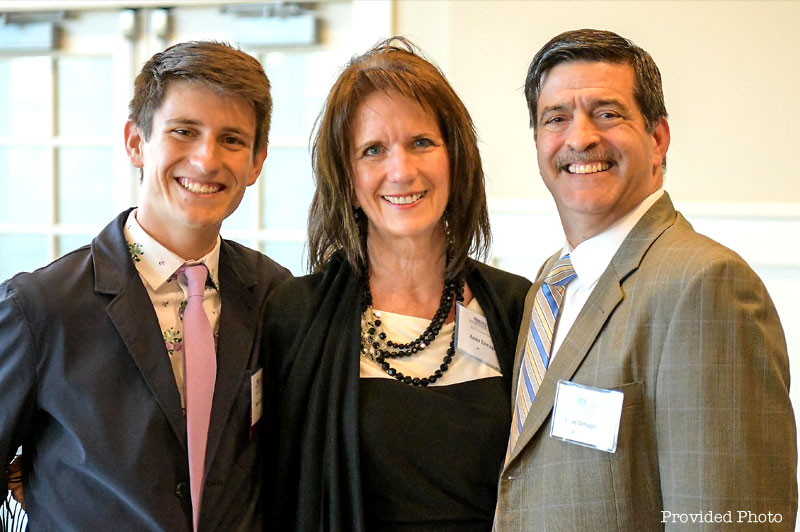
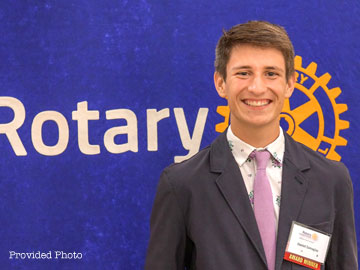
Daniel Zamagias with his parents Anna and Stephen at the 2019 Community Awards Dinner on October 17
Daniel Zamagias of Loveland High School received the 2019 Student of the Year Award by the Rotary Club of Northeast Cincinnati.
Loveland, Ohio– Daniel Zamagias, a member of the senior class at Loveland High School (LHS), has been selected as Student of the Year by the Rotary Club of Northeast Cincinnati. In 2018, Zamagias attended the Rotary Youth Leadership Awards – an intensive leadership training – and he served as a student delegate to the Rotary Club World Affairs Seminar in Waukesha, Wisconsin, in June 2019.
“I’m honored to be selected for the Student of the Year Award and for the amazing opportunities the Rotary Club has offered me,” said Zamagias. “The Worlds Affairs Seminar this summer was truly a once-in-a-lifetime experience. More than 300 delegates from over 30 nations attended the seminar for a full week of discussion and activities around the promises and perils of social media. It was really interesting to share views and work through issues, like ethical dilemmas and the economic and political ramifications of social media use.”
Check Here on Election Night for Complete Local Election Results
Zamagias, an LHS varsity soccer player and member of the National Honor Society, was also chosen by Loveland High School to be a student delegate to the Loveland City Council, which involved shadowing a council member and subsequently running a council meeting in accordance with city government rules and regulations.
In addition, Zamagias has volunteered for several organizations; among others, serving as a photographer for the Joe Nuxhall Miracle League and as a counselor in training at the Cincinnati Nature Center. Zamagias’ future ambitions involve a college education in psychology and biology to later undertake research on mental illness.
At the annual Rotary Northeast Cincinnati Community Awards Dinner on Thursday, October 17, he received a $5,000 scholarship as part of the Student of the Year Award.
If you find this story useful and helpful in your daily life…
Loveland, Ohio – Loveland High School will present the Lerner and Loewe classic musical My Fair Lady at 7 PM on November 6, 7 and 8, and at 2 PM and 7 PM on Saturday, November 9.
Professor of Phonetics Henry Higgins accepts a bet to turn Covent Garden flower girl Eliza Doolittle into a lady who could pass in high society. The toe-tapping “Get Me to the Church on Time,” and the hauntingly beautiful strains of “I Could Have Danced All Night” and “I’ve Grown Accustomed to Her Face” are part of this crowd-pleasing, family-friendly production. Come see who teaches the other one more – Eliza or Professor Higgins!
Tickets are $10 for students/senior citizens and $12 for adults if bought online (https://lovelandhstheater.wixsite.com/lhsdrama), and $11 for students/senior citizens and $13 for adults if bought at the door.
The prospect of higher property taxes brought on by the proposed Loveland school levy has spawned Tigers Helping Tigers, a charitable foundation formed to help those with limited resources pay their tax bills.
Cati O’Keefe is a resident of Downtown Loveland
The foundation was conceived by Art and Kim Jarvis. Art Jarvis is the president of the School Board, which proposed the ambitious new building master plan for the school system. “My job on the Board of Education is to make sure kids get the education they need to excel in the future. And that’s the purpose of the levy,” he says.
That’s his board member perspective. At home with his wife, however, he found their conversations frequently turning to the impact the financial ask could have on those with limited resources. “The community member Art Jarvis was bothered with the thought that the levy could cause fixed-income neighbors to suffer,” he says.
The Jarvises reached out to friends in the community, started sharing ideas, and Tigers Helping Tigers was born. Jarvis and the fledgling board (currently Kim Jarvis and Loveland residents Deb Ricci and Katherine Dannemiller) sat down with Greg Knake, executive director of The Care Center, and detailed their plan to raise $80,000-$100,000 to launch the new foundation.
Knake was on board immediately, framing the issue as a problem that needed to be addressed long before the current levy. “We’ve seen poverty grow 100% locally from 2005-2015 in Loveland,” he says. “Approximately 15% of kids in Loveland are on free and reduced lunch. This is an eight times faster increase than in urban areas.”
We’ve seen poverty grow 100% locally from 2005-2015 in Loveland. Approximately 15% of kids in Loveland are on free and reduced lunch.
Knake believes the proposed tax relief adds another spoke in The Care Center’s service wheel. “We are trying to bring help and resources to families teetering on the edge, and do it in a targeted way by getting people back to work or into a better job, giving them life skills, and breaking the cycle of poverty with one-on-one coaching and mentoring,” he explains.
The Care Center, which Knake describes as a faith-based organization, is collocated with the non-denominational North Star Church on Lebanon Road. The center is in the midst of a fund-raising endeavor itself, with a new facility slated for completion October 2020. “Our strategy employs best-practice research that has started organizations locally, like CityLink and the Healing Center, and is focused on bringing resources together under one roof,” he says.
Knake highlights the synergy between Tigers Helping Tigers and The Care Center: “ We already have relationships with many of the families who would qualify for assistance from the foundation,” he says. “We have the forms and processes in place needed to prequalify families–plus financial coaches and mentors–because hopefully this isn’t just a little bit of help on taxes but is also integrated with financial coaching to get them to an even better place in all parts of their lives.” (While The Care Center encourages people to discover and use its services, participation in the program is not a prerequisite for assistance through Tigers Helping Tigers.)
Tigers Helping Tigers board members are equally pleased with how the two organizations dovetail.
While The Care Center encourages people to discover and use its services, participation in the program is not a prerequisite for assistance through Tigers Helping Tigers.
“I am passionate about The Care Center’s impact on our community, and Tigers Helping Tigers is just another piece in assisting the marginalized, says Ricci. “The Care Center embodies the culture of our community, which generously gives back to those in need. The work of the Care Center team has helped so many cross the bridge of poverty to thriving in life. Having a strong education system is vital to our youth in reaching their greatest potential. This paired with the resources of The Care Center represents a community I am proud to be a part of.”
Dannemiller, who also serves on the fund-raising executive team for Nest Community Learning Center, believes the partnership will pay dividends for the Loveland community. “We have put six kids through the Loveland school system and stayed for the quality of the schools,” she says. “The levy is a hardship, but bridging the gap for people on limited incomes through the Care Center is a natural fit. The organization takes care of people who need help and creates a continuous path for them to get on their feet. Combining our program with theirs will extend help to people in a way that is impactful.”
At the end of the day, it is immaterial whether the current levy passes, fails, or gets kicked down the road to return in another iteration. Real need exists now.
The process of pondering cost versus value on the levy has, for many citizens, served as a reminder that levies–even modest ones–threaten the fragile existence of some community members and families. At the end of the day, it is immaterial whether the current levy passes, fails, or gets kicked down the road to return in another iteration. Real need exists now. Please consider donating to Tigers Helping Tigers and The Care Center. Inquiries regarding donations, receiving services, or volunteering can be made through Greg Knake at greg@carecenter.com or Art Jarvis at jarvisa@fuse.net .
I feel compelled to ask for your support on November 5th for the Loveland Schools levy request. The District has done a great job of seeking community input and providing detail after detail about the specific request.
Brock Kinser lives in the Loveland School District on Enyart Road
While there are many reasons to support the request, as an educator who lives in Loveland and works in another district, I am particularly sensitive to and supportive of the significant need to upgrade the safety and security of our buildings. We, unfortunately, live in a very different world than we did ten years ago, not to mention 50-80 years ago, when the Early Childhood Center, Primary School, and Elementary School were built. Safety requirements are different today, and the current infrastructure places limitations on the upgrades and enhancements that can be made. We have to do everything in our power to protect our children while they are at school.
The District has been prudent and sought feedback from the Department of Homeland Security and other experts in the realm of safety. Many of the recommendations have been implemented, but others are not possible until new facilities are built.
While there are many reasons to support the levy request on November 5th, we have to address the need to upgrade safety and security to protect our children and staff for the circumstances of the modern world. My second-grade son talks about Tiger Care. What better way can we show Tiger Care than providing our youngest students and their educators with a safe and secure environment in which to learn and lead? If you are in doubt, please go take a tour of the campuses and ask yourself if we should do better for the children of our community. Please join me in voting FOR the levy request on November 5th.
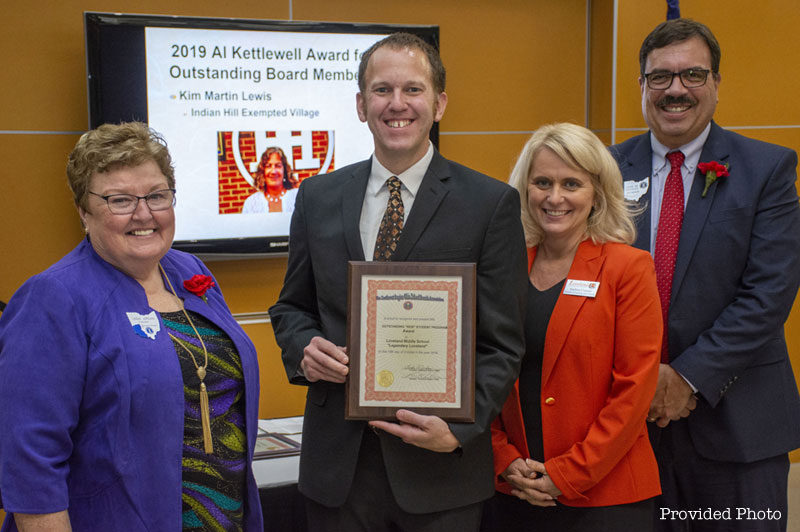
Charlie Mirus received the “Outstanding New Program” award at the OSBA Southwest Region Fall Meeting on October 10, 2019. Pictured (left to right): OSBA Southwest Region President Linda Jordan, Charlie Mirus, Loveland City School District Director of Teaching and Learning Andrea Conner, and OSBA President John Halkias
Loveland, Ohio – “I am humbled and honored to have the efforts of my past and current students honored in this way. The Legendary Loveland gamified approach is just one example of the amazing things happening in each and every classroom across the Loveland School District,” said 8th grade English Language Arts teacher Charlie Mirus
The Ohio School Boards Association (OSBA) Southwest Region has recognized “Legendary Loveland” – a gamified classroom concept implemented by Loveland Middle School Teacher Charlie Mirus – as an “Outstanding New Program.” The program was officially recognized as one of the top three new outstanding programs in the region with an award at the OSBA annual fall meeting on October 10.
“It was a surprise to be chosen, but it’s an honor to be recognized for this approach to teaching and learning,” said Mirus. “Gamification has been the center of my classroom at Loveland since I joined the district at the beginning of the 2018-19 school year. While working with the same curriculum as all other eighth grade English Language Arts classrooms, this approach emphasizes opportunities for collaboration, exploration, and creativity.”
“The greatest benefit has been seeing students take ownership of their own growth and learning,” said Mirus. “I’m excited to see the next great things that students will do because they are so excited to demonstrate innovation and mastery.”
The gamification strategy has gained increased popularity among teachers and students throughout the United States over the past several years. It transforms the delivery of education by turning traditional academic content into games, with the added benefit of increasing both motivation and collaboration among the students.
Teacher Charlie Mirus was asked to explain what happens in his classroom
For those unfamiliar with gamification, it’s the approach of using various ideas inspired by all types of games and applying those ideas to educational or training situations.
Within education, gamified learning experiences have been used by other educators in kindergarten through university/college courses in all subject areas.
I have read about a great number of Fortune 500 companies who utilize aspects of gamification for training as well as to increase motivation and productivity. Types of games that can be used for inspiration include board games, tabletop RPGs – such as Dungeons and Dragons, collectible card games, video games, TV reality shows, and more). The ideas utilized are known as game mechanics, and they are put into place to enhance the experience, increase motivation, and immerse learners into a “world” where their learning is contextualized and given greater meaning.
While I teach 8th grade ELA, and I address the same Ohio Learning Standards and curricular materials, my classroom environment and approach look different than my colleagues.
For example, in my gamified classroom, Legendary Loveland, students are one of three avatar/character types: a mage, a healer, or a warrior. Students (which are referred to as citizens), are placed into teams (known as factions) within their period/class (known as their society). Citizens are given health points (HP) and Action Points (AP). They can also earn experience points (XP) and gold pieces (GP). Each of these currencies has their own benefits, and these are examples of the previously-mentioned game mechanics that are taken from various types of games. At least one citizen from each of the three characters classes makes up each faction. This is important because their roles are interdependent, as citizens have “powers” that are collaborative in nature. These powers allow citizens to positively affect the currencies of members of their factions.
This teamwork aspect goes beyond just “sitting” with one another at connected desks, as it teaches empathy, collaboration, and strategic thinking.
Student’s main drive in my classroom game is to earn XP. Doing so allows students to eventually level up (every 1,500 XP). Leveling up comes with opportunities to earn new powers and use different items (these come in the form of collectible-card game style cards, and they are rewards that are also awarded or earned in various ways).
Examples of items and powers would be being able to turn in an assignment a day late without penalty, listening to music during structured work time, or doubling the reward from a Side Quest.
That idea, of course, brings up the question about what Side Quests are. In short, Side Quests are additional enrichment opportunities that are tied to the Ohio Learning Standards for 8th grade ELA. Side Quests are never required assignments; rather, they are chances to do work, in addition to the typical content. Students can be rewarded with various in-game rewards, such as XP, GP, or items. While Side Quests do not have affect grades in any way, students who do them benefit academically as they work with the standards and the content of the class in new and creative ways.
I have seen an increase in student engagement with Side Quests this year, compared to last year, which was the first year of Legendary Loveland. Students have created Hollywood-style book trailers, magazine covers, character resumes, and more!
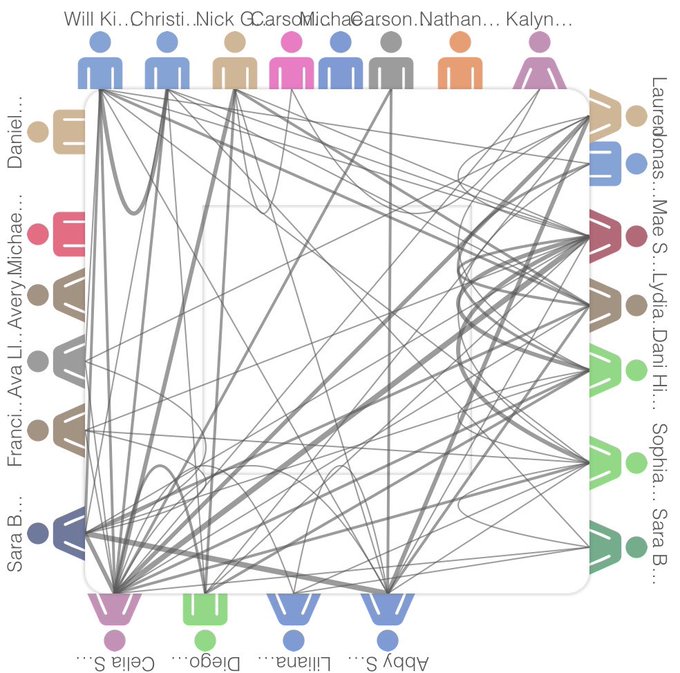
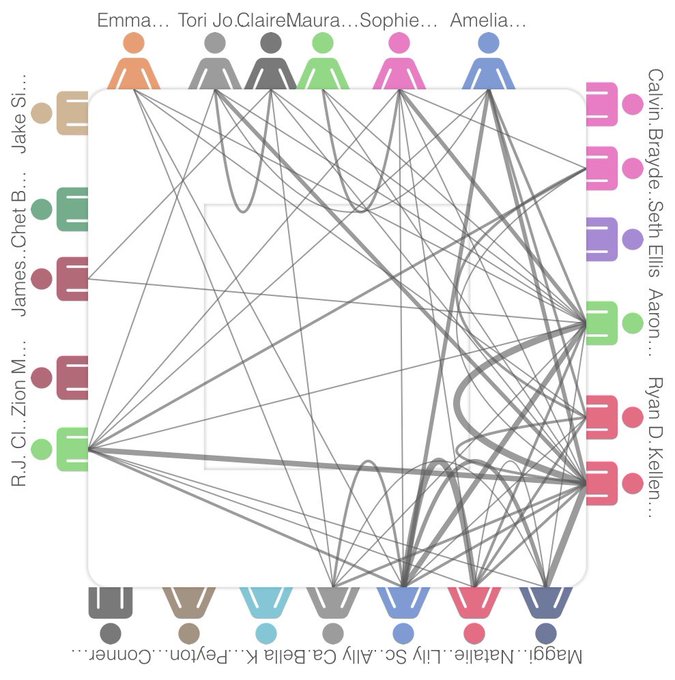
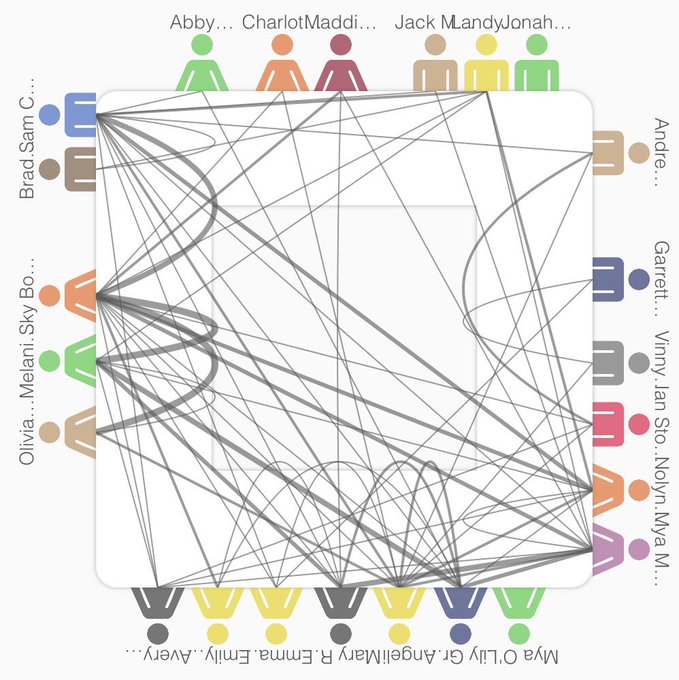
Four societies had a Royal Seminar (Socratic Seminar) during class today. Gamemaster (
to track interaction, trends, participation, and quality of responses. Interesting data. Mostly proud of citizens for embracing a new challenge. #LMSinnovation

















 by Brock Kinser