Tag: election

  • Lynn Mangan: Why I am a yes on the school levy

    Lynn Mangan: Why I am a yes on the school levy

    Lynn Mangan, a resident of the Loveland School District lives in the Eagles Point subdivision in Miami Township.

    by Lynn Mangan

    After listening to the community meeting last Thursday night at the high school, I felt very compelled to write out why I am a yes on the levy.

    First, let me introduce myself. We have lived in Loveland City Schools for almost 23 years. We moved to Loveland when I was expecting our oldest son. My husband, Pat and I have four boys (two are in college) and the younger two are in 10th and 8th grade. I am a wife, mother, family/community member, and business executive. When I look at whether I want to vote yes or no to the levy I try to think about it from all of the angles of who I am.

    As a mom:

    • I am grateful that we are focusing on the total child. We are creating problem solvers, continuous learners, preparing students for their next steps (trades, military or college), and challenging them to try as many new things as possible. We are creating well rounded young adults. And the district is not ignoring the increase of mental health disease. I have numerous examples over the years of teachers who believed in and advocated for my boys to be their best selves.
    • I am grateful for a school district that keeps my children safe and is calling in the experts to keep it that way (I was happy to hear we have engaged the Department of Homeland Security to make recommendations on how to do this). And I’m extremely sad that the safety of our children even has to be on the list.

    As a business executive and community member:

    • I am grateful that the school district is fiscally responsible. Keeping healthcare rates at only 2.2% is unheard of (can my business hire whoever is in charge of this at the district?). Making sure that as many dollars as possible can be put towards the staff serving our children vs on extraneous expenses. The people are what make it happen in every organization and schools are no exception. I appreciate that the district is also reducing energy costs wherever possible too.
    • The curriculum is expanding to prepare children for the real world. I’ve seen firsthand the expansion of so many programs: computer science, robotics, life skills, music, etc. A focus on continuous improvement is an absolute must.
    • Our district leaders are being creative problem solvers and passing on savings when possible (ex. change in the levy structure).
    • I appreciate the balance in the focus on improved learning spaces for our children, increasing our curriculum, making the spaces safer and a focus on the whole student. As a business executive, we have to focus on employee engagement – that means we have facilities that are not 100% about work – just like the school has to improve the facilities for arts and athletics. And the auditorium move is the best use of space to expand the learning areas first. And at the middle school, the track and bleachers are atrocious and unsafe. I don’t really think the baseball fields are necessary but that is okay. At work, we always debate the best choices. It is an 80%/20%. I am happy and confident with 80% of the choices in this plan and that feedback and experts have been engaged to come up with a solid plan.

    I’ll be candid…at first, I was a no. My kids are going to graduate before most of this will be in place. Then I asked myself: If this was a non-profit would I donate to them? Would I want to spend my time helping improve the schools? Does it benefit my family if we say yes even without children in the district?

    How does it impact our family budget?

    • I recognize not everyone is in the same situation as our family. When my kids graduate, the money that we’re currently paying for their extracurricular activities will now go to the schools when the levy passes. This might seem like a strange way to justify it as obviously we’ll be helping with college tuition. It provides me with perspective that even over 37 years this is worth it so that other children and our entire community can benefit.
    • My family has already benefited from increasing home values. We moved within the district three years ago so that my mom could move in with us. Our home sold in one day and it was over asking price. My hope is that when we downsize after our kids graduate, we’ll have the same experience that our home values continue to increase for the benefit of our entire community. I want Loveland students to be known as solid citizens and our continued investment in our schools does this.

    I believe in the leadership of the district

    • And most importantly, I believe in the leadership of the district. Is every decision they make the right one? Nope…and who am I to hold them to that unreasonable standard? I give them a lot of credit for their composure and well thought out plan. It is extremely hard to go in front of 1000s of people to present a plan like this.
    • Does it stink that we have to pay this much property tax? Yes, it does, and I made the choice to live in a community where there aren’t businesses to fund the school system. I grew up in Sycamore and my husband went to Catholic schools. We believe in public schools and didn’t want to pay the huge home prices in Sycamore schools. Of course, I would love to have less taxes due to all the businesses in Sycamore schools. It’s a tradeoff. I’ll take the tradeoff and pay for the increase to invest in our children and our community.

    Overall, no plan will ever be without ways to make it better. I appreciate that the district has asked for feedback, been transparent and is continuing to strive for what is best for our students. I am thankful for teachers that advocate for my children and want to see them succeed in their class and in life. I am a yes.

    If you haven’t already done so, I’d encourage you to listen to the latest presentation here and the corresponding slide deck here.


  • Al Osgood, Jr. – The school district is listening to voters

    Al Osgood, Jr. – The school district is listening to voters

    by Al Osgood, Jr.

    Loveland is so fortunate to have a great school district with strong leaders. The Board of Education’s announcement Monday that they are able to phase in the requested November levy increase is a perfect example of that. They listened to community feedback, and because of the recent reduction in interest rates, they are able to phase in the requested levy increase over three years versus all at once; that will certainly help from a budgeting and cashflow planning standpoint.

    It is critically important to recognize that this levy request is about needs and not wants.  We have buildings that are almost 80 years old, we have students learning in temporary trailers and hallways, we have inadequate

    Al Osgood, Jr. lives in Miami Township and is co-chair of Citizens for Loveland City Schools

    safety and security for today’s world, classrooms are “bursting at the seams” and the list goes on.  These issues are not going away; they will only get worse and more expensive if we wait.  Now is the time to act.  There is a significant cost of inaction.  In fact, multiple district building estimates show that the cost of maintaining the current facilities is MORE than the cost of rebuilding.  Bottom line, choosing to “kick the can down the road” will end up costing us more and have a direct negative impact on our children’s education.

    The district’s request is good for students and good for our community.  Great schools correlate to great communities.  People want to move to and live in Loveland because of our schools and the great community atmosphere that the schools help create.  Great schools are good for our property values and our ability to sell our homes.  Please remember that we don’t need to look too far to see the negative impact to communities and schools with failed levies.

    I want to commend the school district for their open, transparent and inclusive process that they have used in developing the facility master plan and current levy request.  They have been working on this for four years with opportunity after opportunity for the community to participate and provide input.

    Please get the real facts before making a decision at the ballot box.  There are almost daily social media posts and websites that are incorrect or misleading.  It’s easy to assume that everything posted on-line is accurate, but it’s definitely not.  If you haven’t had an opportunity to get the facts, please go to one of the multiple community events that the District has scheduled. The next one is a Community Meeting scheduled for Thursday, September 12th at 7 pm in the high school auditorium. Please go tour the almost 80-year-old LES building at 7 pm on September 17th.  Please attend one of the five currently scheduled Ask the Superintendent discussions. Please call the District office.  Any of these opportunities will allow you to get the real facts and understand why the levy request is needed and needed now.


  • [VIDEO] Board votes to amend parameters of levy request

    [VIDEO] Board votes to amend parameters of levy request

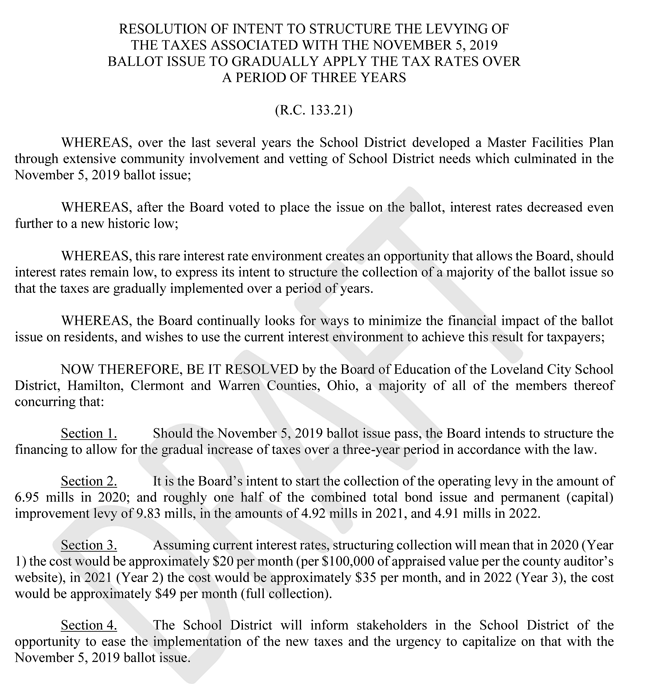
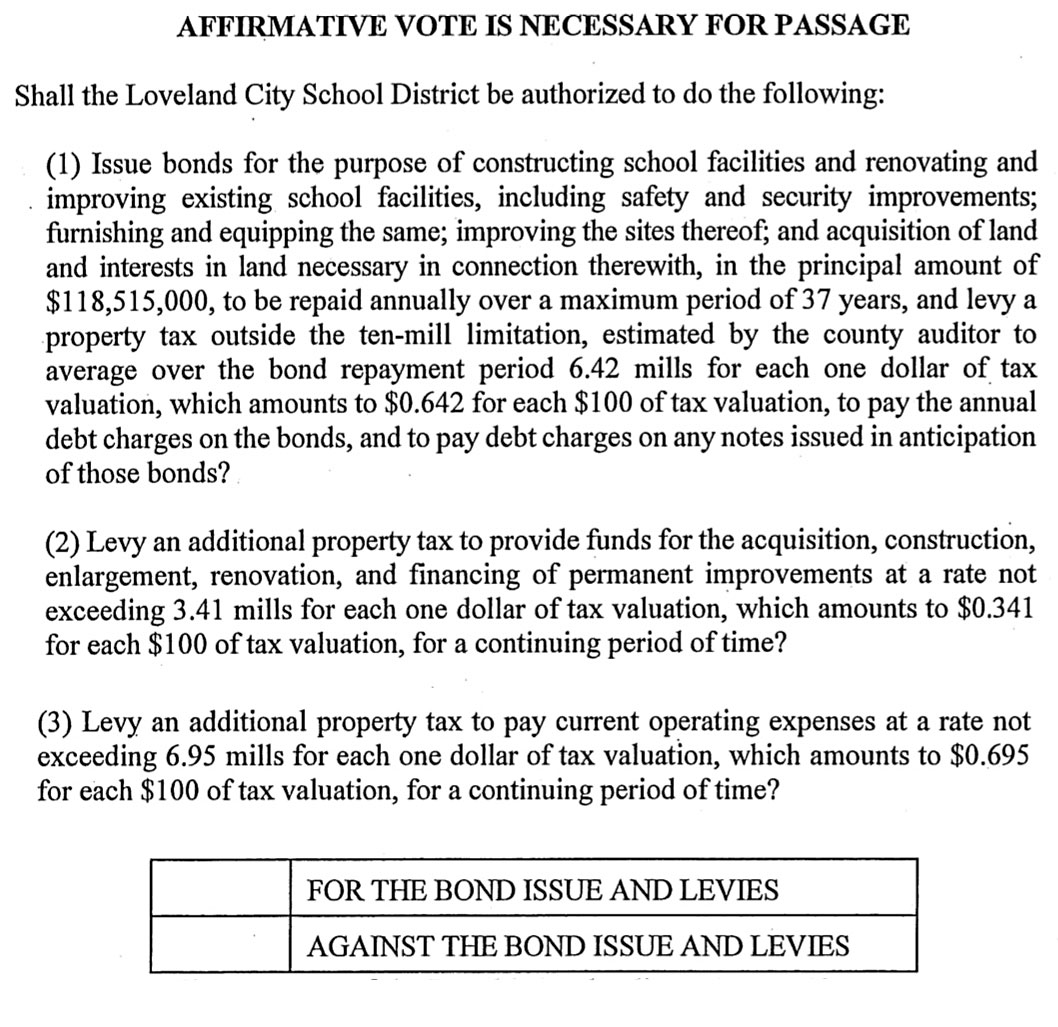
    Below you can read the resolution passed by the Board and the Ballot language that will remain the same.

    Levy skeptics offer opinions after meeting adjourns…

    Loveland, Ohio – At the end of July, the Loveland Board of Education voted unanimously to issue bonds for $118,515,000 and to place a combined operating and bond levy of 16.78-mill on the November 5 ballot to fund daily operations of the school district and to implement the district’s facility master plan, including three new school buildings at Grailville.

    The Board met Monday in a special meeting at 5 PM and voted to amend the parameters of the levy request. They voted unanimously to approve a resolution to structure the levying of the new taxes that will phase them in over three years.

    LOVELAND MAGAZINE TV was at the meeting and recorded the meeting as well as a few comments from residents after the meeting was over.

    Full video of meeting

    Walter Golladay, Pete Palmer, and Marcia Neumann comment on Board action.

    This is the draft Resolution that the Board voted on Monday. There were no changes made before approving it.


    This is how the question will appear on your Ballot. Nothing the Board did Monday changes this ballot language.


    Read Background:

    Paul Motylinski says Monday’s School Board vote on revised levy impact…

    School Board to vote Monday on revised levy impact

    David Callahan: “Saying no to our children is not acceptable to…

    Loveland Board of Education asks for combined 16.78-mill levy

    [BREAKING NEWS] Board votes to build new campus for Pre-K thru…

    Read: Grailville and School District Option to Purchase Agreement and Appraisal

    School Board approves option to purchase 110 acres of land at…

    [From the Loveland School District] November 2019 Levy FAQ

    [Video] Residents speak to Board of Ed about 16.78-mill school levy

    Information sessions with Loveland Schools Superintendent and Treasurer about the November…

    Meeting Needs Now and for the Future

    [Walter Golladay] Loveland City School District to raise 2019 school property…

    David Callahan: “Saying no to our children is not acceptable to…

    Matthew Kapszukiewicz: Loveland schools can count on my support


  • Paul Motylinski says Monday’s School Board vote on revised levy impact won’t change anything significantly

    Paul Motylinski says Monday’s School Board vote on revised levy impact won’t change anything significantly

    Paul Motylinski lives in the Turnbury subdivision in Symmes Township

    by Paul Motylinski

    How does this change anything significantly? (School Board to vote Monday on revised levy impact)

    There are still several issues that need to be addressed with this request being made of the taxpayers; issues such as reducing the millage, and the short and long term cost risk. Below are issues that need to be closely reviewed, addressed, and considered in order to achieve a millage reduction and a clearer path to this levy passing.

    Why are three buildings needed for grades K-5?

    One building for grades K-5, or two separate buildings; one for grades K-2 and one for grades 3-5 will be less costly to design, construct and maintain than three separate buildings, even if located on the same property. The new facility plan for grades K-5 is not efficient cost-wise. Significant cost savings can be realized by reducing the number of buildings, without sacrificing the safety and delivery of education, and still maintains the same number of grade levels between one or two buildings versus three buildings.

    New or renovated educational facilities are more important than upgraded athletic facilities. The current athletic facilities are more than adequate for now. Priority needs to be focused towards the educational facilities’ needs and not the athletic facilities’ needs.

    What maintenance has occurred at the existing middle school athletic facilities?

    Having been to the athletic facilities at the middle school, it appears to me that maintenance has been largely ignored. Illustration of care needs to be shown towards the existing athletic facilities before asking the taxpayers to fund new; otherwise, history will quickly repeat itself. The existing high school athletic facilities are wonderful in my opinion. The field turf and track surface are brand new at the football stadium, and the baseball and softball fields are more than adequate. There is no need to spend taxpayer dollars unnecessarily.

    The immediate needs pertaining to capital building improvements appear to be the current LECC, LPS, and LES buildings. I have attended several functions at all three buildings and it is obvious that these buildings need to be replaced with new ones. I have much respect for the administration and staff for delivering quality education given the antiquated state of these buildings. Regarding the capital building improvements for the LIS, LMS, and the HS, either place this scope on a future ballot for permanent improvements if upgraded athletic facilities take precedent over updated buildings, or eliminate the entire scope for the upgraded athletic facilities. If safer buildings and delivery of quality education are the priorities, then the scope for upgrades to the athletic facilities is expendable.

    Why risk combining the operation portion of the levy with the permanent improvement portion?

    The Loveland community has largely supported the levies placed on the ballot over the last approximately 20 years. I do not want to hear that services will have to be reduced or eliminated since the entire levy did not pass when a stand-alone operation levy will have a much better chance of passing instead of combining with the permanent improvement portion.


    <

    p style=”text-align: center;”>

  • School Board to vote Monday on revised levy impact

    School Board to vote Monday on revised levy impact

    Loveland, Ohio – The Loveland Board of Education will hold a special meeting on Monday, September 9, in the LMS/LIS Media Center at 5 PM. (801 South Lebanon Rd.)

    According to the agenda published for the meeting, the Board will consider a resolution to structure the levying of the taxes associated with the November 5 ballot issue to gradually apply the tax rates over a period of three years.

    On July 26 the Board voted unanimously to issue bonds for $118,515,000 and to place a combined operating and bond levy of 16.78-mill on the November 5 ballot to fund daily operations of the school district and a building and to implement the district’s facility master plan.

    Read Background:

    Loveland Board of Education asks for combined 16.78-mill levy

    [BREAKING NEWS] Board votes to build new campus for Pre-K thru…

    Read: Grailville and School District Option to Purchase Agreement and Appraisal

    School Board approves option to purchase 110 acres of land at…

    [From the Loveland School District] November 2019 Levy FAQ

    [Video] Residents speak to Board of Ed about 16.78-mill school levy

    Information sessions with Loveland Schools Superintendent and Treasurer about the November…

    Meeting Needs Now and for the Future

    [Walter Golladay] Loveland City School District to raise 2019 school property…

    David Callahan: “Saying no to our children is not acceptable to…

    Matthew Kapszukiewicz: Loveland schools can count on my support


  • David Callahan: “Saying no to our children is not acceptable to me.”

    David Callahan: “Saying no to our children is not acceptable to me.”

    David Callahan, a resident of the Loveland School Dristrict lives in the Belle Meade subdivision in Miami Township

    by David Callahan

    Hundreds of community and business leaders were assembled by the board to find the best path forward. This process has been going on for nearly 2 years, so it is not out of the blue. (Loveland Board of Education asks for combined 16.78-mill levy)

    Classrooms are overcrowded and don’t have the necessary modernization to educate our future leaders of the community. The 21st Century workforce will be vastly different than it is today and we need to prepare our most valuable assets, children, to be at the forefront of our community, city, state, and country.

    The cost to do nothing is higher than the cost of this levy.

    Saying no to our children is not acceptable to me. I want my children to have more than I did. My child is 16 and will not see the benefits of this project. My neighbors’ kids will be the beneficiaries and I plan to vote for them and support this levy. Supporting this levy secures our community’s future and makes investments that pay higher dividends. Investment in education has been shown to increase economic growth and stability. I love my community and want to invest in the future. The time is now!


  • Meeting Needs Now and for the Future

    Meeting Needs Now and for the Future

    by Dr. Amy Crouse

    As we launch a new school year at Loveland City Schools, I am particularly grateful to our community, which continues to support and invest in the greater good, especially for our children. Last week, more than 100 community members volunteered to prepare the playground at Loveland Early Childhood Center for our youngest Tigers to enjoy their first recess. And the community’s involvement has been evident throughout the past several years as hundreds of residents provided input in the district’s facility master planning process, where we extensively researched, assessed and vetted the district’s building and infrastructure needs, ultimately developing a plan that will adequately prepare our graduates.

    Dr. Amy Crouse is the Loveland City School District Superintendent

    The message heard from the community was clear: Loveland Schools must continue the positive momentum in academic achievement, yet the aging buildings need renovations and upgrades. With teachers using mobile carts and hallways for instruction and temporary trailer classrooms to absorb our overcrowded classrooms, we must modernize our facilities for our children and our community to have a strong future. The Loveland community expects a high-quality education and the reality is that we need to upgrade and expand science and technology laboratories to prepare students for college and 21st-century careers.

    The plan put forth and adopted unanimously by the Board of Education is cost-effective and unique to Loveland’s current and future needs. The plan:

    • reduces our reliance on trailers as classrooms and mobile carts and hallways for teaching;
    • provides safer and more secure learning environments at all of our schools with secure entrances, camera systems and electronically-activated locks to prevent intrusions;
    • updates and expands offerings of science, technology, engineering and math programs that are increasingly mandatory for colleges and careers.

    The bottom line is, we do a great job of maintaining our buildings and infrastructure, but we are to the point where it’s more costly to maintain than it is to upgrade or, in some cases, rebuild. The district’s facility needs will not go away; they will only increase in cost. There is no zero-cost option and without this levy investment we will need to continue diverting funds from the classroom so that we can make critical fixes in our schools.

    Strong schools mean a strong community, and I encourage everyone to make sure our schools are as strong as possible by joining us over the next couple of months at community conversations. Please see www.lovelandschools.org for all scheduled events. There will be a presentation at Loveland High School on September 12 at 7 p.m. where residents can learn more about the November 5th ballot issue and why it’s needed now. And, as always, please feel free to contact me directly with questions.

    In service to our Tigers.


  • [Video] Residents speak to Board of Ed about 16.78-mill school levy

    [Video] Residents speak to Board of Ed about 16.78-mill school levy

    Loveland, Ohio – Eight residents spoke at the August 15 Loveland City School District Board meeting and expressed their thoughts about the pending vote on a 16.78-mill combined operating levy and bond request that will be on the November 5 ballot.

    You can view these LOVELAND MAGAZINE TV videos to learn what they had to say and how the Board members responded.

    Read this background information:


    School Board approves option to purchase 110 acres of land at…


    Follow this discussion that started July 31 on Loveland Magazine’s Facebook Page.

    Loveland Magazine
    Published July 31 at 5:50 PM

    The additional money if approved by voters will fund daily operations of the school district and a building and construction bond to implement the district’s facility master plan.


    If you are a member of Nextdoor, read this lively discussion about Loveland Magazine’s announcement of the levy.


    Building Tiger Nation Web Site


    The development of the Facility Master Plan


  • Information sessions with Loveland Schools Superintendent and Treasurer about the November 5 ballot issue

    Information sessions with Loveland Schools Superintendent and Treasurer about the November 5 ballot issue

    Loveland, Ohio – With the upcoming vote on a 16.78-mill combined operating levy and bond request on the November 5 ballot, the Loveland City School District has scheduled several opportunities for residents to meet with Superintendent Dr. Amy Crouse and Treasurer/CFO Kevin Hawley in September and October. A community meeting, including a presentation and question-and-answer session, will be held in the Loveland High School auditorium at 7 PM on Thursday, September 12.

    September

    • Community Meeting (Loveland High School Auditorium), Thursday 9/12, 7 PM
    • Tour of Facilities (LES/LPS, 550 Loveland Madeira Road), Tuesday 9/17, 7  PM
    • Loveland Dairy Whip (611 W. Loveland Avenue), Friday 9/20, 5-7 PM
    • Starbucks (10551 Loveland-Madeira Road), Monday 9/30, 4-6 PM

    October

    • Hometown Cafe (111 Railroad Avenue), Thursday 10/3, 8-10 AM
    • Branch Hill Coffee Company (371 Bridge Street), Wednesday 10/9, 7-9 AM


  • [From the Loveland School District] November 2019 Levy FAQ

    [From the Loveland School District] November 2019 Levy FAQ

    Loveland, Ohio – Below is a post from the Loveland City School District about the combined 16.78-mill levy that will be on the Fall ballot. At the bottom of this page, you will find levy information provided by Loveland Magazine.


    Note: This resource will be updated with answers to additional commonly asked questions.

    Helpful Resources
    Directions for accessing the information from your county auditor can be found under “Calculating the Tax” on this website.

    For additional information about the Facility Master Plan and how it developed through extensive community involvement, please visit www.buildingtigernation.org.
    Do you have a question that is not answered in this FAQ? Over the coming weeks, there will be several opportunities for community involvement through small and large group meetings. The current schedule is available here. You are also welcome to call the Superintendent, Dr. Amy Crouse, or the district Treasurer, Mr. Hawley, who welcome the opportunity to answer your questions on the urgency and necessity of this levy request.

    Funding Questions

    1. What are the basics of the combined operating, permanent improvement levy and bond request? How will the dollars be used?

    The November 5 request includes an operating levy, which is necessary with or without the building levy, to run the daily operations of the school district. The permanent improvement and bond portions of the levy are for the much-needed modernization, construction, repairs, and renovations that are outlined in the facility master plan.

    2. What is an operating levy for?

    An operating levy is used to provide money for a school district’s day-to-day operating expenses, including utilities, supplies, and salaries/benefits for staff. The November 2019 operating levy for Loveland Schools is a continuous levy. It will be collected each year, but as home values increase, the tax rate will be reduced in order to hold the payment to the schools at a constant level. This is often referred to as the “tax reduction factor,” or the “HB 920 reduction factor.” HB 920 is a state law that protects homeowners from paying more money in taxes as their homes appreciate.

    This taxpayer protection means revenues remain flat for the schools during the life of the levy, but in the normal course of business, operating expenses rise due to inflation and increased educational requirements. This is the reason the schools typically must return to voters and ask for additional operating funds every three to five years.

    The last operating levy for Loveland Schools was forecasted to cover four years of expenses, and the district has been able to sustain operations for five and a half years since approval.

    3. What is a bond levy or bond issue?

    A bond levy is a special tax used to provide revenue to repay the loan, otherwise known as a bond issue, used for school construction projects, and can by law only be used for that purpose. A bond levy remains in place until the bond is paid off, in this case a maximum of 37 years for the proposed master plan.

    The last bond issue for Loveland Schools was passed in 1998. It provided the funds to build the current intermediate school, renovate the middle school and add an auxiliary gym and large classroom at the high

    school. The school buildings have been exceptionally well-maintained over the years, but two separate assessments, including one by the Ohio Facilities Construction Commission, show that the cost of maintaining the Early Childhood Center, Primary and Elementary Schools is more expensive than replacing them.

    4. What is a permanent improvement (PI) levy for?

    Like a bond levy, a permanent improvement levy (PI levy) can be used only for a certain category of needs. Per state law, funds from a PI levy can only be used for the purchase of items that have a lifespan of five years or more (a capital improvement), or to repay financings used to purchase or construct capital improvements. PI funds can be used for building construction, maintenance and repairs, and certain equipment that is designed to last at least five years. For example, they can be used to replace roofs, windows, and HVAC systems, etc. PI levies cannot be used to pay for salaries, benefits, operating expenses, or basic supplies.

    5. What will the impact be on our property taxes?

    The cost of the 16.78-mill combined operating and permanent improvement/bond levy translates into $587.30 annually or $49 monthly per $100,000 of appraised home value as determined by your local county auditor. For more details, please see the section “Calculating the Tax” on this page.

    6. What is a “mill?”

    A mill is the unit of value for expressing the rate of property taxes in Ohio. It is defined as 1/10 of a percent or 1/10 of a cent (0.1 cent). “Millage” is the factor applied to the assessed value of property to produce tax revenue.
    7.  What’s the difference between the appraised value and the assessed value of a home?

    For tax purposes, a home is taxed on its assessed value, not its appraised or market value. The assessed value is 35% of the appraised value as determined by the local county auditor. For example, a home that is appraised at $100,000 by the auditor is taxed only on $35,000.

    8. Why is the Board of Education requesting this combined levy now rather than in phases?

    The master plan was developed through extensive analysis with subject matter experts and community engagement over the past several years, including large community meetings, targeted focus groups, and a community-based finance committee, which concluded that the chosen plan is the most cost effective for residents. The district is able to take advantage of historically low interest rates at this time and the adopted master plan will be completed in the shortest timeframe possible, minimizing the disruption to students and instruction, as well as the impact of increasing cost of materials and construction over time.

    9. Is there another way to generate the money needed other than using a property tax? For example, a sales tax or an income tax?

    By law, a school district cannot levy a sales tax. The district evaluated alternatives, including an income tax, but the current plan as presented was determined to be the least costly to the greatest number of residents by a group of community member volunteers. This group worked on various funding options with the assistance of a taxation specialist retained by the Board of Education. The current plan provides the least costly option based on several primary factors: current low interest rates, anticipated (high) future inflation rates, and potentially expensive future unfunded state mandates.

    10. How is the district financially accountable and how has it maintained the existing infrastructure?

    The district consistently earns accolades for strong fiscal management and excellent record keeping. This includes a high bond rating from Moody’s of Aa2. The district has a solid history of only asking the voters for what it needs and then making additional adjustments to the budget to stretch the dollars. Only 32% of the district budget comes from the state and the remainder is locally-generated revenue. It has been five years since the district asked for operating dollars and at that time promised the taxpayers it would last four years. In addition, the only remaining bond issue in the district will be paid in full within the next five years.

    The district operates on an ongoing five-year maintenance plan to ensure safety, provide for upkeep, and to extend the life of the buildings. As buildings age, however, they become increasingly more difficult and costly to maintain.

    11. How does our per pupil spending compare to other similar districts?

    The state average for per-pupil spending is $11,953/year. As a fiscally conservative district, Loveland spends approximately $1,000 less, but allocates proportionally more to classroom instruction. Compared to other, similar school districts in the area, the district spends less than Mason, Forest Hills, Madeira, Wyoming, Mariemont, and $4,000 less per pupil than Sycamore and $5,000 less than Indian Hill.

    12. What happens if the ballot issue fails?

    The financial needs and the needs of the buildings in the district will not go away. The facility master plan outlines the repairs, renovations and additions that are needed today; the cost of meeting those needs will continue to increase over time. Without the necessary operating funds, the Board of Education would have to evaluate and execute budget cuts, which would have a direct impact on classroom instruction and the quality of education in the district.

    Facility Master Plan Questions

    1. What is the new property the school district is considering purchasing? Why is it needed and what are the plans for current properties?

    The Loveland Board of Education adopted a resolution at the March 19 business meeting to approve a contract for the option to purchase real estate in Clermont County. The approximately 110-acre large piece of land – part of a property known as Grailville – is currently owned by the Grail, an Ohio nonprofit organization. The Grail plans to maintain property on the opposite side of O’Bannonville Road.

    For the first time in many years, Loveland Schools has the opportunity to purchase a large enough plot of land for a new campus. The current LPS/LES and LECC campuses are not large enough to allow for additions or to demolish and build new, based on state recommendations for the current (and projected) number of students at these locations. The district is looking into various options for the LECC and Loveland-Madeira campuses once vacated, but no decisions have been made, and cannot be made until a bond is passed.

    2. Why does the master plan show three buildings on the Grailville site?  

    The current 1st-4th grade building is really two buildings in terms of square footage – the number of students requires two gyms, two cafeterias, two entrances, and two admin suites. Today, Loveland’s Pre-K through 5th grade students are spread across four different buildings on three campuses. The efficiency in the master plan is captured by sharing a campus. It is more efficient to maintain one versus multiple campuses. Very large elementary schools are undesirable for the learning and developmental needs of students,  which is why the new master plan has three buildings (PK/K; 1st-2nd; 3rd-5th) on the Grailville site.

    3. What will the impact of a new campus be on traffic? 

    The district is in the early stages of working on possible bussing and routing alternatives. Preliminary mapping shows a reduction of trips through downtown Loveland and the opportunity to go in the opposite direction of “rush hour” traffic. The campus will be accessible from both O’Bannonville Road and Route 48/Oakland Road, and the property is large enough for improved staging for buses and parents. It will not be a high school campus, so student drivers will not be impacted by the plan. Currently, about 50 percent of the students are transported daily from Hamilton County to Clermont County (and vice versa) for school, which will not change by adding the new campus.

    Once a bond is passed, approximately a year of designing the campus and at least another year of construction will follow. Students will not move into new buildings until the fall of 2022 at the earliest, which provides ample time to seek positive solutions for safe transportation. The district continues to have a strong relationship with the City of Loveland and Miami Township and will work with them to accomplish a mutually agreeable plan for bussing and routing.

    4. What does the phasing/timing of the master plan look like? Isn’t the plan just a “wish list?” 
    The bond levy will provide the full budget for the comprehensive facility master plan. According to the plan, new buildings and additions will be ready for students in the fall of 2022, and the renovations at the other campuses will be completed by the end of 2025. The plan outlines the needs that have been identified through two separate expert assessments of the district’s buildings and properties, and captures input from hundreds of community members, staff members, and students.
    5. Is the master plan presented the one that the community and focus groups wanted?
    Yes. The community input sessions and focus groups recommended two master plans – the first of which focused on a new high school, and the second of which was recommended by the finance committee for being the most cost effective. It was presented to the Board of Education for adoption and was selected because it achieves the following:
    • Addresses the space and facility needs identified in two separate assessments.
    • Can be completed in the shortest amount of time, limiting disruption to students and staff and minimizing costs that increase over time.
    • Provides for the safety of students and staff.
    • Captures the input of community, staff, and students.
    • Allows for additional programming; supports instruction for students that will allow them to compete in the 21st century workforce; and maintains the momentum in academic improvements at Loveland.

    Key components of the plan:

    • Provides new buildings for Pre-K – 5th grade.
    • Provides a building addition, as well as repairs, renovations and enhancements to the high school.
    • Provides repairs, renovations and enhancements to the middle school.
    6. Looking in the future, when is it estimated that a new high school will need to be built?  
    The high school was built in 1992. A school building typically has a lifespan of about 50 years, so the current high school facility has ample useful life remaining. The assessments of LHS supported repairs and renovations of the current facility rather than replacement, but also that additions are necessary due to overcrowding. (A summary of the assessments is available here.)
    7. What efforts have been made to secure a corporate partner for the master plan?

    The district has reached out to several groups/corporations that have successfully partnered with other districts in the area. In these arrangements, the district is typically required to fund the development

    of land or facility space. Once built, however, the third-party partners could manage the facility and share operating costs or other gain-share arrangements. Such partnerships may benefit the school district later, but the upfront cost of construction increases.

    The district has identified corporate partners that are willing to provide lab equipment and furnishings for specific programming in the new facilities. In addition, it is possible that the Loveland City School District would provide a small amount of square footage at the Pre-K – 5th grade campus to a partner to operate a health clinic that would be accessible to students, families, and the community.

    The master plan does not include a community center, pool or other community facility at this time, but the district is open to discussions on future use of the properties that will be vacated per the master plan. Discussion will continue with other parties and entities, including the City of Loveland, who are interested in collaboration on what type of use would best serve the community.


    The next meetings of the Board of Education are:

    August 15 – Board business meetings are held on the third Tuesday of the month at 6 p.m. in the LMS/LIS Media Center.

    September 3 – Board work sessions are held on the first Tuesday of the month at 6 p.m. in the Board of Education administrative offices.


    To contact Board members:

    President, Art Jarvis jarvisar@lovelandschools.org

    Vice President, Kathryn Lorenz, Ph.D. lorenzka@lovelandschools.org

    Member, Michele Pettit pettitmi@lovelandschools.org

    Member, Ned Portune portunne@lovelandschools.org

    Member,  Eileen Washburn washbuei@lovelandschools.org 

    To contact the Administration

    Superintendent Dr. Amy Crouse (513) 683-5600 crouseam@lovelandschools.org 

    Treasurer/CFO Kevin Hawley (513) 683-5600 treasurer@lovelandschools.org


    Read: Grailville and School District Option to Purchase Agreement and Appraisal


    Loveland Magazine “Local Voter Guide” to issues and candidates