Loveland, Ohio – The Loveland Board of Education will meet for a regularly scheduled business meeting on Tuesday, November 19 at 6 PM, which will include a hearing of the public. Immediately following the meeting, the board will host an opportunity for dialogue between the community, the board, and the administration.
The board will need to submit ballot language for a potential operating levy on the March ballot no later than December 18, requiring a first resolution to be passed at the December 10 board meeting.
“We welcome input from our residents on how to gain community support for the school district to meet its financial needs going forward,” said Art Jarvis, board president. “Based on the results of the recent election, we are not able to pursue a comprehensive approach to the facilities issues as proposed in our master plan at this time. We must, however, continue to serve our Loveland students with a quality education. An analysis of the district expenses will be made over the coming weeks and we are asking our residents to provide input on what they are willing to support in terms of educational programs and services.”
The board will need to submit ballot language for a potential operating levy on the March ballot no later than December 18, requiring a first resolution to be passed at the December 10 board meeting. In order to prepare, the board has added three meetings to its regular meeting schedule and may supplement with additional opportunities for the community to provide input in the process.
The Board of Education’s full meeting schedule can be found here. Meetings start at 6 PM and are held in the LMS/LIS Media Center on 757 South Lebanon Road.
Loveland, Ohio – On December 2, Loveland City Council will meet to swear in the recently elected members. The meeting will begin at 7 PM at City Hall.
Kathy Bailey is the current Mayor, however, after municipal elections in Loveland, Council meets in an “Organizational Meeting” and votes among themselves a Mayor and Vice-Mayor for the next two years.
Sitting at the Council table that night will be the three who finished at the top of the November 5th election; current Mayor, Kathy Bailey (2,642 votes), newly elected member, Andy Bateman (2,190 votes); and, current member, Kent Blair (1,873 votes). Current member Angie Settell (1,247 votes) was not re-elected. Council has 7 members.
The other candidates not elected were, Pat Ahr (1,183 votes) and Cory O’Donnell (769 votes).
Sitting with those who won on November 5th will be current members, Vice-Mayor Rob Weisgerber, and members Tim Butler, Neal Oury, and Ted Phelps.
Let’s have some fun and see if readers can see into the future, “Who is most likely to be Loveland’s next Mayor?”
Just for fun, we’ve thrown in our favorite write-in candidate, Ms. Loveland Frog! Because after-all it would be nice to have a “tad” more gender equality and hear something besides just 7 human voices croaking “Yes” in unison for the next two years.
Kim and Rick Donaldson live on Paxton Road in Miami Township
By Kim and Rick Donaldson
As a community, we support the goal of providing high-quality education for our children. But we also need to consider affordability. Loveland is largely a residential community whose local tax burden falls primarily on individual homeowners who are somewhat less affluent than those in surrounding districts. Whereas a one mil property tax raises about $228 per student in Mariemont, $249 in Madeira, $339 in Sycamore and $607 in Indian Hill, it raises only about $191 per student in Loveland. Consequently, we need to recognize that our school budgets are necessarily more limited, and just as a family with a limited budget must prioritize needs and manage money wisely, so must the school district. The proposed building master plan does not, in our opinion, adequately address these budget constraints.
We wonder what other cost reduction opportunities we might find were we provided with a more detailed plan.
In the board of education’s January 23rdcommunity meeting presentation, there is a single slide showing a $65M baseline plan for repairs at all existing building sites, which was rejected because it “does NOT address any of the core identified needs that were discovered during the assessment process.” After evaluating multiple options for addressing these “needs”, the board settled on a $165M plan and a $7.7M land purchase, i.e. $108M more than the baseline plan. From the very high-level cost breakdown subsequently provided by the administration, we can see that the plan includes $10M for athletic facility upgrades and $22.6M for a new fine arts building. That’s 30% of the incremental cost over the baseline plan going toward enrichment programs affecting a subset of the students, not to fundamental academic programs affecting the entire student body. We wonder what other cost reduction opportunities we might find were we provided with a more detailed plan.
To arrive at a more cost-effective solution, we need to start again from the beginning with clear priorities regarding what is needed, as opposed to what is wanted.
To arrive at a more cost-effective solution, we need to start again from the beginning with clear priorities regarding what is needed, as opposed to what is wanted. Building safety and security come first, followed by those facility improvements that have a proven impact on academic achievement. Increasing classroom space to enable reducing the student to teacher ratio might fall into the latter category. We then need to develop facility concepts that satisfy these needs in a manner that minimizes both construction and future operational costs. For example, the current facility master plan envisions three separate buildings for pre-K through 5thgrade. Combining these into a single building would reduce construction costs, reduce heating and cooling costs and maximize the opportunity for sharing resources and occasional use spaces like cafeterias, gymnasiums, and auditoriums. A two- or three-story building would also provide the opportunity to use an existing site, eliminating the cost of land purchase and development.
These are just a few ideas meant to illustrate the point. Given the right set of objectives and constraints, the district’s architectural consultants would undoubtedly come up with more and better ideas. But the first step toward developing a school facility plan that strikes a reasonable balance between the educational needs of our children and the financial limitations of the community is to vote against the Loveland school levy and bond issue on November 5th.
The prospect of higher property taxes brought on by the proposed Loveland school levy has spawned Tigers Helping Tigers, a charitable foundation formed to help those with limited resources pay their tax bills.
Cati O’Keefe is a resident of Downtown Loveland
The foundation was conceived by Art and Kim Jarvis. Art Jarvis is the president of the School Board, which proposed the ambitious new building master plan for the school system. “My job on the Board of Education is to make sure kids get the education they need to excel in the future. And that’s the purpose of the levy,” he says.
That’s his board member perspective. At home with his wife, however, he found their conversations frequently turning to the impact the financial ask could have on those with limited resources. “The community member Art Jarvis was bothered with the thought that the levy could cause fixed-income neighbors to suffer,” he says.
The Jarvises reached out to friends in the community, started sharing ideas, and Tigers Helping Tigers was born. Jarvis and the fledgling board (currently Kim Jarvis and Loveland residents Deb Ricci and Katherine Dannemiller) sat down with Greg Knake, executive director of The Care Center, and detailed their plan to raise $80,000-$100,000 to launch the new foundation.
Knake was on board immediately, framing the issue as a problem that needed to be addressed long before the current levy. “We’ve seen poverty grow 100% locally from 2005-2015 in Loveland,” he says. “Approximately 15% of kids in Loveland are on free and reduced lunch. This is an eight times faster increase than in urban areas.”
We’ve seen poverty grow 100% locally from 2005-2015 in Loveland. Approximately 15% of kids in Loveland are on free and reduced lunch.
Knake believes the proposed tax relief adds another spoke in The Care Center’s service wheel. “We are trying to bring help and resources to families teetering on the edge, and do it in a targeted way by getting people back to work or into a better job, giving them life skills, and breaking the cycle of poverty with one-on-one coaching and mentoring,” he explains.
The Care Center, which Knake describes as a faith-based organization, is collocated with the non-denominational North Star Church on Lebanon Road. The center is in the midst of a fund-raising endeavor itself, with a new facility slated for completion October 2020. “Our strategy employs best-practice research that has started organizations locally, like CityLink and the Healing Center, and is focused on bringing resources together under one roof,” he says.
Knake highlights the synergy between Tigers Helping Tigers and The Care Center: “ We already have relationships with many of the families who would qualify for assistance from the foundation,” he says. “We have the forms and processes in place needed to prequalify families–plus financial coaches and mentors–because hopefully this isn’t just a little bit of help on taxes but is also integrated with financial coaching to get them to an even better place in all parts of their lives.” (While The Care Center encourages people to discover and use its services, participation in the program is not a prerequisite for assistance through Tigers Helping Tigers.)
Tigers Helping Tigers board members are equally pleased with how the two organizations dovetail.
While The Care Center encourages people to discover and use its services, participation in the program is not a prerequisite for assistance through Tigers Helping Tigers.
“I am passionate about The Care Center’s impact on our community, and Tigers Helping Tigers is just another piece in assisting the marginalized, says Ricci. “The Care Center embodies the culture of our community, which generously gives back to those in need. The work of the Care Center team has helped so many cross the bridge of poverty to thriving in life. Having a strong education system is vital to our youth in reaching their greatest potential. This paired with the resources of The Care Center represents a community I am proud to be a part of.”
Dannemiller, who also serves on the fund-raising executive team for Nest Community Learning Center, believes the partnership will pay dividends for the Loveland community. “We have put six kids through the Loveland school system and stayed for the quality of the schools,” she says. “The levy is a hardship, but bridging the gap for people on limited incomes through the Care Center is a natural fit. The organization takes care of people who need help and creates a continuous path for them to get on their feet. Combining our program with theirs will extend help to people in a way that is impactful.”
At the end of the day, it is immaterial whether the current levy passes, fails, or gets kicked down the road to return in another iteration. Real need exists now.
The process of pondering cost versus value on the levy has, for many citizens, served as a reminder that levies–even modest ones–threaten the fragile existence of some community members and families. At the end of the day, it is immaterial whether the current levy passes, fails, or gets kicked down the road to return in another iteration. Real need exists now. Please consider donating to Tigers Helping Tigers and The Care Center. Inquiries regarding donations, receiving services, or volunteering can be made through Greg Knake at greg@carecenter.com or Art Jarvis at jarvisa@fuse.net .
I feel compelled to ask for your support on November 5th for the Loveland Schools levy request. The District has done a great job of seeking community input and providing detail after detail about the specific request.
Brock Kinser lives in the Loveland School District on Enyart Road
While there are many reasons to support the request, as an educator who lives in Loveland and works in another district, I am particularly sensitive to and supportive of the significant need to upgrade the safety and security of our buildings. We, unfortunately, live in a very different world than we did ten years ago, not to mention 50-80 years ago, when the Early Childhood Center, Primary School, and Elementary School were built. Safety requirements are different today, and the current infrastructure places limitations on the upgrades and enhancements that can be made. We have to do everything in our power to protect our children while they are at school.
The District has been prudent and sought feedback from the Department of Homeland Security and other experts in the realm of safety. Many of the recommendations have been implemented, but others are not possible until new facilities are built.
While there are many reasons to support the levy request on November 5th, we have to address the need to upgrade safety and security to protect our children and staff for the circumstances of the modern world. My second-grade son talks about Tiger Care. What better way can we show Tiger Care than providing our youngest students and their educators with a safe and secure environment in which to learn and lead? If you are in doubt, please go take a tour of the campuses and ask yourself if we should do better for the children of our community. Please join me in voting FOR the levy request on November 5th.
Dale Friemoth is a Loveland School District resident and lives on East Loveland Avenue in Loveland.
I have put together some facts on the proposed Loveland City School District (LCSD) Levy in a question and answer format with footnotes on sources.
After gathering and evaluating these facts, I am voting NO on the Loveland School Levy on the November 5th ballot!
Question
I keep hearing about the Levy lasting for 3 years before the Loveland School Board believes they will need to come back to the voters for more money – are the levies on the ballot for 3 years or are they “permanent”?
The levy on the ballot is divided into three sections totaling 16.78 mills1; one is for 37 years and the other two are for “continuing period of time” or PERMANENT.
1.6.42 mills: Issue bonds for land purchase, construction bond, and improving sites – 37-year duration(This IS permanent for many voters; I’ll be nearly 100 in 37 years!)
2.3.41 mills: Funds for permanent improvements – permanent.
3.6.95 mills: Funds to pay operating expenses – permanent (Note: this is a 24% increase over the last Operating Fund Levy of 5.6 mills in passed in 20142).
Question
What is the monthly and yearly increase over what I’m currently paying for Loveland Schools?
• This levy would be a 42% increase in the school taxes that you are currently paying.
• You will pay an additional $49 per month ($587.30 per year) for every $100,000 of your home’s appraised value2. Own a $250,000 home; your taxes increase ~$1,468 per year!
Question
I’m a renter, will I need to pay this tax levy?
• As a renter, you typically would not pay a real estate tax directly, though common sense would tell us that landlords will attempt to pass on their increased costs.
• This levy will impact you as well – ask your landlord what they intend to do if the levy passes!
Question
Will the Board purchase the land at Grailville even if the levy issue fails?
• The Loveland School District has already paid a $100,000.00 non-refundable deposit on the Grailville property3. According to Art Jarvis, President – Loveland Board of Education1 “The board will purchase the GV property if the levy fails. This levy represents needs, not wants. Unfortunately, the GV (Grailville) property is the only suitable land available in the school district, and it will eventually be needed to expand for our growing student population and their educational needs.”
• Dr. Amy Crouse – Superintendent hedges this some stating“The Board of Education has not yet voted on any purchase of land. The LCSDBOE must take formal action concerning the purchase of the property prior to March (2020) per the option-to-purchase contract with The Grail.”
• Although not formally approved by the Board, the plan would be to pay for the $70,000 per acre ($7,700,000 total) land purchase using funds from the existing Permanent Improvement Levy that was approved to maintain existing buildings.
• Use these funds instead of “diverting funds to pay for temporary solutions such as trailers for classroom space.2”
• Use these funds so LSD won’t need “to continue to defer important safety and security upgrades2”. (Currently deferring important safety and security upgrades – the community should be aghast!!)
• Use these funds instead of “diverting funds from the classroom” so that we can make critical fixes in our schools.
Question
Has the Board of Education and school management held down operating expenses to reduce the impact on taxpayers?
• Since the last Operating Expense Levy in 2014, the Loveland School District’s Operating Expenditures6 increased from $43,225, 390 to $55,568,450 projected for 2019, or 5% compounded annually with a large 13% increase from 2018 to 2019.
• The Cost per Pupil went from $8,600 in 2014 to $10,689 in 2019 which is now $968 per pupil higher than the state average.
• This 5% annual LSD expense growth compares to a 1.66% United States average inflation rate7 (2015-2019E) over the same basic time period. LSD operating expenses are increasing three times (3x) inflation!
Question
If the Levy fails, won’t the Loveland School District be in a financial crisis?
• Loveland School District will have funds required to operate through the end of fiscal 2021 though the district would fall into “fiscal watch” after this time according to the Ohio Department of Education definition.
• There are multiple opportunities to put a reasonable levy on the ballot before the end of fiscal 2021, this is not a crisis!
Question
There has been extensive growth in housing and rental properties within the LSD the past 10+ years, have we seen this same growth in Loveland students attending our schools?
• Loveland District total enrolment decreased from 4,566 to 4,462 in the past 10 years (2007/8 to 2017/18)6 even as the community residence numbers increased.
• As they say for investments “past performance is not indicative of future results” but no one has presented any evidence supporting future headcount growth.
Question
Does the Levy fund updated and new Athletic & Extracurricular Facilities that are historically funded through boosters, private donations, & corporate sponsorships?
• The LSD plans include ~$10M in athletic upgrades8 including: New turf fields for baseball, softball, & multi-use.; New locker rooms, restroom facility, ticket booth, and gateway entrance; and New concessions building.
• Plans also include $22.5M5,8 for a new performing arts building with an auditorium for ~1000 and six (6) additional classrooms.
• This $32. M equals 20% of the total $165M “ask”.
1Official ballot language
2LCSD Website
3LCSD contract to purchase The Grail land
426-August-2019 e-mail to Loveland resident
56-October-2019 letter to Loveland resident
6Ohio Department of Education Score Card
7U.S. Bureau of Labor Statistics
8LCSD breakout of planned cost for implementing “Build Tiger Nation”
If you find this story useful and helpful in your daily life…
There is a logical reason for voting against the 42% tax increase proposed in the Loveland School Levy: a 42% tax increase is illogical. Unconscionable. Federal Income Tax. Ohio State Income Tax. Loveland City Income Tax, State and local sales tax. Hamilton, Clermont and Warren County property tax.
Wayne Pagel is an 11 year resident of Loveland residing on Rich Road.
Our own most recent property tax disbursement indicates that 60% of those taxes were disbursed to the Loveland School District.Through its proposed levy, the Loveland School Board feels that portion should be 77%. A bigger slice of a larger pie.
Good for the community? The 14 other recipients, including Family and Children Services, Public Library, Mental Health, Senior Services, Indigent Hospital Care, should understand that the School Board’s deep dive into the pockets of the taxpayers of Loveland to build Fine Arts Centers, Student Collaboration Areas, and artificial turf practice facilities may put a squeeze on any revenue increases or levies in the foreseeable future. There is a limit to how much we can afford and after all, the School Board seems to be first in line. It’s doubtful the board members will form any PACs, hire any consultants, or orchestrate any media campaigns for those causes representing the other 23% of the community’s needs.
Loveland Schools are stellar. They receive the highest ratings possible.Our teachers are incredible. They deserve to be well compensated. They are. These things are being accomplished because of the commitment and dedication of the people, including parents, doing the hard work of coaching and educating our children every day. A reasonable, practical approach to revenue enhancement would have been well received and supported. Opposing this one by no means represents a lack of concern or support for Loveland educators.
Most of us share in the common goal of providing a good education for our children, saving for their college educations, paying for a home, retiring comfortably. These taxes do not guarantee meeting the needs of our children or for that matter our teachers, rather they are a list of wants. Dollars directed from your income to pay for the Board of Education’s wants can’t be invested for your children’s college expenses. Taxes rarely go down, or away. We can pay off our mortgages and debts, but these taxes will continue well into our own retirements. When children starting school next fall graduate from college, they will have 20 years left to pay on this inherited levy should it pass on November 5th.
Educating our children is our individual and collective responsibility.Setting an example of making practical, economically prudent choices with our financial resources should be part of that education.
Send the message to the Board of Education that the community deserves and demands a better approach. Vote Against the Loveland School Levy on November 5th
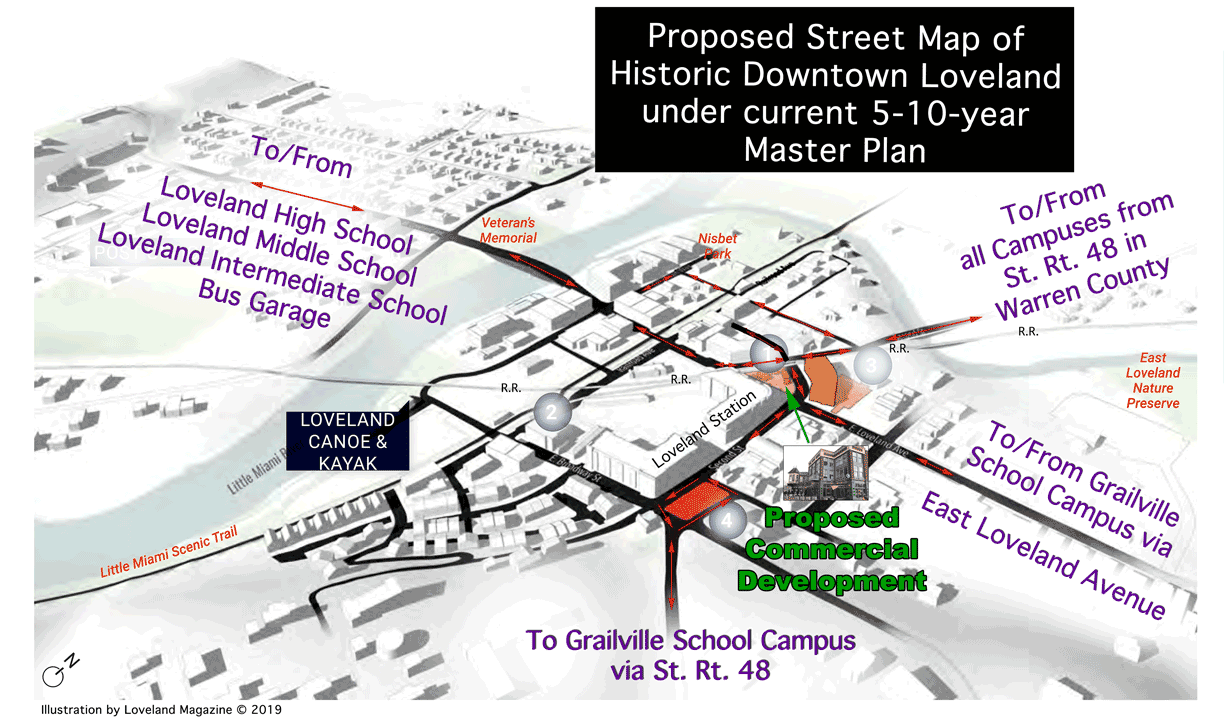
This illustration* shows the reconfiguration of the streets in Historic Downtown in the City of Loveland’s Downtown Strategic Development Plan
(“Right Click” this Map and open a new tab or window for an enlarged view)
Intersection reconfiguration – Develop parcels
• Explore, design and fund a reconfigured Loveland Avenue at State Route 48/Second Street.
• Confirm feasibility of Broadway Square-About.
• Explore, design and fund a reconfigured Broadway and State Route 48/Second Street intersection.
• Develop sites created by reconfigured Loveland Avenue and Second Street reconfiguration.
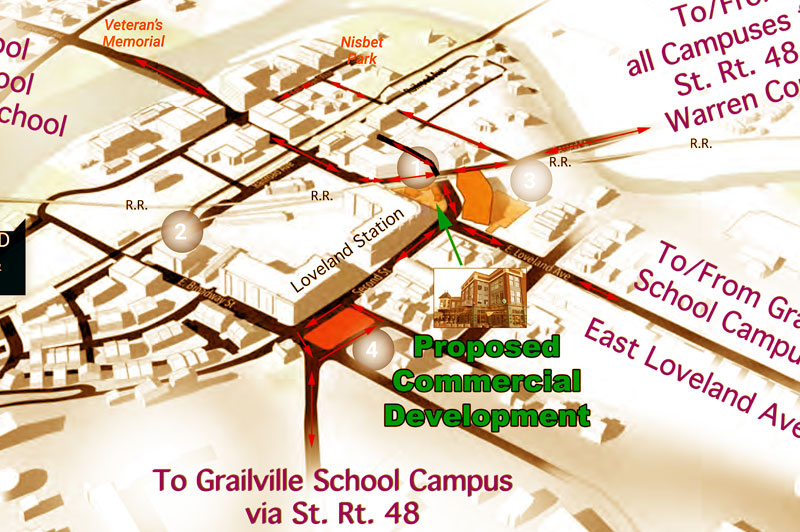
Loveland, Ohio – The 5-10 year timeline of the City of Loveland’s proposed Downtown Strategic Development Plan could throw a wrecking ball into the current strategy of how to route school buses, EMS, Fire, Police, and other rush-hour vehicular traffic to a proposed new school campus at Grailville.
Under the Loveland School District’s facility master plan adopted on April 16, they will be constructing a new Pre-K through fifth-grade campus on 110 acres at the property known as Grailville, located on O’Bannonville Road, east of downtown Loveland. Preliminary plans show the main entrance to the new school campus to be on St. Rt. 48 near St. Columban School and the White Pillars Subdivision. There will also be ingress and egress on O’Bannonville Road.
The real estate is currently owned by the Grail, an Ohio nonprofit organization. The District has an option to purchase the vacant land.
The map above shows the reconfiguration of the streets in Historic Downtown in the City of Loveland’s Downtown Strategic Development Plan that was approved by the Loveland Planning and Zoning Commission this past August and by Loveland City Council on September 10.
The Downtown Strategic Development Plan proposes placing a new commercial development into a space freed-up when West Loveland Avenue and St. Route 48 is bisected. Also, a “Square-About” replaces the current five-way intersection at St. Route 48, Hanna Avenue, 2nd Street, and Broadway.
On July 26 the District passed a resolution asking voters to approve a combined 16.78-mill Operating and Bond levy that if passed on November 5, will pave the way to the Grailville campus opening in the fall of 2022.
The street re-configuration is proposed to be implemented within 5 to 10 years, i.e., 2024-2029.
TIMELINE
March 22, 2019 – District acquires an option to purchase 110 acres at Grailville for 3 new school buildings (Pre-K through fifth-grade campus on 110 acres).
April 16, 2019 – Loveland School District’s facility Master Plan adopted that proposes Pre-K through fifth-grade campus on 110 acres at Grailville).
July 26, 2019 – School District puts combined 16.78-mill Operating and Bond levy on the ballot that if passed on November 5, will pave the way to the Grailville campus opening in the fall of 2022.
August, 2019 – Downtown Strategic Development Plan approved by the Loveland Planning and Zoning Commission with bisected West Loveland Avenue and St. Route 48, and a new “5-Way Intersection”. New commercial development will replace part of current West Loveland Avenue and St. Route 48.
September, 2019 – Loveland City Council adopts the Downtown Strategic Development Plan reccomended by the Planning Commission.
September 2022 – Proposed Grailville Campus opens.
2024-2029 – West Loveland Avenue and St. Route 48 in Historic Downtown are bisected, making space for new commercial development.
2024-2029 – “Square-About” replaces five-way intersection at St. Route 48, Hanna Avenue, 2nd Street, and Broadway.
Read the City of Loveland’s proposed Downtown Strategic Development Plan: Downtown Master Plan (Go to page 51 to read “YEARS 5 TO 10 AND BEYOND”)
(*The under-layer of the illustration (MAP) above is taken from Loveland’s Downtown Strategic Development Plan. Arrows and text have been added to show probable bus and vehicular traffic patterns to a Grailville school campus under the plan)
If you find this story useful and helpful in your daily life…
Some really nice things, in great shape! — including: 2 matching overstuffed armchairs, 4 matching World Market wood tables in various sizes, 5 matching small round wicker side tables, 1 small wicker chest of drawers, 1 lateral file, 10 super-comfy World Market folding wood relaxation chairs with full length cushions, white restroom/bedroom cabinet, monitor, a set of matching rugs – and many small items.
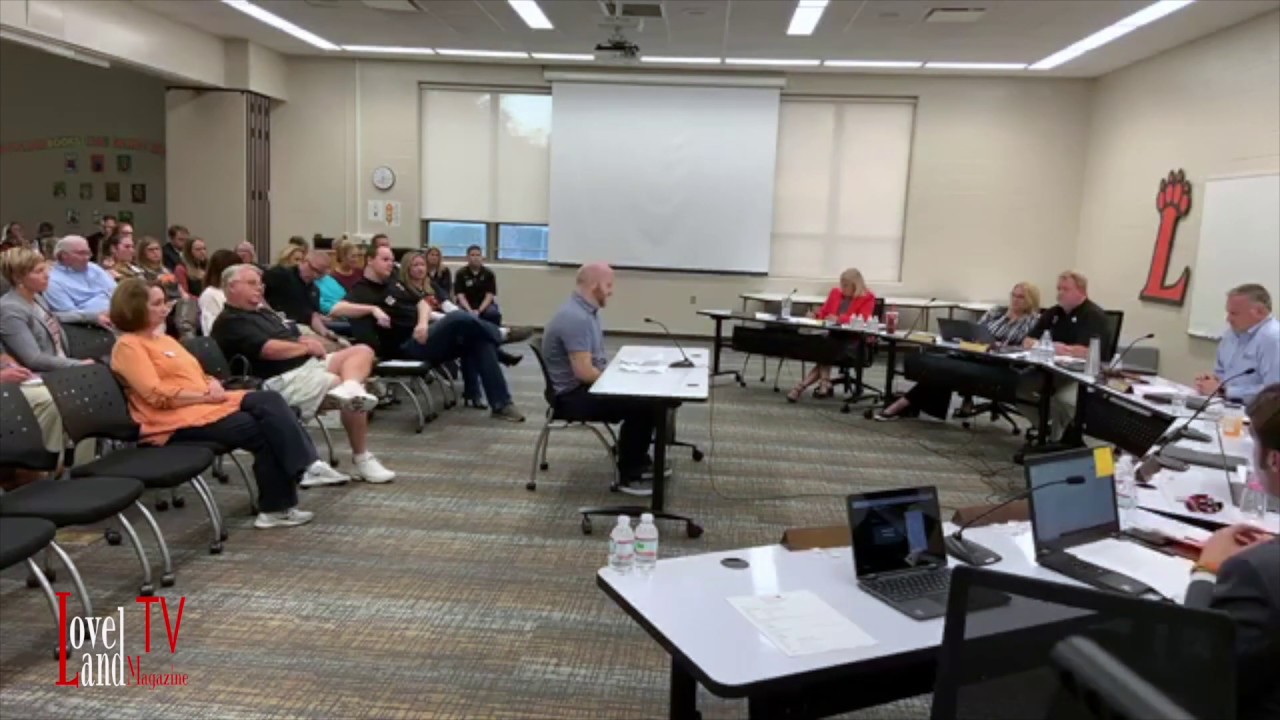
Loveland, Ohio – On Tuesday, October 15 residents spoke at the Loveland Board of Education business meeting about the combined 16.78 mil operating and bond levy that will be on the November 5 ballot.
Speakers in order of appearance were:
Danielle McKay
Dave Shoemaker
Ben Krieger
Adam Gleim
Matt Hassert
Marcia Neumann
Deron Taul
Randi Granat
Patty Russo
David Kern
LOVELAND MAGAZINE TV was there and broadcast live from the meeting. This is a re-broadcast.





 Just for fun, we’ve thrown in our favorite write-in candidate, Ms. Loveland Frog! Because after-all it would be nice to have a “tad” more gender equality and hear something besides just 7 human voices croaking “Yes” in unison for the next two years.






 by Brock Kinser






 (“Right Click” this Map and open a new tab or window for an enlarged view)
 Read the
 Loveland, Ohio – On Tuesday, October 15 residents spoke at the Loveland Board of Education business meeting about the combined 16.78 mil operating and bond levy that will be on the November 5 ballot.
