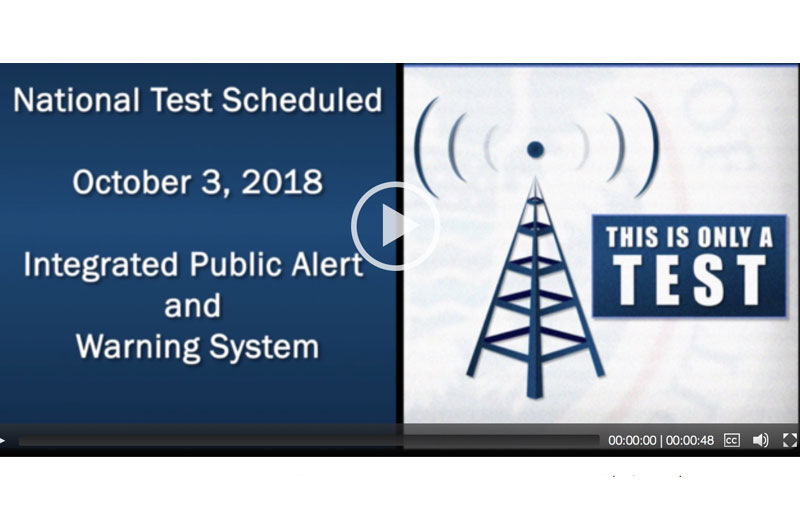
The national test will consist of two portions, testing WEA and EAS capabilities. Both tests are scheduled to begin at approximately 2:20 p.m. ET.
The WEA portion of the test will be directed to all consumer cell phones. This will be the third nationwide test, but the second test to all cellular devices. The test message will display in either English or in Spanish, depending on the language settings of the wireless handset.
The EAS portion of the test will be sent to radios and televisions. This will be the seventh nationwide EAS test.
FEMA and the FCC are coordinating with EAS participants, wireless providers, emergency managers and other stakeholders in preparation for this national test to minimize confusion and to maximize the public safety value of the test.
The purpose of the Oct. 4 test is to ensure that the systems continue to be effective means of warning the public about emergencies, particularly those on the national level. In case the Oct. 4 test is postponed due to widespread severe weather or other significant events, the back-up testing date is Oct. 11.
The WEA portion of the test will be initiated using FEMA’s Integrated Public Alert and Warning System (IPAWS), a centralized internet-based system administered by FEMA that enables authorities to send authenticated emergency messages to the public through multiple communications networks. The WEA test will be administered via a code sent to cell phones.
This year the EAS message will be disseminated as a Common Alerting Protocol (CAP) message via the Integrated Public Alert and Warning System-Open Platform for Emergency Networks (IPAWS-OPEN).
All wireless phones should receive the message only once. The following can be expected from the nationwide WEA test:
Beginning at approximately 2:20 p.m. ET, cell towers will broadcast the test for approximately 30 minutes. During this time, WEA-compatible wireless phones that are switched on, within range of an active cell tower, and whose wireless provider participates in WEA, should be capable of receiving the test message.
For consumers, the message that appears on their phones will read: “THIS IS A TEST of the National Wireless Emergency Alert System. No action is needed.”
Phones with the main menu set to Spanish will display: “ESTA ES UNA PRUEBA del Sistema Nacional de Alerta de Emergencia. No se necesita acción.”
WEA alerts are created and sent by authorized federal, state, local, tribal and territorial government agencies through IPAWS to participating wireless providers, which deliver the alerts to compatible handsets in geo-targeted areas. To help ensure that these alerts are accessible to the entire public, including people with disabilities, the alerts are accompanied by a unique tone and vibration.
Important information about the EAS test:
The EAS portion of the test is scheduled to last approximately one minute and will be conducted with the participation of radio and television broadcasters, cable systems, satellite radio and television providers and wireline video providers.
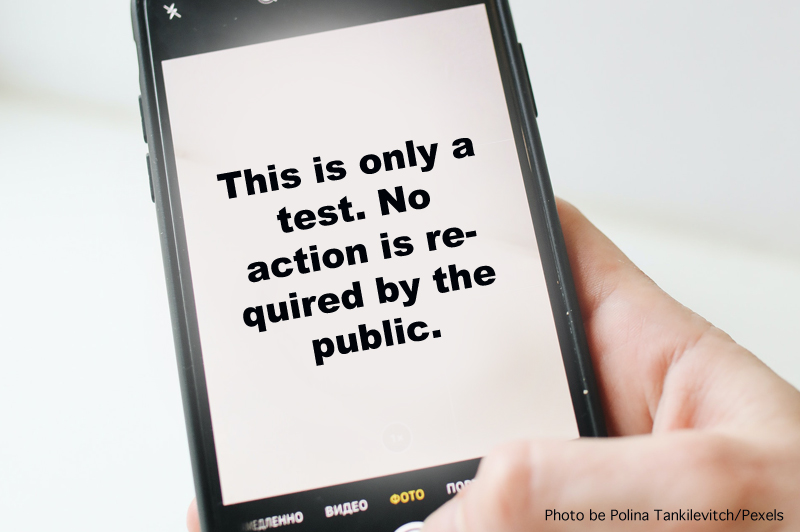
The test message will be similar to the regular monthly EAS test messages with which the public is familiar. It will state: “This is a nationwide test of the Emergency Alert System, issued by the Federal Emergency Management Agency, covering the United States from 14:20 to 14:50 hours ET. This is only a test. No action is required by the public.
State and Federal Assistance Programs We continue to work with the Ohio Emergency Management Agency to determine if the County qualifies for additional assistance programs. Availability of assistance programs varies based on FEMA criteria including severity, magnitude, and impact of the disaster. The following factors are considered when evaluating a request for State and/or FEMA Assistance:
Concentration of damage
Trauma, large number of injuries and deaths, disruptions to community functions, and emergency needs
Special populations
Voluntary agency assistance
Insurance
Damaged residential structures
Assistance to Individuals, Families and Businesses To be considered for State and FEMA financial assistance programs, the county must demonstrate that there are a minimum of 25 primary homes and/or businesses with 40% or more uninsured loss. Out of the 451 structures impacted, only 16 meet this criteria. While the County may not be eligible for additional state and federal financial assistance programs, a Long Term Recovery Committee has been established to identify and address the unmet disaster related needs of impacted residents.
Assistance Process – Each individual, family, and business has unique disaster recovery needs. All are encouraged to seek out resources in the following order:
1. Immediate needs providers, not limited to:
American Red Cross provides emergency assistance (800.RED-CROSS)
2. Insurance Company – contact your insurance provider to determine eligibility
3. Referral to Community and Volunteer services
Volunteer organizations have been assisting residents with woody debris clean up on private property
Local food pantries have provided food and other household items
4. Long Term Recovery Committee (LTRC) – A case management process is being established to verify disaster related needs. This will ensure that the resources and donations are allocated to verifiable unmet needs within the local community.
We are asking for patience as we work to coordinate amongst all of the faith-based, not for profit, volunteer, government, and private sector partners that are supporting the long term recovery effort. The overarching goal is to reduce duplication and maximize the limited resources to ensure the local communities recover from the July 6, 2022 storms.
Public Assistance (PA) The Public Assistance program provides grants to local governments for debris removal, emergency protective measures, and the repair, replacement, or restoration of disaster damaged, publicly owned facilities. To be considered for a State PA program, the County and all of the local jurisdictions collectively will have to exceed $855,264 in eligible expenses. To be considered for a FEMA PA program, the State collectively would have to exceed $19,233,100 in eligible expenses. As these storms were localized to Clermont and Brown Counties, it is unlikely that the State will meet the threshold for a Federal PA program.
We are actively working with our County and local jurisdictions to collect all of the debris management and emergency response expenses as well as the anticipated cost to repair, replace, and restore publicly owned facilities that were damaged by the storms.
Assistance with woody debris clean-up: We continue to connect volunteer organizations with homeowners who need assistance with woody debris. It is anticipated that the volunteer organizations will continue supporting local residents for many weeks. If you have already submitted your information for woody debris assistance, please be patient. If you have not registered, please call 513.735.8500 or e-mail clermontema@clermontcountyohio.gov. Please provide your name, phone number, and address.
We are asking residents not to place brush and woody debris in the right of way. Residents have multiple options for managing the remaining woody debris:
take the debris to Bzak Garden Center at 931 Round Bottom Road. This is a free service to county residents. Logs must be cut into 4 ft. or less lengths.
Mental Health Support The Crisis Hotline 513-528-SAVE (7283) is a free and confidential hotline available 24-hours/7 days a week that provides suicide prevention, crisis intervention and referral information to residents of Clermont County and Brown County of all ages. Crisis workers can give guidance, support and referral information for emotional crisis, suicidal thoughts, domestic violence and addiction issues. The Hotline is operated by Child Focus, funded by the Clermont and Brown County Mental Health and Recovery Boards and accredited by Commission on Accreditation of Rehabilitation Facilities (CARF). You can also use the National Crisis Text Line. Text: 4HOPE to 741741. The Crisis Text Line is independently owned and operated.
The Ohio Department of Insurance offers support to homeowner and renters who have questions on the insurance process. They have a severe weather toolkit that may be useful to residents. Anyone with insurance questions and complaints can reach Ohio Department of Insurance consumer services representatives through www.insurance.ohio.gov, consumer.complaint@insurance.ohio.gov, and 1-800-686-1526.
Financial donations can make the largest impact following a disaster. It allows disaster relief organizations the flexibility to buy the appropriate supplies to address the unique needs of the community. Financial donations can be made to any reputable disaster relief organization that is operating in the area.
Connect Clermont has created a Disaster Relief Fund for Clermont County. These funds will be used to support the long-term recovery effort. 100% of the proceeds will be directed to the impacted residents. Cash or check donations can be brought to any Park National Bank location.
Connect Clermont c/o Disaster Relief Fund 2400 Clermont Center Drive, Suite 100, Batavia, OH 45103.
Under the Coronavirus Response and Relief Supplemental Appropriations Act of 2021 and the American Rescue Plan Act of 2021, FEMA is providing financial assistance for COVID-19 related funeral expenses incurred on or after January 20, 2020.
Find Funeral Assistance information in your language:
Hours of Operation: Monday – Friday 9 a.m. to 9 p.m. Eastern Time
Call this dedicated, toll-free phone number to complete your COVID-19 Funeral Assistance application with a FEMA representative. Multilingual services are available.
If you use a relay service, such as your videophone, Innocaption or CapTel, please provide the specific number assigned to you for service. It is important that FEMA is able to contact you, and you should be aware phone calls from FEMA may come from an unidentified number.
On June 29, 2021, we amended the COVID-19 Funeral Assistance policy to assist with COVID-19 related deaths that occurred in the early months of the pandemic.Policy change FAQ
Required Documents
Official death certificate that shows the death occurred in the United States, including the U.S. territories and District of Columbia.
If the death certificate was issued between Jan. 20 and May 16, 2020, it must either 1) attribute the death directly or indirectly to COVID-19 or 2) be accompanied by a signed statement from the original certifier of the death certificate or the local medical examiner or coroner from the jurisdiction in which the death occurred listing COVID-19 as a cause or contributing cause of death. This signed statement must provide an additional explanation, or causal pathway, linking the cause of death listed on the death certificate to COVID-19.
If the death certificate occurred on or after May 17, 2020, the death certificate must attribute the death directly or indirectly to COVID-19.
If you are eligible for funeral assistance you will receive funds by direct deposit or a check by mail, depending on which option you chose when you applied for assistance.
As promised, the U.S. Department of Labor last week released guidance to the states on how it will disburse money to supplement unemployment checks. But it’s far from clear when — or whether — hundreds of thousands of out-of-work Ohioans will see those funds.
A $600-a-week federal supplement had been credited with keeping millions of unemployed Americans — and the economy — afloat, but it expired at the end of July.
The Democratically controlled House passed an extension of the benefit. The Republican-controlled Senate introduced a bill cutting the supplement to $200 a week, but failed to pass it.
Then President Donald Trump on Aug. 8 signed a memorandum that would repurpose federal disaster relief funds to provide $300 a week in additional support. But it would exclude people getting less than $100 a week in state benefits — a group comprising many minimum-wage workers and service workers who get a low hourly wage and tips on top of that.
The administration of Gov. Mike DeWine signed on to the plan on Monday, saying that additional guidance was needed from the Labor Department before any predictions could be made about when funds would be disbursed.
The money can’t come quickly enough for many Ohioans.
According to the U.S. Census’ Household Pulse Survey for the week of July 9-14, nearly 1 million Ohio adults sometimes or often did not have enough to eat in the past week. In addition, more than 400,000 hadn’t paid the previous month’s rent and 360,000 homeowners hadn’t made the previous month’s mortgage payment.
“This is before the $600 (federal unemployment supplement) expired,” Zach Schiller, research director for the think tank Policy Matters Ohio, said.
Earlier in the week, DeWine also underscored the urgency of getting money out to unemployed Ohioans. He praised Trump for taking the actions he did and he called on Congress to get busy — something that’s unlikely to happen until early September at the soonest.
However, state officials have to clear several hurdles before they can start distributing the federal dollars Trump has attempted to repurpose.
For example, “States will need to develop a self-certification process in accordance with FEMA instructions for claimants to certify weekly that they are unemployed or partially unemployed due to disruptions caused by COVID-19,” the Labor Department guidance says.
And state officials will have to reprogram antiquated, overwhelmed unemployment systems to process the benefit.
“We are examining the DOL guidance on lost wages assistance to see what kind of system programming is needed in order to pay these unemployment benefits,” Dan Teirney, DeWine’s press secretary, said in an email. “As noted in the guidance, all states are required to develop a self-certification process for claimants based on instructions from FEMA.”
He said that once state officials figure all that out, they’ll make beneficiaries whole, but it’s hard to know when that will be.
“While (the Ohio Department of Jobs and Family Services) intends to pay these retroactive benefits as quickly and efficiently as possible, there are several procedural and programming steps that must take place before that can happen,” Tierney said.
There is also a serious question about whether the Trump plan is legal. Georgetown University law professor David Super last week wrote that it is a clear violation of the Stafford Act, the federal law governing disaster assistance.
Schiller criticized the scheme as ill-conceived at a time when so many Ohioans are in desperate need of assistance.
“Altogether, the whole thing is kind of a half-baked measure,” he said.
Marty Schladen has been a reporter for decades, working in Indiana, Texas and other places before returning to his native Ohio to work at The Columbus Dispatch in 2017. He’s won state and national journalism awards for investigations into utility regulation, public corruption, the environment, prescription drug spending and other matters.
Washington, D.C. – U.S. Sen. Sherrod Brown (D-OH) has announced that the U.S. Department of Homeland Security’s (DHS) Federal Emergency Management Agency (FEMA) has awarded a total of $163,811 to two Clermont County fire departments for operations and safety through the Assistance to Firefighters Grants (AFG) Program.The funds include:
$135,239 to the Wayne Township Fire and Rescue
$28,572 to the Goshen Township Fire and EMS
“Ohio firefighters and first-responders work every day to protect our families,” said Brown.“We must support our first-responder organizations so that communities in Clermont County have the resources to shield families and homes from fire hazards.”
The AFG Program supports fire departments across the country to ensure the safety of both first-responders and the public. The program provides funds for supplemental training, upgrades to protective equipment, facility modifications, and other supplies that protect firefighters and first-responders in moments of crisis. Grants are awarded to fire department-based and non-affiliated EMS organizations that best address the priorities of the AFG Program. More information about the AFG Program can be found here.
Interested fire departments can contact Brown’s grant coordinator to receive information about federal grant opportunities by clicking here.
Advertisement Sangha is a place to experience skillfully designed, fun, and inspirational hatha yoga classes close to home.
For the first time, there will also be a Wireless Emergency Alert test.
On October 3rd at approximately 2:20PM EDT, FEMA is testing a nationwide broadcast over radio and television stations. This message is to make sure the Emergency Alert System is operational. And for the first time, there will also be a Wireless Emergency Alert test to make sure cell phones can receive notifications in the event of an emergency.
Batavia, Ohio – The Clermont County Emergency Agency was notified on July 25 that Gov. John Kasich approved the implementation of the State Disaster Relief Program (SDRP) for local government agencies in Clermont County impacted by the Ohio River flood and tornado that occurred this past February.
These jurisdictions have the potential to be reimbursed up to an estimated $943,000. Each eligible agency must submit a letter of intent to apply to the Ohio Emergency Management Agency, which is coordinating this effort, by Aug. 24. The Ohio EMA will then get funding approval from the State Controlling Board, which meets on Sept. 10, before distributing any funds.
These expenses represent local government outlays during the flood and tornado, including debris removal, life-saving emergency protective measures, and the repair, replacement, or restoration of disaster-damaged publicly-owned facilities. This funding is available to the local political subdivisions and non-profit organizations that participated in the damage assessment process.
The jurisdictions and potential reimbursement amounts are:
Batavia Township – $104,000
Clermont County Engineer – $266,139.63
Clermont County Sheriff – $9,237.95
Washington Township – $58,719.40
Village of New Richmond – $124,811.80
Clermont County Commissioners – $11,351.34
Franklin Township – $246,277.44
Monroe Township – $18,081.46
Pierce Township – $44,601.78
Village of Moscow – $30,000
Clermont Municipal Court – $5,089
Clermont County Park District – $3,500
Adams-Clermont Solid Waste District – $21,000
Countywide Total $942,809.80
Previously, these Clermont County jurisdictions had submitted an application to the Federal Emergency Management Agency for disaster relief through its Public Assistance Program. FEMA denied certain expenses that it considered ineligible as FEMA was unable to determine that the damage was caused specifically during the February storms.
Under the SDRP, the state will reimburse 75% of eligible expenses. Each government agency will be responsible for the balance of the expenses.




 The administration of Gov. Mike DeWine signed on to the plan on
  “While (the Ohio Department of Jobs and Family Services) intends to pay these retroactive benefits as quickly and efficiently as possible, there are several procedural and programming steps that must take place before that can happen,” Tierney said.