The Public Utility Commission of Ohio has restarted an audit of $465 million that Akron-based FirstEnergy collected from ratepayers in 2017 and 2018, supposedly to modernize the utility grid.
The state’s official watchdog, the Office of the Ohio Consumers’ Counsel, wants to know whether any of the money was used in a $61 million bribery scandal. That affair so far has resulted in a $1.3 billion nuclear bailout, the indictment of then-House Speaker Larry Householder and the guilty pleas of two of his associates.
But why the audit was called off in the first place also raises serious questions.
Leading the commission in voting to shut down the audit was Chairman Sam Randazzo. He resigned in November after FirstEnergy disclosed that it paid $4 million to someone just before he started regulating the utility in early 2019. Gov. Mike DeWine later said that Randazzo received the payment, but DeWine said he was unaware of it when he appointed the former FirstEnergy lobbyist to chair the PUCO.
For its part, FirstEnergy fired its CEO, Chuck Jones, when news of the payment came to light.
The Randazzo-led utility commission’s timing in stopping the audit might seem strange. It came just after the Ohio Supreme Court ruled in January 2020 that the charge FirstEnergy had been collecting was unlawful — seemingly a time when a regulator would want to know more about what happened with the funds.
A big reason why the court struck down the distribution-modernization charge: Despite allowing FirstEnergy to collect almost a half-billion extra dollars from ratepayers, the PUCO didn’t implement effective rules to ensure that FirstEnergy used the money to update the utility grid.
“Utility companies can be expected to respond to financial motivations, but not if the commission awards them money up front with no meaningful conditions attached,” the decision said. “The PUCO staff’s wishful thinking cannot take the place of real requirements, restrictions, or conditions imposed by the commission for the use of (distribution-modernization) funds.”
Not only did the PUCO call off the audit just as the charge was declared illegal, it did so as the auditors were making some interesting findings.
For example, it found that instead of using all the funds to improve its Ohio distribution system, FirstEnergy was placing some in a “Regulated Utility Money Pool,” from which out-of-state utilities could borrow.
To justify ending the audit — for which PUCO staff wanted more time — Randazzo and the other commissioners claimed that’s what the Supreme Court wanted.
“The court directed the commission to eliminate” the distribution-modernization charge, the PUCO wrote in its dismissal. “In support of this ruling, the court specifically objected to the usefulness of the proposed final review, questioning the lack of an effective remedy resulting from such review.”
However a reading of the Supreme Court’s opinion doesn’t mention any “specific objection” to the audit.
The relevant passage says that the auditors final report wouldn’t be available until after FirstEnergy had collected and spent the money.
“Thus, it is not clear what remedy would be available should the commission (or this court on appeal) find that FirstEnergy has misused DMR funds,” the ruling said.
One reason there’s no remedy, the court noted, is because when it allowed FirstEnergy to jack up its rates, the PUCO didn’t create any mechanism to refund the money to ratepayers if the charge is later declared unlawful or if it is shown the money was misused.
“FirstEnergy has been recovering (distribution-modernization) revenue since January 1, 2017, and the commission did not make the (revenue) subject to refund if FirstEnergy does not meet the required conditions,” the court wrote.
The $465 million FirstEnergy collected from the upcharge isn’t the only such money collected — and kept — by Ohio utilities. The consumer’s counsel reports that since 2009, $1.5 billion has been collected from Ohio ratepayers in upcharges that were later struck down by the courts.
As with the FirstEnergy charge, the PUCO didn’t create a mechanism to force other utilities to pay back the extra money they got back, either.
FirstEnergy objected to reopening that audit, but wouldn’t comment further Monday.
“Due to the ongoing PUCO audits, FirstEnergy is unable to provide additional information at this time,” spokeswoman Jennifer Young said in an email.
In a filing, the consumers’ counsel slammed the company’s objections.
“In an unfortunate display of corporate arrogance, the FirstEnergy Utilities are opposing an investigation by their state regulator, the PUCO, into utility consumer protection issues surrounding what has been described by a prosecutor as ‘likely the largest bribery scheme ever perpetrated against the state of Ohio,’” it said. “The PUCO has the authority under Ohio law to investigate the FirstEnergy Utilities and their owner, FirstEnergy Corp. FirstEnergy should get out of the PUCO’s way and cooperate.”
On December 21, a collection of open government and consumer advocates and former Statehouse reporters who championed open and accountable government called on Governor Mike DeWine to require additional financial disclosure from applicants to the Public Utilities Commission of Ohio (PUCO).
Their letter calls for the governor to require all finalists to disclose all work they have done with utilities, their consultants, and lobbyists over the past 10 years including the nature of the work performed and the amount of compensation received.
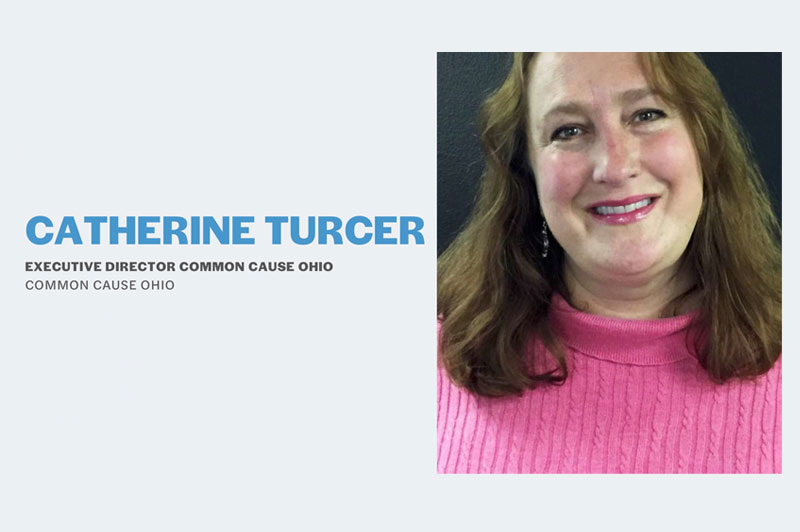
“Ohio’s financial disclosure requirements are simply inadequate,” said Catherine Turcer, executive director of Common Cause Ohio. “We are urging Governor DeWine to require more robust disclosure for the applicants before he considers appointing one of them to the Public Utilities Commission. Ohioans should be able to ‘follow the money’; such disclosure will help Governor DeWine identify conflicts of interest and could help head off future problems.”
Faith in the PUCO was shaken by last month’s revelation that FirstEnergy made a mysterious payment of $4 million to an official tasked with regulating the company. This filing with the Security and Exchange Commission revealed that this $4 million payment in 2019 was to terminate “a purported consulting agreement” that had been in place since 2013.
Although the November 19th filing did not name the recipient of the money, Sam Randazzo fits the description of someone who “subsequently was appointed to a full-time role as an Ohio government official directly involved in regulating” FirstEnergy. Randazzo was appointed chairman by Gov. Mike DeWine on February 4, 2019. The filing came after the FBI raided Mr. Randazzo’s condo as part of its ongoing investigation into corruption at the Statehouse.
A check of Randazzo’s financial disclosure statements lists no $4 million payment from anyone. It does, however, show that he was paid an unknown amount by the Sustainability Funding Alliance of Ohio, a company he incorporated in 2010. The Sustainability Funding Alliance also turned up in a 2018 bankruptcy filing among the companies used by FirstEnergy’s generation subsidiary, FirstEnergy Solutions. It is precisely these kinds of self-dealings and conflicts of interest that could and should be exposed with more financial stringent disclosure requirements for future PUCO applicants. We should not need the FBI to expose after-the-fact the financial ties and machinations of PUCO applicants.
Signatories to the letter include Douglas Jones, Director Emeritus National Regulatory Research Institute; Tom Roberts, NAACP Ohio Conference; Brandi Slaughter, Ohio Council of Churches; Jen Miller, League of Women Voters of Ohio; Catherine Turcer, Common Cause Ohio; Joe Hallett, Toledo Blade, The Plain Dealer, Columbus Dispatch 1985-2014; T.C. Brown, The Plain Dealer 1989-2006; Ted Wendling, The Plain Dealer 1999-2006; Will Skora, Open Cleveland; Jim Underwood, Horvitz Newspaper, The Plain Dealer 1985-1993.
Former PUCO Commissioners Ashley C. Brown, J. Michael Biddison, and Todd Snitchler also sent a letter today to Gov. DeWine urging the Public Utilities Commission to launch a Commission Ordered Investigation (COI).
Click here for a letter that Common Cause Ohio sent to the current members of the PUCO requesting that they provide additional financial disclosure to the public.
To read the letter from open government and consumer groups and advocates to Gov. DeWine, click here.
To read the letter from former PUCO members to Gov. DeWine, click here.
The arrest of former Ohio House Speaker Larry Householder and others in July revealed how the use of dark money organizations enabled an alleged $60 million conspiracy to sway elections and provide costly bailouts to noncompetitive nuclear and coal plants.
As federal and state court cases move forward, questions remain about what can be done to restore confidence in the legislature and to prevent similar situations in the future.
“Dark money is really how special interests win right now,” said Jay Costa, executive director at Voters’ Right To Know. When corporations use shell groups to hide their political spending, they “gain a level of credibility they wouldn’t otherwise have,” he explained. “I like to think of it as the ‘Wizard of Oz’ effect.”
In other words, voters don’t get to see who’s behind the curtain.
Two months after the federal government’s criminal complaint and indictment in July, Ohio Attorney General David Yost has filed a state court lawsuit. The complaint alleges a “pattern of corrupt activity,” and seeks injunctive relief to prevent FirstEnergy, FirstEnergy Solutions, Energy Harbor and others from reaping benefits from the bailouts under House Bill 6. A hearing on a preliminary motion for that relief is currently scheduled for Friday, Oct. 2.
Meanwhile, it’s unclear whether Ohio lawmakers will actually repeal House Bill 6, the bailout law passed as a result of the alleged conspiracy. Both Democratic and Republican lawmakers called for a swift repeal in late July and early August. However, leadership in the Ohio House has so far refused to allow a full House vote on any pending repeal bills.
‘Dragging their feet’
Rep. David Leland, D-Columbus
“They’re just dragging their feet,” said Rep. David Leland, D-Columbus. “We have 58 members of the legislature who are willing to repeal HB 6 right now.”
Instead, Speaker Robert Cupp, R-Lima, has referred the bill to a House Select Committee on Energy Policy and Oversight. So far, those hearings have largely been a general review of the pros and cons of HB 6, rather than a focused oversight of the alleged corruption that led to its passage and whether it should be repealed in order to repair any claimed harm to public trust in the legislature’s integrity.
“The only way that we can prove that Ohio is not for sale is by repealing HB 6,” Leland said. “The polling we’ve seen shows that people by an overwhelming margin are going to punish those people who have voted for HB 6 and have done nothing to repeal it.” Early and absentee voting in Ohio begins on Oct. 6.
“Our legislators are supposed to act in the public interest,” said political scientist Leah Stokes at the University of California at Santa Barbara. Corporations’ interests may sometimes conflict. But, she adds, “it’s really politicians’ and regulators’ job not to be listening to those special interests. That basic responsibility of democracy has failed in Ohio with House Bill 6.”
A straight repeal would mostly restore Ohio energy law to before HB 6 became effective, subject to some follow-up regulatory matters before the Public Utilities Commission of Ohio. A quick replacement could potentially reenact all or much of the law, which also gutted the state’s clean energy standards.
Advocates say that rushing to ram through anything more than a simple repeal this year would either just repeat bad policy or create more problems, even aside the alleged conspiracy’s past influence on the current makeup of the Ohio House of Representatives. Even at that, a repeal bill would now need either an emergency clause or an injunction sought by the state attorney general in order to stop the nuclear subsidies slated to start in January. The committee adjourned on Sept. 30 and no additional meetings are currently scheduled.
HB 6 “is so questionable at this moment. The vehicle itself and the way it was sold is all just a pack of lies,” said Rachael Belz, executive director of Ohio Citizen Action. “We need them to repeal it, and then we need to go from there.” And that second step will take time, she said.
“It’s complicated and complex legislation and policy. And we have to get it right,” said Chris Neme, a principal and co-founder of Energy Futures Group. “Passing a bill in less than a couple of months like the way HB 6 was just leads us down the road of unintended consequences.”
Shining a light on dark money
The bigger question is how to prevent similar abuses in the future. Utilities and fossil fuel interests have given heavily to Ohio political campaigns since the state enacted a 1999 law calling for competition in electricity generation. And the level of giving went up dramatically once a competitive market actually began to develop in the state.
Utilities’ political spending has continued during this election season. FirstEnergy spokesperson Jennifer Young said that its political action committee has since canceled campaign donations it had originally reported as going out in July shortly before Householder’s arrest.
Campaign donations shown for August have in fact been sent out, Young said. FirstEnergy has denied any wrongdoing in connection with its political donations or the alleged Householder scandal.
Meanwhile, a 2010 Supreme Court case, Citizens United, “really opened up the floodgates of fossil fuel and electric utility influence over politics,” Stokes said. Utilities’ political spending is “particularly pernicious,” in her view, because customers “have to buy from these companies” to get electricity delivered to their homes.
At the same time, reporting requirements currently apply only to immediate spenders on political issues and campaigns. They don’t reach all the way up the chain to the original source of the money.
“It’s basically this Russian nesting doll scenario, where you have one donor giving to another donor, giving to another donor, to get to the person who finally spends the money to influence the voters,” Costa explained.
In the case of HB 6, money flowed into Generation Now from multiple sources, with a lion’s share allegedly originating with Company A — understood to be FirstEnergy — and its subsidiaries, according to the federal complaint.
Some of the money in turn then went to a political action committee. Or, it went to other organizations that directly funded pro-HB 6 ads. One such ad claimed a debunked Chinese conspiracy was behind last year’s failed effort to put a referendum on the law on the ballot this fall. A for-profit group called Ohioans for Energy Security paid for that ad. When asked last year, lawyers at the firm that set up the corporation, Isaac Wiles, would not answer questions about the source of its funding.
“The notion that dark money is something some people don’t like is not part of the elements of the crime,” Mark Weaver, an attorney at that firm, said at a Columbus Metropolitan Club forum after news broke about the Householder arrest.
Asked if there was too much money sloshing around at the statehouse, he said it’s “a lot of money, no doubt,” but it “pales in comparison” to the amount that Americans spend on Halloween candy and costumes every year. And he said that the First Amendment protects the right to conduct political speech anonymously.
“Of course, state and local governments may (depending on how they draft) pass additional 501(c)4 disclosure requirements that could meet constitutional scrutiny,” Weaver later added.
Ian Vandewalker, Ian PHOTO CREDIT: Courtesy of Brennan Center for Justice
“There is no absolute right to anonymous speech,” said attorney Ian Vandewalker at the Brennan Center for Justice at New York University School of Law. Elections are treated differently from general speech, because of the overriding interest in making sure elections function properly, he explained at a panel organized by the League of Women Voters of Ohio.
“That requires informed voters. And it requires policies to not be able to cheat the public,” Vandewalker said. “And so those interests require that there be a level of transparency.”
“No regulation, no law, no set of ethical rules substitutes for American voters paying attention to who’s running for office — pressing them hard on what they stand for, looking closely at the issues, and going into the ballot box having done your homework,” Weaver said.
“The reason that information is important and transparency is important is so that voters are educated,” said Catherine Turcer, executive director of Common Cause Ohio. “You can’t make the argument that voters need to be better educated but you shouldn’t give them actual education. It doesn’t make any sense.”
Moreover, disclosure needs to be timely, said Heather Taylor-Miesle, executive director for the Ohio Environmental Council. In the case of HB 6, Generation Now didn’t report its 2017 spending to the Internal Revenue Service until late 2019. By then, millions more had been spent to influence the 2018 elections, the passage of HB 6, and the failed referendum effort against it.
Pending bills
Several bills introduced by Democratic and Republican lawmakers could make a strong start toward improved disclosure, including HB 737, HB 739, and SB 347. Those bills should be broadened to include digital media, as well as more traditional campaign spending, Turcer said.
The bills should also call for disclosure not only of the name of an organization, but the identity of the top three original donors of funding, Turcer added in her Sept. 16 testimony in support of SB 347. “Otherwise, wealthy special interests will attempt to avoid disclosure by creating pop-up shell groups,” she said.
And while Ohio voters won’t know who’s behind all the groups funding attack ads or other political spending this election season, information is available about how lawmakers voted on HB 6. The Akron Beacon Journal has also compiled some information on how some funds were used in the 2018 Ohio House campaigns.
“People should contact their legislators about HB 6” if they want to speak out about the issue, Stokes said, noting that the law passed with support from a mix of both Republicans and Democrats.
“When the public is outraged about an issue and really shows up, these issues get reversed,” Stokes added. “There’s a lot of leverage right now.”
[Note: the original version of this story took additional comments made by Mr. Weaver and summarized them to help the story flow better and to highlight the most relevant points. Mr. Weaver contacted Eye on Ohio and the Energy News Network after publication expressing his concern that the summary was not an accurate representation of his public comments. While we do not share that view, we are happy to share the full text from which that summary was taken. We know our readers are smart and can draw their own conclusions regarding their meaning. Beneath this article is that text, as well as a link to the entire video.]
Mark Weaver: Blaming Citizens United for this I think is wrongheaded. The New York Times, it’s sort of been proven that their collusion story about Russia has fallen completely apart and yet I don’t blame the First Amendment for the right to print what they printed. I think they had a right to print all that. I think it was substantively wrong, but I wouldn’t go after their ability to print that stuff.
And so what the Supreme Court said in Citizens United was, if a few of us get together and want to form a group to communicate, we ought to have a right to do that under the First Amendment.
And a lot of donors are looking at what’s happening in America right now with the doxxing, or the releasing of personal information and targeting people for shame. So that’s why some donors don’t want to give. Now some may have less noble notions for wanting to keep their money and their name private. But we saw what happened to Amy Acton for example where her personal home was targeted by protesters– that’s just wrong.
The notion that- I disagree with you so I’m going to personally vilify you and show up at your house where your family or your children are- so many donors see that as part of 2020 current affairs and so many of them want to avoid that. And I know not everyone has that reason.
Mike Thompson: But the problem comes in not just that somebody gives $500 to a candidate or a cause they believe in. It’s that somebody gives– $61 million or $35 million, let’s be conservative, and we don’t know that’s happening. Is there a middle ground where we can say, okay I can protect your identity, your First Amendment rights, but you can’t have THAT much influence?
Weaver: Well, not Constitutionally, no. It’s not just Citizens United. There was a case out of Ohio called McIntyre vs. the Ohio Elections Commission. This is the 7-2 Supreme Court case that said it’s legal to keep yourself anonymous when spending politically, based out of Ohio, in Westerville, Mrs. McIntyre. I used to teach the case. This morning I looked at it again and I had forgotten about this quote. This is not a close call. 7-2. This is Supreme court on anonymous speech: “It’s not a pernicious, fraudulent practice but an honorable tradition of advocacy and of dissent.”
And they pointed to the Federalist Papers that were written anonymously, to avoid scrutiny of the authors and focus on the ideas. So this notion of anonymous speech is one that’s protected by Supreme Court precedent.
Thompson: Laura, there are efforts at the statehouse to make it more transparent. Is it just lip service or are they serious efforts?
Laura Bischoff: You know it’s interesting. I do think the conditions are probably better now for reform than they were six months ago. So, there’s a couple of different bills pending. One is House Bill 737, which is sponsored by Gayle Manning, a Republican from North Royalton, and Jessica Miranda, a Democrat from Cleveland. And it’s got the support of the Ohio Secretary of State, Frank LaRose. And it would require, if you’re going to have a 501c(4) that’s spending in Ohio on political matters then it would require reporting through the state. Louis Brandeis said that the best disinfectant is sunshine. And so, this kind of works on that premise– transparency and disclosure will help clean it up.
Thompson: Derrick, It comes down to the Supreme Court. And the courts have said money equals speech. How much money? We have unlimited amounts of Free Speech. We can stand on a street corner, 24 hours a day, 7 days a week, and as long as we don’t yell fire in a crowded theatre we can do all we want. Should that same apply to the amount of money someone can give to a campaign? Or to a political cause?
Derrick Clay: Well you know if you have the money to give it, that’s your discretion whether you want to give that money to a c(4). You know, right now we’re under the law from that Citizens United case where people can give unlimited amounts of money to a c(4) nonprofit. So until that court case is overturned or challenged, then that’s the law of the land that we all have to abide by unfortunately.
Thompson: Is it too much money sloshing around at the statehouse? And you guys [points at Weaver and Clay] have both advocated for groups, and helped raise money and spent money that’s been raised. I mean, you’re part of the system-
Weaver: It’s a lot of money, no doubt. But when you look at what America spends on Halloween candy and costumes every year it pales in comparison. There’s lots of money done for lots of things.
Halloween candy and costumes don’t have the protection of the First Amendment. Remember, the Supreme Court has been very clear: the speech that aggravates us the most gets the most protection. And when you’re laying out what’s protected, political speech is the highest. And so whatever laws get passed, and I’m interested to read the details, and I’m interested in whatever laws are being put out there, they will have to withstand First Amendment scrutiny just like the news organizations represented today.
This article first appeared on Eye on Ohio and is republished here under a Creative Commons license.
Ohio’s official utility watchdog wants to know where Akron-based FirstEnergy got the $60 million that federal prosecutors say fueled the largest bribery scandal in Ohio history.
The Office of Ohio Consumers’ Counsel on Tuesday evening filed several motions with the Ohio Public Utilities Commission:
A request for an investigation and a management audit of FirstEnergy.
A requirement that the company show that it hadn’t misused consumer money to support the passage of a nuclear bailout.
And that the regulator reopen a probe into how FirstEnergy spent money intended to upgrade the electricity grid.
In July, the U.S. Attorney’s office charged then-House Speaker, Larry Householder, R-Glenford, in an alleged scheme to funnel FirstEnergy money through 509(c)(4) “dark money” groups in a corrupt effort to elect supportive lawmakers and make Householder speaker.
The feds say the goal was to pass House Bill 6, a $1.3 billion bailout that went primarily to two failing nuclear power plants, but also subsidized two failing coal-powered generators. In addition, the money was used to fund a xenophobic campaign to stop a voter repeal of HB 6 and to line the pockets of Householder and his alleged conspirators, federal officials said.
Also charged were Matt Borges, a lobbyist who was formerly chairman of the Ohio Republican Party, Neil Clark, a lobbyist who owns Grant Street Consulting, Juan Cespedes, also a lobbyist, and Householder’s aide, Jeffrey Longstreth.
In its filing, the consumers’ counsel said it was asking the utilities commission to do its job.
“The (Public Utilities Commission of Ohio) has the right and duty to regulate public utilities, for the protection of the public,” it said. “The PUCO should require FirstEnergy to show that money it collected from consumers, including the distribution modernization charge money, was not improperly used regarding House Bill 6 and that it did not violate any utility regulatory laws or PUCO orders regarding House Bill 6.”
A FirstEnergy spokeswoman said her company will comment through official channels.
“We are unable to comment on pending litigation, but we will respond to the motion by September 23 as required,” External Communications Manager Jennifer M. Young said in an email.
In its filings, the consumers’ counsel noted that “Long before the House Bill 6 subsidies, FirstEnergy was authorized to charge its consumers nearly $7 billion for these and other FirstEnergy power plants as part of the transition to power plant competition (and a supposed end to future power plant subsidies) under Ohio’s 1999 electric deregulation law.”
The documents also focused on $465 million FirstEnergy was allowed to collect from Ohio ratepayers in 2017 and 2018 as a “distribution modernization rider.” In other words, the charge was meant to fund improvements to the lines and poles and other equipment needed to efficiently deliver electricity in Ohio.
The consumers’ counsel pointed to an independent audit showing that at least some of the money was used for other purposes. For example, it was placed in FirstEnergy’s “Regulated Utility Money Pool,” where its out-of-state utilities could borrow from it.
The dividends FirstEnergy paid shareholders also took a big jump once the company started collecting more from ratepayers, supposedly to improve the power grid. The money for dividends from FirstEnergy’s Ohio utilities went from $141 million in 2016 to $350 million in 2017 — the first year of the subsidy — to $400 million in 2018.
The Ohio Supreme Court subsequently declared the charge to be unlawful, but the money wasn’t refunded to ratepayers.
After the court ruling, the utilities commission shut down an investigation into the extra charge and how the money was used. But now the consumers’ counsel says it “should be reopened in light of the new information alleged in the U.S. Criminal Complaint about FirstEnergy’s use of extraordinary amounts of money in its efforts for the passage of House Bill 6.”
After other interested parties have a chance to respond to the consumers’ counsel motions the utilities commission will decide whether to approve them.
Marty Schladen has been a reporter for decades, working in Indiana, Texas and other places before returning to his native Ohio to work at The Columbus Dispatch in 2017. He’s won state and national journalism awards for investigations into utility regulation, public corruption, the environment, prescription drug spending and other matters.
In reaction in Ohio’s Speaker of the House Larry Householder being arrested by the FBI as part of a $60 million pay-to-play scheme, Common Cause Ohio Executive Director Catherine Turcer released the following statement:
“This pay-to-play scandal would have been stopped in its tracks if Ohioans were able to see who was behind efforts to influence their opinions and votes — if they could “follow the money.” We shouldn’t need an FBI investigation to connect the dots. If we had strong campaign finance disclosure rules, Larry Householder would not have been able to pervert our political system the way that he did.
This scheme began with his quest for power — his election as Speaker of the Ohio House of Representatives — and revolves around the passage of the nuclear and coal bailout of a FirstEnergy subsidiary, House Bill 6.
Householder allegedly took millions of dollars at the same time he pushed legislation to bail out non-competitive coal and nuclear plants with more than $1 billion in public money, gut subsidies for renewable energy, and roll back clean energy standards.
Ohioans have a right to an accountable government and to know who is trying to influence lawmakers, their votes, and opinions. The federal investigation into Generation Now and today’s arrest of Speaker Householder are just the latest example of why the Ohio legislature needs to take immediate action to increase campaign finance disclosure.
It’s past time for the Ohio legislature to take action to increase transparency of political spending and stop allowing ‘dark money’ to distort the democratic process. The source of campaign funding information helps voters examine the motivation of ads they see on TV and the internet. Shining the light on ‘dark money’ will also encourage those funding these egregious ads to be more accountable.
Common Cause and its members will work with Republican and Democratic allies to find a path for strong money in politics transparency reform. Ohio voters deserve nothing less.”
xxxxx
Common Cause Ohio is a non-profit, non-partisan advocacy organization that works to strengthen public participation in our democracy and ensure that public officials and public institutions are accountable and responsive to citizens. Through a powerful combination of coalition building, lobbying and litigation, grassroots organizing, policy development, research and public education, we spotlight local, state and national issues that affect every Ohioan.