One of the largest utility scandals in U.S. history has remained largely unknown outside Ohio — until now.
Last week, HBO released a documentary that covers the long, sordid saga, which led to the federal criminal convictions of a former speaker of the Ohio House of Representatives and a former head of the Ohio Republican Party.
“The Dark Money Game: Ohio Confidential” follows the story of how utility companies used roughly $60 million in bribes to public officials to secure more than $1.5 billion in ratepayer subsidies for aging, uneconomical coal and nuclear plants.
Canary Media contributing reporter Kathiann Kowalski has spent more than a decade covering the House Bill 6 saga and Ohio utilities’ other efforts to get ratepayer-funded bailouts. Dan Haugen, a senior editor at Canary Media, recently spoke with Kowalski about her reactions to the new film.
The following transcript has been edited slightly for length and clarity.
Haugen: So, you watched this new HBO documentary “Ohio Confidential” the other day. What about it is still on your mind today?
Kowalski: I was struck by the focus they used of how dark money and gerrymandering undermined voters’ will in the wake of a 2010 Supreme Court case that opened the door for unlimited corporate spending on political campaigns, subject to few conditions.
Haugen: Was there any factual information that wasn’t previously reported by you or others?
Kowalski: A lot of it was very familiar, given the fact that I had read through most of the exhibits, read Neil Clark’s book, gone to part of the trial, and been following this for years. There was an interesting scene where they were able to get footage of the FBI observing a private detective that former Ohio GOP Chair Matt Borges and company had apparently retained to follow Tyler Fehrman, who was a witness in the federal criminal case.
Haugen: Did the film change your understanding of the HB6 story in any way?
Kowalski: They did a decent job connecting some dots. I had not thought through how former Ohio House Speaker Larry Householder’s actions also enabled a far-right coalition in the Legislature to push through an anti-abortion law in 2019. It gave me a broader perspective on the anti-democracy angle of the public corruption, but my understanding of the basic story did not change.
Haugen: Where did the abortion legislation appear on the timeline?
Kowalski: The way that the filmmaker presents it is that once Householder helped these people get the anti-abortion legislation passed, he then had people who felt they owed him something. I looked at the timing, and Gov. Mike DeWine signed the anti-abortion legislation the day before House Bill 6 was introduced.
Haugen: One of the biggest unknowns still today is what, if any, role the governor’s office had in all this. You and others have reported on a December 2018 dinner with FirstEnergy executives, DeWine, and Jon Husted, just weeks before the latter two took office as governor and lieutenant governor. Neither has been charged nor accused of any wrongdoing. Does the film shed any new light on their connections?
Kowalski: The filmmakers include an allegation of $5 million going from FirstEnergy to help elect DeWine. And they note a disclaimer from DeWine’s office that it was all within the confines of what was allowed under the law. That’s basically about all they did. It was not a deep dive into the governor’s actions or Husted, who was recently appointed to fill Vice President JD Vance’s U.S. Senate seat. I think maybe they wanted to keep their story tightly focused on the legislature and what has been proven in the first federal criminal case. That also avoids having to include more disclaimers about how nothing’s been proven against others, everybody denies wrongdoing, etc., etc.
Haugen: So is this something you would recommend that your readers watch?
Kowalski: Yes. It’s compelling storytelling. It does a good job of explaining things in plain terms. There’s a limited cast of characters, and you can follow the story. If House Bill 6 is new to you, it’s definitely worth watching. And it’s certainly important now as we’re looking at not only the continued use of dark money in politics through either nonprofits or limited liability corporations, but also, with technology, likely more ways to cover up potential bribes. So, yes, people should be aware of this.
________________
Kathiann M. Kowalski, Canary Media
Kathiann M. Kowalski is a contributing reporter at Canary Media who covers Ohio. She reports on energy, science, and policy issues and is the author of 25 books. In addition to her journalism career, Kathi is an alumna of Harvard Law School and has spent 15 years practicing law. She is a member of the Society of Environmental Journalists, the National Association of Science Writers, and the Society of Professional Journalists.
Dan Haugen is a senior editor at Canary Media. He joined Canary Media as part of its 2025 merger with the Energy News Network, where he was managing editor and oversaw state and local reporting on clean energy policy. He previously worked as a newspaper reporter, freelance writer, and watchdog editor at a Gannett-owned newsroom in South Dakota. He currently lives with his wife and two kids in Minneapolis, where he enjoys reading books, collecting vinyl, and watching baseball.
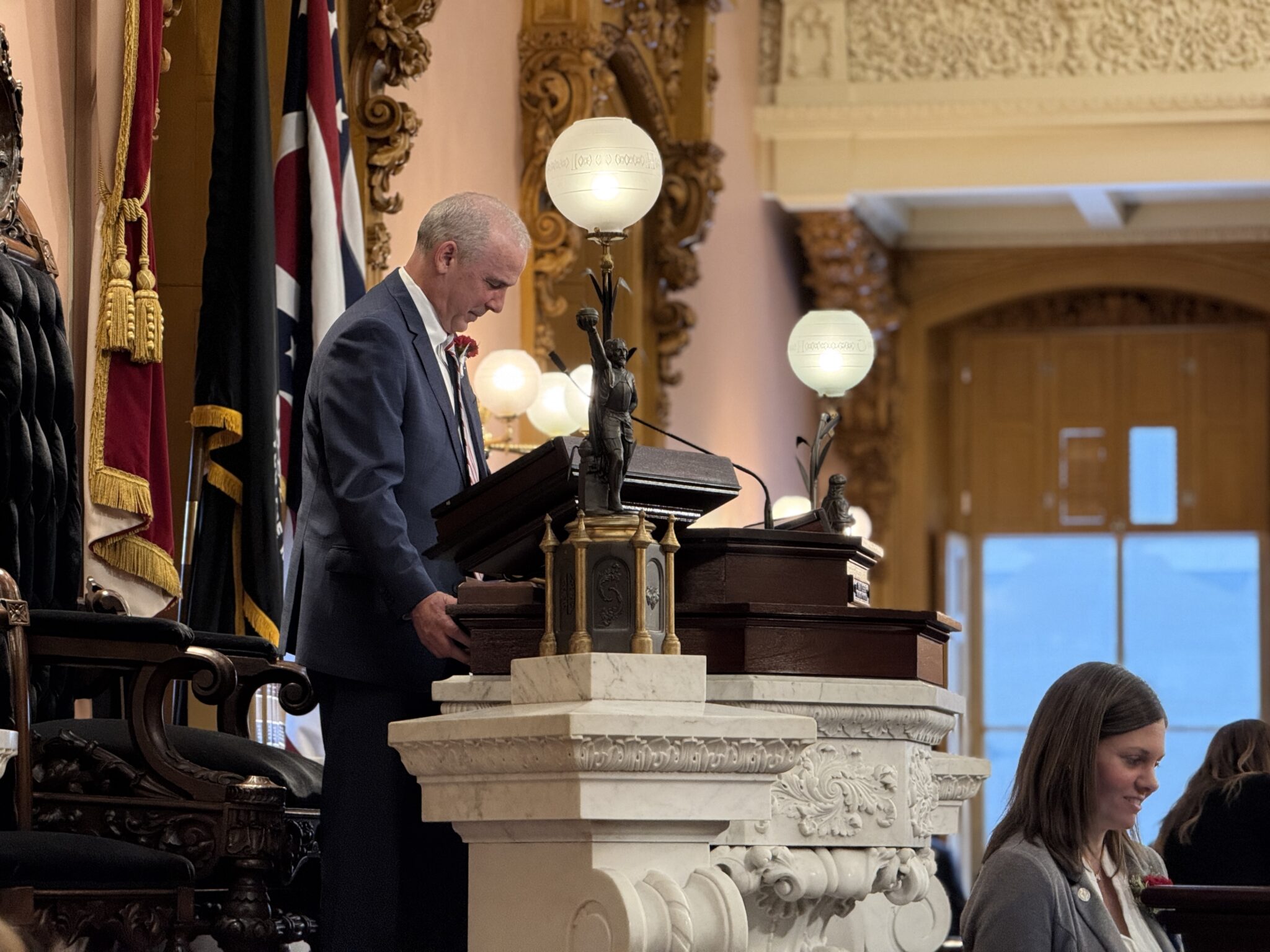
Ohio House Speaker Matt Huffman. (Photo by Morgan Trau, WEWS.)
by Marilou Johanek – Ohio Capital Journal
Just as Elon Musk’s so-called Department of Government Efficiency (DOGE) was never really about improving government efficiency – quite the opposite, in fact – the 5,000-plus page biennial budget rewrite the Ohio House slapped together and sent to the Ohio Senate was never really about improving the common good of everyday Ohioans.
It was about advancing the hard-right priorities of powerful politicians who answer to big money – not constituents in gerrymandered voting districts.
Yet even for the supremely arrogant kingpin of state government, Ohio House Speaker Matt Huffman, the budget bill passed out of the General Assembly’s lower chamber on April 9 was beyond the pale in cruelty and cunning.
It is the Ohio version of Project 2025 with all the unsparing, exacting hallmarks of the Trumpian blueprint, recklessly destroying federal institutions and agencies that, however imperfectly, protect, serve and promote the welfare of we, the people.
But that’s the MAGA nihilistic way and Ohio Republicans are doing their part in tearing down what made Ohio great. Huffman, the Lima Republican who runs the state under the one party rule he rigged with unconstitutional redistricting, is in the catbird seat calling the shots. The speaker (and former Ohio Senate president) lords over the GOP supermajority in the Ohio House while his political protégé, Ohio Senate President Rob McColley, accommodates the boss.
Huffman, who once said the quiet part out loud about GOP gerrymandering (“We can kind of do what we want”), now has a straight runway to enact his blueprint on Ohioans whether they like it or not. I suspect his budget proposal will survive, largely intact, with the House caucus he controls and the one he led with an iron fist for four years in the Senate.
Local public schools, public libraries, clean drinking initiatives, lead poisoning prevention, pediatric cancer funding, home visits for new mothers, food assistance programs and health care coverage for the poor are all on the chopping block in Huffman’s House Bill 96.
What wasn’t on his slash-and-burn budget list were government handouts (taxpayer-funded vouchers) to upper-income private school families. But doling out unlimited government subsidies to the affluent, whose darlings are already attending and affording elite high schools and religious institutions, is Huffman’s thing.
He is on a crusade to shower hundreds of millions of public education dollars on unaccountable private and predominantly religious schools – despite clear prohibitions against such a diversion of public money in the Ohio Constitution.
“No religious or other sect, or sects, shall ever have any exclusive right to, or control of, any part of the school funds of this state,” the state constitution reads.
But Huffman has defied the state constitution before with impunity (on gerrymandering) and did so again by ramrodding his universal voucher bonanza through the legislature for everyone, regardless of income. Never mind that the giant state giveaway – to offset private school costs for the well-off – blew a $1 billion dollar hole in the general revenue budget its first year.
Never mind that public schools in the state, forever cash-strapped and dependent on tapped out property owners, labored under an unequal, inadequate school funding formula (ruled unconstitutional by the Ohio Supreme Court) for 26 years before a bipartisan coalition agreed to a phased-in funding solution over six years. The final two-year phase was expected to be fully funded in the current biennial budget negotiations.
Not under Huffman. Not in a state where the Republican lock on power is absolute and the Statehouse heavyweight has free, unchecked rein to flout the law and grossly defund the public schools that educate the vast majority of Ohio students (approximately 1.6 million) while greatly expanding appropriations for private school tuitions, homeschooling expenses and even unchartered, nonpublic schools with deeply held religious beliefs that are virtually unregulated by the state!
Funding for the “thorough and efficient system of common schools” state government is constitutionally obligated to secure – and that would have been secured under the Fair School Funding Plan from 2021 – shrank by over $400 million. House Republicans added insult to injury by robbing fiscally prudent school districts of surplus revenue for future planning to give uneven, one-time property tax relief in some districts and not others. They also ensured that property tax owners will face more school levies from local districts forced to deplete that surplus operating revenue. Sound policymaking (or genuine property tax relief) this is not.
But it is a gut punch to public schools, just as a $100 million reduction in funding to Ohio’s public libraries is, or cutting over $22 million from the Help Me Grow program is for in-home visits to newborn babies to mitigate the state’s infant mortality problem. But Matt Huffman’s Ohio-centric Project 2025 is also a kick in the teeth to democratic self-governance.
Last budget go-around Republican lawmakers stripped the Ohio Board of Education of most of its power and gave it to the governor. This two-year budget proposes cutting all 11 elected members of the board and shrinking the gubernatorial appointments from nine to five. This is Matt Huffman removing voters entirely from state education policy as he engineers total opaque privatization of Ohio schools.
How is silencing the electorate improving the common good?
Marilou Johanek is a veteran Ohio print and broadcast journalist who has covered state and national politics as a longtime newspaper editorial writer and columnist.
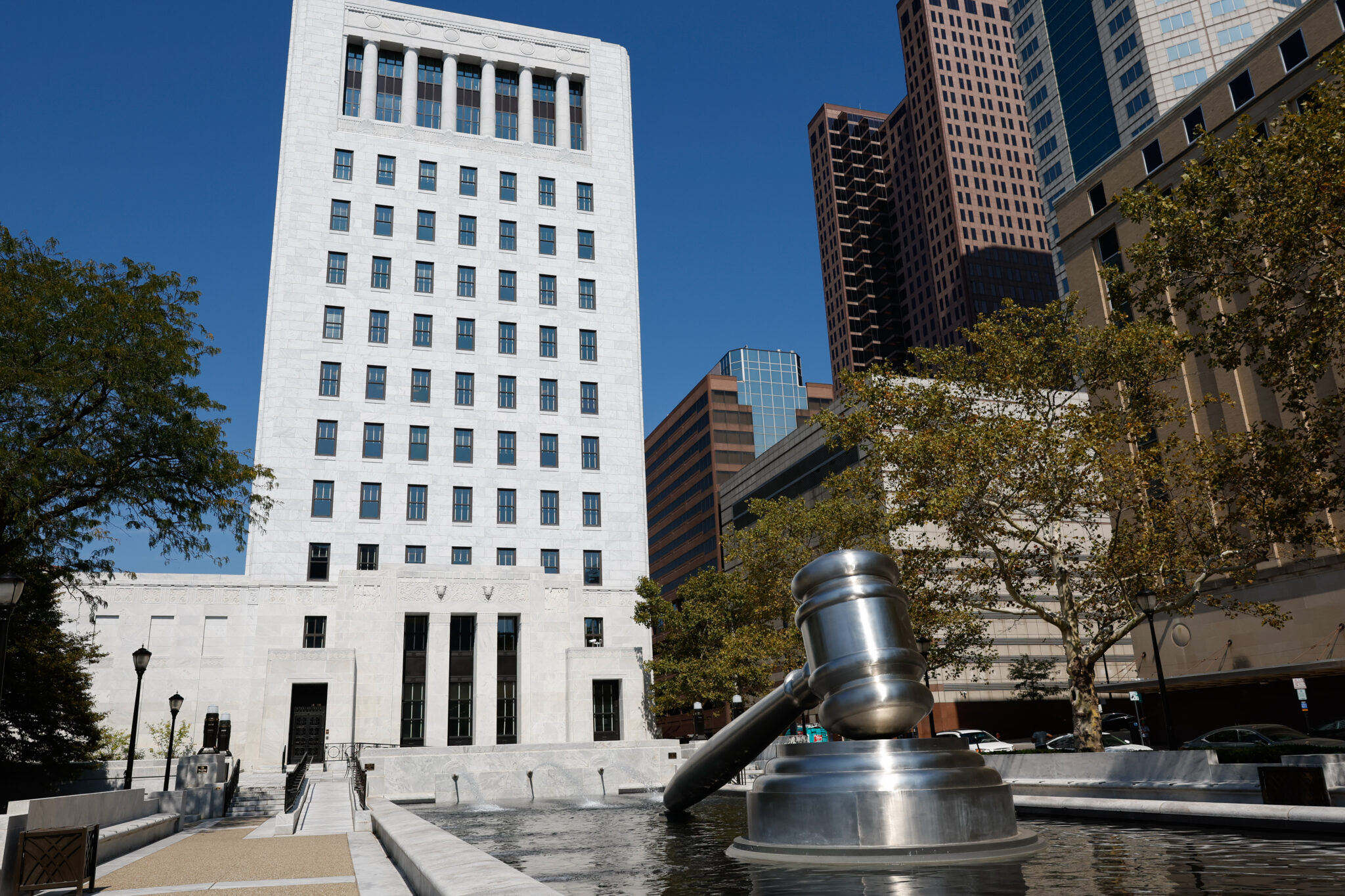
The Gavel outside the Supreme Court of the State of Ohio, September 20, 2023, at 65 S. Front Street, Columbus, Ohio. (Photo by Graham Stokes for Ohio Capital Journal. Republish photo only with original article.)
Ohio’s highest court currently has a 4-3 Republican majority
Three Ohio Supreme Court seats will be up for grabs during the November election. The outcomes will decide the balance of the court and have major impacts on a wide variety of issues that affect the lives of Ohioans, from education and environmental issues to gerrymandering and elections to civil and reproductive rights.
Partisan labels were added to the previously-nonpartisan races by the state legislature in 2021.
This year, incumbent Democratic Justice Michael P. Donnelly is being challenged by Republican Hamilton County Court of Common Pleas Judge Megan Shanahan.
Incumbent Democrat Justice Melody Stewart is being challenged by incumbent Republican Justice Joseph Deters, who opted not to run for his current seat and decided to go up against Stewart.
Vying for Deters’ open seat is Democratic candidate Lisa Forbes, of the Eighth District Court of Appeals, and Republican candidate Dan Hawkins, of the Franklin County Court of Common Pleas.
Deters decided to run for a full-term seat by challenging Stewart, rather than a partial term for the seat Ohio Gov. Mike DeWine appointed him to on Jan. 7, 2023. Because of this, whichever candidate wins Deters’ current seat will have to run again in 2026 for a full six-year term.
Ohio’s highest court currently has a 4-3 Republican majority. If all three Republicans are elected, the Republicans would hold all but one seat on the bench, for a 6-1 majority. On the flip side, if all three Democrats win their elections, the Democrats would hold a 4-3 majority. The Ohio Supreme Court has been under Republican control since 1986.
Democratic Justice Jennifer Brunner’s seat will be up in 2026. Republican Chief Justice Sharon Kennedy, Republican Justice Pat DeWine and Republican Justice Pat Fischer’s seats will be up in 2028.
The Ohio Supreme Court could make decisions on a plethora of critical issues: reproductive rights, gerrymandering, school vouchers, home rule, and environmental issues, among others.
“If there’s a law around it, it could end up in the Supreme Court and have a real, tangible impact on each of our lives,” said Elisabeth Warner, spokesperson for the League of Women Voters of Ohio.
Even though 57% of Ohio voters approved an amendment last year to enshrine reproductive rights in the state’s constitution, the court will inevitably rule on abortion access.
“There are still a lot of anti-abortion laws on the books, so that’s something that the Supreme Court is going to be ruling on,” Warner said.
Ohio’s anti-abortion laws were not automatically nullified when last year’s amendment passed, so abortion advocates are working to undo those laws.
Another lawsuit is currently pending in Hamilton County Court of Common Pleas over whether Ohio’s six-week abortion ban is unconstitutional after voters passed last year’s amendment.
Those lawsuits will likely make their way to the Ohio Supreme Court — meaning the seven justices will end up deciding to what extent reproductive rights are protected.
“At the end of the day, the Ohio Supreme Court will determine whatever’s in the Ohio Constitution that voters put into the Ohio Constitution,” said Catherine Turcer, Common Cause Ohio’s executive director. “It is interpreted by the Ohio Supreme Court.”
Turcer and Warner both criticized the 2021 law that requires party affiliation listed on the ballot for Ohio Supreme Court candidates. More than 1 million Ohio voters left the two Supreme Court races blank during the 2020 election.
“We shouldn’t actually be thinking Democrats and Republicans because at the end of the day, what you want is a referee who’s independent and impartial,” Turcer said.
Megan Henry is a reporter for the Ohio Capital Journal and has spent the past five years reporting in Ohio on various topics including education, healthcare, business and crime. She previously worked at The Columbus Dispatch, part of the USA Today Network.
Ohio Capital Journal is part of States Newsroom, the nation’s largest state-focused nonprofit news organization.
Reporting more than 731,000 signatures submitted to the Ohio Secretary of State’s Office, Citizens Not Politicians said it cleared a massive hurdle in their plan to reform the state’s redistricting process by replacing politicians with a citizen commission.
The group hoping to get a citizen-led redistricting commission inserted as an amendment to the Ohio Constitution was required to collect 413,487 signatures by July 3 in order to qualify for the Nov. 5 general election. That number accounts for 10% of the total votes cast in the last gubernatorial election, a threshold state law requires for ballot initiatives.
Ohio also requires petitions to receive at least 5% of the vote in at least 44 counties. Citizens Not Politicians said it did this in 57 counties, while also collecting signatures in all 88 counties in the state.
During a rally celebrating the submission of the signatures on Monday, retired Republican Ohio Supreme Court Chief Justice Maureen O’Connor told a crowd of hundreds in the Statehouse atrium that the initiative received the third highest signature total the state has seen in more than a century. She said it was “one of the most widely supported citizen-initiated constitutional amendments in Ohio’s history.”
“Ladies and gentlemen, let me let you in on a little secret,” she told supporters who attended the rally. “This amendment will pass. We will prevail.”
The signatures will now be verified by the Secretary of State’s Office, to filter out possible duplicate or invalid voter signatures, before a final count will be released.
O’Connor joined in on the redistricting reform process after being chief justice of a supreme court that rejected six different maps adopted by the Ohio Redistricting Commission, a commission made up of elected officials.
The current seven-member Ohio Redistricting Commission includes the Ohio House Speaker and Ohio Senate President, along with the governor, secretary of state, auditor of state, and two minority party legislative leaders. If approved by the voters, the amendment would replace the politician commission with the Ohio Citizens Redistricting Commission, which would have 15 members, five matching the political party of the governor at the time, five from the party of the gubernatorial candidate who received the second-most votes in the most recent election, and five unaffiliated members.
The most recent map adopted by the current redistricting commission was cleared by the state’s highest court after O’Connor left due to age limits, and the head chair was taken up by Republican Chief Justice Sharon Kennedy.
The rally and the reason for it brought out all sorts, from education and nurses association members to bricklayers and religious leaders.
Maria Montanez is a part of the Ohio Organizing Collaborative’s Building Freedom Ohio, which works with residents who have been a part of the criminal justice system.
Montanez said she is a convicted felon, but one who served her time while also obtaining a Bachelor’s degree in business administration.
“When I got out of prison, I wasn’t given a fair chance,” Montanez said. “Even though I came out with an accolade and prepared myself to be a productive citizen within the community, I’m still looked at as a felon.”
She wants to see changes to collateral sanctions in Ohio, and thinks making changes to voting rules and making voting districts representative can help make that happen.
“There’s plenty of people that look like me, feel like me and are living the same civil debt that I am living today,” she said.
For Cleveland-area school nurse David Spanos, changing the way redistricting is done could help bring more funding to public schools, and lift fair partisan representation into reality, rather than map manipulations meant to help incumbents hold on to power.
“I don’t think Ohio would be a Republican state if it weren’t for gerrymandering,” Spanos said.
Cincinnati resident and salon owner Desirae Futel works hard to help her customers learn where and when to vote, and what their voice means when it comes to change in politics.
“Gerrymandering has long silenced communities like mine, but today, we stand to change that,” she told the crowd.
With the signatures now submitted, the campaign to get voters to the ballot in support of the measure begins. That strategy includes battling against those who oppose the new redistricting plan, according to O’Connor.
“They’re going to scheme and spread disinformation, and try and muddy the waters and confuse the voters,” she said.
But if the motivation encapsulated in the Statehouse atrium spreads to the rest of Ohio voters, Montanez said the votes will go their way.
“It’s in the numbers that we move this, it’s in the capacity, it’s not just one person,” she said.
SUSAN TEBBEN
Susan Tebben is an award-winning journalist with a decade of experience covering Ohio news, including courts and crime, Appalachian social issues, government, education, diversity and culture. She has worked for The Newark Advocate, The Glasgow (KY) Daily Times, The Athens Messenger, and WOUB Public Media. She has also had work featured on National Public Radio.
Ohio Capital Journal is part of States Newsroom, the nation’s largest state-focused nonprofit news organization.
One might think that a movement associated with a former state Supreme Court chief justice could draft a petition summary that passes legal muster. But twice already, Ohio Attorney General Dave Yost has rejected summaries of a petition to put an anti-gerrymandering amendment on Ohio’s November 2024 ballot.
So far, nobody’s explicitly accusing Yost of deliberately slow-walking approval of the anti-gerrymandering amendment, but frustration is growing — and one advocate of redistricting reform pointed out that further delays can become critical quickly.
“The slower this goes, there are increasingly serious consequences,” said Catherine Turcer, executive director of Common Cause Ohio, which supports the amendment.
Ohio’s legislative and congressional districts are highly gerrymandered. While Donald Trump carried the state by less than eight percentage points in 2020, Republicans control 68% of seats in the state House, 78% in the state Senate and 66% of the state’s seats in the U.S. House of Representatives.
Ohio voters apparently didn’t want things to be this way. In 2015 and 2018, redistricting amendments to curb extreme partisan gerrymandering in the legislature and Congress both passed with more than 70% of the vote.
But since the 2020 Census, seven sets of maps passed by the Republican-dominated Redistricting Commission have been rejected by the Ohio Supreme Court. By effectively running out the clock, the districts rejected by the court are still in effect.
Former Chief Justice of the Supreme Court of Ohio Maureen O’Connor. (Photo by Graham Stokes for Ohio Capital Journal. Republish photo only with original story.)
Former Chief Justice Maureen O’Connor, a Republican, voted with the court’s three Democrats to reject the GOP-drawn maps, until she was forced to retire because of her age in 2022. Now she’s working with the group Citizens Not Politicians to put another constitutional amendment on the ballot.
She says this one will close loopholes by creating a truly independent redistricting commission made of up of citizens that won’t place a partisan thumb on the scales.
It would ban partisan gerrymanders and create a 15-member commission of Republicans, Democrats and independents to draw the lines. Current and former officeholders, lobbyists and large donors would be banned from sitting on it.
Despite the claims made by GOP leaders during their August attempt to restrict citizen access to the process, voter-initiated amendments to the Ohio Constitution are anything but easy.
First activists have to draft a proposed amendment and a summary of it, gather 1,000 signatures from registered voters and submit them to the attorney general. If the Ohio Attorney General approves the petition summary as accurate, then they have to gather more than 400,000 signatures from registered voters — with a percentage coming from each of 44 of the state’s 88 counties.
And, because many signatures are typically disqualified, proponents try to gather hundreds of thousands more than the minimum. It’s an intensive, costly, time-sensitive process.
Two petition summary rejections and a third submission in waiting
So far, Citizens Not Politicians has twice had its petition summaries rejected.
On Aug. 23, Attorney General Yost rejected the first summary, citing nine instances of “omissions and misstatements.”
For example, the summary said that a bipartisan panel appointing commissioners would hire a professional search firm to “assist” it. But the proposed amendment says that the consulting firm would “solicit applications for commissioner, screen and provide information about applicants, check references, and otherwise facilitate the application review and applicant interview process.”
The summary was, well, too summary, Yost ruled.
“The summary thus diminishes the actual role of the search firm in the application process, by merely stating the search firm would ‘assist’ the panel,” the ruling said.
Then after listing specific shortcomings the attorney general found in the first summary, the letter made a statement that made it seem all but certain that a second attempt would fail as well.
“The above instances are just a few examples of the summary’s omissions and misstatements,” it said.
A spokeswoman for Yost didn’t respond when asked why the attorney general didn’t specify the other problems he found with the petition summary. She also didn’t respond to a question asking whether Yost, who is eyeing a run for governor, believes extreme partisan gerrymandering is a problem in the United States.
Citizens Not Politicians quickly gathered another 1,000 signatures and submitted a new summary. On Sept. 14, Yost rejected that as well, but this time he cited only one deficiency.
The summary didn’t explain that the proposed amendment lays out a specific method of determining the party affiliation of redistricting commission members, while the amendment would leave it to the GOP-controlled Ohio Ballot Board to determine the affiliations of members of the panel that would select those commissioners, Yost wrote.
“To be clear, a fair and truthful summary should articulate this distinction so that a signer can understand the Amendment’s true meaning and effect,” Yost’s letter said. “Otherwise, the summary misleads a signer into misbelieving that party affiliation is judged consistently and with the same objective criteria when it is not.”
Citizens Not Politicians submitted a third version of the summary language last Friday and Yost has until Oct. 2 to accept or reject it. The group was less than pleased with the latest ruling.
“We are disappointed and frustrated that the Attorney General has chosen to reject our petition summary for a second time,” its spokesman, Chris Davey, said in a statement. “We adjusted our summary language as the Attorney General requested on the first submission, and we know our summary language was accurate.”
The impacts of delays
Advocates of the gerrymandering amendment might seem like they have a long time to get their ducks in a row, but time can grow short quickly and delays can be disastrous for them.
It’s not perfectly analogous, but Yost played a role in another delay — one that helped kill an attempt to repeal the corruptly passed House Bill 6. That’s the bribery scheme in which Akron-based FirstEnergy paid more than $60 million and got a $1.3 billion ratepayer bailout in return. Former Ohio House Speaker Larry Householder, R-Glenford, is now serving a 20-year prison term for his role in the scandal, but somehow, HB 6 remains on the books.
The law was so objectionable that as soon as it passed in 2019, a strong effort at a voter-initiated repeal was announced.
Leaders of the attempted repeal had 90 days after the law’s enrollment to gather at least as many valid signatures as 6% of the number who voted in the most recent gubernatorial election — about 265,000 in 2019. But first, they had to submit a summary of the ballot language along with 1,000 valid signatures for review by the attorney general and the Ballot Board.
Yost rejected the first summary that was submitted and by the time a second was approved — along with another batch of 1,000 signatures — the repeal team had only 54 days left of the original 90 to submit more than a quarter-million valid signatures.
With 40% of the clock expired — and with FirstEnergy spending more than $30 million on a brutal, dishonest campaign to thwart the repeal — time ran out before circulators could gather enough signatures to get it on the ballot.
Anti-gerrymandering protest. (Photo by Olivier Douliery, Getty Images.)The timetable for the anti-gerrymandering isn’t nearly that compressed, but each passing week is crucial, Turcer, of Common Cause Ohio, said.
“It could be that this is standard operating procedure,” she said of the two rejections so far. “But it could slow things down so much that they can’t collect signatures during early voting and Election Day.”
She was referring to Nov. 7, when a closely watched abortion rights amendment is expected to draw many Ohioians to the polls. In-person early voting starts Oct. 11 — just 22 days away.
Turcer explained that early voting and Election Day are important for petition circulators because that’s when registered voters — the group eligible to sign petitions — are gathered at county boards of election during early voting and at polling places on Election Day.
Assuming Yost approves the summary language on Oct. 2, it still has to be approved by the Ballot Board and petition forms need to be printed.
“Citizen initiatives are incredibly challenging,” Turcer said. “But they’re much harder if you have a compressed time period.”
MARTY SCHLADEN
Marty Schladen has been a reporter for decades, working in Indiana, Texas and other places before returning to his native Ohio to work at The Columbus Dispatch in 2017. He’s won state and national journalism awards for investigations into utility regulation, public corruption, the environment, prescription drug spending and other matters.
The Ohio Redistricting Commission will meet on Wednesday for the first time since May 2022 to discuss Ohio Statehouse voting districts.
After well over a year of inaction, and five different Ohio Supreme Court rejections, the commission comes back to work with heavy criticism of previous maps, and a mixed amount of optimism among anti-gerrymandering advocates that things will change.
“Even though activists from across the state wrote letters, attended, called (senators and representatives) … we know that those calls to do something different largely fell on deaf ears,” said Petee Talley, head of the Ohio Coalition on Black Civic Participation, of previous efforts to comment on district maps.
Court cases out of states like Alabama and Florida showed courts on all levels, including the U.S. Supreme Court, did not agree that racial demographics should be shoved to the side when debating voting districts.
Groups like Talley’s OCBCP, the NAACP of Ohio and the Ohio Organizing Collaborative said in a recent press call they were happy to see the rulings after Ohio mapmakers admitted they were instructed by legislative leaders not to include demographic data in Statehouse maps.
“We are hopeful that we have a vote in the next drawing in what these districts look like so that we can get the representation that we need,” Talley said on the call.
But in expressing doubts about the process considering the elected officials on the redistricting commission, Tom Roberts, a former state senator and the current president of the NAACP’s Ohio chapter, cited Secretary of State Frank LaRose’s recent letter expressing the need for maps to be passed by the end of September in order to be used in the November 2024 general election.
“This just tells me that they have no interest in drawing fair maps, they have no interest in doing the right thing,” Roberts said.
The former elected official said he’s “not optimistic” that the ORC will do “any more than they did the last time.”
The only way to get to fair maps, Roberts said, is to remove elected leaders from the commission and make it a citizen-run body. That concept has been brought up in the form of a proposed constitutional amendment for the ballot in 2024 attempting to revise the redistricting process yet again by replacing the politicians on the Ohio Resdistricting Commission with an Ohio Citizens Redistricting Commission.
The amendment had a set back as language for the proposal was rejected by the Ohio Attorney General’s office, but amendment advocates have since resubmitted language for reconsideration.
The idea of changing the way legislative and congressional maps are drawn was put to legislators in a recent Gongwer-Werth poll, where 100% of Democratic legislators polled said changes should be made, and 71% of Republican participants disagreed. Only 18% of the GOP legislators surveyed said there should be changes, with 12% undecided.
Of 51 legislators polled, 61% said lawmakers should continue to serve on the redistricting body. The partisan split was significant, however, with 88% of Democrats in the survey saying no lawmakers should acts as map adopters as 12% undecided, and 91% of Republicans landing on the side of lawmaker-led redistricting, with 6% against it and 3% undecided.
Unanimously, Democratic participants said the governor should not be a member of the commission, but 76% of GOP survey-takers saying the leader of the executive branch should be a part of the map drawing process.
Republicans were split when asked if a more competitive district map could be drawn in Ohio, with 45% of those participating saying there could be a more competitive map, and 42% of the GOP members surveyed saying it couldn’t be done.
Unsurprisingly, all Democratic participants said more competitive districts were possible.
Ohio’s U.S. Congressional district map won’t see a change until after the 2024 election, as court cases challenging the map declared unconstitutional by a bipartisan majority on the previous Ohio Supreme Court were dismissed by the current Ohio Supreme Court at the request of map challengers.
With a map draw set to happen after 2024 either way, challengers said they decided that continuing the case would only add confusion and another state of “limbo” for voters as a general election with hot-button issues approaches.
SUSAN TEBBEN
Susan Tebben is an award-winning journalist with a decade of experience covering Ohio news, including courts and crime, Appalachian social issues, government, education, diversity and culture. She has worked for The Newark Advocate, The Glasgow (KY) Daily Times, The Athens Messenger, and WOUB Public Media. She has also had work featured on National Public Radio.
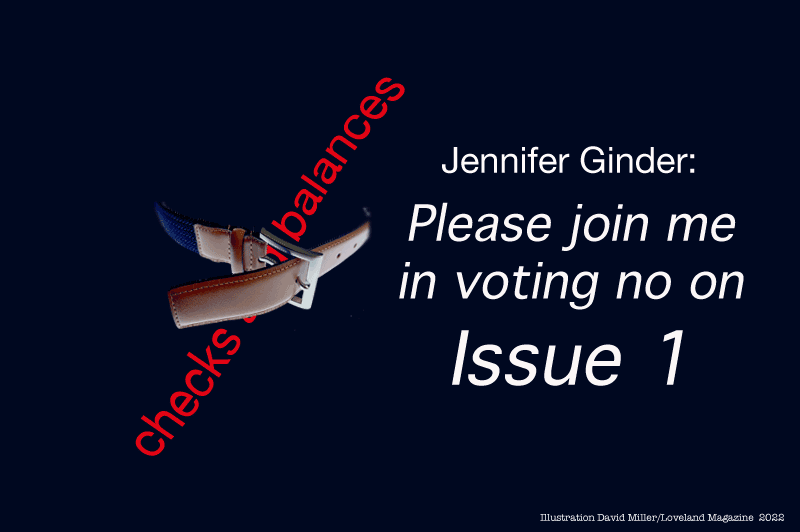
Issue 1 does not “protect our constitution;” it does the opposite.
Jennifer Ginder is a writing consultant, wife and mother of two college-aged daughters in Loveland, Ohio.
by Jennifer Ginder
I voted no last week on Issue 1 because it would end simple majority rule, making my vote matter less.
The language on the actual ballot is confusing, so it’s important to know the facts. Issue 1 would make it harder for citizen groups to change the Ohio Constitution by raising the percentage of people who have to vote “yes” to future proposed amendments from 50% +1 (majority) to 60% (super majority). It would also require that petition signatures be obtained from all of Ohio’s 88 counties rather than the current 44. This means a single county without enough signatures could kill an entire initiative. Issue 1 also eliminates the 10-day “cure” period, during which amendment campaigns can collect additional signatures if needed due to invalid signatures being tossed out.
The “Vote Yes” campaign rhetoric is misleading and designed to divide and create fear. While proponents initially insisted Issue 1 was only about protecting the integrity of the constitution, they now say the quiet part out loud: they want to stop the popular reproductive rights amendment from passing.
So, Issue 1 is designed to protect the Ohio Constitution from the will of Ohio voters.
● Issue 1 does not “protect our constitution;” it does the opposite. The campaign itself is funded by an Illinois billionaire and supported by a handful of powerful interest groups. Issue 1’s onerous requirements would make it nearly impossible for citizen groups to get an amendment on the ballot and passed. This would invite more – not less – influence by wealthy, out-of-state interests because they will be the only forces that can afford to participate in the process. The current citizen-led amendment process is ambitious and comprehensive.
● Rather than wait for the general election in November, where we typically vote on important, statewide questions, we are having a special election on August 8 for this proposal only. Lawmakers voted for this even though it will cost taxpayers $20 million, and even though they passed a law last December prohibiting special elections in August.
● Some say the constitution has been amended too many times already. But most of those changes were initiated by the legislature, not citizen groups. Over the last 111 years, only 19 of 71 citizen-initiated amendments have been adopted.
● Opposition to Issue 1 is widespread and bipartisan. It includes all of Ohio’s living former governors and five attorneys general, mayors and local leaders, as well as more than 200 hundred organizations.
Issue 1 is not about reproductive rights or any other, single issue. It’s about control, and would effectively eliminate citizen-led amendments in Ohio, regardless of their objective. When legislators are not responsive on issues important to us – like school funding, responsible gun ownership, minimum wage, or gerrymandering – we will have no recourse if Issue 1 passes. No checks and balances. Please join me in voting no on Issue 1.
In an Ohio House committee, witnesses pleaded with lawmakers to reject the effort to install a 60% threshold for future constitutional amendments. The joint resolution they’re considering would put the question to voters on an upcoming ballot. After breaking for an extended recess around lunch time, lawmakers heard more testimony and voted to advance the resolution.
But the 7-6 margin was probably tighter than supporters wanted. All five Democrats on the committee voted against it, and of the eight Republicans on the committee, only state Rep. Brett Hudson Hillyer, R-Ulrichsville, who previously floated amendments to make the resolution more palatable to opponents, voted against it.
Elsewhere in the Statehouse, a different House committee set to vote on restoring August elections Tuesday morning delayed its start. Almost six hours later, the chair canceled the hearing.
The same conservative lawmakers pushing to bring back August elections got rid of them just a few months ago. At the time, they argued they’re too costly and generate meager voter turnout. But now, an August election day suits their plan to advance the supermajority amendment.
Taken together the two proposals represent a last-ditch effort by some Republican lawmakers to hobble an abortion rights amendment ahead of November’s election. More than 200 interest groups have come out against the effort. Four previous governors and five previous attorneys general — Republican and Democratic — have also publicly criticized the plan.
But the proposal’s opponents got a reprieve of sorts from House Speaker Jason Stephens. The Kitts Hill Republican scrapped Wednesday’s House session after declining to schedule the 60% supermajority or August special election measures.
That puts an exceptional amount of pressure on the House session scheduled for May 10 — the last day lawmakers can approve the measures in time for an August election.
SJR 2 opposition
During Tuesday’s hearing, opponents harped on what they called the hypocrisy of lawmakers pushing the supermajority resolution forward. From the outset, Republicans backing the proposal have contended their effort is a way to discourage “out of state special interests” from buying the state constitution, and that it has nothing to do with undermining an abortion rights amendment on the horizon.
A group called Save Our Constitution PAC is now running ads targeting five GOP members perceived as insufficiently supportive. The funding for those ads comes, not from Ohio, but from Illinois billionaire Richard Uihlein. The owner of the shipping supplies company Uline, has previously funded far-right candidates around the country and groups promoting election denialism.
Dorsey Hager from the Columbus Central Ohio Building and Construction Trades Council criticized Uihlein’s involvement.
“An idea introduced to protect the Ohio constitution — our Constitution — from special interest is actually being promoted by a group funded by an Illinois billionaire who’s trying to change Ohio’s constitution,” he said.
Save Our Constituion PAC’s treasurer is David Langdon, the same Cincinnati attorney who’s behind the non-profit Protect Women Ohio. That organization is currently running spurious attack ads against the abortion rights amendment.
The ACLU’s Gary Daniels drew a bright line between efforts in favor of the joint resolution and those in opposition of abortion rights.
“Soda taxes, casinos, former House Speakers, monopolies and evil special interests are among the list of reasons supporters have cooked up to argue SJR 2 is necessary,” Daniels argued.
“But Ohioans know — and very few supporters are left pretending — this involves anything but abortion and gerrymandering.”
All 88 Counties
Opponents also keyed in on a less discussed, but potentially even more consequential set of restrictions added to the resolution.
Not only would organizers seeking a constitutional amendment need to clear 60% at the ballot, they’d first need to gather signatures from 5% of the electorate in all of Ohio’s 88 counties. Current law requires that percentage from at least 44 counties and grants organizers a “cure period” to gather valid signatures if the ones they turn get rejected.
“To cover all 88 counties, and then be denied that cure period,” Trevor Martin argued, “is again, it’s devastating to the citizen initiative process.”
Mia Lewis from Common Cause Ohio explained legitimate signatures can get rejected for mundane discrepancies. Say you’ve moved but haven’t updated your voter registration — using your current address would scrap your signature. Sometimes organizers gather signatures for close to year. If you move in the interim and update your registration, that old signature gets thrown out.
“It’s blindfolding the people that are trying to collect the signatures and telling them to take this leap of faith,” she argued. “There is no way for them to know how many of those signatures won’t be valid. They don’t know how many people are going to move. They don’t know how many people have put the wrong address that doesn’t match the registration.”
She called requiring signatures from all 88 counties and eliminating the cure period “punitive.”
Bonds
Opponents also took aim at the supermajority threshold’s impact on bond issues. Hager, from the Trades Council, brought up a school bond issue in his hometown of Marysville.
“If this passes, they’re gonna be able to add on to the STEM school in Marysville where they’ll be able to produce more kids in science, technology that will go to work at Scott’s, go to work at Honda (and) keep those industries growing and thriving,” Hager argued.
Requiring a 60% supermajority, he contended, would endanger those investments.
But Rep. Brian Stewart, R-Ashville, argued bonds aren’t a big issue. Stewart, who’s sponsoring the House version of the 60% threshold measure, argued every bond for the last 15 years would clear the bar.
“Why are you in your sort of fear mongering over 1990 bond issues when we’ve passed every bond issue for the last 15 years with over 60% of the vote?” Stewart asked Jen Miller from the Leauge of Women Voters of Ohio.
Miller acknowledged Stewart is correct about the most recent bond proposals. But taking a longer view the track record gets murky.
Former state representative and Dispatch editor Mike Curtin analyzed bond issues going back to 1980. Under a simple majority, two thirds passed, but with a 60% supermajority the record flips. Of the eighteen bond issues only eight would pass, and two of those just barely.
Noting how that picture changes with a broader view, Miller pressed Stewart on the growing opposition for his legislation.
“If this were such a great proposal, would we have so many former AGs and governors of both political parties coming out in opposition? Would you have to 240 organizations and growing come out in opposition? Would you need a million dollars from an out-of-state megadonor billionaire?” Miller asked.
Nick Evans has spent the past seven years reporting for NPR member stations in Florida and Ohio. He got his start in Tallahassee, covering issues like redistricting, same sex marriage and medical marijuana. Since arriving in Columbus in 2018, he has covered everything from city council to football. His work on Ohio politics and local policing have been featured numerous times on NPR.
Ohioans have had the right to direct democracy since 1912, but now lawmakers and Secretary LaRose are going after the power of the people. Because of gerrymandering and dark money, Ohioans have faced years of unpopular and unjust legislation related to democracy, women’s reproductive rights, public education, and so much more.
Yesterday, Rep Brian Stewart and Secretary of State LaRose proposed a bill that would require a 60% yes vote to pass a citizen initiated constitutional amendment, while maintaining that constitutional amendments referred by the Legislature would still only require a simple majority vote to pass.
LaRose claims that this measure is necessary to protect the Ohio Constitution, and that the time is right. We say ABSOLUTELY NOT!
Ohio citizens must already overcome extreme challenges to placing an issue on the ballot. The process requires hundreds of thousands of verified signatures and a strict geographical distribution across at least half of Ohio’s 88 counties.
The process is not overused. In fact, since 1950, only ten out of 44 ballot measures have passed (23%). If so few citizen initiated amendments pass, what problem are we looking to solve?
If this measure passes the Ohio Legislature, it will be on the ballot in May 2023; primary elections in odd numbered years have always historically had very low voter turnout. As little as 10% of the electorate will likely decide how Ohio citizens can practice direct democracy and affect change.
Send a message to your elected leaders and demand that they stop this threat to democracy!
More about the proposal to restrict access to Ohio Voters…
Secretary of State Frank LaRose (speaking) alongside Rep. Brian Stewart, R-Ashville, introducing a constitutional amendment requiring a 60% supermajority for all future citizen-led ballot amendments. (Photo by Nick Evans, OCJ.)
Legislative Republican leaders also negotiating other changes, nix plan for automated voter registration
Lawmakers raised two ideas Thursday with massive implications for Ohio voters. One is an initiative requiring citizen-led constitutional amendments gain a 60% supermajority at the ballot for passage, the other is a House bill aimed at rewriting the underlying infrastructure of how the state conducts elections.
The amendment
State Rep. Brian Stewart, R-Ashville, joined Ohio Secretary of State Frank LaRose to introduce their plan to “safeguard Ohio’s constitution from special interests,” by proposing the supermajority for passage.
“We have repeatedly watched as special interests buy their way onto the statewide ballot and then spend millions of dollars drowning the airwaves to secure fundamental changes to our state by a vote margin of 50% plus one vote,” Stewart argued.
Their plan singles out the citizen-led process for amending the state constitution and raises the threshold for passage to 60%. The signature threshold for making the ballot would remain unchanged. LaRose argued lifting that benchmark would give the same interest groups a relative advantage.
Ohio Secretary of State Frank LaRose. Official photo.
“If a special interest group can afford to pay, you know, million dollars to hire people with clipboards,” LaRose reasoned, “they can afford to pay a million and a half dollars to hire more people with more clipboards.”
The stakes are high for any groups whose ideas have fallen on deaf ears in Columbus. The prospects for abortion protection, recreational marijuana, minimum wage increases, gun violence prevention, or further redistricting reform provisions are effectively non-existent in the GOP-controlled Statehouse. LaRose and Stewart’s proposal would move the goal posts for any of those ideas.
The proposal itself, of course, will need to go to voters and get just 50% plus one to alter the Ohio Constitution. It will follow a different process, too. Stewart’s resolution would make the ballot through a General Assembly vote rather than the citizen signature-gathering process.
That lawmaker-led process won’t see any changes in the threshold for passage, either. LaRose and Stewart dismissed any suggestion their approach is unfair. Lawmakers have to meet a supermajority benchmark, too, they argued. It’s on “the front end” where they have to clear a 2/3 supermajority to make the ballot.
Under maps declared to be unconstitutional gerrymandering by a bipartisan majority on the Ohio Supreme Court, Ohio Republicans once again won rock-solid supermajorities in the Ohio House and the Ohio Senate last week.
LaRose and Stewart highlighted how 11 of 16 citizen-led amendments have failed since 2000, so it wasn’t clear exactly why they want to raise the bar higher as they also noted of the five measures that passed, three cleared 60% at the ballot box.
The legislation
Republican Ohio House Majority Leader Bill Seitz. Official photo.
Meanwhile, state Rep. Bill Seitz, R-Green Township, kicked off Thursday morning by proposing sweeping changes to an already sweeping elections bill. The biggest move involved nixing the automated voter registration language contained in the initial proposal.
Those provisions would’ve leaned heavily on the Bureau of Motor Vehicles to help voters register or update their registration any time they interact with the agency. If voters’ registration is regularly updated, the thinking goes, there will be fewer names to purge. But Seitz said after months of negotiations, the Ohio Senate hasn’t budged.
“If we’re going to get anything done,” Sietz said, “we’ve got to have an agreement between two chambers, and the Senate does not yet feel comfortable with automated voter registration, even though I am comfortable with it.”
“But it takes two to tango as they say,” he added with a wry chuckle.
Among other changes, voters would be able to request absentee ballots online, but they’d have to submit paper requests on a specific form. The deadline for requesting one would be seven days before an election. The bill trims the deadline for absentee ballots to arrive post-election to seven days as well.
Drop boxes would be available for the duration of early voting, but they’d be restricted — no more than three, all on board of elections premises and under 24/7 video surveillance.
The bill eliminates the final day of early voting but distributes those hours in the week prior by extending weekday hours.
Seitz also dropped a number of ID provisions from the original bill. He noted Senate legislation plans to offer free photo-ID to anyone — not just poor Ohioans as his bill envisioned.
“They can be, you know, Leslie Wexner or Carlin Lindner III and they could still get a free photo ID,” he quipped referencing the founder of The Limited and the co-CEO of American Financial Group.
Pushback
A slew of press releases were released Thursday afternoon from good government groups and voters rights organizations slamming the Stewart and LaRose proposal to increase the passage threshold for citizen-initiated amendments.
As for the Seitz proposal, voting rights advocates applauded the inclusion of online ballot requests and funding for electronic poll books. But League of Women Voters of Ohio Director Jen Miller warned the proposal would make elections “more complicated, expensive and inefficient.”
She urged lawmakers to expand in person voting hours during the final weekend of early voting. Miller argued boards will get more bang for their buck expanding weekend voting compared to tacking on extra early morning hours during the week.
Miller also pushed them to reconsider the automated voter registration they’d just removed. She argued 22 other states have similar policies including West Virginia, Georgia and Michigan.
“It removes barriers to registration, but it also helps every voter because the accuracy of voter rolls are improved and it can reduce administrative costs for the boards of elections,” Miller explained. “And we reduce our provisional ballot counts which are typically very high in Ohio.”
Miller returned to the idea of excessive provisional ballots in a discussion of stricter voter ID requirements.
“When someone votes provisionally, which of course we support, that actually takes away all workers from the process,” Miller explained. “It increases lines, and it also increases a lot of post-election work for boards of elections. So we think that the system as is works.”
Speaking afterward, Seitz rejected out of hand the idea that more stringent voter ID requirements could increase the number of provisional ballots cast.
“I don’t buy that at all, that’s crap,” he said, “look at everything you need a photo ID for in life, okay?”



 Last week, HBO released a documentary that covers the long, sordid saga, which led to the federal criminal convictions of a former speaker of the Ohio House of Representatives and a former head of the Ohio Republican Party.









 NICK EVANS


