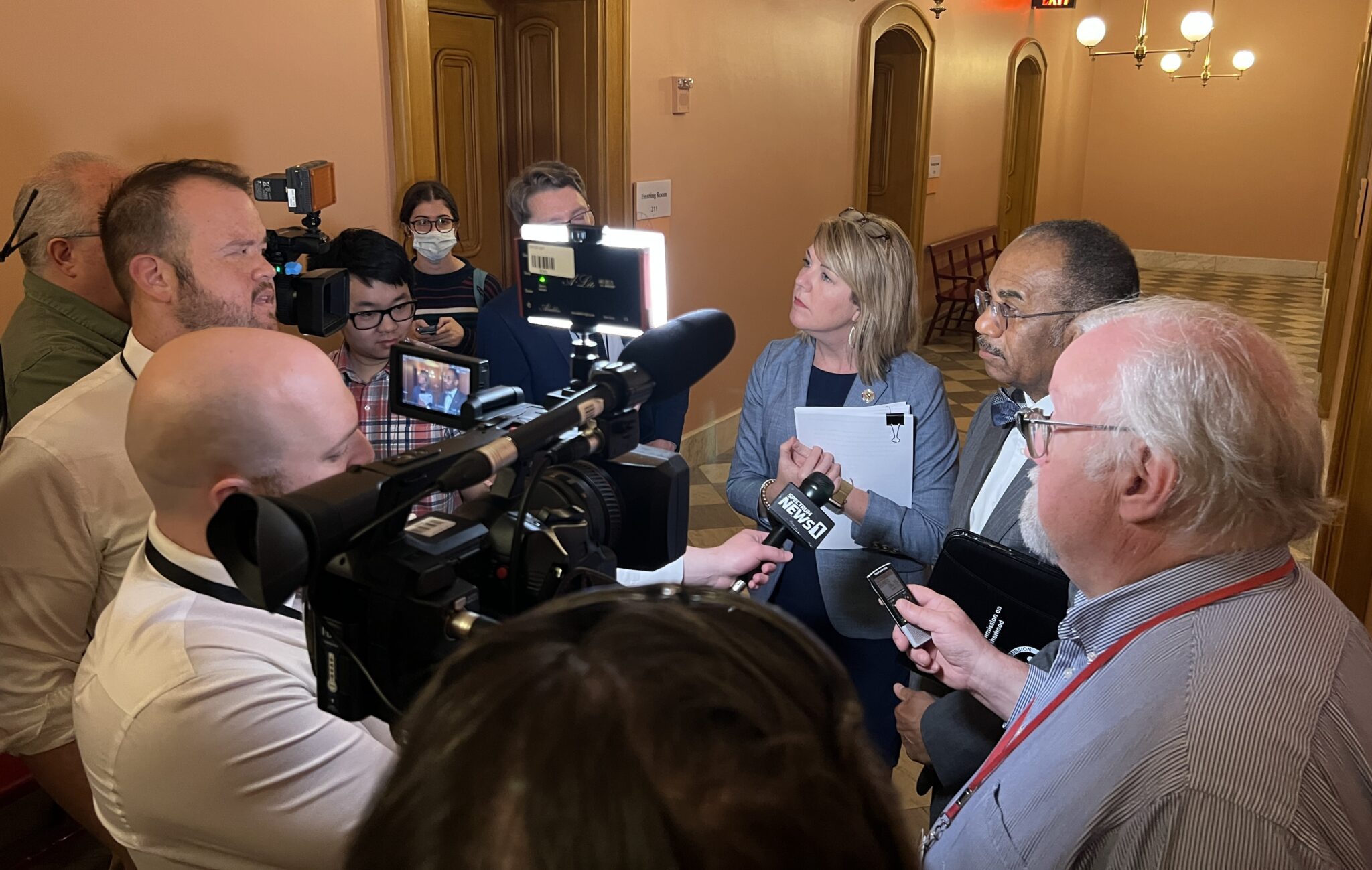
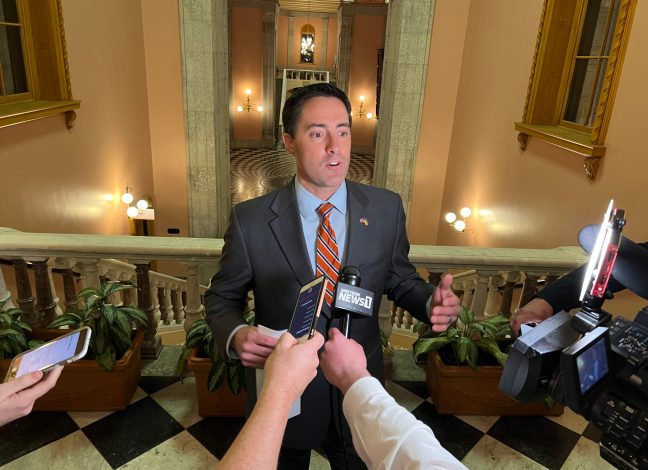
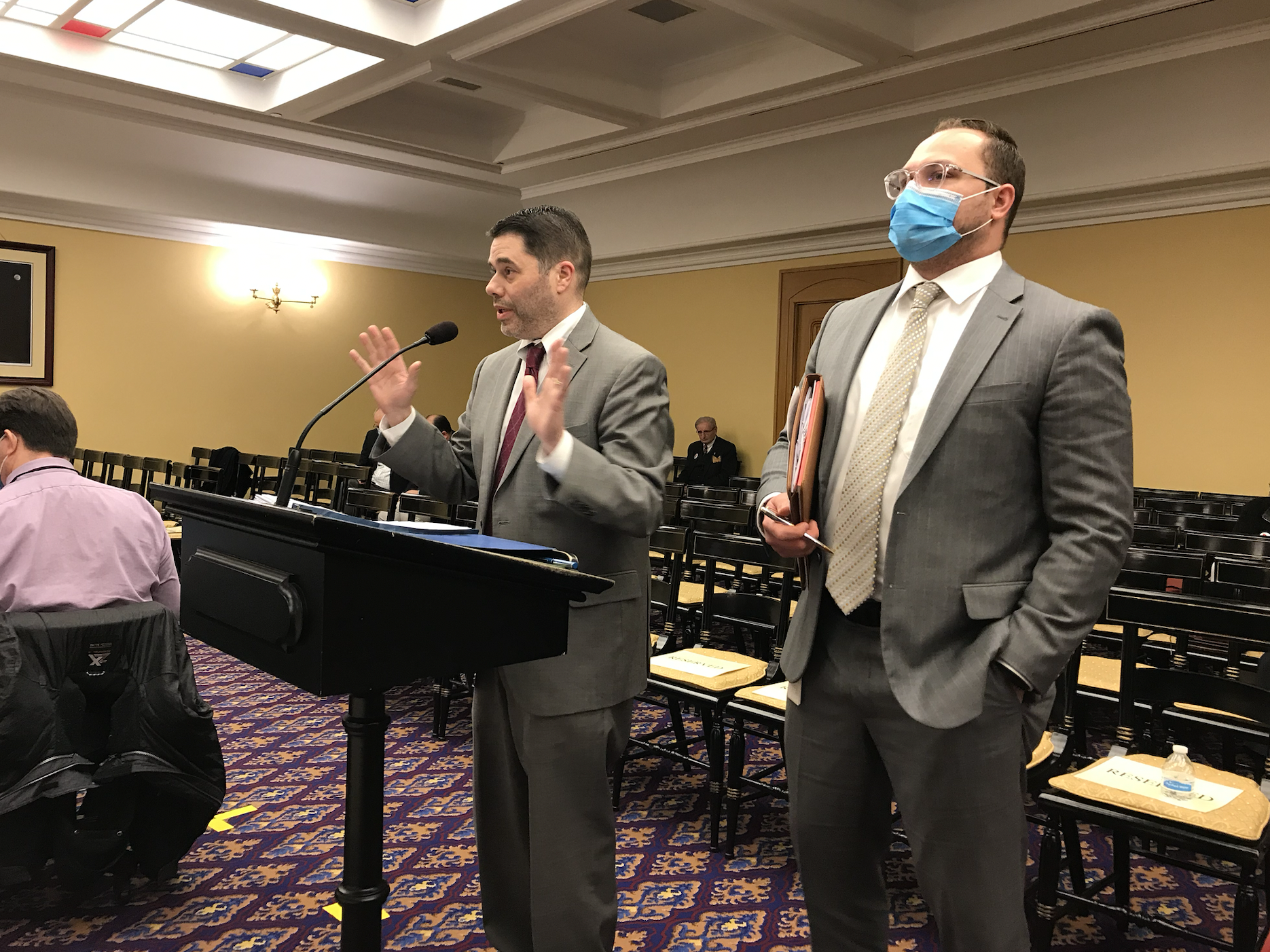
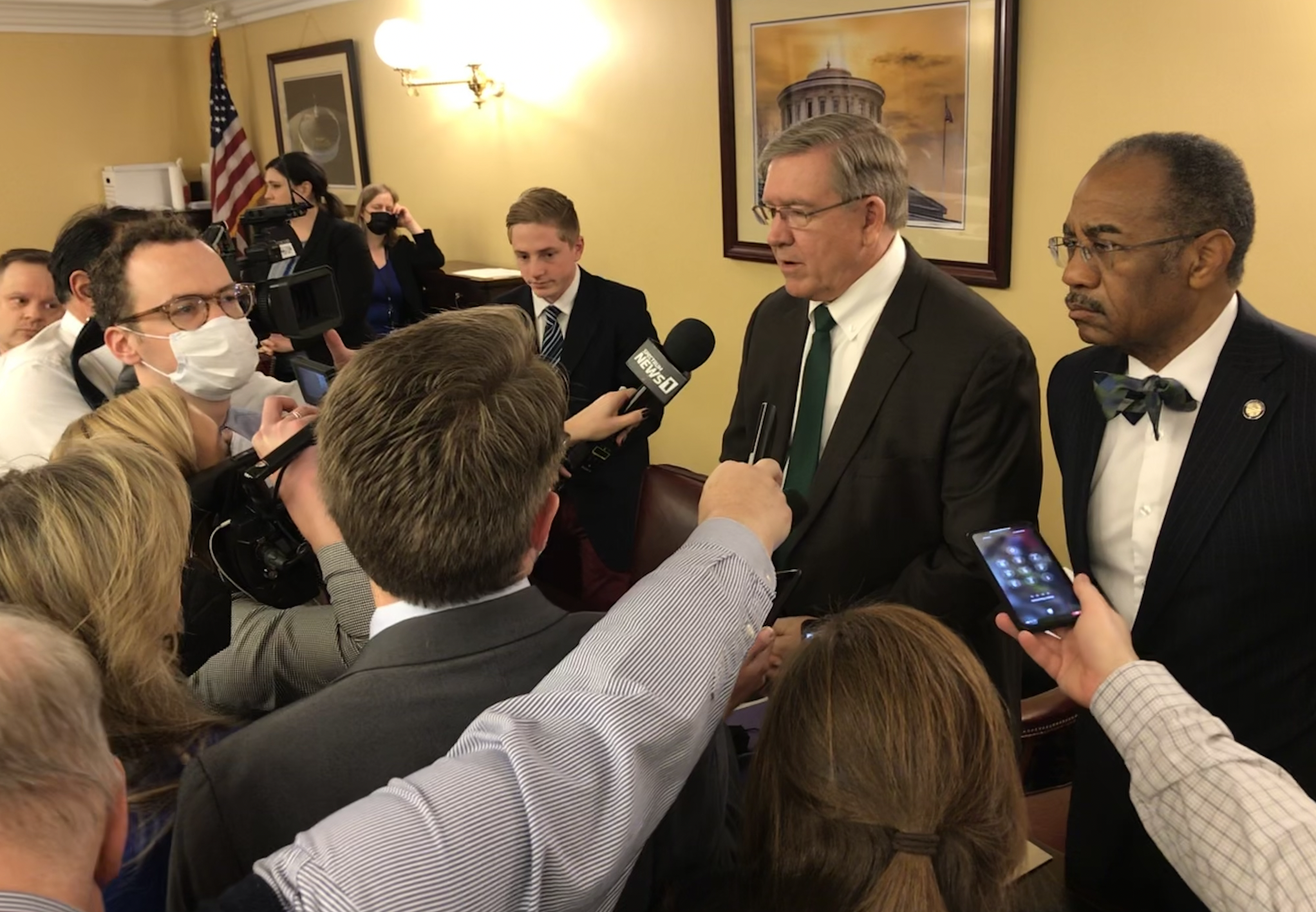
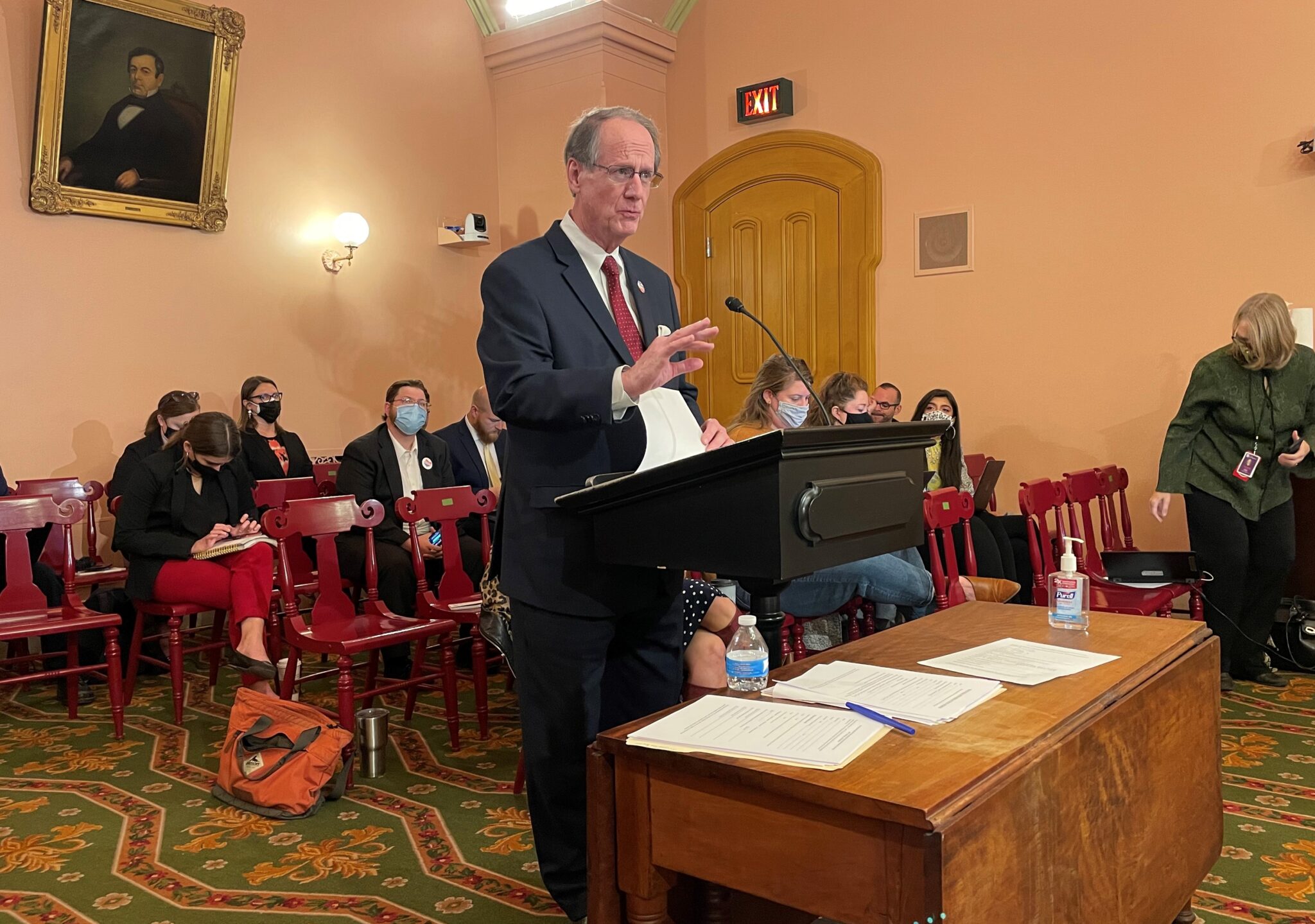
House Minority Leader Allison Russo and state Sen. Vernon Sykes speak to media outside of Room 313 of the Ohio Statehouse. The two Dem members of the Ohio Redistricting Commission tried to convince GOP members to renew talks on legislative redistricting plans, but no other members showed. (Photo: Susan Tebben, OCJ)
Members of the Ohio Redistricting Commission have not publicly announced any plans to meet and discuss legislative redistricting, despite requests by Democratic members, and a mandate by the Ohio Supreme Court.
Commission co-chair, state Sen. Vernon Sykes, D-Akron, and House Minority Leader Allison Russo, D-Upper Arlington, met with reporters Monday outside the committee room that has been used for ORC meetings, the most recent of which was March 28, when a simple majority passed a fourth version of legislative maps.
Those maps were subsequently rejected as unconstitutional by a majority of Ohio Supreme Court justices, who then gave the commission until May 6 to come up with a new plan.
“This is a state process, these are state legislative maps,” Russo said. “This is, I think, terrible precedent that is being set that we will have federal courts come and overrule what our state process is in these partisan gerrymandering cases.”
The two Democrats asked the rest of the commission members to meet with them and start the legislative process again, but no other members showed up Monday morning. Commission rules state that three members are needed to call for a meeting of the whole.
Sykes said fellow co-chair, House Speaker Bob Cupp, agreed to talk with Sykes this week about the future of the process. A spokesperson confirmed the Friday conversation, but said a public meeting has yet to be scheduled.
“We’ll be sure to let you know when a meeting is scheduled,” said Aaron Mulvey, spokesperson for Cupp.
Secretary of State Frank LaRose’s spokesperson simply said he had no plans to attend the Monday event with Sykes and Russo, and a spokesperson for Senate President Matt Huffman said there was “no meeting scheduled this morning.”
Any questions about official meetings would be for the co-chairs, spokesperson John Fortney said.
Gov. Mike DeWine’s office had previously told reporters he had a scheduling conflict.
Requests for follow-up comments from Auditor Keith Faber’s office went unanswered, but he had previously stated through a spokesperson he would not be available Monday morning.
While the date for Statehouse races to be on a primary ballot is still up in the air, all other races in the state are continuing on the May 3 primary ballots. Early and absentee voting is ongoing for those races.
Ohio Secretary of State Frank LaRose on Tuesday denied that he had called for the impeachment of Ohio Supreme Court Chief Justice Maureen O’Connor after she had repeatedly ruled against LaRose and the rest of her fellow Republicans on the Ohio Redistricting Commission.
Audio obtained by the OCJ of Secretary Frank LaRose speaking at a Union County Republicans breakfast last week.
The state’s top elections official was at the Franklin County Board of Elections on Tuesday as he kicked off early voting for most of this year’s primaries. It won’t include ballots for state legislative candidates because of a dispute over gerrymandering — a fracas over the boundaries of the districts in which members of the state House and Senate will run.
Tired, apparently, of partisan gerrymandering, Ohio voters in 2015 overwhelmingly approved a constitutional amendment that requires districts be drawn so that the partisan makeup of the legislature resembles the partisan breakdown in recent statewide elections.
That’s not how things stand now. Republicans have won recent elections with about 54% of the vote, but they control 65% of the seats in the state House and 78% of the state Senate.
This year, using the new system for the first time, the five Republicans on the seven-member redistricting commission have passed four sets of maps that O’Connor and the three Democrats on the Supreme Court have ruled are too partisan.
Republican Justice Pat DeWine has continued to sit in the case even though several ethics experts have said he has a clear conflict because his father, Gov. Mike DeWine, is a member of the redistricting commission. Justice DeWine has voted in favor of upholding the maps that his father and the other Republicans have passed.
Meanwhile, Republican frustration with O’Connor, who will leave the court at the end of the year, has been boiling over. Some Republican members of the legislature last month floated the idea of impeachment.
Gov. DeWine called the notion “extraordinary” and said it’s a bad idea to talk about removing judges whenever one disagrees with their decisions. But LaRose, the secretary of state, wasn’t so reticent on Friday when asked at a Union County Republican breakfast if O’Connor should be impeached.
“I think that she has not upheld her oath of office, and that to me is a basic test of a public servant,” he said. “That’s up to the state legislature, whether they want to impeach the chief justice or not. I certainly wouldn’t oppose it.”
LaRose stipulated that any impeachment would take so long that “it may feel really good, and it may be the right thing to do because she’s violated her oath of office by making up what she wants the law to say instead of interpreting what it actually says. But I don’t know if it would accomplish much, but I’d be fine with it if they did.”
At Tuesday’s event, LaRose tried to draw a distinction between saying impeachment may be the right thing to do and actually calling for it.
“The thing that I did was not call for anybody to be impeached,” he said. “I answered a question that was asked at a little breakfast gathering where I was with a group of supporters in Union County and what I said was, ‘It’s up to the state legislature.’ There are 33 senators and 99 representatives. If they gather evidence and hold that trial for an impeachment, if they decide as the people’s representatives to do that, then I don’t oppose that.”
LaRose and some legislative Republicans are not alone in being frustrated by the redistricting battle. For the second time, the Supreme Court has ordered members of the commission to show why they shouldn’t be held in contempt for failing to pass maps that comply with the court’s interpretation of the state Constitution. Responses were submitted on Monday.
Some members have argued that they shouldn’t be held individually liable for the actions of a seven-member body they don’t control. And some have argued for the court to simply impose maps on the commission would overstep its powers as a judicial body.
LaRose on Tuesday said holding contempt proceedings is another overreach.
“It’s a ridiculous idea that a co-equal branch of government would be held in contempt for doing our job in a way that the court doesn’t like,” he said. “What we have attempted to do all throughout this process is follow the rules that are set out in the Constitution — and not just the one part of the Constitution that the court seems to be focusing on, but all of the line-drawing rules in the Ohio Constitution.”
LaRose was asked if he was attacking a co-equal body by publicly saying that he, a statewide official, was OK with the impeachment of a Supreme Court justice who had ruled against him.
“Certainly not,” he said. “The Constitution lays out the process for impeaching and removing a justice from the Ohio Supreme Court or other elected officials. That’s not a power I have. I can express my opinion as a citizen just like any of us can and what I was telling this group of supporters in Union County a couple days ago is that if the state legislature found evidence and carried out that process, then I wouldn’t stand in the way of that.
“And I certainly have concerns that the court has delved into really the politics of this more than they should have. But that’s a choice up to the General Assembly and certainly not a choice I get to make. I was simply expressing my opinion,” he said.
Democratic Secretary of State candidate Chelsea Clark said LaRose’s comments about O’Connor make him unfit for his office.
“It’s now obvious to anyone that Frank LaRose can’t be trusted to administer organized elections and now when he’s called out for the chaos, he wants to blame the referees,” she said in an email. “To claim ‘it would feel good’ to impeach the chief justice because he disagrees with the court’s rendering is pathetic. For someone who claims to believe in separation of powers, Secretary LaRose has no problem trying to overturn the will of the people.”
LaRose on Tuesday said primary elections for legislative seats most likely will take place in August.
A bipartisan majority on the Ohio Supreme Court has for the third time rejected Statehouse district maps passed along partisan lines by Republicans on the Ohio Redistricting Commission.
A majority of the court justices said the map challengers had shown “beyond a reasonable doubt” that the most recent maps violated the constitution, particularly the provisions prohibiting partisan favoritism.
“Substantial and compelling evidence shows beyond a reasonable doubt that the main goal of the individuals who drafted the second revised plan was to favor the Republican Party and disfavor the Democratic Party,” the majority wrote in its Wednesday opinion.
The court sent the job back to the commission with a March 28 deadline to file an “entirely new” district plan for the General Assembly with the Ohio Secretary of State’s Office. A copy of the plan should then be sent to the court the next day.
The breakdown of votes matched previous votes by the court striking down maps, with Chief Justice Maureen O’Connor, Justice Michael Donnelly, Justice Melody Stewart and Justice Jennifer Brunner forming the majority opinion. Justices Sharon Kennedy and Patrick Fischer dissented. Also dissenting was Justice Patrick DeWine, son of governor and commission member Mike DeWine.
Justice DeWine recused himself from an issue in the case in which the commission members could be held in contempt of court for not filing new maps within the last deadline, but did not recuse himself from the entire case.
The justices in the majority once again pointed to Senate President Matt Huffman and House Speaker Bob Cupp as controllers of the map-making process, saying the evidence in this case “is just as strong, if not stronger” than it was in previous map-making attempts.
“The Democratic members of the commission had no opportunity to provide input in creating the second revised plan, and they had no meaningful opportunity to review and discuss it or to propose amendments once it was presented at the commission hearing on February 22, 2022,” the majority wrote.
The court said they have “identified a flawed process” in all three of its rulings on the legislative maps, plans adopted after being the “product of just one political party.”
“The evidence shows that the individuals who controlled the map-drawing process exercised that control with the overriding intent to maintain as much of an advantage as possible for members of their political party,” according to the ruling.
With these new maps, the court agreed with arguments made by anti-gerrymandering groups who said a disproportionate number of so-called “Democratic-leaning” districts were actually toss-ups, with less than a 1% advantage for the Democrats.
The newest plan had 19 House districts considered toss-ups, and seven Senate districts in the same toss-up range.
“The result is that the 54 percent seat share for Republicans is a floor, while the 46 percent share for Democrats is a ceiling,” the court wrote (italics their own).
That amount of toss-up districts, the court found, is “evidence of an intentionally biased map,” and is just one piece showing partisan lopsidedness on the part of the GOP.
Justices also made a point to single out Huffman in saying he appears to have voted against a Democratic map proposal “based, at least in part, on a misunderstanding” of the constitutional provisions regulating redistricting in the state.
Huffman called out the plan introduced by commission co-chair state Sen. Vernon Sykes and House Minority Leader Allison Russo because, according to him, the plan would have impacted the ability of Republican incumbents to keep their seats.
“Making that observation demonstrates, beyond a reasonable doubt, that Senate President Huffman misunderstands the requirements of Article XI and the reasons for their adoption,” the majority stated. “Senator Huffman’s concern for protecting incumbents is not grounded in Article XI.”
Kennedy and DeWine wrote their own dissent, that shamed the majority opinion for issuing a judgment “guaranteed to disrupt an impending election and bring Ohio to the brink of a constitutional crisis.”
The Ohio Secretary of State, yet another member of the redistricting commission, has issued frequent warning about the lateness of the redistricting effort, though he has yet to go against the Republican majority vote.
With the May 3 primary approaching quickly, Secretary Frank LaRose all but begged the General Assembly to approve extra money to speed up the delivery of absentee ballots to overseas and military Ohioans, and to extend the amount of time the county boards of elections have to send out the ballots, from 45 days before the election to 30.
In previous court filings and public comments, LaRose said the primary likely couldn’t withstand another map delay.
In shutting down the most recent map effort, the dissenting court justices say the majority of the court did much of what it did in previous rejections of redistricting maps by allegedly overriding the power of the constitution with its own interpretation.
In previous dissents, Kennedy and DeWine accused the majority justices of “moving the goalposts” by putting requirements in the constitution where none could be found, but this time, they say, “the majority tears down those goalposts altogether.”
“Through its actions today, the majority undermines the democratic process, depriving the voters of the constitutional amendment they enacted and leaving in its place only the majority’s policy preferences,” Kennedy and DeWine wrote. “In so doing, it threatens the very legitimacy of this court.”
The majority of the court added a new level to the next steps in redistricting by ruling the map-drafting “should occur in public” and that the commissioners should “convene frequent meetings to demonstrate their bipartisan efforts to reach a constitutional plan within the time set by this court.”
Dissenting justices say that the majority finding the most recent maps unconstitutional because this transparency method didn’t happen the first (or second) time “is ludicrous.”
“Nothing in the constitution requires the seven commissioners to sit down together to draft the plan – effectively handing each one of them an unbridled veto power,” Kennedy and DeWine wrote in their dissent.
The majority on the court also had a suggestion for the commission: “The commission should retain an independent map drawer — who answers to all commission members, not only to the Republican legislative leaders — to draft a plan through a transparent process.”
After the Ohio Redistricting Commission passes a new plan, map challengers will once again have three days to object after the maps are submitted.
The Secretary of State’s office declined to comment on the court ruling Wednesday night.
The Ohio Supreme Court’s isn’t done: It is still considering court challenges to congressional maps passed earlier this month. The court also hasn’t said whether it will reschedule a contempt of court hearing it brought up after the ORC didn’t come up with legislative maps by its February 17 deadline.
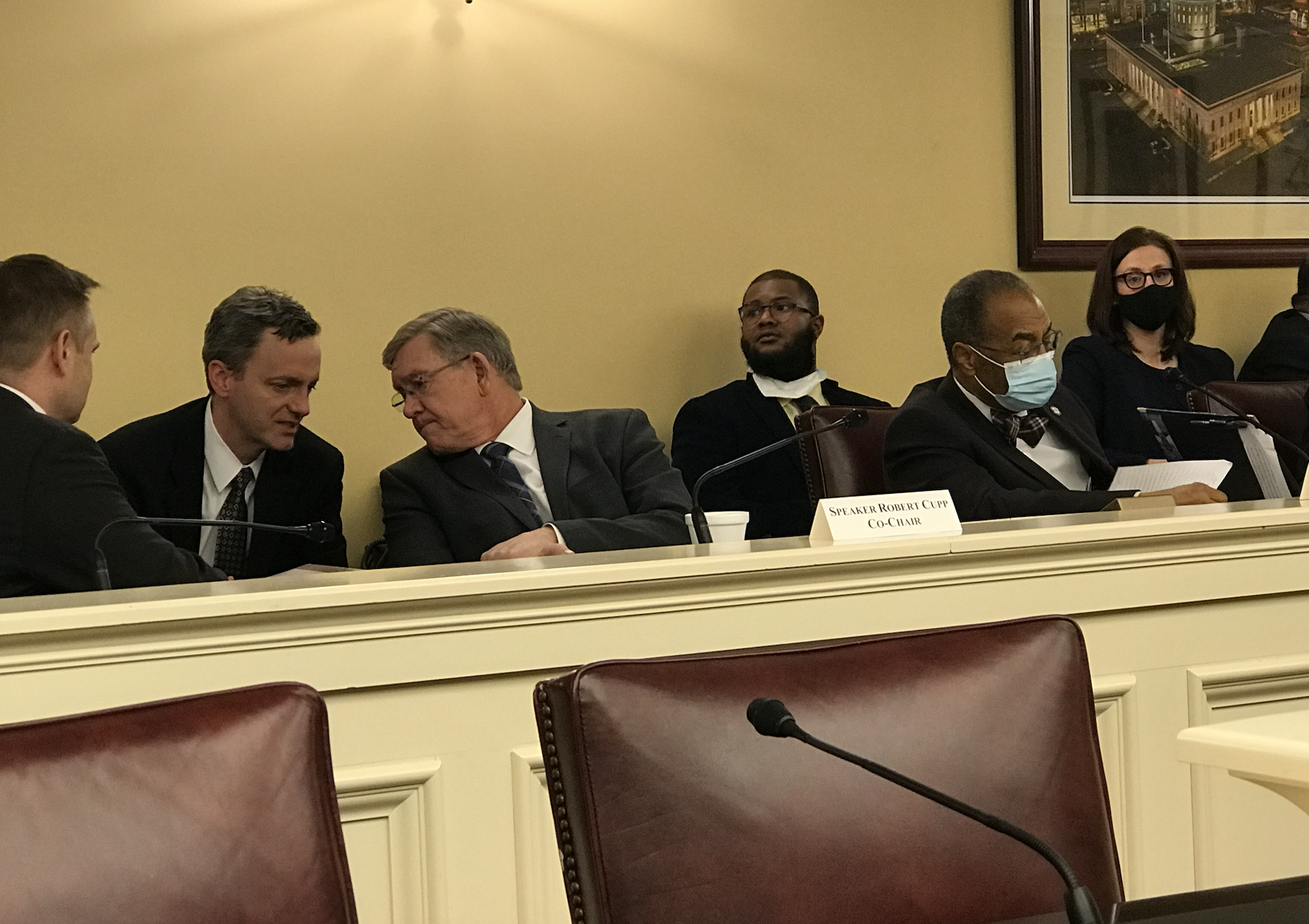
The Ohio Redistricting Commission co-chairs, House Speaker Bob Cupp, second from left, and state Sen. Vernon Sykes, second from right, prepare to restart the Ohio Redistricting Commission meeting on Thursday after a recess. The ORC adjourned the meeting without sending a new legislative redistricting map to the Ohio Supreme Court, as they ordered it to do. (Photo: Susan Tebben, OCJ)
Heated questioning and behind-the-scenes discussions between Ohio Redistricting commissioners led to a deadline-breaking decision to make no decision Thursday after the Ohio Supreme Court rejected two previous attempts at Statehouse maps as unconstitutional gerrymanders.
The Ohio Redistricting Commission could now face contempt of court, and the state faces a constitutional crisis after the commission adjourned without adopting a legislative redistricting map to submit by their court-ordered Thursday midnight deadline.
The GOP members of the commission, of which there are five, did not present a map during Thursday’s meeting. Senate President Matt Huffman, who did most of the talking for the majority party, said there was no reason to, because mapmakers had told commissioners that they could not comply with the supreme court’s directives and all the redistricting provisions of the constitution simultaneously.
“Under these circumstances, I don’t believe the commission is able to ascertain a General Assembly district plan,” Huffman told the commission before they adjourned.
Gov. Mike DeWine only spoke at one point during the meeting, which was as the impasse became clear, and a map did not appear to be forthcoming.
He did not agree that the commission could leave without bringing a map before the court, and did not think that was what the commission should do anyway.
“I don’t think we have the luxury of saying we’re just quitting,” DeWine said.
After the meeting adjourned, DeWine doubled down on his opinion that the commission had an obligation, and a legal one at that, to produce some sort of map for the state’s high court to consider.
I think it is a mistake for this commission to stop and basically say that we’re at an impasse. I don’t think that is an option that the law gives us.
– Ohio Gov. Mike DeWine
The commission was offered a map by the two Democrats on it with a 54-45 partisan breakdown, but GOP members voted down the measure along party lines after lengthy and tense criticism by Republicans, for the most part Senate President Matt Huffman.
Taking the brunt of GOP criticism was House Minority Leader Allison Russo, who made the motion for the commission to accept the Democratic drawn maps.
Huffman took the commission through the Democrats’ maps region by region, pointing out different GOP-incumbent districts that he said violated the constitutional provision prohibiting the favoring or disfavoring of one political party over another.
He accused the Democratic caucus of racial gerrymandering in a few districts, specifically the Ohio Senate’s 25th District, made up mostly of Lake County, and House District 44, covering Ottawa and parts of Lucas County. Huffman accused the Democrats of gerrymandering by redrawing the districts and the communities therein to favor their candidates.
Russo denied any existence of “packing and cracking,” the strategy of packing communities into a smaller area than necessary to benefit one party or another, or spreading a community out among a larger space than necessary to dilute its voting power.
“What you’re asserting is just simply false,” Russo said.
Throughout the meeting, she parried with Huffman and other Republicans, consistently asking the commission members to spell out specific constitutional violations in the Democratic maps.
“If you have a map to propose that achieves this or suggestions to propose that address some of these concerns that you have, so far I have not yet seen a constitutional violation,” Russo said.
When asked by Russo if the GOP had a map proposal to bring before the commission, Huffman hedged, saying he needed to finish his questions and “see how it goes.”
He brought up the idea to “let the public decide” on the Democratic maps as he continued his dissection of the map, but said there were hours of testimony to refer to in lieu of more public hearings.
“I’m not proposing additional public input,” Huffman said.
What’s next?
After the commission adjourned without doing as the Ohio Supreme Court asked, legislative leaders didn’t have a plan as to what would come next.
“I don’t know; I don’t have a next step,” Huffman said.
Cupp, a former Ohio Supreme Court justice himself, refused to speculate on what the courts might do, but said the commission will “try to keep working and if there’s some ideas that come forward on how to develop a legislative district map,” he said, the commission “would work very hard to do that.”
Auditor Keith Faber made a motion to change the rules of the commission well into Thursday evening, after the commission went into a recess to discuss the Democrats’ presentation. The change, which was passed 6-1 with only Russo voting against the motion, allows the commission to reconvene at the request of three members of the commission. Those members do not have to be the co-chairs, and it does not have to be a bipartisan request.
Co-chair state Sen. Vernon Sykes, D-Akron, confirmed that the court can not adopt the maps themselves, but as far as what happens next, he, too, was in the dark.
He did, however, say it is possible the commission members could be held in contempt of court for failing to follow a court order.
“I believe that is a possibility,” Sykes said.
When asked if he would be okay with that happening as a consequence, he said he is “okay with us moving forward, whatever can be done to help us move forward.”
When pressed on if that included contempt: “Including whatever we can do.”
Constitutional scholars remain uncertain about the next steps of the process, mostly because the state hasn’t gone through it before.
“This is a new process, and Ohio voters clearly wanted more collaboration and a more bipartisan process than we’ve seen so far,” said Mike Gentithes, associate professor who teaches constitutional law at the University of Akron.
The University of Akron’s Seiberling Chair of Constitutional Law, Dr. Tracy Thomas, gave the outside perspective on the situation, saying it was “likely to end up in the courts for a while regardless of the outcome today.”
Several states have invalidated maps because of partisan favoritism and sent them back for revisions without a solution for a stalemate.
“In the absence of some constitutional mandate or overriding federal legislation, which we don’t really have, the line-drawing is part of the political process and subject to the usual majoritarian control,” Thomas told the OCJ.
The Ohio Supreme Court is not likely to let this lack of action slide, in Gentithes’ opinion, and this could potentially lead to yet another overhaul of the process, since it seems the incentive to have 10-year maps with bipartisan agreement didn’t have the desired effect.
“That might teach us how to restructure an amendment to actually have some teeth,” Gentithes said.
The primary election is an entirely different bear, and Secretary of State Frank LaRose spent his short time speaking at the commission meeting impressing upon the commission the urgency of making decisions.
“This challenge is not one that can be met with creativity, and grit and tenacity … instead this one is simply dictated by logistical deadlines,” LaRose said.
Adding to the threat of legal trouble for the commission, without district lines, LaRose said the commission is in danger of missing a federal deadline to send absentee ballots to Ohio citizens who are overseas or in the military.
“We are dangerously close to possibly violating federal law,” LaRose said.
Cupp chuckled at a question about whether or not he accepted the idea of breaking federal law, saying, “I’m not okay with breaking any law.”
The primary date is unlikely to change, in his mind, because of a lack of support for the idea in his chamber.
“I don’t think in the House that there is a majority vote for moving the primary election at this time,” Cupp said. “Let alone, the two-thirds vote we would need for it to happen immediately.”
Republican mapmakers Ray DiRossi, at podium, and Blake Springhetti present the GOP legislative map proposals to the Ohio Redistricting Commission on Saturday. The commission passed the GOP maps on a 5-2 simple majority. (Photo: Susan Tebben, OCJ)
After two more days of discussion and debate, the GOP majority on the Ohio Redistricting Commission adopted four-year legislative maps Saturday night with a 5-2 simple majority, setting up the time table for potential objections and court review.
The Ohio Redistricting Commission meeting went into Saturday night after recessing Thursday and not meeting again until 2:30 p.m. Saturday afternoon.
Ohio House districts, as proposed by the GOP majority and adopted by the Ohio Redistricting Commission on Saturday. (Right-Click to open in a new tab to view larger)
During the Saturday afternoon session, Republicans and Democrats presented separate maps, though the Democratic co-chair of the commission, state Sen. Vernon Sykes, D-Akron, said the purpose of the Democratic caucus effort was not to present separate maps as much as it was an exercise to prove constitutionally proportional representation could be done.
It became clear as the day went along that disagreement was still threatening the process. House Speaker Bob Cupp said even in the last hour of the commission’s time on Saturday, when they recessed to discuss each plan, the co-chairs were discussing whether or not it was worth it to continue negotiations or try to amend the maps.
“A majority of the commission felt that that was just, while it may have been a good thing, was not possible to do,” Cupp said.
Earlier in the day, the Democratic co-chair said members of his caucus were still operating under the idea that agreement and common compliance to the constitution was at the end of the redistricting tunnel.
“Not until just a day or two ago was I told that there was a feeling that we could not meet the proportionality requirements,” Sykes said.
The Ohio Supreme Court told the commission they needed to come back with a map that followed Section 6 of the constitution, the part of the redistricting process that prohibits overt partisanship. The court said the commission had to endeavor as much as possible to get to a 54% Republican to 46% Democratic split in statewide voter preferences.
The Republican maps adopted had a 57 GOP to 42 Dem split in the Ohio House, and a 20 GOP to 13 Dem breakdown in the Senate. Four of the Democratic-leaning seats give the Dems a narrow 50-51% advantage, considered a tossup by many. All but one of the Senate seats in the plan were above 54%.
In the House, 12 of the “Democratic leaning” seats in the GOP plan could also be considered tossups, with a Dem favor of only 50-51%. All of the GOP-leaning seats favor Republicans by more than 52%.
The Democratic attempt had 45 Dem-leaning seats in the House and 54 GOP districts, with 18 GOP districts in the Senate and 15 Democratic districts.
After the vote, Cupp argued that while 54-46 was a goal expressed by the supreme court, perfection was not. He denied that the constitution or the court order spoke to an “absolute ideal,” instead saying the court wanted a plan to “closely correspond.”
“If the ideal is 55 House seats or 54 House seats, we have 57 leaning Republican,” Cupp said. “That is just three seats off and in a 99-member legislature, that is essentially 97% to the goal.”
The minority side released an opposition statement, read at the end of the ORC meeting by House Minority Leader-Elect Allison Russo, D-Upper Arlington, which accused the Republican commissioners of “a lack of political courage and a blatant disregard for the court’s order and the will of the Ohio voters.”
She also touched on the same concern that Democratic mapmaker Chris Glassburn brought up in the last few days of commission hearings, the “razor-thin margins,” those districts considered tossups, within the maps.
He spoke on the topic again, saying the Democratic proposal has less tossup districts, which leads to less concern that the Ohio Supreme Court could consider the map “asymmetrical” in its partisanship.
Ohio Senate districts, adopted by a 5-2 simple majority of the Ohio Redistricting Commission on Saturday. (Right-Click to open in a new tab to view larger)
Republican mapmakers Ray DiRossi and Blake Springhetti presented the map before the commission, saying they spent the week attempting to bring the maps into compliance with the constitution and the supreme court order.
“The decisions were centered around complying with the court order, and closely corresponding with Section 6, and we did this,” Springhetti told the commission.
The Republicans also released a statement to comply with a constitutional requirement explaining why a 4-year map was passed with a simple majority, rather than a 10-year, bipartisan map.
“The commission believes that the number of Republican-leaning districts and Democratic-leaning districts closely corresponds to strict proportionality, particularly in light of the distribution of voters and geography of Ohio,” the statement reads.
The adoption of the maps sends them back to the state’s high court for review, and sets the stage for a three-day window in which objections can be filed with the Ohio Supreme Court, who said in their decision rejecting the previous maps that they would oversee the process yet again.
Anti-gerrymandering groups have already come out in force against the maps, criticizing not only the final product but the lack of public process along the 10-day stretch.
“I knew it would be a challenge, but it certainly becomes a challenge when you don’t engage in a public process, when you don’t actually discuss regionally,” said Catherine Turcer, executive director of Common Cause Ohio.
House Speaker Bob Cupp, center right, and state Sen. Vernon Sykes, far right, co-chairs of the Ohio Redistricting Commission, speak to media after Tuesday’s meeting to restart the legislative redistricting process. (Photo: Susan Tebben, OCJ)
The Ohio Redistricting Commission began anew on Tuesday, though the details of their newest legislative mapping process are still up in the air.
In its Tuesday meeting of the ORC, commission co-chairs House Speaker Bob Cupp and state Sen. Vernon Sykes said work to correct problems identified by the Ohio Supreme Court with legislative district maps has already begun between the Democratic and Republican caucuses.
The commission is working on a deadline of Saturday, which is 10 days from the date the supreme court made their decision. Cupp said the commission is keeping in mind meeting the deadline so that the maps can be considered for any objections, which have to be submitted within three days of map approval.
“This is a very time-sensitive matter, and we’re well aware of that,” Cupp said.
Secretary of State (and ORC member) Frank LaRose said more than one deadline needs to be met in the process.
“The General Assembly has ordered me to conduct an election on May 3, and I am committed to making sure that that happens,” LaRose told the commission. “But without finality on maps, that starts to become mechanically impossible very soon.”
Some deadlines are already doomed because of how much time the redistricting process has taken, LaRose said. This weekend is the deadline for the state to submit the Federal Write-In Absentee Ballot forms for the next election.
“That’s not going to be met because we’re not going to be ready to do that this weekend,” LaRose said.
Because of the timeline, LaRose said he’s asked the legislature for temporary authority to adjust the administrative deadlines between the candidate filing deadline at the beginning of February and the May primary.
The request is similar to the one approved under Senate Bill 258, the bill that approved the congressional district lines in November, that moved deadlines for the congressional elections.
However, Cupp said he doesn’t sense “any appetite to change either the filing deadline or the primary election,” even if administrative deadlines change.
The commission has about a week to come up with new maps that follow all constitutional regulations for redistricting, and aim for a 54% Republican/46% Democratic balance in the state aligned with statewide voter preferences. Sykes said the commission has agreed and shared data to be used in the mapmaking process, which will be the 2016 to 2020 statewide election data.
Cupp said the commission is committed to working toward that 54-46 ratio.
“(The supreme court has) determined that that needs to be closely followed,” Cupp said.
Last week, in a 4-3 decision, the state’s highest court rejected maps approved by the commission in September 2021. Justices in the majority vote said the commission did not even attempt to meet constitutional standards to create a map that doesn’t favor or disfavor one political party over another, or use the proper data to calculate the statewide voter preferences.
The court found that Cupp and Senate President Matt Huffman were the only two commission members “involved when the plan that was ultimately adopted was drawn,” and the principal mapmakers were not asked to comply with Section 6 of the constitution, which prohibits partisanship.
At the Tuesday meeting, Gov. Mike DeWine – father of Supreme Court Justice Patrick DeWine and dissenter in the redistricting ruling – took time to read over the court’s decision on legislative redistricting and level-set the commission on the task at hand. He said the commission should “take affirmative steps” to comply with the constitutional standards, and make certain everyone from commission members to staffers know they need to comply.
“So, anybody who is drawing a map, anybody who works with any members of this commission should be instructed by the individual commission members to do that,” DeWine said.
The newest member of the commission, newly minted Democratic Ohio House leader state Rep. Allison Russo, D-Upper Arlington, was sworn in to fill the position left vacant by former House Minority Leader Emilia Sykes. She said the commission should take its second chance at the maps “to do what is right by Ohioans and deliver bipartisan 10-year maps.”
“We should start with the assumption that it is absolutely possible, and move forward,” Russo said after the meeting.
Russo told commission members during the meeting and the press afterward that she is pushing for public meetings to be scheduled quickly before the ORC loses the opportunity.
The commission did not set up any future meetings or give any indication of how the map-making process is going during Tuesday’s meeting. Cupp said he and Sykes will be meeting to discuss a schedule for future meetings “as business would warrant us to.”
“Obviously this is a little uncertain process, it’s new,” Cupp said. “We’re kind of feeling our way as we go.”
Anti-gerrymandering advocates attended the meeting and said they were encouraged to hear the court’s expectations playing into the first meeting, but saw a lack of public input as the process started.
“It would be better to have an understanding of what maps they’re starting with, when hearings will be, how the public can participate, and so it’s my hope that even within the next 24 hours we get a lot more information,” said Jen Miller, executive director of the League of Women Voters of Ohio.
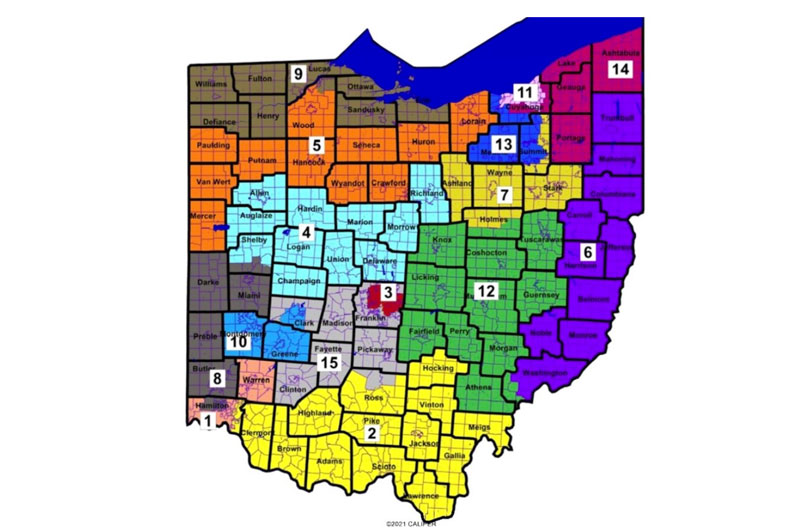
Ohio Gov. Mike DeWine has signed Statehouse Republicans’ congressional map for Ohio giving the GOP a substantial advantage, claiming that of all the maps presented it “makes the most progress to produce a fair, compact and competitive map.”
DeWine pointed to fewer county splits in the map and the number of Ohio cities the map keeps whole.
“With seven competitive congressional districts in the SB 258 map, this map significantly increases the number of competitive districts versus the current map,” DeWine said.
The GOP congressional map signed by Gov. Mike DeWine. (Right-Click to enlarge map)
Without bipartisan support, the map is slated to only be in place for four years. With DeWine’s signature, legal challenges are expected to be forthcoming. Statehouse legislative maps approved by the Ohio Redistricting Commission with only Republican support in September are facing legal challenges currently before the Ohio Supreme Court.
DeWine’s son, Justice Pat DeWine, has refused to recuse himself from the case, making Chief Justice Maureen O’Connor the potential swing vote on the constitutionality of the Republican plans that continue Republican supermajorities in the Ohio House and Senate and now an 11-2 advantage in congressional maps with two potential toss-up districts.
Ohio voters passed redistricting reform for state legislative maps in 2015, with more than 70% support, and congressional redistricting reform in 2018 with nearly 75% support. Those reforms called for maps that do not “unduly favor or disfavor” one political party or another.
The map approved Thursday in the House was introduced just Monday night as an amendment replacing the maps previously discussed in committee hearings. After the map was unveiled, it had one hearing in which a committee heard public comment. Every speaker was an opponent. The Princeton Gerrymandering gave the map a flunking grade.
An analysis of the map on Dave’s Redistricting App shows seven Republican districts, two Democratic districts and six districts listed as competitive for being within a 54-46 margin. Five in six of the “competitive” districts lean Republican, and the one that leans Democratic, Ohio’s 13th district, does so by 0.88%. It was passed along partisan lines in both the Ohio Senate and Ohio House this past week.
DeWine’s signing of the GOP congressional maps was criticized by anti-gerrymandering advocates.
“Once again, Gov. DeWine has failed to stand up to the extremists in his party. He could have rejected gerrymandered maps, but chose weakness instead,” said Desiree Tims, president and CEO of Innovation Ohio. “These rigged districts will lead to more extreme politicians who pass dangerous laws that devastate Ohio communities.”
The map will give Republicans 80% to 87% of Ohio’s congressional seats, the advocates noted, despite the fact that Republicans only win about 55% of Ohio’s statewide vote.
“Regardless of our skin color or zip code, everybody deserves to have a meaningful influence on our political process and choosing who gets to represent us,” said Jeniece Brock, Policy and Advocacy Director of the Ohio Organizing Collaborative. “By cracking and packing communities of color, this congressional map dilutes the power and voices of Black and brown Ohioans.”
Ohio Senate Republicans rushed through a congressional redistricting map Tuesday introduced to the public less than 24 hours before.
It was passed out of committee 5-2 along partisan lines before being passed by the whole chamber later in the day 24-7, also along partisan lines.
The GOP congressional map passed through the state Senate on Tuesday afternoon. (Right-click to open new tab and enlarge)
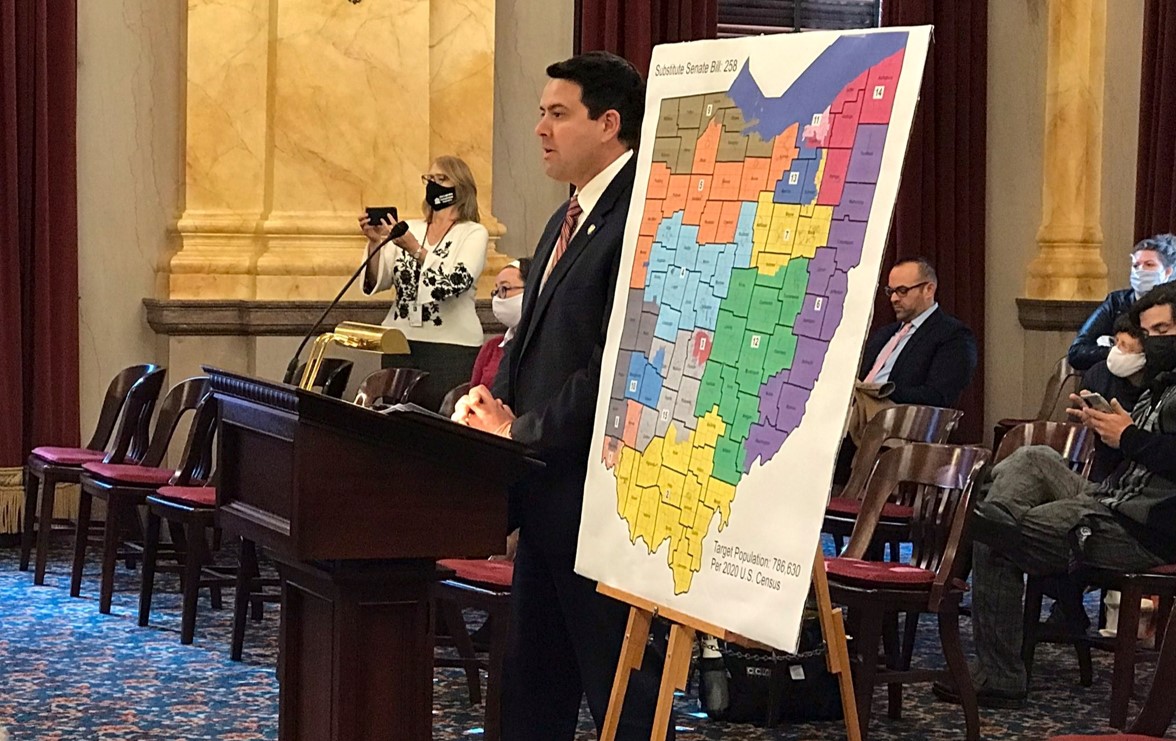
The passage came on the same day a committee who had been considering a different map as part of Senate Bill 258, substituted the map that state Sen. Rob McColley, sponsor of the bill, said was spearheaded by Senate President Matt Huffman, along with House Speaker Bob Cupp.
An analysis of the map on Dave’s Redistricting App shows seven Republican districts, two Democratic districts and six districts listed as competitive for being within a 54-46 margin. Five in six of the “competitive” districts lean Republican, and the one that leans Democratic, Ohio’s 13th district, does so by 0.88%.
Senate President Matt Huffman said negotiations had been going on since the census data came out, but that in terms of congressional redistricting, Dems and the GOP were “at loggerheads.”
Huffman accused Democrats of gerrymandering, saying their demand was for a map that had six Dem districts and six Republican ones, which he didn’t think was “within the spirit of the reforms.”
“I think we all pretty much knew where we were at,” Huffman said on Tuesday.
Minority Leader Sen. Kenny Yuko, D-Richmond Heights, had previously said on the Senate floor that he had hoped for better.
“I was hoping for a little more compromise. I was hoping there would be a little more conversation,” Yuko said.
State Sen. Cecil Thomas, D-Avondale, said in an argument against the maps on the Senate floor that it was obvious that the 13-2 maps were gerrymandered in favor of the GOP, and even the Democratically leaning Hamilton County was drawn in favor of Republicans in terms of the next election.
“This supposed competitive district leans Republican by more than 3 points…making it an automatic uphill battle for the Democrat,” Thomas said.
The constitution’s “plain language” was the most important part of determining district lines, as McColley argued on the floor of the Senate. Huffman said there were things they had to interpret, such as the shapes of districts, but issues not explicitly stated in the redistricting rules had to take a back seat.
“In the end, the constitution comes first, and those aspirational things come second,” Huffman said.
Thomas and other Democrats criticized the lack of racial data used in determining the maps, just as supporters of Democratic maps had said GOP maps unfairly split communities, particularly communities of color. Huffman doubled down on the fact that Republicans didn’t use racial data, saying it’s illegal for them to do so unless “there is appropriate evidence presented which requires that.”
He said the maps were drawn with race in mind as a divisive factor.
“(Thomas) is wrong that we simply tried to draw lines having to do with race in this case,” Huffman said.
In Senate Local Government and Elections Committee Tuesday morning, McColley defended the map, Huffman and Cupp by saying he supports it as drafted.
“(Cupp and Huffman) have done an awful lot of due diligence and have done an awful lot of discussions on this map, so anything that I’m going to do is going to be deferring to them,” McColley said.
McColley also seemed to suggest that Ohio could be a swing state in saying district lines shouldn’t be the “end all, be all arbiter” for determining political power and the results of future elections.
“You can look in the legislature, you can look in Congress, you can look other places and realize that in many cases, the shifting sands of politics and the issues of the day ultimately are what decide elections, it’s not just simply because you are a 50.1 (percent lean) or a 49.9,” McColley said. “Given a period of time, these seats could switch back and forth potentially over the course of a decade.”
The map was universally panned by anti-gerrymandering groups like All On the Line and the League of Women Voters and Ohioans who have spoke up in committee hearings since the beginning of the process.
Many complaints, as in previous map hearings, rested on procedure, with testimonies that were put in ahead of the 24-hour advance submission rule being tossed out by their authors, because they pointed to a map that was no longer on the table.
Fair Districts Ohio member Trevor Martin said the abbreviated timeline of last night didn’t allow for a comprehensive review of the maps, only an “eyeball test” of the district lines and shapes.
“We have no idea what we’re looking at, what we’re looking at is a mess,” Martin told the Senate committee. “It’s like you don’t hear us, and it’s infuriating.”
Jen Miller, executive director of the League of Women Voters of Ohio, asked in vain for more hearings because without shape files to look at, zooming on a PDF was their only option, and not the ideal way.
Katy Shanahan, of the Ohio chapter of All On the Line responded for several testifiers when state Sen. Jerry Cirino, R-Kirtland, said the anger and accusations of cheating by the Senate GOP expressed by advocates was “a unique method of persuasion on the part of those who are opposing this bill.”
“So, you’re right, a lot of what you’re hearing today is exasperation, it’s frustration and it’s righteous anger that we have to stand here and beg you to care enough about our democracy to do the right thing and deliver on your campaign promises to give us a fair map and a fair redistricting process,” Shanahan said.
In committee hearings Wednesday, Republican lawmakers in the House and Senate unveiled their plans for new congressional districts.
In both cases Democrats complained the maps were shared at the eleventh hour, leaving members unable to properly analyze the proposals before them. Procedural votes along partisan lines and unanswered questions about the drafters’ intent seem to presage a bitter fight more likely to produce a lengthy court battle than a 10 year congressional map.
Consequences
Pictured is Ohio’s congressional delegation as it has looked after the 2012, ’14, ’16, ’18, ’20, and ’21 elections. (Click to view larger map)
Ohio Republicans have had a 12-4 advantage in congressional districts since the maps were last drawn in 2011, with no congressional seats flipping parties in any election since that time. Ohio lost one district in the 2020 U.S. Census, going from 16 down to 15.
Both the House and Senate GOP maps would incorporate large swaths of Republican territory into Toledo Democratic U.S. Rep. Marcy Kaptur’s district effectively rendering it a Republican district. Kaptur said in a statement that fair districts are a foundational requirement of the American Republic, assuring that the voices of all people are able to influence government.
“Lawmakers should not be able to insulate themselves from the views of their constituents through a rigged system of gerrymandering,” she said. “The proposals unveiled today are a clear violation of this most basic principle.”
The House map splits Hamilton, Franklin, Cuyahoga and Summit counties all into three districts. In Summit, one stretches up to Lake Erie communities such as Ashtabula, and another stretches down to the Hocking Hills area of Southeastern Ohio. In Franklin County, the city of Westerville is moved into the district currently occupied by Republican U.S. Rep. Jim Jordan, and in Hamilton County, Democratic Cincinnati is slimly connected to the entirety of Republican Warren County.
The Senate map also splits Hamilton, Franklin and Cuyahoga counties into three districts, with Democrats holding the advantage in the city centers and Republicans having the advantage in the respective other two districts including parts of each county. This map also moves a significant portion of Franklin County into Jim Jordan’s district. The Senate GOP map also includes most of Montgomery County, home of Dayton, and Republican Warren County in the same district.
The House proposal
The guiding principle behind the House map appeared to be plausible deniability. North Canton Republican Scott Oelslager delivered pre-drafted remarks describing how his map complied with new constitutional demands, but he balked at almost every question about his proposal.
The Ohio House Republican proposed U.S. Congressional District map. From the Ohio House of Representatives. (Click to view larger map)
He affably ducked questions from Democratic members as too “technical”, and acknowledged House staffer Blake Springhetti handled the actual drafting of the map. Speaking after the hearing, he admitted even his remarks weren’t all his own — Springhetti helped come up with those, too.
Pressed by Rep. Tavia Galonski, D-Akron, about whether he’d object to Springhetti testifying about the proposal, Oelslager dodged.
“That’s a decision that will be made by leadership above me and counsel,” he said.
Asked more generally by Rep. Richard Brown, D-Canal Winchester, whether his party is even seeking a ten year map, which would require the support of at least a third of Democrats, Oelslager again deflected.
“That’s actually a decision that I’m not involved with; I have not had any discussions with anybody, and I believe that will be a decision made above my pay grade in this process,” Oelslager said.
Every member of the House leadership team, save the speaker, serves on the Government Oversight committee where Oelslager presented his proposal.
Democrats raised objections early, noting the 300 page substitute amendment and Oelslager’s testimony were posted less than 20 minutes before the committee began. Once the documents were shared, the maps were presented in a format that made rapid analysis difficult.
But Democrats did voice concerns about the most obvious potential problems such as the four counties — Hamilton, Franklin, Cuyahoga and Summit — being split among three different districts. Another district runs from Ohio’s southernmost county along the eastern border all the way past Youngstown in the northeast corner of the state.
Despite sidestepping questions on how borders were determined, Oelslager did share a rundown of partisan performance. He described the breakdown as 8-5-2, where Republicans would have eight safe seats, Democrats would have two and five would be a “toss-up.” That toss up range is broad, though, with the majority party having as much as 55% of the likely vote share and the minority having at least 45%.
But outside observers dispute Oelslager’s analysis. The partisan lean metrics in Dave’s Redistricting App suggest the House Proposal would give Republicans a strong advantage in 9 districts, not 8. Four of the remaining districts would be considered competitive based on a 45-55% split, and two would be safe Democratic seats.
Shortly after the committee, Ohio League of Women Voters executive director Jen Miller criticized a lack of transparency in the process. Without maps available ahead of time, she said, it’s impossible to know how good or bad the lines might be.
“We want to think about voters in all 88 counties and how they’re represented and what they need. We can’t do that yet. It’s going to take us quite some time,” Miller explained. “But we certainly are concerned that we could not get the map in a timely fashion, and we are concerned that we are once again maybe running out the clock. Estimates do look as though it is not partisan balanced, which is one of the things I think voters really wanted.”
The Senate proposals
The Senate Local Government and Elections Committee heard about one map that’s been out since the end of September, and another that made its debut during the committee meeting.
State Sen. Rob McColley, R-Napoleon, presents the Senate GOP map in Local Government & Elections Committee on Wednesday. Photo by Susan Tebben, OCJ.
Premiering Wednesday was the Senate GOP’s congressional map, presented by state Sen. Rob McColley, R-Napoleon.
“We wanted to be sure that we put out a map that we were comfortable standing behind and that we felt gave us an opportunity with the minority party to meet and discuss that,” McColley said after presenting his map.
McColley said he was the lead on the map “concepts,” but Ray DiRossi, senate budget director and legislative map-drawer, was the one to insert the concepts into mapping software.
In the Senate Republican map, McColley said 14 counties are split, with the three biggest counties — Cuyahoga, Franklin and Hamilton — split twice.
The Senate GOP map proposal has six Republican-leaning districts, 2 Democrat-leaning and seven that would be competitive, which McColley also defined as being within the 45-55% range.
Statewide election data and constitutionally required data was used in the maps, however McColley said racial data was skipped in the GOP map, something Republicans were criticized for in the legislative map-drawing process.
The Ohio Senate GOP’s proposed U.S. Congressional district map. From the Ohio Senate. (Click to view larger map)
DiRossi told the Ohio Redistricting Commission during his presentation of those maps that racial and demographic data was skipped deliberately at the direction of “legislative leaders.”
Criticism of the maps was limited, mostly because of the abrupt timeline in receiving the GOP map, but an overarching look at the maps gave University of Cincinnati politics professor David Niven a look into political strategy, he said.
“It is an astonishing work of defiance of the constitution, an astonishing defiance of voter will,” Niven said.
Niven said the splitting of counties is at times confusing, which he thinks is a political strategy as part of the maps.
“The effect of this is (voter) confusion and dampened representation,” Niven said.
Collin Marozzi of the ACLU of Ohio said he was still reviewing the Senate effort, but from a brief look during the committee meeting, it didn’t surprise him to see Republicans making the decisions they made, but he wanted to hear more about why.
“It’s deliberate choices, they made their choices and I think the people of Ohio deserve to have an explanation as to why they made them, not just the fact that they did or didn’t make them,” Marozzi said.
State Senate Minority Leader Kenny Yuko and state Sen. Vernon Sykes presented the Senate Democratic Caucus map officially to the commission, with policy advisor Randall Routt jumping in with breakdowns directly from the map.
“As elected leaders, we owe it to our constituents to produce fair maps,” Yuko said. “Let’s work together, and let’s get this mission accomplished.”
The Democratic map came just before the Oct. 1 deadline for the legislature to approve congressional redistricting maps the first time, which blew by without any significant action from either General Assembly body.
The deadline passed, and the process moved to the Ohio Redistricting Commission, on which Sykes sat as co-chair, and their Oct. 31 deadline came and went without any map approval.
In Wednesday’s committee meeting, Routt said the map was “merely a starting proposal” but a proposal they felt complied with not only the Ohio constitution, but the salvaging of communities across Ohio.
The Ohio Senate Dems proposed congressional district map. (Click to view larger map)
In explaining the map, Routt said only 11 counties were split, with the splits only occurring once in each county. No counties were split more than once.
“We attempt to keep communities together in our map, and we think that’s an overriding state objective,” Routt told the committee.
Committee member state Sen. Tina Maharath, D-Canal Winchester, took time to ask if Democratic bill sponsors felt the redistricting process had met expectations. Yuko and Sykes both said no, and Sykes said with no GOP map to consider until Wednesday, it’s been difficult to negotiate a ten-year plan with bipartisan agreement.
“We’re at this third stage of this process and fortunately it looks like today … we’re starting out hopefully with a plan, and maybe we’ll be better able to negotiate a bipartisan deal,” Sykes said.
McColley said concerns about transparency are not necessarily well-placed, and likened the process to creating a piece of legislation, in that some preparatory conversations “don’t happen in the public.”
“Usually there’s a public proposal … and then we’ll have a proposal and a process going forward to work off of, and that’ll inform much of the public dialogue that occurs with this map,” McColley said.
All three maps are the subject of scheduled public hearings Thursday morning in Senate Local Government and Elections and House Government Oversight.
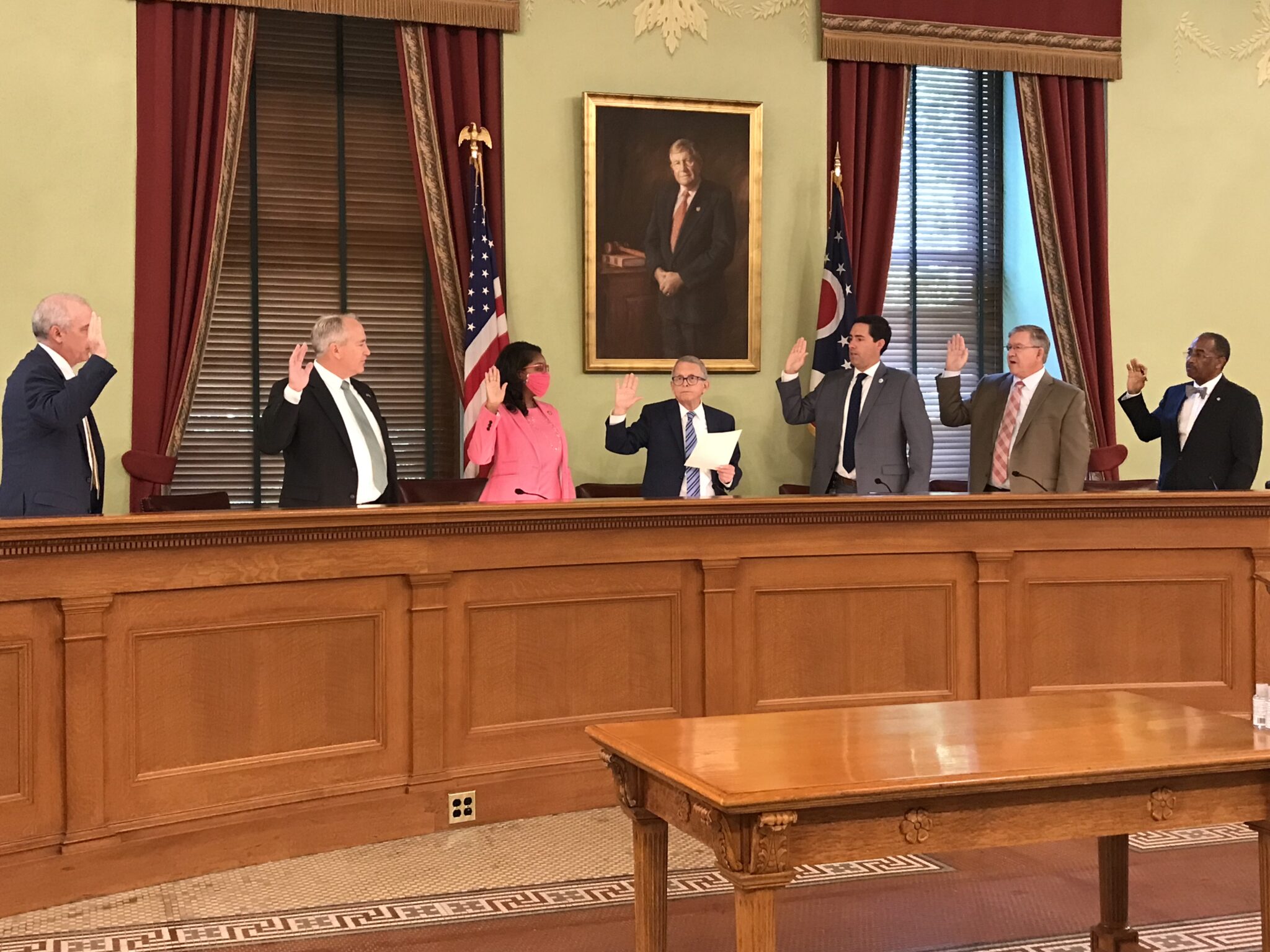
Members of the Ohio Redistricting Commission are sworn in at the Ohio Statehouse. From left, Senate President Matt Huffman, state Auditor Keith Faber, House Minority Leader Emilia Sykes, Gov. Mike DeWine, Secretary of State Frank LaRose, House Speaker Bob Cupp and Sen. Vernon Sykes. Photo by Susan Tebben
The ACLU has filed an expected lawsuit disputing the partisan legislative redistricting maps passed earlier this month by the Ohio Redistricting Commission.
The Ohio and national chapters of the American Civil Liberties Union, along with law firm Covington & Burling, LLP, announced the lawsuit Thursday afternoon, accusing the Republican majority of “disrespecting the letter and spirit of the constitutional reforms passed overwhelmingly by Ohio voters in 2015.”
The ACLU and Covington & Burling are presenting the lawsuit on behalf of the Ohio Chapter of the A. Philip Randolph Institute, unnamed individual plaintiffs and the League of Women Voters of Ohio.
The parties in the court challenge contend that the maps violate the constitution by not accounting for the “partisan balance of House and Senate districts correspond closely to the statewide preferences of the voters of Ohio.”
“This is an illegal map, plain and simple,” said Robert Fram, of Covington & Burling, in a statement.
The lawsuit accuses the commission of a “brazen manipulation of district lines for extreme partisan advantage” that “doubly dishonors the honors of this state.”
“After decades of working to end partisan gerrymandering in the Buckeye State, the League of Women Voters of Ohio asks the Ohio Supreme Court to defend the rights of everyday Ohioans to have legislative districts that serve and represent them rather (than) be rigged to favor the short-sighted and selfish interests of political parties and candidates,” said Jen Miller, president of the League of Women Voters said in a statement.
Redistricting Commission co-chair state Sen. Vernon Sykes, one of the two Democrats to vote against the map said he, too, believes the maps are not constitutional.
“Unfortunately, the maps adopted last week by the Republican members of the Redistricting Commission do not comply with those requirements,” he said in a statement. “They favor one political party and do not meet the litmus test of fairness and proportionality described by the Constitution.”
A spokesperson for fellow co-chair and House Speaker Bob Cupp also defended the maps.
“Lawsuits happen every time there is a new map,” said Aaron Mulvey deputy press secretary for the House GOP. “We knew this was coming, and the state will defend the constitutional maps approved by the Redistricting Commission.”
If the Ohio Supreme Court finds the maps to be unconstitutional, they would return to the commission for a second time.
The lawsuit comes as congressional redistricting is set to begin this month. If the state legislature can’t come to an agreement by Sept. 30, those maps will also go to the commission for consideration.
SUSAN TEBBEN is an award-winning journalist with a decade of experience covering Ohio news, including courts and crime, Appalachian social issues, government, education, diversity and culture. She has worked for The Newark Advocate, The Glasgow Daily Times, The Athens Messenger, and WOUB Public Media. She has also had work featured on National Public Radio.