Tag: Governor DeWine

  • Ohio purchasing 2 million at-home, rapid COVID-19 tests

    Ohio purchasing 2 million at-home, rapid COVID-19 tests

    Loveland, Ohio – Governor DeWine announced today that the state is purchasing 2 million at-home, rapid COVID-19 tests using telehealth services where the results are delivered in minutes without the need to send the test to a lab for processing. Developed by Abbott, BinaxNOW is an antigen test that detects the virus when people are most infectious.

    To facilitate the delivery of the BinaxNOW test to the home and the guided collection and testing process, Abbott has partnered with digital health solutions provider eMed™, who will deliver people their results through Abbott’s complementary NAVICA™app in a matter of minutes. eMed™ will report the rapid test results in the electronic lab reporting system. 

    “Abbott has been a valued partner throughout this pandemic and this new partnership will help us continue aggressive testing at colleges and universities, and pursue access to rapid testing in every county in Ohio,” said DeWine. “These tests combined with the telehealth solutions provided by eMed™ will provide equitable access to testing for those who may not be able to access traditional testing because of their working hours, have mobility or transportation issues, or have caregiving responsibilities.”

    “The partnership with the State of Ohio is proof of our ability to get millions of tests in the hands of people who need them,” said Dr. Patrice Harris, eMed CEO. “We are proud of this joint accomplishment which fortifies our belief that serial testing, when deployed in accordance with public health best practices, CDC and FDA guidance, plays a critical role in mitigating the spread of COVID-19 and getting our society and economy on the right track.”

    This partnership will provide at least 2 million of the BinaxNow tests for Ohioans as, Abbot, eMed™, and the Ohio Department of Health pursue innovative efforts to end the COVID-19 pandemic.

  • AMENDED HEALTH ORDER for Nursing Homes

    AMENDED HEALTH ORDER for Nursing Homes

    Governor DeWine announced today that Ohio Department of Health Director Stephanie McCloud signed the Sixth Amended Director’s Order to Limit Access to Ohio’s Nursing Homes and Similar Facilities, with Exceptions.

    This revised order clarifies that in-person compassionate care visits are permitted in nursing homes and similar facilities. The new order does not change required precautions all visitors must take, including but not limited to, wearing of a facial covering and social distancing.

  • DeWine announces revised mask and social gathering orders

    DeWine announces revised mask and social gathering orders

    At the end of September, Ohio averaged under 1,000 new cases per day; this week, Ohio hit a record high of more than 6,500 new cases reported in a single 24-hour period.

    At the end of September, Ohio averaged under 1,000 new cases per day; this week, Ohio hit a record high of more than 6,500 new cases reported in a single 24-hour period.

    In a statewide address to Ohioans Wednesday evening, Ohio Governor Mike DeWine called on citizens to recommit to their individual efforts to prevent coronavirus spread as Ohio moves through its most intense, widespread, and dangerous surge of cases to date.

    Ohio is currently facing a record number of coronavirus-related hospitalizations and intensive care admissions, with nearly 3,000 people in the hospital, including more than 700 people in the ICU.

    During the first week of November alone, 104 Ohioans infected with the coronavirus died.

    To reinforce the necessity of wearing masks and slowing virus spread, Governor DeWine announced two forthcoming orders:

    Revised Mask Order

    DeWine said, “To protect frontline workers and customers, the Ohio Department of Health will reissue Ohio’s mask order and add the following provisions:

    • Each store will be required to post a sign outlining face-covering requirements at all public entrances to the store;
    • Each store will be responsible for ensuring that customers and employees are wearing masks; and
    • A new Retail Compliance Unit, comprised of agents led by the Ohio Bureau of Workers’ Compensation, will inspect to ensure compliance. 
    • A first violation will result in a written warning and a second violation will result in closure of the store for up to 24 hours.

    New Social Gathering Order

    Ohio’s April order that limits public events and private gatherings of more than 10 people is still in effect, however, there has been rampant spread of the virus as a result of banquets, wedding receptions, and social gatherings following funerals according to DeWine.

    “To address the tragedies that have resulted from such events, the Ohio Department of Health will issue an order that will place significant new restrictions on these social activities,” DeWine said.

    Specifically, open congregate areas will no longer be permitted to open, and everyone will be required to be seated and masked unless they are actively consuming food or drinks.

    Bars, restaurants, and fitness centers may remain open, but this will be reassessed one week from tomorrow for potential closure. 

    “If the current trend continues and cases keep increasing, we will be forced to make these closures,” said DeWine. “I am very well aware of the burden this will place on employees and owners, but these are places where it is difficult or impossible to maintain mask-wearing, which we know now is the chief way of slowing this virus.”

    Concern for healthcare workers

    “With this new wave of COVID-19, the onset of flu season, and an already-exhausted group of healthcare workers, there are serious concerns that there won’t be enough people to fully staff our healthcare facilities in the next few weeks,” said DeWine. “If we don’t change this, Ohio won’t be able to provide appropriate care for COVID patients or for Ohioans who require other emergency care for things like accidents, strokes, and heart attacks. Hospitals will again be forced to postpone important, but less urgent, care.”

    Although testing capacity in Ohio has nearly doubled, the number of people testing positive for the coronavirus has increased almost four times. At the end of September, Ohio averaged under 1,000 new cases per day; this week, Ohio hit a record high of more than 6,500 new cases reported in a single 24-hour period.

    “As we wait for the vaccine, which could come as soon as December, we have so much to protect,” said DeWine. “What each Ohioan does in his or her own life impacts every citizen and every place we desperately want and need to keep open– our schools, nursing homes, hospitals, and businesses.”

    For Governor DeWine’s entire address, visit ohiochannel.org or read his prepared remarks at coronavirus.ohio.gov.

  • New AARP Dashboard Reveals Ohio’s Efforts to Protect Nursing Home Residents During Coronavirus Pandemic Still Fall Short

    New AARP Dashboard Reveals Ohio’s Efforts to Protect Nursing Home Residents During Coronavirus Pandemic Still Fall Short

    Recently Reported Shortages in PPE and Staffing are Worrisome as Ohio’s Percentage of COVID-19 Deaths in Nursing Homes Exceeds National Average

    Columbus, Ohio – AARP’s Ohio state director, Holly Holtzen, said today that a new AARP dashboard reveals concerning trends in three critical areas linked to how Ohio’s nursing homes are handling the coronavirus pandemic, all of which could provide state officials with insights on how to do better.

    “Early on our state took notable steps to curb the virus in our nursing homes. But no state is doing enough to stem the loss of life,” said Holtzen. “As Ohio’s nursing homes resume in-person visitation amidst a surge in reported infections and Governor DeWine’s announcement of a new all-time high for the number of COVID-19 related hospitalizations, this data can shine a light on the areas and issues contributing to the heartbreaking situation in our nursing homes.”

    “The fact that nursing home residents account for nearly half of Ohio’s COVID-19 deaths is beyond alarming,” said Holtzen. “To still have PPE shortages in Ohio’s nursing homes eight long months into this crisis is inexcusable.”

    Using data from the Centers for Medicare & Medicaid Services— which is self-reported by nursing homes—the AARP Public Policy Institute, in collaboration with the Scripps Gerontology Center at Miami University in Ohio, created the AARP Nursing Home COVID-19 Dashboard to provide four-week snapshots of the virus’ infiltration into nursing homes and impact on nursing home residents and staff. Notably, the first release of the dashboard on October 14 reveals that nursing homes in every state reported shortages of Personal Protective Equipment (PPE), ranging from 8 percent of facilities in the best-performing states, to 60 percent in the lowest-performing state. The dashboard also compared state and national data on COVID-19 cases and deaths, staff cases and staffing shortages.

    By their own reports, more than 33 percent of Ohio nursing homes reported having less than a week’s worth of PPE on hand over the four week period ending Sept. 20, compared to about 28 percent nationwide.  Some 35 percent of Ohio nursing homes also reported staffing shortages in direct care workers during this period, compared to the national average of 29 percent.

    The share of Ohio’s COVID-19 deaths occurring in nursing homes is nearly twice the national average during the four-week reporting period.

    The share of Ohio’s COVID-19 deaths occurring in nursing homes is nearly twice the national average during the four-week reporting period. In Ohio, nearly two of every four reported COVID-19 deaths occurred in a nursing home, even though nursing home residents represent less than one percent of the state’s population.

    Holtzen also noted that more than half of all Ohio nursing homes have had at least one COVID-19 infection since January.

    “The fact that nursing home residents account for nearly half of Ohio’s COVID-19 deaths is beyond alarming,” said Holtzen. “To still have PPE shortages in Ohio’s nursing homes eight long months into this crisis is inexcusable.”

    Holtzen renewed AARP Ohio’s call forstepping up efforts to provide all long-term care facilities with adequate supplies of PPE, ensuring proper staffing levels, as well as increased frequency of mandatory and prioritized access to COVID-19 testing and testing results for residents, staff, vendors and visitors in elder-care facilities.

  • A RED TIDE: 65% of Ohioans now living in counties with ‘very high’ levels of COVID-19

    A RED TIDE: 65% of Ohioans now living in counties with ‘very high’ levels of COVID-19

    Jake Zuckerman is a statehouse reporter. He spent three years chronicling the West Virginia Legislature for The Charleston Gazette-Mail after covering cops and courts for The Northern Virginia Daily.
     
    This story was written by Jake Zuckerman with local news added by Loveland Magazine staff.

    Thursday was Ohio’s worst day of the pandemic and all evidence suggests things are likely to worsen, according to interviews and new state data.

    Nearly 2,200 new COVID-19 infections were reported Thursday, the state’s third record breaking day last week.

    There were 1,041 Ohioans in the hospital with COVID-19 — about 100 shy of the all-time high set in late July. The COVID-19-hospitalized population has nearly doubled since mid-September.

    A “Public Emergency” has been declared in RED counties – with very high exposure and spread.

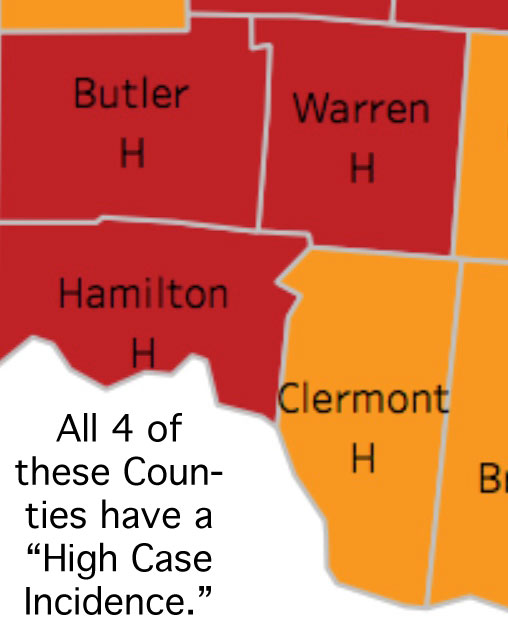
    On Thursday, Governor DeWine released Ohio’s updated Public Health Advisory System map. New health data compiled by the Ohio Department of Health found that 29 counties currently have a very high risk of exposure and spread (Level 3): Hamilton, Butler, and Warren are among the “RED” counties.

    “We’ve gone up dramatically in a relatively short period of time,” Gov. Mike DeWine said to reporters Thursday.

    “What you’re seeing in today’s numbers should get our attention,” DeWine said. “There’s a red tide flowing all over the state of Ohio.”

    The good news: More Ohioans than ever are being tested for the new coronavirus. The bad news: The rate at which those tests are coming back positive has doubled since Sept. 23, a sign the virus is growing more prevalent.

    Thirteen new counties turned red this week indicating “very high exposure and spread” on the Ohio Public Health Advisory System — a product of seven inputs like hospital visits, outpatient care visits in a county, population-adjusted infection rates and others. Twenty-nine counties are red, spanning about two-thirds of the state’s population.

    “What you’re seeing in today’s numbers should get our attention,” DeWine said. “There’s a red tide flowing all over the state of Ohio.”


    DeWine said some of the newly-turned red counties are slated to host community events like political rallies, pub crawls and social gatherings and that “now is really the time to rethink whether these are in the best interest of the community.”

    He did not address his own administration’s decision to exempt recent rallies for President Donald Trump from the statewide mask requirement.

    View previous week’s DATA

    While DeWine said there are no plans in store for any kind of statewide stay-at-home order, he declined to promise against instituting the policy down the line.

    All told, nearly 176,000 Ohioans have contracted COVID-19. Nearly 17,000 have been hospitalized, and 5,038 have died since March.

    In red counties, health department staff said they continue to see spread at family gatherings like bonfires, birthday parties and barbeques.

    Jennifer Hiestand, a public information officer at the Zanesville-Muskingum County Health Department, estimated 60% of people in public are wearing masks. Contact tracers have found “mini outbreaks” that are seemingly the result of people letting their guards down.

    In red counties, health department staff said they continue to see spread at family gatherings like bonfires, birthday parties and barbeques.

    “People just made the decisions not to social distance or not to wear a mask, those things that they probably should have,” she said.

    Mahoning County Health Commissioner Ryan Tekac said he is seeing a lot of the county’s progress this summer start to erode as cold weather drives people inside.

    “I think there are some concerns right now that individuals are putting their guards down,” he said.

    Ohio’s recent case surge fits in with a national trend. The New York Times reports cases are trending upward in 41 states, especially in the Midwest.

    Sycamore Aves mom reminds us of the importance to stay home if you’re experiencing COVID-19 symptoms. These next few weeks will be crucial. Please do your part so we can stay in school!

    Two holidays are coming up that will test Ohio’s public health discipline — Halloween and Thanksgiving.

    Tekac said there’s a lot of concern, especially with Thanksgiving, about the potential for outbreaks. However, he said people know the guidance; wear masks, keep your distance, wash your hands, outside is better than inside.

    He said at a certain point it comes to individuals making their own good decisions.

    Dr. Anthony Fauci, the top infectious disease expert at the National Institute of Health, told CBS News it’s an “unfortunate fact” that Thanksgiving will cause a lot of spread and suggested skipping out on the tradition this year.

    “I think given the fluid and dynamic nature of what’s going on right now and the spread and uptick of infections, I think people should be very careful and prudent about social gatherings,” he said.

  • GOP lawmaker Rep. John Becker wants to see if DeWine can be criminally charged

    GOP lawmaker Rep. John Becker wants to see if DeWine can be criminally charged

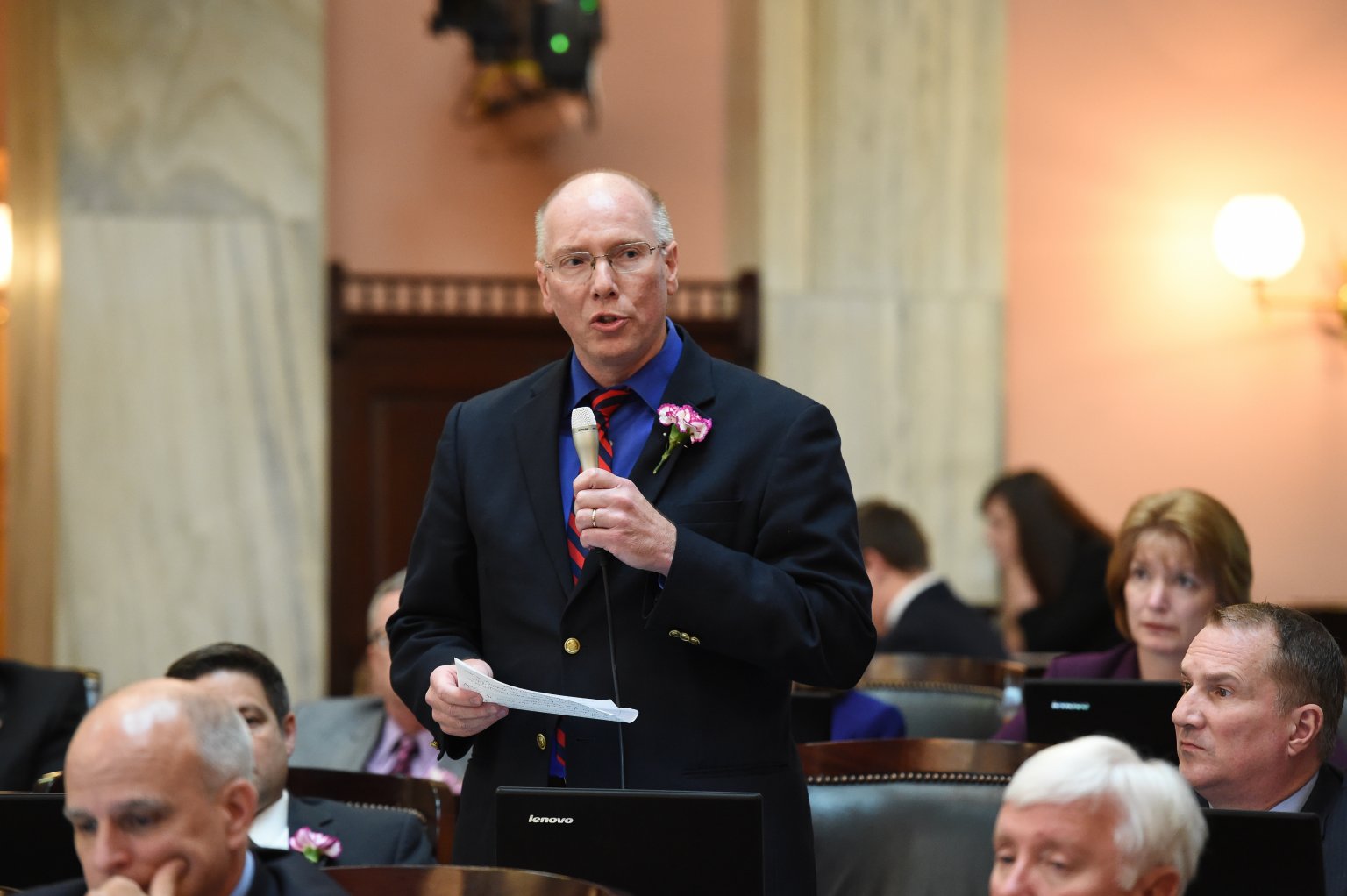
    State Rep. John Becker, R-Union Twp (Photo from Ohio House website)
    vvvv

    vvvv

    With his impeachment effort against the governor making little progress, state Rep. John Becker pulled up his email and brainstormed a late-night solution.

    It was almost 2 a.m. when Becker typed out a request to the Legislative Service Commission, a nonpartisan group that conducts law and policy research for lawmakers. 

    Becker is among the biggest critics of DeWine in the state legislature

    “I believe that Governor DeWine is in violation of (Ohio Revised Code) 2921.45,” Becker wrote in the Sept. 1 email. “What is the process for criminal charges to be filed? Can the (Attorney General) do that? Other options?”

    Still waiting for an answer, Becker sent another 2 a.m. request a few days later. He sought more “legislative history and legal case law” involving the 2921.45 section of code.

    The law states: “No public servant, under color of his office, employment, or authority, shall knowingly deprive, or conspire or attempt to deprive any person of a constitutional or statutory right.” Violators are guilty of a first-degree misdemeanor, punishable by up to 180 days in jail and a $1,000 fine. 

    Becker is among the biggest critics of DeWine in the state legislature and views the governor’s response to COVID-19 as amounting to a “constitutional crisis.” The decision to delay primary election voting, the temporary closure of some businesses, the mask mandate — to Becker, these are the instances of DeWine assuming “dictatorial powers” and violating Ohioans’ constitutional rights.

    Becker wants to see if DeWine can face criminal punishment for his pandemic response.

    “My goal is to get the state opened up and the abuse of power to come to an end,” Becker said to the Ohio Capital Journal.

    Impeachment and criminal charges?

    Throughout 2020, DeWine has relied on a separate section of state law which gives the Ohio Department of Health authority to make “special or standing orders … for preventing the spread of contagious or infectious diseases.” 

    On Aug. 24, Becker announced he had drafted articles of impeachment against DeWine. Three fellow Republican legislators immediately gave support for impeachment: Reps. Nino Vitale of Urbana, Candice Keller of Middletown and Paul Zeltwanger of Urbana.

    There have been a slew of lawsuits and legislative challenges to that authority. Becker sponsored one of the first bills seeking to limit the power of the state health director and many other Republican-sponsored bills have followed. DeWine has vowed to veto any such bill which interferes with the state’s pandemic response. 

    On Aug. 24, Becker announced he had drafted articles of impeachment against DeWine. Three fellow Republican legislators immediately gave support for impeachment: Reps. Nino Vitale of Urbana, Candice Keller of Middletown and Paul Zeltwanger of Urbana.

    “For my colleagues, it’s put up or shut up,” Becker said. 

    Becker claims there was support for impeachment from at least one Republican member who wound up not joining as a sponsor.  

    There was swift backlash from Ohio Republican leaders the day articles were drafted, which Becker thinks quashed any desire for others to join the effort.

    “Nobody wants to touch it,” Becker said. 

    Becker had planned to officially file the articles a week or so after drafting them, but instead is holding off. Once they are filed, no one else can sign on as a sponsor. He’s holding out hope that legislative sentiments may change before the end of 2020. 

    It would take a majority vote from the Ohio House of Representatives to impeach DeWine, then a two-thirds vote from the Ohio Senate to convict him. With only four representatives currently on board, they are 46 supporters short.

    Speaker of the House Bob Cupp, R-Lima, has come out against the impeachment effort, saying that policy disagreements do not rise to the level of removing the governor. 

    “For my colleagues, it’s put up or shut up,” Becker said.

    In a recent YouTube video, Becker acknowledged his colleagues believe the disagreements should be resolved legislatively rather through impeachment. 

    “Frankly I agree,” Becker said. “Legislation was the way to do it and we have tried that, and the governor has promised to veto everything that we’ve put out there attempting to roll back his power.”

    Beyond impeachment, Becker alleges the governor has committed a number of crimes. Among them: that DeWine illegally canceled and rescheduled the primary election.

    Hours before the polls were set to open Ohio Department of Health Director Dr. Amy Acton signed an order preventing the polling places from opening. DeWine and Acton feared holding an in-person election would lead to the virus spreading.

    Ohio primary election dates are set by the state legislature. Lawmakers unanimously approved a new primary election plan involving an all-mail vote conducted throughout all of April. Becker voted for that plan.

    Becker also alleges the mask mandates at churches, public places and businesses are in violation of Ohioans’ civil liberties.

    Becker also alleges the mask mandates at churches, public places and businesses are in violation of Ohioans’ civil liberties. 

    In May, the U.S. Supreme Court denied a request that it block a California law restricting crowd sizes at church services.

    Chief Justice John Roberts, an appointee of President George W. Bush, wrote in the majority opinion that the church restrictions were level with social distancing requirements at other public gatherings. Given the lack of treatment, cure, vaccine or sufficient knowledge about the new disease, he wrote, it’s too early to deem the restrictions unconstitutional.

    “Although California’s guidelines place restrictions on places of worship, the restrictions appear consistent with the Free Exercise Clause of the First Amendment,” he wrote.


    Tyler Buchanan

    Tyler Buchanan is an award-winning journalist who has covered Ohio politics and government for the past decade. A Bellevue native and graduate of Bowling Green State University, he most recently spent 6 1/2 years as a reporter and editor of The Athens Messenger and Vinton-Jackson Courier newspapers. He is a member of the BG News Alumni Society Board and was a 2019 fellow in the Kiplinger Program in Public Affairs Journalism.

  • Fall  High School Contact Sports Receive the Go-Ahead From DeWine

    Fall High School Contact Sports Receive the Go-Ahead From DeWine

    by Cassie Mattia

    Loveland, OhioStudent-athletes all across Ohio jumped for joy Tuesday when Governor Mike DeWine announced that he will be signing a new Ohio Department of Health order. This order will permit the Fall contact sports of Field Hockey, Soccer, and Football, to move forward with competition against other schools.

    Although the Governor confirmed his support for the new health order in a press conference on Tuesday he also said he wanted to ensure that Ohio’s coaches continued to inspire their student-athletes to follow safety precautions. DeWine stated that he hopes that by allowing high school athletes to have a season that will then inspire them to be as careful as they can be.

    “I hope that our coaches will use this an opportunity to focus on helping these young people understand what really is at stake,” Dewine said, “Coaches, you, in a normal year, inspire, you mentor, you instruct, you instill discipline and self-discipline in your student-athletes. For all of that, we are very grateful for what you do. You make a lot of sacrifices, work long hours and you inspire our kids. We thank you very much for that. But this year, it’s going to take more. It’s going to be inspiring them in regards to the goal of keeping COVID out of their team,” DeWine added.

    Field hockey, Soccer, and Football will now be joining the OHSAA’s previously approved Fall sports, which were Girls and Boys Golf, Girls Tennis, Girls Volleyball, and Girls and Boys Cross Country.

    With the majority of high schools in Ohio desperately wanting to play sports this Fall, the OHSAA has been working with the Governor’s Office and the Ohio Department of Health to create a new health order that contains modifications from the previous health orders released. With the new Health Director’s Order comes two separate mandates and recommended best practices documents for schools to follow for competitions. If practices aren’t followed the OHSAA could issue consequences for the violation of these requirements as prescribed in Bylaw 11, Penalties. The new health order will still include symptom assessments, mandated facial coverings, enforcement of social distancing, cleaning and sanitizing, and what to do when faced with confirmed COVID-19 cases or exposure to the virus. The finalized health order will be sent to schools this week.

    Bob Goldring, the OHSAA’s Interim Executive Director, also voiced his support of contact sports being allowed to compete in Ohio.

    “The OHSAA is moving forward because we want kids to have an opportunity to participate, and the Governor’s Office is providing that opportunity and a chance,” Goldring explained, “So for that, we are most appreciative. It’s important to remember that our student-athletes have been practicing and training with others for weeks and even months, and it has gone well. So, we believe they deserve the chance to move forward, and that the high school space is also different than the collegiate space.”

    The OHSAA staff has also been consistently working hard to create sport-specific modifications and recommendations for schools when conducting interscholastic competition.  If you would like to read over the updated sports modifications and safety precautions you can click on the following link:https://ohsaa.org/Home/OHSAA-COVID-19-Correspondence.

    OHSAA’s Goldring, like Governor DeWine, when speaking on Tuesday also emphasized the importance of student-athletes, coaches, and school administrators being the absolute best advocates for safety.

    “COVID-19 certainly has created a risk factor, and that is something on which each family has to decide for their student, and each local school district has to make decisions on moving forward based on all the information they have been presented,” Goldring continued. “But we also believe our student-athletes, coaches and school administrators – in education-based programs – are suited to be the best advocates for safety, strongly promoting and following mandates and recommendations to wear facial coverings, stay socially distanced and so forth. Our coaches, especially, are role models to so many of our student-athletes. So hopefully our student-athletes will follow their lead and guidance, especially when they talk to students about what to consider away from school.”

    If you would like to look over the full text from Tuesday’s updated memo sent to the OHSAA’s member schools visit the following link: https://ohsaaweb.blob.core.windows.net/files/BulletinBoard/20200818AdministratorUpdate.pdf

    OHSAA’s Fall Sports Seasons are Scheduled to Begin on the Following Dates:

       Friday, Aug. 21 – Soccer and Field Hockey

       Monday, Aug. 24 – Volleyball, Cross Country, and Football

       Both Golf and Girls Tennis Seasons have already begun.

    Have more questions about the new sports health orders and mandates? The Governor’s Office, the Ohio Department of Health, the National Federation of State High School Associations, colleagues at other state high school athletics/activities associations, members of the OHSAA’s Joint Advisory Committee on Sports Medicine, and members of the Governor’s Sports League Advisory Group created a series of questions and answers for those wanting to learn more! Click on the following link to read:https://ohsaaweb.blob.core.windows.net/files/Sports/2020/OHSAAReturnToPlayQA.pdf.

    For the latest updates in the world of sports be sure to tune into Sports 411 With ME, Cassie Mattia!

  • Governor DeWine Tests Positive for COVID-19

    Governor DeWine Tests Positive for COVID-19

    Columbus, Ohio – Today, Ohio Governor Mike DeWine took a test for COVID-19 as part of the standard protocol to greet President Donald Trump on the tarmac at Burke Lakefront Airport in Cleveland.

    Governor DeWine tested positive. Governor DeWine has no symptoms at the present time.

    Governor DeWine is returning to Columbus where he and First Lady Fran DeWine, who also has no symptoms, will both be tested.

    Governor DeWine plans to follow protocol for COVID-19 and quarantine at his home in Cedarville for the next 14 days.

    DeWine is 73.

    Lt. Governor Jon Husted also took the COVID-19 test today as part of the protocol to greet the president. Lt. Governor tested negative.

  • Clermont County elevated to RED COVID 19 Alert

    Clermont County elevated to RED COVID 19 Alert

    The Public Health Advisory Alert System is a color-coded system designed to supplement existing statewide orders through a data-driven framework to assess the degree of the virus’ spread and to engage and empower individuals, businesses, communities, local governments, and others in their response and actions.

    The system consists of four levels that provide Ohioans with guidance as to the severity of the problem in the counties in which they live.  The levels are determined by seven data indicators that identify the risk level for each county and a corresponding color code to represent that risk level.

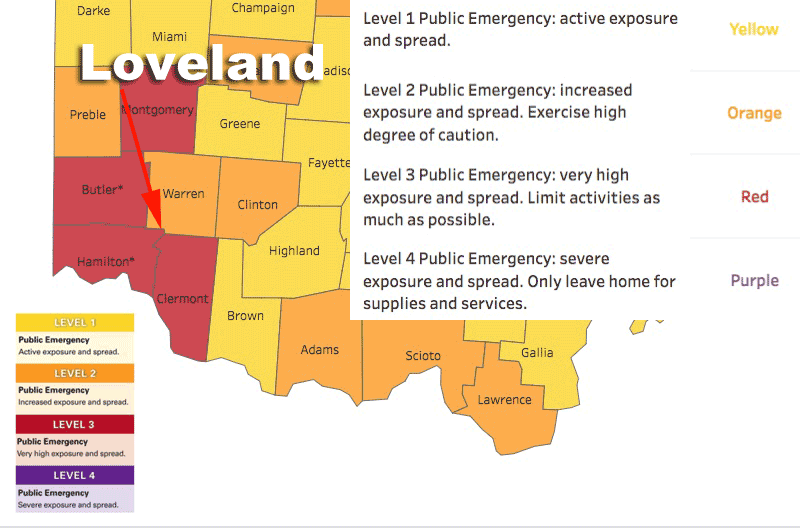
    Loveland, Ohio – Governor DeWine announced today that new public health data has led the Ohio Department of Health to designate that Clermont County is now among 12 counties as being in a Red Alert Level 3 Public Emergency as defined by the Ohio Public Health Advisory System.

    Clermont County had been in Level 2 until the announcement today.

    Hamilton County remains RED Alert Level 3 however it is on Ohio’s “Watch List” as they are approaching Purple Alert Level 4.

    Mandates for people to begin wearing masks in public in Clermont County will begin at 6 PM on Friday, July 10.

    Governor DeWine announced the creation of the Ohio Public Health Advisory System last week to provide local health departments, community leaders, and the public with data and information on the severity of the COVID-19 spread in the counties in which they live. The system consists of four levels with specific risk-level guidelines. Each level is calculated with data gathered on seven public health indicators.

    Read the Health Order

    Director’s Order for Facial Coverings in Butler, Cuyahoga, Franklin, Hamilton, Huron, Montgomery, and Trumbull Counties in Level 3 Public Health Advisory

    Those in counties designated as Red Alert Level 3 or Purple Alert Level 4 are required to wear a face covering:

      • In any indoor location that is not a residence;
      • When outdoors and unable to consistently maintain a distance of six feet or more from individuals who are not members of their household; or
      • While waiting for, riding, driving, or operating public transportation, a taxi, a private car service, or a ride-sharing vehicle.

    The order does not apply to children under the age of 10 or any other minor who cannot safely wear a face covering. The order also reflects the mask guidance in place for employees and businesses which does not require a person to wear a mask if their physician advises against it, if wearing a mask is prohibited by federal regulation, if communicating with the hearing impaired, when alone in an office or personal workspace, and other similar measures.

    Schools that offer Kindergarten through Grade 12 instruction should follow the guidelines set forth last week by the Ohio Department of Education and the Ohio Department of Health.

    The Ohio Department of Health will update county rankings every Thursday. Any county that increases to Red Alert Level 3 will automatically be included in the face-covering mandate. Any county that decreases from Red Alert Level 3 to Orange Alert Level 2 will automatically be released from the face-covering requirement.

  • [POLL] Do you feel safe sending your child back to school in light of the “Red” Alert?

    [POLL] Do you feel safe sending your child back to school in light of the “Red” Alert?

    “The Public Health Advisory Alert System is a color-coded system designed to supplement existing statewide orders through a data-driven framework to assess the degree of the virus’ spread and to engage and empower individuals, businesses, communities, local governments, and others in their response and actions.”

    Loveland, Ohio – Today beginning at 6 PM all of Hamilton County which includes parts of the Loveland School District is under an order of the Ohio Department of Health that mandates the wearing of face coverings in public.

    Loveland High School, the Intermediate and Middle School Campus, and the Primary and Elementary Campus are all within the RED alert area. There are approximately 4,000 students that attend these schools.

    The Early Childhood Center is in Clermont County which is in the Orange Alert area.

    Loveland Schools are currently scheduled to resume classes on August 26, 48 days from now.

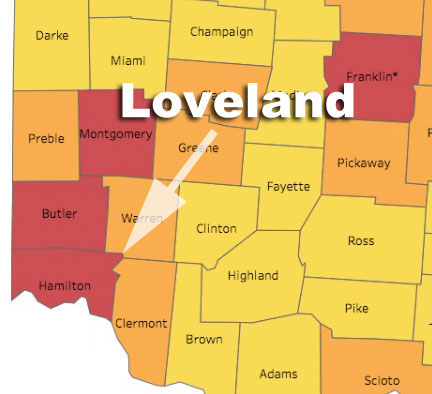
    Loveland is in three counties. The Little Miami River is the East/West dividing line between Hamilton County and Clermont County, A smaller part of Loveland is in Warren county. Hamilton County is in the RED in Ohio’s Public Health Emergency Alert system. Clermont and Warren are both currently ORANGE.

    Also, Governor Dewine tweeted on July 7, “As the #COVID19 pandemic has progressed more younger Ohioans are being diagnosed with #COVID19. We are seeing young people who are getting very sick. There is also the concern that they are passing it on to those who are at risk.” He released this graphic to emphasize that point.


    [poll id=”5″]


    Read the Health Order

    Director’s Order for Facial Coverings in Butler, Cuyahoga, Franklin, Hamilton, Huron, Montgomery, and Trumbull Counties in Level 3 Public Health Advisory