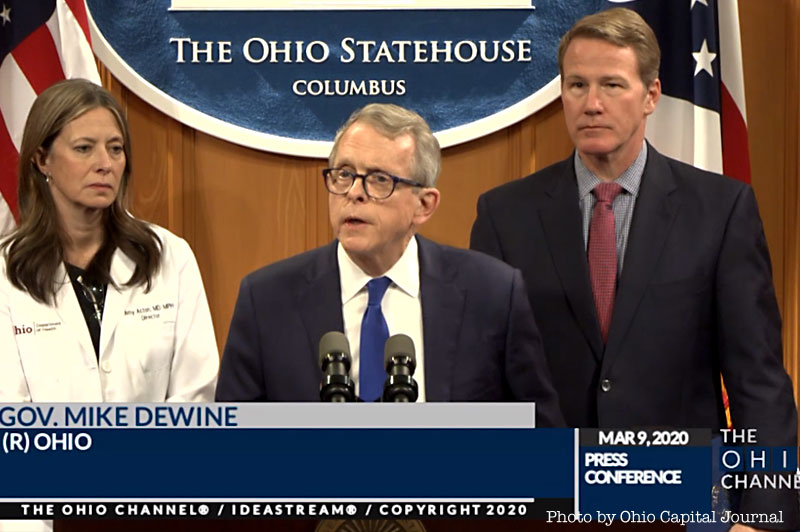
Columbus, Ohio – On Thursday, Governor Mike DeWine announced that the state emergency in Ohio caused by the COVID-19 pandemic will be lifted as of Friday. He urged those who have not yet received the vaccine to find a clinic near them by visiting gettheshot.coronavirus.ohio.gov.
Governor DeWine also released new information regarding visitation to nursing homes and assisted living facilities.
On Friday, the state regulations which describe how visits should occur were removed. This will allow residents to have more than two visitors, and there is no longer a scheduling requirement. According to the Governor, Ohio nursing homes are expected to continue to follow federal guidance from the Center for Medicare & Medicaid Services, and both nursing homes and assisted living facilities will be expected to follow CDC guidance. A testing requirement still remains for staff members who are unvaccinated, and they will need to continue to be tested twice per week.
The Ohio Department of Aging will be hosting a series of webinars to ensure facilities have access to all the information and resources necessary for safe and healthy operations. More information about these webinars can be found on the department’s website at aging.ohio.gov.
Columbus, Ohio – On Wednesday, Governor Mike DeWine announced that the Ohio School Safety Center will award a total of $10 million in grants to fund security enhancements at K-12 public schools and institutions of higher education in Ohio.
“It’s important that we work proactively to ensure that our school buildings and grounds are as safe as possible to protect both students and staff,” said Governor DeWine. “Two new grant programs offered through the Ohio School Safety Center will help schools and universities pinpoint any weaknesses in their physical security and make needed improvements and upgrades.”
The 2021 Campus Safety Grant Program, which began accepting applications today, will award $5 million to qualifying public colleges and universities for improvements to physical security on their campuses. The 2021 K-12 Safety Grant Program, administered by the Ohio Facilities Construction Commission (OFCC), will award an additional $5 million to qualifying public K-12 schools for similar school safety expenses.
Governor DeWine created the Ohio School Safety Center in 2019. It is housed in the Ohio Homeland Security Division of the Ohio Department of Public Safety and works to assist local schools and law enforcement agencies to prevent, prepare for, and respond to threats and acts of violence, including self-harm, through a holistic, solutions-based approach to improving school safety.
Columbus, Ohio – Ohio Governor Mike DeWine issued a statement Monday evening following the approval by the Food and Drug Administration’s to administer the Pfizer COVID-19 vaccine to those ages 12-15.
DeWine said, “I am encouraged that the FDA has already updated Pfizer’s Emergency Use Authorization to include youth ages 12-15. Following a recommendation, as soon as Wednesday, from the Advisory Committee on Immunization Practices (ACIP) and the CDC, Ohio will immediately expand vaccine eligibility to youth ages 12-15 and provide appropriate guidance for parents, guardians, and vaccine providers across the state. Vaccinations are our way back to a more normal life.”
Watch the virtual press conference with the FDA to discuss the authorization of the Pfizer-BioNTech COVID-19 vaccine for use in adolescents.
Below is the Press Release issued today by the FDA
Today, the U.S. Food and Drug Administration expanded the emergency use authorization (EUA) for the Pfizer-BioNTech COVID-19 Vaccine for the prevention of coronavirus disease 2019 (COVID-19) caused by severe acute respiratory syndrome coronavirus 2 (SARS-CoV-2) to include adolescents 12 through 15 years of age. The FDA amended the EUA originally issued on Dec. 11, 2020 for administration in individuals 16 years of age and older.
“The FDA’s expansion of the emergency use authorization for the Pfizer-BioNTech COVID-19 Vaccine to include adolescents 12 through 15 years of age is a significant step in the fight against the COVID-19 pandemic,” said Acting FDA Commissioner Janet Woodcock, M.D. “Today’s action allows for a younger population to be protected from COVID-19, bringing us closer to returning to a sense of normalcy and to ending the pandemic. Parents and guardians can rest assured that the agency undertook a rigorous and thorough review of all available data, as we have with all of our COVID-19 vaccine emergency use authorizations.”
From March 1, 2020 through April 30, 2021, approximately 1.5 million COVID-19 cases in individuals 11 to 17 years of age have been reported to the Centers for Disease Control and Prevention (CDC). Children and adolescents generally have a milder COVID-19 disease course as compared to adults. The Pfizer-BioNTech COVID-19 Vaccine is administered as a series of two doses, three weeks apart, the same dosage and dosing regimen for 16 years of age and older.
The FDA has determined that Pfizer-BioNTech COVID-19 Vaccine has met the statutory criteria to amend the EUA, and that the known and potential benefits of this vaccine in individuals 12 years of age and older outweigh the known and potential risks, supporting the vaccine’s use in this population.
“Having a vaccine authorized for a younger population is a critical step in continuing to lessen the immense public health burden caused by the COVID-19 pandemic,” said Peter Marks, M.D., Ph.D., director of the FDA’s Center for Biologics Evaluation and Research. “With science guiding our evaluation and decision-making process, the FDA can assure the public and medical community that the available data meet our rigorous standards to support the emergency use of this vaccine in the adolescent population 12 years of age and older.”
The EUA amendment for the Pfizer-BioNTech COVID-19 Vaccine was issued to Pfizer Inc. The issuance of an EUA is not an FDA approval (licensure) of a vaccine. The EUA will be effective until the declaration that circumstances exist justifying the authorization of the emergency use of drugs and biologics for prevention and treatment of COVID-19 is terminated, and may be revised or revoked if it is determined the EUA no longer meets the statutory criteria for issuance or to protect public health or safety.
FDA Evaluation of Available Safety Data
The available safety data to support the EUA in adolescents down to 12 years of age, include 2,260 participants ages 12 through 15 years old enrolled in an ongoing randomized, placebo-controlled clinical trial in the United States. Of these, 1,131 adolescent participants received the vaccine and 1,129 received a saline placebo. More than half of the participants were followed for safety for at least two months following the second dose.
The most commonly reported side effects in the adolescent clinical trial participants, which typically lasted 1-3 days, were pain at the injection site, tiredness, headache, chills, muscle pain, fever and joint pain. With the exception of pain at the injection site, more adolescents reported these side effects after the second dose than after the first dose, so it is important for vaccination providers and recipients to expect that there may be some side effects after either dose, but even more so after the second dose. The side effects in adolescents were consistent with those reported in clinical trial participants 16 years of age and older. It is important to note that as a general matter, while some individuals experience side effects following any vaccination, not every individual’s experience will be the same and some people may not experience side effects.
The Pfizer-BioNTech COVID-19 Vaccine should not be given to anyone with a known history of a severe allergic reaction, including anaphylaxis—to any component of the vaccine. Since its authorization for emergency use, rare severe allergic reactions, including anaphylaxis, have been reported following administration of the Pfizer-BioNTech COVID-19 Vaccine in some recipients.
FDA Evaluation of Available Effectiveness Data
The effectiveness data to support the EUA in adolescents down to 12 years of age is based on immunogenicity and an analysis of COVID-19 cases. The immune response to the vaccine in 190 participants, 12 through 15 years of age, was compared to the immune response of 170 participants, 16 through 25 years of age. In this analysis, the immune response of adolescents was non-inferior to (at least as good as) the immune response of the older participants. An analysis of cases of COVID-19 occurring among participants, 12 through 15 years of age, seven days after the second dose was also conducted. In this analysis, among participants without evidence of prior infection with SARS-CoV-2, no cases of COVID-19 occurred among 1,005 vaccine recipients and 16 cases of COVID-19 occurred among 978 placebo recipients; the vaccine was 100% effective in preventing COVID-19. At this time, there are limited data to address whether the vaccine can prevent transmission of the virus from person to person. In addition, at this time, data are not available to determine how long the vaccine will provide protection.
Ongoing Safety Monitoring
As part of the original EUA request, Pfizer Inc. submitted a plan to continue monitoring the safety of the vaccine as it is used under EUA. This plan has been updated to include the newly authorized adolescent population, and includes longer-term safety follow-up for participants enrolled in ongoing clinical trials, as well as other activities aimed at monitoring the safety of the Pfizer-BioNTech COVID-19 vaccine and ensuring that any safety concerns are identified and evaluated in a timely manner.
It is mandatory for Pfizer Inc. and vaccination providers to report the following to the Vaccine Adverse Event Reporting System for Pfizer-BioNTech COVID-19 Vaccine: all vaccine administration errors, serious adverse events, cases of Multisystem Inflammatory Syndrome and cases of COVID-19 that result in hospitalization or death.
Governor Mike DeWine today issued the following statement on nursing home visitation:
The number of new COVID-19 cases in Ohio’s nursing homes has dropped significantly to 343 new cases last week compared to the peak of 2,832 new cases in December.
As the number of nursing-home cases continues to drop due to vaccinations in long-term facilities, Governor DeWine today reminded nursing home staff and families of nursing home residents about the status of visitation in Ohio’s nursing homes. Visitation is permitted at nursing homes in Ohio if the facilities meet the federal Centers for Medicare and Medicaid Services (CMS) criteria to allow visits:
No new onset of COVID-19 cases in the last 14 days;
The facility is not currently conducting outbreak testing; and
CMS reports the COVID-19 county positivity rate at less than 10 percent.
Compassionate care visits, which are special visits in which a family member or other visitor provides comfort, support, and assistance to a resident whose well-being is suffering or at risk, are always permitted regardless of the criteria above.
Governor DeWine sent a letter today to all nursing homes in Ohio reminding them to check their county positivity rate every week to determine their visitation status and to remind them to allow for compassionate care visits.
If you have a loved one in need of a compassionate care visit but are having trouble scheduling a visit, contact Ohio’s Office of the State Long-Term Care Ombudsman at OhioOmbudsman@age.ohio.gov or 1-800-282-1206.
Loveland, Ohio – The Loveland City School District announced today that they will relax COVID 19 quarantine guidelines and start using protocol announced on December 5 by Governor Mike DeWine
DeWine announced that Ohio was changing its guidance regarding quarantines following an in-classroom exposure in K-12 schools. The Ohio Department of Health said, “Moving forward, students and teachers exposed to a COVID-positive person in school are no longer required to quarantine as long as the exposure occurred in a classroom setting and all students/teachers were wearing masks and following other appropriate protocols.”
Loveland school students returned to the classroom today, Monday, January 4.
Here is the announcement issued by the District today:
Changes to K-12 School Quarantine Guidelines
Loveland Tiger Family,
We hope that you have had a safe and healthy winter break, and that your students have eagerly returned to their school activities!
As a result of the evidence of low in-school transmission rates of COVID-19, Governor Mike DeWine announced in his press conference last week that school districts will no longer have to quarantine students and staff who are in a “classroom setting” wearing masks and following other safety protocols that would have previously been named a close contact and had to stay home in quarantine for at least 10 days. Hamilton County Public Health, and under their direction the Loveland City School District, will follow this order.
For the purpose of this order, we wish to reiterate that the following:
Safety protocols to be adhered to include mask wearing, hand sanitizing and hand washing, maintaining social distance guidance, and continuing our thorough cleaning protocols – the “bundle”.
Where these protocols cannot be adhered to, students and staff may still need to quarantine following close contact with a person who is positive for COVID-19. For example, eating lunch prevents the wearing of a mask, and as such, close contact in this setting may require quarantining. However, as the district has worked hard to maintain social distancing in our cafeterias, we would expect that this would happen infrequently.
At this time, the district is waiting for guidance on whether or not students would need to quarantine for close contact on a bus. A future communication will clarify that issue. In the interim, Loveland will continue to quarantine close contacts for this setting.
Per the Governor’s order, this new quarantine guidance does NOT apply to close contacts that happen outside of the classroom setting. Students and staff who are identified as a close contact of a positive case outside of the classroom setting (for example, a family member, a teammate, or a close contact outside of school tests positive) will still need to follow the new CDC/ODH approved guidelines. This does include all athletics and extracurricular activities.
We will continue to communicate pertinent COVID-19 information with families as we did during the first semester:
Daily communications when a staff member or student tests positive within 48 hours of being at school if asymptomatic, or within 48 hours of having symptoms.
Personal communications from school when students are determined to be in close contact of a positive case, even if no longer required to quarantine.
Our COVID-19 Dashboard updated on Fridays and inclusive of at-school cases and quarantines (if applicable), as well as a separate tally of community cases that do not meet the definition of being at-school noted in the first bullet.
The district also announced that they have been notified of the following positive cases of COVID-19:
On 12/22/20, a student at Loveland Middle School, last at school on 12/14/20;
On 1/3/21, a student at the Loveland Early Childhood Center, last at school on 12/18/20;
On 1/4/21, a student at Loveland High School, last at school on 12/14/20; and
On 1/4/21, a student at Loveland High School, last at school on 12/16/20.
BREAKING UPDATE: Bloomberg News has reported this morning (12-2-2020) that the Pfizer vaccine scheduled for the Loveland Area has received approval in Britain. “The emergency authorization clears the way for the deployment of a vaccine that Pfizer and its German partner have said is 95% effective in preventing illness. The shot will be available in Britain from next week.” This is ahead of decisions in the U.S. and European Union. Read on…
Today, Ohio Governor Mike DeWine toured the Ohio Department of Health’s Receipt, Store, and Stage (RSS) warehouse facility located in Central Ohio, to see the facility and review the process that will be used to redistribute the COVID-19 vaccine in Ohio.
The Ohio Department of Health’s Vaccine Preparedness Office has been preparing for the arrival of the vaccine for months, distributing adult influenza vaccine with the same process that will be used to distribute the COVID-19 as a test exercise, and running daily drills with prototype packaging to break down and repackage the vaccine in smaller units.
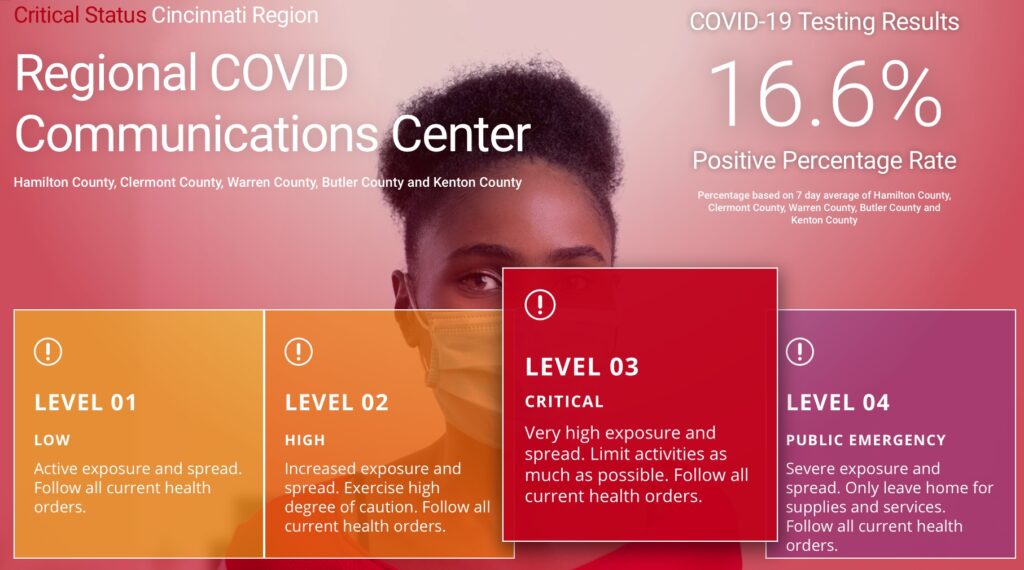
There are currently 2,931 active COVID 19 cases in Clermont County
There are currently 33,498 active COVID 19 cases in Hamilton County.
There are currently 9,421 active COVID 19 cases in Warren County.
On Monday, the Ohio Department of Health took part in a nationwide end-to-end training exercise with the packaging that will be used to distribute the Pfizer vaccine. The Pfizer vaccine is expected to be the first manufacturer to receive the Emergency Use Authorization (EUA) by the Food and Drug Administration (FDA). The vaccine will be shipped to Ohio using the following process:
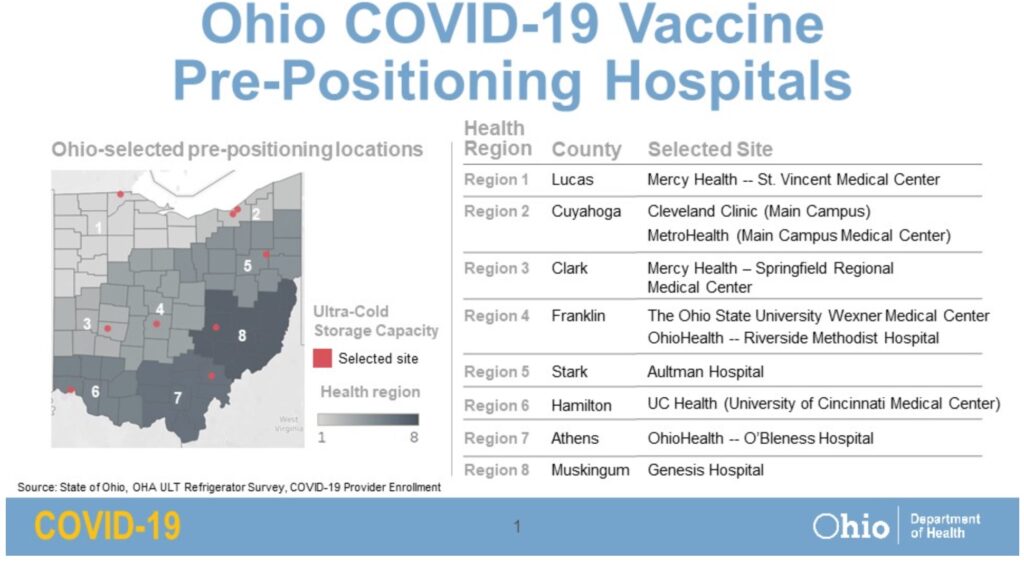
The Pfizer vaccine will be shipped directly to Ohio’s 10 prepositioned hospital sites. As vaccine supply increases, additional providers will receive direct shipments if ordering 975 doses or more of the vaccine.
Providers requiring fewer than 975 doses, such as smaller local health departments and physician’s offices, will not receive a direct shipment from Pfizer. In these cases, Pfizer will ship the vaccine to the ODH RSS warehouse, where the vaccine will be redistributed in increments of 100. The warehouse is equipped with ultracold freezers that can each hold up to 720,000 doses to be stored in the RSS at any one time.
When vaccinations are ready to be shipped from the RSS warehouse, they must be removed from ultracold storage and repackaged with dry ice in under two minutes. To ensure the vaccine can be repackaged safely, quickly, and effectively, ODH staff and members of the Ohio National Guard are running daily practice drills that include the following steps:
Each box is transported to a table where the vials are counted.
The box is closed and handed off to another team member who will place the vaccine box in a larger cold shipping container lined with bubble wrap..
Once the correct number of doses are placed in the larger cold shipping container, dry ice is added to the package, along with a sheet of cardboard. The lid is replaced and the package proceeds to the next step.
The package is sealed, a shipping label is applied, and the package is moved out for delivery.
All packages will be delivered to the providers within six hours. The vaccine will remain stable if sealed in the original shipping container from the RSS warehouse with dry ice for up to 5 days.
Vaccine National Drug Control (NDC) and lot number information will all be tracked electronically, and parcels will be tracked as they are delivered. Each delivery vehicle will contain a GPS enabled device.
Here is video of ODH staff and members of the Ohio National Guard practice drills
Upon granting of an emergency use authorization, it is anticipated that the Moderna vaccine will be shipped directly to providers administering the vaccine and will not be processed by ODH at the RSS warehouse.
Health care workers and nursing home residents should be at the front of the line when the first coronavirus vaccine shots become available, an influential government advisory panel said on Tuesday.
The Advisory Committee on Immunization Practices who make recommendations to the Centers for Disease Control and Prevention voted 13-1 today that Health care workers and nursing home residents should receive coronavirus vaccine shots when they become available.
Cassie Mattia is the Associate Editor of Loveland Magazine and lives in Historic Downtown
Columbus, Ohio – High school winter sports are a go in the state of Ohio! On November 20th the Ohio High School Athletic Association (OHSAA) sent out a memo to schools confirming that the up and coming winter sports season would begin as scheduled.
The OHSAA memo read, “While individual school districts can pause sports at any time due to the COVID-19 pandemic, the OHSAA does not intend to alter the statewide season dates.The decision came after discussions with the Governor’s Office, the OHSAA Board of Directors, OHSAA staff, and many school administrators, along with the results of a recent survey of OHSAA member school administrators. Of 1,464 survey responses, 826 respondents (56 percent) voted to begin winter sports as previously scheduled.”
According to the survey, 33 percent of Ohio’s school administrators wanted to post-pone winter sports until early January, while 11 percent voted to post-pone winter sports indefinitely until Ohio’s COVID-19 conditions got significantly better.
The OHSAA made sure to mention the Governor’s Curfew Order in the memo as well stating, “the Governor’s 10:00 p.m. Ohio curfew order does not mean that teams and fans must be home from their competitions by 10:00 p.m., but venues must be vacated by 10:00 p.m. The OHSAA encourages schools and conferences to alter start times if needed so that competitions end in time to close the facility by 10:00 p.m.“
OHSAA has made it very clear since the beginning of the COVID-19 pandemic that their number one priority is the safety of the student-athletes, coaches, and fans. In order to continue interscholastic competition during the winter sports season OHSAA developed “sport-specific requirements, recommendations, and modifications.” Below are the links to each winter sports requirements, recommendations, and modifications provided by OHSAA.
Although Ohio’s High school winter sports seasons are allowed to continue as planned, for the time being, OHSAA was sure to include in the memo Friday mandates, spectator capacity, and recommended best practices per the Ohio Department of Health Director’s Sports Order (https://bit.ly/2RWa1jh). OHSAA’s memo read, “It is especially important that requirements for facial coverings, social distancing, and frequent hand washing be followed and that facility hosts disinfect and clean competition and high contact areas frequently. Also note that the Order has a limit on spectator capacity, which is the lesser of 15 percent of fixed, permanent seats or 300.“
CURRENT COVID-19 DATA There are 235,170 confirmed and probable cases of COVID-19 in Ohio and 5,461 confirmed and probable COVID-19 deaths. A total of 20,015 people have been hospitalized, including 3,969 admissions to intensive care units. In-depth data can be accessed by visiting coronavirus.ohio.gov. Video of today’s full update, including versions with foreign language translation, can be viewed on the Ohio Channel’s YouTube page. For more information on Ohio’s response to COVID-19, visit coronavirus.ohio.gov or call 1-833-4-ASK-ODH.
Columbus, Ohio – Ohio Governor Mike DeWine and Lt. Governor Jon Husted today provided the following updates on Ohio’s response to the COVID-19 pandemic.
RECORD-BREAKING CASES & HOSPITALIZATIONS DeWine announced today that Ohio is once again breaking records in regard to COVID-19 cases and hospitalizations.
• Between yesterday and today, health officials have reported a total of 4,961 new positive coronavirus cases in Ohio, the highest number of new cases in a 24-hour period to date.
• There are currently 2,075 patients hospitalized with COVID-19 which is a 55 percent increase in hospitalized patients compared to two weeks ago.
• Of the hospitalized patients, 541 people are in intensive care. The previous record for intensive care admissions was 533 in April.
“This virus is flaring up, and we have to push it down – the economy depends on it,” said Governor DeWine. “If the virus continues to aggressively spread, people will lose confidence in their ability to safely go to stores, restaurants, and other businesses. If we want to keep our economy moving, we must all live with this virus and we must all be more careful.”
Governor DeWine stressed that the new record number of cases is not due to increased testing capacity in the state. Since September 24, the total number of tests in Ohio has increased by approximately 44 percent, but positive cases have increased 280 percent in the same time period. If a person is tested multiple times, they are only counted once.
STATEWIDE HIGH INCIDENCE
New health data compiled by the Ohio Department of Health revealed today that all 88 counties in Ohio are now considered “high incidence” as defined by the Centers for Disease Control and Prevention.
“There have been so many cases in the past two weeks that the risk of catching this virus in every county of this state is very real and very concerning,” said Governor DeWine. “Again, I ask everyone to recognize their personal responsibility in slowing the spread of this deadly disease. It’s up to every citizen in Ohio to choose to slow the spread by wearing masks, distancing, and making overall smart decisions.”
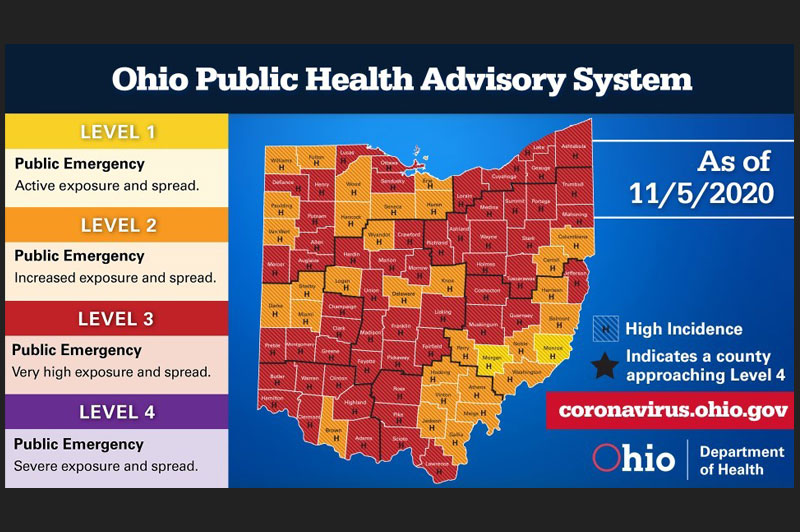
According to today’s updated Ohio Public Health Advisory System map, 56 counties are currently rated as having a very high risk of exposure and spread (Red Level 3), up from 43 counties last week. This represents the highest number of Red Level 3 counties since the launch of the advisory system in July. As of today, 86 percent of Ohioans are living in a Red Level 3 county.
Governor DeWine announced multiple key additions to the existing administration at the Ohio Department of Health (ODH).
Chief Medical Officer Dr. Bruce Vanderhoff: Dr. Vanderhoff previously served for more than a decade as a Senior Vice President and as the Chief Medical Officer at OhioHealth. He has years of experience leading large teams in successfully dealing with important healthcare issues in Ohio and prepared OhioHealth to deal with the threat of Ebola and the H1N1 flu pandemic.
Director Stephanie McCloud: Director McCloud previously served as Governor DeWine’s administrator of the Ohio Bureau of Workers’ Compensation, managing an agency of 1,800 colleagues and over $28 billion in assets. She has considerable experience in the area of mental health and addiction treatment which is a priority in Ohio’s health improvement plan.
Senior Deputy Lance Himes: Himes had previously served as the interim director of ODH where he has played an integral role in running and managing many aspects of the pandemic response operation. He will lead the coordination of the state’s vaccine distribution plan and will continue to work directly with Ohio’s local health commissioners.
Chief of Staff Kathleen Madden: Madden had previously served as Assistant Director at the Ohio Office of Budget and Management and will now play a key role in keeping ODH’s pandemic and non-pandemic programs and operations on track. She will work to prioritize and resolve critical issues, provide oversight and guidance to ODH staff, and ensure that ODH funds are spent responsibly and strategically. Other key members of the ongoing COVID-19 response who will continue their roles in assisting ODH are:
Adjutant General Maj. Gen. John Harris, Ohio National Guard: Maj. Gen. Harris will continue work to ensure complex operations, such as COVID testing and contact tracing, are well-coordinated, monitored, and improved when necessary. He will also work directly with Senior Deputy Himes on the planning and logistics of the forthcoming vaccine distribution program.
Director Ursel McElroy, Ohio Department of Aging: Director McElroy will continue to direct virus prevention efforts for older adults in the community and in long-term settings, including nursing homes and assisted living facilities.
Director Lori Criss, Ohio Department of Mental Health and Addiction Services: Director Criss will continue to lead efforts to address the increasing mental health needs of citizens during the pandemic.
NEW OHIO BWC ADMINISTRATOR Governor DeWine announced that John Logue, the Ohio Bureau of Workers’ Compensation’s (BWC) Chief of Strategic Direction, will become the new administrator of Ohio BWC effective on November 16. Logue has worked for 26 years in the industry. Before returning to BWC in 2019, he most recently served as the vice president of client services for International Absence Management Company where he focused on Ohio workers’ compensation.
Columbus, Ohio – AARP Ohio delivered more than 4,000 petitions today to Governor Mike DeWine and the Director of Ohio’s Department of Administrative Services Matthew Damschroder, urging the Administration’s support of two essential policy solutions to lower prescription drug costs in Ohio.
Collected from residents across the state, the petitions call for drug price transparency and for Ohio to leverage its full purchasing power during negotiations.
Director Damschroder heads the special council established in House Bill 166, tasked with providing recommendations to the General Assembly, Governor DeWine, and the Joint Medicaid Oversight Committee regarding Ohio’s best path forward to decrease the high cost of prescription drugs in Ohio.
The petition delivery coincides with the council’s last public participation meeting before preparing their final report and recommendations to Governor Mike DeWine.
“We applaud Governor DeWine’s focus on improving Ohio’s prescription drug price transparency, affordability payment models, and health care efficiency. Creating the council was a step in the right direction and now we need to see action to hold drug makers accountable,” said AARP State Director Holly Holtzen. “Older Ohioans are struggling with rising prescription drug prices and cannot afford to wait any longer, especially now.”
Urges using state buying power to negotiate lower drug prices.
Requiring drug makers to provide transparency and justification for price increases is one of the two solutions Ohioans who signed the petition are urging. Using state buying power to negotiate lower drug prices is the second.
“Promoting transparency around drug prices exposes unfair price gouging practices, forces accountability for dramatic prices increases and drives costs down,” said AARP Ohio’s Associate State Director of Advocacy Latoya Peterson. Peterson represents AARP and their 1.5 million members in Ohio on the prescription drug council.
Negotiation is a commonsense, but powerful approach.
“Negotiation is a commonsense, but powerful approach. Some states have begun buying prescription drugs in bulk for some residents, including Medicaid beneficiaries, state employees and retirees, and prisoners. And some states are joining with each other to create even larger buying pools as a way to bring down the high costs of medicines, ” said Peterson.
AARP has been tracking drug prices for 12 years in their Rx Price Watch Report. For each year, the price for prescription drugs has increased much faster than inflation. Here in Ohio, the average annual cost of prescription drug treatment increased 57.8% between 2012 and 2017, while the annual income for Ohioans only increased 13%.
“No American should be forced to choose between paying for the medicines they need and paying for food, rent, or other necessities,” said Peterson.
Columbus, Ohio – Governor Mike DeWine Thursday declared that “We’re in a crisis S/state in Ohio.” He was speaking at a COVID 10 news briefing in Columbus.
The governor dithered. The state legislature said no way.
So on Tuesday, the Springfield City Commission took it upon itself to pass a resolution (which lacks the force of law) calling for all residents to cover their faces while indoors, a practice research says will slow the spread of COVID-19 through Ohio.
By Wednesday, Dayton became the first major city in Ohio to require masks by law. Similarly,Yellow Springs passed a resolution andBexley passed a local ordinance requiring masks.
“The mask is a symbol of freedom,” said David Estrop, a Springfield city commissioner, at a hearing, echoing comments from the governor. “It allows us to continue to reopen this state, yet do so in a way that’s safe.”
By Wednesday, Dayton became the first major city in Ohio to require masks by law. Similarly, Yellow Springs passed a resolution and Bexley passed a local ordinance requiring masks.
On Wednesday, the Ohio Department of Health reported more than 1,000 new cases, the first time that stat has reached quadruple digits since officials mass-tested inmates in three state prisons in late April. Wednesday marks 16 days of the coronavirus accelerating its spread, as measured by the 10-day average new caseload.
Despite the worsening coronavirus outlook in Ohio and nationwide, state lawmakers continue to whip up anti-mask fervor. While Gov. Mike DeWine encourages everyone to wear masks, he has refrained from issuing any statewide mandate as the national epidemic worsens and states pause their economic re-openings.
DeWine demurs
In April, Gov. Mike DeWine took a hardline stance on masks, saying they’d be the only way business can reopen after he lifted the stay-at-home order.
Last week, referencing worsening outbreaks in Montgomery and Hamilton counties, DeWine floated the idea of implementing a mask mandate on a county-by-county basis.
However, he has yet to issue any such order. A spokesman declined to say whether DeWine will announce any mask requirement at his next briefing.
In a statement Wednesday, DeWine applauded Dayton Mayor Nan Whaley, a Democrat, for requiring the use of face coverings.
“Wearing a mask will allow us to help keep businesses open and help prevent further spikes,” he said. “I encourage other communities to consider following Dayton’s lead.”
Voted down
Where masks have found friends in the public health community and Ohio cities, they found enemies in the GOP-controlled state General Assembly.
Where masks have found friends in the public health community and Ohio cities, they found enemies in the GOP-controlled state General Assembly.
Both the Speaker of the House and the Senate President have refused to wear masks at legislative functions.
“It’s my RIGHT not to wear a mask, and I do NOT support a government that tries to quarantine the healthy,” he wrote.
Rep. Nino Vitale, R-Urbana, takes to social media regularly to promote baseless conspiracy theories about masks limiting blood oxygen or how they “force virus into the brain.”
Rep. Candice Keller, R-Middletown criticizes Bureau of Workers’ Compensation for distributing masks to Ohio businesses.
Rep. Candice Keller, R-Middletown,produced a Facebook video June 25 criticizing Ohio’s Bureau of Workers’ Compensation for distributing masks to Ohio businesses.
Despite the lawmakers’ claims, research suggests masks are an effective, inexpensive and non-invasive way to slow the spread of COVID-19.





![[VIDEO] Governor visits RSS Warehouse site as State prepares for vaccine distribution](https://lovelandmagazine.com/wp-content/uploads/2020/12/hypo-needle.jpg)