Tag: Issue 1

  • Split ballot board approves reproductive rights amendment summary written by Ohio Sec. of State

    Split ballot board approves reproductive rights amendment summary written by Ohio Sec. of State


    In a 3-2 decision, the Ohio Ballot Board rejected using the full amendment proposal text for voters to see, and the approved summary language leaves out protecting contraception, fertility treatment and miscarriage care

    BY:  Ohio Capital Journal

    In a 3-2 split decision Thursday, the Ohio Ballot Board rejected using the full text of a proposed reproductive rights amendment on the ballot in November, adopting instead summary language written by the Ohio Secretary of State’s Office that was criticized for being incomplete and inaccurate.

    The board’s approval of the language – which is now titled Issue 1 for the November general election – was the next step in the process of voters deciding whether or not the Ohio Constitution will include the right to abortion, as well as contraception, fertility treatment, miscarriage care, and continuing one’s own pregnancy. Those last four items were all left out of the language approved by the ballot board majority.

    The summary language does not change what the actual amendment would state in the constitution, but would be the last representation of the amendment voters read before the casting their approval or rejection.

    The full text of the amendment will be available at boards of elections during the election, but not in the ballot booths with voters. LaRose said posters with the text will be accessible at voting locations.

    In the summary language approved by the board, the medical term “fetus” is changed to “unborn child,” and the amendment’s “decision” language is changed to “medical treatment.”

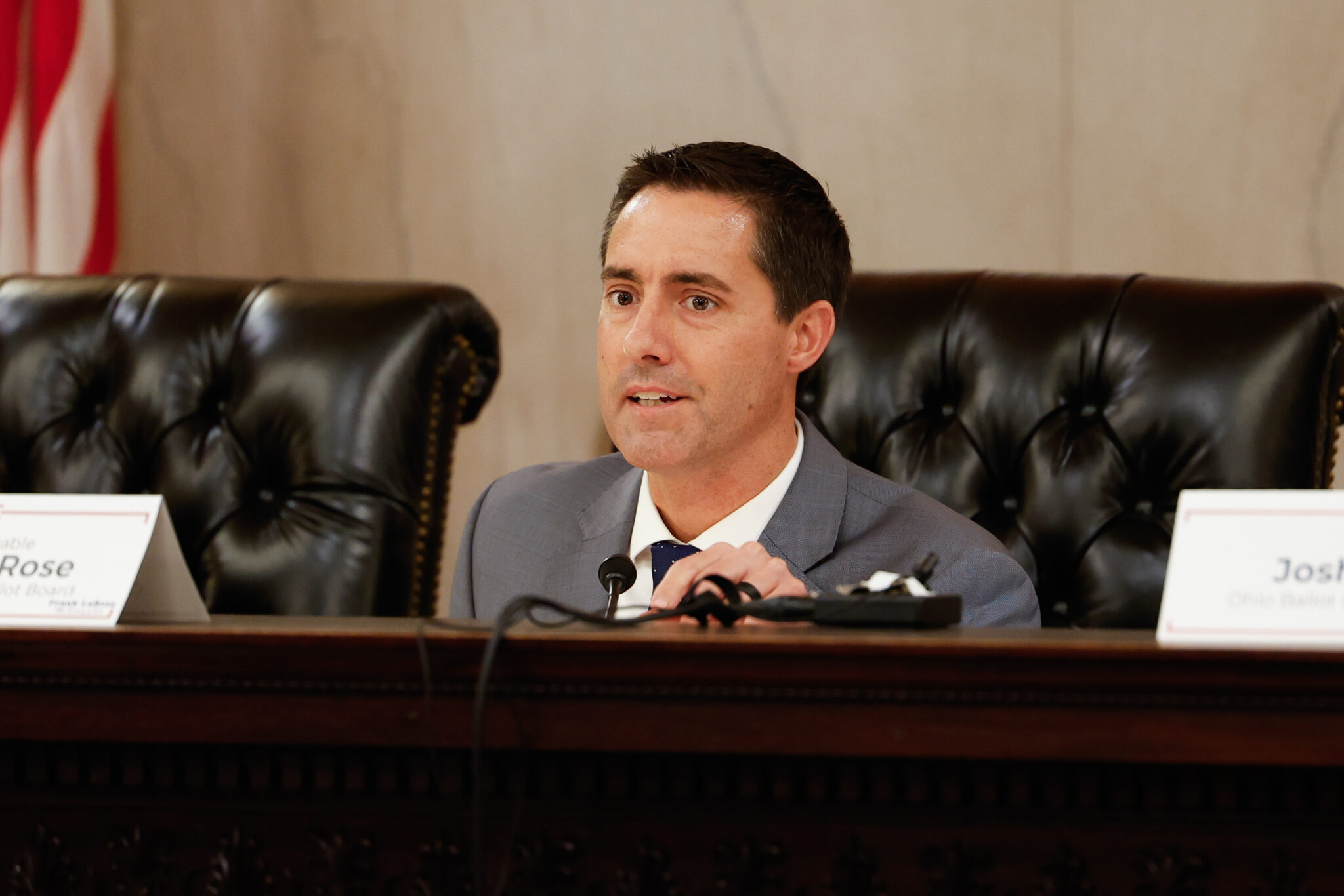
    The leader of the Ohio Ballot Board, Secretary of State Frank LaRose, said the changes were made by “staff” of the board, though Democratic board member and state Rep. Elliot Forhan said “I would assume that the buck stops with the secretary of state.”

    LaRose during the meeting also said that, “having worked extensively on drafting this, I do believe it’s fair and accurate.”

    LaRose has been vocal in his opposition of the amendment, even saying the effort around the previous Issue 1, which would have changed the threshold to approve a constitutional amendment had it not been roundly defeated, was targeting the abortion rights fight specifically.

    At the beginning of Thursday’s meeting, he prefaced the board’s activity by saying the group was not there to “debate the merits” of the amendment or the marijuana ballot initiative also on the table at the meeting.

     Ohio Ballot Board member, State Sen. Theresa Gavarone, R-Bowling Green, speaks at the Ballot Board meeting Thursday. (Photo by Graham Stokes for Ohio Capital Journal. Republish photo only with original article.) 

    Board member and state Sen. Theresa Gavarone, however, gave a speech in the middle of the meeting harshly criticizing the amendment and calling it “a bridge too far,” even after multiple comments by LaRose about the neutrality with which the board was supposed to conduct their business.

    “This is a dangerous amendment that I’m going to fight tirelessly against,” Gavarone said. “But that’s not why we’re here today.”

    Gavarone also claimed, as anti-abortion groups throughout the state do as well, that the amendment is “an assault on parental rights.” Neither the amendment nor the summary approved by the board mention parental rights of any kind.

    The senator continued her comments during the board meeting, saying the true nature of the amendment “is hidden behind overly broad language,” despite the fact that the board summary took out pieces of the full text.

    The summary passed by the board does not include a list of the rights to “reproductive decisions” spelled out in the ballot measure, including contraception, fertility treatment, continuing one’s own pregnancy, and miscarriage care, all of which would be impacted under the new constitutional amendment.

    A clause in the proposed amendment that says “the state shall not, directly or indirectly, burden, penalize, prohibit, interfere with, or discriminate against” the exercise of the amendment by an individual or an assistant of the individual was reduced to “the citizens of the state of Ohio” in the summary.

    The phrase “the citizens of the state of Ohio” is also used in the clause summarizing a prohibition of abortion that would only happen if a pregnant patient’s physician finds the pregnancy to be viable.

    The phrase “pregnant patient” in the ballot measure was changed to “pregnant woman” in the summary.

     Ohio Ballot Board member, State Sen. Paula Hicks-Hudson, D-Toledo, speaks at the Ballot Board meeting Thursday. (Photo by Graham Stokes for Ohio Capital Journal. Republish photo only with original article.) 

    State Sen. Paula Hicks-Hudson, the other Democratic member of the ballot board, made two motions to change the language of the summary to bring back the full text or certain clauses of the actual amendment text into the approved language.

    “The full text is clear, it’s concise and it’s direct, which is one of the requirements that’s needed for us to present to voters in the state of Ohio,” Hicks-Hudson said.

    Both motions were rejected 3-2, with LaRose, Gavarone and the final board member, Bill Morgan, voting against the motions.

    Morgan didn’t speak during the meeting other than to register his votes, and didn’t specifically comment on the amendment discussion or language afterward.

    “I think it’s what we were supposed to do, what the ballot board does,” Morgan told the OCJ.

    Groups for and against the initiative anticipated potential issues with the board’s decision, with pro-abortion rights group Ohioans United for Reproductive Rights requesting that the ballot language mirror the amendment itself, so voters could see the entire constitutional change when they vote in November.

    Lauren Blauvelt, a member of the coalition, decried the changes made to the language, and said the group is considering a lawsuit to fight back.

    “The entire summary is really propaganda and we are going to talk about all of the reasons why Ohio voters should just be able to see the language for what it is,” Blauvelt said after the board meeting.

    Anti-abortion groups argued against using the full text, saying it was unnecessary, and Ohio Right to Life president Mike Gonidakis pushed back on calls for a lawsuit against the summary.

    “Any litigation filed on this is going to be thrown out by the Ohio Supreme Court because the statutory responsibility of the ballot board is to provide a fair and accurate representation. That’s what the law requires, and that’s what they did today,” Gonidakis said.

    Gonidakis said he did not work with anyone on the ballot board on the summary language, but he wished the language was “stronger.”

     Mike Gonidakis, president of Ohio Right to Life, talks to the press after the Ohio Ballot Board meeting Thursday. (Photo by Graham Stokes for Ohio Capital Journal. Republish photo only with original article.) 

    “Look, at the end of the day, people are going to make up their minds before they go in the ballot box anyways, and they’re not going to go in and then try to figure out what they want to do by reading something on a screen,” he said.

    The proposed amendment has gone through a rollercoaster of activity since the Ohio Ballot Board approved the measure in March as compliant with the regulations for a constitutional amendment proposal, allowing a petition campaign that resulted in nearly 500,000 supporting signatures from Ohio voters.

    Amid all the necessary hoops through which the abortion rights campaign has jumped, abortion rights groups have also had to battle against lawsuits attempting to block the amendment from voters. Another lawsuit alleged the Ohio Ballot Board hadn’t taken enough time or consideration before certifying that the amendment was compliant.

    The Ohio Supreme Court rejected both lawsuits, clearing the way for voters to see the issue in the Nov. 7 general election.

    Susan Tebben
    SUSAN TEBBEN

    Susan Tebben is an award-winning journalist with a decade of experience covering Ohio news, including courts and crime, Appalachian social issues, government, education, diversity and culture. She has worked for The Newark Advocate, The Glasgow (KY) Daily Times, The Athens Messenger, and WOUB Public Media. She has also had work featured on National Public Radio.

    MORE FROM AUTHOR

  • Ohio’s Issue 1 goes down to defeat

    Ohio’s Issue 1 goes down to defeat

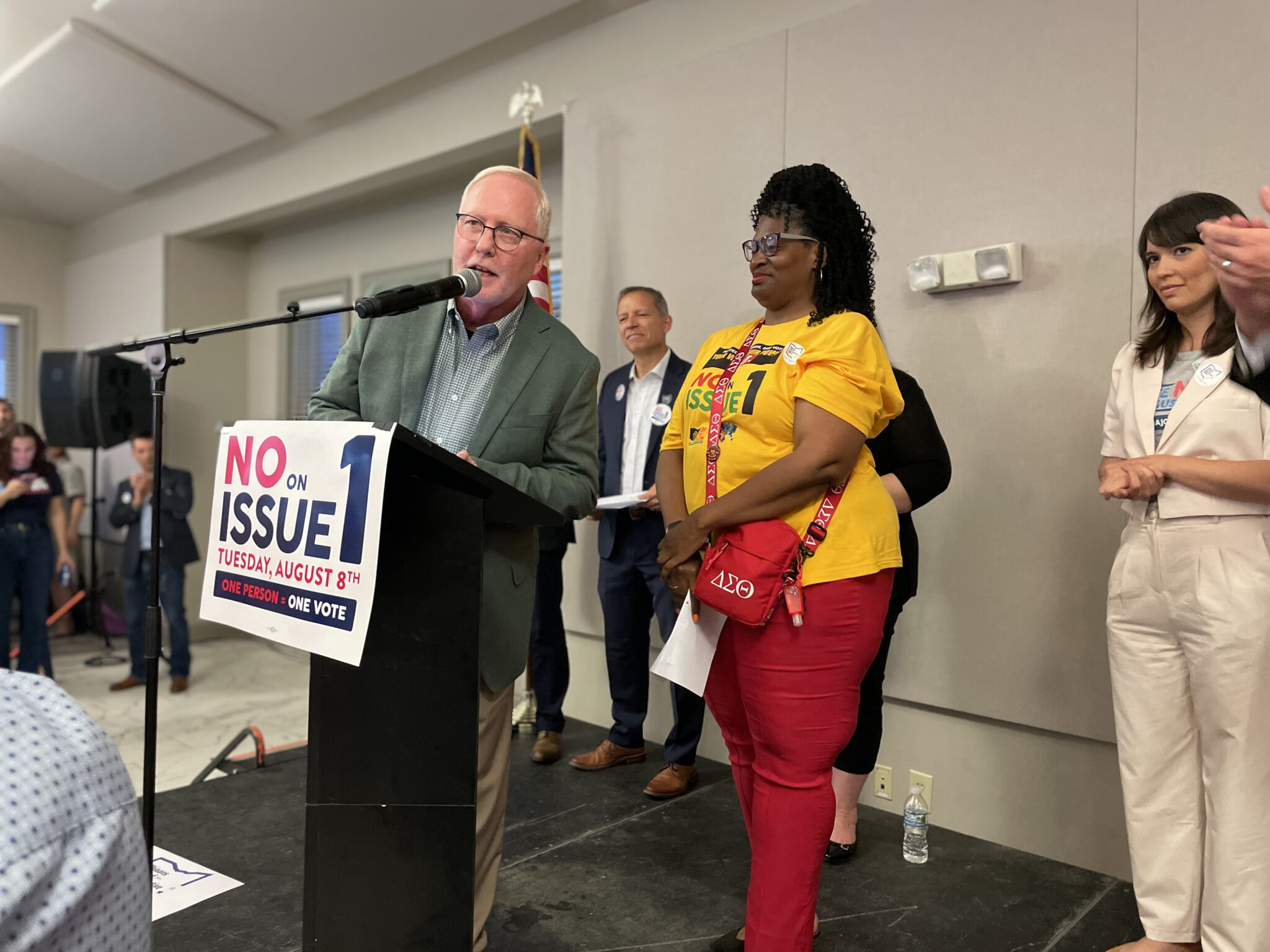
     One Person One Vote spokesman Dennis Willard introducing Deidra Reese from Ohio Unity Coalition at the ‘No’ campaign party. (Photo by Nick Evans for Ohio Capital Journal)

    The Republican-backed effort to make amending the state constitution more difficult lost by 14 points according to unofficial results

    BY:  AND  Ohio Capital Journal

    The Republican-led effort to make amending Ohio’s constitution more difficult has failed.

    As of 11:45 p.m., unofficial results for the Aug. 8 special election show voters rejected Issue 1 57% to 43%. The Associated Press called the race at 9 p.m. While precincts were still reporting late into the night and absentee ballots will continue to roll in, the 13 point margin offered a resounding victory to a broad coalition of Issue 1’s opponents.

    “The majority still rules in Ohio,” One Person One Vote spokesman Dennis Willard said from the podium at the ‘No’ campaign’s watch party.

    Deidra Reese from Ohio Unity Coalition put it differently.

    “I kept saying to my friends that we were going to beat the brakes off ‘em,” she said. “And that’s what we did, y’all.”

    In addition to imposing a higher threshold for adoption, the measure would’ve made it much harder to put amendments on the ballot in the first place. Organizers would have faced minimum signature requirements in all 88 counties instead of the current 44 county benchmark.

    Those vast implications and supporters’ transparent intention to undermine an upcoming abortion rights amendment scrambled the map. Although statehouse Republicans were able to lean on substantial supermajorities to place Issue 1 on the ballot, their effort played out in fits and starts.

    They first failed to secure the necessary votes in the final days of last year’s session. The ordeal was ugly enough it cost the man tapped to be the next House speaker his gavel.

    Then Speaker Jason Stephens slow-walked the proposal past the deadline for May’s primary election, but supporters weren’t done. They aimed instead for August and proposed legislation undoing a prohibition on such elections they’d approved just months earlier. That legislation eventually died in committee, but lawmakers decided to schedule an August election anyway by writing it into their resolution.

    In a split decision the Ohio Supreme Court allowed it to go forward.

    The saga tested loyalties among traditional conservative allies. Some groups sat out — remaining neutral or even voicing opposition. Others held their noses and grasped for any justification other than fighting reproductive rights.

    It tested party loyalties as well. Supporters’ claims that a higher threshold would “protect” Ohio’s constitution, weren’t able to overcome the knee-jerk reaction against its anti-majoritarian changes.

    The No party

    As early returns rolled in, people milled around a firefighters union banquet hall in Columbus. They balanced paper plates loaded with party cut pizza and salad, awkwardly sneaking in bites between greetings. There was an excited hum as they repeatedly updated election trackers on their phones. About an hour after polls closed, the One Person One Vote coalition declared victory.

    Willard said voters saw Issue 1 for what it was.

    “A deceptive power grab, designed to silence our voices and diminish our voting power,” he said. “We defeated Issue 1 because an enormous coalition that spans ideological divides came together to defend democracy.”

    Representatives from that coalition — firefighters, organized labor, advocates for reproductive rights, and minority voters — joined Willard on the podium. Ohio Education Association president Scott DiMauro called it the “biggest baddest broadest most diverse nonpartisan grassroots coalition.”

    “More than 200 organizations said no way are we letting Issue 1 pass,” DiMauro told the crowd. “They didn’t just say no, they said…” The crowd roared out the “hell no” DiMauro was looking for.

     Dr. Marcela Azevedo, co-founder of Ohio Physicians for Reproductive Rights. (Photo by Nick Evans for Ohio Capital Journal) 

    The AFL-CIO’s Tim Burga called out the “hypocrisy and dishonesty” behind the proposal. Dr. Marcela Azevedo — Issue 1’s chief target as part of the group that put an abortion rights measure on the ballot — praised the “overwhelming” enthusiasm among opponents.

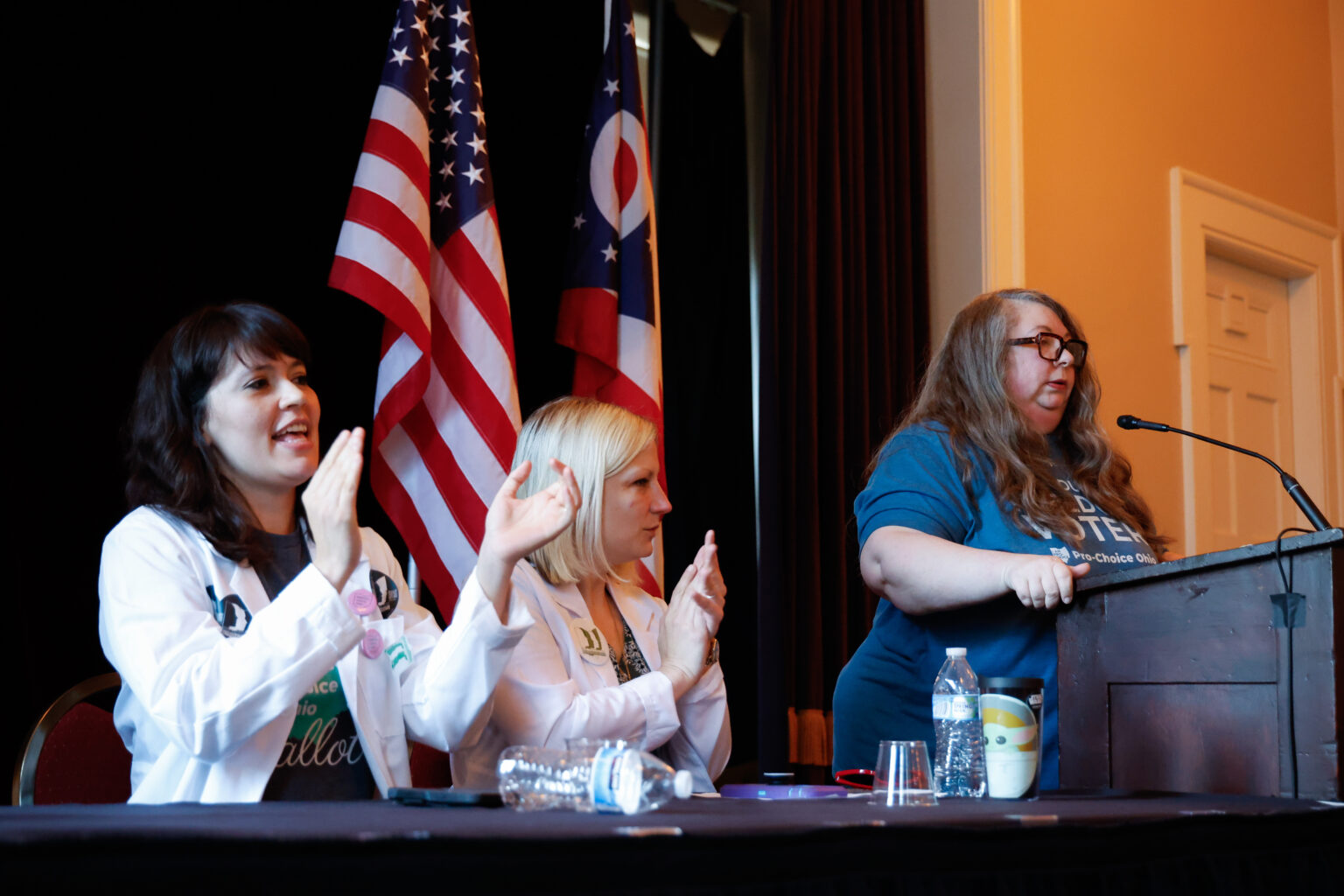
    The Ohio Physicians for Reproductive Rights leader agued, “The unprecedented turnout truly demonstrates that Ohioans are passionate about protecting their own rights, and also protecting their ability to self-govern.”

    Looking forward, Ohio Democratic Party chair Liz Walters crystalized what the outcome means for voters.

    “This fall, Ohioans will have a chance to stand up about reproductive rights in the state,” she said, referencing the abortion rights amendment appearing on November’s ballot.

    “They’ll have a chance to tell these same out of touch politicians that health care choices belong to families, not to politicians,” she added.

    The Yes campaign

    The mood was subdued at the Ohio GOP Protect our Constitution Vote Yes watch event hosted by Ohio Senate President Matt Huffman, R-Lima.

    “I’m personally very disappointed,” he said. “I think it’s a question that was worth asking of the voters, not only because of the two issues that are on the ballot in November, but the six to 10 that are planned over the next couple of years. … The question really is, are we going to allow our constitution to be amended on a regular basis.”

    Huffman didn’t hold back on spreading the blame.

    “One thing that hurt us in the election was the length of time of the campaign,” he said.

    Huffman said they would have had a better chance of passing the amendment had it been on the May ballot.

    “Until May 10, we didn’t know there was a campaign,” Huffman said. “So it took us a long time to put the campaign together to execute the campaign.”

     Ohio Senate President Matt Huffman, R-Lima, and Ohio Rep. Jim Hoops, R-Napoleon, speak to the media about the results of the August special election on Aug. 8. (Photo by Megan Henry for Ohio Capital Journal.) 

    He also pointed the finger at Ohio Republicans who opposed Issue 1 — including former Govs. John Kasich and Bob Taft and former Ohio Republican Attorney General Betty Montgomery.

    “There were some key folks on our side of the aisle, Republicans, especially who actively oppose this, some pretty vociferously,” Huffman said.

    He said the Ohio GOP will likely try to make it harder to amend the constitution again.

    “But perhaps not in the same kind of atmosphere that we have had over the past 10 or 12 months,” Huffman said.

    Ohio Representative Jim Hoops, R-Napoleon, said Ohio’s voting maps showed the urban and rural counties were divided over Issue 1.

    “What we’re looking at here in the state are issues that we need to bring people together instead of being divisive,” he said. “And I think, you know, as we move forward, those are the kinds of things we have to look at.”

    Despite Tuesday’s election results, Ohio Right to Life President Mike Gonidakis said he feels great about the November election.

    “When you have weed and you have abortion on the ballot in November, we’re going to solidify our conservative base here in Ohio and vote no on both of them this November,” he said.

    Recreational marijuana may be on Ohio’s November ballot as a proposed law, not amendment. The Coalition to Regulate Marijuana like Alcohol originally didn’t submit enough valid signatures, but they submitted additional signatures last week during the 10-cure period.

    Ohio House Speaker Jason Stephens, R-Kitts Hill, said they are now focusing on the November election.

    “As a 100% pro-life conservative, we must defeat Issue 1 on November 7 to stop abortion from being a part of our state’s constitution,” he said.

    _____________________

    Follow OCJ Reporter Megan Henry on Twitter.

    Follow OCJ Reporter Nick Evans on Twitter.

    Nick Evans
    NICK EVANS

    Nick Evans has spent the past seven years reporting for NPR member stations in Florida and Ohio. He got his start in Tallahassee, covering issues like redistricting, same sex marriage and medical marijuana. Since arriving in Columbus in 2018, he has covered everything from city council to football. His work on Ohio politics and local policing have been featured numerous times on NPR.

    MORE FROM AUTHOR

    Megan Henry
    MEGAN HENRY

    Megan Henry is a reporter for the Ohio Capital Journal and has spent the past five years reporting in Ohio on various topics including education, healthcare, business and crime. She previously worked at The Columbus Dispatch, part of the USA Today Network.

    MORE FROM AUTHOR

  • [Video Interview] Jane Gonzales and Patty Lawrence talk about reproductive and voting rights ballot issues

    [Video Interview] Jane Gonzales and Patty Lawrence talk about reproductive and voting rights ballot issues

    David Miller is the Managing Editor of Loveland Magazine

    by David Miller

    Loveland, OhioJane Gonzales from Loveland and Patty Lawrence from Miami Township sat with me this morning in the LOVELAND MAGAZINE TV studio to talk about current politics and the activities they have been engaged in in recent months in the community.

    Both have circulated petitions to place a constitutional amendment on the Ohio ballot that they say if passed would protect women’s reproductive rights and health. The petitions they asked local residents to sign were earlier in the week delivered to the Ohio Secretary of State where it will be determined if the petitions contain enough valid signatures to place the amendment before voters in the November general election. (Ohio abortion rights supporters submit signatures for November ballot)

    After Ohio citizens began collecting signatures, the Ohio legislature passed their own legislation, Issue 1, which will be before voters in a special election in August that directly affects the amendment both Lawrence and Gonzales have collected signatures for. 

    Issue 1 will be the only issue on the August special election ballot.


  • Issue 1 is designed to protect the Ohio Constitution from the will of Ohio voters

    Issue 1 is designed to protect the Ohio Constitution from the will of Ohio voters

    Issue 1 does not “protect our constitution;” it does the opposite.

    Jennifer Ginder is a writing consultant, wife and mother of two college-aged daughters in Loveland, Ohio.

    by Jennifer Ginder

    I voted no last week on Issue 1 because it would end simple majority rule, making my vote matter less.

    The language on the actual ballot is confusing, so it’s important to know the facts. Issue 1 would make it harder for citizen groups to change the Ohio Constitution by raising the percentage of people who have to vote “yes” to future proposed amendments from 50% +1 (majority) to 60% (super majority). It would also require that petition signatures be obtained from all of Ohio’s 88 counties rather than the current 44. This means a single county without enough signatures could kill an entire initiative. Issue 1 also eliminates the 10-day “cure” period, during which amendment campaigns can collect additional signatures if needed due to invalid signatures being tossed out.

    The “Vote Yes” campaign rhetoric is misleading and designed to divide and create fear. While proponents initially insisted Issue 1 was only about protecting the integrity of the constitution, they now say the quiet part out loud: they want to stop the popular reproductive rights amendment from passing.

    So, Issue 1 is designed to protect the Ohio Constitution from the will of Ohio voters.

    ●  Issue 1 does not “protect our constitution;” it does the opposite. The campaign itself is funded by an Illinois billionaire and supported by a handful of powerful interest groups. Issue 1’s onerous requirements would make it nearly impossible for citizen groups to get an amendment on the ballot and passed. This would invite more – not less – influence by wealthy, out-of-state interests because they will be the only forces that can afford to participate in the process. The current citizen-led amendment process is ambitious and comprehensive.

    ●  Rather than wait for the general election in November, where we typically vote on important, statewide questions, we are having a special election on August 8 for this proposal only. Lawmakers voted for this even though it will cost taxpayers $20 million, and even though they passed a law last December prohibiting special elections in August.

    ●  Some say the constitution has been amended too many times already. But most of those changes were initiated by the legislature, not citizen groups. Over the last 111 years, only 19 of 71 citizen-initiated amendments have been adopted.

    ●  Opposition to Issue 1 is widespread and bipartisan. It includes all of Ohio’s living former governors and five attorneys general, mayors and local leaders, as well as more than 200 hundred organizations.

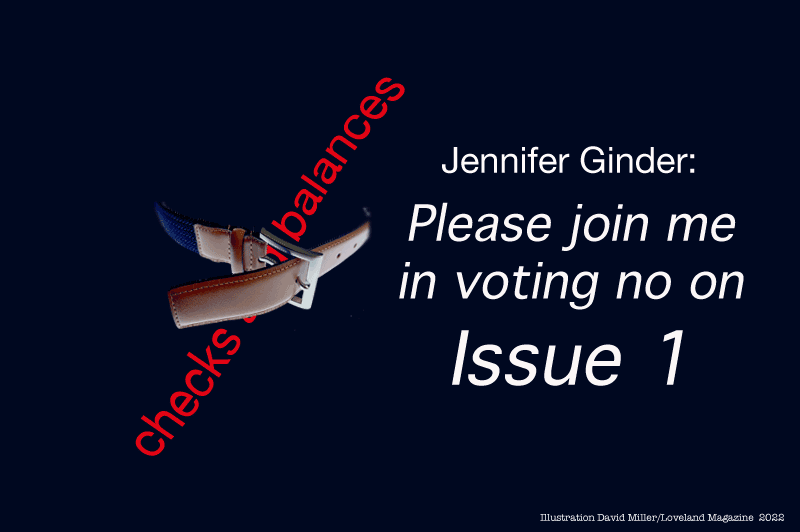
    Issue 1 is not about reproductive rights or any other, single issue. It’s about control, and would effectively eliminate citizen-led amendments in Ohio, regardless of their objective. When legislators are not responsive on issues important to us – like school funding, responsible gun ownership, minimum wage, or gerrymandering – we will have no recourse if Issue 1 passes. No checks and balances. Please join me in voting no on Issue 1.

  • Ohio abortion rights amendment a go for November ballot

    Ohio abortion rights amendment a go for November ballot

    495,938 valid signatures certified to bring proposal to Ohio voters

    BY:  Ohio Capital Journal

    An abortion rights amendment proposed for the Ohio Constitution was certified on Tuesday to go forward for consideration by voters in November as nearly 500,000 signatures in support were verified by the Secretary of State’s office.

    In a letter to the campaign that collected signatures to put the ballot measure to Ohioans this year, Secretary of State Frank LaRose said 495,938 valid signatures were recorded, and a total of 55 counties fulfilled the percentage requirements for verification.

    “Therefore, in the absence of judicial direction to the contrary, I will direct the boards of election to place the proposed amendment on the November 7, 2023, general election ballot,” LaRose wrote.

    When advocates turned their boxes of signatures in to the secretary of state’s office on the July 5 deadline, they reported more than 700,000 signatures were submitted to be verified statewide.

    Despite the lower number, the final tally is well above Ohio’s legal requirements to put an amendment proposal on the ballot.

    Based on current law, abortion rights advocates needed to collect 413,487 signatures in 44 of 88 counties, a number based on election results from the last governor’s race.

    Ohioans United for Reproductive Rights (OURR), a coalition of groups supporting the the codification of abortion rights in the state constitution, celebrated the news, but also set their sights on another hurdle at the ballot: Issue 1, hitting voters next month in the August 8 primary.

    Issue 1 would make it harder for Ohio voters to amend the constitution by raising the threshold from a simple majority to 60%. If passed, Issue 1 would require the abortion ballot measure to meet that threshold.

    It would also require proposals made after January 1, 2024, to meet signature requirements in all 88 counties instead of the current requirement of 44 counties.

    “Now that the petition drive is complete, we’re eager to continue the campaign to enshrine those rights in Ohio’s constitution and ensure that Ohioans will never again be subject to draconian reproductive health care policies imposed by extremists,” wrote Lauren Blauvelt and Dr. Lauren Beene, executive committee members for the OURR, in a statement.

    “This is a major step for Ohio, but it’s bigger than just one state,” said Kimberly Inez McGuire, executive director for Unite for Reproductive and Gender Equity. “This is about reversing the tide of abortion bans and securing a better future for us all.”

    GOP leaders including LaRose have admitted Issue 1 supporters are motivated by their desire to stop the abortion rights amendment.

    The campaign standing in opposition to the abortion amendment, Protect Women Ohio, and anti-abortion lobby Ohio Right to Life, decried the new development, pushing ahead with their efforts to block the amendment from passage.

    Peter Range, CEO of Ohio Right to Life, called the amendment “anti-life,” and said it is “even more imperative that every pro-life Ohioan votes yes on Issue 1 this August to ensure that our constitution, our preborn and our families are protected,” according to a statement sent by the group.

    Protect Women Ohio said they have spent “an initial” $8 million on TV, radio and digital ads in support of Issue 1, and against the November abortion amendment.

    With the amendment now allowed to go to the ballot, the Ohio Ballot Board chaired by LaRose will draft the language voters will read about the measure on their ballots.

    Recent polls show 57.6% of Ohioans support the abortion rights amendment, while 32.4% oppose it and 10% are undecided. On the Aug. 8 Issue 1 effort to change the threshold for passage of amendments from 50% to 60%, another recent poll showed 57.2% of Ohioans oppose Issue 1, while 26% support it, and 17% are undecided.


    Susan Tebben
    SUSAN TEBBEN

    Susan Tebben is an award-winning journalist with a decade of experience covering Ohio news, including courts and crime, Appalachian social issues, government, education, diversity and culture. She has worked for The Newark Advocate, The Glasgow (KY) Daily Times, The Athens Messenger, and WOUB Public Media. She has also had work featured on National Public Radio.

    MORE FROM AUTHOR

    ____________________

    Related Loveland Magazine Interview:

  • [Video Interview] Jane Gonzales and Patty Lawrence talk about reproductive and voting rights ballot issues

    [Video Interview] Jane Gonzales and Patty Lawrence talk about reproductive and voting rights ballot issues

    David Miller is the Managing Editor of Loveland Magazine

    by David Miller

    Loveland, OhioJane Gonzales from Loveland and Patty Lawrence from Miami Township sat with me this morning in the LOVELAND MAGAZINE TV studio to talk about current politics and the activities they have been engaged in in recent months in the community.

    Both have circulated petitions to place a constitutional amendment on the Ohio ballot that they say if passed would protect women’s reproductive rights and health. The petitions they asked local residents to sign were earlier in the week delivered to the Ohio Secretary of State where it will be determined if the petitions contain enough valid signatures to place the amendment before voters in the November general election. (Ohio abortion rights supporters submit signatures for November ballot)

    After Ohio citizens began collecting signatures, the Ohio legislature passed their own legislation, Issue 1, which will be before voters in a special election in August that directly affects the amendment both Lawrence and Gonzales have collected signatures for. 

    Issue 1 will be the only issue on the August special election ballot.


  • Gathering signatures to put abortion amendment on November ballot is ‘going very well’

    Gathering signatures to put abortion amendment on November ballot is ‘going very well’

    Abortion rights groups attempting to get the measure on the ballot need to get 413,000 signatures by July 5.

    BY: Ohio Capital Journal

    Less than two weeks until the deadline, Ohio Physicians for Reproductive Rights is saying abortion right advocates will get the signatures needed to put a measure on the November ballot that would enshrine abortion rights in the Ohio Constitution.

    Abortion advocates attempting to get the amendment on the ballot need to collect 413,000 signatures by July 5.

    “The signature gathering effort has been going very well and we are on track to be successful,” Dr. Lauren Beene, OPRR co-founder and general pediatrician in Northeast Ohio, said Thursday during a media call. “We will have reached our goals to be able to submit before the deadline coming up in July.”

    OPRR said they were unable to quantify how many signatures have been gathered so far because the number constantly changes.

    “We’re actually in the verification and counting phase right now,” Beene said.

    This comes as the one-year anniversary of the Dobbs decision nears, which overturned Roe v. Wade and gave states the power to regulate abortion access. OPRR, which formed after the Dobbs decision, has grown to more than 4,000 individual healthcare members.

    Abortion is currently legal in Ohio up to 21 weeks as the six-week abortion ban is held up in court.

    Issue 1

    Before the November election, abortion advocates first must look to the Aug. 8 special election when Ohioans will vote on Issue 1, which would raise the threshold for a constitutional amendment to pass from a simple majority of 50% plus one to 60%.

    Ohio Secretary of State Frank LaRose recently said Issue 1 is, “100% about keeping a radical pro-abortion amendment out of our constitution.”

    “Issue 1 is obviously extremely important to us,” OPRR co-founder and pulmonologist Dr. Marcela Azevedo said. It is targeted towards our issue. … We are pretty aware that this is just another desperate attempt to thwart the will of voters with a goal of ending majority rule and transferring the power from the people to politicians and lobbyists in Columbus. This constitutional amendment is just another ploy.”

    Heartbeat bill

    After the Dobbs decision last June, Ohio’s six-week abortion ban was in place for about 11 weeks until a Hamilton County judge put a temporary restraining order on the heartbeat bill.

    “Living under a time period where you’re doing the right thing for patients and it’s illegal was not something I would have thought it would have experienced in my career,” said Dr. Amy Burkett, a board-certified OB/GYN in northeast Ohio and OPRR member. “Doing the right thing was not supported by my state legislature.”

    That’s how the constitutional amendment was born.

    “Our solution to the ambiguity and confusing nature of the poorly written heartbeat ban is our constitutional amendment right,” Beene said. “What we are putting forth what people have been coming out of the woodwork to sign.”

    She said the decision for someone to get an abortion should be between them and their doctor.

    “You have to make sure what’s most important is that when our patients need access to care, that access to care is available and available immediately,” Beene said.

    OPRR members said it’s tough to quantify how many people were referred out of state by Ohio doctors while the six-week ban was in place, but said it’s not always possible for patients to go out of state.

    “That’s a huge burden to patients to have to go somewhere else for the care that’s considered evidence based health care,” Burkett said. “They need funds for travel. If it’s overnight they’re missing more work, they may need childcare.”

    Ohio had 21,813 abortions in 2021, according to the Ohio Department of Health.

    Follow OCJ Reporter Megan Henry on Twitter.


    Megan Henry
    MEGAN HENRY

    Megan Henry is a reporter for the Ohio Capital Journal and has spent the last five years reporting on various topics including education, healthcare, business and crime at The Columbus Dispatch, part of the USA Today Network.

    MORE FROM AUTHOR

  • In split decision Ohio Supreme Court allows Aug. 8 election to go forward

    In split decision Ohio Supreme Court allows Aug. 8 election to go forward

    “Gavel,” a sculpture by Andrew F. Scott, outside the Supreme Court of Ohio. Credit: Sam Howzit / Creative Commons.

    BY:  Ohio Capital Journal

    Along party lines, the Ohio Supreme Court on Friday gave the green light to an attempt by Republican leaders of the state’s gerrymandered legislature to make it much harder for voters to amend the state Constitution. The court ruled in a 4-3 decision that it’s OK for the issue to be placed on the Aug. 8 ballot even though the legislature just outlawed such elections in January.

    The Republican majority said that regardless of the law, the Ohio Constitution gives the legislature great latitude in deciding when elections will be held. In a dissent, the Democratic minority argued that while that might be the case, the legislature still has to follow the laws it has passed — and change the ones it doesn’t like.

    Issue 1 would raise the percentage of votes needed to pass a voter-initiated amendment from 50% to 60%. It would also require that a given number of the hundreds of thousands of signatures needed to get an amendment on the ballot come from each of Ohio’s 88 counties instead of the current 44.

    Critics — including bipartisan groups of former governors and attorneys general and more than 240 other groups — say the requirements would make voter-initiated amendments practically impossible. Some add that Issue 1 would greatly enhance the gerrymandered legislature’s power over the state Constitution relative to that of Ohio voters — the exact opposite of what former President Theodore Roosevelt argued for when he successfully advocated adoption of the current system in 1912.

    Republican leaders, including Secretary of State Frank LaRose, pushing the amendment have given inconsistent reasons for why it’s needed. But to partisan audiences they’ve conceded that one reason for putting the matter on the ballot in a low-turnout Aug. 8 election is to try to block a voter-initiated abortion-rights amendment expected to be on the ballot in November.

    One, Rep. Brian Stewart, R-Ashville, also admitted to colleagues last year that he wants to make it harder for another anti-gerrymandering amendment to pass. Ohio’s current lawmakers represent districts that an earlier bipartisan Supreme Court repeatedly ruled were unconstitutional under two amendments already overwhelmingly passed by voters.

    The voting-rights group One Person One Vote sought an order stopping the Aug. 8 election, noting that under a law signed by Gov. Mike DeWine on Jan. 6, almost all statewide August elections are prohibited.

    The Republican majority on Friday agreed — kind of. In its opinion it said the law does not authorize, “an August special election for a statewide office, question, or issue.”

    Even so, the opinion — signed by Republican Justices Sharon L. Kennedy, Pat DeWine and Joe Deters and concurred with by Justice Pat Fischer — says the legislature doesn’t have to follow that law.

    “Regardless of what the Revised Code provides with respect to special elections, however, Article XVI, Section 1 of the Ohio Constitution controls the matter before us,” it said. “That provision authorizes the General Assembly to submit the issue ‘at either a special or a general election as the General Assembly may prescribe.’”

    That’s ludicrous, Justice Michael Donnelly said, in essence, in one of two dissents. If the legislature wants to hold an Aug. 8 election, it needs to change the law that it so recently passed, he argued.

    “But rather than changing the law, the General Assembly and respondent, Secretary of State Frank LaRose, want to be told that the Ohio Constitution allows the General Assembly to break its own laws,” Donnelly wrote. “Rather than doing the work themselves, they want this court to fix their mess and do their work for them. Sadly, a majority of this court obliges.”

    Democratic Justices Melody Stewart and Jennifer Brunner joined in the dissent and Brunner wrote a separate dissent of her own.

    In it, Brunner said the majority is wrong to claim that since the Ohio Constitution delegates to the legislature the power to determine the time of elections, that allows it to violate the law it passed prohibiting them in August. Laws frequently constrain constitutional rights, such as those related to speech and guns, she argued.

    “Many of our statutory laws burden some constitutional right in some way, and yet they are presumed to be constitutional when enacted and are not struck down unless they are found to have impermissibly burdened a constitutional right,” she wrote.

    Dennis Willard, spokesman for plaintiffs One Person One Vote said in a statement that despite Friday’s reversal, his group would continue to work to get people to polls and vote no on Aug. 8.

    “Today’s ruling is disappointing, but the choice before voters remains the same no matter when we vote: Preserve majority rule in Ohio, or dismantle it,” he said. “We’re confident Ohio voters will see Issue 1 for the scam that it is: a corrupt power grab by special interests and politicians.”


    Marty Schladen
    MARTY SCHLADEN

    Marty Schladen has been a reporter for decades, working in Indiana, Texas and other places before returning to his native Ohio to work at The Columbus Dispatch in 2017. He’s won state and national journalism awards for investigations into utility regulation, public corruption, the environment, prescription drug spending and other matters.

    MORE FROM AUTHOR

  • Ohio Chamber won’t discuss its allies in effort to lock down state Constitution

    Ohio Chamber won’t discuss its allies in effort to lock down state Constitution

    Ohio Chamber of Commerce President Steve Stivers. (Photo by Drew Angerer/Getty Images, 2017.)

    They include abortion foes, gun-rights groups, an election denier, and the gerrymandered legislature

    BY:  Ohio Capital Journal

    The Ohio Chamber of Commerce is supporting a proposed amendment to the state Constitution that has huge implications for such issues as abortion, gun control, and even democracy itself.

    But Steve Stivers, president and CEO of the chamber, isn’t willing to talk about those things as his organization joins the effort to make it much harder for voters to amend the Ohio Constitution.

    The Chamber last month came out in support of a proposal by Ohio’s Republican-controlled legislature that would make it far harder for voters to gather enough signatures to put a constitutional amendment on the ballot. It would also require a majority of at least 60% to pass it instead of the current 50%. In doing so, the Chamber is joining forces with Ohio Right to Life, the Buckeye Firearms Association, and an out-of-state, election-denying billionaire.

    The measure, Issue 1, will be on the ballot Aug. 8 because Republicans in the legislature last month reversed a ban on such elections that they passed just last year because voter turnout in the dog days of summer is typically abysmal. In August 2022 it was 7.9%.

    On May 11, Stivers issued a statement saying the Chamber takes no position on abortion rights — even though the measure it’s supporting is intended to block a voter-initiated abortion-rights amendment that is expected to appear on the November ballot. Stivers also said the group isn’t taking a position on other “social” issues that are popular with voters, but the Republican supermajority in the state legislature — declared an unconstitutional gerrymander multiple times by a bipartisan Ohio Supreme Court — seems determined to stymie.

    “The Ohio Chamber Board voted today to take no position on the November election’s reproductive rights issue,” Stivers said. “The Ohio Chamber is a business association and takes positions on business issues, not social issues. While we support protecting our constitution in August, this has everything to do with subjects like minimum wage, employment at-will, and other business issues.”

    That ignores businesses’ interest in avoiding unpopular legislation such as Ohio’s harsh abortion restrictions passed out of an extremely gerrymandered legislatureA survey conducted last August indicated that a third of job seekers wouldn’t even consider working in states with strict abortion limitations and that 27% percent of workers in states with the most restrictive abortion laws wanted to leave.

    But Stivers, a former Republican congressman, has declined to discuss such things. Since issuing the May 11 statement, the Chamber hasn’t responded to requests for an interview with Stivers, and it ignored written questions that were sent as a follow-up.

    Lack of transparency

    The refusal of the state’s most prominent business organization to discuss the ramifications of a constitutional change it’s supporting adds another undemocratic layer to an initiative that already has many, said Catherine Turcer, executive director of Common Cause Ohio, which opposes State Issue 1. She said the Chamber and its members will sink lots of corporate money into the fight to cut voters’ power, but it doesn’t want to be open with them.

    “One of the challenges with corporate donations and business organizations is that the money does the talking,” Turcer said. “It gets spent on elections, but we don’t hear directly from the people behind it. And we should expect to hear that because at the end of the day, a corporation doesn’t get to vote. At the end of the day, a corporation is an artificial entity. (Behind them are) human beings making decisions and we should understand what is happening. Or at least the press should have an opportunity to ask questions.”

    The position the Chamber is taking in favor of State Issue 1 is out of step with four former governors of both parties, five former Ohio attorneys general, and more than 240 organizations — such as Turcer’s — who are adamantly opposed to the measure because they believe it would effectively lock Ohio voters out of their state Constitution.

    The provision Issue 1 seeks to change was championed by former President Theodore Roosevelt as a way to force an unresponsive government to address the public’s concerns.

    Adopted in 1912, it sets a high bar for voters to gain access to the Ohio Constitution. It requires supporters of an amendment to gather a large number of voter signatures (413,000 for the abortion-rights amendment planned for the November ballot) and it requires that a given number of them be gathered in each of 44 counties in the various regions of the state. After all that, it also has to gain a majority of the vote to become part of the Constitution.

    Under Issue 1, Republicans in the legislature, anti-abortion groups, pro-gun groups — and the Chamber — want to require 60% of the vote for an amendment to pass, even as they try to pass the restriction under the current, 50% requirement. In other words, they’re trying to get a simple majority in a low-turnout Aug. 8 election to pass an amendment saying that a 40% minority can quash future amendments supported by 59.9% of Ohio voters.

    Issue 1 “is a proposal to substantially diminish the most significant power held by the people, the power of initiative petition to amend the Ohio Constitution. Our Constitution leaves no doubt about this,” Ohio Supreme Court Justice Jennifer Brunner, wrote in a partial dissent published on Monday. She was dissenting because she thought the court didn’t go far enough in ruling that parts of Issue 1 are “likely to mislead voters.”

    Like Brunner, Turcer argues that the effort to enhance the power of the gerrymandered legislature relative to the voters is undemocratic. And — along with former Republican Gov. Bob Taft — she argues that even from the standpoint of its supporters, the measure is shortsighted.

    “It’s problematic that organizations decided to make it harder for citizens to change the Constitution because they don’t like specific policies. But it’s not always going to be 2023,” Turcer said. “There are a number of different ways we can improve the state and leaving that to a minority of Ohio voters is really scary. It’s really scary to think that a majority of voters — whether it’s 55% or 58% — approve of something, but they can’t actually put that policy in place.”

    Misleading claims

    Adding to accusations that the proposed change is anti-democratic are the misleading reasons proponents have given for needing it.

    Stivers, Ohio Secretary of State Frank LaRose, and other proponents argue that voter access needs to be ratcheted down to “protect” the Ohio Constitution from monied out-of-state interests. But when he announced an earlier version of the measure last year, LaRose couldn’t point to any examples of such interests amending the Constitution in the past.

    Nor will LaRose or Stivers comment on an out-of-state special interest who has donated more than $1 million in support of their effort to lock Ohio voters out of the state Constitution. That’s Illinois billionaire Richard Uihlein, who helped fund the rally that preceded the violent Jan. 6, 2021 riot at the U.S. Capitol, and who has since spent millions funding candidates who falsely claim Donald Trump won the 2020 election.

    At the same press conference last year in which LaRose claimed he was trying to protect the Constitution, he also claimed that he was thinking long-term. He said he wasn’t trying to block the expected amendment protecting abortion rights.

     The Republican majority members of the Ohio Redistricting Commission in 2021 and 2022. Top row from left, Ohio Gov. Mike DeWine and Secretary of State Frank LaRose. Bottom row from left Ohio Auditor Keith Faber, then-House Speaker Bob Cupp, and Senate President Matt Huffman. Official photos. 

    LaRose also denied that he wanted to foil another attempt by Ohio voters to stop extreme gerrymandering after he and other Republicans on the state Redistricting Commission ignored repeated orders by the state Supreme Court to follow earlier amendments passed with 70% of the vote. The Republican commissioners last year ran out the clock on the process and lawmakers in the consequently unconstitutional districts voted to put the amendment that would make it much harder for Ohio voters to amend the Constitution on the Aug. 8 ballot.

    In her dissenting opinion Monday, Justice Brunner said that by ignoring constitutional prohibitions against gerrymandering, Republican leaders make it easy to come up with the needed votes for the legislature to put a constitutional amendment on the ballot while making it almost impossible for voters to do the same.

    “If the General Assembly continues to ignore (anti-gerrymandering) orders of this court regarding the state legislative redistricting process, gaining a three-fifths vote should not be difficult for it to accomplish,” she wrote.

    Lack of candor

    Turcer of Common Cause said that business groups such as the Chamber ignore issues like gerrymandering at their peril. That’s because lawmakers from gerrymandered districts have every incentive to cater to the most charged-up elements of their base and ignore everybody else. It‘s an engine that produces extreme legislation that can prompt boycottsprotests and require businesses to provide special benefits to protect employees.

    “The folks who do support Issue 1 and the special election clearly don’t care about gerrymandering — the manipulation of district lines to manipulate elections and policy,” Turcer said. “Gerrymandering has a profound consequence for our business leaders and the business community. It is extremely short-sighted to not think about how challenging it will be to do a citizen initiative with the news rules that are in place.”

    LaRose again demonstrated in May that he was being less than forthright when he claimed his support for the effort was only out of concern for the future integrity of the Ohio Constitution, and not current fights over abortion and gerrymandering.

    “That’s not what this kind of a change should ever be about,” LaRose said last November.

    But last month, the state’s top elections official told Seneca County Republicans “It’s 100% about keeping a radical pro-abortion amendment out of our constitution,” WEWS reported.

    The lack of candor about their reasons for wanting to effectively lock Ohio voters out of the state Constitution seems to extend even to the name of the campaign committee supporting the measure: Save Our Constitution.

    “A more accurate name might be Save Our Constitution from Ideas We Don’t Like,” veteran Ohio political reporter Howard Wilkinson opined earlier this month.

    It’s possible that Stivers, the Chamber, and other business interests are narrowly focused on stopping a minimum wage hike to $15 an hour — which enjoys the support from 60% of the public.

    The Chamber might also be responding to pressure from legislative Republicans. The Cleveland Plain Dealer reported that GOP leaders last month put the arm on corporate lobbyists to contribute to the Issue 1 push as they draw up a multi-billion dollar state budget that is of great interest to the companies the lobbyists represent.

    Either way, Turcer said, the Chamber and its members are trying to water down democracy for their own, narrow purposes.

    “For political expediency, they would like to make it harder for us to participate in direct democracy,” she said. “They would prefer to dilute the power of voters rather than promote their own policy agenda with voters.”


    Marty Schladen
    MARTY SCHLADEN

    Marty Schladen has been a reporter for decades, working in Indiana, Texas and other places before returning to his native Ohio to work at The Columbus Dispatch in 2017. He’s won state and national journalism awards for investigations into utility regulation, public corruption, the environment, prescription drug spending and other matters.

    MORE FROM AUTHOR