Image above is from one of the many virtual tours that Great Oaks now offers to students that cannot visit the campus
Choosing classes to take during high school can be a challenge. Sophomores at area high schools typically get the chance to visit the career labs at Great Oaks campuses before making such a decision, but with current pandemic restrictions many sophomores may not have that opportunity.
“Seeing the professional equipment and technology that our students use in their programs is important for those considering a career program,” said Great Oaks Director of Student Services Nancy Mulvey. “We want them to get to know the instructor, hear from other students and graduates, and walk through the labs.” Mulvey said that because most of Great Oaks’ 36 school districts aren’t able to send groups of sophomores to tour the nearest campus, Great Oaks has created virtual tours.
The virtual tours, posted on greatoaks.com, include 360-degree views of each lab at each campus, along with profiles of the instructors, conversations with alumni, pictures of students at work, and information about future careers.
“Thousands of students each year apply for these hands-on, experiential learning programs that lead to professional certifications,” said Mulvey. “We want to make sure that they have a chance to explore and ask questions.”
Loveland, Ohio – The Loveland Christian Church is inviting the community to a candlelight Christmas Eve service. Join them either in person or online at 6 or 8 PM. The in person capacity will be 75 people per service.
In order to follow CDC guidelines, our in-person service will have limited availability. To register for in-person services, visit LovelandChristianChurch.org to make a reservation.
All of their online service information can also be found on the website or by following them on FaceBook.
A winter without an Ohio State-Michigan football game is, well, it’s like hot soup without a spoon. It’s like an Ohio highway without orange barrels.
“I know that life in Ohio is not complete without the glory of Ohio State football and other football,” President Trump told supporters in Circleville.
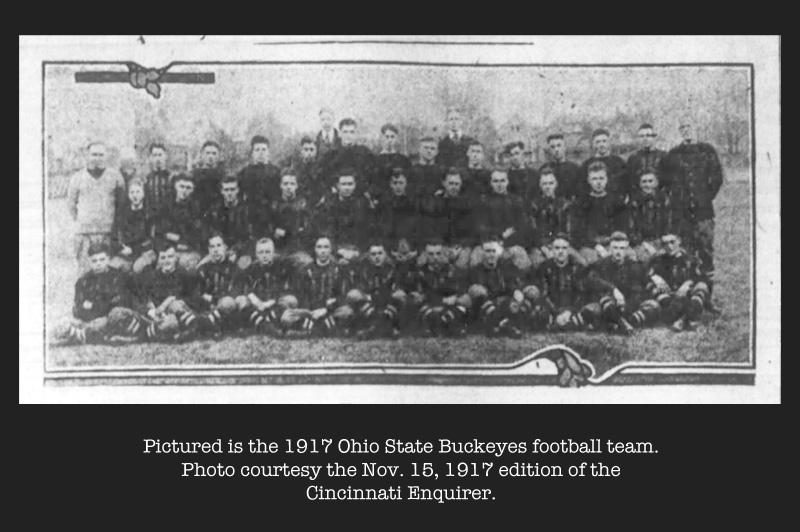
The rivalry is older than the Circleville Pumpkin Show. The two teams first played in 1897 and competed in most years over the next decade or two, though they took several years off during World War I.
Starting in 1918, though, the Buckeyes and Wolverines faced off in every season thereafter. Until this year. A yearly tradition that began the year of the Spanish flu pandemic ends the year of the COVID-19 pandemic.
The streak of playing 102 years in a row predates Kewpee burgers in Lima and Skyline chili in Cincinnati. It predates the construction of the Cedar Point causeway in Sandusky and the Terminal Tower in Cleveland.
It even predates the founding of the NFL in Canton.
Life was different in 1917, the last year the two teams didn’t play. Let’s look at a few news storylines from that year:
Darke County newspaper: Ohio lawmakers are stupid
The Greenville Journal in western Ohio offered a rather provocative headline on March 15, 1917: “General Assembly Noted As Peculiar.” The subheadline: “Legislature, Taken in the Aggregate, Is Below Average Ohio Body in Intellectual Force.”
Newspapers weren’t nearly as polite back then.
Dr. Clarence Maris, a Columbus physician and political writer, offered an explanation as to why the 1917-18 Ohio General Assembly was, in his view, lacking in intelligence.
“(M)any of the Democrats elected in normally Republican counties or senatorial districts were thought by the party managers to have no chance for election,” Maris wrote,” and men were put up to be sacrificed, but the (Woodrow) Wilson peace wave carried them into office.”
Maris went on to list a number of legislative projects undertaken by the legislature to back up his claim. In defense of Ohio’s lawmakers from the 1910s, Maris made a lot of wild claims. A decade later, the New York Times quoted him as saying Ohio State University was rife with communism and that the “youth movement” at OSU was controlled by Moscow.
Ohio overhauls its statewide health authority
The above Greenville Journal paper had another noteworthy article on March 15 in a separate column called “News Culled In The Capital.”
The Ohio House of Representatives had just voted to abolish the state board of health. Instead, lawmakers wanted to have a singular state health commissioner run the show, which would be aided by an advisory council. Governor James Cox supported the move.
The reason for this change? The Marion Star reported the health board “has been in the limelight repeatedly during the last year because of internal dissensions.”
The Lima Times-Democrat reported that “too much bickering” from the seven health board members made them the “subject of considerable criticism.” The newspaper continued: “The health commissioner, to be chosen by the council, with the governor’s approval, will be endowed with administrative and executive powers.”
The new law specified the commissioner had to be a physician and be skilled in sanitary science. The term would be for five years. Dr. A. W. Freeman of Cincinnati was chosen in September 1917 to be the first state health commissioner.
New Cleveland Indians pitcher paid a pretty penny
Team owner Jim Dunn made a big bet in signing pitcher Joe Wood ahead of the 1917 season.
This illustration of “Smoky” Joe Wood printed in a 1917 edition of the Sandusky Star-Journal.
After all, Dunn paid $15,000 for his prized new hurler.
“Smoky” Joe Wood, formerly of the Boston Red Sox, didn’t pitch in 1916. But the Tribe hoped he would return to form in ‘17.
“Tris Speaker, Wood’s former teammate and close friend, has said that he believes Joe is in as good of shape as he ever was,” the Sandusky Star-Journal reported. “But of course till Wood shows the goods on the diamond the deal is completely a gamble.”
For reference, a century later, Cleveland Indians star Carlos Santana was paid $20,333,333 for the 2019 season. He came to bat 686 times that year, earning $29,640 per plate appearance.
In essence, Santana earned “Smoky” Joe Wood’s 1917 salary twice over every time he stepped in to hit.
The most terrifying places these days are the eviction courts in Hamilton and Butler counties.
Go see them in the Butler County Government Building in Hamilton, and in Jail Building (Justice Center), Room B, 1000 Sycamore St. in Cincinnati. You will see, as I did, single mothers of small children pleading vainly for more time to find another place to stay, only to hear the magistrate issue a writ of possession enabling the marshals to put the families on the street in three or four days. The mother’s head sinks. She is hurried away from the podium by the deputy as the next case is called.
Some tenants present the court with the Centers for Disease Control eviction moratorium declaration, which purports to postpone evictions until Dec. 31. If the tenant does not send the landlord a copy of the declaration, it is considered invalid, and the eviction proceeds.
Some tenants have sought rent assistance, but the government agency refused to provide it because the landlord is requiring late fees in addition to the rent. And the eviction proceeds. Many tenants are finding out that there is no more rent assistance.
Nearly all of the evictions are for nonpayment of rent, and the pleas of tenants that partial payments of rent be accepted are declined by the landlords. The evictions proceed.
There are few lawyers representing tenants. The Legal Aid lawyers are overwhelmed, and there are few private lawyers volunteering for The Volunteer Lawyers for the Poor. A tenant going to eviction court without a lawyer is doomed.
Come the new year in January, and there will be a disaster for tenants. Governments must act now. The CDC temporary moratorium must be continued. Congress must provide additional rent assistance. The city of Cincinnati, commendably, has provided additional funding to Legal Aid to provide more tenants with lawyers. Butler County should do the same.
More emergency housing aid must be provided short term. And longer term, Congress and the Biden administration has to dramatically increase the funding for Section 8 vouchers, which enable tenants to pay 30% of their income for rent and enables them to seek housing on the private market – the landlord receiving the balance of the rent from the government. According to the 2019 American Housing Survey, more than half of all renters are paying 30% or more of their income on rent. These families are constantly living on the brink of eviction.
Now is the time for Sen. Rob Portman, Representatives Steve Chabot, Warren Davidson and Brad Wenstrup to come to the aid of their countrymen and women. First, come to eviction court and see firsthand what is happening.
Coordination with the CDC Advisory Committee on Immunization Practices Recommendations Will Ensure Access to Vaccines for Minority Communities and Other Groups at Disproportionate Risk to Covid-19
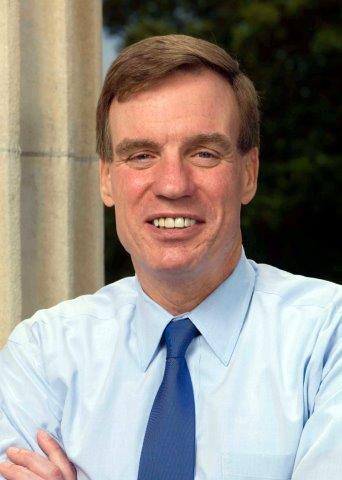
Washington, D.C. – As the Food and Drug Administration’s (FDA) independent vaccine review panel meets to consider the emergency use authorization of an initial COVID-19 vaccine, U.S. Sens. Sherrod Brown (D-OH) and Mark Warner (D-VA) led eight of their colleagues in urging Health and Human Services (HHS) Secretary Alex Azar and Centers for Disease Control and Prevention (CDC) Director Robert Redfield to ensure a fair and equitable vaccine distribution.
The letter follows HHS Secretary Azar’s comments that states should decide who gets the first round of the federally approved COVID-19 vaccine, which could lead to a patchwork of varying distribution plans and affect vaccine access for minority and high-risk populations disproportionately impacted by the virus. The senators’ letter calls on federal health officials to provide more support to states so that they fully understand and appropriately implement expert guidelines ensuring equity.
Mark Warner (D-VA)
“We are writing to urge the Department of Health and Human Services to ensure a fair and equitable distribution of a COVID-19 vaccine by working closely with states to understand and appropriately implement COVID-19 vaccine distribution recommendations made by the Centers for Disease Control and Prevention’s (CDC) Advisory Committee on Immunization Practices (ACIP). As we approach potential emergency use authorization by the Food and Drug Administration for one or more COVID-19 vaccines, it is essential that we do everything we can to ensure access to the vaccine for communities and populations hit hardest by the pandemic,” wrote the senators to HHS Secretary Azar and CDC Director Redfield.
The CDC’s Advisory Committee on Immunization Practices (ACIP) is a 15-member panel comprised of leading medical and public health experts with a focus on the fields of immunization practices and public health. The Advisory Committee reports to the CDC Director and is responsible for developing evidence-based public health recommendations for the safe and ethical use of vaccines. In the case of COVID-19, where initial supplies of a vaccine will be limited, ACIP will make recommendations to ensure the vaccine is equitably distributed. Historically, states and localities – in coordination with federal health authorities – use ACIP recommendations to develop their vaccination strategies. Ohio plans to incorporate recommendations from ACIP to plan and execute its vaccine distribution program.
In their letter, the senators also underscore how the COVID-19 crisis has continued to disproportionately affect older Americans, communities of color, and essential workers. In many cases, these disparities have been exacerbated by factors like overrepresentation in front-line jobs, higher rates of chronic disease, inequitable access to health care, and longstanding bias within the health care system itself.
The senators also urge that HHS and CDC work closely with state and local officials to ensure they fully understand and implement ACIP’s recommendations in a manner that prioritizes public health, equity, and the wellbeing of vulnerable communities.
Sens. Brown and Warner were also joined on the letter by Sens. Michael Bennet (D-CO), Angus King (I-ME), Cory Booker (D-NJ), Maggie Hassan (D-NH), Tammy Duckworth (D-IL), Bob Menendez (D-NJ), Jeff Merkley (D-OR) and Richard Blumenthal (D-CT).
Loveland, Ohio – Tony Carovillano graduated from Loveland High School in 1987.
Mother-in-law Lynne McManus Lee told Loveland Magazine this morning, “Our family is so proud of him. He’s one of the best!”
FROM 16-YEAR-OLD RIDE OPERATOR TO GM: MEET TONY CAROVILLANO
As the vice president and general manager of Worlds of Fun, Tony Carovillano is responsible for leading the operation of the park’s 235 acres and all of its rides and slides. His day typically starts at the front gate where he welcomes ambassadors and guests. From there, he bounces around attending meetings, checking on projects, leading his directors and planning for upcoming events. The day usually stretches past 8 hours, and the workweek almost always stretches beyond five days, but just as Tony did when he started – he relies on the energy of the park to keep him going.
For the past 35 years, amusement parks have been Tony’s life. He fell in love with the industry soon after he started as a train conductor at Kings Island in Mason, Ohio outside of Cincinnati. He was 16, and he’s been along for the ride ever since that whistle blew.
Working on the Railroad at Kings Island
After turning 16, it was time for Tony to get a job. To his delight, he was hired to work in rides at Kings Island after his sister, who was a supervisor at the log flume, put in a good word for him. Decked out in his train conductor uniform, Tony went to work on the K.I. & Miami Valley Railroad.
Clermont County, Ohio – Nestlé Purina PetCare has announced a $550 million investment to build a new factory in Williamsburg Township, Ohio, to meet increasing demand for its pet foods.
The Williamsburg Township location will join Purina’s network of 21 existing manufacturing locations across the United States and be the company’s first new factory built from the ground up since 1975. This expansion is part of a broader growth plan for Purina and marks the second new factory Purina has announced in 2020 after the company revealed plans in late September to convert a former brewery into a new pet food factory in Eden, North Carolina.
These jobs will be approximately 32-minutes from downtown Loveland.
Preliminary plans call for Purina to invest $550 million to build its new factory in southwest Ohio and produce dry dog and cat food brands, including Purina Pro Plan, Purina ONE and Dog Chow.
The 1.2 million-square-foot facility will sit in Williamsburg Township’s South Afton Industrial Park. Purina plans to employ more than 300 people at its new factory location by 2024. Many of the jobs will include professional staff, production operators, technical staff and engineers.
Construction will begin this fall, and the factory is expected to be operational in 2023.
“Clermont County is an excellent location for Purina’s newest factory thanks to the region’s distribution opportunities, a workforce with great potential and strong community values,” said Nolan Terry, Vice President, Manufacturing, Purina. “We have a unique opportunity to bring all of our best technical and innovative manufacturing thinking under one roof as we construct this facility from the ground up.”
According to a press release issued by the company, the facility will be Purina’s most technologically advanced pet food factory, utilizing robotics and innovative digital tools and featuring a training center to promote learning and development.
The release also said that Purina is committed to making pet care products in an environmentally responsible manner.
Purina’s new operations will be designed with sustainability at the forefront, including a commitment to send zero waste for disposal, and production processes designed to recover and reuse heat and water. Purina also is striving to make the facility 100 percent powered by renewable electricity in the shortest practical timeframe, while supporting the company’s ambition for zero environmental impact in company operations by 2030.
The Ohio Development Services Agency approved a Job Creation Tax Credit to support the project.
“Governments don’t create jobs, businesses do,” said David Painter, President of Clermont County Board of Commissioners. “Commissioners invested in South Afton Industrial Park to provide the infrastructure and space where private business could create jobs for our residents.”
Painter continued by saying, “Williamsburg local school district will receive negotiated payments in lieu of taxes for coming decades. Clermont County will recoup its initial investment in South Afton. This is a win for Clermont County government, the Williamsburg area, Nestlé Purina and the residents of Clermont County.”
Overall, Nestlé employs 3,300 people across the state of Ohio, with operations in Solon, Marysville, Cleveland, Brecksville and Zanesville, spanning Nestlé USA, Nestlé Professional, Nestlé Foodservice and Nestlé Purina operations.
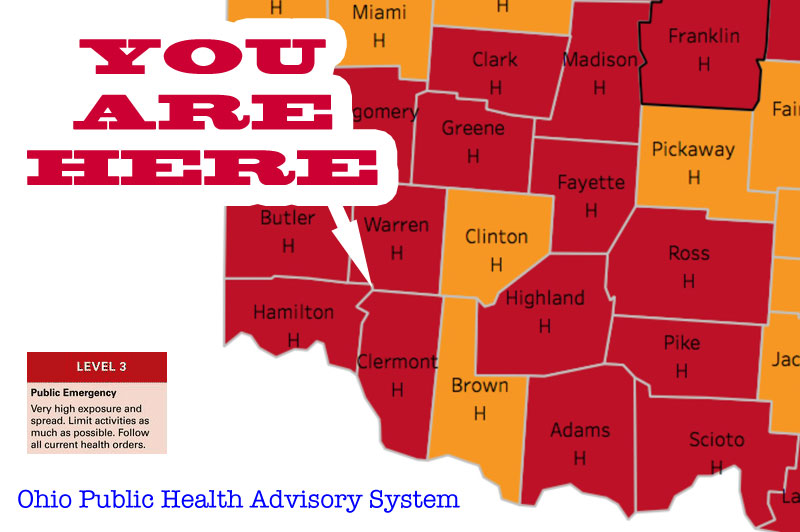
Loveland, Ohio – Although Hamilton County is no longer listed on Ohio’s watch list to turn PURPLE, there are still serious concerns about spread of the coronavirus new health data compiled by the Ohio Department of Health reveals.
Clermont County is now a RED County.
Hamilton County remains RED.
Warren County remains RED.
Level 3 (RED) on the Risk Level Indicator means there has been a public emergency declared and there is very high level of spread and exposure in the county.
The Ohio Department of Health guidance in a RED county is to:
Conduct a daily health/symptom self-evaluation and stay at home if symptomatic.
Maintain social distancing of at least 6 feet from non-household members.
Wear face coverings in public, especially when social distancing is difficult to maintain.
Increase caution when interacting with others not practicing social distancing or wearing face covers.
Avoid traveling to high-risk areas.
Follow good hygiene standards, including:
Wash hands frequently with soap and water for at least 20 seconds.
Use hand sanitizer frequently.
Avoid touching your face.
Cover coughs or sneezes (e.g., into a tissue, or elbow).
Symptom self-evaluation monitoring.
Avoid contact with anyone who is considered high-risk.
High-risk individuals should take extra care to follow precautions.
Seek medical care as needed, but limit or avoid unnecessary visits to hospitals, nursing homes, and residential care facilities to see others as much as possible.
Decrease in-person interactions with others
Consider necessary travel only
Limit attending gatherings of any number
Forty-three Ohio counties currently have a very high risk of exposure and spread (Red Level 3), up from 38 counties last week. This represents the highest number of Red Level 3 counties since the launch of the advisory system in July. As of today, 78 percent of Ohioans are living in a Red Level 3 county. Less than 1 percent of Ohioans live in a Yellow Level 1 county.
“The virus is raging throughout the state, and there is no place to hide,” said Governor DeWine today. “We must face this virus head-on with the tools that we know can beat this virus back: masks, social distancing, washing hands frequently, and good ventilation when inside.”
DeWine announced today that Ohio has now hit a record number of cases reported in a single 24-hour period. Between yesterday and today, health officials have reported a total of 3,590 new positive coronavirus cases in Ohio which is more than 700 cases more than the previous high number of cases reported last Saturday. A total of 194 new hospitalizations were also reported in the past 24 hours, the third-highest number of hospitalizations reported in a single day so far.
Meanwhile, the Loveland School District reported today that they were notified that two more Loveland High School students have tested positive for COVID-19. One student was last at school on Thursday, 10/22/20, and the other on Monday, 10/26/20. (Also read: COVID-19 Positive Cases in Loveland Schools)
Loveland PK-8 grades are in the “Full Capacity” mode of attendance for students not enrolled in the remote academy. Loveland High School remains in a blended mode of attendance for students not enrolled in the remote academy.
COVID-19 Case Rates Per County as of Oct. 28, 2020
County
Color
Cases Per 100 K
Case Count
Population
Clermont
RED(H)
219.9
454
206,428
Hamilton
RED(H)
261.4
2,137
817,473
Warren
RED(H)
303.5
712
234,602
“H” indicates there is “High Incidence” The 14-day period used for this table covers data from Oct. 14 to Oct. 27. The data were pulled on Oct. 28 and exclude incarcerated individuals. Source: Ohio Disease Reporting System (ODRS). Population from 2019, U.S. Census Bureau.
–
There are currently 96 Clermont County cases in the 45140, 45147, and 45150 Zip Code areas. Forty have died in Clermont County and there are 340 current active cases.
Hamilton County is reporting that there have been 320 cases in the 45140 Zip Code. There are currently 177 cases in the county and 235 deaths recorded. The 7-day average for new cases is 177.
In Warren county there are currently 295 hospitalizations and 642 new cases in the last 14 days. Sixty-six have died and 3 have died in the last 14 days. There is an average of 72 new cases per day in the county. No zip code level data is available for Warren County.
(While the city of Loveland lies partially in Clermont County, the city’s public health services are contracted with Hamilton County Public Health. So, if a resident lives in the city of Loveland and tests positive for COVID-19, that case would be counted in Hamilton County Public Health’s statistics, not Clermont County’s.)
Per CDC
Among adults the risk for severe illness from COVID-19 increases with age, with older adults at highest risk. People of any age with the following conditions are at increased risk of severe illness: chronic kidney disease; chronic obstructive pulmonary disease; weakened immune system from solid organ transplant; obesity (body mass index of 30 or higher); serious heart conditions such as heart failure, coronary artery disease, or cardiomyopathies; Sickle cell disease; and Type 2 diabetes mellitus.
Children who are medically complex, who have neurologic, genetic, metabolic conditions, or who have congenital heart disease are at higher risk for severe illness from COVID-19 than other children.
People who need to take extra precautions include racial and ethnic minority groups; people experiencing homelessness; women who are pregnant or breastfeeding; people with disabilities; and people with developmental and behavioral disorders.
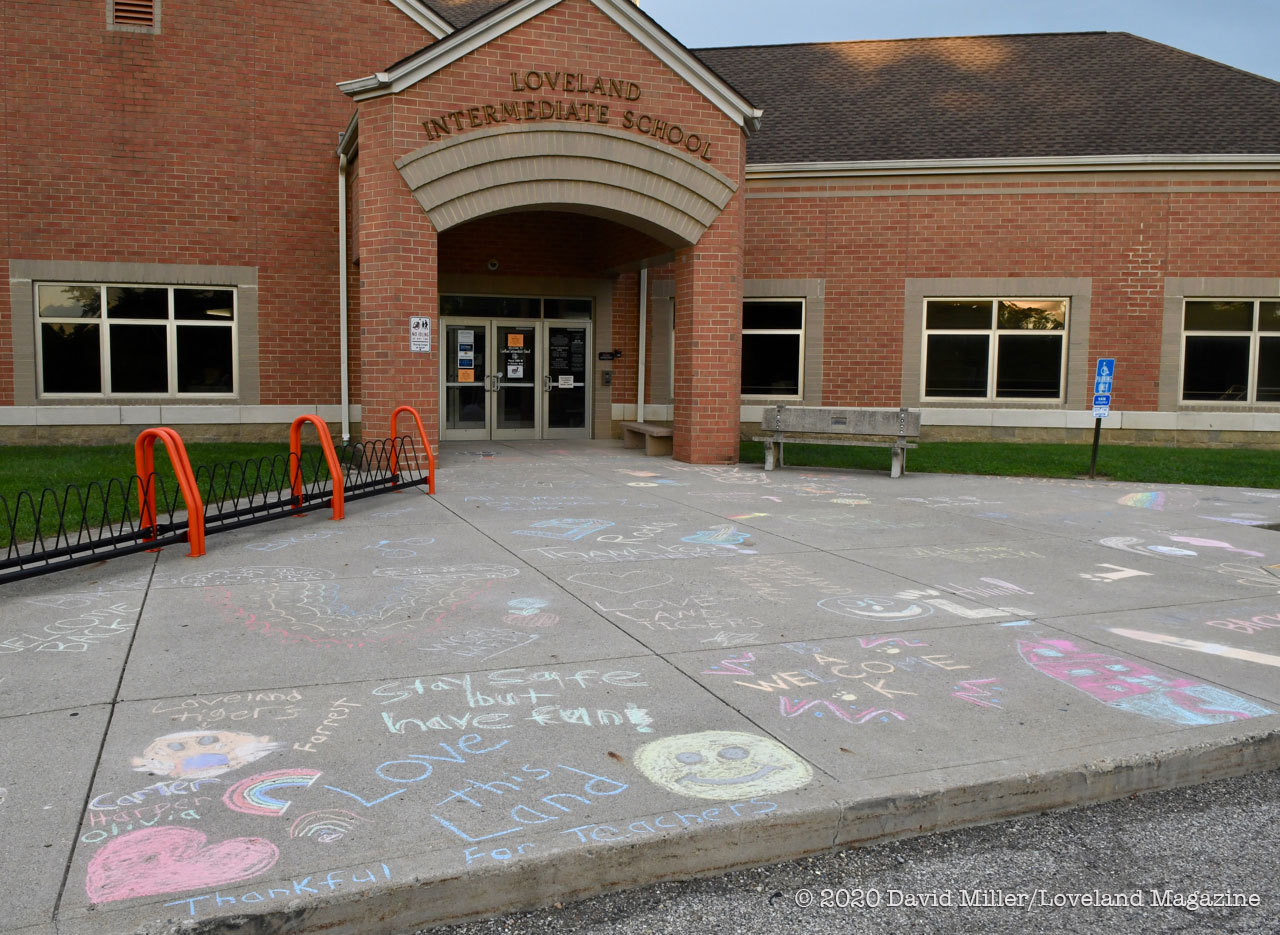
Loveland, Ohio – Here are the “Pandemic Preparedness and Planning” reports for the Loveland Intermediate School that were obtained through a public records request to the District.
Loveland Magazine asked the Superintendent to provide Loveland Magazine with the report “Pandemic Preparedness and Planning” that LJB Inc. prepared for the District. LJB was awarded a contract in July for $66,250 for “Pandemic Preparedness and Planning” services. The report was prepared under the previous CDC definition of “close contact”.
Here is what was prepared for the Loveland Middle School
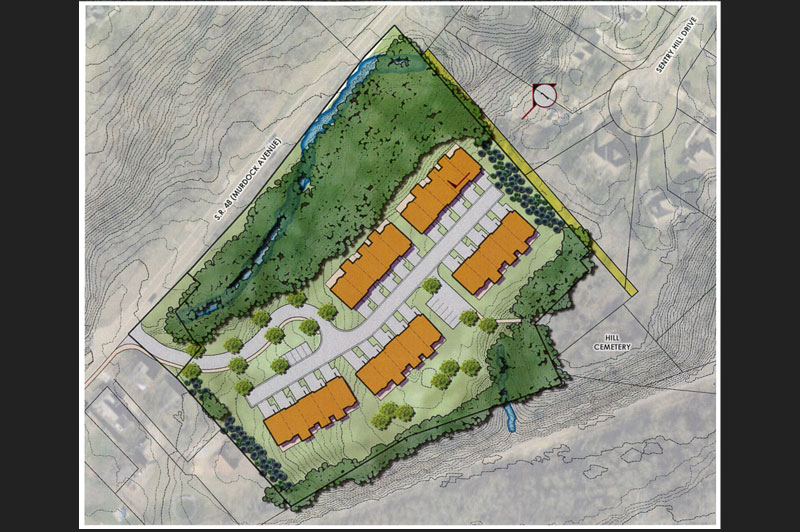
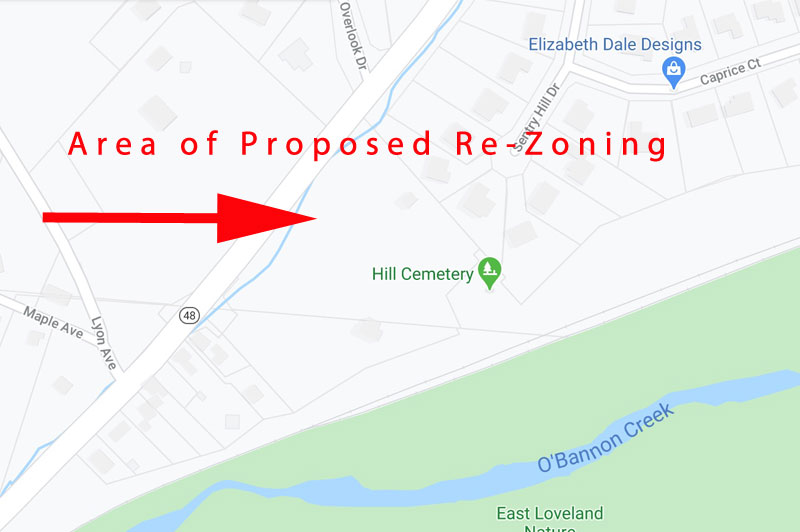
Loveland, Ohio – Joe Farruggia with Zicka Homes has been trying to rezone property off North Second Street (St. Rt. 48) south of the Sentry Hill subdivision with the potential use to build a 28-unit condominium development called the Blossom Hill Project since the first week in June. He has submitted three variations of the proposal, the latest on October 20. The current proposal is to limit the project to 25 or fewer individual units.
The site is approximately 5.5 acres on St. Rt. 48 adjacent to the Sentry Hill subdivision and on the opposite side of the street of the Loveland Health Care facility.
Previously, on June 24th and July 21, the Planning and Zoning Commission held public hearings for the zoning map amendment and recommended approval of the amendment. However, each time, Farruggia chose not to move forward with the processes which would be to have a public hearing before the City Council.
The latest iteration was also approved by the Planning Commission last week and sent to City Council for their consideration. The recommendation from Assistant City Manager Tom Smith is for Council to schedule a public hearing for the re-zoning on November 24.
The developer is asking for changes to the Loveland Zoning Map from the current zoning of Medium Density Residential to Residential Multi-Family.
The recommendation of the Commission according to Smith included the following conditions:
The proposed housing development for the property as submitted o Planning and Zoning Commission must be actively under construction within eighteen (18) months from the date of approval by City Council in order to maintain the zoning;
The approval shall be withdrawn, and the zoning shall revert to Residential Medium Density (R-MD) should the eighteen (18) month condition lapse.
Approval shall be exclusive to this applicant. No transferees or assignees of the applicant are subject to this approval.
Smith also said the developer agreed to requests made by Sentry Hill resident, Dave Stanton. These items were also part of the Planning and Zoning Commission’s motion for recommendation:
Construct a four to five-inch earth berm, fully landscaped with trees and grass, to be constructed along the property line of the two homes in the Sentry Hill subdivision and maintained by the new subdivision’s HOA.
Street lighting and exterior lighting on the townhomes be designed to prevent light pollution into the Sentry Hill Subdivision.
Townhomes to be constructed, at 40 feet, shall not exceed the height of the referenced home of 214 Sentry Hill Drive.
Limit the number of townhomes to be built at 25 or less.
No dumpsters or centralized garage collection. Individual residential trash and recycling pickup to be consistent with all the residential surrounding areas.
No stand-alone garages or sheds.
Exterior architecture and materials (brick, stone, and Hardie Plank) shall be consistent with the look and feel of neighboring communities.
Even though there are COVID 19 restrictions for the number of audience members in the hearing chamber, five residents appeared to express their displeasure with the re-zoning. No residents spoke in favor of the rezoning or the condos.
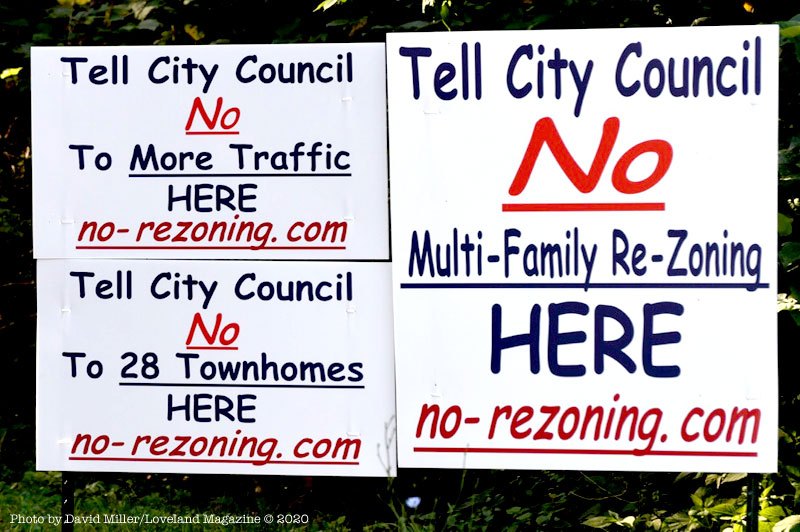
These signs were erected in July by citizens opposed to multi-family zoning adjacent to their homes on St. Route 48 in North Loveland.
Residents have pointed out that the proposal must follow the guidance of the City Master Plan specifically for North State Route 48. They say the project must maintain similar development densities, preserve open space, a rural atmosphere, and assure that there is adequate infrastructure to support the development as mandated in the current plan. They cite the current gridlock of Historic Downtown that must be addressed before the development moves forward.
City Manager Dave Kennedy has argued that the current Comprehensive Strategic Plan (2002) is old and not in line with the current needs of the City. The City is currently rewriting a new master plan for the City. Residents say re-writing the plan is well and good, but until there is a new plan the City and Zicka are governed by the one that exists.
Residents of South 48 also protest that adding so many residential units will add to their already current traffic nightmares of trying drive into and out of Historic Downtown.
During the hearing, Tom Scovanner told the Commission they should be skeptical of the studies Zicka presented to them. One presenter represented that they had prepared their study for the Commission, and Scovanner said, “No, they represent Zicka.” He posed the question to the Commission of whether they would have ever seen the study if it did not turn out favorably to the developer.
Scovanner, a litigator for Clermont County also said in no uncertain terms that the P&Z cannot do anything the Loveland law doesn’t allow them to do. Holding up the code, he said, “You’re bound by these codes. This doesn’t comport with the Comprehensive Master Plan.”
Tom Scovanner spoke to Planning Commission against the re-zoning for condos on Rt. 48.
Dave Stanton spoke to Planning Commission against the re-zoning for condos on Rt. 48.
Sue Ann Walker spoke to Planning Commission against the re-zoning for condos on Rt. 48.
Allen Brooks spoke to Planning Commission against the re-zoning for condos on Rt. 48.
Courtney Hauck spoke to Planning Commission against the re-zoning for 28 condos on Rt. 48.