Cincinnati, Ohio – The Cincinnati Zoo & Botanical Garden got off to a great start on January 5 with the arrival of a healthy baby tamandua. Nine-year-old Isla gave birth early in the morning after being on birth watch for more than a month. The sex of the pup has not yet been determined.
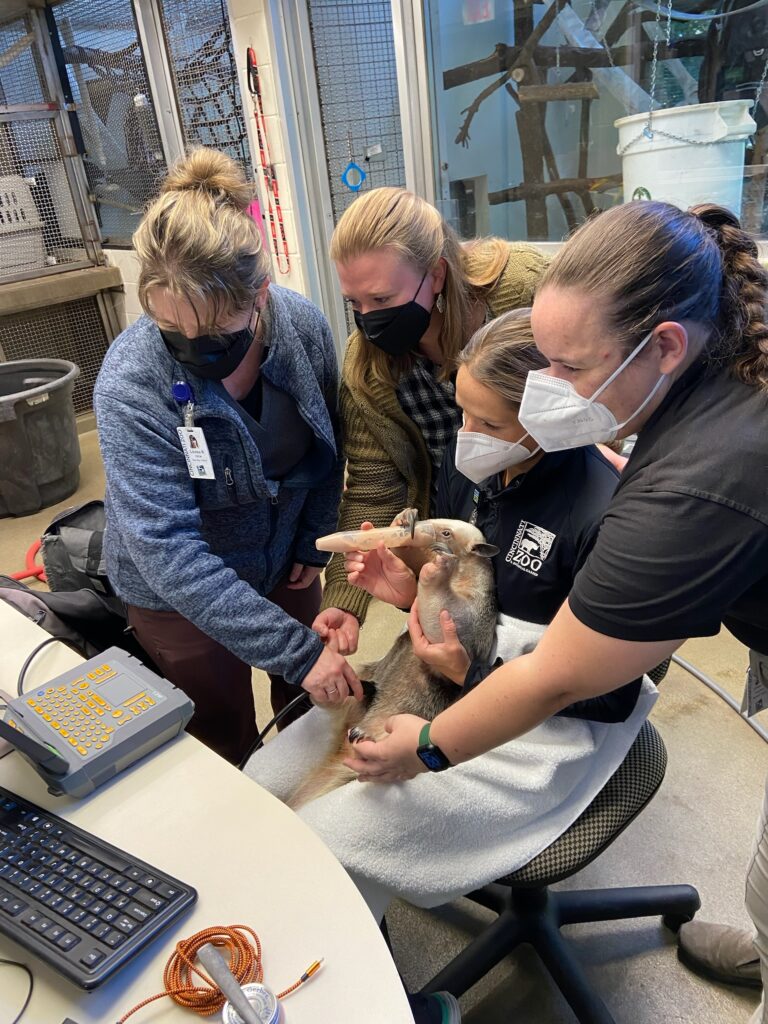
“The birth window for tamanduas is 130-190 days, and Isla’s pup came at the very end of that window,” said Cincinnati Zoo’s zoological manager Julie Grove. “Our Zoo Volunteer Observer (ZVO) team has been monitoring Isla’s every move since mid-November, and our care team has performed regular ultrasounds to track fetal development. Isla’s keepers have established an amazing bond with her, and she cooperates fully with ultrasounds and other health-related procedures.”
This TikTok shared by @CincinnatiZoo highlights the hard work and dedication that the tamandua care team put into managing her pregnancy.
The long birth window created an opportunity for Zoo employees to participate in a baby pool. Each date/time guess was $5, and all proceeds will be sent to the Anteaters & Highways project (https://www.giantanteater.org/). The winner will be among the first to see the baby up close!
Also called the lesser anteater, the tamandua uses its long snout to sniff out ant, termite, and bee colonies. Long claws enable it to dig into nests, and a long sticky tongue licks up the insects. A single tamandua can eat up to 9,000 ants in a single day!
Look for pup-dates, including when you might be able to see the baby, on the Zoo’s social channels.
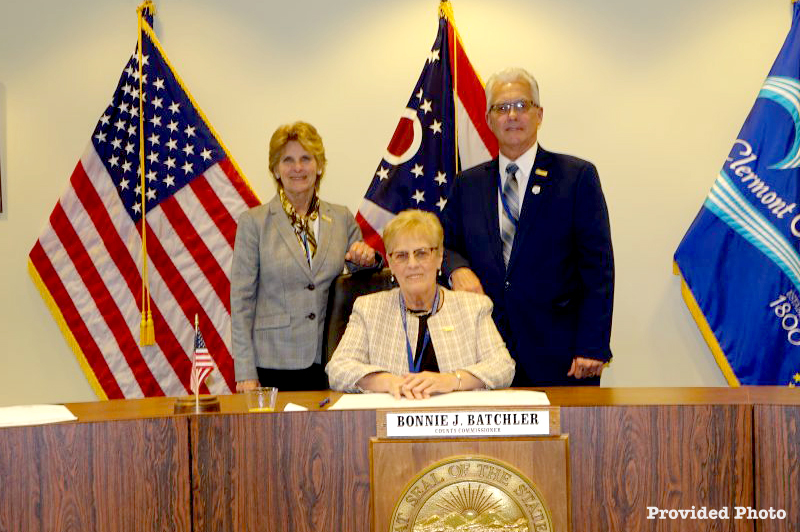
Batavia, Ohio – Commissioner Bonnie Batchler was elected President, and Commissioner Claire Corcoran, Vice President, of the Clermont County Board of Commissioners for 2023 at the January 9 annual Reorganization Meeting. Commissioner David Painter is also on the Board.
The 2023 meeting schedule for Regular Sessions was also established. The commissioners are scheduled to meet every Wednesday of the year, except for certain holiday weeks, and the second and fourth Mondays of the first six months of the year. All meetings are scheduled to begin at 10 AM. Commissioners are mandated to have at least 50 Regular Sessions during the calendar year.
Commissioners offered comments and reflections relating to 2022 and thoughts about 2023.
“This past year, and the past two years, have been two of the most rewarding years of my life, serving the county in a different capacity, working with Commissioner Painter, Commissioner Corcoran and the whole staff here at the county,” Commissioner Batchler said. “It’s been a pleasure getting to know people that I didn’t know before that work for this county. What dedicated people we have. I look forward to this coming year and business that is going to take place to move this county forward.”
“Excellent board, excellent staff here at Clermont County,” Commissioner Painter said. “Clermont County is definitely moving in the right direction… It was a great year. ’23 I think will be an even better year.”
Painter singled out the new Purina facility, work on State Route 32, small business expansion, Hamilton Safe consolidation, a new Land Bank, county investment in roadways, block grant projects, Juvenile Court expansion, a new sewage treatment plant in Newtonsville/Wayne Township, and Ivy Point. He said Clermont County has one of the lowest sales tax rates in Ohio.
“We did accomplish a lot in the past year,” Commissioner Corcoran said. “I think we need to reflect on why we are here. We are here as commissioners as leaders – and that means we are relying on everyone in this county.”
Corcoran mentioned county employees, elected officials, Economic Development, the Budget Management Office, Human Resources, judges, Safety…. and others in attendance. She cited social service agencies who work with Job & Family Services, the Clermont County Chamber of Commerce, and the Kiwanis Club.
“I just love that everyone comes together,” she said.
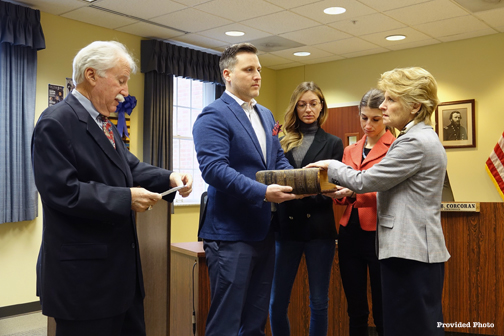
After the reorganization meeting, Corcoran was sworn in for a second four-year term.
Photo: (from left) Husband Jeff Corcoran, son Keegan Corcoran, daughter-in-law Amber Corcoran, daughter Kelsi Corcoran, and Commissioner Claire Corcoran.
Claire Corcoran says she looks forward to her second four-year term on the Board of County Commissioners and believes Commissioners will spearhead a collaborative effort to keep Clermont County moving ahead. She will be Vice President of the Comission.
Corcoran, has lived in Goshen Township since 2001. From 1974-1988, she worked in the Division of Domestic Relations for Hamilton County Common Pleas Court, where she was a manager focusing on home and child support investigations.
From 1988 to 2008, Corcoran worked as a supervisor and manager for Hamilton County Job & Family Services, responsible for a number of projects. From 2012-2015, she served as a Goshen Township Trustee, and from October 2015 through January 2016, as the interim township administrator. Corcoran also served on the Goshen Local School District Board from 2008-2011.
“We have accomplished a lot in the last four years,” she said. “And we will achieve much more in the future as we all do our part to keep the progress going.”
Photo: (from left) Husband Jeff Corcoran, son Keegan Corcoran, daughter-in-law Amber Corcoran, daughter Kelsi Corcoran and Commissioner Claire Corcoran
The Board of County Commissioners also made designations about service on a number of boards and committees:
• Board of Revisions, Batchler
• Automatic Data Processing, Corcoran
• Investment Advisory, Batchler
• Investment Advisory, Painter
• Records Commission (chairperson), Batchler
• Area 12 Chief Elected Official Consortium, Painter
* Area 12 Chief Elected Official Consortium (alternate), Corcoran
• Ohio-Kentucky-Indiana Regional Council of Governments Executive Committee, Painter
• Ohio-Kentucky-Indiana Regional Council of Governments Executive Committee (alternate), Batchler
• Adams-Clermont Solid Waste District Policy Committee, John McManus
• Tax Incentive Review Council, Painter
* Tax Incentive Review Council, Michael McNamara and Greg Bickford
* Prevailing Wage Coordinator, Mary Rains
• County Commissioners Association of Ohio Official Voting Representative, Painter
• Family & Children First Council, Corcoran
• Land Bank, Batchler
• Land Bank, Painter
• Planning Commission (alternate), Andrew Lawrence
• Jeff Harris was reappointed as county apiary inspector.
If you don’t have health insurance — or just want to explore your options — go to healthcare.gov on or before Jan. 15 to get covered with affordable health insurance now.
Having and keeping good quality affordable health care is personal for me. The Affordable Care Act saved my life.
In 2017, I walked into a doctor’s office with a nagging cough and walked out with a stage four cancer diagnosis. My Obamacare policy paid for the six months of chemotherapy and a month of radiation treatments I needed to be in remission today. As a small business owner, before the ACA I was only eligible for junk insurance. If I still had that policy, I would be bankrupt or dead.
Nobody knows what our future holds. From an accident to an unexpected diagnosis, we all deserve great health care when we need it. When we are sick or injured, our focus should be on healing, not living through sleepless nights worrying how to pay for it.
In the past, Affordable Care Act health insurance policies weren’t always affordable for some middle class Americans like me and perhaps you, too. At the time I was diagnosed, I did not qualify for financial help.
These health insurance savings are especially important for self-employed people, small business owners and employees, gig workers, temp workers, and older people who have retired but are not yet eligible for Medicare.
To find out what discounts you are eligible for (and also whether you may be eligible for Medicaid or other programs in your state), go to healthcare.gov and plug in your estimated income for 2023. If you live in a state with its own state-based health insurance exchange, you will be redirected to the website for your state.
The deadline for open enrollment is Jan. 15. After that date, you would only be able to sign up if you qualified for a special enrollment period — perhaps you moved, or experienced a life change such as getting married or divorced, or lost health insurance through your employer.
There is much more work to do, but we have come far on making health care more affordable in the past few years.
Even if you didn’t qualify for help before, the subsidies available through the Inflation Reduction Act mean that millions more Americans like you and I will get financial assistance. Take a few minutes to go through your options, and figure out what coverage possibilities you’re eligible for.
If there is more you want to know about open enrollment and your options, check out my CareTalk show and podcast, where experts answer your health insurance questions and talk through larger issues in our health care system.
Time is running out to ensure you and your family have access to affordable health care this year. The life you save could be your own. Get covered through healthcare.gov today.
A law recently signed by Ohio Gov. Mike DeWine finally removes derogatory language about people with disabilities from state law, a move years in the making.
Advocates praised the passage and signing of the Mental Health and Disability Terminology Act, introduced with bipartisan sponsors as House Bill 281.
The bill was years in the making, and removes words like “idiot,” “lunatics,” and “derangement” that were still a part of Ohio Revised Code.
“The words are very stigmatizing, they’re very traumatizing and antiquated,” said Katherine Yoder, executive director of Ohio’s Adult Advocacy Centers. “It’s one of those things that as society … and as people’s humanity evolves, language is the most obvious thing that changes.”
As the work began in 2021 to get the bill into the Ohio House, legislators reacted with surprise, mainly because they thought the changes had already been made.
State agencies were renamed in 2009 to remove the word “mental retardation” from county and state agencies, but the language remained in revised code.
Yoder said it’s common for people to think these language changes have been made to eliminate words so commonly known as pejorative, but those not working directly with people with disabilities may overlook changes that haven’t been made.
So, when the attempt to remove the language was put together in 2021, Yoder was relieved to find the legislative push led by organizations doing the work. It’s one thing to be supportive of the moves and take charge without knowing the world in which people with disabilities live, Yoder said.
“It’s another thing to kind of step back and allow that community or that cultural group to make the necessary changes and advocate for themselves,” Yoder said.
Part of the measure’s journey through the Ohio House and Senate was educating legislators in committee meetings. HB 281 passed quickly through the House with state Reps. Dontavius Jarrells, D-Columbus, and Tom Young, R-Washington Twp. at the helm.
“It’s something that obviously you have to seek out and you have to learn,” Yoder said.
The legislation was bolstered by a host of organizations, such as Nationwide Children’s Hospital, the Ohio Association of County Behavioral Health Authorities, the Ohio Developmental Disabilities Council, Disability Rights Ohio, and the Mental Health & Addiction Advocacy Coalition.
“Emphasizing a person’s humanity and individuality rather than defining them solely by a specific characteristic fosters understanding and inclusion, and the use of people-first language in statute will promote more equitable access to the benefits of our laws and civil society,” said Erich Bittner, director of government relations for the Ohio Association of County Boards of Developmental Disabilities, during a November meeting of the Senate Health Committee.
For the Adult Advocacy Centers, language is particularly important because of the work they do helping crime victims who have developmental disabilities. Language is a “foundational piece” to avoid marginalizing individuals, and when Ohio Revised Code can be cited with antiquated language still included, equity is hard to achieve, according to Yoder.
In criminal justice, Yoder said there’s a gap in training for those investigating crimes where the victim has disabilities. From talking to victims to creating accessibility at courthouse for those attending court cases, the many layers of changes needed to help start with allowing the voices of the victims to be heard.
“The justice system was never set up with people with disabilities in mind,” Yoder said.
With the language changes approved, advocates are hoping to move forward with more changes, like increased representation in criminal justice with forensic interviewers, more specifically trained to help those with disabilities through criminal cases.
“The goal or the focus (of forensic interviewing) is not helping people with developmental disabilities find their voice,” Yoder said. “They already have their voice. It’s about allowing their voice to be heard.”
As the year goes along, advocates also hope to receive some of the remaining American Rescue Plan funds to help build facilities for advocacy work, and to tackle crimes like benefits trafficking – the victimization of people with disabilities for their government assistance checks.
The NFL powers-that-be threw that riddle at the Bengals Friday when the owners voted to potentially send the AFC North champion and 11-4 Bengals on the road to Baltimore for next week’s Wild Card playoff game if they lose Sunday’s season finale at Paycor Stadium (1 p.m.-Cincinnati’s Local 12) against the 10-6 Ravens and then lose a coin flip for home field.
Despite a better winning percentage no matter the outcome, the only way the Bengals can secure a Paycor playoff game next week is with a win over a Baltimore team that doesn’t have quarterback Lamar Jackson (knee) for the fifth straight game and maybe not backup Tyler Huntley (throwing shoulder), limited all week and called questionable by head coach John Harbaugh.
Loveland, Ohio – The LIFE Food Pantry is a faith and community-supported organization that provides food, financial assistance, and programs to those experiencing hardship.
BABY, IT’S COLD OUTSIDE! The holidays have passed but the needs have not–our shelves empty as quickly as we can fill them. If you can help, please choose items from the list below and drop them off at the pantry at your convenience! There is a drop-box outside of the Pantry. Thank you for your support–we truly could NOT do this without you!
Here are the current needs of the Pantry:
You can download this list to your phone or print it to take with you while shopping.
The State Teachers Retirement System of Ohio has been flagging the results of a special audit conducted in response to complaints from some teachers and retirees. But for its part, the group representing the state’s retired teachers isn’t backing down from its critiques of the system.
The examination, conducted by state Auditor Keith Faber, was prompted by retirees who have received few cost-of-living adjustments in recent years while retirement system employees have gotten big salaries and bonuses. And, in the most recent fiscal year, they did so as their investments lost billions.
In a Dec. 29 statement, the retirement system noted that the probe found no evidence of illegal conduct.
“The special audit found no evidence of fraud, illegal acts or data manipulation related to the funds held in trust by STRS Ohio for its members,” the statement said.
It added, “The special audit’s findings include, ‘STRS’ organizational structure, control environment and operations are suitably designed and well monitored, both internally and by independent experts. These experts help assure that STRS follows applicable asset and liability measurement, reporting, investing and cash management laws, professional standards, and best practices. Our conclusions are consistent with the findings of these independent firms.’”
The same statement quoted STRS Executive Director Bill Neville as saying, “It is noteworthy that the special audit’s findings refute much of the inaccurate information circulated about STRS Ohio over the past two years, and the report provides extensive detail and analysis in support of its conclusions.”
However, at least some of the complaints retirees have been raising don’t involve claims of criminality.
At least 200 of the retirement system’s 500 employees make more than $100,000 a year. And, with bonuses, in the 2021-2022 fiscal year 33 of the system’s employees made more than $300,000. Nine made more than $500,000.
The retirement system manages about $90 million in teachers’ assets. The system makes traditional investments, while also putting money into high-fee “alternative” investments such as private equity and hedge funds.
In making such investments, the system is effectively trying to beat the stock market. STRS spokesman Nick Treneff has said alternative investments also allow for a more diversified portfolio, which can help to manage risk.
But over at least the medium term, the stock market has proven to be the better investment.
Over the past decade, it has provided a 14.8% return on investments, while the system’s alternative investments have provided 11.84% once fees are subtracted, Treneff said in July.
Retirement system salaries and bonuses have grown large as retiree benefits have stagnated.
The latter group got a 3% cost-of-living bump in their benefits last year — their first since 2017. Treneff has explained that the freeze was due to new rules set down by the legislature in 2012. State and local governments were still reeling from the Great Recession and there were nationwide concerns about unfunded pension liabilities.
In addition, the General Assembly hasn’t increased its contribution rate to the pension fund in 38 years.
But what really has retirees incensed is the way the STRS board handled staff bonuses last year. In August, it awarded $10 million in bonuses even though it estimated that it would lose $3 billion in an environment that was brutal for investors.
Then in October, the actual numbers for alternative investments came in. System losses were 77% higher than original estimates — $5.3 billion.
For perspective, the losses follow $22.3 billion in gains a year earlier, according to the system’s financial statements.
However, the retired teachers union argued, if staffers are going to do well in times of plenty, they shouldn’t do so well when times are bad. Also, the group argued, the system’s board should have delayed awarding bonuses until after the actual loss figures came in instead of using a big underestimate.
In light of those occurrences, the Ohio Retired Teachers Association wasn’t mollified by a clean audit
“As expected, the State Auditor confirmed that a broken system yields broken results,” ORTA’s Executive Director Robin Rayfield said in a statement. “Although finding no direct evidence of criminal activity, the Auditor confirmed that the board allowed the staff to use an accounting gimmick to pay themselves $10 million in bonuses despite losing $5.3 billion last year. For years, the board’s bad policies have yielded bad results for teachers, who are working longer and paying more for less, while enriching STRS staff. The only way to change bad policies is to change the STRS board, which teachers will do in this Spring’s election.”
WASHINGTON – On the eve of the second anniversary of the U.S. Capitol insurrection, congressional Democrats and dozens of veterans on Thursday in a press conference called on incoming House Republican leaders to condemn political violence and hold their members who supported the attack accountable for their actions.
Meanwhile, President Joe Biden is scheduled on Friday to host a ceremony where he will speak about the Jan. 6 attack, and award medals to a dozen people who “demonstrated courage and selflessness during a moment of peril for our nation,” according to a White House official.
Rusty Bowers, the former speaker of the Arizona House who resisted pressures to overturn 2020 election results.
Jocelyn Benson, the Michigan secretary of state who faced armed protesters outside her home when she resisted pressure over election results.
Al Schmidt, a former GOP commissioner in Philadelphia and member of the Philadelphia County Board of Elections who during the 2020 election faced threats for defending the integrity of the election.
At the veterans’ press event near the Capitol Reflecting Pool, House members Jason Crow of Colorado, Chrissy Houlahan of Pennsylvania and Mikie Sherrill of New Jersey talked about how their values to uphold democracy started with their military service when they took an oath to protect the Constitution.
They voiced their concerns about how many veterans were part of the Jan. 6 mob.
“When you raise your right hand, and you take that oath to give everything to your country, that is a lifetime commitment,” Crow said. “A lifetime commitment and uniform, but continuing to fight for and preserve our democracy, and never has that been more important than the era that we live in right now.”
Extremism worries
U.S. Rep. Chrissy Houlahan, D-Penn., with military veterans at the U.S. Capitol on Thursday, Jan. 5, 2023. Houlahan spoke at a press conference about the second anniversary of the Jan. 6, 2021 attack on the Capitol calling on the House Republican majority to denounce political violence. Photo by Ariana Figueroa/States Newsroom.
House Democrats have held hearings and issued reports that have shown the growing worries about extremism among veterans and have recommended the U.S. Department of Veteran Affairs protect veterans from those groups. Separately, an analysis by NPR found that 1 in 5 of the defendants charged for their involvement in the riot were veterans.
“While the individuals who descended upon and disrespected these storied halls represent a very small fringe faction of the population, it is no secret that they were inspired by some of the most senior officials in our government who failed to accept the results of the 2020 election,” said Houlahan.
She, Crow and Sherrill were in the House chamber during the insurrection, when hundreds of pro-Trump supporters stormed the Capitol in an attempt to prevent members of Congress from certifying the results of the 2020 presidential election.
President Donald Trump was impeached for a second time for his role in the insurrection, and a special committee investigating the attack unanimously voted to refer him and others to the Justice Department for potential criminal charges, including inciting or aiding an insurrection.
The special House panel investigating Jan. 6 found that Trump was directly involved in efforts to pressure state officials in Georgia, Arizona and elsewhere to overturn the 2020 election results in their states.
White House awards
Michael Fanone, who served as a Metropolitan Police Department Officer and defended the Capitol on Jan. 6, 2021, suffering injuries, spoke at a press conference on the second anniversary of the attack on the Capitol, calling on the House Republican majority to denounce political violence. Photo by Ariana Figueroa/States Newsroom.
This will be the first time Biden will give out the Presidential Citizens Medal, which is awarded to individuals who have done an extraordinary act of service for the United States or fellow Americans.
Among the recipients will be Eugene Goodman, the U.S. Capitol Police officer who is credited with diverting rioters from the Senate floor, allowing senators and staff to evacuate.
The president will also posthumously award a medal to the late Brian Sicknick, a Capitol Police officer who was injured while responding to the Jan. 6 attack and later died.
Michael Fanone, a Metropolitan Police Department Officer who responded to the Jan. 6 attack and was injured, will also receive a medal. Fanone later resigned, and has continued to put pressure on congressional Republicans to acknowledge their role in spreading the false narrative that the 2020 presidential election was stolen.
He most recently sent a letter signed by more than 1,000 veterans to top Republican leaders on Wednesday, calling on them to denounce political violence and the Jan. 6 attack.
Fanone, who was at the press event, said he wants MAGA Republicans to know “that myself and thousands, tens of thousands of veterans and members of the law enforcement community are paying very close attention to the things that they’ve said.”
He singled out Reps. Marjorie Taylor Greene of Georgia and Kevin McCarthy of California, who is struggling to garner enough votes to secure the position of speaker of the House.
“This type of chaos will happen every single day in the House as some of the most extreme politicians our country has ever seen hold our democracy hostage,” Fanone said about the speaker race that has continued for three days.
Without a speaker, no members of Congress can be sworn in and the chamber cannot conduct government business such as committee meetings or constituent services.
The veterans’ press conference was hosted by Courage for America, an initiative organized by progressives to speak out against extremism and counter the GOP House, and Common Defense, a grassroots organization that works to promote progressive ideas in the veteran community.
A ‘new sense of hope’
Sherrill, who served in the Navy for nine years, said she remembers being crouched in the House gallery, a cell phone in one hand, calling her loved ones, and a gas mask in the other.
“I had this great sense of sorrow that it had come to this,” she said about veterans who attacked the Capitol. “The other side of my brain had really a sense of rage. How dare they?”
“And yet as I sit here today … I think about how far we’ve come with the January 6 hearings,” she said, adding that many people who ran as election deniers lost their campaigns.
“I feel a new sense of hope,” Sherrill said. “Our democracy is stronger and more resilient than ever, and so it’s with almost a sense of joy, that I start this new term in Congress, because I know the American people have our back.”
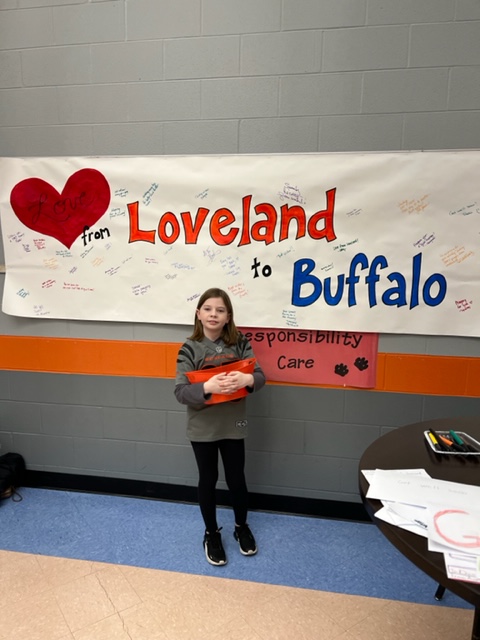
Loveland, Ohio – Last Thursday the Loveland School District held a Town Hall. This is from the Twitter feed of @LovelandTigers.
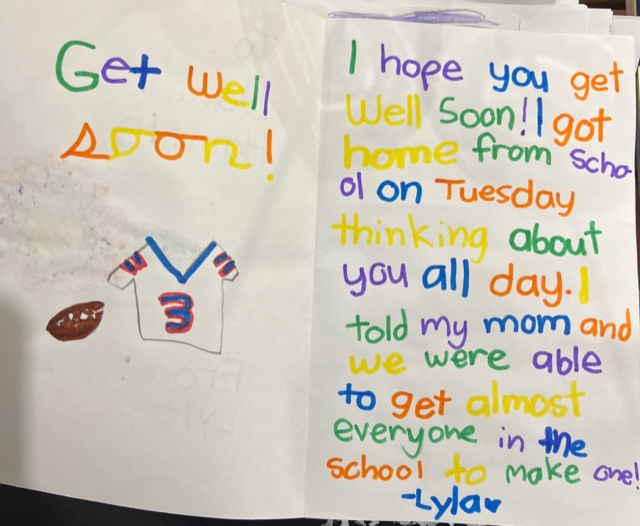
“Thank you to everyone who signed our “Love from Loveland to Buffalo” banner at last night’s Town Hall. And thank you to Lyla at LES for leading this effort to show support for Damar Hamlin of the Buffalo Bills with get-well cards and notes from classmates!“

























![[Tonight] “Preview Night” for Loveland High School’s Show Choirs](https://lovelandmagazine.com/wp-content/uploads/2023/01/show-choir-preview.png)