The emphasis of Loveland’s camps will be learning the fundamentals of each sport and having fun. We believe that in order to reach your full potential as a future Tiger you must have a solid foundation of fundamentals. Campers will be given a variety of individual methods of practicing that will enable all to practice at home on their own. We hope you first and foremost have an enjoyable experience. Go Tigers!
Please register all campers for the grade they will be entering for the 2021-2022 school year (Spring Camps will be for the 2020-2021 year).Please Pre-register for all camps!Walk-up registration is available if there is space available.Camps are rain or shine.
Loveland, Ohio – Here is the latest up-date from the Loveland City School District concerning the search for a new superintendent:
The latest timeline for the superintendent search was discussed during the Board of Education meeting on Tuesday, April 20
CFES, the search firm assisting the process, is expected to deliver an anonymous “Potential Candidate Report” to the Board and the Community Advisory Group (CAG) today. This will allow members to review and evaluate the candidates ahead of a Special Meeting of the Board on May 3. During this meeting, the Board will determine which candidates to invite for interviews. Interviews are scheduled to take place during a Special Meeting of the Board on Monday, May 10, and if needed, Tuesday, May 11. Much of the process that unfolds during these Special Meetings will take place in Executive Session.
A Virtual Community Event with the finalists is scheduled for Tuesday, May 18. A final selection will follow during a Special Board Meeting on Wednesday, May 19 with the signing of a contract and announcement of the new Superintendent expected to take place before the end of May.
Thank you to our Loveland City Schools community for being involved with this process. We will keep you informed as the next steps are taken.
Loveland, Ohio – Ohio took a step closer toward a constitutional school funding model with the passage Wednesday of a two-year operating budget in the Ohio House of Representatives, a sweeping bill that also proposes an across-the-board income tax cut, a broadband internet expansion plan and more spending to aid businesses struggling from the pandemic.
The House passed a two-year, $74.4 billion budget for Fiscal Years 2022 and 2023 by a vote of 70 to 27.
Democrats took issue with certain portions of the budget, but its education funding reforms helped lead a dozen of them to ultimately join the Republican majority in approving the bill.
The budget now heads to the Ohio Senate, which will negotiate its own version over the coming months. Members of both legislative chambers will eventually hash out disagreements before a final version is sent to Gov. Mike DeWine for approval this summer.
“We are investing in Ohio’s priorities and Ohio’s future,” said Rep. Scott Oeslager, R-North Canton, who serves as the House budget chairman as he has for several previous budget cycles.
Oeslager said the ongoing pandemic has presented a wide array of challenges for Ohio, and the ongoing needs associated with the crisis are evident. He complimented House members for crafting a “balanced, responsible and truly meaningful” budget.
This budget does not include any federal spending from the American Rescue Plan. Speaker Bob Cupp, R-Lima, said Ohio has not yet received this relief funding and a forthcoming committee would determine how best to spend it.
Here are budget highlights as approved by the Ohio House of Representatives.
Education funding model overhaul
Amesville Elementary in the Federal Hocking School District. Photo from district website. Lawmakers approved a new education funding model in the House budget passed on Wednesday.
It has been more than 24 years since the DeRolph v. State decision was handed down by the Ohio Supreme Court, which ruled Ohio’s state funding model does not provide an equal opportunity for all students to learn and is therefore unconstitutional.
Lawmakers were tasked with determining a more equitable, constitutional funding model — something they have failed to accomplish in the decades since.
Cupp has led a renewed push to reform the funding system in recent years and said after Wednesday’s vote he was glad this budget achieves that goal.
The House-approved budget includes a nearly $2 billion increase in school funding, with most districts expected to receive more funding over the next six years. (A spreadsheet showing the funding estimates for each individual district in Ohio was published by The Columbus Dispatch.)
The Loveland City School District may receive $941,996 additional State tax dollars according to the Columbus Dispatch.
Cupp said he did not want to speculate on potential disagreements the Senate may have with this funding plan, but hoped there would be more productive conversations between members of the two chambers on this subject.
“We think they will agree that it is a very good plan going forward,” he said.
Detailed Ohio Capital Journal reporting on the education reforms included in this budget is forthcoming.
More spending for COVID-19 relief, and vacating penalties for public health violations
The budget includes relief spending to benefit a variety of Ohio businesses.
Millions of dollars would go toward helping entertainment venues, bars, restaurants and hotels. Additionally, there is a “New Business Relief Grant” program to specifically help those businesses that opened after Jan. 1, 2020.
Republicans also inserted a budget provision that would vacate all public health violations incurred by Ohio businesses since March 2020.
A number of Ohio bars, including several on the island village of Put-In-Bay, were cited in 2020 for violating COVID-19 health orders. The House budget would expunge these violations and repay any fines levied against businesses. Photo from the Ohio Investigative Unit.
Businesses that have faced penalties for violating public health orders, such as not enforcing mask and distancing mandates, would have their violation records expunged. Any disciplinary actions currently in progress would be halted.
The state would be forced to repay any fines levied and reinstate licenses revoked. The Legislative Service Commission (LSC) estimates this would amount to $100,000 in fines repaid to health order offenders.
Cupp defended this provision by saying Ohio businesses failed to abide by public health orders because the virus was an “unknown” phenomenon in 2020.
“The restrictions were new, they were different, and a lot of businesses sort of got caught up in this administrative web. As we work our way out of the pandemic, we think it’s important to take another look at (the violations) and to give them some sort of the benefit of the doubt…,” Cupp said.
Tax cuts
Another main portion of the bill involves income tax cuts and deductions.
There is a 2% personal income tax cut for all earners, which LSC estimates would save taxpayers around $380 million in the coming two years.
“Once more, the wealthy and big businesses will fare far better than working families under this budget,” said Rep. Michael Skindell, D-Lakewood, who unsuccessfully proposed taking out the tax cut and diverting it to other priorities.
Those earning under $40,000 per year would receive virtually no benefit from this tax cut, the study found. Ohioans earning between $40,000-61,000 per year would see their taxes cut by an average of $7 over the course of an entire year.
The top 1% of Ohio earners, those making more than $490,000 per year, would comparatively see their taxes cut by an average of $612 each year.
Skindell said the tax cut shows a “huge disparity and continues the tax shift in this state.”
Separately, the House budget institutes an income tax deduction on capital gains earnings for Ohio-based “venture capital operating companies.” Such investors could deduct all of their earnings from investments in Ohio businesses and 50% of earnings from investments in businesses elsewhere.
LSC estimated this provision may cost the state tens of millions of dollars per year in income tax revenue lost.
Broadband internet expansion
The House budget includes $190 million in funding toward new broadband internet expansion projects. (Photo by Leonardo Fernandez Viloria/Getty Images).
Ohio lawmakers have worked toward a bipartisan effort this year of expanding broadband internet access in the state.
The budget allocates $190 million over the next two years toward grants to pay for new broadband expansion infrastructure projects.
Other pieces of the budget
Here are some other noteworthy provisions from the budget bill:
The governor had proposed changing antiquated language in Ohio law to clearly state all couples can adopt children (LGBTQ couples are legally allowed to in Ohio). The governor suggested changing the phrase “husband and wife” to read “legally married couple,” but Republican lawmakers took out this change to leave the original language in place.
The budget allocates millions of dollars for firefighting equipment and training, along with millions more for a law enforcement training program.
The budget provides $25,000 to Ohio domestic violence groups to give clients travel vouchers, gas cards and ridesharing credits.
Millions of dollars will go toward the Foundation for Appalachian Ohio, as well as money for workforce development around the state and in Appalachian communities.
The budget includes greater investments for maternal/infant health programs.
The budget does not include several major proposals from the governor, including gun safety reforms and a $50 million public relations campaign for Ohio.
Loveland, Ohio – On Thursday, April 29th, the Loveland High School Jazz Lab Band and Jazz Orchestra will be performing at the Narrow Path Brewing Company in Historic Downtown Loveland starting at 7 PM.
On Tuesday, May 4th, the Loveland High School Concert and Symphonic bands, along with the Wind Ensemble will be performing in the Nisbet Park Amphitheater starting at 6 PM.
The Jazz bands will be playing a wide variety of tunes, such as the theme from “Family Guy” and a Stevie Wonder Medley. You all can enjoy Narrow Path’s wide variety of beers while listening to fun music and supporting the Loveland music program.
The High School’s concert bands have a fun variety of tunes as well, including the one and only theme song from “Star Wars”. They will have interim superintendent Bradley Neavin guest conduct a piece as well.
These two outdoor, COVID-19 friendly events are a great way for all of you to support the wonderful music program in Loveland, and see what they do.
The music program in the Loveland City Schools wants to bring the music to the public instead of bringing the public to the music.
I am involved in both the Jazz Orchestra and the Wind Ensemble at the High School, and it is so important for everyone involved in the bands to be able to share our hard work with everyone. Each and every person involved in the music program at Loveland loves music and loves making music. So getting to do these concerts is a really great opportunity.
I asked Bea Aldrich, a graduating senior, what her favorite part of the music program at Loveland is and she said she loves how “there are so many different opportunities for extracurriculars that anyone can find something they enjoy”.
The program is just a really great outlet for so many people. That’s why it is important that we have the public’s support. With your support, we can keep doing what we love.
So, if you want to have a fun time listening to some fantastic music, come support us on April 29th and May 4th!
Loveland, Ohio – Here is the most recent update on the search for the next Loveland City Schools Superintendent:
Our search consultants, CFES, are in the process of assembling interested potential candidates for our next Superintendent. We have also continued to work through the details of upcoming steps with CFES as outlined below:
– CFES will provide anonymous, detailed information on a set of potential candidates meeting our Ideal Candidate Profile. They will not screen out anyone who has expressed interest in applying for our position and all individuals who are interested in being considered will be presented to the Community Advisory Group and the Board (again, anonymously) for evaluation. The Board will subsequently determine the list of Candidates for interview with advice from the Community Advisory Group.
– Next, The Community Advisory Group, and separately the Board, will conduct non-public individual interviews with each Candidate. From these interviews, the Board with Community Advisory Group input, will select 1-3 Finalists.
– The selected Finalists will be available for virtual public introductions and interactions. Community feedback will be collected and supplied to both the Community Advisory Group and the Board.
– Finally, the Board will determine (again with advice from the Community Advisory Group) a selected Candidate and proceed with job offer & contract negotiations.
We intend to share progress on a regular basis and will look for ongoing broad community feedback through the Community Advisory Group and public sessions of the Board and the Finalists’ Virtual introductions session. Understandably, other elements of the process may be confidential and conducted in ‘Executive Sessions’ as appropriate.
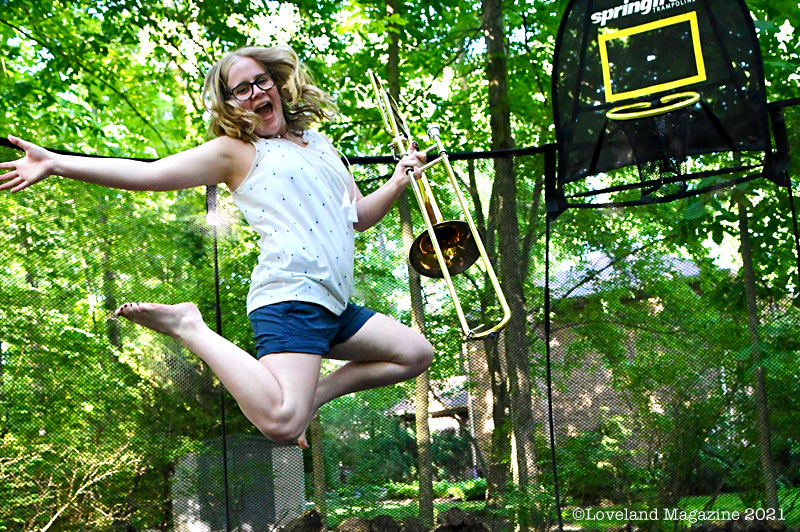
Loveland, Ohio – Senior Miya Brines set a new Loveland High School high jump record on Saturday, March 27 clearing the bar at 5’6 1/2″ in the Loveland dual meet vs Princeton at Tiger Stadium. She placed 1st in the high jump.
LHS Senior Miya Brines
“I am very honored to be in the Loveland High School record books with so many other athletes. I believe hard work and dedication have a big impact on the way I perform and compete as an athlete,” Brines said.
Miya also thanked her coaches for investing their time and effort into herself and the team and cannot wait for her future as an athlete.
The previous record was 5’6 set in 2016 by Kendall Ewert.
She also came in 1st in the long jump with a leap of 16′-10.75″, 1st in the 100-meter hurdles running a 14.59, and 1st in the 300 Meter hurdles at 48.67.
Brines will continue her track and academic career at the University of Iowa.
David Miller is the Editor and Publisher of Loveland Magazine
by David Miller
Loveland, Ohio – Peggy Johnson announced her retirement at the end of January after 39 years in education and 6 years as Principal of Loveland High School (LHS).
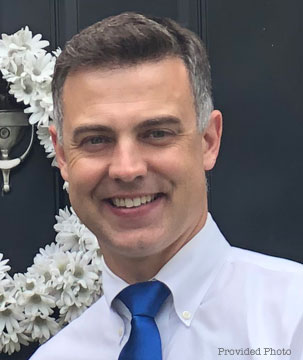
Thirty-nine-year-old Wyoming High School Principal, Adam Reed, who is entering his 17th year in education was recently announced as Johnson’s successor for the 2021-2022 school year.
Reed grew up in Fairfield and currently lives in Loveland with his family. “I enjoy spending time with my family, golfing, and traveling,” Reed told Loveland Magazine in an email exchange. Education has been his only career path.
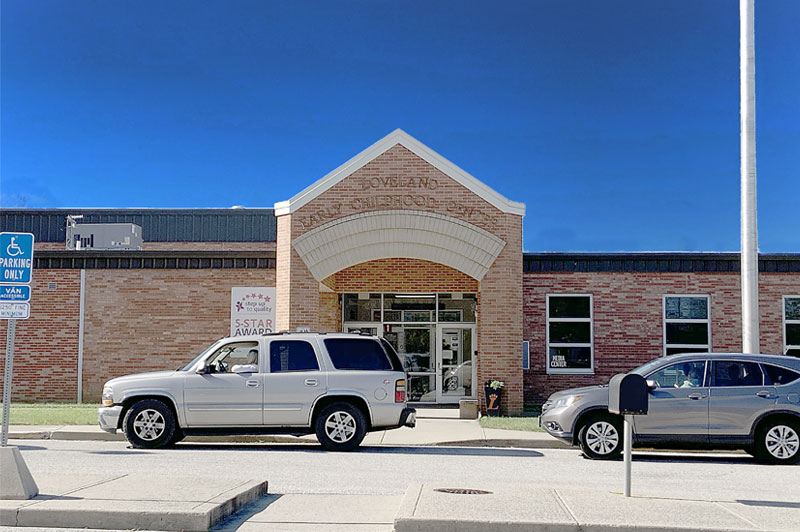
“My wife Kate and I have three sons. Nolan is 7 and attends the Loveland Primary School, Hunter is 5 and will attend the Loveland Early Childhood Center next year, and Carson just turned 2.
Adam Reed will be the next Principal at Loveland High School
Reed earned both his B.A. and Masters in Education at the University of Cincinnati before earning his Administrative and Superintendent Licensure from Xavier University.
He is a graduate of Fairfield High School, was a varsity baseball coach, and was an assistant coach on a final four basketball team while at Fairfield.
I asked Reed what were his proudest accomplishments with the Wyoming schools and mentioned that the school certainly has bragging rights in regards to academics. “Leading the high school through the pandemic. Supporting students and teachers academically and socially and emotionally while creating the safest learning environment possible,” was his answer. Reed added, “Being an instructional leader with my staff as we integrated technology into their teaching practices and making the high school a Google school.” Reed is also proud that he created a culture where students “felt heard and valued”.
Adam Reed will be the next Principal at Loveland High School
I also asked Reed what does he feel are his best skills that he will bring to LHS. He said, “I am a student-focused administrator and educator. I believe in meeting our students where they are in order to support their learning and goals after high school. I look forward to creating a positive culture and environment to support our teachers and students.”
“While at Wyoming, I participated in our district-wide One Degree Shift work surrounding diversity,” was Reed’s response to a question about the goals of the Loveland District’s Diversity Advisory Board. He further emphasized, “For the 2021-2022 school year, Wyoming High School has created two new courses, African American Studies, and Women’s Studies. As I transition to Loveland, I will continue to focus on our students and meet them where they are. The work of the Loveland Diversity Advisory Board will be instrumental in creating a safe, equitable, educational environment that celebrates diverse perspectives, identities, cultures, and worldviews for all our students.”
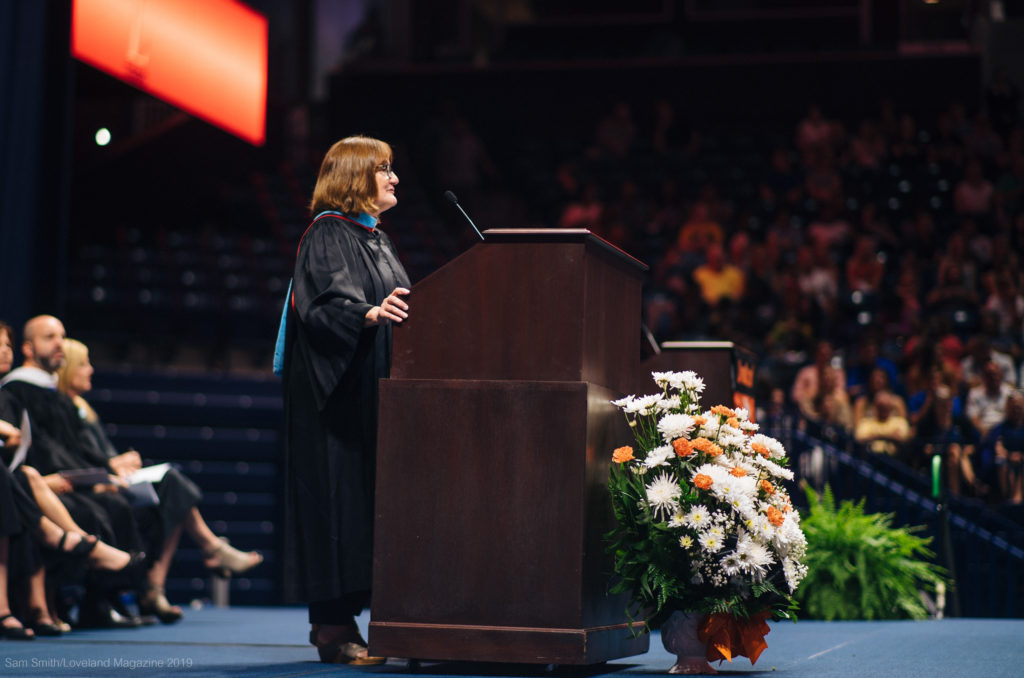
In speaking about her retirement, Peggy Johnson said in a statement issued by the District, “Working with teenagers is an unbelievable honor and seeing how they pursue their interests, overcome challenges, and succeed is a most rewarding experience.”
Johnson has spent 39 years in education, beginning her career as a student-teacher in the Fall of 1980 at Loveland High School. She went on to teach students with hearing and language impairments for 17 years and served as a Special Education Supervisor in Hamilton City Schools. She served as principal of Turpin High School for 13 years and spent the last 6 years leading Loveland High School.
Principal Peggy Johnson at the 2018 Commencement (Loveland Magazine file photo)
A release by the District announcing her retirement said, “While at LHS, Johnson expanded the Advanced Placement program, business program, increased performance on state assessments, and “was dedicated to her students” according to Loveland Director of Human Resources Charles Ogdan. “There isn’t an event that happens where Ms. Johnson isn’t there mingling with students, taking pictures, and posting on Twitter in support of student success and growth,” Ogdan said.
“I wish to thank the LHS school community for the opportunity to work with talented, passionate, and dedicated educators and students and enthusiastic supportive parents and community,” Johnson said in the statement.
To the Loveland Community,

We cannot thank you enough for your continued generosity. The Ben Morrison Memorial Fund at LCNB Bank has exceeded our expectations.  We will be able to give a scholarship in Ben’s name for many years to come.

I personally have felt all of your love and prayers. They continue to help me get through each and every day.

Again, thank you to all of you!

Tori, Donnie, Ashlei and Kevin and Chelsei
“There is value in having no child feel rejected and invisible in their own school. If I can help it, none of them will.“
A story by a Loveland resident presented by Loveland Magazine in collaboration with the Loveland Diversity Advisory Board
A sharp pain startled me. Something had pelted my head. Whatever it was ricocheted to the floor with a hollow plink. I rubbed the back of my skull and looked around trying to determine what had hit me. As I did, I took another sharp blow, this time to the cheek, followed again by a distinct plinking sound. The next shot hit my shoulder. Then my neck. Finally one of the projectiles flew past my face and I was able to identify what was being hurled toward me.
It was a penny.
I looked in the direction from which the projectiles originated and saw a lunch table of my fifth grade peers laughing, trying to look inconspicuous in the conspicuous way guilty ten year-olds have a tendency to do.
“Did she pick them up?” one whispered.
“Shhhhh! She’s looking over here,” the other said, waving his hand in the universal sign to keep it down.
More giggles.
x
I sheepishly rubbed my cheek, which by now was smarting and red. I looked down at the floor where several pennies lay in a telltale scatter at my feet.
Another sharp pain.
“Pick up the pennies, Jew,” someone from the table jeered, just loud enough for me to hear.
I felt the tears welling behind my eyes and willed them not to escape. No one would see me cry. Despite my best intentions, a tear leaked out, betraying me as it rolled down my injured cheek. Its saltiness stung against the broken skin.
x
The perpetrators weren’t the school’s “bad” kids. They weren’t the “troublemakers.” They weren’t the kids who wadded up the stiff brown paper towels, wet them, and threw them up on the bathroom ceiling where they’d stick and harden like cement.
These were the kids who raised their hands to read aloud from the social studies textbook when the teacher asked for volunteers.They attended PSR at the church down the street from my house where a giant tree sprouted pink blossoms each spring before dropping her petals in a sudden heap. These were the kids who, if I’d told a teacher, would elicit the response of ‘Well now that doesn’t sound like them. I’m sure they meant nothing by it. Have you tried ignoring it?’
x
The lone tear fell onto the lunch table, a solitary puddle on the faux wood facade. Pennies? What does that even mean? I pondered this question silently, focusing intently on the fallen tear to prevent more from spilling out. I felt ashamed and embarrassed. I never mentioned it again.
This was the first time it happened, but it wouldn’t be the last.
At ten years old, I didn’t understand the deeply anti-Semitic implications of these kids’ actions. As an adult, I know they picked up on these stereotypes somewhere. I feel confident that the hateful message was learned outside of school, however subtly transmitted. Maybe slips of the tongue by their parents. Maybe from the innuendos presented in the news channel their family watched. Maybe from friends whose families held biases. But what about what they learned–or didn’t learn–while they were in school? What was the message there?
There was nary a mention of Jewish people in my elementary school. Despite a small population of Jewish students, the curriculum had settled into a comfortable rhythm they saw no need to update. I remember clearly how each year my teachers were startled when they learned that I didn’t have a Christmas tree.
“What do you mean?” my second grade teacher asked incredulously. “Everyone has a Christmas tree,” And so it went.
x
I accepted my lot early. I dutifully completed my “Letter to Santa” assignments each December prior to “Christmas Break” where I’d take home the ornament I had to make for my non-existent tree. In the spring, I mustered up fake gusto to color oil pastel Easter egg cut-outs. I completed the multiplication worksheets asking how much tinsel Jane needs to trim her Christmas tree and conducted the science experiments on decorating Easter eggs with various substances, bright red beet juice staining my hands for days.
The message coming from the school was clear: one specific religion was the universal norm. Obviously, I was different. That made me a target.
I share this with you to illustrate that representation matters. While some may disagree, they are likely the ones who have never been in a situation where they were the “other.”
Representation doesn’t mean anyone has to alter their own convictions or feel put on the defensive. It doesn’t mean one side is right and the other is wrong, that there’s a hidden agenda, or that any one lifestyle is being attacked.
What it does do is allow students to learn that the world is full of people whose beliefs, values, and opinions differ from their own. It means the students who aren’t part of the status quo feel a sense of belonging. At its best, it fosters mutual understanding and civility. Representation neither promotes one lifestyle, race, or religion, nor detracts from another. All representation does is to allow students to see that there are different ways of being and that there is validity in who we ALL are.
x
While I cannot change my school experience, we owe it to our own kids the opportunity to explore diversity through equal and prominent representation. If you’re a minority, there is value in seeing someone like yourself; if you’re in the majority, there is value in seeing that there’s an actual living, feeling human being behind the label. Most importantly, there is value in having no child feel rejected and invisible in their own school. If I can help it, none of them will.
Loveland, Ohio – This is the “Thought Exchange” survey to build the profile the Board of Education can use for the Loveland City School District superintendent search.










![[Video] Senior Miya Brines sets Loveland High School high jump record](https://lovelandmagazine.com/wp-content/uploads/2021/03/Miya-Brines-2.jpg)