Loveland, Ohio – This week, the Loveland City School District has shared videos on FaceBook to give families a better insight into what to expect as they welcome back students on Monday, August 31.
Here’s what Loveland High School teachers and administrators had to say.
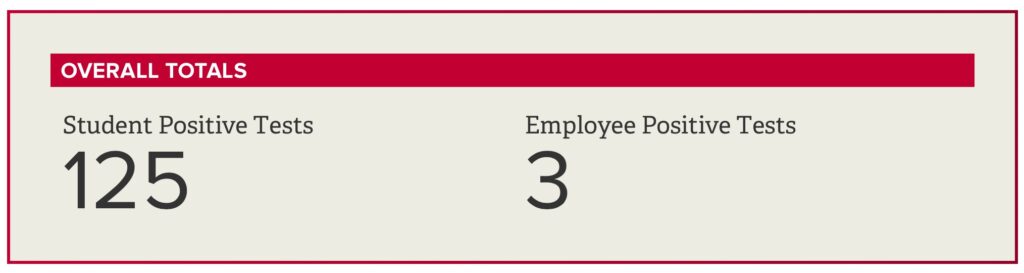
Oxford, Ohio – Following our report of 4 days ago that since the start of classes, that they had 10 positive COVID-19 tests among students and 2 among employees on the Oxford campus, Miami University now has announced that it learned on August 24, that twenty-seven student-athletes from various teams have now tested positive for COVID-19.
Fall classes began on Monday, August 17, mostly remote, with graduate students and some programs in person. Students who will be living off campus have been encouraged to stay home, if they can, until face-to-face courses start on Monday, September 21.
The university said, “Many, but not all, had attended an off-campus social gathering, over a week ago. The Butler County General Health District “out of an abundance of caution” is quarantining all Miami University student-athletes who have returned to Oxford, and any coaches and staff who were in contact with them.
The Butler County General Health District issued the blanket quarantine order to ensure no student-athletes would be missed through the normal method of contact tracing.
In the announcement by the university, Jennifer Bailer, Health Commissioner for Butler County General Health District, said, “As we know, the COVID-19 virus can spread quickly between people and infect groups of people in a hurry. This disease is serious. In young adults it is often mild, but has the potential to become critical for those with underlying disease or other risk factors.”
“One of the main functions of public health is to identify persons who have been in contact with COVID-19 cases as quickly as possible and ask them to quarantine for 14 days and monitor themselves for symptoms. This helps in preventing the disease to spread any further,” stated Bailer.
“My concern for the health of all of our student-athletes is paramount,” said David Sayler, director of athletics. “I am disappointed that poor judgment has led to this quarantine order and put in jeopardy our efforts to have our teams study and practice together.”
The announcement by the university did not say the total number of student-athletes who have been ordered to quarantine.
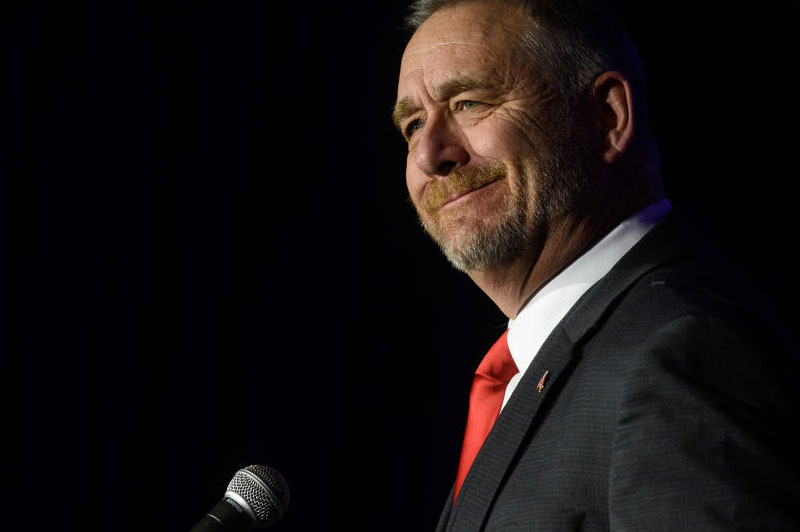
Columbus, Ohio – Ohio Attorney General Dave Yost today announced a more than $85 million multistate settlement with American Honda Motor Co., Inc. and Honda of America Mfg., Inc. over allegations the automaker concealed safety issues related to defective airbag systems in certain Honda and Acura vehicles. The systems were designed and manufactured by Takata Corp., a longtime Honda supplier, and were first installed in vehicles sold in the United States in the 2001 model year.
The frontal airbags posed a significant risk of rupture, which could cause metal fragments to fly into the passenger compartments of vehicles.
The settlement, reached between Honda and the attorneys general of 48 states, territories and the District of Columbia, concludes a multistate investigation into Honda’s failure to inform regulators and consumers that the frontal airbags posed a significant risk of rupture, which could cause metal fragments to fly into the passenger compartments of vehicles. The ruptures resulted in at least 14 deaths and 200 injuries in the U.S. alone.
“I’d never buy a car if I knew systems meant to save me and my family could actually hurt us,” Yost said. “That is what Honda denied Ohio consumers – the chance to make the best decisions for their families. This agreement will ensure that doesn’t happen again.”
“I’d never buy a car if I knew systems meant to save me and my family could actually hurt us,” Yost said.
The states made the case that Honda engineers suspected that the airbags’ propellant, ammonium nitrate, could burn aggressively and cause the inflator to burst. Despite these concerns, Honda delayed warning consumers and safety officials, even as it began partial recalls in 2008 and 2009. Further, Honda continued to represent to consumers that its vehicles, including its airbags, were safe. Since 2008, Honda has recalled approximately 12.9 million Honda and Acura vehicles equipped with the suspect inflators.
Ohio Attorney General Dave Yost
The states alleged that Honda’s actions, or perhaps more accurately its failures to act, as well as its misrepresentations about the safety of its vehicles, were unfair and deceptive, and that Honda’s conduct violated state consumer protection laws, including Ohio’s Consumer Sales Practices Act, O.R.C 1345.01 et seq.
Under the terms of the consent judgment, which will be filed with the Franklin County Court of Common Pleas, Honda has agreed to strong injunctive relief which, among other things, requires it to:
Take steps to ensure that future airbag designs include “fail-safe” features to protect passengers in the event the inflator ruptures.
Adopt changes to its procurement process for frontal airbags, ensure that its suppliers have the appropriate industry certifications and satisfy key industry performance standards, as well as improve record-keeping and parts tracking.
Implement recurrence prevention procedures designed to prevent a tragedy like this from happening again, such as requiring that Honda approve all new frontal airbag designs before the company will consider them for use in new vehicles.
Abide by prohibitions on misleading advertisements and point of sale representations regarding the safety of Honda’s vehicles, including the airbags.
Make improvements in critical areas such as risk management, quality control, supplier oversight, training and certifications, and implement mandatory whistleblower protections.
Honda also agreed to pay the participating attorneys general a total of $85,151,210.15, of which Ohio’s share is $2,367,714.89.
In addition to Ohio, the multistate group includes Alabama, Alaska, Arkansas, Colorado, Connecticut, Delaware, the District of Columbia, Florida, Georgia, Guam, Idaho, Illinois, Indiana, Iowa, Kansas, Kentucky, Louisiana, Maine, Maryland, Massachusetts, Michigan, Minnesota, Mississippi, Missouri, Montana, Nebraska, Nevada, New Hampshire, New Jersey, New York, North Carolina, North Dakota, Northern Mariana Islands, Oregon, Pennsylvania, Rhode Island, South Carolina, South Dakota, Tennessee, Texas, Utah, Vermont, Virginia, Washington, West Virginia, Wisconsin, and Wyoming.
Consumers who own a Honda or Acura vehicle are strongly encouraged to visit Honda’s airbag recall website at Hondaairbaginfo.com, or call its customer service toll-free number at 1-888-234-2138, to see if the vehicle is subject to a recall. Consumers may also check for open recalls by going to Safercar.gov. All safety recall repairs are free at authorized Honda dealers.
Morrow, Ohio – On August 6, Little Miami Local Schools announced that it was pushing back the opening dates of school for the 2020-2021 school year by one week.
The first day of school for grades 5-12 was on Monday, Aug. 24.
The first day for grades PreK-4 is Wednesday, Aug. 26.
Students who are enrolled in Virtual Learning Academy will also begin their courses on these days.
The information below contains the plans for returning students and staff to Little Miami school buildings for the 2020-2021 school year.
“As with many things in these unprecedented times, this plan could change with new or additional information.”
Student Learning
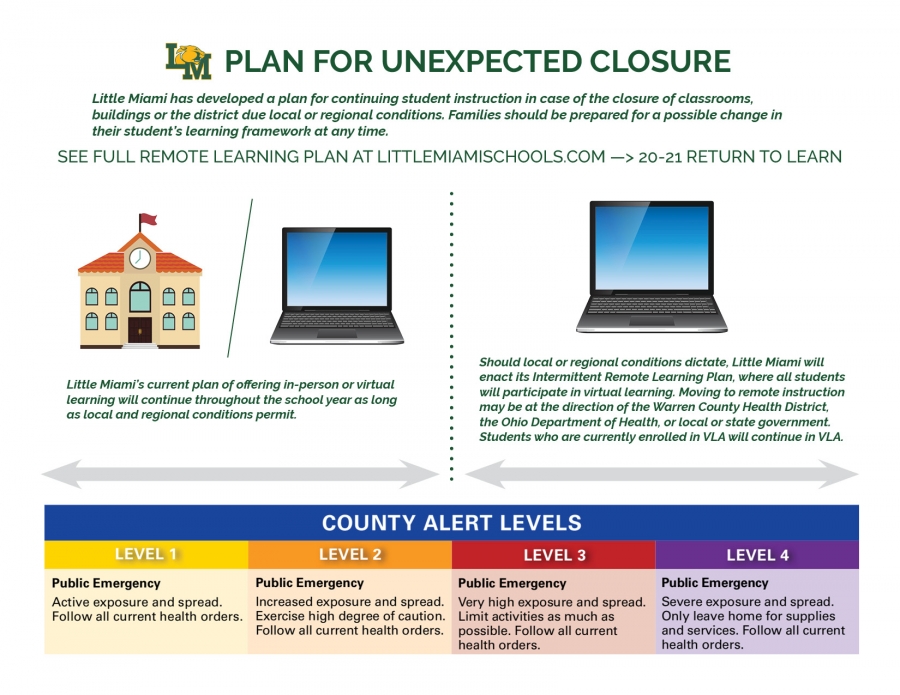
For the 2020-2021 school year, Little Miami will offer two learning options.
In-person instruction. Students will attend school five days per week. Families understand that some level of risk will always be present when children and school district employees occupy school district facilities. Face coverings are required for students and staff, with some exceptions. Read the Board policy on face coverings.
Remote learning through Virtual Learning Academy, a third-party vendor. This option is for students whose families do not wish to send them to school. Students will agree to remote learning from home one semester at a time. Students will not be permitted to come in and out of remote learning. VLA classes will be supported by Little Miami teachers. See more information on VLA here.
In Case of Unexpected Closure/Remote Learning
Should local or regional conditions dictate, Little Miami will enact its Intermittent Remote Learning Plan, where all students will participate in virtual learning. Moving to remote instruction may be at the direction of the Warren County Health District, the Ohio Department of Health, or local or state government. Students who are currently enrolled in VLA will continue in VLA.
“Little Miami has worked very hard to make sure students and staff can return to – and stay in – our buildings this school year. Little Miami has also tried to be clear with students and staff that there is some risk returning to school. In the event that someone tests positive for the virus, Little Miami will take our lead from the Warren County Health Department regarding protocols. Should local or regional conditions dictate, Little Miami will enact its Intermittent Remote Learning Plan, where all students will participate in virtual learning. Moving to remote instruction may be at the direction of the Warren County Health District, the Ohio Department of Health, or local or state government. Students who are currently enrolled in VLA will continue in VLA.”See Little Miami’s intermittent remote learning plan.
2020-2021 VIRTUAL LEARNING AT LITTLE MIAMI
For the 2020-2021 school year, Little Miami will offer two learning options: in-person instruction in LM buildings, or remote learning through Virtual Learning Academy (VLA). VLA is operated by the Jefferson County (Ohio) Educational Services Center.
More than 1,000 students opt to begin year remotely
About 1,000 Little Miami students — approximately 20 percent of the district’s enrollment — have elected to begin the 2020-21 school year using Virtual Learning Academy.
The number of families electing to go remote was fairly consistent across grade levels. The average number of remote learning students per grade is 75. More than 200 high school students will be using VLA to begin the year.
Blue Ash, Ohio – September 8 will be the first day of school for all students, including those in a virtual classroom learning setting. Parents have been asked to look for more information about their student’s school’s transition days for face-to-face learners on September 3-4. Half of Grades K-4, Grades 5-6, Grades 7-8, and Grades 9 and 12 students will attend on each of those days to ease the transition to school.
September 8 will be the first day of school for all students. It will also be the first day of school for students in the virtual classroom setting.
Grades K-4, Grades 5-6, Grades 7-8, and Grades 9 and 12 students in the in-person option will enter the hallways on either September 3 or 4. Half of each will attend on each of those days to ease the transition to school.
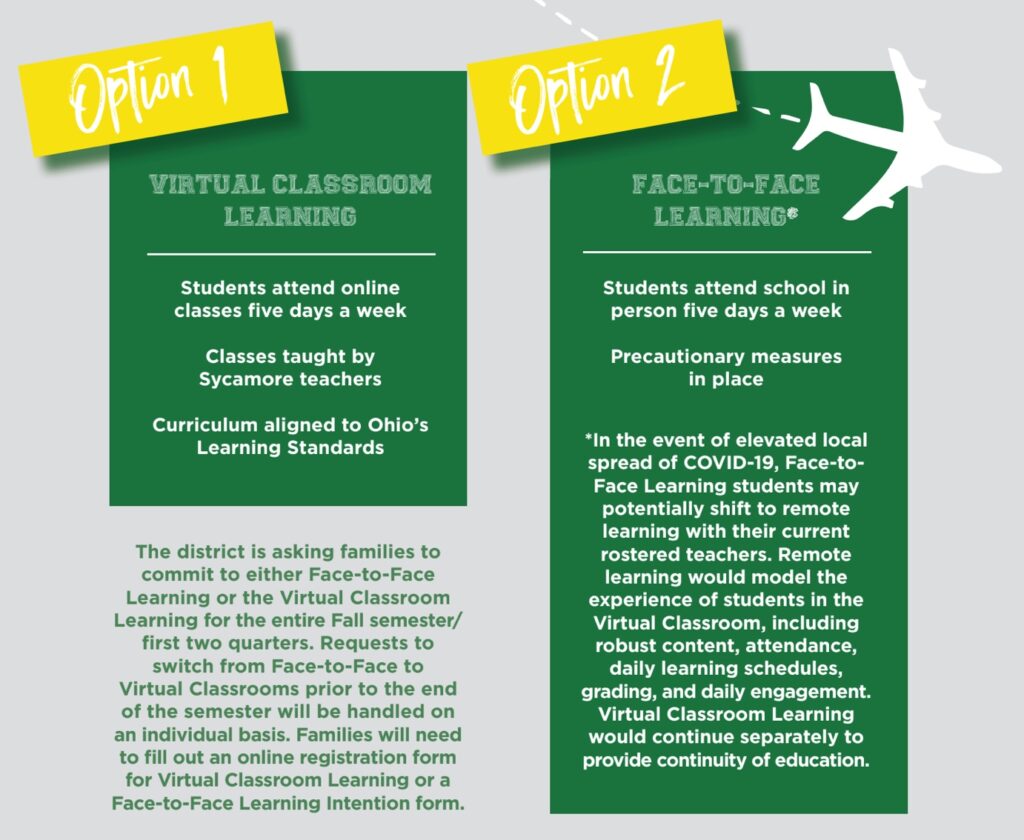
Families have been offered two options for the return to school.
Sycamore Community Schools will provide students Grades K-12 who cannot or do not wish to return to school with 100% virtual classroom learning fIve days a week.
In Virtual Classroom Learning, parents and guardians of elementary students assume the role of a “Learning Partner”. Each child will be taught by a Sycamore Community Schools teacher who will support the child in his or her learning, grade submitted work, and monitor the child’s progress. However, parents and guardians provide “vital support” for younger students in an online learning environment.
Students will follow a daily schedule of instruction
Sycamore teachers will instruct the virtual classrooms
Virtual classrooms will follow the same sequencing and teach the same standards as the face to face instructional model.
Aligned to Ohio’s Learning Standards and Sycamore Schools’ curriculum maps.
100% online environment
Student privacy protected
How will Virtual Classroom Learning be different from the 4th Quarter remote learning experience?
Attendance will be taken daily
Students will have a daily learning schedule
Students will be actively engaged in learning new content
Student learning will be assessed formatively and summatively
Students will receive grades per the district grading scale
Teachers will engage with students daily
Teachers will monitor student progress to ensure students are learning and progressing successfully through the standards
Virtual Classrooms will be monitored to ensure student engagement and curricular alignment, similar to the process in a face to face teaching environment
To ensure educational equity, Virtual Classroom ‘walk-throughs’ by an administrator or instructional expert will occur, similar to the process in a face to face teaching environment
Live streaming of classes will be considered as an option where appropriate, such as with unique courses at the HS
How will Virtual Classroom Learning be similar to Face-to-Face Learning?
Sycamore teachers will teach the virtual classrooms
Sycamore teachers will develop relationships with students
Sycamore teachers will use curriculum resources and best instructional practices to engage students in learning
Sycamore teachers in the virtual classroom will collaborate with the face to face teachers
Students will take the same common assessments in both models, as well as MAP assessments, as a means to ensure educational equity and alignment of learning expectations
Students will receive Intervention, Special Education, Gifted and/or ESOL support and have access to mental health services
Every effort will be made to allow students to take the same courses as in the face to face environment. Some exceptions may occur.
Curriculum is either the same as Sycamore’s or aligned tightly with Ohio’s Learning Standards and Sycamore’s Curriculum to ensure educational equity.
FACIAL COVERINGS
All staff members are required by the state of Ohio to wear district-approved facial coverings during the school day, unless it is unsafe to do so or where doing so would significantly interfere with the learning process.
All students Grades K-12 will be required to wear district-approved masks on the bus and during the school day with the exception of lunch, recess, and PE classes, or if social distancing can be ensured.
Families will be responsible for providing clean, cloth masks
District will provide a mask if a student forgets, loses, or destroys their mask at school
Masks must meet CDC recommendations and adhere to the Sycamore Code of Conduct • Medical waivers will be given for both students and staff
Accommodations for medical waivers include 6 feet or more distancing from others in class and physical barriers
MODIFIED RECESS WILL BE PROVIDED AT THE PK-8 GRADE LEVELS INCLUDING, BUT NOT LIMITED TO:
Adjustments in schedules to reduce numbers of students on the playground
Limited use of shared equipment
Sanitation in between cohorts
Playground supervisors will ensure physical distancing as much as possible
MODIFIED PHYSICAL EDUCATION WILL BE PROVIDED AT ALL LEVELS INCLUDING, BUT NOT LIMITED TO:
Use of outdoor spaces as much as possible
Forward only positioning for exhalation activities
Limited partner/group games and shared equipment
Sanitation in between cohorts
REIMAGINED MUSIC AND THEATER CLASSES WILL BE PROVIDED WITH:
Enhanced levels of music appreciation, songwriting, and music culture/history
Limited exhalation and shared instrument activities
12 feet physical distancing and forward only positioning for exhalation activities
Use of outside spaces as much as possible
You can read Sycamore’s complete back to school plan HERE.
Indian Hill, Ohio – The Indian Hill School District is ready to welcome students back on Thursday, August 27, for the 2020-2021 school year.
A message from Superintendent Kirk Koennecke
The Plan Overview
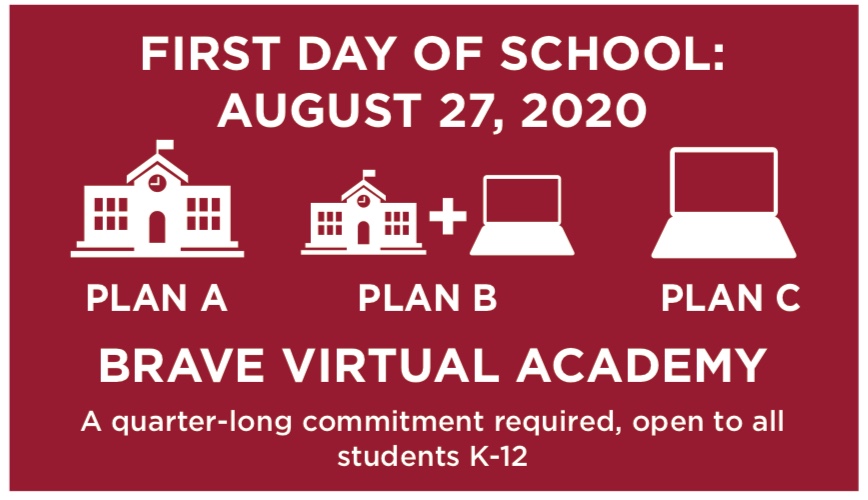
Each family will begin the 2020-2021 school year with two options:
1. In-person Learning at the Indian Hill School District
2. Brave Virtual Academy
In-Person Learning
Plan A: Five days a week of in-person instruction
Plan B: Hybrid, two days a week of in-person instruction and three days of online learning
Plan C: Online learning facilitated by assigned teachers if conditions warrant that a face-to-face setting is not safe
Please note: If you select In-Person Learning for your student, local health conditions will help to determine whether our District will participate in Plan A, Plan B, or Plan C. Please see accompanying documents for more information about the Indian Hill Schools Attendance Model Overview.
What does the start of the school year currently look like for In-Person Learning?
For the start of the 2020-2021 school year, students who select to participate in In-Person Learning will return to school in a Plan B, hybrid model on Thursday, August 27.
Do I have a choice of days for the hybrid learning model?
Students will be assigned to Team 1 on Mondays and Tuesdays or Team 2 on Thursdays and Fridays. Though we would like to make this a choice per family, we will be sorting students into these groups based on several factors: coordinating the same schedule for siblings in the same family; transportation routing and needs; and enrollment balance. Families will be notified of placement through a placement letter by August 13. We also recognize that there will be some families who have extraordinary circumstances that may warrant a request of a specific group. In that placement communication that will be sent to you directly from your student’s building, there will be a form to complete to indicate a request to change team assignment due to extraordinary circumstances.
Not comfortable with In-Person Learning? Welcome to the new Brave Virtual Academy!
The Brave Virtual Academy is a brand new offering of the Indian Hill School District. This option is available to all students K-12 who choose to remain home. We are only requiring students commit a quarter at a time to give families as much flexibility as possible. Students in the Brave Virtual Academy will work directly with Indian Hill faculty in a virtual setting using our unique Indian Hill curriculum.
Our staff did an incredible job of navigating emergency distance learning in the midst of so many unknowns this past spring. This upcoming school year will be different. Our educators have spent the summer entrenched in professional development with national experts to sharpen skills for our Brave Virtual Academy.
Specific teachers will be assigned to the Brave Virtual Academy. Their sole responsibility will be the education of students who have selected this learning plan. At Indian Hill High School, students will have access to the full course of study. An individual learning plan will be developed for each Indian Hill High School student that may include participation in a state-of-art eLearning platform, independent study, and virtual participation in in-person classes.
What Brave Virtual Academy is not: Plan C.
This has been a point of mild confusion, so we want to help explain what will happen with your student.
If you selected In-Person Learning and the District is forced to transition to Plan C due to safety concerns, your student will continue learning with the same teachers and same peers online. Students who selected Brave Virtual Academy will see no change if the District transitions to Plan C.The students in the Brave Virtual Academy will remain in their previously established courses with Indian Hill faculty and peers.
We want you to have complete details for all that our Brave Return to School program entails including: health and safety measures; attendance model overview; plan details; and our COVID-19 screening flowchart. Click here to view the information packet we have built; we hope these documents will answer your questions.
What will stay the same? Our #IHPromise to you and your family …
Each day brings change and challenge, but also new opportunities. We have a vision of Enduring Excellence in Learning, Leadership, Innovation, and Service. This is part of our #IHPromise to you, and that will never change.
Dayton, Ohio – University of Dayton President Eric F. Spina, Ph.D
began his “Dear Students” letter on Sunday with praise for their “cooperation in wearing face coverings, physical distancing and avoiding group gatherings. We’ve noticed a real improvement in recent days. I’ve seen it with my own eyes as I walked around campus.”
However, the Sunday message continued in announcing that in the past two days, a “concerning” number of students are now in isolation for testing positive or in quarantine as close contacts. Spina said, “It is clear several clusters of the virus have emerged among networks of students based upon activities that occurred a week or so ago that did not comply fully with our safety protocols. These clusters appear to be interconnected, and we need to take more stringent measures now to prevent the virus from spreading further.”
As of August 23, UD has 68 identified positive cases on campus. Individual cases are posted in detail on the UD dashboard reflecting results from individuals who have been working, living, studying or otherwise on campus. (See the UD status levels definitions below)
[bg_collapse view=”button-orange” color=”#4a4949″ expand_text=”Show Status Levels” collapse_text=”Show Less” ]
Status 1 – GREEN – CONTAINED: A small number of individuals have tested positive, and contact tracing suggests that exposures are confined and the situation can be contained, isolated, and remediated. If an exposed or infected individual is a resident, they will be referred to quarantine or isolation as needed. Affected areas are decontaminated and University medical and contact tracing staff can monitor for possible escalation. All other campus and residence operations remain unaffected.
Status 2 – GREEN – LOCALIZED: An outbreak, for example, could occur in a particular floor, classroom, office suite, or common area where contact tracing still allows for a high degree of confidence in the ability to isolate and contain any flare-ups. It may require a floor, class, office suite, or common area to be closed for a period of time to allow for proper decontamination and containment to prevent ongoing exposure. A larger number of residents may be put in isolation or asked to quarantine.
Status 3 – YELLOW – CAUTION: An outbreak occurs where the ability to contact trace with high confidence makes it difficult to identify a specific area for containment, isolation and remediation. It may be necessary to close affected areas or buildings, isolate or move affected students, and/or ask impacted employees to move to remote operations. Some courses may switch to strictly online modality.
Status 4 – RED – WARNING: In the event contact tracing cannot reliably identify affected parties or spaces and contain the spread of COVID-19 campuswide, the University may switch all students to fully remote learning while staying in their on-campus residences. Commuter students will not come to campus and will use virtual learning tools. Students with the ability to return home may be asked to do so. Impacted employees will be asked to work remotely. The University will return to more normal, in-person operations once it can contain the outbreak.
Status 5 – PURPLE – VACATE: If the spread of COVID-19 on campus or locally is such that public health guidance or direction, or the University administration with the advice of our medical panel deems it critically necessary for the safety of our entire campus community to move students off campus to continue their classes, the University will initiate the following process:
Students within 400 miles of campus have 24 hours to move out of their on-campus residences.
All other domestic students will have 48 hours to move out of their on-campus residences.
International students can work with CIP regarding any special accommodations.
Students unable to move out of their on-campus residences in the allotted time can email housing@udayton.eduto make alternate arrangements.
Should an immediate evacuation of campus be necessary such that students cannot take their belongings with them, the University will contact students at a later date about a possible move-out process.
[/bg_collapse]
In consultation with the school’s medical advisory panel and with the support of Public Health – Dayton & Montgomery County, U.D. elevated the campus status level to 3 – YELLOW – CAUTION.
A temporary shift to remote learning for undergraduate courses, Aug. 24-28 was implemented.
The university has implemented several measures to help identify, contain, and isolate the spread of the virus. Those measures include:
All undergraduate classes will be held remotely at least for the next week. Undergraduate commuter students should not come to campus. Please remember you are responsible for checking your email for updates from your instructors.
Graduate courses and clinical experiences may convene in person, with the permission of the program director and the dean.
Dining services will continue as established for this fall.
Mass will be virtual.
RecPlex will be closed, but outdoor recreation will be allowed using proper safety protocols.
Roesch Library will be closed to undergraduates.
Student clubs and organizations must meet remotely.
Undergraduate student employees should not report to work in-person, unless they work for Student Development, Dining Services or Admissions and receive guidance from supervisors.
Students are not to leave campus unless they have been asked to go home to isolate or quarantine, or unless it is absolutely necessary. Students who leave campus for extended periods may be subject to testing/quarantine/isolation upon their return.
As announced earlier, the University will launch the next phase of our testing program this week to help us better understand where clusters are emerging and to identify those who are infected with the virus, but who may not know it. This is essential as we seek to minimize the spread of the virus..
We continue to believe we can contain this virus on campus, especially with the positive attitude that so many of you have demonstrated. While we have seen the virus pop up in connected clusters, we have not yet seen wide community spread.
The President urged students to be forthcoming with contact tracers, and reminded students that neither them nor the contacts they identify will face discipline for “merely becoming sick.”
In a separate message to parents, faculty, and staff, Spina said, “It is clear that while there does not appear to be wide community spread of the virus”
Spina added that the temporary move is a vote of confidence in the student’s ability and willingness to help limit the spread of COVID-19, “so we won’t have to make it a permanent move.”
Spina’s plea was for students to “Please remain vigilant about observing UD and public health safety measures, and encourage fellow students to abide by them. The entire campus community appreciates your efforts to wear face coverings indoors and outdoors, practice physical distancing, and, especially, to avoid gatherings or groups larger than 10 people.”
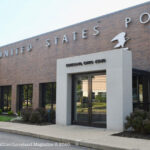
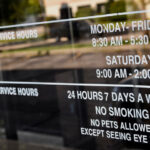
Loveland, Ohio – To supplement the story below (4 Ohio Republicans join House Dems to pass bill to boost post office funding by $25B) from the Ohio Capital Journal, Loveland Magazine visited two of the closest local U.S. Post Offices to document the number of mailboxes placed outside the buildings. We also documented the days and hours of operation of each.
While unlikely that the Trump Administration would attempt to interfere with the delivery of election-related mail in our heavily Republican voting area, nearly all Loveland mail does go to or from the Dalton Street processing center in Cincinnati. Interfering with mail delivery in the heavily Democratic voting urban areas of Cincinnati’s urban core is not beyond reasonable suspicion. And, the President may use mail problems in any part of the country to delegitimize and dispute the November election results.
One day ago the President tweeted, “The greatest Election Fraud in our history is about to happen. This may top the Democrats illegally spying on my campaign!”
On August 20 the President tweeted this, “They are sending out 51,000,000 Ballots to people who haven’t even requested a Ballot. Many of those people don’t even exist. They are trying to STEAL this election. This should not be allowed!”
Trump said last week on Fox News that he opposes some funding because he doesn’t want it used for mail-in votes, repeating his claim that it would lead to “fraudulent” election results.
WCPO has reported that processing machines from Cincinnati’s Dalton Street post office have been removed and remain offline and unusable.
The Cincinnati Enquirer recently reported that according to Jim Sizemore, president of the American Postal Workers Union in Cincinnati that in May and June, the USPS “pulled the plug on eight mail processing machines in Cincinnati, accounting for 19% of the processing center’s capacity.” The eight machines could process collectively 243,000 pieces of mail an hour according to the Enquirer. Mail is piling up on the floor at the Queensgate facility according to Sizemore.
WCPO’s John Matarese says the VA is now notifying veterans that they should order their medicine earlier than usual because at this time it cannot guarantee on-time delivery. And, by law, it cannot ship medication via private services.
Sen. Rob Portman said on August 21 on his FaceBook page, “A number of veterans have reached out to my office recently expressing concern about delays in the USPS delivery of their critical prescription medications. This is not acceptable. This morning I pressed Postmaster General DeJoy for answers.” And on August 19 Portman said, “We must protect Ohioans right to vote during to the ongoing COVID-19 pandemic. That’s why I sent a letter to the Postmaster General with Congressman Bob Latta calling on the USPS to ensure the timely & accurate delivery of election-related materials in Ohio.”
Rep. Brad Wenstrup told constituents in an email on Monday that the postal service has enough money on hand, “$14 billion cash” and that he voted to “open a $10 billion line of credit through the CARES Act” to help with any COVID-19 issues. Wenstrup said the USPS has enough money on hand to remain “fully function” until August of next year and that Speaker Pelosi has “manufactured a crisis and rushed the House back to vote on an irresponsible and unneeded amount of money on a problem that does not currently exist.”
Paige Pfleger reported in a Cincinnati Public Radio story on August 20 that, “Since the pandemic, even more Ohioans have opted to receive their medications by mail, to avoid possible exposure or to save money.”
Antonio Ciaccia of the Ohio Pharmacists Association is quoted in the story, “We have heard some extreme anecdotes over the last couple weeks where patients are waiting one, two, three weeks for their medications,” and adds that he’s never heard so many complaints about delivery delays.
On August 18, Senator Sherrod Brown is quoted in a Cleveland.com article about mail sorting equipment being dismantled in Cleveland. Brown said, “As the U.S. Postal Service has warned Ohio and other states that it may not be able to meet mail-voting deadlines this November, the visibly idle equipment along with mail delays and post office budget shortfalls have fueled fears that the upcoming election will be undermined.”
Reporter Sabrina Eaton writes in the Cleveland.com article:
President Donald Trump’s assaults on mail-in balloting, even as he has requested an absentee ballot to vote from his new residence in Florida, have raised questions over whether he’s deliberately trying to sabotage an election that will likely have more mail-in ballots than ever because of reluctance to vote in person during the coronavirus pandemic.
In a news conference over the weekend, Trump said universal mail-in voting would be “catastrophic. It’s going to make our country a laughingstock all over the world.”
“The ballots are lost, there’s fraud, there’s theft, it’s happening all over the place,” said Trump. “Now we’re going to do it with this whole, vast, big section of the country? It’s crazy.
Check out these two voter guides recently published by Loveland Magazine with information about requesting absentee ballots. Keep in mind that Ohio officials are recommending you stay ahead of these absolute dates to ensure your mail coming to and from the post office is delivered in time for your vote to count.
Loveland Magazine is interested in hearing from readers if they have experienced any delays in receiving mail (timely delivery of medicine, paychecks and other essentials) or about concerns they may have about receiving absent ballot requests or sending their ballot back to the local Boards of Elections. Please send us your thoughts.
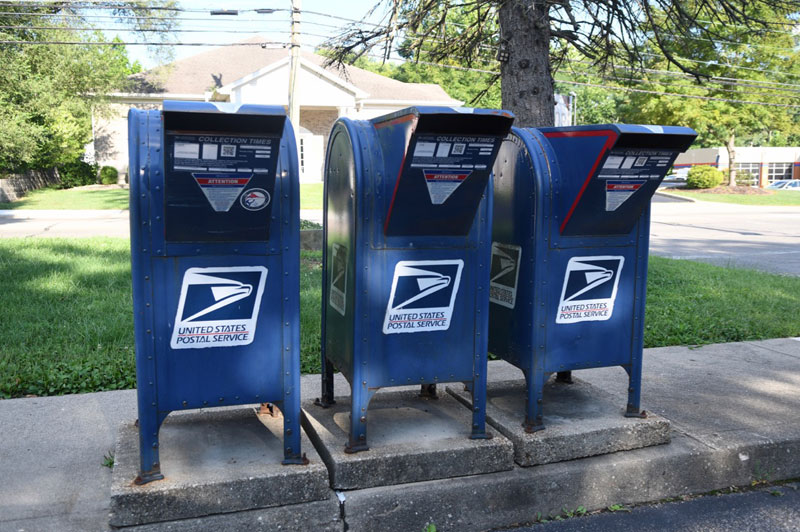
These photos were taken on the evening of August 16 at the Loveland and Symmes post offices. We do not know if any additional boxes were recently removed but is does not appear so. Although the quantity of mailboxes and hours of operation at these locations would not necessarily reflect current delays in mail delivery, we did want to document current conditions in advance of the November 3rd Presidential Election.
Mail boxes at the Symmes Township Post Office at 9370 Fields Ertel Road
Mail boxes at the Loveland Post Office at 200 Loveland Madeira Road
Loveland Post Office at 200 Loveland Madeira Road
Collection times on the mailboxes at the Loveland Post Office at 200 Loveland Madeira Road
Service times at the Symmes Township Post Office at 9370 Fields Ertel Road
Service times at the Loveland Post Office
4 Ohio Republicans join House Dems to pass bill to boost post office funding by $25B
House Speaker Nancy Pelosi said Saturday that mail delays are depriving Americans of timely delivery of medicine, paychecks and other essentials. Photo by Justin Sullivan | Getty Images
WASHINGTON — The U.S. House convened a rare weekend session Saturday in an attempt to stop the U.S. Postal Service from allegedly disrupting mail service to sabotage the November elections.
The Democratic-led chamber passed a bill 257-150 that would infuse $25 billion into the agency as it prepares for a surge in mail-in ballots and bar it from changing operations or service levels in place at the beginning of the year.
The prohibition would remain in effect through January 2021 or for the duration of the coronavirus crisis — whichever is later.
The bill passed largely along party lines, though more than two dozen Republicans joined Democrats in backing the legislation, including four Ohio Republicans: Reps. Troy Balderson (12th District), David Joyce (14th District), Steve Stivers (15th District) and Mike Turner (10th District). Rep. Bob Gibbs (R-7th District) did not vote. No Democrats voted against the bill.
One Republican in favor was Rep. Brian Fitzpatrick of Pennsylvania, who said the post office needed to be funded so his constituents could get their mail delivered on time. “Republicans and Democrats must come together and address the serious challenges that USPS has been facing for some time now,” he said.
Senate Majority Leader Mitch McConnell (R-Ky.) is not expected to take up the measure. He told his hometown paper Tuesday that he doesn’t think a stand-alone bill funding the postal service would pass the chamber.
The White House threatened Friday to veto the post office boost, calling it “an overreaction to sensationalized media reports that have made evidence-free accusations that USPS has undertaken reforms to achieve political rather than operational objectives.”
But House Speaker Nancy Pelosi (D-Calif.) maintains that the administration is trying to suppress votes as the nation heads into a fraught election season in which the postal service will serve as “election central.”
In addition to undermining the integrity of the elections, the delays are depriving Americans of timely delivery of medicine, paychecks and other essentials, Pelosi said at a press conference Saturday.
Democratic lawmakers made similar allegations on the House floor.
The administration has mounted a “sabotage campaign” to manipulate the vote, Rep. Debbie Dingell, a Michigan Democrat, said Saturday morning.
Democratic Rep. Brenda Lawrence of Michigan and a member of the House Oversight and Reform Committee, said the bill would prohibit the postmaster general from making any changes that would undermine the post office. She said the postmaster general has “tried to rip it apart from the inside” and “our democracy is hinging” on delivery of the mail.
“Don’t mess with the USPS,” said Rep. Debbie Wasserman Schultz (D-Fla.).
Republicans charged Democrats with ginning up a manufactured crisis intended to deny the president a second term. House Minority Leader Kevin McCarthy (R-Calif.) said postal problems predate 2020 and the Trump administration.
GOP Rep. Rob Woodall of Georgia called Saturday’s vote a “punctuation mark” at the close of last week’s Democratic National Convention. This “wasteful partisan exercise” will “go nowhere” in the GOP-controlled Senate and “help no one,” he added.
Rep. Debbie Lesko, a Republican from Arizona, echoed the sentiment, calling the controversy “phony political theater.” Pelosi has gone “politically postal,” she said, quoting a recent Wall Street Journaleditorial.
The House approved $25 billion for the postal service in a $3 trillion coronavirus relief package approved in May. Pelosi pointed out Saturday that the USPS board of governors — a bipartisan group of members appointed by Trump — backs the funding.
Trump said last week on Fox News that he opposes some funding because he doesn’t want it used for mail-in votes, repeating his claim that it would lead to “fraudulent” election results.
He said changes to overtime, retail hours and the location of mail processing machines and blue mailboxes were made to save costs and streamline operations but said earlier this week he would suspend some of his moves until after the elections to avoid the appearance of impropriety. He also said he wouldn’t close existing mail processing facilities and would use “standby” resources in October to meet mail surges.
On Friday, he insisted that secure elections are his “sacred duty” and top priority this fall.
But Pelosi on Saturday called DeJoy’s promise into question, pointing to his decision not to replace mail infrastructure that has already been removed. She also pointed to Trump’s comment earlier this week calling for law enforcement officers at polling places.
“It is all designed to suppress the vote,” Pelosi said.
DeJoy is slated to testify again on Monday in a hearing before the Democratic-led House Oversight and Reform Committee, where he is expected to face more withering questioning. Robert Duncan, chair of the U.S. Postal Service Board of Governors, will also appear before the committee.
Allison Stevens is a Washington D.C. reporter for States Newsroom, a network of state-based nonprofit news outlets that includes the Ohio Capital Journal.
A school funding bill originally sponsored by new Ohio House Speaker Bob Cupp is getting a fresh look and hopefully time in front of legislative committees before year’s end, according the legislator now heading up the bill.
The other original sponsor of the proposed legislation, state Rep. John Patterson, said a substitute bill is in the works that should touch on longstanding concerns the Ohio Supreme Court had about the constitutionality of the state’s education system.
“We’re taking a more balanced approach in the new bill,” Patterson, D-Jefferson, said.
The state’s contribution to education budgets has stagnated over time, while private schools have benefitted from the EdChoice scholarship program, in which some state funding for public school districts has been redirected to religious, charter and community schools.
EdChoice scholarships were frozen at current levels in an omnibus bill responding to the COVID-19 pandemic.
State Rep. John Patterson, D-Jefferson.
Patterson said a substitute version of House Bill 305 seeks to address “overarching criticisms” of the original bill, and the education system itself. One of the major criticisms is the distribution of money in the school funding formula between school districts with varying financial situations.
“Under the current formula, districts are all interconnected, so as one district becomes wealthier, another becomes poorer,” Patterson told the Ohio Capital Journal.
So, in the new plan co-sponsored this time by Rep. Gary Scherer, R-Circleville, the legislators want to reassess the amount that districts are able to raise on their own before they decide what the amount of state aid would be to schools.
The proposed bill would also take the weight solely off of property taxes for school funding, something the 1997 decision by the Ohio Supreme Court in DeRolph v. State of Ohio ruled was a big reason the education system violated the state constitution.
The new plan will combine property and income taxes along with a calculation of a district’s wealth level to “determine a district’s true capacity to raise its fair share,” according to Patterson.
“The question is what is fair for the locals, and what is fair for the state,” Patterson said. “We have fine-tuned for that.”
Ohio House Speaker Bob Cupp (Ohio House Photo)
Disadvantaged students would receive more immediate help than in previous funding models if the new bill is made law. In the original proposal for the bill, aid would have been phased in over time for school districts, but legislators are now looking to channel that aid to districts immediately.
Patterson planned to meet with interested parties — teachers’ unions, public school officials and community school representatives on Tuesday to discuss the plan. One of those parties is the Ohio Federation of Teachers, who said school funding needs a direction that accounts for social and emotional learning as well as test proficiency.
“We’re hopeful that (the sponsors) are moving in the right direction,” said OFT executive director Melissa Cropper. “No school funding formula will be perfect, but having no school funding formula has been a disaster.”
In the next month, simulations of financial situations will be run to test the effectiveness of the bill as it stands, and Patterson hopes the bill will be ready when the Ohio House returns to regular session in September.
After anticipated amendments and passage of the bill, Patterson said implementation of the new formula could take years.
With EdChoice pitting private schools and public schools against each other for funding in the state model, Patterson said concerns were brought from both sides, and his bill plans to address private school issues as well.
“What I’ll say is we have heard their criticism and have addressed their concerns in the substitute bill,” Patterson. “I think they’re going to be pleased.”
The changes made to the bill Cupp once authored have the blessing of the new speaker, according to Patterson.
“Speaker Cupp understands the absolute necessity of passing House Bill 305 in this General Assembly,” Patterson said.
Neither Cupp nor Scherer responded to requests for comment.
Susan Tebben is an award-winning journalist with a decade of experience covering Ohio news, including courts and crime, Appalachian social issues, government, education, diversity and culture. She has worked for The Newark Advocate, The Glasgow Daily Times, The Athens Messenger, and WOUB Public Media. She has also had work featured on National Public Radio.


![[VIDEO] A day at Loveland High School will look like this](https://lovelandmagazine.com/wp-content/uploads/2020/08/proud-tiger.jpg)
![[VIDEO] What will a day be like for students at the Loveland Intermediate School](https://lovelandmagazine.com/wp-content/uploads/2020/08/lis-day.jpg)











 By
By 

